
CMS Definition of Third-Party Marketing Organizations (TPMOs)
An overview of the Centers for Medicare & Medicaid Services (CMS) definition for TPMOs and their role within the "chain of enrollment" for Medicare plans.
An overview of the Centers for Medicare & Medicaid Services (CMS) definition for TPMOs and their role within the "chain of enrollment" for Medicare plans.
An overview of the IEC 62304 standard for medical device software. This guide explains its purpose, scope, and required life cycle processes for safety.
An analysis of top ERP systems for the pharmaceutical sector, evaluated on regulatory compliance (21 CFR Part 11), batch traceability, and serialization.
Examine the role of AI in Health Information Exchange (HIE), focusing on data standardization, security, predictive analytics, and ethical considerations.

This article explains the core functions of LIMS for sample management, data integrity, and regulatory compliance, and provides a comparative analysis of top systems.

Learn methods for integrating ChatGPT with private enterprise data using Microsoft Azure. Covers security controls, compliance, and the Azure OpenAI Service.
Learn about the FDA Adverse Event Reporting System (FAERS), a database for post-marketing drug safety surveillance and detecting new adverse event signals.
Learn the official definition of Software as a Medical Device (SaMD) from the IMDRF. Understand its scope as standalone software and its regulatory status.
Learn about Clinical Decision Support (CDS) systems, from early rule-based expert systems to modern data-driven models powered by artificial intelligence.
This article defines open-source LIMS and details its core functions, such as sample registration, data collection, quality control, and workflow management.
This article provides a comprehensive review of global Health Management Information Systems (HMIS), detailing their function, software types, and implementation.
An overview of the healthcare revenue cycle, a financial process covering all administrative and clinical functions from patient scheduling to payment collection.
An explanation of Clinical Data Management (CDM) and its function in research. Learn how CDM ensures high-quality, reliable data for clinical trials.
An overview of key researchers and industry leaders in the US applying generative AI models to pharmaceutical R&D, drug discovery, and biomarker research.
Learn about AHIP certification, the standard for Medicare agents. This guide explains the MFWA training, program requirements, costs, and its industry role.
An analysis of AI adoption trends in U.S. hospitals. Examines clinical and operational use cases, technology partnerships, and ethical considerations in healthcare.

Examines the top 10 programming languages by usage and popularity in the context of AI-assisted coding, analyzing AI tool support and ecosystem maturity.
An analysis of the 2025 healthcare administration job market. Examines key trends, demand drivers, worker shortages, and BLS employment projections.
An analysis of large language model (LLM) diagnostic performance on medical benchmarks compared to physicians, exploring accuracy, limitations, and implications.
Learn about mechanistic interpretability, a method to reverse-engineer AI models. This article explains how it uncovers causal mechanisms within neural networks.
An overview of pharmaceutical KPIs for quality, compliance, and operational excellence. Explores metrics for R&D, manufacturing, and regulatory standards.
An analysis of the core technologies and design philosophies of Wolfram Alpha (symbolic AI) and ChatGPT (generative AI), detailing their key differences.
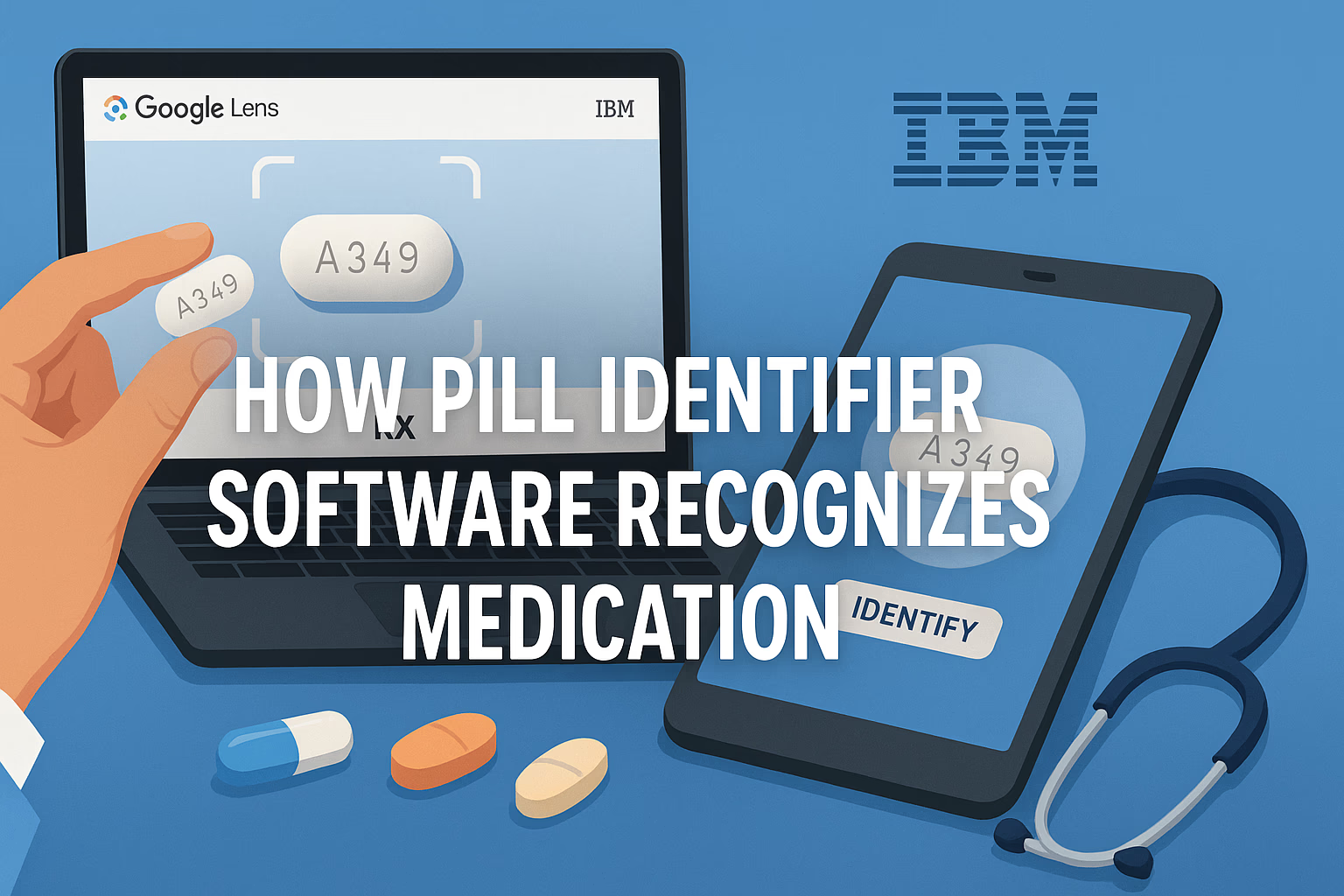
This article explains how pill identifier software improves patient safety by accurately identifying medication using physical traits, preventing costly medical errors.
An educational profile of ZUSDURI, a mitomycin hydrogel for intravesical chemoablation of low-grade, intermediate-risk non-muscle invasive bladder cancer (NMIBC).