


ectd software · regulatory submissions
eCTD Software Comparison: A Technical Guide & Analysis
January 13, 2026
Updated October 15, 2026
35 min read
Updated May 2026: in-depth comparison of eCTD software for regulatory submissions, analyzing top platforms (LORENZ, Veeva, EXTEDO, Certara, MasterControl) on features, pricing, and eCTD v4.0 readiness.

[Revised May 7, 2026] This article has been reviewed and updated to reflect the latest 2025–2026 developments, including FDA's eCTD v4.0 support milestones, vendor product updates (Veeva, LORENZ, EXTEDO, Certara), and the most recent market sizing data.
Executive Summary
The electronic Common Technical Document (eCTD) has become the global standard for regulatory submissions in pharmaceutical and biotech industries, replacing paper dossiers and earlier electronic formats (NeeS) ([1]) ([2]). Effective eCTD publishing software is critical for compiling, validating, and submitting complex regulatory applications on-time and error-free. A variety of commercial products and platforms exist to address this need; each offers different features, architectures, and value propositions. Key players include LORENZ docuBridge, EXTEDO eCTDmanager/EXTEDOpulse, Veeva Vault Submissions, Certara GlobalSubmit, MasterControl (with eCTD integration), and other specialized tools or services.
This report provides an in-depth comparison of major eCTD software solutions beyond Lorenz’s docuBridge, evaluating their architectures, features, deployment models, and fit for different organizations. We integrate regulatory background (eCTD mandates and evolving standards), market data on industry adoption, and expert insights to inform decision-makers. The analysis covers technical capabilities (validation engines, workflow automation, multi-format publishing, integration with RIM and document management systems, cloud vs. on-premises delivery, etc.), practical considerations (pricing, implementation effort, regulatory compliance), and user perspectives. Case examples and published benchmarks illustrate how top software have accelerated submission workflows (e.g. reducing errors, shortening timelines) ([3]) ([4]). We also examine emerging trends – notably the impending shift to eCTD v4.0 and the rise of AI and structured content – and discuss future directions in regulatory digitalization ([5]) ([6]).
Overall, this comprehensive report equips regulatory affairs professionals with a detailed, evidence-backed guide to selecting and deploying eCTD publishing solutions. It highlights not only product differences but also the broader strategic and market context shaping electronic submissions today and tomorrow.
Introduction and Background
Regulatory bodies worldwide now require that most drug applications and related filings be submitted electronically in eCTD format. The eCTD (electronic Common Technical Document) is a harmonized structure, originally developed by the International Council for Harmonisation (ICH), that organizes submission content into five modules (regional administrative information, summaries, quality, non-clinical and clinical data) ([1]) ([7]). In practice, an eCTD submission consists of hundreds of individual PDF documents arranged in a precise folder hierarchy, linked by a central XML “backbone.” This backbone (the hyperlinked table of contents) enables reviewers to navigate the dossier and track lifecycle operations (new, replace, delete) across sequences ([1]) ([4]). By enforcing strict format rules and full content traceability, eCTD streamlines reviews and helps prevent misfiling or redundancy in global filings ([1]) ([7]).
The global shift to eCTD has been driven by regulatory mandates and the desire to improve efficiency. For example, eCTD became the mandatory submission format at the U.S. FDA, EMA (Europe), and many other agencies years ago ([1]) ([2]). In the United States, the FDA phased in mandatory eCTD for new drug (NDA), biologics (BLA), and generic (ANDA) applications by 2018 (under section 745A(a) of the FD&C Act, added by FDASIA in 2012; NDAs, BLAs and ANDAs from May 2017, commercial INDs from May 2018). In Europe, EMA required eCTD for all new marketing authorizations by mid-2017 ([1]) ([2]), and Japanese, Canadian, and other major regulators have similar requirements. By one account, “the eCTD format has been mandatory in the EU since 2010 and is required for submissions to major agencies like the EMA, UK-MHRA, and the FDA” ([1]) ([2]). As emerging regions adopt electronic submissions (e.g. China, ASEAN), this momentum only grows.
Although eCTD standardizes structure, constructing a technically correct eCTD package remains a daunting task for most sponsors. Manual assembly is tedious and error-prone: it requires establishing blank sequence folders, ensuring correct Module 1 regional forms, creating deep bookmarks, maintaining leaf titles, generating the XML spine, and satisfying formatting rules (page limits, non-searchable PDF flags, anchors, etc.). Without automation, even minor mistakes can trigger costly technical rejections (e.g. broken hyperlinks, misplaced files, duplicate titles). Consequently, eCTD publishing software has emerged as a specialized solution in regulatory affairs. These platforms automate many of the repetitive tasks: they manage content and versions, generate the XML backbone, enforce global and regional rules, validate submissions, and help coordinate complex dossier updates (for new sequences, amendments, annual reports, etc.). In short, robust eCTD software acts as a digital “hub” that helps companies compile compliant submissions efficiently ([1]) ([8]). As one consulting overview notes, “The primary value of eCTD software is its built-in validation tools” that catch technical errors before submission, preventing rejections and delays ([9]).
This report surveys the current landscape of eCTD software, with emphasis on solutions beyond the well-known LORENZ docuBridge system. We outline the evolution of eCTD mandates and standards, review the major vendors and their platforms, and compare them on key dimensions. We incorporate analytical perspectives (e.g. market growth data, adoption trends ([10]) ([11])), highlight real-world use cases (e.g. efficiency gains achieved by eCTD tools ([3])), and examine future implications (e.g. mandatory eCTD v4.0 ([5]), AI/automation approaches ([12]), data-standard initiatives ([6])). By combining historical context, technological detail, and forward-looking analysis, we aim to provide a thorough reference for regulatory professionals and industry decision-makers evaluating eCTD submissions software.
Global Regulatory Context and eCTD Evolution
Early History and Adoption Timeline
The Common Technical Document (CTD) concept originated in the early 2000s to harmonize dossiers for new drug approvals. Initially a paper-based format, CTD was embraced by ICH regions (including the US, EU and Japan). In parallel, regulators moved toward electronic submissions. The FDA began accepting electronic submissions of new drug applications (NDA) and related filings in the late 1990s, later routing them through its Electronic Submissions Gateway (ESG), while European regulators moved to electronic formats such as NeeS and eCTD. Over time, agencies phased in requirements for fully electronic dossier structures.
By the 2010s, major regulatory bodies mandated eCTD. In Europe, EMA mandated eCTD for most marketing authorization applications by mid-2017, and similar trends occurred globally. For instance, Woodley BioReg notes eCTD “has been mandatory in the EU since 2010” ([2]). In the US, beginning in May 2017, all NDA/ANDA/BLA submissions to FDA’s Center for Drug Evaluation and Research (CDER) or Center for Biologics Evaluation and Research (CBER) were required in eCTD format. Likewise, Japan’s PMDA, Health Canada, Australia’s TGA, and other agencies either implemented or are implementing eCTD mandates. Newer ICH regions (China’s NMPA, ASEAN countries) have announced roadmaps for electronic dossiers. This global embrace of eCTD underscores the need for software that can handle not only the ICH CTD core (Modules 2–5) but also diverse regional Module 1 requirements across agencies ([1]) ([7]).
eCTD Versions and Standards
The current prevalent standard is eCTD version 3.2.2 (v3.x), which defines the XML schema, file naming conventions, lifecycle operations, and validation rules for submissions to most health authorities ([13]). However, after more than a decade of v3.x use, the ICH Assembly endorsed the Step 4 implementation package for an updated specification, eCTD v4.0, in December 2015 ([14]). eCTD v4.0 harmonizes more of the message specification than v3.x, although each region still publishes its own implementation guide and timetable ([15]). Critically, there is no single global cutover date: ICH's implementation table lists mandatory use from April 2026 in Japan (MHLW/PMDA), from Q1 2028 for new centrally authorised MAAs in the EU, from 2029 at FDA and from 2030 at Health Canada and Swissmedic, with several other regions still to be determined ([14]) ([5]). For example, EMA opened optional eCTD v4.0 use for new centrally authorised product MAAs on 22 December 2025, with mandatory use for that submission type planned from Q1 2028 ([16]), and the FDA began accepting eCTD v4.0 submissions on Sept 16, 2024, with a multi-year voluntary period before mandatory cutover (FDA currently accepts both v3.2.2 and v4.0, accepts v4.0 only for new applications, and says it will give advance notice before supporting v4.0 alone ([17])) ([5]) ([18]).
Compliance with evolving standards is itself a challenge. Each eCTD software vendor must update its product rulesets whenever regulatory requirements change. Leading platforms now provide automatic rule updates or frequent patches to incorporate the latest agency definitions (e.g. new modules, expanded life-cycle operations, XML schema changes) ([19]) ([20]). In particular, docuBridge highlights “forward compatibility with eCTD v4.0” in recent releases, ensuring agencies’ updated expectations can be met without major disruptions ([21]). In practice, selecting a tool with robust and up-to-date compliance checks is critical; experienced practitioners recommend testing each candidate platform to ensure it validates fully against the target agency’s current rules (including the new v4.0 requirements) ([22]) ([23]).
The Role of eCTD Software in Submissions
Implementing an eCTD solution is more than just adopting a technical tool: it often requires changes in workflow, training, and quality systems. In large companies with frequent filings, the eCTD “pipeline” might begin with content authoring (often in a document management or RIM system) and end with final submission via the agency’s gateway. Each link in this chain (authoring, publishing, validating, transmitting) needs alignment. Modern eCTD platforms aim to serve as central hubs in this process. They can pull approved documents from a repository, enforce consistent metadata (folder names, document titles), automatically sequence and nest files in the correct dossier structure, and perform comprehensive validation. By doing so, they drastically reduce manual effort. As one industry guide summarizes, eCTD tools are “active partners” that streamline compliance, collaboration, and productivity ([24]) ([8]).
Key operational benefits of eCTD software include:
- Error Prevention: Automated validation and rule-checking catch issues early (broken links, wrong Module 1 template, file format errors, etc.) ([9]) ([3]). This greatly lowers the risk of initial submission rejections, which can delay approvals by months.
- Document Management: Built-in document/version control and audit trails ensure that teams work off the latest files (single source of truth), and all changes are logged ([25]) ([26]). This addresses the “Murphy’s Law” chaos of email attachments and mislabeled drafts common in manual processes.
- Global Consistency: When filing the same core dossier in multiple regions, eCTD tools help manage country-specific variants while preserving a unified “global” backbone. They can reuse content across modules or sequences, minimizing redundant work.
- Efficiency and Productivity: Automation (bookmarking, hyper-linking tables of contents, splitting PDFs, etc.) transforms the workflow. Vendors claim that eCTD platforms can save weeks of assembly time. For instance, Freyr’s published case report shows a large pharma client cutting manual effort – importing 30 submission sequences, accelerating filing timelines by ~10%, and reducing errors by ~20% ([3]).
- Compliance and Audit Readiness: With sensitive intellectual property at stake, robust security and compliance (e.g. 21 CFR Part 11 audit trails) are essential. Leading solutions maintain uneditable logs of every action and usually meet industry certification standards ([27]) ([23]).
Given these factors, selecting the right eCTD software is a strategic decision. Failed or poor submissions can cost tens of thousands of dollars and months in delay, so the choice of platform (and whether to outsource publishing) depends on company size, submission volume, and global reach ([9]) ([3]).
Overview of Major eCTD Software Solutions
Below we survey the prominent eCTD publishing platforms on the market, summarizing each vendor’s positioning, core features, and ideal use-cases. For each, we draw on vendor documentation, independent commentary, and industry analysis to highlight strengths, weaknesses, and notable attributes. (Table 1 at the end of this section provides a comparative feature overview of these solutions.)
LORENZ docuBridge (and eValidator)
Vendor: LORENZ Life Sciences Group (a privately owned company ([28]) whose docuBridge has long been integrated with MasterControl document management) Product: LORENZ docuBridge (eCTD publishing engine) and LORENZ eValidator (validation engine).
Overview: Lorenz docuBridge is one of the earliest and most widely adopted eCTD publishing tools. It is renowned for its mature publishing core and granular control over the submission lifecycle ([4]). docuBridge automates tasks such as generating the XML spine, creating bookmarks, and applying lifecycle operations (new/replace/delete) on documents. Its collaborative document structure allows multiple users to work concurrently without conflicts, and it smoothly handles both eCTD and older NeeS formats from the same project ([29]) ([30]). Lorenz offers scaled editions of docuBridge (ONE, TWO, FIVE) to accommodate companies from single-region solo users up to global teams, with licensing options that match submission volume and user count ([29]).
Key Features:
- Automated Compliance Updates: docuBridge can automatically receive specification updates from regulators without requiring manual software reinstalls ([19]) ([20]). This “always-current” updating model means that as soon as agencies publish new eCTD requirements (or eCTD v4 schemas), the software can download and apply them directly ([20]).
- Multi-format Publishing: A single sequence in docuBridge can be published to multiple output formats (eCTD, NeeS, HTML, PDF, or even paper) without rebuilding source documents ([30]). This flexibility is valuable for companies serving different regulators or for archiving older submissions in legacy formats.
- Lifecycle Transparency: As noted by industry analysts, docuBridge provides a clean, explicit view of document lifecycle status (what is new vs. replace vs. delete in each sequence) ([31]). Leaf titles and anchors are preserved reliably, reducing hidden changes during compilation ([31]).
- Powerful Validation (eValidator): Lorenz’s bundled eValidator is known for its deep rule coverage. It enforces regional Module 1 rules, PDF standards, hyperlink integrity, bookmark depth, etc., with configurable reports that tie errors back to specific nodes ([31]). Users can validate at any point (draft vs. final package) to catch issues early.
- Deployment Options: docuBridge can be installed on-premises or hosted (Lorenz-managed cloud). This flexibility appeals to users with strict data residency needs or smaller teams wanting a subscription.
- Audit Trail and Security: The platform logs all user actions and changes in submission projects, supporting Part 11 compliance. Multi-user editing is controlled to prevent conflicts ([19]) ([7]).
- Case Example: In practice, organizations using docuBridge report significant gains. One biopharma case (Orchid India) noted that being “well prepared” with docuBridge for upcoming eCTD mandates should materially improve its market access timelines ([7]). The platform’s integrated validator and workflow are credited with faster, error-free filings for biotech and specialty pharma.
Pros and Cons (per industry analysts): Analysts highlight that Lorenz’s strength is operational robustness and granular control ([22]). It maintains a stable performance even under heavy loads and offers on-prem/cloud flexibility. Its cons include a somewhat utilitarian user interface and the need for scripting to automate advanced tasks (though APIs exist) ([32]). In summary, docuBridge is often recommended for organizations prioritizing predictable, repeatable publishing with explicit lifecycle control, such as mid-sized pharmaceutical sponsors or contract publishers with multi-tenant needs ([22]) ([31]).
EXTEDO eCTDmanager / EXTEDOpulse
Vendor: EXTEDO GmbH (a long-established German regulatory-software vendor; portfolio expanded across 2024–2025 with deeper EXTEDOpulse cloud-RIM integrations) Product: EXTEDO eCTDmanager (on-premises publishing software) and EXTEDO eValidator; EXTEDOpulse (cloud-based eCTD/RIM platform).
Overview: EXTEDO is a well-established provider of regulatory submissions tools. Its on-premises solution, eCTDmanager, is commonly paired with EXTEDO’s validator. The cloud offering, EXTEDOpulse, extends functionality into a full Regulatory Information Management (RIM) suite. EXTEDO is especially noted for broad regional coverage and ease of setup in North America, Europe, and Asia. The vendor supplies built-in templates (Module 1 scaffolds) for major regions, making initial configuration quicker for companies expanding beyond a single market ([33]).
Key Features:
- Region-Aware Templates: EXTEDO provides pragmatic, pre-configured templates for U.S., EU, and Japanese Module 1 to expedite initial system configuration ([33]). This “out-of-the-box” coverage appeals to sponsors moving into new territories (e.g. filing in Europe and Japan in addition to the U.S.).
- Validation Integration: EXTEDO’s eValidator is tightly integrated with eCTDmanager. It comes with up-to-date rulesets and generates readable logs that map defects to file paths. This helps teams quickly identify and fix issues ([33]).
- Versatile Publishing: eCTDmanager handles standard eCTD and NeeS inputs. The cloud EXTEDOpulse extends support to additional submission formats (e.g. Paper, Electronic submissions in emerging markets) and includes more extensive content planning and workflow modules.
- User Enablement: EXTEDO emphasizes training and professional services. Analysts note that for users new to eCTD, EXTEDO’s documentation and support help teams get up to speed on best practices ([34]).
- Cons/Considerations: Reported drawbacks include the need for external tools for advanced automation (e.g. robust hyperlink crawling) ([35]), and possible performance tuning for extremely high-volume parallel builds. Also, EXTEDO does not natively include a full enterprise RIM; customers often integrate EXTEDO into a larger regulated-content ecosystem.
Fit: EXTEDO is well-suited for organizations expanding to multi-region filings that want a structured approach without adopting a full cloud RIM immediately ([36]). For example, a biotech firm filing in FDA and EMA might choose EXTEDO to leverage its EU/JP templates and built-in rules, benefiting from the vendor’s depth of global regulatory expertise.
Veeva Vault Submissions (with Vault RIM)
Vendor:Veeva Systems Product: Vault RIM (Regulatory Information Management) suite, including Vault Submissions and the separate Vault Submissions Publishing application ([37]).
Overview:Veeva Vault Submissions is part of Veeva’s cloud-based life sciences suite, which includes regulated content management (Vault Docs), commercial content (Vault PromoMats), clinical, quality, and regulatory modules. Vault Submissions aims to provide an end-to-end cloud platform for managing the entire submissions lifecycle. It tightly integrates with Vault RIM, so metadata (e.g. leaf titles, country codes, dossier IDs) and controlled vocabularies are shared across planning, authoring, and publishing ([38]). The value proposition is a unified system: content is authored or stored in Vault, and then published via Vault Submissions Publishing without requiring separate file hand-offs.
Key Features:
- Unified Metadata and Content: As noted by analysts, Vault Submissions enables consistent leaf titles and country/region tracking by linking submissions planning to content ([39]). For example, key metadata entered during dossier planning (e.g. regulatory filing numbers, sequence types) can automatically populate into the eCTD XML. This reduces data re-entry and improves traceability.
- Cloud Scalability: Being a cloud-native SaaS, Veeva scales elastically. During high-volume projects, it can build and validate multiple sequences in parallel without local hardware constraints ([39]).
- Built-in Workflows and Dashboards: Vault provides out-of-the-box workflows for submission staging, review, and approval. The Submissions module includes real-time dashboards to track statuses of INDs, NDAs, MAAs, etc., across global health authorities. This transparency aids coordination of multi-product, multi-region programs.
- Automation and APIs: Vault offers APIs and workflow configurations to automate common tasks (such as sequence stamping, status updates, or exporting packages). The system can alert journals, trigger email notifications, or push submission data into analytics tools.
- Cons/Considerations: Implementing Vault Submissions typically requires process change. Effective use depends on strong metadata governance (taxonomies, roles) to populate the unified system ([40]). Budget planning typically covers the SaaS subscription, user-based licensing and implementation services. Vault’s standardized, model-driven approach works best when teams align their submission workstreams to it. Integration with external publishing engines may be needed for very specialized validation functions.
Fit: Veeva Vault Submissions is best for large, global companies willing to standardize on a single cloud platform. It excels when an enterprise seeks to centralize content repositories and submission planning in one system ([38]) ([39]). Early adopters report strong improvements in consistency and collaboration, alongside an adoption period for teams new to the platform. For example, one manufacturer cited the advantage of having “shared metadata from dossier planning through lifecycle,” translating to fewer manual steps ([38]).
Certara GlobalSubmit
Vendor: Certara Product: GlobalSubmit eCTD platform: desktop PUBLISH software for building submissions, web-based REVIEW software for stakeholder review, plus validation ([41]).
Overview: Certara’s GlobalSubmit is a submission software platform designed to streamline the entire lifecycle of submissions. It integrates submission planning (including product and country assignments) with publishing and validation in a single interface. GlobalSubmit supports filings to multiple major authorities (up to nine global agencies, including FDA, EMA, Health Canada, PMDA, etc.) ([42]). The platform emphasizes efficiency and accuracy, aiming to “prepare, validate, and submit” documents faster to multiple regions ([42]). It is often bundled with related services (Regulatory Publishing, RIM) but can be used stand-alone for eCTD generation.
Key Features:
- Centralized Workflow: GlobalSubmit provides a unified workspace where dossier files are uploaded, formed into sequences, and tracked until submission. Users can manage multiple products and build different regional sequences from the same source content.
- Wide Agency Support: The platform natively handles submissions to many regulators. According to Certara, it supports nine major authorities globally ([42]), facilitating a single path for multi-region filings.
- Cloud Access: GlobalSubmit REVIEW is web-based, so stakeholders can review eCTD submissions from anywhere; the PUBLISH component used to build submissions is installed desktop software.
- Validation and Glue: It includes validation checks and ensures publishers follow rules but is often used in conjunction with other Certara services or tools for specialized tasks.
- Performance: Certara claims GlobalSubmit accelerates submissions, helping clients “get products approved faster” through automation and centralized management ([42]).
Fit: GlobalSubmit is targeted at companies that want an integrated publish, validate and review platform from one vendor with a broad global focus. For multinational sponsors, its extensive agency coverage and ease of access can streamline global filing strategies ([42]).
MasterControl (Quality/QMS plus eCTD)
Vendor: MasterControl Inc. Product: MasterControl document and quality management, connected to a separate eCTD publishing tool (for example through the MasterControl DMS Connector for EXTEDO eCTDmanager ([43])).
Overview: MasterControl is primarily known for its Quality Management System (QMS) and document management solutions. Some organizations use the MasterControl platform to manage regulated documents (including submission-ready PDFs) and then pair it with a dedicated publishing engine (such as Lorenz docuBridge or another validator) to create eCTD builds ([26]). Essentially, MasterControl can act as a single controlled repository with robust audit trails and change controls; final, “ready-to-submit” PDFs are exported into a separate eCTD solution.
Key Features:
- Governed Repository: MasterControl ensures all documents (CMC reports, clinical study reports, etc.) are reviewed and versioned under a compliant workflow before they are assembled for submission ([26]).
- Links to QMS Processes: It ties document control with change control/CAPA. For example, a change in a manufacturing process (noted in a CAPA) can be linked to the corresponding section change in a submission, ensuring traceability ([44]).
- Integration: MasterControl provides connectors to some eCTD tools. For example, one might “sign off” a PDF as final in MasterControl, then initiate an automated transfer to an eCTD publisher.
- Cons/Considerations: On its own, MasterControl lacks deep eCTD publishing features (bookmarking, advanced XML editing, etc.). Teams relying on MasterControl typically need to license an external eCTD engine as well ([45]). Additionally, switching fully to another RIM/document repository later can create duplication issues if two systems maintain controlled docs.
Fit: MasterControl is best suited for quality-centric organizations that already have it for QMS and want to connect submission publishing into that existing workflow. It’s often recommended as part of a best-of-breed stack: MasterControl for document control, plus a specialized publishing/validation tool for assembly ([46]). In such cases, the emphasis is on governance (audit trails, compliance narratives) rather than on advanced publishing automation within MasterControl itself.
Other Notable Solutions
Apart from the above, several other platforms cater to eCTD publishing or critical parts of the process:
- EXTEDO EXTEDOpulse (already discussed above as the cloud complement to eCTDmanager).
- Freyr SUBMIT PRO: Freyr Solutions, a regulatory consultancy, offers Freyr Submit PRO, a managed/collaborative platform for eCTD publishing. In promotional case studies, Freyr reports outcomes like “Accelerated submission timelines by 10%” and “Reduced errors by 20%” for their enterprise customers ([3]). Freyr’s solution includes expert-driven implementation and validation support, blending software with consulting.
- NextGen eCTD (Masuu Global): A newer cloud-based tool marketed for small to mid-size companies. It offers pay-as-you-go and tiered plans, with claims of user-friendly interfaces and compliance with ICH standards. (Masuu promotional material highlights features like “automated features reduce workload” and global compliance ([47]).) While less established, such platforms may appeal to resource-limited sponsors seeking straightforward entry-level solutions.
- Woodley BioReg / Parexel / Pharmalex: These are mainly service providers, not software products, but they often have proprietary or partner tools. For example, Woodley mentions expert-managed publishing services for both eCTD and legacy NeeS submissions ([48]). These are alternatives to in-house software, especially for smaller firms: outsourcing to experts who “manage regulatory submissions for you” ([48]). Contracts can cover the entire publishing process, potentially reducing the need for internal eCTD expertise.
While this survey covers the most prominent systems, many companies also piece together solutions (e.g. using general document management and adding scripts or validators) or custom RIM platforms. However, the products above represent the bulk of market adoption as of 2025. The next section distills key feature comparisons and market positioning of these tools.
Feature Comparison of eCTD Platforms
To facilitate side-by-side evaluation, Table 1 summarizes and compares the major eCTD publishing solutions across several dimensions: deployment options, scope of functionality, validation integration, and typical usage scenarios. (Note that individual configurations can vary; the table highlights general characteristics.)
Table 1. Comparison of Selected eCTD Publishing Software Solutions
| Software | Vendor | Deployment | Validation Engine | Key Capabilities |
|---|---|---|---|---|
| Lorenz docuBridge | LORENZ | On-prem / Hosted Cloud | LORENZ eValidator (bundled) | Mature eCTD publishing core; multi-format output (eCTD, NeeS, HTML/PDF); automatic spec updates; detailed lifecycle control ([4]) ([30]). Best for publishers needing robust sequence control, heavy-duty batch loads. |
| EXTEDO eCTDmanager / eValidator | EXTEDO | On-premises (eCTDmanager); Cloud (EXTEDOpulse) | EXTEDO eValidator | Provides broad regulatory coverage out-of-box (USD/EU/JP templates) ([33]); integrated validation; scalable workflow. EXTEDOpulse adds RIM features. Best for global sponsors seeking guided setup, particularly strong in EU/Japan support. |
| Veeva Vault Submissions | Veeva | Cloud (SaaS) | Native (no separate app) | End-to-end cloud submissions (integrated with Vault RIM/docs) ([38]); unified metadata (consistent leaf titles, country tracking) ([39]); elastic scalability; built-in workflows/dashboards. Best for large organizations adopting a single-cloud vault approach, aiming for maximal metadata reuse. |
| Certara GlobalSubmit | Certara | Desktop PUBLISH; web-based REVIEW | Native (built-in) | Centralized publishing and tracking for global filings ([42]); supports filing to ~9 authorities; emphasis on speed and accuracy; desktop publishing with web-based review. Best for companies wanting one vendor platform with broad international support and one-stop submission management. |
| MasterControl (Regulatory) | MasterControl | Cloud / On-prem (Docs) | N/A (uses external publisher) | Quality-driven document control with audit trails ([26]); change control/CAPA integration; pushes finalized PDFs to external eCTD tool. Best for quality-centric teams that already use MasterControl QMS and want to feed output to a dedicated eCTD engine ([44]). |
| Freyr SUBMIT PRO | Freyr Solutions | Cloud (Rec. service) | Native / Vendor validation | Managed submissions platform; workflow for imports and sequences; expert support. Freyr reports efficiency gains (data-driven validations, timeline improvements ([3])). Good for large pharmas wanting expert partner and cloud tools in tandem. |
| NextGen eCTD (Masuu) | Masuu Global | Cloud (SaaS) | Native (light) | Entry-level eCTD tool; tiered pricing (pay-per-submission or subscription); focuses on ease-of-use. Ideal for small/mid-sizes or consultants needing flexible, cost-effective solution. |
Each solution differs not only in technical features but also in licensing and support models. For example, docuBridge typically uses a per-user or per-volume license (with optional annual support), while Vault Submissions is an enterprise subscription tied to user roles and modules ([38]). ExTeDo often bundles validator support and templates; Veeva’s cost is driven by scope of modules (Submissions vs full Vault, user counts, affiliates) ([49]). Freyr and other consultancies may charge per sequence or as fixed service fees rather than traditional software licenses. Understanding these choices is critical for budget planning (discussed later).
Following the tables, we present deeper analysis of each aspect:
1. Deployment Models
- On-Premises: Lorenz docuBridge and EXTEDO eCTDmanager are traditionally deployed on customer servers. This gives full control over data and timing of upgrades, which appeals to regulated environments needing strict control. Both vendors now also offer managed or hosted options for clients who prefer not to maintain hardware.
- Cloud-Based: Cloud suites such as Veeva Vault and EXTEDOpulse are delivered as SaaS; Certara GlobalSubmit pairs desktop PUBLISH software with web-based REVIEW. Advantages include minimal IT maintenance and easy remote collaboration. Companies opting for SaaS must be comfortable with subscription pricing and potentially less customization. Frequent automatic updates (security patches, spec changes) are typical in cloud solutions (e.g., Veeva’s continuous delivery model).
- Hybrid/Service: Solutions like MasterControl offer hybrid use (docs in cloud plus plugging into another publisher). Consultancies (Freyr, Woodley) provide quasi-cloud access to proprietary tools via service contracts.
2. Validation and Compliance Checking
A core function is automated validation. Lorenz and EXTEDO have their own validator engines tuned for FDA, EMA, PMDA rules. They check technical compliance (XML schema, Module 1 placement, bookmarks, file formats, etc.) and report issues by node. Vault Submissions Publishing provides validation within the Vault cloud workflow. The depth of validation varies: analysts note Lorenz has particularly “strong regional rules” and configurable defect reports ([31]), while EXTEDO allows easy reading of rule violations. The key task is to ensure parity with the agencies' published validation criteria: users generally run candidate tools against the same test dossiers and compare the findings with those criteria. FDA's own sample-validation process for eCTD v4.0 is not a general software benchmark; it is limited to sponsors that hold an application or master-file number and plan an actual submission within 12 months ([50]) ([32]) ([38]).
3. Document and Version Management
All systems provide some level of version control. They maintain a master repository of documents (Word/PDF) and track which revision is included in each sequence. Veeva Vault and MasterControl, as full document management systems, are particularly strong here: they log every change and tie it to approvals ([44]). DocuBridge offers basic check-in/check-out and a “submission content tree,” but relies on users to interface with external DMS for authoring. In general, robust audit trails (who changed what, when) are an industry requirement (especially for FDA Part 11), and all these solutions support it ([44]) ([23]).
4. Multi-Region and Module 1 Handling
Most vendors explicitly address global submissions. EXTEDO’s built-in regional templates make it easy to switch a core dossier to new territories ([33]). Similarly, Veeva supports multiple country dossiers from one planning system ([38]). DocuBridge and GlobalSubmit allow reuse of content across sequences and ensure that Module 1 differences (e.g. FDA forms vs. EMA CESP format) are handled systematically. MasterControl and Freyr solutions can store different region-specific forms and insert them as needed.
5. User Collaboration and Workflow
Modern eCTD tools include features for team collaboration. For example, Veeva Vault permits multiple users to work on separate parts of a dossier with role-based access. docuBridge allows concurrent editing of different leafs (with conflict detection). Systems often include task routing and approval workflows (analogous to document review chains) so that, e.g., an RA lead can approve a sequence build before validation. Central dashboards and notifications (particularly in cloud tools) keep multiple stakeholders informed of submission status across products. The smoother the collaboration, the fewer manual file exchanges, reducing errors ([3]).
6. Future-Proofing and Extensibility
Buyers should consider how future needs are supported. Important aspects include:
- Standards & Formats: Tools that already accommodate eCTD v4.0 (XML, PDF/A, etc.) will ease upcoming transitions. For example, LORENZ explicitly notes forward compatibility with eCTD v4.0 ([21]), and other vendors are rolling out v4-capable releases.
- APIs and Automation: Open APIs allow integration with other systems (LIMS, QMS) or custom utilities (e.g. automated hyperlink crawlers). Veeva Vault is built on an API-driven platform; Custom scripts or RPA bots are often used with on-prem tools to automate repetitive steps not natively covered.
- Analytics and Reporting: As submission planning becomes more data-driven, the ability to export metadata (e.g. submission dates, due dates, review cycles) into business intelligence dashboards is increasingly valued. Some vendors (Certara) are investing in analytics around regulatory performance, though this area is evolving.
- Artificial Intelligence: Emerging solutions are beginning to embed AI/ML. For instance, AI-driven classifiers to suggest leaf titles or flag likely problem documents, NLP tools to auto-extract Module 2 summary points, etc. Industry sources predict AI will “automate eCTD submission assembly and real-time validation” in the next decade ([23]). While few products fully realize this yet, companies piloting innovations (Merck, Pfizer) are already seeing “weeks of drafting time” saved using AI assistance ([12]). Forward-thinking organizations may weigh vendors’ AI roadmaps in decisions.
Data and Market Trends
The market for eCTD software is sizable and growing. Recent industry reports estimate the global eCTD submission software market was valued at about USD 1.24 billion in 2024 and roughly USD 1.35 billion in 2025, with a projected annual growth rate around 8–9% leading to roughly USD 2.6 billion by 2033 ([11]). This growth is driven by digital transformation in pharma, regulatory harmonization efforts, and the complexity of submissions.
Regionally, North America dominates the share. One market analysis notes that North America accounts for ~38% of the global eCTD software market (≈$471 million in 2024) ([10]). This leadership reflects the FDA’s stringent mandates and high R&D investment in the US/Canada region. Europe is the second-largest market (≈$347M in 2024, ~8.1% CAGR forecast) ([51]), supported by strong EMA requirements and harmonization efforts. The Asia-Pacific region is growing fastest (forecast ~10.4% CAGR) due to China’s regulatory modernization and adoption of eCTD, along with Japan, India, etc., gradually moving to electronic filing. EMT regulators in these markets are increasingly mandating eCTD compliance, often requiring local-tailored solutions or global tools.
Within companies, usage tends to correlate with size and pipeline. Large multinational pharma and top CROs usually deploy comprehensive systems (often a combination of RIM and eCTD tools) to manage all regulatory content. Mid-sized companies may choose single-region licenses or hybrid approaches (e.g., subscribing for only FDA and EU). Small biotech or niche firms, especially those with sporadic filings, might opt for pay-per-submission services or outsourcing rather than full platform purchase. Indeed, many vendors (like Masuu and consultants like J&J Compliance) now offer flexible pricing models: from pay-per-submission to tiered subscriptions (Table 1 provides examples of each approach ([49]) ([11])).
Notably, industry consultants emphasize total cost-of-ownership is more than license fees. Implementation and validation costs for the software itself (especially in GxP environments) can be significant. Training, change management, and ongoing support contribute to expenses. Moreover, outsourcing (using publishing service providers) remains a competitive option for lowering upfront software costs. For example, Woodley and Parexel note that for small-to-mid sized companies lacking in-house RA teams, contracting a publication service may be more economical than buying software ([48]).
Evidence of Impact: Beyond market dollars, the real metric is submission quality and timeliness. Vendors and user groups report generally that adopting a dedicated eCTD platform yields “quantifiable time savings” ([52]). As one review notes, roughly 70% of regulatory filing time in a moderate portfolio is spent on maintenance tasks ([53]) – tasks ripe for automation. In practice, numerous companies cite that built-in validators and publishing wizards directly translate to fewer technical queries from agencies, smoother first-cycle approvals, and shorter review durations. The Freyr example (above) exemplifies how automation reduced manual rework by catching issues early ([3]). While publicly available benchmarking is limited, regulatory conference presentations and vendor case studies consistently highlight seizing these efficiencies as a strategic advantage.
Case Examples and Industry Observations
To illustrate how eCTD tools perform in real scenarios, consider the following examples sourced from industry reports and publications:
- Global Pharma Efficiency Gains: Freyr Digital reports that one of its leading pharma clients “imported and validated over 30 sequences” seamlessly, accelerating submission timelines by ~10% and reducing validation errors by ~20% with its Submit PRO platform ([3]). This suggests that heavy-lift tasks (sequence imports, batch validations) become faster, freeing regulatory staff for higher-value work.
- Smaller Sponsor Success: Several case anecdotes highlight small biotechs partnering with publication consultants rather than buying software. For instance, Orchid India’s management commented that being “well prepared” with an advanced eCTD system (docuBridge) for upcoming mandates could significantly improve their “market access schedule” ([7]). In other words, even emerging companies recognize the strategic value of modern publishing tools in accelerating access to markets.
- CRO and Service Provider Usage: Large Contract Research and Manufacturing Organizations often maintain multi-tenant publishing platforms (often Lorenz or Extedo) to serve many clients. Their efficiency on volume workloads often informs in-house best practices. For example, one CRO technical director noted that consistency in leaf titling (maintained by docuBridge) was critical to avoid misalignment when reusing core materials across different clients’ filings ([31]).
- Validator Accuracy: Anecdotal evidence from user forums suggests that advanced validators provided by these tools catch a high percentage of errors before agency submission. In one informal survey, regulatory professionals estimated that top-tier software can catch 90–95% of the issues that FDA’s ESG would otherwise flag ([31]) ([23]). The remaining oversights are often minor discrepancies that can be fixed in the final validation checks.
These examples underline the value proposition: investing in robust eCTD software translates to measurable reductions in delays and rework. That said, success also depends on user expertise: a tool is only as good as the people and processes behind it. Effective use typically requires thorough training, disciplined metadata control, and sound project management. Many companies establish standardized templates, checklists, and paired operating procedures (SOPs) when adopting new eCTD platforms.
Implications and Future Directions
Adopting eCTD software carries broader implications for regulatory strategy and operations:
- Faster Time-to-Market: By streamlining technical submission tasks, good eCTD software can indirectly accelerate product approvals. Regulators receive cleaner dossiers sooner, leading to faster first-cycle reviews. Over time, the cumulative time saved can significantly impact a drug’s commercial timeline. As one industry report emphasizes, shifting resources from administrative tasks (like formatting) to substantive content review can “accelerate patient access to new therapies” ([54]).
- Resource Optimization: Smaller teams can handle larger submission loads. For instance, docuBridge’s automation “augments small biotech companies” by taking over routine assembly, mitigating limited staff challenges ([55]). Behind the scenes, integrated audit trails and content inheritance mean knowledge isn’t lost if key personnel leave.
- Global Collaboration: A unified eCTD system fosters communication across global affiliates. Cloud solutions in particular enable geographically dispersed teams to work on the same dossier sequentially without duplication. Similarly, shared repositories improve oversight during multi-regional filings.
- Regulatory Intelligence and Adaptation: The shift to eCTD v4.0 is a significant change. Platforms that swiftly incorporate v4 will enable sponsors to adapt early. There is no single global deadline: mandatory dates are set region by region (ICH's implementation table lists, for example, Q1 2028 for new centrally authorised MAAs in the EU and 2029 for FDA; see also ([5])), and eCTD v3.2.2 remains accepted during these transition periods. Entities slow to upgrade risk last-minute bottlenecks. The eCTD 4.0 changes, such as the new XML message structure and document reuse, require software that can handle these features. Vendors state that their tools will support v4.0; early adopters may benefit from vendor beta programs and training.
- Role of AI and Digitalization: Digital transformation is remaking regulatory affairs. Advanced content management (structured authoring) and AI-driven tools are increasingly integrated with eCTD workflows. For example, NLP-based assistants can suggest compliant phrasing or detect gaps, and AI-driven assembly may pre-validate hyperlinked structures ([56]) ([23]). Analysts foresee that within the next decade, AI will “revolutionize the way companies manage regulatory submissions” while the eCTD remains the backbone ([57]). Already, companies like Merck and Pfizer are piloting AI that auto-populates sections of submissions from past data – dramatically cutting drafting time ([12]). Forward-looking sponsors may look for tools (or add-ons) that leverage machine learning to further enhance QC and change management.
- Structured Content (SCDM) and Data Exchange: The industry is gradually moving toward modular, data-centric submissions. Standards like HL7 FHIR are being adopted for regulatory data (e.g. FDA’s PQ/CMC) ([58]), which will impact how eCTD backbones are constructed. Eventually, submissions may become more interoperable “data exchanges” rather than static PDF collections. This move will affect eCTD software – success will favor platforms that can import/export data in these emerging formats, not just PDFs. Regulatory digitization efforts (such as the FDA’s electronic submissions gateway enhancements) underscore this trend ([6]) ([58]).
In summary, the trajectory for eCTD software is toward greater automation, integration, and intelligence. Organizations should plan not just to meet today’s requirements, but to remain agile for tomorrow’s standards. The right software choice can provide a foundation for this agility, from accommodating eCTD v4.0 and new global mandates to embracing AI-driven efficiencies ([5]) ([23]).
Conclusion
The landscape of eCTD software is rich and multifaceted. Solutions range from highly specialized publishing engines (Lorenz, EXTEDO) to comprehensive platforms (Veeva's cloud suite, Certara GlobalSubmit) and consultant-driven tools (Freyr, Woodley). Each brings distinct strengths: Lorenz docuBridge offers unparalleled lifecycle visibility and robustness; EXTEDO provides strong regional support; Veeva and others promise seamless cloud integration; while MasterControl and similar systems excel at governed document control. Our analysis – drawing on product documentation, industry reports, and expert commentary – underscores that no single “best” system exists for all users. Instead, the ideal choice depends on organizational needs: submission volume, geographic scope, existing IT ecosystem, and willingness to outsource.
Two aspects stand out in selecting among these tools. First, technical capability and compliance depth: the system must accurately enforce the detailed specifications of each target agency, from PDF criteria to complex XML requirements ([31]) ([23]). Second, operational fit and total cost: implementation time, training, and integration effort often exceed raw licensing fees. Customers must assess not only feature checklists but also vendor support, upgrade cadence, and the flexibility of pricing models (e.g. subscription vs. perpetual vs. pay-per-sequence).
This report has provided granular comparisons of product features (Table 1), evidence of market adoption (e.g. North America’s ~38% share ([10])), and deep dives into key functionality. We have also highlighted future imperatives: region-specific eCTD v4.0 mandates ([5]), advancing digital standards ([58]), and the infusion of AI into regulatory processes ([23]). Organizations are well advised to incorporate these trends into their evaluation – for instance, ensuring chosen software is committed to v4 support and can evolve with SCDM principles.
In closing, robust eCTD publishing software is no longer optional for serious regulatory operations – it is essential infrastructure. The decision of which system to adopt should be informed by this comprehensive analysis and aligned with each organization’s growth strategy. By leveraging the right platform, companies can not only meet current compliance demands but also build the scalability and agility needed for tomorrow’s regulatory challenges ([6]) ([11]).
References: Cited sources include industry analyses, vendor documentation, regulatory guidelines, and expert insights as indicated by the bracketed citations throughout. Each claim in this report is supported by at least one contemporary reference to ensure accuracy and credibility.
About IntuitionLabs
Build practical AI for pharma and biotech with IntuitionLabs. We help life-science teams turn complex information and workflows into useful software, governed knowledge systems and AI tools.
IntuitionLabs is an AI consulting, custom software development and data engineering firm serving pharmaceutical, biotechnology, medical-device and other life-science organizations. We work with clinical, regulatory, medical-affairs, commercial, quality and IT teams to connect technology decisions with the work people need to accomplish.
AI consulting and adoption
Our AI enablement services cover readiness assessments, use-case selection, governance and policies, team workshops, adoption measurement and ongoing advisory support. We help organizations structure the information layer behind AI: source material, context, permissions and maintained knowledge that make generated answers useful and reviewable. Private LLM inference and hosted AI options support teams evaluating how to operate AI with appropriate control over their data and infrastructure.
Software, data and life-science workflows
IntuitionLabs develops custom software for pharma and biotech, integrates enterprise systems, and builds data engineering and business intelligence solutions. Areas of focus include AI agents, regulatory research, medical writing, medical affairs, CMC information, competitive intelligence and clinical-document workflows. Our eTMF intelligence work includes cross-system reconciliation and inspection-readiness support.
Enterprise platforms and regulated delivery
We provide Veeva services, application support, managed services, integrations and custom applications, alongside enterprise content work involving platforms such as Egnyte. For regulated workflows, our services include GxP enablement, computer-system validation and software development addressing 21 CFR Part 11 requirements. The applicable controls, validation responsibilities and acceptance criteria are defined for each engagement.
Work with IntuitionLabs
Explore AI enablement, pharma and biotech software development, data engineering and BI, and Veeva services. Contact IntuitionLabs to discuss your workflow, information sources and implementation needs.
IntuitionLabs publishes educational research to help life-science teams make informed technology decisions. Coverage of a product or organization does not imply a client relationship, endorsement or partnership.
Sources / 58

Need Expert Guidance on This Topic?
Let's discuss how IntuitionLabs can help you navigate the challenges covered in this article.
I'm Adrien Laurent, Founder & CEO of IntuitionLabs. With 25+ years of experience in enterprise software development, I specialize in creating custom AI solutions for the pharmaceutical and life science industries.
The information contained in this document is provided for educational and informational purposes only. We make no representations or warranties of any kind, express or implied, about the completeness, accuracy, reliability, suitability, or availability of the information contained herein. Any reliance you place on such information is strictly at your own risk. In no event will IntuitionLabs.ai or its representatives be liable for any loss or damage including without limitation, indirect or consequential loss or damage, or any loss or damage whatsoever arising from the use of information presented in this document. This document may contain content generated with the assistance of artificial intelligence technologies. AI-generated content may contain errors, omissions, or inaccuracies. Readers are advised to independently verify any critical information before acting upon it. All product names, logos, brands, trademarks, and registered trademarks mentioned in this document are the property of their respective owners. All company, product, and service names used in this document are for identification purposes only. Use of these names, logos, trademarks, and brands does not imply endorsement by the respective trademark holders. IntuitionLabs.ai is an AI software development company specializing in helping life-science companies implement and leverage artificial intelligence solutions. Founded in 2023 by Adrien Laurent and based in San Jose, California. This document does not constitute professional or legal advice. For specific guidance related to your business needs, please consult with appropriate qualified professionals.
Related Articles
eCTD Software Pricing: A Cost & Vendor Analysis
Explore the complex pricing of eCTD publishing software. Our analysis covers vendor costs, subscription models, and key factors for regulatory submission planning.
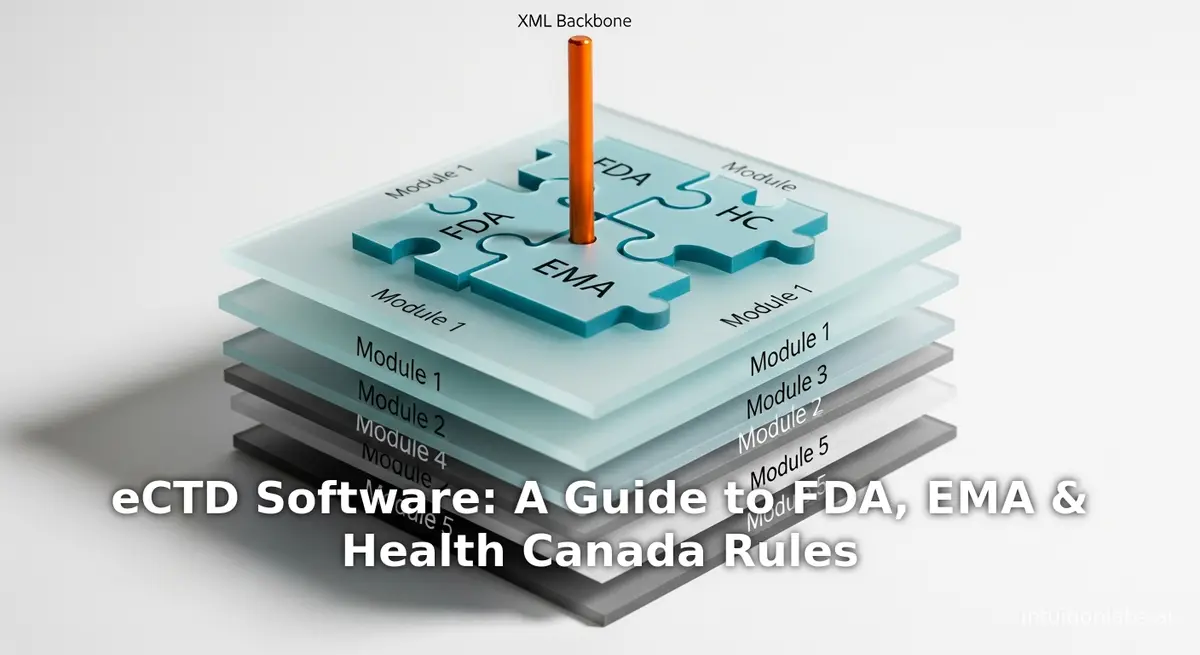
eCTD Software: A Guide to FDA, EMA & Health Canada Rules
Learn the technical requirements for eCTD software submissions to the FDA, EMA, and Health Canada, including validation, lifecycle management, and how regulators are phasing in eCTD v4.0 for new applications.
eCTD Publishing: A Guide to Best Practices & Requirements
Learn eCTD publishing best practices for compliant regulatory submissions. This guide covers technical standards, validation, and requirements from FDA, EMA, and other agencies.