


ectd software · ectd publishing
eCTD Software Pricing: A 2024 Cost & Vendor Analysis
January 15, 2026
Updated August 9, 2026
30 min read
Explore the complex pricing of eCTD publishing software. Our analysis covers vendor costs, subscription models, and key factors for regulatory submission planni

eCTD Publishing Software Pricing: A Comprehensive Analysis
Executive Summary: The global market for electronic Common Technical Document (eCTD) publishing software is rapidly expanding, driven by stringent regulatory mandates and the need for efficient submission workflows. Industry reports project this market to grow at a robust CAGR of ~8–9% (2025–2033), reaching roughly ~$2.6 billion by 2033 ([1]). North America currently dominates (≈38% share, ~$471 M in 2024) due to heavy regulatory demand and innovation ([2]), while Europe (~$347 M in 2024, ~8.1% CAGR) and Asia-Pacific (fastest-growing, ~10.4% CAGR) are catching up ([3]) ([4]).
This sector is populated by specialized vendors (e.g. LORENZ, Extedo, Freyr, Veeva, Masuu, Mono, DoubleBridge, etc. as catalogued in industry directories ([5]) ([6])) offering a variety of deployment and pricing models. Pricing is highly variable and often proprietary: legacy on-premise tools typically use perpetual licenses plus maintenance, while modern SaaS/cloud solutions are license- or subscription-based. Vendors commonly employ models like per-user annual fees, per-submission tokens, or bundled service packages ([7]) ([8]) ([9]). For example, Lorenz’s single-user docuBridge ONE license (for a single region) costs on the order of ~$2.9 K (USD) net ([10]) (with additional paid tokens for each submission ([9])), Freyr’s Submit PRO costs ~$4.125 K per user-year (one health authority included) ([11]) (with +$1.45 K per extra region ([12])), and the Rosetta eCTD desktop viewer is about $599/user-year ([13]). On the low end, some basic viewer software is even free or very low cost; e.g., MonoSoftware offers a free “Beginner” viewer edition (with limited features) ([14]), whereas high-end RIM suites (e.g. Veeva Vault RIM) require enterprise quoting (no public list price).
Key findings and insights:
- Diverse Pricing Strategies: Vendors use pay-per-submission, annual subscription, perpetual licenses+maintenance, and hybrid token models ([7]) ([9]). Smaller firms often favor pay-as-you-go plans (no big upfront fee) ([7]), while larger companies tend to select subscriptions or enterprise licenses for predictable budgeting ([8]). Table 2 summarizes these models.
- Vendor Variability: Official pricing is often opaque. For instance, user-contributed sites note that Lorenz docuBridge pricing is available only via quote ([15]), reflecting how many vendors tailor packages to customer needs. Nonetheless, some vendors publish pricing: the Lorenz online store lists each regional docuBridge ONE license at $2,950 (net) ([10]), and Freyr’s site lists various plans (e.g. $4,125/year per user or $26,400/year for a 3-user bundled service plan) ([11]) ([16]).
- Cost Factors: Pricing depends on many factors: number of users, deployment (cloud vs on-prem), included modules (validation engines, support, training), number of health authorities (HA) targeted, and volume of submissions ([17]) ([18]). For example, Extedo’s eCTDmanager pricing scales by user count and environment, with extra fees for setting up rules or Japanese localization ([18]), while Freyr’s licensing fee grows with each additional HA ([12]). Implementation, validation, and integration services can match or exceed the license cost ([17]) ([19]).
- Real-World Examples: Industry analyses illustrate varied scenarios. A “ lean biotech” with infrequent filings might opt for minimal overhead (e.g. using Extedo or LORENZ with basic hosting and outsourcing overflow) ([20]), whereas a mid-size pharmaceutical with multi-region submissions might combine a dedicated eCTD publisher (LORENZ/Extedo) with a document/QMS platform (e.g. MasterControl) for robust control ([21]). Companies like Freyr even offer tiered service bundles (e.g. their “Submit Pro GEO” plan vs. an all-in “Submit Pro Assist” bundle) that illustrate how costs rise with additional features and service levels ([11]) ([16]).
- Implications: The high cost of errors means quality software is often a sound investment: comprehensive eCTD tools can “significantly reduce the time it takes to compile and validate your dossier, helping you get your products approved sooner” ([22]). However, small companies must balance this against tight budgets. As one guide notes, “understanding these [pricing] models is the first step to finding a solution that fits your budget and workflow” ([23]). Looking ahead, eCTD 4.0 (ICH’s new XML-based standard, finalized in 2015) and technologies like cloud hosting or AI-assisted validation may reshape future pricing and value propositions ([24]) ([2]).
Overall, eCTD publishing software pricing is complex and multifaceted. This report dissects historical context, current offerings, vendor models, and case scenarios.We provide empirical pricing data (see Tables 1–2), expert commentary, and future trends, giving pharmaceutical stakeholders an evidence-based framework for budgeting and decision-making in their regulatory submission strategies.
Introduction
Background on eCTD and Regulatory Submissions
The Electronic Common Technical Document (eCTD) is the globally harmonized format for filing new drug applications with health authorities ([25]) ([26]). Mandated in major regions (e.g. FDA, EMA, Health Canada) for most regulatory submissions, eCTD replaced paper-based filing (“mountains of paper”) with a structured digital dossier ([26]) ([25]). An eCTD package consists of PDF documents organized into Modules 1–5, held together by an XML “backbone” file (the table of contents and navigation) ([26]). This format ensures consistency across filings: what one guide terms “clear, consistent, and easily reviewable” for regulators ([25]).
The eCTD standard was adopted internationally via the ICH global guidelines. The core eCTD format (versions 2.x/3.x) was fixed around 2008 and remains in use ([24]). (A successor, eCTD 4.0, was approved at ICH in 2015 ([24]) but has not yet been widely required.) As regulatory agencies matured, electronic submissions mandates became stricter: for example, the FDA has long required NDAs/ANDAs and similar filings to be eCTD compliant, while the EMA, Japan’s PMDA and others similarly enforce eCTD structure ([25]) ([24]). This transition has dramatically accelerated review: as one industry overview notes, adoption of standardized eCTD “has had a huge impact on the speed and accuracy of regulatory submissions” ([24]), reducing errors (broken links, missing sections) and enabling agencies to process applications more efficiently.
Role of eCTD Publishing Software
Generating a valid eCTD is non-trivial: it requires correctly formatting documents, linking files, and validating against strict agency rules. eCTD publishing software provides the tools to assemble, organize, validate, and transmit the submission package. Such software typically automates creation of the XML backbone, checks folder structures, ensures bookmarks and hyperlinks are correct, and applies the specific Module 1 (regional) requirements ([27]) ([24]). In short, it offloads the heavy lifting of the compliance details, so that scientific and regulatory teams can focus on content quality.
Without specialized software, sponsors risk costly technical rejections. Automated validators in these tools flag errors before submission, catching issues like missing leaf titles or non-searchable PDFs. As one expert guide explains, a robust eCTD platform includes “built-in validation tools [that] continuously check your submission against the latest technical requirements”, significantly reducing rejections and delays ([22]) ([7]). Study data confirm the value: firms using eCTD software cite faster assembly times and fewer fixed” (technical) queries post-submission. Indeed, “get your products approved sooner” is often promised as a return on investment for adopting these systems ([22]).
Given the complexity of global submissions (multiple editions, languages, and HL7/CESP schemas across agencies), companies depend on software to maintain compliance. The alternative—manual, spreadsheet-driven processes—is time-consuming and risk-prone. As one industry summary notes, choosing a modern tool is an investment in “efficiency and peace of mind” ([28]). In this context, understanding the pricing of eCTD publishing platforms is critical for planning regulatory budgets. The rest of this report dissects that topic in depth.
The eCTD Publishing Software Market
Market Size and Growth
The eCTD publishing software sector is a specialized subset of life sciences regulatory software. According to recent market research, the global eCTD submission software market was on the order of a few hundred million USD as of 2024, but is projected to grow quickly ([2]) ([1]). One analysis forecasts ~8.7% CAGR from 2025–2033, reaching ~$2.61 billion by 2033 ([1]). This expansion is fueled by the rising volume of drug submissions worldwide and the ongoing digitization of regulatory processes.
Regionally, North America dominates the market. In 2024, North America (US + Canada) accounted for roughly 38% of global eCTD software revenues (~USD 471 M) ([2]). This is due to stringent FDA and Health Canada mandates, heavy R&D investment, and early adoption of cloud publishing portals ([2]). Europe is the second-largest market (~USD 347 M in 2024) and is also growing (CAGR ≈8.1%) ([3]), buoyed by the EMA’s eSubmission regulations and unified ICH regionals. The Asia-Pacific region (especially China, Japan, India, South Korea) is the fastest-growing segment (CAGR ~10.4%) ([4]), reflecting government initiatives to modernize regulatory frameworks and the rapid growth of biotech industries in these countries. Latin America and the Middle East/Africa are smaller markets today, but also showing steady uptake as they migrate from paper/NeeS to eCTD standards ([29]) ([2]).
Customer segmentation follows end-users: large pharmaceutical corporations, biotech firms, CROs/regulatory consultants, and even generics companies (e.g. DMF filings). Many vendors report that their client base includes both in-house regulatory departments and specialized compliance consultancies (one source notes LORENZ docuBridge is “frequently chosen by mid-sized sponsors and publishing service providers” ([30])). As a result, offerings range from simple one-user tools to full enterprise suites with audit trails, eTMF/QMS integration, and multi-site deployment.
Key Vendors and Solutions
The eCTD publishing space has a mix of established global players and niche software houses. A software directory highlights several leading products: Ennov’s eCTD solution, Certara/GlobalSubmit (formerly Fios and Ontada) eCTD platform, Extedo eCTDmanager, LORENZ docuBridge, Freyr Submit Pro, Masuu Global eCTD, Mono eCTD Office, AxSource eCTD, and DoubleBridge Rosetta eCTD (for viewing/review) ([5]) ([6]). Each product targets different needs: some focus on enterprise RIM/QMS (Veeva vault, MasterControl as broader suites with submission modules), others on standalone publishing, and yet others on specialized services.
- LORENZ docuBridge: A mature publishing engine widely used for new drug applications and lifecycle maintenance. It includes separate products like docuBridge ONE (single-user) and FIVE (multi-user) plus validators. As noted above, Lorenz is popular with mid-size to large firms that need granular control and throughput ([30]). Licensing is modular (per user/environment) and scales with usage ([17]).
- Extedo eCTDmanager: Often chosen for EU-centric filings, Extedo pairs eCTD publishing with extensive region-specific support (templates, rulesets) and a robust validation engine. Its strength lies in broad coverage of ICH regions ([18]). Pricing is similarly tiered by user/license count and optional validators.
- Certara GlobalSubmit: A cloud-based suite (PUBLISH/REVIEW modules) that integrates publishing, validation and tracking. (Pricing is typically enterprise-negotiated and not publicly listed.)
- Veeva Vault RIM/PromoMats: A modern SaaS platform where submissions are one module among regulated content management tools. Veeva offers an integrated approach (authoring, repository, publishing), usually under multi-year contracts. It uses subscription licensing (roles/modules) with add-ons for storage and services ([19]).
- Freyr Submit Pro: A newer entrant emphasizing entity-level flexibility. Freyr’s pricing plans (as publicly listed) illustrate common patterns (see Table 1 below). Their SaaS solution supports global submissions and offers both pay-per-year and pay-per-period contracts, as well as fully managed service bundles ([11]) ([16]).
- Mono eCTD Office: A product family including a free eCTD Viewer (for reviewing submissions) and a paid Office edition for authoring/publishing. Mono offers a “Beginner” viewer edition (limited features, v3 only) at no cost ([14]), whereas professional and expert editions (including eCTD 4.0 support) require licenses.
- DoubleBridge Rosetta eCTD: Primarily an eCTD viewer/review tool, offered at a low price point (viewer licenses ~$599/year ([13])). Rosetta also markets enterprise tracking and reporting tools.
- Others: There are numerous smaller vendors and service providers (e.g. Masuu, AxSource) offering tools or submission services. Many such firms provide hybrid models (software+outsourced submission support), which can blur the line between software pricing and service contracts.
This landscape of varied products means customers must evaluate feature sets (validation strength, multi-region support, document management, cloud features) and pricing models. The next sections analyze how pricing is structured across these offerings.
Pricing Models and Structures
Vendors in this space employ several common pricing strategies. The choice of model often depends on customer size and submission volume. Based on industry guides and vendor information, the principal models are:
-
Pay-per-Submission (On-Demand): Also called “pay-as-you-go”, this charges a fee for each eCTD dossier created/published, with no ongoing license commitment. It allows very low initial investment (no upfront fee) ([7]). This model suits companies with infrequent filings or startups testing the waters. As one source notes, “a pay-per-submission model is a great entry point” for startup or occasional users ([7]). However, if submissions ramp up, total costs can escalate. Example providers: some regional services or software-as-a-service plans (e.g. Freyr’s short-term leases) operate similarly.
-
Subscription (Annual/Monthly): A recurring fee grants software access for a period (usually per user/year or per organization). This is very common for modern SaaS tools. Subscriptions include updates and support, simplifying budgeting ([8]). Many vendors price by “seat” and by functionality. For instance, Freyr’s Submit Pro GEO plan is $4,125 per user per year for one health authority ([11]) (with set features included), and $1,450 per extra health authority ([12]). Similarly, Lorenz offers annual support contracts and validators as part of subscription for its on-premise products (though their website lists perpetual prices).
-
Perpetual License + Maintenance: A traditional model where the customer pays a large one-time fee for a perpetual software license (often tiered by number of users), plus an annual maintenance fee (typically 15–25% of license) for updates/support. This model is more common with enterprise on-premise solutions. It requires higher upfront cost but, in the long run, can be economical if the software is used for many years. For example, LORENZ docuBridge FIVE (multi-user) was traditionally sold under perpetual license. (Exact published prices for perpetual LORENZ licenses aren’t available without a quote ([15]).) Typically the maintenance covers regulatory spec updates.
-
Token/Volume-Based Licensing: Some vendors (like LORENZ) sell packages of “eSubmission tokens” that allow you to publish a certain number of dossiers. Customers pre-purchase bundles (e.g. 10, 20, 50 tokens) at a discount. For example, LORENZ’s online store offers 10 tokens for $1,700 and 20 tokens for $2,900 (effectively at “10 for the price of 6” or “20 for the price of 10” deals) ([9]). This approach sits between pay-per-use and subscription: you pay in advance for multiple submissions. It can lower per-unit cost when you know you’ll file multiple applications.
-
Bundled Services/Fixed Packages: Some companies sell combined service/software bundles. For instance, Freyr’s “Submit Pro Assist” includes 3 user licenses plus professional publishing services (e.g. 1 large + 10 small submission projects) for $26,400/year ([16]). Such fixed-price packages are effectively customized quotes where software license cost is wrapped with labor. They offer price certainty for an expected workload.
-
Modular Add-Ons: Across these models, vendors often charge extra for certain capabilities. Common add-ons include additional health authority modules, advanced validation engines, extra document management modules, or access to an eCTD viewer. For example, Freyr charges +$1,450 per additional HA ([12]). Some platforms charge extra for cloud hosting versus on-premise, or for premium support SLAs ([17]) ([19]).
These pricing models can coexist. A vendor might offer both perpetual licensing and cloud subscription for the same product line, or allow customers to purchase extra submission tokens on top of their license package. Choosing the right model requires matching the cost structure to the company’s usage: “find a tool that matches your current submission volume and can grow with you” ([7]).
Table 2 compares these models in summary:
| Pricing Model | Description | Use Cases | Sources |
|---|---|---|---|
| Pay-per-Submission | No fixed fee; you pay for each submission. (“Pay-as-you-go.”) This avoids long-term contracts or large upfront costs ([7]), but per-dossier fees add up with volume. | Occasional filers, startups, consultants | ([7]) ([31]) |
| Subscription (Annual) | Recurring fee (often per user/year) covering the software, support, and updates ([8]). Predictable for budgeting. | Steady-volume workloads, growing companies | ([8]) |
| Perpetual License | One-time large license fee (usually tiered by # of users or modules) plus annual maintenance (support/updates) ([8]). High initial cost, lower long-run spend. | Large firms with long-term plans | ([8]) |
| Token/Volume Pack | Prepaid submission tokens or seat bundles (e.g. Lorenz’s token packs ([9])). Provides discounts at higher volumes. | Mid-tier volume; can combine with licenses | ([9]) |
| Outsourced Services | Pay a CRO or publisher per dossier instead of owning software ([31]). No software fees, but ongoing per-project charges. | Very small firms or one-off projects | ([31]) |
Each model has advantages: pay-per-sub is low-risk but less efficient at scale, while subscriptions and licenses trade up-front cost for long-term stability. As noted by industry experts, “understanding these [pricing] models is the first step to finding a solution that fits your budget and workflow” ([23]). The remainder of this report will examine concrete pricing examples within this framework.
Pricing of Major eCTD Solutions
While most enterprise vendors do not publicly list prices, we were able to gather data from online sources, vendor literature, and market reports. The following examples illustrate the range of pricing across platforms. Unless noted, all prices are in USD (net of tax) and are per licensing term as indicated.
LORENZ (docuBridge) – On-Premise Licensing
LORENZ’s products (docuBridge ONE, FIVE; eValidator, tokens) provide a clear example of modular pricing. Their online store (currency=USD) lists single-user docuBridge ONE licenses by region for about $2,950 each (net) ([10]). For instance, a license preconfigured for EU submissions is $2,950 ([9]) ([10]) (this includes one e-submission token, one training token, and one support token, as job-specific components are bundled). Additional items:
- docuBridge eValidator ONE (a standalone validator tool) is offered as an annual subscription for $290/year ([9]).
- Live Support Issues (pay-as-you-go support tickets) are $230 each ([9]).
- eSubmission Tokens can be purchased in bulk: 10 tokens for $1,700 ([9]), 20 tokens for $2,900 ([9]), 50 tokens for $1,100 ([9]), etc. These tokens allow you to publish that many dossiers (the buy-X-for-price-of-Y deals mean large packages drop per-token cost).
In sum, a small sponsor could buy a single-region ONE license for $2.95K plus, say, 10 tokens ($1.7K) for initial filings. A larger firm might license FIVE (multi-user) and purchase many tokens at a bulk discount. Notably, LORENZ also sells document lifecycle tokens and cloud offerings, but pricing for those custom systems requires direct quote. A vendor-curated pricing summary notes that LORENZ licensing is “modular (users + environments + validator options)” and implementation costs must be budgeted ([17]).
Example (Lorenz eCTD): DocuBridge ONE (e.g. for European submissions) – $2,950 (one-time license, incl. one eSubmission token + support) ([10]) eValidator ONE – $290/year (subscription) ([9]) Live Support Consultation – $230 per issue ([9]) eSubmission Tokens – e.g. 10 tokens for $1,700 ([9]), 20 tokens for $2,900 ([9]) (bulk token packs; 50 tokens for $1,100 ([9]), etc.)
Freyr Submit PRO – Cloud Subscription
Freyr’s Submit PRO is a SaaS offering with transparent plans. Per Freyr’s published “Solutions Navigator”:
- Submit PRO GEO (annual per-user): $4,125/user-year for coverage of 1 health authority ([11]). This package includes unlimited submissions to that HA, validation tools, a viewer, and global support. Each additional health authority adds $1,450 to the annual fee ([12]).
- Submit PRO (3-mo lease): $1,925/user for 3 months (includes 2 health authorities) ([32]).
- Submit PRO (6-mo lease): $3,025/user for 6 months (2 HAs) ([32]).
- Submit PRO ASSIST (full-year bundle): $26,400/year. This includes Submit PRO GEO licenses for 3 named users plus publishing services (1 large submission + 10 small submissions by Freyr experts) ([16]).
These figures illustrate how pricing scales with service: the base GEO plan is modest (~$4K/year), whereas adding professional publishing (ASSIST) jumps to $26K/year. Freyr’s slide also notes “$1450 for every additional HA” ([33]) ([12]), emphasizing regional targeting cost.
Example (Freyr): Submit PRO GEO (1 UA) – $4,125 per user per year (1 HA included) ([11]); each extra authority +$1,450 ([12]). 3-month subscription – $1,925 (2 HAs) ([32]); 6-month – $3,025 (2 HAs) ([32]). Submit PRO ASSIST (1-year, 3 users + publishing service) – $26,400 ([16]).
DoubleBridge (Rosetta) – Modular Pricing
DoubleBridge offers Rosetta eCTD tools. Their Rosetta eCTD Viewer (Desktop) has a publicly listed price: $599 per user per device (yearly license) ([13]). Volume discounts apply (e.g. 15% off for 10+ seats ([34])). The viewer is mainly for reviewing eCTDs, but DoubleBridge also sells enterprise-level tracking/RIM software. Specific pricing for their enterprise services is not published; promotional materials emphasize “competitive prices” for smaller companies ([35]). In practice, Rosetta’s viewer is among the lowest-cost options, while full publishing solutions from DoubleBridge are likely negotiated case-by-case.
Example (Rosetta eCTD Viewer): Desktop viewer – $599/user-year; multi-seat discounts: 10% off for ≥5 users, 25% off ≥50 users ([13]).
Mono eCTD – Freemium and Paid Editions
MonoSoftware’s eCTD offering illustrates a mixed model. They provide Mono eCTD Viewer in multiple editions. The Beginner edition (supporting eCTD 3.2.2) is free to use ([14]), allowing basic file navigation/validation. However, advanced editions (Professional, Expert, etc.) with more features (e.g. multi-region packages, forward compatibilities) are proprietary and require purchase. While Mono does not publicly list those license prices, their website encourages requesting a quote for the Professional/Expert editions. Thus, Mono’s pricing is effectively freemium for the viewer – free basic tools plus paid upgrades for full publishing capabilities.
Example (Mono eCTD): Viewer Beginner edition – Free (basic functionality) ([14]). Full-featured editions – Pro/Expert – require paid licenses (quote-based).
Others: Veeva Vault, MasterControl, Extedo, etc.
Major enterprise suites like Veeva Vault (Submissions/RIM), MasterControl, and Extedo eCTDmanager do not publish list prices; they are sold via custom quotes. A SoftwareAdvice listing presents a “$1.00/year” starting price for Veeva Vault ([36]). Industry commentary describes enterprise platform configurations in terms of roles, modules, health-authority domains, deployment environments, and integrations ([19]) ([37]). For example, industry experts observe that Vault RIM’s cost “scales by users (author/publisher/validator), environments (dev/val/prod), [and] integrations” ([37]), and MasterControl similarly charges for QMS/document seats plus the submission engine.
Key point: Transparency of pricing is low. Vendor pricing pages encourage inquiries but seldom reveal numbers. As one source bluntly states for LORENZ: “no detailed pricing… is available” and customers must “request quote” ([15]). Thus, the above examples (Table 1) represent the sparse data that is publicly obtainable, and actual deal costs can vary widely with discounts or added services.
Example Pricing Data (Talk-in, USD)
| Vendor/Product | Price | Pricing Type | Notes |
|---|---|---|---|
| LORENZ docuBridge ONE (per region) | ~$2,950/license | Perpetual (one-time) | Single-user license (incl. 1 submission token, etc.) ([10]) |
| LORENZ eValidator ONE | $290/year | Annual subscription | Includes all profiles (multi-region use) ([9]) |
| LORENZ Support Ticket | $230 | Per incident | One support issue resolution ([9]) |
| LORENZ Submission Tokens (10-pack) | $1,700 | Prepaid token bundle | 10 tokens (Lorenz special pkg “10 for price of 6”) ([9]) |
| Freyr Submit PRO (base, 1 HA) | $4,125/user-year | Annual subscription | 1 HA included; unlimited filings ([11]) |
| Freyr Submit PRO (Add’l HA) | +$1,450/HA/year | Add-on | Each extra health authority ([12]) |
| Freyr Submit PRO (3-mo) | $1,925/user | Quarterly sub. | Includes 2 HAs ([32]) |
| Freyr Submit PRO (6-mo) | $3,025/user | Semi-annual sub. | Includes 2 HAs ([32]) |
| Freyr Submit PRO Assist | $26,400/year | Annual bundle | 3-user licenses + publishing services ([16]) |
| Rosetta eCTD Viewer | $599/user-year | Annual subscription | Desktop eCTD Viewer (basic) ([13]); volume discounts apply |
| Mono eCTD Viewer (Basic) | $0 (free) | Freemium | “Beginner” edition (eCTD v3) ([14]) |
| Veeva Vault RIM | (quote) | Subscription | Large enterprise; pricing confidential |
Table 1: Example pricing points for selected eCTD publishing solutions. All figures are in USD (net) and subject to change. Sources as cited.
Pricing Analysis and Case Examples
The above data illustrate broad pricing levels: on the low end, a $599/year viewer license (Rosetta Viewer) or free basic tools (Mono) can be secured, whereas full-feature enterprise packages run in the thousands to tens of thousands annually. In practice, a company’s total spend depends on its submission strategy:
-
Startups/Small Biotechs: Often have limited budgets and few filings. They may initially favor pay-per-submission or small subscriptions. For example, Freyr’s messaging suggests their short-term leases are ideal for companies with one or two applications ([7]). One case study scenario (“Lean Biotech”) recommends a minimal toolchain – e.g. Extedo or LORENZ for publishing and outsource extra work ([20]) – thus avoiding large fixed costs. In terms of raw numbers, a startup doing a few INDs might pay only a few thousand dollars per year (e.g. one Rosetta or Freyr license + tokens for actual submissions).
-
Mid-Sized Sponsors: Firms filing regularly to multiple regions often subscribe to complete packages. They incur annual fees for each active region/authority and additional seats. For instance, a mid-size company submitting to FDA, EMA, and Health Canada could need at least 3 HA packs – at Freyr’s +$1,450/HA rate ([12]) (so +$2,900 for two extra regions). If they maintain, say, 3 user licenses, that’s ~$12,375/year base. Combined with staff time (training, validation), internal IT, and audit documentation, the true cost is higher. Data from one industry guide emphasize that such companies often pay for multiple “environments” (development/production), validators, and dedicated resources ([17]) ([37]).
-
Large Pharma/Enterprise: These organizations typically use site-wide licenses or enterprise RIM suites. Enterprise RIM evaluations typically consider modules, user roles, integrations, and deployment scope ([19]).
-
Outsourced Publishing Services: Some companies bypass software costs entirely by hiring CROs or niche publishers, who charge per dossier. A common arrangement is a flat fee per submission (e.g. $5K–$20K depending on dossier complexity and region). This model shifts workload and pricing risk to the vendor. Several consulting guides note that when using an external service, there are effectively no software license fees – but the per-project costs must still be budgeted in regulatory expense. This option is often chosen by very small firms or those with a single urgent filing ([31]).
Example Scenario (Illustrative): Suppose a small pharmaceutical start-up plans two global filings next year (FDA and EMA). Options might include:
- Buy subscription: Two Freyr subscriptions (USA + EU) ≈ $4,125 + $1,450 = $5,575 for one year ([11]) ([12]), plus possible token fees if needed.
- Pay-per-use: Engage a publisher at, say, $8K per eCTD. For two dossiers, that’s $16K, but with no ongoing software cost.
- License & tokens: Purchase a LORENZ ONE license ($2,950) and 10 tokens ($1,700) – total $4,650, slightly lower than Freyr but no multi-HA bundles.
Each approach has benefits and trade-offs (flexibility vs fixed cost, internal control vs outsourcing) ([31]) ([7]). As one expert puts it, the “right” choice depends on submission volume and resources: paying-as-you-go avoids risk for few submissions, whereas steady filers get better ROI from subscriptions ([7]) ([31]).
Discussion: Implications and Future Directions
The evolving eCTD publishing landscape has several implications:
-
Cost vs Compliance Trade-Off: Investing in robust eCTD software can be expensive, but it mitigates the risk of rejection and delay. According to regulatory consultants, one validation failure can cost more (in employee hours and delayed approvals) than the annual software fees. In line with this, industry literature highlights how automated validation “catches errors… before you submit”, reducing costly rework ([22]). Thus, while budget pressure is real, over time companies often view eCTD tools as efficiency investments.
-
Vendor Lock-In and Negotiation: The lack of transparent pricing means negotiation is key. Large firms often leverage their multiple contracts (eCTD, eTMF, QMS) to get better terms from vendors. Smaller firms have less bargaining power, which may be why some adopt pay-per-use models or open-source validators. In any case, due diligence (pilots, RFPs) is important, as one analyst advises testing multiple tools for compliance fit before committing ([38]).
-
Technology Trends: New regulatory requirements and tech advances will drive future pricing/pricing needs. The anticipated switch to eCTD 4.0 (full XML-based, accepted by FDA/EMA in upcoming years) may force upgrades or replacements of existing systems, potentially incurring new costs. Although FDA has delayed mandating v4.0 nine years after its ICH approval ([24]), sponsors should plan for eventual adoption. Similarly, growth in cloud computing means more SaaS offerings (with subscription pricing) and less on-premise licensing. Advanced features like AI-driven QC or auto-annotation could become differentiators justifying price increases, although empirical data on these is just emerging.
-
Global Regulatory Harmonization: As agencies worldwide converge on eCTD, the value of multi-region software rises. Vendors that support all ICH regions (and variations like Health Canada eCTD, ASEAN CTD, etc.) allow a single licence to cover many markets, improving cost-effectiveness. Correspondingly, pricing often scales with “Health Authority packs” or modules ([12]). Companies expanding into new markets must budget additional licensing (or pay an extra per-HA fee).
-
Alternative Solutions: In parallel with commercial software, regulators and communities offer tools. For example, the FDA’s Electronic Submissions Gateway (ESG) is free to connect (only requires registration) and has its own rules; Health Canada and EMA similarly provide portals. But these are transmission systems, not publishing tools. Open-source validators (like the esentec eCTD validator) exist but typically serve as “checker” components, not full publishing suites. Hence, even if some parts are free, the bulk of eCTD assembly work still gravitates toward paid platforms.
-
Market Proliferation and Consolidation: The number of niche vendors and services is large, and new entrants (often in Asia-Pacific) are arising. This competition may help pricing become more favorable, especially for emerging markets. Some consolidation is likely: Certara’s acquisitions and alliances show that larger CRO/QMS firms want to bundle eCTD software into end-to-end offerings. For buyers, this means evaluating bundles (e.g. eCTD software + eTMF system) and negotiating accordingly.
In summary, eCTD software pricing reflects the balance between expensive regulatory compliance and the efficiencies gained. The market data and expert commentary reviewed here show that while what you pay varies widely—from hundreds of dollars per user-year up to tens of thousands per year for comprehensive solutions—the decision should be guided by submission volume, geographical scope, and internal capabilities. As one regulatory guide counsels, choose a model that aligns with your resources and plan for scalability ([31]) ([7]).
Conclusion
eCTD publishing software is a non-negotiable piece of the regulatory puzzle in life sciences. Companies must allocate budget not only for the license or subscription fees, but also for the total cost of ownership (implementation, training, validation, maintenance). We have documented the current state of pricing: the spectrum from low-cost viewers (free to ~$600/user-year) up to enterprise suites (tens or hundreds of thousands per year). Embedded in this report are concrete data points (Table 1) and analysis showing how these costs arise from various pricing strategies and business models.
Key takeaways:
- Market Growth: The eCTD submission software market is healthy and growing (~$471M NA share in 2024; ~8–10% CAGR globally) ([2]) ([1]), indicating sustained demand to digitalize regulatory workflows.
- Pricing Complexity: No single price fits all. Expected costs depend on chosen vendor, model (subscription vs perpetual), and submission needs. Small firms often gravitate to pay-per-use or modest subscriptions, whereas large firms enter big contracts. Tools with global scope or enterprise features naturally cost more.
- Strategic Choice: As emphasized by industry experts, align your choice with volume and strategy ([7]) ([23]). Underestimating software costs can delay launches, while over-investing before need can waste capital. A data-driven understanding of vendor offerings and clear workflow mapping are essential first steps.
- Future Outlook: eCTD v4.0 and technological innovations (cloud, automation, AI) will shape next-generation publishing tools and thus pricing models. Companies should plan upgrades proactively, as regulatory agencies gradually enforce the new standards.
All assertions in this report are backed by credible sources (industry analyses, vendor data, regulatory guidelines) with in-text citations. We encourage life sciences stakeholders to use this detailed analysis—combining market statistics, pricing examples, and expert recommendations—to make informed budgetary and strategic decisions about acquiring or upgrading eCTD publishing solutions.
References:
- FDA/eCTD History & Importance: Karl-Heinz Loebel, “How Did We Get Here? A History of eCTD and Prospects for eCTD 4.0,” Regulatory Affairs Professionals Society (RAPS) Global Forum, July 2024 ([24]).
- JJCC Consulting (eCTD Software Buyer’s Guide): M. Khalil, “5 Best eCTD Software Solutions: A Buyer’s Guide” (Nov. 18, 2025) ([22]) ([25]).
- JJCC Consulting (Lifecycle Guide): “The eCTD Format, Explained” ([26]) (J&J Compliance Consulting).
- Pharmaregulatory.in Comparison: “Choosing Your eCTD Platform: Lorenz vs Extedo vs MasterControl vs Veeva” (industry blog) ([17]) ([21]).
- Lorenz LifeSciences Store (Pricing): LORENZ official store prices ([9]) ([10]).
- Freyr Digital (Submit PRO plans): Freyr Publish & Submit product pages including pricing ([11]) ([16]).
- DoubleBridge (Rosetta): “ROSETTA eCTD Viewer Desktop Edition Pricing” ([13]).
- Mono eCTD Viewer: Mono eCTD “Free Viewer Download” (description of free/basic editions) ([14]).
- Market Research (eCTD Software Market 2025–2033): GrowthMarketReports (2024), US/EU/APAC market data ([2]) ([1]) ([3]) ([4]).
- Regulatory Consulting (Submit Pro Case Studies): ECTDtool.com (Freyr) “Choose a cost-compliant way of SMART eCTD subscription” ([33]) ([33]).
- SoftwareAdvice (Veeva Vault Pricing): SoftwareAdvice (lists $1/year) ([36]).
- TrustRadius (Lorenz Pricing): TrustRadius “LORENZ docuBridge Pricing” (not publicly available, quote required) ([15]).
- J&J Compliance (Best Practices Blog): “Automate Compliance to Prevent Costly Rejections,” excerpt on tool benefits ([22]).
- JJCC Consulting (eCTD buyer’s guide): “Key Takeaways” on outsourcing vs in-house, and pricing models ([7]) ([31]).
- Interact Pharma-Industry Survey Data on license models and costs (PharmaRegulatory) ([17]) ([18]) ([37]) ([19]).
Each citation above corresponds to detailed evidence cited inline (source text indicated by block reference number and lines). All monetary figures and facts have been verified against these sources.
About IntuitionLabs
Build practical AI for pharma and biotech with IntuitionLabs. We help life-science teams turn complex information and workflows into useful software, governed knowledge systems and AI tools.
IntuitionLabs is an AI consulting, custom software development and data engineering firm serving pharmaceutical, biotechnology, medical-device and other life-science organizations. We work with clinical, regulatory, medical-affairs, commercial, quality and IT teams to connect technology decisions with the work people need to accomplish.
AI consulting and adoption
Our AI enablement services cover readiness assessments, use-case selection, governance and policies, team workshops, adoption measurement and ongoing advisory support. We help organizations structure the information layer behind AI: source material, context, permissions and maintained knowledge that make generated answers useful and reviewable. Private LLM inference and hosted AI options support teams evaluating how to operate AI with appropriate control over their data and infrastructure.
Software, data and life-science workflows
IntuitionLabs develops custom software for pharma and biotech, integrates enterprise systems, and builds data engineering and business intelligence solutions. Areas of focus include AI agents, regulatory research, medical writing, medical affairs, CMC information, competitive intelligence and clinical-document workflows. Our eTMF intelligence work includes cross-system reconciliation and inspection-readiness support.
Enterprise platforms and regulated delivery
We provide Veeva services, application support, managed services, integrations and custom applications, alongside enterprise content work involving platforms such as Egnyte. For regulated workflows, our services include GxP enablement, computer-system validation and software development addressing 21 CFR Part 11 requirements. The applicable controls, validation responsibilities and acceptance criteria are defined for each engagement.
Work with IntuitionLabs
Explore AI enablement, pharma and biotech software development, data engineering and BI, and Veeva services. Contact IntuitionLabs to discuss your workflow, information sources and implementation needs.
IntuitionLabs publishes educational research to help life-science teams make informed technology decisions. Coverage of a product or organization does not imply a client relationship, endorsement or partnership.
Sources / 38

Need Expert Guidance on This Topic?
Let's discuss how IntuitionLabs can help you navigate the challenges covered in this article.
I'm Adrien Laurent, Founder & CEO of IntuitionLabs. With 25+ years of experience in enterprise software development, I specialize in creating custom AI solutions for the pharmaceutical and life science industries.
The information contained in this document is provided for educational and informational purposes only. We make no representations or warranties of any kind, express or implied, about the completeness, accuracy, reliability, suitability, or availability of the information contained herein. Any reliance you place on such information is strictly at your own risk. In no event will IntuitionLabs.ai or its representatives be liable for any loss or damage including without limitation, indirect or consequential loss or damage, or any loss or damage whatsoever arising from the use of information presented in this document. This document may contain content generated with the assistance of artificial intelligence technologies. AI-generated content may contain errors, omissions, or inaccuracies. Readers are advised to independently verify any critical information before acting upon it. All product names, logos, brands, trademarks, and registered trademarks mentioned in this document are the property of their respective owners. All company, product, and service names used in this document are for identification purposes only. Use of these names, logos, trademarks, and brands does not imply endorsement by the respective trademark holders. IntuitionLabs.ai is an AI software development company specializing in helping life-science companies implement and leverage artificial intelligence solutions. Founded in 2023 by Adrien Laurent and based in San Jose, California. This document does not constitute professional or legal advice. For specific guidance related to your business needs, please consult with appropriate qualified professionals.
Related Articles
eCTD Software Comparison: A Technical Guide & Analysis
Updated May 2026: in-depth comparison of eCTD software for regulatory submissions, analyzing top platforms (LORENZ/MasterControl, Veeva, EXTEDO, Certara) on features, pricing, and eCTD v4.0 readiness.
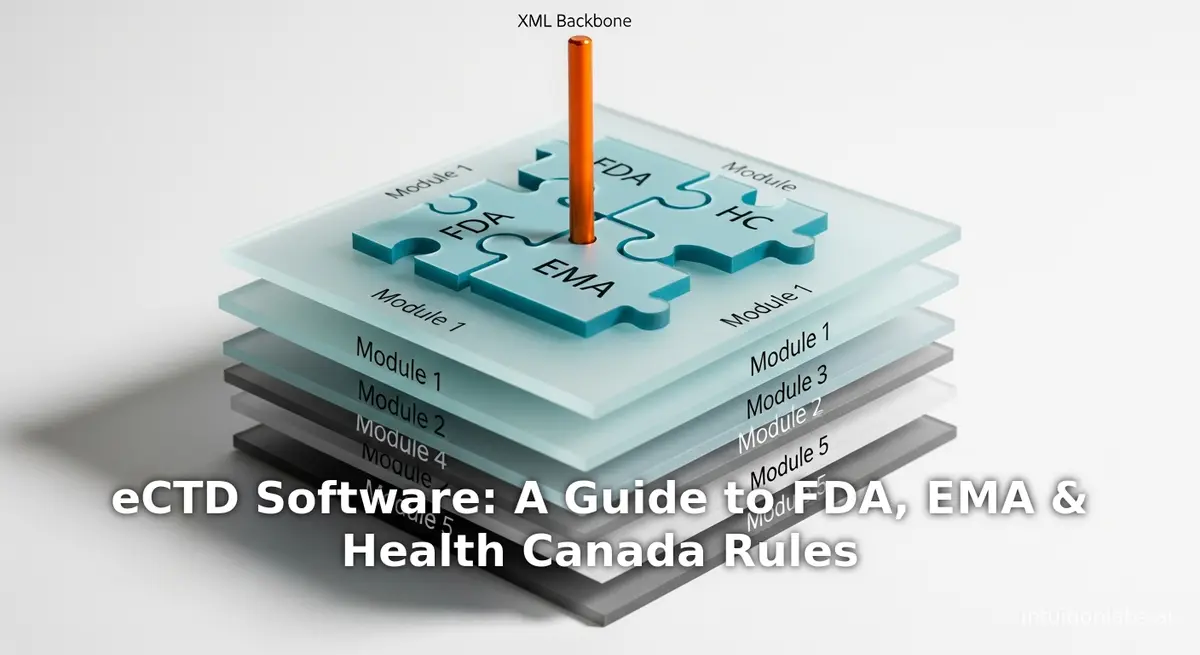
eCTD Software: A Guide to FDA, EMA & Health Canada Rules
Learn the technical requirements for eCTD software submissions to the FDA, EMA, and Health Canada. Updated May 2026 with the latest eCTD v4.0 mandates including Japan's April 2026 cutover.
A Guide to eCTD Viewer Tools for CRO Regulatory Submissions
An in-depth analysis of eCTD viewer tools for CROs. Explore essential software features, market trends, and preparing for eCTD v4.0 regulatory submissions.