


ectd publishing · regulatory submissions
eCTD Publishing: A Guide to Best Practices & Requirements
January 15, 2026
Updated May 11, 2026
40 min read
Learn eCTD publishing best practices for compliant regulatory submissions. This guide covers technical standards, validation, and requirements from FDA, EMA, an

[Revised May 10, 2026] This article was reviewed and updated in May 2026. Key milestones referenced (FDA acceptance of eCTD v4.0 since September 16, 2024; EMA's EU M1 v3.1 mandatory date of March 1, 2025; Health Canada validation rules v5.3 effective May 2025; EMA's optional eCTD v4.0 for new CAP MAAs from December 2025; and WHO's phased ePQS rollout running through 2026) have all proceeded on schedule. Sponsors submitting to the EU should now be operating under EU M1 v3.1 and validation criteria v8.1, and early adopters are beginning to file CAP MAAs in eCTD v4.0 format under the EMA pilot. Cited URLs were re-verified.
Executive Summary
The electronic Common Technical Document (eCTD) has revolutionized regulatory submissions, becoming the global standard for organizing and transmitting drug regulatory dossiers. This report provides a comprehensive analysis of eCTD publishing best practices, drawing on regulatory guidance, industry sources, and academic research. It reviews the historical context and rationale behind eCTD adoption, outlines the technical standards and workflows involved, and examines best-practice strategies for efficient, compliant eCTD publishing. Key findings include the overwhelming adoption of eCTD in major markets – for example, an FDA analysis found that by 2022 roughly 94% of submissions to CDER were eCTD format ([1]). Regulatory agencies worldwide (FDA, EMA, MHRA, PMDA, etc.) have complementary requirements and timelines for mandatory eCTD use. Best practices revolve around meticulous planning, validated publishing software, strict adherence to naming and structural requirements, comprehensive metadata and indexing, and thorough multi-stage quality review. Data show that eCTD usage has grown rapidly (from ~10% of U.S. submissions in 2007 to 59% by 2012 ([2])) and that sponsors investing in robust eCTD processes reap efficiencies in review time. Case studies (e.g. transitioning an EU eCTD to the Australian format ([3])) underscore the need for region-specific expertise. Looking forward, new developments (eCTD v4.0, HL7 RPS-based formats, and digital content structuring) promise further benefits but also require organizational change. In conclusion, rigorous eCTD publishing methodologies – covering organization, tool usage, data management, and validation – are essential for smooth submission and review, faster approvals, and compliance with evolving regulations ([4]) ([5]).
Introduction and Background
The Common Technical Document (CTD), developed in 1989 by ICH (US, EU, Japan) as a harmonized dossier structure for drug applications ([6]), laid the foundation for modern regulatory submissions. In the 2000s, regulatory authorities moved to an electronic version – the eCTD – to streamline review. Formally adopted by ICH in 2008 ([1]), the eCTD extends the CTD by adding an XML-based electronic backbone that indexes all content files. This indexing allows agencies and sponsors to track dossier changes across the product’s lifecycle, making it easier to find, replace, or supplement documents. As the FDA notes, eCTD submissions “make it easier for FDA to review data, approve new drugs, and monitor drugs after they go on the market” ([7]); it further simplifies the process for sponsors “because it is the same format used by drug regulatory agencies in other countries” ([8]). In short, eCTD was introduced to improve efficiency, consistency, and data integrity in the pharmacovigilance and approval process.
Because eCTD became the norm globally, sponsors must publish (assemble, format, and validate) their regulatory packages in this electronic format. Regulatory publishing thus refers to all activities that prepare the CTD content into the structured electronic format required by agencies, including converting documents to PDF, building the XML tables-of-contents, applying labels and metadata, and validating the final package. Effective eCTD publishing bridges the scientists who generate data and the reviewers who need to navigate the dossier ([9]) ([10]).
This report examines that eCTD publishing process in depth, emphasizing best practices at each stage. It covers the historical evolution of eCTD, the current global regulatory framework, the technical components of an eCTD dossier, recommended workflows and quality checks, and real-world examples. We discuss how validated software tools and content-management systems can aid publishing, how sponsors can avoid common pitfalls (such as naming errors or missing XML tags), and how agencies are updating their requirements (e.g., eCTD v4.0 adoption). By citing official guidance and studies, we aim to provide a practical yet thorough guide to publishing eCTD submissions that meet both current compliance demands and emerging future directions.
Regulatory and Technical Framework
Global eCTD Adoption and Guidelines
The eCTD standard is international. Since ICH Step 4 endorsement in 2008 ([1]), nearly all major regulatory agencies accept – and in many cases require – eCTD submissions. As Loebel (2024) observes, “the eCTD was approved by ICH in 2008, and it rapidly became the primary means of submission to the major markets” ([1]). The same source notes that eCTD is “accepted—and required for most submissions—in the US, EU and European Economic Area, UK, Japan, Switzerland, Canada, South Korea, China, Taiwan, [and GCC],” with many other countries (Brazil, Mexico, etc.) actively implementing eCTD ([1]). Indeed, FDA data show explosive growth: in 2007 only ~10% of CDER submissions were eCTD, but by 2012 it was 59%, with projections that eCTD would become 80–90% of submissions by 2017 ([11]). In practice, a modern sponsor can assume that submissions to FDA, EMA, MHRA, PMDA, Health Canada, TGA and many others must be in eCTD format.
Each regulatory region follows the ICH eCTD Specification (latest stable version 3.2.2) for modules 2–5, but region-specific requirements apply (mostly in Module 1, which is region-only content). For example, FDA’s Module 1 has specific folders for administrative info, patents, and labeling, while EMA’s Module 1 covers European-specific administrative data (see Table below). Health Canada, TGA, PMDA, etc. have their own M1 versions (though all now align to ICH v3.2.2 for core modules). Agencies provide detailed implementation guides for their module 1 and business rules. For instance, EMA’s eSubmission portal provides the EU Module 1 Specification and harmonized guidance, while Health Canada publishes its own validation criteria and backbone structure ([5]).
Regulatory timelines for adopting eCTD vary by region:
-
United States (FDA): Historically, FDA phased in mandatory eCTD use.In guidance linked to PDUFA goals, the FDA required that 24 months after final guidance, “all original NDA and BLA submissions” must be electronic, and 36 months post-guidance for commercial INDs ([12]). In practice, by January 2008 FDA stipulated that all electronic submissions must be in eCTD format (paper was still accepted, with full electronic requirement later) ([13]). Recently (Sept 2024) CDER/CBER began accepting eCTD v4.0 submissions ([14]), with future phases planned to handle backward compatibility and communications.
-
Europe (EMA): The EMA has required eCTD for centralized marketing-authorisation applications for many years (effectively mandatory by ~2010). They update their EU Module 1 (M1) specifications periodically; the latest EU M1 v3.1 (eCTD v3.2.2) will become mandatory for use on March 1, 2025 (submissions must comply with EU M1 v3.1 and validation criteria v8.1 by then) ([15]). The EMA is planning eCTD v4.0 steps: a pilot for CAPs (centrally authorised products) started in late 2024, with optional submission of eCTD v4 for new CAP MAAs from Dec 2025 ([16]). By that date applicants need systems supporting EU technical requirements (v4 vocabularies, etc) ([16]).
-
United Kingdom (MHRA): MHRA historically accepted eCTD via the EMA route and national routes. Recently, MHRA modernized its system: since April 2024 it has used Lorenz DocuBridge for eCTD management ([17]). It now enforces strict ICH compliance – for instance, any change to a document not in its historic database triggers an error about missing “historical sequences” ([18]). MHRA is working toward automated validation and intends to support new eCTD formats under its Regulatory Connect program ([18]).
-
Japan (PMDA): PMDA implemented eCTD earlier (for NDAs from about 2016) and remains somewhat unique (e.g. starting each submission as a new dossier lifecycle). Japan plans to mandate eCTD v4.0 by 2026 ([19]), and it provides a domestic Implementation Guide for eCTD v4 (linked on PMDA’s site) ([20]).
-
Health Canada: Health Canada has eCTD guidance and requires the Canadian Module 1 Backbone, eCTD validation rules, etc. It routinely rejects submissions with errors; its 2025 update explicitly encourages sponsors to pre-validate files using commercial eCTD tools ([5]).
-
Australia (TGA): The TGA requires “all prescription medicine applications” to be in eCTD format ([21]). It issued draft guidance on an Australian M1 structure for eCTD v4 (July 2025 update) and accepts submissions via its Business Services portal.
-
Global: The World Health Organization (WHO) is modernizing its prequalification dossiers as well. In late 2023 WHO announced a phased rollout (via the new ePQS portal): voluntary eCTD submissions for new products in 2024, mandatory eCTD for all new products by 2025, and by 2026 all prequalified product dossiers (new and legacy) must be in eCTD ([22]).
Table 1 below summarizes the key adoptions by region and the status of eCTD v4.0:
| Region/Agency | eCTD (v3) Status | eCTD v4.0 Status | Notes/Requirements |
|---|---|---|---|
| US (FDA) | eCTD mandatory for NDAs/BLAs (since ~2010); >90% of submissions by 2022 ([1]) ([12]) | eCTD v4 accepted since Sept 16, 2024 ([14]); forward compatibility planned | FDA guidance: validate eCTD, use ESG/ESTA gateway ([7]) ([23]); two-way comm. removed from v4 guide ([24]) |
| EU (EMA) | eCTD mandatory for CAPs; required CTD structure; EU M1 v3.1 (based on ICH v3.2.2) mandatory by 1 Mar 2025 ([15]) | eCTD v4 optional from Dec 2025 for new CAP MAAs ([16]), pilot 2024; timeline toward full adoption | EMA uses eSubmission gateway; requires EU eAF forms; must include tracking tables in Module 1 cover letter ([25]) ([26]) |
| UK (MHRA) | eCTD required for submissions; uses DocuBridge platform (since Apr 2024) ([17]) | Not yet announced; new MHRA system enforces tighter rules | MHRA now flags missing historic sequences, requiring updates to meet ICH eCTD specs ([18]) |
| Japan (PMDA) | eCTD v3.x mandated for NDAs; each submission is separate lifecycle ([27]) | eCTD v4 to be mandatory by ~2026 ([19]) | Requires Japanese translations/bridging data; holds DMFs in CTD format ([27]) |
| Canada | eCTD accepted; eCTD v3.2.2 (ICH) structure; requires bilingual docs in M1 | eCTD v4 adoption pending ICH timeline | Validates each submission; published eCTD validation rules v5.3 (effective May 2025) and urges pre-validation ([5]) |
| Australia | eCTD mandatory for prescription medicines ([21]) | Draft eCTD v4 M1 guidance published (2025) | Uses TGA Business Services portal; requires sponsor Business Service e-ID for each active ingredient ([28]) |
| WHO PQ | eCTD adoption in progress (via new ePQS portal) | Phase 2 (2025): eCTD required for new products; Phase 3 (2026): all dossiers must be eCTD ([22]) | Companies encouraged to prepare legacy dossiers; WHO plans eCTD validation criteria and FAQs ([29]) |
Table 1. Status of eCTD adoption in key regulatory jurisdictions (as of 2025) ([1]) ([22]).
Regulatory guidelines and documents form the basis of eCTD publishing requirements. The ICH M2 guideline (Step 5, 2002/2003) and its technical Q&A (M8) lay out the standard backbone and folder structures. Agencies publish technical catlogs (e.g. FDA’s eCTD Specification v3.2.2 and v4.0, EMA’s EU M1 specifications and validation tables). For example, FDA’s Consolidated Guidance and Specifications for eCTD lists all required headings and validation criteria, and the EU provides harmonized technical guidance to align all Member States. These references – along with agency portals and help desks – are essential resources for publishers. Notably, agencies constantly update their guidance: active surveillance of these updates is a best practice, since rules (file naming, allowed media, localization requirements, etc.) can change.
eCTD File Structure and Components
An eCTD submission is organized into five modules: Module 1 (region-specific administrative information) and Modules 2–5 (the common technical document). Within Modules 2–5, the structure follows ICH format (Module 2: summary, Module 3: quality, Module 4: nonclinical, Module 5: clinical). Each document (usually a PDF) resides in folders that correspond to sections of the CTD. Crucially, an eCTD also includes an XML “backbone” – often called the Table of Contents (TOC) XML or index – that lists every document, its location, and metadata tags (document type, dates, etc.). In ICH eCTD v3.2.2, this backbone comprises several XML files in each sequence folder, such as index.xml (ICH backbone) and region-specific module 1 index files.
Key technical rules apply to this structure:
- File naming conventions: All file and folder names in an eCTD sequence must be lowercase, and special characters are disallowed. For example, the FDA notes that "the eCTD specification requires lower case letters in all files and directory names…which is different from the file name conventions of R packages" ([30]). Violating these naming rules (e.g. uppercase letters, spaces, non-ASCII characters) will cause validation errors.
- Lifecycle (sequence) numbering: eCTD uses sequences numbered 0000, 0001, 0002, ... to capture the dossier’s life cycle. Each new submission (original application, response, update, etc.) is a new sequence. Sequences must increase consecutively; skipping a sequence number is an error (Canada’s rules explicitly state that 0004 cannot appear if 0003 is missing, even if 0004 otherwise has no content) ([31]). The XML index indicates for each document whether it is “new”, “replaced”, or “deleted” relative to the previous sequence.
- Validation checks: Agencies provide detailed criteria. For example, Health Canada’s validation rules (v5.3) include checks for empty folders, correct index naming (
index.xmlin root of sequence), file size limits, sequence order (no gaps), and that word/PDF files have no passwords ([32]) ([33]). FDA similarly publishes validation criteria documents (for v3 and v4). It is standard best practice to run the submission package through a validator (FDA’s ESG validation or third-party tools) before actual filing ([23]) ([5]). - Metadata and linking: Some agencies (notably EMA) require additional “tables” such as cross-reference tracking tables in Module 1 (e.g. an Annex listing Module 2/PIP or RMP references ([26])). Controlled vocabularies (like pharmacy codes, document type codes) must match the agency’s published lists (EMA makes these available as Genericode XML packages for M1 v4, and FDA has regional code lists).
- File formats: Only certain file types are allowed. Typically, documents must be 300 dpi or better, searchable PDFs (text not images unless necessary), and data files (e.g. SPSS, SAS) in specified formats. Agencies often reject overly large files: e.g. Health Canada sets PDF max 200 MB (warning at 150 MB) and SAS xpt max 1 GB ([34]). Multimedia or audio files are generally disallowed.
- RPS/eCTD v4 specifics: eCTD 4.0 (based on HL7’s RPS) changes the document structure by using a non-hierarchical, parameterized XML. New features were introduced (two-way communication, regulatory activity grouping, more flexible document replacement) ([35]). For example, RPS was designed so agencies could provide review comments directly via the gateway; however, FDA later chose to remove this two-way communication feature from its technical guide ([24]). eCTD v4 also requires updated software and controlled vocabularies (FDA and EMA have published new validation criteria and OIDs for v4).
- Country-specific module 1: Module 1 content varies by region. Autor should consult each region’s eCTD M1 specification. Key differences: Canada requires bilingual leaflets and signed attestations; the EU requires eAF forms and an EU-specific RMP format; PMDA requires Japanese translations and a full ICH-formatted DMF.
By understanding these structural elements and technical requirements, publishers ensure the eCTD package meets the exact specifications. The next sections detail how to implement such structure in practice.
eCTD Publishing Workflow
The eCTD publishing process can be divided into document-level tasks and submission-level tasks. As one industry overview explains, publishing typically involves Document Level Publishing – converting individual documents into final PDF form with correct formatting and bookmarks – followed by Submission Level Publishing – assembling those PDFs according to the CTD structure and generating the overall eCTD package ([10]).
-
Submission Management and Planning: Before any files are assembled, a submission manager/planner defines the dossier scope and timeline ([36]). This includes identifying which documents belong in each module and sequence, scheduling reviews, and assigning responsibilities (authors, reviewers, publishers) ([37]). Early planning is critical: the FDA advises sponsors to “plan early” and coordinate with review divisions to avoid last-minute issues ([38]) ([7]). Missing deadlines or rushing (e.g. submitting without proper application number) can cause major problems ([39]).
-
Collecting Source Files: Source documentation (reports, records, spreadsheets, figures) is collected from content teams. These files are prepared for final PDF conversion: any images or scanned content should be of high quality and text-recognizable. (Scanning poor-quality paper, or using images without OCR, can lead to non-searchable PDF which some agencies may balk at.) Word and Excel files must be cleaned of tracked changes and comments; team coordination is essential to provide final content.
-
Document-Level Publishing: Each document is finalized in PDF form. This involves:
- Formatting: Applying required fonts, margins, and pagination. Many publishers use templates to ensure uniform appearance.
- Bookmarks and Hyperlinks: Embedding bookmarks (outline entries) in PDFs to mirror reports’ table of contents. Cross-reference hyperlinks (e.g. “see Section 5.3”) should be checked for validity. Effective bookmarking and linking makes navigation easier for reviewers.
- Footers/Headers: Applying page numbering consistent with regulatory practice. For example, in FDA submissions page numbering often restarts for each module or report, whereas some agencies prefer continuous numbering. Footnotes or headers may identify document names.
- Metadata: Setting PDF document properties (title, author, keywords) as needed. While not always required, proper metadata aids automated indexing and provenance.
- Language Versions: If multiple language versions are needed (e.g. Latin vs. Cyrillic, or bilingual English/French for Canada), ensure character encoding is correct and fonts embedded.
During this stage, any required front/back pages (e.g. proprietary info disclaimers) or annexes (e.g. tables of contents tracking spreadsheets) are attached. Document-level QC includes spell-checking, verifying figure clarity, and ensuring any tables meet template formatting. As an industry review notes, this step is about creating a “Table of Contents” entry for each PDF and ensuring compliance with ICH criteria ([10]).
- Building the eCTD Backbone: Once all documents are finalized, publishers begin submission-level assembly. The XML backbone (often called
index.xmland related M1 index files) is created or updated. Using publishing software (commercial eCTD tools like Lorenz, Extedo, etc.), the publisher organizes files under the correct CTD sections. The ICH-specified XML schema requires precise element and attribute values (for module/section names, update types, etc). Most tools generate these indices automatically when files are placed in the right folder structure, but custom edits are often made (e.g. adding metadata fields or special nodes).
- Tree Structure: Ensuring each PDF is in the correct module/section folder. For example, Module 3 Quality CMC documents go under
module3/section_3.x/. Any deviation will break validation — for instance, if a Module 2 summary PDF is placed in the Module 4 folder, the validation will fail. - Sequence Structure: The main eCTD zip is assembled sequence by sequence. Sequence 0000 (the initial dossier) contains all base documents. Subsequent sequences (0001, 0002, etc.) contain only those documents that are new, changed, or deleted from previous versions, along with a complete index that allows reconstruction of the dossier’s state.
- Lifecycle and Merging: The publisher must specify in the XML whether each document is New, Replacement, or Deletion (by using
<action>tags). For example, a revised clinical study report in sequence 0001 would be marked as a replacement of the sequence 0000 version. Efficient handling of lifecycle changes is vital to avoid confusion: omitting a “replaced” label can make reviewers think something vanished. A recommended practice is to double-check the XML to ensure every changed document is properly flagged. - Working Documents: Some regions support a special “working documents” folder. For example, EMA requires that any draft/working documents (that should not be considered part of the official eCTD TOC) be placed in a folder named
xxxx-workingdocumentsparallel to the main sequence folder ([25]). Each “workingdocuments” folder suffix must match its sequence number. Publishers must strictly follow such naming (otherwise EMA’s system will reject the package ([25])).
- Validation and Quality Assurance: With the package assembled, rigorous validation is essential. Automated validators (provided by agencies or third parties) check the eCTD against the technical specifications. As FDA bluntly advises, “Review and validate your eCTD submission prior to submitting to avoid submission errors” ([23]). Validation catches issues like missing XML elements, incorrect file naming, oversized documents, or incorrect metadata. Any errors generate an official report (e.g. *.xml) detailing the location and nature of each problem.
Best practice is iterative validation and correction: publishers typically run a validator early (e.g., after assembling each sequence) to catch issues before building the full package. Multiple human reviews (a publishing QA team) should also manually examine the PDF content and the module structure. Consistency checks are critical – any inconsistencies in style, formatting, or naming across modules will not trigger a machine error but can cause misunderstandings. For example, a whitepaper notes that consistency in content, formatting, and metadata is “essential for a smooth review process” and “minimizes the risk of errors” ([40]).
- Submission and Follow-Up: Once validated and packaged (usually as a zip or via a submission gateway), the eCTD is sent through the agency’s electronic portal (FDA’s ESG, EMA’s Gateway, etc). Sponsors should confirm receipt and monitor any post-submission validation from the agency side. If an agency issues a “Refuse to File” due to technical nonconformity, the publisher must quickly re-package and re-submit corrected portions.
Throughout this workflow, careful documentation (submission plans, version control logs, issue trackers) should be maintained. Automated content-management integration (see below) can help track document versions across submissions.
Best Practices for eCTD Publishing
Drawing on regulatory guidelines and industry experience, this section outlines best practices at each stage of eCTD publishing. These practices help ensure compliance, reduce errors, and speed up the submission process.
-
Early Planning and Team Coordination: Develop a detailed plan with milestones, responsibilities, and cross-functional reviews. As one source advises, “a comprehensive plan…outline a clear timeline, define milestones, and assign responsibilities to each team member” ([37]). In practice, form a regulatory publishing team (which may include regulatory affairs, document specialists, and a project manager) to coordinate with scientists and reviewers. Start preparing sequence 0000 well in advance, and schedule buffer time for iteration. Engaging the appropriate regional experts is important – e.g. include Japanese or Chinese regulatory staff early if submitting to those markets.
-
Use Validated, Up-to-Date Tools: Employ industry-standard eCTD publishing software that is validated against agency requirements. It is “non-negotiable” that the tool complies with the eCTD specifications for your target agencies ([41]). Keep software updated to the latest version, since agencies frequently release new validation criteria (for example, FDA’s eCTD criteria update v3.2.2 in 2017 and are updating for v4.0). Use the software’s built-in checks, templates, and controlled-vocabulary lists. For large organizations, integrate the publishing tool with a content-management system (CMS) so that component documents (like Module 3 QbD documents) can be reused across multiple submissions without reformatting.
-
Adhere Strictly to Naming and Structure Conventions: Follow the naming conventions exactly (lowercase, no special chars). Ensure the folder tree mirrors the CTD structure precisely. For example, Module 1’s folders must be named as per the agency’s M1 spec (e.g. “1_regions”). Similarly, use the correct location in Module 2/3/4/5 for each report. Misplacing a document is a common error: publishers should double-check against each agency’s index template. For example, EMA recently reminded sponsors that working documents must be in an
0007-workingdocumentsfolder matching sequence "0007" ([25]). Always consult the latest ICH and regional guidelines when naming folders and XML elements. -
Maintain Consistency: Consistency in style and content reduces confusion. Use uniform fonts and formatting (e.g. same page size, margins, and heading styles) throughout the eCTD. Avoid treating different sections with different formats. Keep terminology consistent: abbreviations defined once and used everywhere, identical wording in repeated sections, etc. One industry guide notes “Consistency in content, formatting, and metadata is essential for a smooth review process” ([40]). Maintain a style guide and templates (e.g. for Module 2 summaries or Module 3 sections) to enforce uniformity. Prioritize building a master template set early that all contributors use.
-
Embed Comprehensive Metadata: Make full use of metadata fields in the backbone XML and PDF properties. For each document entry, include the correct title, author (if required), document type, and any required tags (such as study or protocol IDs). For example, the EMA M1 spec may require adding an eCTD specific code or identifier. Also populate PDF properties (Title, Subject, Keywords) so that the submission is self-descriptive. Good metadata helps reviewers find documents quickly and helps the agency manage submissions. Consider using consistent prefixes or file-naming conventions internally to track versions.
-
Prepare Required Cover Pages and Tables: Most agencies require customized cover letters, forms, and tracking tables. Develop standard cover letter templates corresponding to each application type (NDA, IND, supplement, etc.), but tailor them for each submission. For EMA/MHRA, ensure all required annexe tables (e.g. summary of changes, or PIP tracking) are included as separate PDFs in Module 1 ([26]). For FDA, include compliant forms (e.g. FDA Form 356h) and adhere to proper formatting of application metadata. Populate all front-matter thoroughly, as small omissions here (like a missing application number) can trigger rejections ([39]).
-
Execute Rigorous Review and Validation: Before any official submission, subject the package to multiple layers of review:
-
Technical Validation: Run the package through the chosen validator (FDA ESG or commercial) early and often. Fix any errors immediately. Validation reports should be closed out (no open errors) before final generation. The FDA explicitly warns that “what may seem like a small error can have big implications” (e.g. a wrong digit in an application number) ([39]); indeed, validators will catch those.
-
Content QA: Independently review the PDF content for accuracy. Verify that critical information (e.g. safety data narratives, chemical names) matches source data. Check that all figures/tables have legends and page breaks are in sensible places. It often helps to have a person (QA editor) who was not involved in authoring to do a fresh read-through.
-
Cross-Reference Checks: Ensure all cross-references in text match the actual document numbering in final PDFs. For instance, if Module 4 says “(see Table 2 in Module 3, Section 3.2.S)”, verify that Table 2 is indeed there and the labels match. Many publishing tools can auto-detect broken links, but manual checks catch nuances.
-
Team Sign-Off: Before submission, obtain sign-off from stakeholders (Regulatory Affairs, QA, etc.) that the eCTD package is complete and final. Maintain records of these approvals for audit compliance.
-
Structure for Reuse and Lifecycle: Build your eCTD content so it can be reused in future submissions. For example, Core Module 2 (overview & summary) often changes little between sequences; keep a clean source so it can be easily updated. Use content management to store documents centrally so future supplements draw upon previous text. Maintain an archive of past eCTD sequences with notes on what changed each time (sometimes called an eCTD Redline). Proper lifecycle management avoids unnecessary rework – for instance, if a long-clinical study report needs only minor updates, replace only the affected appendices or analysis sections rather than the whole report.
-
Be Mindful of Regional Requirements: As seen in Table 1 and the regional summaries, each agency has peculiar rules. Publishers should consult the relevant guidance for each target market. For example, the U.S. requires pre-assigned application numbers before submission and may accept DVDs for large submissions ([42]), while China (NMPA) demands full Chinese translation of all documents ([43]). Ignoring such rules leads to delays. Maintain a checklist of agency-specific checks for each dossier (e.g., Japanese translation in module 5, German labeling for Swiss submissions, tracked change statements if required, etc.).
-
Plan for Emerging Technologies: The regulatory landscape is evolving. With eCTD v4.0 (RPS), sponsors should begin testing tools for the new format – FDA has already provided validators and EMA has a pilot program. Consider how structured content (cloud-based authoring, modular labeling) tools from the Pharma 4.0 movement might integrate. Be prepared for agencies to introduce more structured data requirements (e.g. linking to IDMP/ISO standards). One study suggests moving “away from document-based filings towards electronic data libraries” to reduce repetitive effort ([44]). While full structured data is not here yet, sponsors can start by tagging their content semantically or breaking lengthy PDFs into modular sections that can be repurposed.
-
Cost and Training Considerations: Recognize that eCTD publishing requires investment. Industry analyses note that initial software and validation system costs climb into the hundreds of thousands of dollars (often $200k–$300k upfront plus ~$100k–$200k annual) ([45]). This may be a barrier for smaller companies. Best practice is to budget appropriately, perhaps using consultants or commercial publishing services if internal resources are lacking. Likewise, training is key: publishing staff should be well-versed in ICH rules and each target agency’s specifics. Regular training updates (e.g. when ICH arranges workshops) and internal SOPs ensure consistency.
-
Quality Over Speed: Finally, maintain a conservative approach to deadlines. Several sources emphasize allowing ample time for multi-step processes. For instance, FDA tips include: “Allow plenty of time to complete the multi-step account creation process and become familiar with the ESG interface” and “submit the sample early to allow time to make adjustments prior to the final submission” ([46]). While eCTD is meant to speed review, rushing a submission without thorough checks remains risky.
By adhering to these comprehensive best practices – planning meticulously, using the right tools, enforcing consistency, and validating fully – sponsors can navigate the complex eCTD requirements confidently. This diligence often results in smoother reviews and faster approvals ([47]).
Data and Evidence of eCTD Impact
Adoption Trends: Data from regulatory agencies and industry sources underscore the rapid eCTD uptake and its effects. For example, World Pharmaceutical Frontiers reports that CDER’s eCTD submissions grew at ~300% annual compound rate during 2005–2008, and by early 2012 eCTDs formed 59% of all submissions ([48]). This growth occurred even before eCTD was absolutely mandatory for all applications; from this we infer that sponsor-driven transition was strong. By 2022, FDA reported ~94% of all submissions are eCTD through its Electronic Submissions Gateway ([1]). AMoreover, over 8 million eCTD sequences had been filed through FDA’s portals by 2022 ([1]), reflecting the scale of use. Internationally, the Applied Clinical Trials review notes that besides FDA/EMA, “various other countries like Australia, Switzerland, Canada, etc. have adopted the ICH guidelines… Most countries and their regulatory authorities have migrated to the eCTD format” ([49]).
Benefits: Though quantitative impact data is limited in literature, qualitative benefits are well documented. Enhanced organization, easy navigation, and more efficient review are consistently cited advantages ([7]) ([50]). For instance, FDA reports that reviewers can “easily find and access” needed information in eCTD format ([7]). Sponsors often find eCTD permits submitting supplements or global variations faster, as content can be reused. A study on structured data suggests that automating parts of the submission (as eCTD partly does) can “improve overall efficiency and speed in the compilation and review of regulatory submissions” ([44]).
Cost Trade-offs: However, eCTD conversion has upfront costs. Estimates cited in industry publications indicate initial system implementation (software, hardware, validation) in the mid-hundred-thousand-dollar range, with ongoing annual costs also substantial ([45]). Thus, companies weigh these costs against anticipated savings in internal labor and shorter review times. In one analysis, the “barriers to adoption” included exactly those capital/operational costs and the effort to master regulatory rules ([45]). Anecdotally, larger firms justify the investment by the recurring use of eCTD (especially for products with many life-cycle filings) and by better regulatory compliance. Moreover, errors caught pre-submission (using validators) save ‘re-submission’ costs and time. An FDA tip underscores this: a “small error” could derail an application, so avoiding that through validation is worth the effort ([39]) ([23]).
Efficiency Metrics: Some reports suggest streamlining: for example, one whitepaper cited the promise of eCTD as enabling “more efficient and thorough agency review” ([50]). When agencies do not have to re-key or physically file documents, reviewers spend less time retrieving data. While hard metrics (e.g. average review cycle days before/after eCTD) are seldom published, FDA’s move toward eCTD was partly driven by the observation that non-electronic submissions congest review processes. Indeed, after eCTD adoption FDA eventually eliminated certain paper-only requirements (e.g. IND cover letters can be eCTD).
Case Studies: Real-world examples illustrate best practices in action. Clinigen Group describes a scenario where a European biotech needed to submit an application in Australia. The team “converted the EU eCTD format to the Australian eCTD format, ensuring compliance with TGA requirements,” which required both technical conversion and regulatory knowledge ([3]). This case underscores the importance of region-specific expertise and validated conversion processes. Another example emerged from the R-consortium: Zhao et al. detail a workflow using an R package (pkglite) to pack statistical analysis scripts into an eCTD. They note that this tool enabled “the first publicly available R-based submission to the US FDA” ([51]). This emphasizes how even highly technical content (like reproducible analysis code) can be integrated when following best practices (in this case packing code into a text module meeting eCTD rules).
In summary, both quantitative data and qualitative findings point to strong adoption of eCTD (with near-universal agency acceptance) and significant gains in dossier management. Sponsors that invest in proper eCTD publishing workflows are reaping benefits in review efficiency and alignment with regulatory expectations, albeit with notable implementation costs ([45]) ([1]).
Case Studies and Perspectives
This section highlights real-world examples and expert viewpoints on eCTD publishing, illustrating practical issues and solutions.
-
Trans-Regional Submission Example: A case study by Clinigen (a regulatory service provider) involved a European orphan-drug developer seeking Australian approval ([3]). Clinigen “converted the EU eCTD format to the Australian eCTD format” for the company, ensuring TGA compliance ([3]). Key to success were efficient workflows and strong collaboration. In practice, this meant knowing the differences (e.g. TGA had its own Module 1 demands and used the TGA Business Services gateway) and seamlessly transforming an EMA submission into one acceptable for TGA. This real-world example shows why one of the best practices is to “master global eCTD publishing” by understanding regional nuances ([41]) ([52]).
-
Inclusion of Statistical Code: An academic-consortium publication described a fully R-based eCTD submission workflow ([53]) ([54]). The authors (from the R Consortium and FDA) developed pkglite, a tool to pack R scripts and packages into a text-based file that can be included in an eCTD dossier. They demonstrated submitting a clinical trial analysis as an eCTD: all R code, dependencies, and results were embedded in Module 5 (as recommended by FDA’s data standards). This case study highlights an advanced best practice: inclusion of analysis code as part of “source data” in line with FDA guidance. It required respecting eCTD rules (e.g. converting the R package into a lowercase text file, due to naming rules ([30])). This example underscores that modern submissions often blend regulatory content with complex data; thus, publishing teams must be prepared to incorporate new data types. The FDA has explicitly stated that sponsors should submit the software programs used to create ADaM datasets ([55]), and this case shows how it can be done practically.
-
Agency Evolution and Harmonization: Regulatory authorities themselves provide insights. For example, FDA and EMA have issued voices on eCTD 4.0 upgrade. At DIA conferences, FDA stated that eCTD remains “agency’s preferred format” despite emergence of new technologies ([56]). EMA and ICH have emphasized that moving to eCTD v4.0 will bring benefits like “enhanced metadata structures” and “greater interoperability with global authorities” ([57]). Conversely, experts note challenges: the same DIA report notes that while RPS format adds capabilities, it also demands “new publishing and review software” ([58]). Stakeholders report that conceptually eCTD 4.0 solves 3.x shortcomings (two-way comms, more flexible document handling ([35])), but practical adoption has been slow – e.g., FDA only began accepting v4 in 2024, nine years after approval ([59]). These perspectives serve as caution that any transition (like to v4) requires careful readiness planning (another best practice).
-
Small vs. Large Organization Views: Although direct citations are scarce, industry commentary distinguishes between large and small sponsors. Large pharmaceutical companies often maintain in-house publishing departments or use full-featured systems, giving them agility in eCTD generation. Small or virtual companies may rely on CROs or consultants. A best practice derived here is to seek expertise: if lacking resources, engage experienced eCTD publishing services or consultants. The Clinigen case is an example of outsouring the specialized task.
-
Evolving Requirements Feedback: Occasionally, sponsors receive informal feedback. For instance, as MHRA moved to its new system, it proactively notified companies of missing historical sequences in archived submissions ([18]). The MHRA’s communication essentially guided companies to improve dossier completeness. This illustrates a real-world scenario where best-practice publishing means keeping archives correct. As a result, companies should track sequence histories meticulously so that future corrections are minor.
Together, these cases underscore that eCTD publishing is a blend of technical execution (software, XML) and regulatory strategy (understanding submission context). Learning from others’ experiences – whether successful conversions across regions, innovation in packaging data, or engaging in regulatory pilots – is a valuable part of developing one’s own best practices.
Discussion and Future Directions
Current Implications: The widespread use of eCTD has made electronic submissions a core competency in pharmaceutical R&D. The practices noted above position companies to submit dossiers that agencies can process quickly. A well-formed eCTD is typically reviewed faster – review divisions can navigate via the backbone and focus on content – and is less likely to be rejected on technicalities. Conversely, neglecting eCTD best practices can cause Refuse-to-File outcomes, wasting time and goodwill.
Agencies themselves continue improving infrastructure. The FDA’s (electronic) gateway and the EMA’s eSubmission Portal are robust but still evolving. They increasingly integrate automated validation at upload. The UK MHRA’s upgrade heralds a trend toward instant automated technical validation and possibly self-serve corrections ([60]). Thus, sponsors who implement best practices benefit now and will be better prepared as systems advance.
Future Trends:
-
Adoption of eCTD v4.0 (RPS): The next few years will see a gradual shift to RPS-based submissions. Sponsors should monitor the eCTD v4 implementation guides and validation rules. Early adopters are strongly encouraged (e.g., EMA’s pilot invites tool vendors to test eCTD v4 by early 2026 ([61])). Once matured, v4 may enable new efficiencies (e.g., if two-way communication or aggregated submissions become available). However, as experts caution, “new publishing software will be needed” and the v4 format is “less human-readable” ([58]). Publishers should start training on v4 tool chains now and ensure their document management is flexible.
-
Structured Content / Automation: The industry is exploring moving beyond static PDFs. Initiatives like templated authoring and data libraries (as described by Beierle et al. and ISPE’s Pharma 4.0 concepts ([44])) aim to auto-populate common sections (e.g. generic clinical statements) across submissions. In the future, an eCTD may be assembled by pulling data from centralized content repositories or knowledge bases, then layering in sequence-specific analysis. Such an approach would radically cut authoring time. Best practices in the future will likely include use of document generation tools, semantic markup (e.g. tagging content with standardized terms), and possibly submission-by-submission atomic data entries. For now, sponsors can take steps like storing documents in a shared repository, using consistent section numbering schemes, and exploring software that integrates with data sources.
-
Regulato ry Science Integration: There is a push toward richer data exchange standards. For instance, the FDA’s upcoming Project NextGen submission pilot (often tied to eCTD v4 developments) and the EU’s SPOR (IDMP) systems will require better linkage of dossier data to global product identifiers. Best practice will evolve to maintain linkage between the eCTD and any global databases (e.g. aligning product codes with ISO IDs). This may lead to future eCTDs containing additional data files or references (e.g. representations of chemical structures, or SCOR of documents).
-
Global Alignment and Collaboration: Agencies are cooperating (through ICH) to harmonize eCTD requirements, but discrepancies remain. The “global dossier” concept envisions one core eCTD for multiple regions with appended region-specific tails. Already, EMA and (formerly) MHRA allowed UK MAA by splitting the Module 1. As more countries adopt eCTD, a best practice is to align submission planning so that new data collection (e.g. labeling changes) fits all targets. The WHO’s move to eCTD by 2026 ([22]) means that even for global health products, teams must consider eCTD from the outset.
-
Advanced Validation and AI: We can expect validation to become smarter. AI tools are emerging to check compliance beyond static rule checking – for example, verifying that submitted intervals match study protocols, or that control numbers follow pattern. Some vendors (as suggested by marketing of “RIM” platforms) claim AI-driven auto suggestions for missing documents or warnings about inconsistencies. Best practice will include learning these new tools and keeping manual sense-making checks alongside them.
-
Regulatory Expectations: Finally, as agencies grow accustomed to eCTDs, their expectations rise. They may begin to reject subpar submissions more readily (the stricter MHRA validation being one example ([18])). They may also start requiring more real-time interactions (e.g. e-subsystem queries). Therefore, sponsors must not only meet existing checklists but anticipate improved e-standard-of-care.
In summary, the eCTD publishing landscape is maturing: it is no longer enough to learn it during your first submission. Instead, organizations should institutionalize eCTD expertise, continually update processes, and invest in technology. Those that do will enjoy more efficient reviews and faster patient access to therapies. The writing is on the wall: as FDA reminds, eCTD makes the submission “self-contained” and “easy to restore, transfer, review, and submit” ([62]). Sponsors who leverage that self-contained nature – by packaging their knowledge in compliant eCTDs – will be best positioned in the future regulatory environment.
Conclusion
The era of eCTD publishing has arrived, and its best practices are now critical knowledge for regulatory affairs professionals. This report has examined every facet of eCTD publishing: from historical evolution and regulatory mandates, through the minutiae of folder structures and XML, to the workflows and tools that make a quality submission. Key takeaways are that success demands careful planning, validated technology, adherence to agency rules, consistent attention to detail, and rigorous validation. These best practices transform a complex, multi-step process into a reliable pathway for dossier submission.
Our review of data and cases confirms that organizations following eCTD best practices reap real benefits: dramatically higher rates of compliant submissions (e.g. 94% in electronic format ([1])) and positive regulator feedback. Conversely, shortcuts (such as ignoring a small technical requirement) can trigger big rejections. As one industry blog summarizes, applying these practices can “navigate the complexities of global regulatory submissions with greater confidence and efficiency” and ultimately lead to faster approvals ([47]). We have shown that eCTD publishing is more than a clerical step – it is the final critical interface between a company’s science and regulators’ review systems.
Looking ahead, eCTD publishing will continue to evolve. New specifications (eCTD v4.0/RPS), global harmonization efforts (WHO PQT timelines), and digital transformation (data libraries, AI checks) are on the horizon. Publishers must remain vigilant and adaptable. Many of the practices recommended today will serve as the foundation for conquering tomorrow’s challenges.
In conclusion, rigorous execution of eCTD publishing best practices is no longer optional – it is essential. By embedding these practices into organizational processes (and staying aligned with evolving regulatory guidance), sponsors can ensure that their evidence packages are review-ready. This not only mitigates regulatory risk but also strengthens the bridge from laboratory to patient by enabling lifesaving medicines to reach market as swiftly as possible ([47]) ([1]).
References
About IntuitionLabs
Build practical AI for pharma and biotech with IntuitionLabs. We help life-science teams turn complex information and workflows into useful software, governed knowledge systems and AI tools.
IntuitionLabs is an AI consulting, custom software development and data engineering firm serving pharmaceutical, biotechnology, medical-device and other life-science organizations. We work with clinical, regulatory, medical-affairs, commercial, quality and IT teams to connect technology decisions with the work people need to accomplish.
AI consulting and adoption
Our AI enablement services cover readiness assessments, use-case selection, governance and policies, team workshops, adoption measurement and ongoing advisory support. We help organizations structure the information layer behind AI: source material, context, permissions and maintained knowledge that make generated answers useful and reviewable. Private LLM inference and hosted AI options support teams evaluating how to operate AI with appropriate control over their data and infrastructure.
Software, data and life-science workflows
IntuitionLabs develops custom software for pharma and biotech, integrates enterprise systems, and builds data engineering and business intelligence solutions. Areas of focus include AI agents, regulatory research, medical writing, medical affairs, CMC information, competitive intelligence and clinical-document workflows. Our eTMF intelligence work includes cross-system reconciliation and inspection-readiness support.
Enterprise platforms and regulated delivery
We provide Veeva services, application support, managed services, integrations and custom applications, alongside enterprise content work involving platforms such as Egnyte. For regulated workflows, our services include GxP enablement, computer-system validation and software development addressing 21 CFR Part 11 requirements. The applicable controls, validation responsibilities and acceptance criteria are defined for each engagement.
Work with IntuitionLabs
Explore AI enablement, pharma and biotech software development, data engineering and BI, and Veeva services. Contact IntuitionLabs to discuss your workflow, information sources and implementation needs.
IntuitionLabs publishes educational research to help life-science teams make informed technology decisions. Coverage of a product or organization does not imply a client relationship, endorsement or partnership.
Sources / 64

Need Expert Guidance on This Topic?
Let's discuss how IntuitionLabs can help you navigate the challenges covered in this article.
I'm Adrien Laurent, Founder & CEO of IntuitionLabs. With 25+ years of experience in enterprise software development, I specialize in creating custom AI solutions for the pharmaceutical and life science industries.
The information contained in this document is provided for educational and informational purposes only. We make no representations or warranties of any kind, express or implied, about the completeness, accuracy, reliability, suitability, or availability of the information contained herein. Any reliance you place on such information is strictly at your own risk. In no event will IntuitionLabs.ai or its representatives be liable for any loss or damage including without limitation, indirect or consequential loss or damage, or any loss or damage whatsoever arising from the use of information presented in this document. This document may contain content generated with the assistance of artificial intelligence technologies. AI-generated content may contain errors, omissions, or inaccuracies. Readers are advised to independently verify any critical information before acting upon it. All product names, logos, brands, trademarks, and registered trademarks mentioned in this document are the property of their respective owners. All company, product, and service names used in this document are for identification purposes only. Use of these names, logos, trademarks, and brands does not imply endorsement by the respective trademark holders. IntuitionLabs.ai is an AI software development company specializing in helping life-science companies implement and leverage artificial intelligence solutions. Founded in 2023 by Adrien Laurent and based in San Jose, California. This document does not constitute professional or legal advice. For specific guidance related to your business needs, please consult with appropriate qualified professionals.
Related Articles
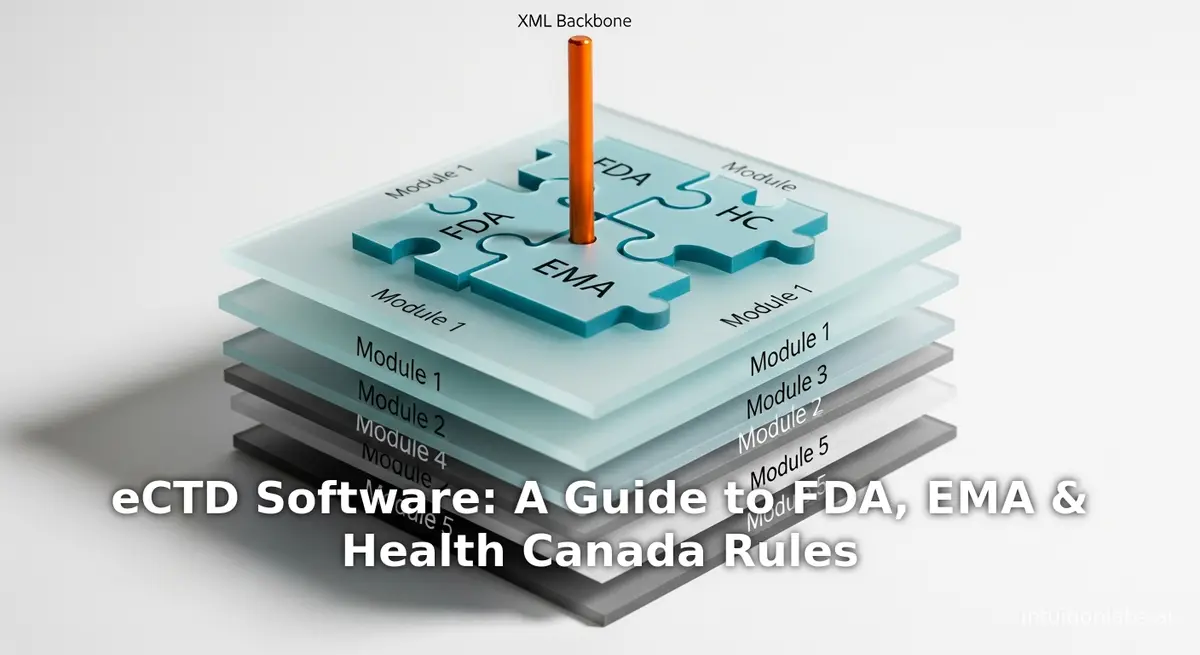
eCTD Software: A Guide to FDA, EMA & Health Canada Rules
Learn the technical requirements for eCTD software submissions to the FDA, EMA, and Health Canada. Updated May 2026 with the latest eCTD v4.0 mandates including Japan's April 2026 cutover.
eCTD Sequence Management: A Guide to Regulatory Submissions
Learn the fundamentals of eCTD sequence management for compliant regulatory submissions. This guide explains sequence numbering, lifecycle operations, and best
eCTD Publishing Process: A Guide to Regulatory Submissions
Learn the complete eCTD publishing process for regulatory submissions. Updated May 2026 with the latest eCTD v4.0 milestones (PMDA mandate Apr 2026, EMA optional Dec 2025, FDA voluntary, ANVISA 2026).