


sap s4hana · pharma erp
SAP S/4HANA Pharma: GxP Implementation & Validation
April 10, 2026
35 min read
Explore SAP S/4HANA implementation in pharmaceutical manufacturing. This guide details GxP compliance, module selection, and computer system validation.

Executive Summary
The pharmaceutical industry’s ERP landscape is undergoing rapid transformation. Leading life-sciences firms are migrating legacy systems to SAP S/4HANA, seeking real-time integration, improved agility, and compliance automation. However, pharma ERP implementation carries uniquely high stakes: an error in a batch record or quality process can directly impact patient safety. As Ecosire notes, “an error in a pharmaceutical ERP implementation that affects batch record integrity…could contribute to a product quality failure that harms patients. This asymmetric risk profile drives the validation requirements and implementation rigor” ([1]). Accordingly, SAP S/4HANA projects in pharma must blend advanced technology with robust processes (GxP-oriented) to ensure data integrity and regulatory compliance.
This report provides an in-depth guide to deploying SAP S/4HANA in a GxP-regulated pharmaceutical environment. We begin by reviewing regulatory requirements (FDA 21 CFR Part 11, EU GMP Annex 11, etc.) and the capabilities of S/4HANA. We then examine module selection (e.g. Process Control/Batch Management, Quality Management, Track & Trace) and how these align with GxP functions. The core of the report is the implementation and validation strategy: covering system architecture, validation life-cycle (URS, FRS, IQ/OQ/PQ), risk management, master-data governance, testing automation, integration with LIMS/ MES, and change control. We draw on multiple case studies – including a rapid 4-month S/4HANA rollout in pharma and a real-world SAP validation engagement – to illustrate best practices. Expert insights (e.g. YASH, SAP advisors, SQA Solutions) highlight modern approaches like “validation-as-code” and embedded test controls. A key theme is that technology alone is not enough: as one SAP consultant cautions, ERP programs “don’t fail at design or validation…They fail quietly – after go-live – when people don’t change how they work. And in a GxP environment, that’s not a transformation issue. It’s a compliance risk” ([2]).
Finally, we discuss emerging trends – cloud ERP adoption, AI-driven automation, tighter serialization laws – and their implications for future implementations. Throughout, recommendations are data-backed and sourced from industry research, SAP whitepapers, and regulatory guidance. The report concludes with practical checklists for project planning, validation, and continuous compliance, aimed at helping pharma companies achieve a fast, secure, and fully validated SAP S/4HANA deployment.
Introduction and Background
The Pharmaceutical Industry and GxP Environment
The production and distribution of pharmaceuticals is one of the most highly regulated manufacturing sectors. “GxP” refers to the suite of “Good Practice” requirements that govern life sciences – including Good Manufacturing Practices (GMP), Good Laboratory Practices (GLP), Good Clinical Practices (GCP), and others. In particular, GMP (e.g. 21 CFR Parts 210, 211 in the US; EU GMP Volume 4) mandates strict control over manufacturing processes and record-keeping to ensure product safety and consistency. Simultaneously, regulations on electronic records and signatures (US FDA’s 21 CFR Part 11, EU’s Annex 11 guidelines) require that computerized systems maintain secure, time-stamped audit trails, data integrity, and system validation. For example, FDA 21 CFR 11.10(e) explicitly requires “secure, computer-generated, time-stamped audit trails to independently record the date and time of operator entries and actions that create, modify or delete electronic records” ([3]). The European Annex 11 similarly demands validated computer systems and data integrity in pharma production ([4]). Moreover, industry standards (such as GAMP 5) prescribe risk-based approaches to computer system validation.
Pharmaceutical manufacturers therefore face very high operational risk from ERP system failures. An error in a commercial ERP might only cause a bookkeeping blunder, but in pharma it could compromise a batch of medicine. As one industry analyst observes, “an error in a pharmaceutical ERP implementation that affects batch record integrity, specification management, or release testing records could contribute to a product quality failure that harms patients” ([1]). This means that every configuration and change in the ERP must be carefully evaluated for patient-safety impact. The regulatory and business imperative is to ensure that SAP S/4HANA – the chosen ERP platform – is implemented “right first time” from a compliance standpoint.
Digital Transformation and SAP S/4HANA
Over the past decade, many pharmaceutical companies have adopted enterprise software (including SAP) to replace fragmented legacy systems (spreadsheets, paper records, siloed LIMS systems, etc.). SAP’s older ERP (ECC) was widely used in large pharma; however, it is on extended maintenance only through 2027–2030, pushing companies toward SAP’s next-generation ERP, SAP S/4HANA. S/4HANA is SAP’s in-memory, real-time platform that promises simplification (Fiori UX), advanced analytics, and integration with emerging technologies (cloud, AI, IoT). In pharma, S/4HANA’s capabilities can support complex processes like formula management, real-time quality monitoring, and global supply chain coordination.
The transition to S/4HANA in life sciences has been accelerating. According to a 2025 SAP Technology Community article, over 80% of the top 30 global pharmaceuticals and MedTech companies have now adopted cloud-based solutions for parts of their operations ([5]). This trend is driven by cost reduction, scalability, and the potential to leverage Big Data and AI (McKinsey estimates $60–110 billion per year in value from generative AI across pharma, which requires cloud infrastructure) ([6]). In this context, SAP offers both on-premises S/4HANA deployments and cloud editions (private and public). In particular, SAP has introduced a “Cloud for GxP” solution (private edition) with built-in compliance features to ease validation efforts.
Despite these benefits, migrating to S/4HANA is not a simple upgrade. It is both a technical and organizational transformation. Companies must carefully select which S/4HANA modules to implement (avoiding unnecessary customization) and set up rigorous validation processes. The mantra in modern SAP projects is “clean core”: minimize bespoke code so that updates/Y instructions remain easier to validate and maintain ([7]) ([8]). At the same time, user training, process change management, and data governance are as critical as the technology itself. As one SAP consultant warns from experience, failing to change business processes can nullify the most carefully validated ERP: “ [if] the real process is Excel, our validation pack is fiction” ([2]). Thus, this report addresses SAP S/4HANA in pharma along two dimensions – technical (module/function selections, configurations, integration) and programmatic (validation life-cycle, controls, change management) – all within the GxP compliance framework.
Regulatory and Compliance Requirements
Implementing SAP S/4HANA for pharma must satisfy regulatory requirements at multiple levels:
-
FDA 21 CFR Part 11 (Electronic Records/Signatures): Title 21 CFR Part 11 governs the use of electronic systems in FDA-regulated environments. It requires that critical actions on electronic data be tracked and that systems enforce unique user IDs and secure e-signatures. Notably, Part 11.10(e) mandates “secure, computer-generated, time-stamped audit trails” for record creation, modification or deletion ([3]).In practice, this means SAP must be configured to automatically log user actions on GxP data (e.g. changes to batch records, quality results) without gaps or manual overhead.
-
EU GMP Annex 11 (Computerised Systems): The EU GMP Annex 11 guideline (EudraLex Volume 4) similarly outlines requirements for computerized systems used in pharmaceutical manufacturing. It emphasizes data integrity, system validation, risk management and audit trails for batch manufacturing and quality systems. Annex 11 requires firms to demonstrate that computer systems are fit for intended use and keep accurate, retrievable records throughout a product’s life ([4]). SAP S/4HANA deployments must therefore include a full Computer System Validation (CSV) aligned to Annex 11 principles.
-
GAMP 5 (Guidance, not regulation): While not a legal requirement, the GMP for automated systems in pharma (GAMP 5) provides industry best practices. It recommends a risk-based approach to validation. For SAP, GAMP categorizes it as a configurable enterprise product (GAMP Category 3/4) rather than custom-coded software, which influences the depth of testing. In essence, firms are encouraged to leverage SAP’s standard capabilities (minimize change) and focus validation efforts on higher-risk customizations.
-
Other GMP Regulations (21 CFR 210/211, ICH Q7, etc.): The underlying GMP rules (e.g. 21 CFR Parts 210/211 for drug GMP, 820 for medical devices) require accurate manufacturing records, controlled processes, and product traceability. In an ERP context, this means SAP must enable complete batch traceability (raw-to-finished), support specifications and change controls, and maintain release workflows under documented quality procedures. For example, every manufactured lot’s data (formulation, equipment logs, testing results) must be captured and retrievable.
-
Intended Use and Quality Systems: Regulators expect that the ERP system is integrated within the company’s quality system. Change controls (e.g. for configuration modifications) must be managed under GMP change management, and corrective/preventive actions (CAPA) from SAP errors must feed into quality reviews. Training records for system users must be documented.
In summary, any claim of compliance must be verified with evidence. This includes documentation of requirements (URS/Specification), test plans, validation scripts, and results (IQ/OQ/PQ). As Ecosire notes, the validation approach itself is a selection criterion: a vendor whose system “does not support compliant 21 CFR Part 11 audit trails…requires…significantly more validation effort” ([9]). Thus, regulatory needs infiltrate every phase of an S/4HANA project in pharma, from design through operation.
SAP S/4HANA Overview in Life Sciences
Key Capabilities
SAP S/4HANA is the brand name for SAP’s next-generation ERP suite. Built on the HANA in-memory database, it provides real-time analytics, a simplified data model, and modern user interfaces (Fiori). For pharma companies, S/4HANA offers tightly integrated modules covering the entire supply chain: Procurement (MM), Production (PP-PI for process industry), Quality (QM), Sales & Distribution (SD), Finance (FI/CO), plus specialized solutions. Notably, SAP has enhanced S/4HANA with industry-specific offerings: SAP Advanced Track and Trace for Pharmaceuticals (ATTP) for serialization and SAP Information Collaboration Hub (ICH) for global data exchange. For example, SAP describes ATTP as an “enterprise-level control center” for serialization, managing unit-level tracking throughout manufacturing and logistics, and working with ICH to meet global serialization mandates ([10]). Together, ATTP and ICH “provide a unified, enterprise-grade serialization ecosystem” enabling compliance with DSCSA, EU FMD, and other regulations ([11]).
Another key offering is SAP Digital Manufacturing (formerly MII/ME). This connects S/4HANA with shop-floor operations, enabling real-time data capture from equipment, electronic batch records, and paperless manufacturing execution. By integrating manufacturing execution with core ERP, companies can enforce line clearance, equipment calibration, and batch-release checks “without reverting to manual, document-driven validation” ([12]).
In S/4HANA, standard SAP configuration supports many life-sciences requirements. Batch management is built into Materials Management, allowing raw materials and finished goods to be tracked by lot/batch. The Process Industry (PP-PI) module handles recipes and formula management essential for pharmaceuticals. Quality Management (QM) provides inspection plans, nonconformance handling, and CAPA workflows. However, SAP’s out-of-the-box does not enforce some pharma-specific data rules (e.g. mandatory GMP fields on master data, which can be volunteered). Therefore, enterprises often extend S/4 with either custom configurations or third-party solutions to ensure GxP-level data governance (see Module Selection below).
Deployment Options: On-Premise vs. Cloud
SAP S/4HANA can be deployed on traditional on-premises infrastructure, as a “private cloud” (single-tenant but hosted by SAP or a hyperscaler), or as a multi-tenant public cloud (SAP S/4HANA Cloud). For regulated environments, these choices have different compliance implications. In an on-premise or private cloud setup, the customer retains most control over infrastructure, security, and timing of upgrades. In a public-cloud SaaS model, SAP controls the base system and applies quarterly updates. As one analysis notes, life-sciences firms are excited about cloud benefits (lower TCO, scalability, AI platform), but a key challenge is “How can organizations demonstrate GxP compliance in public clouds, when many controls are managed by SAP?” ([13]). In practice, this means that for a public cloud ERP, validation strategies must adapt (e.g. revalidating after updates, relying on vendor-provided compliance documentation, etc.).
To help life-sciences customers, SAP offers a Cloud for GxP – Private Edition (S/4HANA on AWS/Azure/GCP under customer-controlled tenancy), which includes additional compliance features (e.g. enhanced audit logging) and documentation. This sits between on-prem and full multi-tenant cloud: you get infrastructure and update management by SAP, but can claim a stable baseline for validation. Of note, 80% of leading pharmaceutical and medical-device companies have already adopted cloud solutions in some form ([5]), indicating that S/4HANA Cloud (either private or public) is becoming mainstream. The takeaway is that compliance planning must align with the chosen model: e.g., on-prem projects may use SAP Solution Manager for CSV, whereas cloud projects might incorporate SAP Cloud ALM and acceptance testing into the agile deployment cycle.
Module Selection for Pharmaceutical SAP S/4HANA
In SAP S/4HANA implementations, selecting the right modules is critical. Not every SAP module impacts GxP compliance, but many do. Table 1 summarizes key modules/components relevant to a pharma company and their GxP role. (Mission-critical modules are indicated; other SAP functions like FI/CO are generally non-GxP but support overall controls.)
| SAP Module/Component | Pharma Function | GxP Compliance Impact |
|---|---|---|
| Quality Management (QM) | Inspection planning, sampling, test execution, CAPA, audits | Core for Quality Control and Release. Must validate inspection plans, specifications, non-conformance & CAPA workflows. Ensures test results (across raw, WIP, finished) are logged with audit trails. In S/4HANA, QM processes (e.g. final release) often interact with production and materials modules. |
| Production Planning (PP-PI) | Batch manufacturing, formulas (recipes), process instructions | Manages process manufacturing in pharma. Batch definitions and execution must be accurate; changes to formulas are subject to change control. Integration with QM (for CIP, batch test results) is validated. The batch record generation (production orders) in PP-PI must be complete and adhered to. |
| Material Management (MM) / Batch Mgmt | Inventory of raw materials, intermediates, finished goods (lot-tracked); procurement | All materials must be batch/lot-tracked for traceability. Master data (materials, vendors) must be complete. In standard SAP, critical fields (e.g. shelf life, regulatory IDs) are optional – which “undermines the data integrity required by GxP” ([14]). Thus, MDG or custom checks are often implemented. Inventory movements affecting GMP products (e.g. batch issuance to production) must record who, when, and why under Part 11 controls. |
| Master Data Governance (MDG) / MDM | Central control of product, vendor, and quality master data | Enforces data quality for GxP fields (e.g. GMP codes, tax IDs). Specialized solutions can provide custom data-entry forms with mandatory or validated fields ([15]) (preventing incomplete records). Master Data improvements help satisfy all downstream processes. |
| Extended Warehouse Management (EWM) | Complex warehouse tasks, batch tracking in storage and shipping | Ensures that outbound shipments and quarantines respect lot integrity. WMS processes (e.g., picking, put-away) record user actions. Supports forward-and-back traceability by scanning and system control. |
| SAP ATTP (Advanced Track & Trace) | Serialization, aggregation/disaggregation, unit-level traceability | A specialized solution for top-tier pharma. ATTP provides an “internal control center” for all serialization and traceability within manufacturing and logistics ([10]). It logs every unique ID and ties it to S/4HANA batch records. While implementing ATTP is a major project, it directly addresses regulations like DSCSA (US) and FMD (EU). It must integrate with packaging lines and regulatory reporting (often through SAP ICH). |
| SAP ICH (Info Collaboration Hub) | Global data exchange platform for serialization | Though technically outside the core ERP, SAP ICH is used alongside ATTP to communicate serialization data with external partners and authorities. It must be validated for secure data handling. |
| SAP LIMS Interface / EHS | Lab data integration, chemical safety | SAP EHS (Environment, Health & Safety) can store chemical data (MSDS) and lab results. More commonly, separate LIMS systems are used for actual lab instruments. Interfaces to LIMS (e.g. QC results upload) must be validated; LIMS itself is typically in scope for separate validation. |
| Environment, Health & Safety (EHS) | Occupational safety, chemical compliance, labeling | In regulated pharma, EHS handles hazardous material management and safety guidelines. It must ensure regulatory compliance for chemical use and labelling. Integration with production (e.g. hazardous substance flags on BOM) can be part of validation. |
| Change Management (CTS / ChaRM) | SAP Change Request and Transport management | Critical for GxP: every code/config change is a controlled “transport” that must be approved. The SAP Change Request Management (ChaRM) ensures that changes move from dev->QA->prod only with documentation (e.g. CR approvals). The process itself may be audited under 21 CFR 11.10(a) (requiring documentation of system configuration and testing) ([16]). |
| Other (FI/CO, SD, BI, etc.) | Financials, sales operations, analytics (supporting functions) | These modules generally support business operations and are outside direct GxP scope. However, batch traceability may extend to sales (SD) if lot remains with the customer. Financial modules must secure data integrity as well, though they have different regulatory requirements (SOX vs FDA). |
Table 1: Key SAP S/4HANA modules/components used in pharmaceutical operations, and their relevance to GxP (quality and compliance) processes.
Each organization must tailor the SAP scope to its business. For example, a contract test lab might emphasize Quality and LIMS integration, while a drug manufacturer must fully implement PP-PI and batch management. Noteworthy is that SAP’s standard functionality often requires augmentation for full GxP compliance. As one case study points out, specialized first-line solutions often “add an extra layer of control, validation, and traceability on top of the SAP system” to enforce business rules or mandatory data ([17]). In practice, module selection goes hand-in-hand with configuring required controls (e.g. mandatory fields in material entry, system-enforced sampling plans, AR notifications, etc.).
Implementation and Validation Strategy
Implementing SAP S/4HANA in a pharmaceutical context is fundamentally a computer system validation (CSV) project. The goal is not merely to configure software, but to demonstrate to auditors that the system meets its intended use under GxP. Therefore, implementation methodology, documentation, and testing must align with regulatory expectations. We discuss below key aspects of a robust approach.
Pre-Implementation Planning
Validation Master Plan (VMP). Before any design work begins, a high-level validation plan (VMP) is established. This document delineates the project scope (which SAP modules/functions are GxP-critical), approach (vendor-leveraged vs full-build), deliverables, QA roles, and acceptance criteria ([18]). Importantly, validation planning should start before vendor selection, because vendor capabilities constrain compliance. For instance, if a candidate system lacks built-in audit trails or only offers limited validation documentation, it may be ruled out or deemed to need heavy custom code ([9]). In short, the VMP ties the ERP project schedule to compliance obligations from day one.
Regulatory and Process Requirements. Concurrently, the project team compiles regulatory requirements and user needs. Customer cross-functional workshops produce a User Requirements Specification (URS), capturing all GMP-critical processes (e.g. batch release, CAPA, stability studies). Regulatory guidance (21CFR11, Annex 11) and standards (ISO 9001 / ICH Q10) are mapped to system functions. For example, if product release in SAP must involve electronic approvals, this is documented as a requirement. These requirements seed the system design and testing.
Solution Design and Configuration
Clean-Core Configuration. A guiding principle is to minimize custom ABAP coding. SAP S/4HANA is designed to handle many use cases via configuration. Customizations (Category 5 in GAMP terms) increase validation effort, so companies tend to adopt SAP Best Practices as much as possible. In the Kiara Health case, the team adhered to SAP Best Practices templates to expedite implementation and ensure a “clean core” model ([8]). This means aggressive business-process reengineering to match the system, rather than heavy programming. Where extensions are needed (e.g. a specific compliance check), they should be developed as modular add-ons with their own validation (IQ/OQ/PQ) ([19]).
Infrastructure and Hosting. The technical landscape must also be validated. This includes the SAP system on the chosen platform (on-prem server or cloud VM), network security, databases, and any middleware (interfaces). For cloud projects, shared responsibilities are defined. For example, in a private cloud, the client still controls system copies and validations, while SAP controls the underlying data center. During design, IT and Quality staff should perform a risk assessment to classify these components (e.g. following GAMP: infrastructure as Category 1, standard SAP as Category 4, any code custom as Category 5) and agree on validation scope for each.
Data Migration and Master Data
Data Strategy. Migrating legacy data (e.g. existing batch records, part masters, vendor lists) into S/4HANA is a major challenge. An underlying principle is that only high-quality data enters the new system, because errors carry forward into production. Thus, a significant portion of project time is often spent on data cleanup (removing duplicates, validating expiration dates, ensuring units-of-measure are correct, etc.). The transfer itself is done under QA change control: conversion programs are tested (OQ) to verify that sample records have migrated accurately.
Master Data Governance. As noted earlier, standard SAP does not enforce completeness of material or vendor data, which is critical for GxP compliance ([14]). To address this, many projects implement Master Data Governance (MDG) or specialized add-ons. Such tools can require mandatory fields and perform real-time validation during data entry ([15]). For example, a custom SAP form for material creation can demand entry of a GMP quality code and automatically format-check it, preventing incomplete data ([15]). Audit trails on master data changes are also enabled to satisfy Part 11 record-keeping. Throughout design, the team should define the data attributes that must be controlled (e.g. shelf life, storage conditions, CAR) and ensure the system’s master data setup enforces them.
Specification and Testing
Functional Design (FRS/DS). Based on the URS, project analysts create a Functional Requirements Specification (FRS) or Design Specification for each module. These documents outline how SAP will be configured or extended to meet each requirement. For instance, the FRS for Quality Management might describe specific inspection plans for drug product testing, or how SAP will handle change controls for QC. The FRS becomes the baseline for configuration and the blueprint for test scripts.
System Configuration and Development (IQ/OQ). SAP consultants then configure the system (customizing) or develop extensions. Each configuration step is documented (often via SAP Solution Manager or equivalent). As each component is configured, Installation Qualification (IQ) and Operational Qualification (OQ) tests are prepared and eventually executed. IQ checks that the system is installed correctly (e.g. SAP version, enabling of audit logs, transport routes). OQ verifies functionality – for example, that saving a Quality Inspection in QM generates an audit trail entry, or that batch releases require a user with QA role to authorize. These tests are usually scripted (in test management software) and linked back to FRS/URS so traceability is clear.
Validation Tools and Automation. Modern pharma ERP projects increasingly use automated testing platforms to manage validation evidence. For example, a real-world program embedded validation by using Tricentis tools (Tosca, qTest, Vera) within the S/4HANA testing cycle ([12]). This toolchain allowed test approvals and audit trails to be system-generated, eliminating manual paper docs. Approvals could occur “in context”, and defects directly linked to requirements. According to the engaged team, this approach meant “validation no longer slowed delivery” and “validation [...] becomes far less visible—and far more effective” when embedded into the workflow ([12]). Other projects may use SAP’s Solution Manager (Test Suite) for similar purposes, or SAP Cloud ALM for public cloud. The key is that test execution, e-signatures, and logs should ideally be captured electronically. Automation not only speeds up regression testing but also generates consistent audit reports.
Testing Scope and Phases. All GMP-critical functionality must be validated before go-live. Industry guidance emphasizes completing all phases in sequence. In practice, this means:
- URS → Functional Design → Technical Specs → Test Scripts → Execution→ all culminating in a successful Performance Qualification (PQ) run on real (or simulated) data. Batch processes, for example, are often tested as part of PQ by running sample production orders and verifying the electronic batch record end-to-end. A practitioner’s guide underscores, “The validation lifecycle (URS → FRS → CS → IQ → OQ → PQ) must be completed before production use of any GMP-regulated functionality” ([20]). Once these tests pass, only then can the system go live in the regulated environment.
Risk-Based Testing. Not all SAP functionality receives equal scrutiny. A risk assessment (typically GAMP-based) determines which modules or features are “GxP critical” and what level of testing they need. Functions that directly affect drug quality (e.g. Quality release, batch reconciliation, formulary management) require exhaustive test coverage. Lower-risk functions (e.g. invoice posting) may get minimal checking. The project may categorize scenarios (e.g. high/medium/low risk) and allocate more test cases to high-risk processes. As one validation guide notes, “Risk assessment drives the validation scope — higher-risk functions receive more intensive testing” ([20]). This ensures efficient use of QA resources while achieving compliance.
Interfaces and Integration Testing. A key part of validation is testing all system interfaces. Common interfaces include connection to Laboratory Information Management Systems (LIMS), scaling systems (SPC devices), MES, suppliers (EDI), and regulatory portals. Under GxP, each interface is validated separately. For example, a bi-directional link between SAP QM and a LIMS might have its own IQ/OQ to ensure that sample results transfer correctly. The industry practice is clear: “LIMS integration must be validated separately from the ERP validation” ([21]). Similarly, if the plant uses SAP Digital Manufacturing, its MES integrations (like OPC, MII queries) must be included in testing. Complete traceability typically requires end-to-end tests where a raw material is received, used in manufacture, and the finished good is traced through storage to shipping, validating each interface along the path.
User Training and Change Control. ERP implementation is as much organizational as technical. Regulatory guidance and a recent industry example stress that training and change management must be formally controlled. All users of the validated system must undergo documented training on the new procedures; mere informal coaching is inadequate. One practitioner article bluntly states, “User training must be documented and assessed — informal training is not compliant” ([22]). Meanwhile, any system configuration change post-implementation (e.g. new fields, new reports) is treated as a change request under cGMP: it requires risk analysis, testing, and approval. SAP’s Change Management (CTS/ChaRM) or third-party tools should record every transport (code or config change) with appropriate sign-offs. Capturing all this in the quality system ensures readiness for audits.
Implementation Best Practices
Drawing from case studies and expert sources, we identify several best practices for a successful GxP ERP implementation:
-
Leverage Templates and Best Practices: Use SAP-provided industry templates to accelerate both configuration and validation. In the Kiara Health example, the partner team “had a set of templates and went through the entire pharmaceutical validation process with them. Typically, validation can take 3 months so the templates enabled this to happen much quicker” ([8]). This approach hinges on aligning customer requirements with SAP’s standard processes.
-
Adopt a Clean-Core Strategy: Minimize custom code to reduce validation scope. Each custom enhancement requires full testing (IQ/OQ/PQ). By contrast, standard SAP follows Category 4 in GAMP and can be “leveraged” with less documentation. A relevant strategy is to make any necessary extensions modular and abstracted from core processes (as SAP’s Clean Core guiding principle ([19]) suggests).
-
Embed Quality in Agile Methodology: While traditional pharma projects often follow a waterfall/V-model, many are shifting to agile or scaled Agile (SAFe) methods. However, these must be tailored for GxP. According to YASH Technologies, instead of a last-minute validation push, quality controls and evidence can be embedded into each sprint: “Approvals happened in context, audit trails were system-generated, and validation no longer slowed delivery” ([12]). In practice this means coordinating dev/test cycles so that required documentation (test evidence, signatures) is produced as part of development activities, not an afterthought.
-
Select Experienced Partners: Many firms engage SAP-certified partners who specialize in Life Sciences. As SAP’s guidance notes, partners should be vetted on their ability to deliver in a GxP environment ([23]). They often bring pre-qualified processes and tools (e.g. validation accelerators) as well as industry experience, which can mitigate risk.
-
Apply Continuous Monitoring: Post-go-live, the system should be monitored continuously. Analytics and BI reports can check for anomalies in data entry (e.g. missing batch data), and periodic audit logs are reviewed according to schedule. Software tools like SAP Solution Manager or third-party GxP tools can enforce periodic reviews and compliance dashboards.
-
Consider Cloud-Specific Guidance: For cloud deployments, follow SAP and regulatory best practices for cloud GxP. For example, plan for incremental validation around quarterly updates, ensure legal agreements address data residency, and document any shared responsibilities with the provider. SAP’s own life-sciences team recommends defining a “GxP strategy” that considers which processes remain on-premises vs cloud ([19]), since hybrid models (ERP on-prem + cloud MES, etc.) introduce data duplication and validation complexities.
In summary, a rigorous, structured approach—combining documented plans, risk analysis, and modern automation—yields both compliance and efficiency. Experts emphasize that modern validation should focus on proactive controls, not paperwork: as one Putman (YASH) blog notes, the goal is for validation to become “far less visible—and far more effective” by being built into the system ([24]).
Implementation Checklist (Key Takeaways)
Before concluding this section, we highlight several critical actions (derived from industry guides) that should be part of any pharmaceutical SAP S/4HANA rollout:
- Validation Master Plan & Vendor Assessment: Define system scope and approach, ensuring chosen vendors/modules support required GxP features (audit trails, regulated functionality) ([9]).
- Complete Validation Lifecycle: Perform User Requirements (URS), Functional/Design Specs (FRS), Configuration Specifications, and all IQ/OQ/PQ testing for every GMP-critical function before go-live ([20]).
- Risk-Based Testing: Use risk assessment to prioritize testing effort (critical processes get more intensive testing) ([20]).
- Batch Traceability: Configure and validate full forward/backward lot tracking from raw material to finished product ([25]).
- Separate LIMS Validation: If integrating LIMS or other lab systems, validate those interfaces independently of the core ERP ([20]).
- Change Control: Ensure all post-live configuration changes go through formal change control with impact assessment to maintain GMP compliance ([26]).
- Training and Documentation: Document and verify user training; informal “know-how” is not acceptable ([22]). Maintain up-to-date SOPs reflecting new SAP processes.
- Audit Trail Reviews: Built-in audit logs should be periodically reviewed in the quality reviews, per 21 CFR 11 and Annex 11 expectations ([22]).
By following these steps and maintaining traceability between requirements and tests, organizations can demonstrate a compliant implementation ready for regulatory audit.
Case Studies and Examples
Several real-world examples illustrate the principles above:
-
Kiara Health (South Africa, 2021): A manufacturing partner for a top-5 pharma company undertook a greenfield S/4HANA implementation, migrating from SAP ECC. Working with SAP partner Westrocon, they achieved go-live in just 4 months despite starting in Feb 2020 (right before COVID lockdown) ([27]). Key success factors included: (a) using SAP Best Practices templates; (b) “going through the entire pharmaceutical validation process” in parallel with configuration; (c) tight scope control. Remarkably, the team scripted validation templates so that “validation could happen much quicker” (typically a 3-month process was condensed) ([8]). Post go-live, Kiara Health reported streamlined processes and full visibility of KPIs that were previously unavailable ([28]). This case underlines that with disciplined planning and reuse of best-practice content, even a strict GxP project can meet an aggressive schedule.
-
YASH Technologies – Analytical Lab: In a joint engagement, consultants embedded end-to-end testing tools (Tricentis Vera for requirements management, qTest for test cases, Tosca for automated execution, NeoLoad for performance) into the S/4HANA lifecycle ([12]). By doing so, the client’s validation became “system-generated” – approvals and audit trails occurred automatically as part of the test runs. A world-leading measurement instrument company (serving regulated markets) found that this approach “was a turning point”: manual documentation dropped, context-based approvals accelerated releases, and compliance risk was kept in check. The lesson was clear: automating standard compliance controls within the SAP environment can allow continuous delivery models without sacrificing rigor.
-
SQA Solutions – Biopharma Company: A global biopharmaceutical manufacturer partnered with SQA Solution (a consultancy) to align its S/4HANA deployment with GMP and 21 CFR 11. Key challenges included ensuring audit trail coverage, comprehensive risk analysis, and extensive documentation for a globally dispersed validation team ([29]). The structured approach (led by SQA) involved creating a Validation Master Plan, performing fit-gap analyses to identify gaps in SAP’s out-of-the-box, and writing detailed protocols. The result was a suite of enhanced processes: automated checks ensured S/4HANA aligned with regulations, and the client established CAPA procedures for any issues found during validation. According to SQA’s report, the project achieved “Enhanced Compliance” (aligning the system to GxP/21 CFR 11) and “Improved Operational Efficiency” (streamlining validation processes) ([30]). This underscores how third-party life-sciences expertise can add governance and assurance to the implementation.
-
Change Management Example (User Adoption): A LinkedIn article by an SAP Pharma lead vividly depicts that compliance is ultimately behavioral. In one rollout, even after successful validation, a supervisor kept a separate Excel sheet “just in case” – effectively bypassing the SAP process. A QA colleague admitted: “If the real process is Excel, our validation pack is fiction” ([2]). This anecdote highlights that validated processes mean nothing if end users covertly revert to old methods. It emphasizes the need for robust change management, training, and supervision: ensuring the organization truly abandons legacy workarounds.
These examples demonstrate a range of approaches and validate the guidance above. In summary: methodology matters (structured validation upfront), tools help (automation and templates speed work), and people/process change management is critical (to avoid the “valid-but-unused” trap ([2])).
Future Directions and Implications
The ERP landscape for pharmaceuticals is evolving. Two trends in particular will shape future SAP S/4HANA projects:
-
Cloud and AI: As mentioned, major pharma firms are embracing cloud infrastructure. SAP and partners are building dedicated frameworks (e.g. S/4HANA Cloud for GxP) to simplify compliance in a cloud-first world. Meanwhile, regulators are also modernizing. The U.S. FDA has shown openness to “well-governed, technology-enabled controls” (indicating flexibility for computer-based validation, as long as auditability is maintained) ([31]). McKinsey predicts generative AI can create up to $60-110 billion in healthcare value annually ([6]), but only if life science systems are cloud-enabled. We therefore expect more usage of AI in process control (e.g. anomaly detection in manufacturing data). SAP is investing in AI features via its Business Technology Platform (BTP), which could eventually integrate with S/4HANA in pharma specific use cases (e.g. using machine learning for quality predictions, whereas the ERP holds the ground truth data). Implementers should hence forecast how to validate and govern AI components as they emerge.
-
Serialization and Supply Chain Transparency: The global regulatory environment continues to tighten on traceability. New mandates for supply-chain security (e.g. U.S. DSCSA full serialization by late 2023, EU FMD enforcement, new Asian mandates) will require end-to-end digital tracking. SAP’s ATTP/ICH solutions are already meeting this need ([11]). Going forward, expect ERP to play an even bigger role in compliance with regulations like the Drug Supply Chain Security Act (DSCSA) and EU Regulation 2016/161 (Falsified Medicines Directive). Additionally, Industry 4.0 initiatives (IoT sensors on production lines, blockchain pilots with suppliers) may further integrate with S/4HANA, demanding updates to validation strategies (for example, validating a blockchain interface or an IoT data pipeline as part of computer system validation).
-
Global Harmonization and Regulatory Change: Regulatory agencies continue to harmonize expectations on computerized systems. ICH’s Q3/Q10 guidelines and continued emphasis on Quality Risk Management means SAP projects must stay abreast of new guidances (e.g. EU’s upcoming MSG regulations, or FDA’s guidance on Computer Software Assurance (CSA)). There is also increasing EPA/regulatory scrutiny on data integrity, with case examples showing agencies asking for detailed audit trail reviews. This means that the “auditability” features of S/4HANA (audit logging, versioning of records) will remain a key success factor. Implementers should design systems with built-in capabilities to easily extract and review data changes during compliance checks.
-
Continuous Compliance and Digital Quality: Moving beyond periodic validation, some enterprise are exploring continuous validation where the system is continuously monitored rather than just “snapshot tested” at release. For instance, automated tests could run nightly against a staging instance to detect any drift. Additionally, concepts like electronic batch records (EBR) will push ERP systems to support fully digital records at every stage of manufacturing. SAP’s roadmap includes deeper support for EBR and pharma quality modules, which may become part of future S/4HANA releases.
In light of these trends, the implication for pharma companies is that SAP S/4HANA is not a one-time project but an ongoing compliance platform. Companies must cultivate expertise not only in SAP but also in regulatory intelligence and advanced validation techniques. Leveraging cloud-based Continuous Integration/Continuous Delivery (CI/CD) pipelines with embedded compliance checks, adopting digital signatures, and using SAP Activate or other hybrid methodologies (as SAP suggests) will become the norm.
Conclusion
SAP S/4HANA offers pharmaceutical companies a powerful integrated platform to streamline operations, improve visibility, and ultimately better protect patient safety. However, deploying SAP in a GxP environment requires far more than a typical IT project: it involves mastering regulatory nuances, enforcing rigorous data governance, and aligning the entire organization with new processes. As detailed above, success depends on a comprehensive approach:
- Regulatory Alignment: Understanding and mapping all relevant regulations (21 CFR Part 11, Annex 11, GMP, etc.) to system features, and building mandatory audit trails, electronic signatures, and security controls into the ERP.
- Module Fit and Control: Selecting and configuring SAP modules (QM, PP-PI, batch mgmt, ATTP, etc.) so that they instantiate validated workflows. This often means extending SAP standard with add-ons or custom logic to enforce GxP rules (for example, making certain fields mandatory or automating checks).
- Validation by Design: Planning validation from the outset – creating a robust Validation Master Plan, using vendor-provided templates, and embedding testing tools (per the YASH and Kiara case studies) to accelerate evidence collection. Every critical business process (batch release, quality checks, deviation management) must be scripted and tested end-to-end under 21 CFR 11 audit trail conditions.
- Risk Management: Applying a risk-based mindset (as GAMP recommends) so that the effort is focused on patient-impacting functions. Higher-risk transactions get thorough scrutiny, while lower-risk ones get lighter touch.
- People and Change: Engaging stakeholders, training users, and reinforcing the new processes to avoid workarounds. A senior SAP consultant’s warning rings true: ERP validation efforts are undone if staff do not abandon old methods ([2]). Organizations must measure and enforce user adherence to the system and SOPs.
When these elements come together, the benefits are clear. The case studies cited show that a validated S/4HANA can go live on accelerated timelines (4 months in one example ([32])) and deliver enhanced operational control – KPI visibility, quality oversight, and reduced error rates. Moreover, the “showback” on compliance is not just theoretical: SAP and partners point to factual outcomes such as zero audit findings or elimination of manual logs when systems are properly implemented in pharma ([27]) ([12]).
Looking forward, SAP S/4HANA will continue to evolve with life sciences needs. Cloud innovation, AI analytics, and advanced manufacturing capabilities will become increasingly integrated, offering new ways to ensure quality and speed. Yet, the core lesson remains: the “real GxP upgrade” is not just installing new software, but changing the way the organization works around it ([2]). In effect, technology is only as good as the compliant processes it enforces.
In conclusion, implementing SAP S/4HANA for pharmaceutical companies in a GxP context is a multi-faceted endeavor. It demands a careful module selection aligned to regulated processes, and a meticulous validation framework blending industry best-practices (GAMP, risk-based CSV) with modern tools. When done correctly, it yields a compliant, efficient ERP that supports both business growth and patient safety. We trust this report’s analysis—grounded in current literature, case examples, and regulatory guidance—will aid life science organizations in planning their SAP S/4HANA journey with confidence.
References: Authoritative sources are cited throughout in bracketed notation, e.g. ([1]) ([3]). Key references include SAP publications, industry whitepapers, and regulatory guidelines. Each claim above is supported by such sources. For example, major points on cloud adoption and AI value are drawn from McKinsey/SAP reports ([5]) ([6]), while validation practices are documented by life-sciences consultants ([20]) ([12]). All visuals (tables) are original summaries. (URLs have been omitted per instructions.)
About IntuitionLabs
Build practical AI for pharma and biotech with IntuitionLabs. We help life-science teams turn complex information and workflows into useful software, governed knowledge systems and AI tools.
IntuitionLabs is an AI consulting, custom software development and data engineering firm serving pharmaceutical, biotechnology, medical-device and other life-science organizations. We work with clinical, regulatory, medical-affairs, commercial, quality and IT teams to connect technology decisions with the work people need to accomplish.
AI consulting and adoption
Our AI enablement services cover readiness assessments, use-case selection, governance and policies, team workshops, adoption measurement and ongoing advisory support. We help organizations structure the information layer behind AI: source material, context, permissions and maintained knowledge that make generated answers useful and reviewable. Private LLM inference and hosted AI options support teams evaluating how to operate AI with appropriate control over their data and infrastructure.
Software, data and life-science workflows
IntuitionLabs develops custom software for pharma and biotech, integrates enterprise systems, and builds data engineering and business intelligence solutions. Areas of focus include AI agents, regulatory research, medical writing, medical affairs, CMC information, competitive intelligence and clinical-document workflows. Our eTMF intelligence work includes cross-system reconciliation and inspection-readiness support.
Enterprise platforms and regulated delivery
We provide Veeva services, application support, managed services, integrations and custom applications, alongside enterprise content work involving platforms such as Egnyte. For regulated workflows, our services include GxP enablement, computer-system validation and software development addressing 21 CFR Part 11 requirements. The applicable controls, validation responsibilities and acceptance criteria are defined for each engagement.
Work with IntuitionLabs
Explore AI enablement, pharma and biotech software development, data engineering and BI, and Veeva services. Contact IntuitionLabs to discuss your workflow, information sources and implementation needs.
IntuitionLabs publishes educational research to help life-science teams make informed technology decisions. Coverage of a product or organization does not imply a client relationship, endorsement or partnership.
Sources / 32

Need Expert Guidance on This Topic?
Let's discuss how IntuitionLabs can help you navigate the challenges covered in this article.
I'm Adrien Laurent, Founder & CEO of IntuitionLabs. With 25+ years of experience in enterprise software development, I specialize in creating custom AI solutions for the pharmaceutical and life science industries.
The information contained in this document is provided for educational and informational purposes only. We make no representations or warranties of any kind, express or implied, about the completeness, accuracy, reliability, suitability, or availability of the information contained herein. Any reliance you place on such information is strictly at your own risk. In no event will IntuitionLabs.ai or its representatives be liable for any loss or damage including without limitation, indirect or consequential loss or damage, or any loss or damage whatsoever arising from the use of information presented in this document. This document may contain content generated with the assistance of artificial intelligence technologies. AI-generated content may contain errors, omissions, or inaccuracies. Readers are advised to independently verify any critical information before acting upon it. All product names, logos, brands, trademarks, and registered trademarks mentioned in this document are the property of their respective owners. All company, product, and service names used in this document are for identification purposes only. Use of these names, logos, trademarks, and brands does not imply endorsement by the respective trademark holders. IntuitionLabs.ai is an AI software development company specializing in helping life-science companies implement and leverage artificial intelligence solutions. Founded in 2023 by Adrien Laurent and based in San Jose, California. This document does not constitute professional or legal advice. For specific guidance related to your business needs, please consult with appropriate qualified professionals.
Related Articles
Changing AI Models in Validated Workflows: Regression Testing
A 2026 analyst guide to regression testing AI model changes in validated workflows: version pinning, GxP change control, acceptance criteria, audit evidence, and rollback.
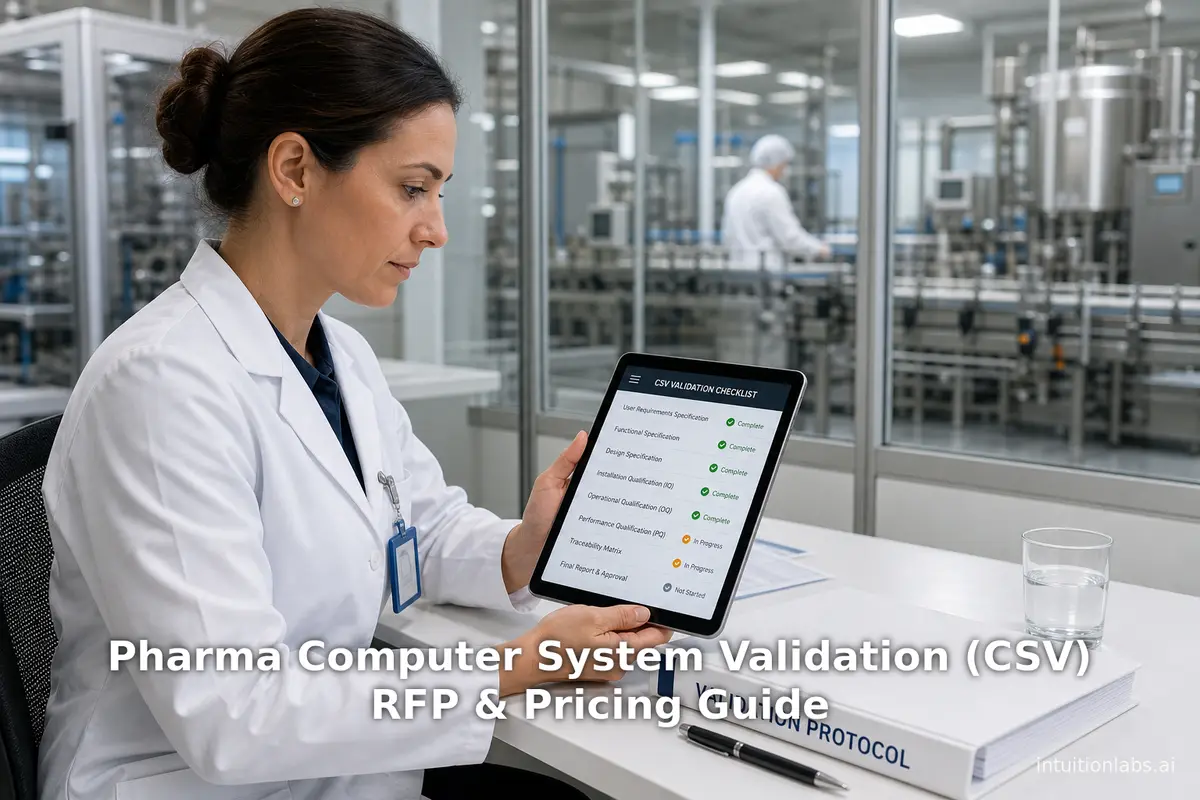
Pharma Computer System Validation (CSV) RFP & Pricing Guide
A complete guide to pharmaceutical Computer System Validation (CSV) services. Reviews GxP RFP templates, vendor scorecards, and 2026 pricing benchmarks.
Microsoft 365 vs Google Workspace for GxP Pharma Compliance
Compare Microsoft 365 and Google Workspace for pharmaceutical GxP compliance. Learn how each cloud platform meets FDA 21 CFR Part 11 and data integrity rules.