


pharma mes · electronic batch records
Pharma MES & eBR Software Guide for GMP Manufacturing
March 2, 2026
70 min read
Review commercial software solutions for GMP-compliant manufacturing. Compare pharma MES, electronic batch records (eBR), and ERP systems for 21 CFR compliance.

Executive Summary
Pharmaceutical and biotech manufacturers – including large pharma, emerging biotech, and contract manufacturing organizations (CDMOs/CMOs) – face stringent Good Manufacturing Practice (GMP) and regulatory requirements (e.g., FDA 21 CFR Part 11, EU GMP Annex 11, GAMP5) in their production operations. In response, a broad ecosystem of commercial software solutions has emerged to provide GMP-compliant manufacturing execution capabilities, especially for complex processes like custom assembly, kit preparation, sterile compounding, and electronic batch records (eBR). These solutions span dedicated pharmaceutical Manufacturing Execution Systems (MES), standalone electronic batch record (EBR) platforms, industry-specific ERP systems, and integrated Quality Management/Document Control systems with MES features.
This comprehensive report surveys these solutions, detailing for each: vendor, product name, key features, deployment options (cloud, on-prem, hybrid), pricing models, target users, compliance and validation support, integration capabilities, and case study evidence. We cover legacy large-scale MES (e.g. Werum PAS-X, Rockwell PharmaSuite, Siemens Opcenter, Emerson Syncade, Honeywell POMS, GE Proficy), modern life-science MES (e.g. MasterControl Manufacturing Excellence, Apprentice, Tulip), pure EBR platforms (e.g. Aizon Execute, Vimachem EBR), pharmaceutical ERP offerings (e.g. SAP S/4HANA, Oracle Cloud, Infor CloudSuite, BatchMaster, SYSPRO, ProcessPro), quality/QMS platforms that add MES-like shopfloor functions (e.g. Veeva Vault Quality/Batch Release, MasterControl Manufacturing Excellence, dōT Compliance, Qualio, ETQ Reliance), and emerging SMB/MRP solutions (e.g. Katana MRP, MRPeasy, Fishbowl, Cin7). We also examine low-code platforms (Tulip, Mendix, OutSystems) as enablers for custom digital shop-floor apps.
Key findings: pharmaceutical MES and EBR adoption is driven by the need to eliminate error-prone paper records, ensure full data traceability and audit readiness, speed batch releases, and enable “review by exception” (as advocated by EY experts ([1])). Market analysts project a strong CAGR, hitting multi-billion-dollar scale by 2030. Notably, in a CDMO case study (AGC Pharma, manufacturer of small-molecule APIs), thousands of paper batch records (with hundreds of thousands of manual entries involving ~150 employees) are being digitized with EBR, significantly reducing labor and error risk ([2]). In another example, Werum’s PAS-X MES was implemented in <6 months for PT Dankos Farma (Kalbe Pharma group, Indonesia) to automate weighing/dispensing and integrate in-process checks, yielding ‘right-first-time’ operations and enabling future eBR (“paperless”) rollout ([3]).
We find that enterprise MES suites (Werum PAS-X, Rockwell PharmaSuite, Siemens Opcenter, Emerson Syncade, Honeywell POMS, GE Proficy) are deep, highly configurable systems targeting large global firms and CDMOs. They are typically deployed on-premises (often with cloud or hybrid options), are sold via quotes/perpetual licenses, and require extensive validation. These support full MES and eBR workflows: Master Batch Records, audit trails, electronic signatures tied to QA approvals, change controls, calibrated equipment logs (including sterile processing cycles), material pick lists, labeling, CAPA/deviation links, and batch costing. They are explicitly 21 CFR Part 11 and Annex 11 compliant, and vendors provide GAMP5 category definitions and validation documentation. For instance, Rockwell’s PharmaSuite “provides role-based optimization” for each lifecycle stage and helps “adhere to regulatory compliance guidelines” ([4]); Siemens Opcenter Execution Pharma “streamline [s] fully compliant manufacturing execution” consistent with FDA and GMP ([5]).
Mid-market MES/EBR solutions (MasterControl Manufacturing Excellence, Apprentice, Tulip) offer similar GMP features but with more flexible, cloud-native architectures and often faster implementations. MasterControl Mx (Manufacturing Excellence) is a cloud MES focused on life sciences, with integrated eBR, equipment tracking, and built-in validation tools, marketed to companies from clinical through commercial scale ([6]). Apprentice.io provides a “no-code” cloud MES enabling users to build dynamic, AI-accelerated batch record workflows and capture data electronically at the line. Tulip Interfaces, a low-code MES platform, positions itself as “GxP-aligned” for regulated industries, with visual workflow editors for eBR/digital logbooks and integration via open APIs. These offerings typically use subscription pricing (per user or per facility) and support SaaS or hybrid deployment. For example, the MRPeasy eBR solution targets smaller outfits: its pricing starts ~$49–$69/user/month and provides lot traceability, expiry tracking, and digital batch log generation ([7]).
Pharma-capable ERPs (SAP S/4HANA, Oracle Cloud, Infor CloudSuite Life Sciences, BatchMaster, SYSPRO, ProcessPro) supply end-to-end solutions including MRP, batch production, and quality modules. These handle bill-of-materials revisions, formulation tracking, COA generation, traceability and audit trails. SAP and Oracle offer broad industry suites with life sciences content; many features in these systems support CFR 21 compliance (e.g. SAP’s Audit Trail functionality, Oracle’s Life Sciences ERP). BatchMaster (a leading process-ERP vendor) explicitly advertises compliance with CFR 21 Part 11 via “enforced SOP-based operations, audit trails, and electronic signatures” ([8]), plus features like potency calculations, FEFO inventory with expiration, label printing, stability testing, certificate-of-analysis management, and batch costing ([8]) ([9]). BatchMaster can be deployed on-premise or cloud and is typically priced by seat or functionality. SYSPRO and ProcessPro can be configured for regulated manufacturing with lot control and traceability, though fewer details are publicly available.
Quality/QMS platforms with MES capabilities are gaining traction. Veeva Vault Quality Cloud (including Vault QMS, QualityDocs, and the newly launched Vault Batch Release) provides life-science content management and batch release workflows. Vault Batch Release automates aggregation and sign-off of batch documentation by exception ([10]). MasterControl’s QMS suite can be extended with Manufacturing Excellence for batch records. Platforms like dōT Compliance and Qualio (originally eQMS for medical devices/biotech) now often support digital batch logs and integration with production data. ETQ Reliance (now part of Hexagon) offers extensive quality apps (document control, CAPA, etc.) with integrations to ERP/automation. These solutions are entirely cloud-based, with per-user or subscription pricing, and aim at mid-sized biotech/pharma firms. For instance, Qualio emphasizes “purpose-built eQMS for pharma” with FDA/GxP compliance and mentions integrated document and batch record control ([11]).
Mid-market MRP/inventory solutions (e.g. Katana, Fishbowl, Cin7) generally target smaller manufacturers and focus on core production planning, inventory tracking, and sales integration rather than full GMP compliance. Two notable examples have begun adding pharma-friendly features: Katana MRP (cloud MRP) offers BOM management, lot tracking, and multi-language support, with apps for traceability and expiry control. MRPeasy (cloud MRP) includes lot/serial traceability and auto batch record generation ([12]), and its pricing starts at $49–$69/user/month ([7]). Fishbowl Inventory (inventory/MRP for SMB) markets directly to pharma, touting “FEFO logic, barcode integration, material genealogy and expiry management” on its website ([13])([8]). Fishbowl’s cloud offering starts at $229/month (Essentials, 2 users) up to $429/month (Growth tier, 5 users) ([14]) ([15]). These solutions are often SaaS with per-user pricing, and are best for lower-volume production; strict 21 CFR compliance features may be limited or require additional configuration. Cin7 and Acumatica (with manufacturing modules) are other cloud ERPs extending into manufacturing and inventory, but are rarely pharma-specific out-of-box.
Low-code platforms (Tulip Interfaces, Siemens/Mendix, OutSystems) are also used in pharma manufacturing. They provide frameworks to build custom MES/eBR applications. For example, Tulip offers GMP-compliant templates and drag-and-drop workflows; Siemens Molded AG leveraged Mendix to create digital lab/pharma apps, and OutSystems has showcased pharmaceutical automation (e.g. TTMS’s case study of a diagnostics manufacturer building various apps ([16])). Pricing for low-code platforms is typically per app or per developer seat, often requiring TM through enterprise licenses.
Across all categories, core features sought by pharma are: electronic batch records (EBR) and logbooks, robust audit trails (timestamped and immutable), electronic signatures (with context such as production/QA approval), document lifecycle controls (SOP management, review/approval), configurable role-based access, revision-controlled BOMs, full lot and expiry tracking (often with COA integration), serialization/barcode label printing, digital capture of sterility/cleanroom logs (e.g. autoclave cycles recorded with validation), material requisition/pick lists, interfaces to ERP/WMS (via API, EDI, or file transfer), and integrated quality processes (CAPA, deviations). Many solutions also offer built-in analytics/dashboards for batch trends, SPC, OEE, and regulatory reporting. For instance, BatchMaster advertises “track real-time batch costs… identify inefficiencies and increase margins” ([9]), underscoring the business efficiency angle.
Regulatory Compliance & Validation: All solutions targeting pharma emphasize 21 CFR Part 11 and EU Annex 11 support. Vendors provide audit tail functionality, secure user authentication (often with SSO/Active Directory integration), e-signature manifest per CFR (signer identity, timestamp, intent, purpose), and encrypted/electronic records copies. Many come with (or can be delivered with) GAMP5-based validation documentation (URS/FDS, DQ, IQ/OQ/PQ protocols, risk assessments). For example, many platforms are validated as GAMP Category 4 or 5 (customized packaged software), with vendor IQ/OQ scripts and templates. Several vendors offer “pre-validated” or rapid-deployment options for faster qualification: Vimachem advertises its EBR solution as “pre-validated for rapid deployment” (reducing implementation by 2+ months) while ensuring 21 CFR-compliant data integrity ([17]) ([18]). Veeva Vault is itself a 21 CFR Part 11 certified platform as a cloud service. EU data residency (e.g. servers within EU) is provided by solutions from large providers (e.g. SAP, Veeva, Siemens, Werum, Infor) if requested for EU GMP compliance. Multi-language support is common in global systems (MasterControl, BatchMaster, Katana and MRPeasy all list multi-language interfaces).
Pricing and Deployment: Pricing models vary widely. Large enterprise MES/QMS suites (PAS-X, Syncade, PharmaSuite, Infor, SAP) are typically quote-based, multi-year licenses (often perpetual or subscription with annual maintenance). These run on-premises or private cloud (some offer SaaS/hosted options for smaller customers). Midmarket vendors often use SaaS subscription, priced per user or by module. For example, MRPeasy lists $49–$69/user/month (Starter vs Professional) ([7]), Fishbowl at $229–$429/month for 2–5 users ([14]) ([15]), and Qualio and Veeva are also per-user subscriptions (often five figures annually for midsize deployments). Low-code platform fees depend on development user count or monthly active users, often beyond standard MES costs. On-premises implementations require separate server and IT costs.
Target Market: Enterprise-heavyweights like Werum PAS-X, Rockwell PharmaSuite, Siemens Opcenter Execution Pharma, and Oracle ERP serve large pharmaceutical companies and major CDMOs. MasterControl, Apprentice, and Veeva pitch to the entire life-science market (from biotech SMEs scaling up to multinationals) with flexible cloud solutions. Mid-market solutions (BatchMaster, SYSPRO, Katana, Fishbowl, MRPeasy) target smaller pharmacies, biotech/formulation companies, and serial CMO lines with simpler needs. Quality-lean firms may adopt platforms like Qualio or dōT Compliance (often funded by investors) that provide rapid setup (~weeks to months) and an agile interface.
Case Studies: Numerous real-world examples illustrate these trends. In addition to the Werum/Kalbe case mentioned, an EY-sponsored article highlights the power of “review by exception” in eBR/MES to shorten QA release cycles ([1]). AGC Pharma Chemicals (CDMO) is digitizing thousands of batch records, eliminating hundreds of thousands of manual entries ([2]). Veeva cites life science customers who integrated Vault QMS with shop-floor data to accelerate audits.
Implementation Timelines: Projects can range from months to >1 year. A typical mid-sized MES rollout (including validation) might take 3–9 months; larger multi-site SAP/Oracle or PAS-X deployments often require 9–18 months or more. The Dankos PAS-X example was completed in under 6 months ([3]), reflecting Factorytalk/ Werum’s agile local execution. Vendors often provide pre-engineered configurations or phased rollouts (e.g. start with warehouse and dispensing, then expand to full eBR). Accelerated “config-as-services” options can cut project time.
Vendor Profiles: Many vendors are well-established in life sciences. For example, MasterControl (founded 1993) has 1,200+ life science customers globally and offers integrated quality/manufacturing modules. Werum IT Solutions (now Körber Pharma) has decades of expertise in licensed MES (PAS-X was first released in the late 1990s). Rockwell Automation and Siemens (tech conglomerates from the 19th/20th centuries) derived their pharma MES from larger automation portfolios. Emerson Electric (Syncade) and Honeywell (POMS) similarly leverage decades of process control/PT capabilities. Newer entrants include Apprentice (founded ~2019 in Boston), Tulip (founded 2014), Aizon (founded 2018, Spain, now backed by Siemens/Technoflex), and Qualio (founded 2012, San Francisco). Veeva Systems (founded 2007) is publicly traded and focused entirely on cloud life-science software. BatchMaster (2002, California) and Fishbowl (2001, now part of Acumatica) target process manufacturers. Mendix (2005, Netherlands) is a Siemens subsidiary for low-code apps.
Future Directions: Digital transformation is intensifying in pharma manufacturing. Trends include AI-driven analytics on MES data, “connected worker” apps (mobile eBR), more cloud-native deployments, and convergence of QMS/MES data. Industry 4.0 initiatives (smart factories) are promoting deeper equipment integration (e.g. real-time monitoring of autoclave cycles and environmental sensors feeding directly into batch records). Regulatory guidance (like FDA’s 2022 draft on data integrity) encourages risk-based approaches and could spur simpler digital tools. Vendors are increasingly offering pre-configured templates for specific segments (e.g. aseptic filling, cell&gene therapy). Low-code and no-code platforms may empower smaller firms to build custom compliance workflows without huge IT projects. Meanwhile, consolidation (like Siemens and Werum, Hexagon with ETQ, Acumatica acquiring Fishbowl) is concentrating offerings.
In conclusion, the pharmaceutical MES and eBR software landscape is rich and specialized. Companies should evaluate solutions not only on functional fit (MBR/EBR capability, traceability, flexibility) but also on compliance assurances (21 CFR/Annex 11, GAMP5 documentation), deployment preferences, and costs. For high-volume GMP operations, dedicated MES suites (PAS-X, PharmaSuite, Opcenter, etc.) remain gold-standard. For agile or smaller operations, cloud-first MES/EBR (MasterControl Mx, Apprentice, Veeva, MRPeasy) offer rapid deployment with easier maintenance. Crucially, successful implementations combine robust software with process re-engineering – after all, “if it wasn’t written down in a batch record… it didn’t happen” ([19]). The shift from paper to digital records is underway across the industry, improving quality and compliance as manufacturers scale up complex pharma and biotech production.
Introduction and Background
Pharmaceutical manufacturing is one of the most heavily regulated industries worldwide. Good Manufacturing Practices (GMP) require exhaustive documentation, traceability, and control over every step of drug and biologic production. Traditional paper batch records and manual logs have long been recognized as bottlenecks: they are labor-intensive, error-prone, and slow. A 2021 case study with AGC Pharma Chemicals (a CDMO of APIs) highlighted that an FDA-inspected plant was generating thousands of paper batch records each year, requiring “hundreds of thousands of manual entries” across ~150 personnel ([2]). Eliminating transcription errors and improving traceability were urgent priorities. As one industry expert summarized, “Recordkeeping is critical…in the tightly regulated pharma space, [batch records] are almost as important as the product itself” ([19]). Regulatory bodies affirm this: “if it wasn’t written down in a batch record… it didn’t happen” ([19]).
Against this backdrop, digital manufacturing execution systems (MES) and electronic batch record (EBR) solutions have become essential. A proper MES integrated with production controls and ERP enforces process controls, captures data electronically at the shop-floor, and automates reviews (FDA favors “review by exception” methodologies ([1])). It ties together master batch recipes, equipment status, material inventories, and quality checks, ensuring GMP compliance (FDA 21 CFR Part 11, EU Annex 11) from raw materials to final product release. The goal is “paperless manufacturing” with end-to-end traceability.
Historically, MES evolved from factory automation in the 1990s, but in pharma they only took off in earnest in the 2000s. Early adopters were mostly large biotech and CDMOs (e.g. Genentech, Lonza) seeking to improve yield, quality (right-first-time performance), and audit readiness. Over the last decade, innovation accelerated: life-science-specific MES suites now often operate software-as-a-service (SaaS), embed data analytics, and sometimes leverage AI for anomaly detection. This shift is reflected in a growing market: according to MarketsandMarkets, the global pharmaceutical MES market is projected to reach ~$4.62 billion by 2030, expanding at a double-digit CAGR ([20]). (Even higher figures are quoted by some industry analysts, reflecting broad “digital manufacturing” trends).
We also see segmentation by company size and product type. Large brand-name pharma and top-tier CDMOs tend to deploy comprehensive on-prem MES solutions (Werum’s PAS-X, or Siemens/Emerson through their affiliates). Mid-size companies, biotech firms, and CMOs often adopt cloud-based MES/EBR or agile ERPs with built-in compliance (MasterControl Mx, Veeva Vault, BatchMaster, etc.) due to lower upfront costs and simpler validation. Small startups or niche manufacturers might use off-the-shelf MRP/inventory software (Katana, MRPeasy, Fishbowl) and retrofit cheap digital workflows where needed. Many software providers now position themselves explicitly on this maturity continuum. For example, BatchMaster’s “Pharma ERP” page emphasizes a “secure, scalable cloud platform” that can “ensure compliance with FDA 21 CFR Part 11 and cGMP” ([8]). County-level or regional regulatory pressures (e.g. EU requiring data residency) further influence deployment choices (leading big vendors to offer localized cloud hosting).
In sum, GMP-compliant manufacturing execution encompasses a broad category of systems [see Table 1] including:
- Pharmaceutical MES Suites: Full-featured systems that control and monitor batch production across multiple sites. E.g., Werum PAS-X, Rockwell PharmaSuite, Siemens Opcenter Execution Pharma, Emerson Syncade, Honeywell POMS, GE Proficy MES. These often come from industrial automation firms and provide deep batch execution, quality integration, and regulatory controls.
- Life-Science MES/eBR Platforms: Modern, often cloud-first solutions specifically built for pharma. E.g., MasterControl Manufacturing Excellence, Apprentice.io, Aizon Execute, Vimachem eBR, Tulip Interfaces. These emphasize graphical workflows, SaaS deployment, and rapid configuration.
- Industry ERPs with Pharma Modules: Comprehensive ERP systems offering manufacturing modules for the process industries along with compliance tools. E.g., SAP S/4HANA (with a Life Sciences sector solution), Oracle Cloud ERP (Life Sciences edition), Infor CloudSuite (Food & Beverage / Life Sciences), BatchMaster ERP (Pharma Edition), SYSPRO, ProcessPro, Aptean Ross, etc. They provide tighter integration of procurement, inventory, production, and finance.
- Quality/Document Management Systems: Cloud QMS with extensions into manufacturing workflows. E.g., Veeva Vault Quality (with Batch Release), MasterControl QMS (with Manufacturing Excellence module), dōT Compliance (UK-based eQMS), Qualio (fast-growing eQMS). These are primarily for QMS (documents, CAPA, training) but increasingly include eBR or work instruction capabilities, sometimes via out-of-the-box “manufacturing QA” app.
- Mid/Small MRP Solutions: Generic manufacturing software adapted by small pharma makers. E.g., Katana MRP, MRPeasy, Fishbowl Inventory, Cin7. These handle BOMs, inventory with lots/expiries, and basic reporting — sufficient for low-volume costume assembly or packaging operations.
- Low-Code Platforms: Application development platforms (Mendix, OutSystems, Tulip) with pharma templates or accelerators. These platforms can be used to build custom MES/eBR apps (e.g., interfacing to PLCs or barcode scanners) without programming, offering high flexibility.
Table 1: Representative Software Solutions for GMP MES and eBR in Pharma (selected examples by category). (See subsequent detailed sections for each product’s specifics.)
| Category | Product / Suite | Vendor | URL | Deployment | Pricing | Target Market | Notable Features (selected) |
|---|---|---|---|---|---|---|---|
| MES Suites (Large Pharma) | PAS-X MES Suite | Körber (Werum) | [21] | On-prem/Cloud/Hybrid | Quote-based, enterprise | Global pharma, CDMOs | Full MBR-driven MES, ERP/WMS integration, audit trails, role-based ops, multi-site standardization. EBR option. (Implemented in ~6 months at Kalbe ([3])) |
| FactoryTalk PharmaSuite | Rockwell Automation | [22] | On-prem/Cloud | Quote-based | Pharma, biotech | Batch & discrete MES, FDA-compliant, role-based UX, standardized recipes. Includes QS for lifecycle stage optimization ([4]). | |
| Opcenter Execution Pharma | Siemens Digital Industries | [23] | On-prem/Cloud | Quote-based | Pharma, biotech | MBR-driven workflows, automates SOPs and QA mgmt. “Streamline batch manufacturing processes… fully compliant with FDA/GMP” ([5]). | |
| Syncade MES (Electronic Batch Mgmt) | Emerson | [24] | On-prem | Quote-based | Pharma, biotech | MES for sterile/pharma ops, focus on autosystems integration, paperless EBR, batch/lot tracking. (Used in biopharma pilot projects). | |
| POMS (Pharma Operations Mgmt Suite) | Honeywell | [25] | On-prem/Cloud? | Quote-based | Pharma, biotech | Suite comprising batch management, lab integration, analytical data capture. Emphasizes operational excellence and regulatory compliance. | |
| Proficy MES | GE Digital | [26] | On-prem/Cloud | Quote-based | Pharma, biotech | MES and OEE solution for biotech and pharma. Batch scheduling, historian integration. (Derived from GE Proficy/Predix platforms.) | |
| Life-Science MES/eBR | Manufacturing Excellence (Mx) | MasterControl | [27] | Cloud/Hybrid | Quote-based | Life sciences (mid→ent) | CloudMES with full eBR/logbook, instrument calibration logs, AI-driven insights. Patent-pending “validation tools” reduce deploy time ([6]). |
| Apprentice MES (EBR) | Apprentice Labs | [28] | Cloud (SaaS) | Quote-based | Pharma, biotech (all sized) | Auto-digitalization of batch procedures, no-code recipe templates, parallel logic. Emphasizes AI assistance to “accelerate” batch workflow digitization. | |
| Tulip MES | Tulip Interfaces | [29] | Cloud, Edge | Subscription | Pharma, medical device | Low-code MES platform. “GxP-aligned” app store for manufacturing workflows. Flexible integration (API/OPC UA), drag-drop UIs, mobile operator apps. | |
| Aizon Execute (Intelligent Batch Record) | Aizon (JV of Technoflex/Siemens) | [30] | Cloud (AWS) | Quote-based | Biopharma, pharma | Cloud EBR with AI. Real-time sensor/KPI analytics, automated deviation detection, review-by-exception, audit-trail dashboards. | |
| Vimachem EBR | Vimachem | [31] | Cloud/On-prem | Quote-based | Pharma, biotech (mid-enterprise) | Pre-configured eBR solution. Templates for weighing/dispense, equipment logs, QA sign-offs. Emphasizes rapid validated rollout (reduce deploy ~2+ months) ([17]). | |
| Enterprise ERP (Pharma) | SAP S/4HANA for Life Sciences | SAP | [32] | On-prem/Cloud | Subscription / TPM | Enterprise pharma | Full ERP with modules for production, QA, R&D. Lot/batch traceability, regulation mgmt, integrated QMS (via SAP QM/QMS modules). Possibly PtID (EQ). |
| Oracle Cloud ERP (Life Sciences) | Oracle | [33] | Cloud | Subscription | Enterprise pharma | Manufacturing execution within SCM Cloud. Supports batch mgmt, process manufacturing. ISO/GxP templates via Oracle IDM. | |
| Infor CloudSuite Life Sciences | Infor | [34] | Cloud | Subscription | Pharma, biotech | End-to-end ERP for regulated CPG: formulation, UDI/FSMA, predictive maintenance. Batch/lots audit trails, course Rx (formulation mgmt, yield calc). | |
| BatchMaster Pharma ERP | BatchMaster Software, Inc. | [35] | Cloud/On-prem | Subscription / License | Small→Mid pharma/CDMO | Industry-specific ERP. Forecast/production planning, FEFO inventory, potency calculations, CFR 21 Part 11 compliant (SOPs, audit trails, e-signatures) ([8]). Includes COA/reporting, label compliance, integrated lab/QA, and real-time batch costing ([8]) ([9]). | |
| SYSPRO (Medical Devices ERP) | SYSPRO Inc. | [36] | Cloud/On-prem | Subscription | Small→Medium manufacturers | ERP with batch trace, recall mgmt. Not pharma-certified but offers lot tracking, manufacturing trace, multi-site management. | |
| ProcessPro (Aptean) | Aptean (Process Manufacturing) | [37] | On-prem/Cloud | License / Subscription | Food & process mfg | Tier-2 manufacturing ERP. Process orders, QC tests, labeling, costing. Can be validated in biotech use-cases. | |
| Others (QAD, Deacom, Epicor, etc.) | Various | — | — | — | Various small/mid ** | General ERPs that can be tailored for process industries, sometimes used with supplemental 21 CFR software or LIMS. | |
| Quality/QMS w/ MES | Vault Quality & Batch Release | Veeva Systems | [38] | Cloud (SaaS) | Subscription | Biotech, pharma | Veeva Vault Quality: unified cloud QMS (documents, training, CAPA, audits). Vault Batch Release: automates aggregation/review of batch data, integrated e-signature and content traceability for faster lot release ([10]). Needs underlying Vault QMS & Docs. |
| MasterControl QMS & Mx | MasterControl | [27] | Cloud | Subscription | Life science companies | Cloud QMS (Doc Control, CAPA, etc.) + optional Manufacturing Excellence module. Manage manufacturing logs, eBRs, equipment calibration. Pw-risk validation tools shorten deployment ([6]). | |
| dōT Compliance (pharma QMS) | dōT Compliance (UK) | [39] | Cloud | Subscription | Pharma, Med Device | AI-powered eQMS for med-devices/pharma. Provides document control, CAPA, audit mgmt. Also offers production planning and lot tracking apps independently. | |
| Qualio (eQMS for pharma) | Qualio | [40] | Cloud | Subscription | Pharma/biotech startups | Intuitive eQMS: document management, training, CAPA, risk. Emphasizes rapid setup (“We went live mid-December after contacting in November” as a customer quote ([41])). Partners with ERP (NetSuite, etc.) for quality data. | |
| ETQ Reliance Quality | ETQ, Inc. (Hexagon) | [42] | Cloud | Subscription | Regulated mfg (auto, med) | Enterprise QMS with apps (Doc, CAPA, audit, NCMR). Can integrate with MES/ERP. Historically strong in pharma/Chemicals with process compliance. | |
| Mid-Market MRP/Inventory | Katana MRP | Katana MRP | [43] | Cloud | Subscription | Small med device/pharma | Intuitive cloud MRP. Real-time stock, BOM mgmt, demand forecasting, lot/serial tracking, expiration tracking. Multi-language interface. ([44]) (though Katana’s site implies focus on regulated mfg ([45])). |
| MRPeasy | MRPeasy Inc. | [46] | Cloud | $49–$79/user/month ([7]) | Small manufacturers (incl pharma) | Cloud ERP/MRP for SMBs. Basic BOM, production scheduling, full lot traceability, automated electronic batch record reports ([12]). Expiry date tracking, accounting integration (QuickBooks). Simple user-based pricing. | |
| Fishbowl Inventory (Manufacturing) | Fishbowl/Acumatica | [47] | Cloud/YrBilling | $229–$429/mo (Essentials/Growth) ([14]) ([15]) (per 2–5 users) | Small→Mid biotech/pharma | Inventory & MRP with pharma add-ons. FEFO lot requisition, serial number tracking, mobile barcoding, expiration alerts, COA printing. “Meet regulatory requirements” with traceability ([48]). | |
| Cin7 (Core + MRP modules) | Cin7 (now part of DEAR) | [49] | Cloud | Subscription | SMB manufacturers & wholesalers | All-in-one inventory/pos/warehouse/3PL integrated software. Manufact control (BOM, assemblies), lot tracking, multi-channel order management, PLM/CAD integration. | |
| Low-Code Platforms | Siemens Mendix (LifeSci apps) | Siemens Digital Industries | [50] | Cloud/Platform | Quote-based | Enterprises needing custom apps | Rapid application development platform. Widely used for manufacturing dashboards, compliance checklists, digital logs. Siemens offers LSH templates (e.g. Biotech digital forms). |
| OutSystems (with Pharma templates) | OutSystems Inc. | [51] | Cloud/Platform | Quote-based | Enterprises / IT teams | Low-code enterprise dev platform. Some partner-built solutions for Pharma (e.g. inspection, QC). Can integrate to existing ERP/SCADA/LIMS. |
Note: The above table is illustrative and not exhaustive. Pricing and deployment terms are subject to change.
Dedicated MES Solutions
Werum PAS-X MES (Körber Pharma Software) ([3])
Vendor: Körber Pharma (formerly Werum IT, Germany) – a longtime MES specialist (Werum’s PAS-X launched in the 1990s, acquired by Körber Group). Product: PAS-X MES Suite (current versions 4.x). URL:[52] ([53]). Deployment: On-premises and cloud-based options; highly scalable for multi-site pharma operations ([53]). Pricing: Enterprise / quote-based (multi-year license/maintenance). Target Market: Large pharmaceutical companies and CDMOs. PAS-X is “the world’s leading supplier” of pharma MES ([54]). Used by leading drug makers and contract manufacturers globally. Core Features: PAS-X delivers a master-batch-record (MBR) driven MES – the bill of materials, process steps, sampling, and approvals are defined in an electronic MBR. It controls production execution (weighing, dispensing, sterility procedures) enforcing SOPs. Key capabilities include:
- Electronic Batch Records (EBR): Fully electronic batch documents with embedded workflows, user-check entries (manual and automated data), and audit trail of all data (ensuring “right first time” execution) ([3]). PAS-X can manage complex multi-part records (e.g. for personalized therapies or intricate combinatorial kits) without custom coding ([55]).
- Review-by-Exception: Quality staff approve batch releases by exception; if data are in spec, batches auto-release to production. This is a common PAS-X workflow (reflecting industry best practice ([56])).
- Integration: PAS-X integrates with ERP systems (e.g. SAP or Oracle) for production orders, BOMs and consumption updates ([57]). It also links to lab (LIMS) and quality systems to exchange COAs, deviations, training records, etc. Device integration (weigh scales, aggregators, HPLC, etc.) is supported.
- Facilities & Equipment: Manages equipment qualification status, automated calibration schedules, including specialized equipment cycles (e.g. autoclaves). While not explicitly stated on public site, PAS-X typically logs cleaning/sterilization runs per batch or campaign.
- Validation/Compliance: PAS-X is designed for FDA 21 CFR Part 11 and EU Annex 11. Workflows include e-signatures for release/rejection (operator sign-off, QA release signature). Strict version control for BOMs and SOPs is maintained. Werum provides validation documentation (FDS, FAT, IQ/OQ protocols following GAMP5 category 4/5). PAS-X deployments often require customer-driven qualification efforts (vendor may assist with templates).
- Document Control: Manages revisions of master recipes and procedures. While primarily manufacturing-focused, PAS-X can link to document management by controlling which versions of SOPs/training are current on the shop-floor.
- Analytics: Real-time dashboards, OEE/performance metrics, and audit reports. Werum promotes “Drive growth in batch and discrete processing while easing compliance” ([4]), and a related whitepaper emphasizes production analytics.
Notable Case: Factorytalk (Werum’s ASEAN partner) implemented Werum PAS-X for PT Dankos Farma (Kalbe Pharma’s contract packaging arm). In 2015 the project—covering raw material dispensing and finished goods check-weighing—went live in under 6 months ([3]). Integration with Oracle ERP provided automatic BOM and stock updates ([57]). The software ensured “accurate weighing of the BOM” and included barcode and scale interfacing, with operator UIs in Bahasa ([57]). Dankos plans to extend PAS-X to full eBR for “entirely paperless” end-to-end production (a testament to build-out potential ([56])). This illustrates typical PAS-X ROI: stronger compliance and traceability, with rapid implementation through experienced local engineering teams.
Rockwell Automation – FactoryTalk PharmaSuite ([4])
Vendor: Rockwell Automation (US): global industrial automation company. Product: FactoryTalk PharmaSuite MES. URL:[58] ([4]). Deployment: On-premises or hosted. Part of the FactoryTalk OperationsSuite platform. Pricing: Quote-based enterprise. Target Market: Large and mid-sized pharmaceutical and biotech manufacturers. Rockwell’s MES also fits manufacturers with hybrid batch/discrete processes. Core Features:
- MES for Life Sciences: Designed specifically for pharmaceutical manufacturing (compounded, small-molecule, biologics). “PharmaSuite MES is the Manufacturing Execution System for the Life Sciences industry” ([4]). It handles campaign and batch planning, execution, quality, traceability.
- Batch Execution: Supports ANSI/ISA S88 batch recipes, electronic batch records, real-time data capture. Recipes can be implemented via connected controllers or manual steps. Integrates with Rockwell’s PLCs and Automation controllers for machine data.
- Compliance: Built-in support for 21 CFR Part 11: secure user logins, e-signatures on critical steps, complete audit trail. FDA inspectors often recognize FactoryTalk solutions in industry (details in eBook cited ([59])). PharmaSuite provides “process historian” logs for review by exception release.
- Quality & Lab Mgmt: Supplements MES with quality event capture (deviations, OOS handling). May integrate with PTC’s ThingWorx/MfgX for predictive quality, or LIMS for lab results.
- Integration & Standardization: Rockwell emphasizes an “open-content architecture” for integration. ERP and LIMS links are available; they promote use of their ASE (Application Migration) tool for upgrades. PharmaSuite also can drive standardized recipes and quality practices across sites.
- Implementation: Rockwell often works via systems integrators to deploy PharmaSuite. Typical multi-month projects; e.g., a Rockwell case study cites achieving “time to results” gains, but no timeline given.
- Reporting/Analytics: Naturally ties into FactoryTalk Historian and VantagePoint for SPC/QMS dashboards. PharmaSuite often leveraged in “digital transformation” e-Books to show pharma plant modernization.
Siemens – Opcenter Execution Pharma ([5])
Vendor: Siemens Digital Industries Software (formerly Camstar, then combined with SIMATIC IT to form Opcenter). Products: Opcenter Execution Pharma (specific variant of Opcenter Execution, formerly SIMATIC IT). URL:[60] ([5]). Deployment: On-premises or cloud/hybrid (Siemens Cloud). Pricing: Quote-based. Target Market: Pharma and biotech companies, especially large pharmas and CMOs (Siemens often cites global companies). Core Features:
- Master Batch Record (MBR) Driven: Siemens emphasizes using a single MBR to drive planning, execution, and review. The MBR contains product definitions, bill of materials, process definitions, in-process controls, and review rules ([61]).
- Flexible Execution: Supports both manual tasks and automated PCS/SCADA integration; the MBR “incorporates values directly from the automated recipe” ([62]).
- Compliance: Siemens explicitly notes compliance: “optimize batch manufacturing fully compliant with FDA and GMP” ([5]). It enforces SOP steps, record locking, user signatures on deviations or stage completions. Options exist for e-signature steps for issue/release.
- Quality Management: Integrated QC execution allows sample scheduling, tests, and COA generation. Quality holds/release can be built in (e.g. automatic hold if result out-of-spec, release-by-exception workflows).
- Integration: Designed to work with Siemens industry (TIA) controllers, PlantPAx, as well as external ERP (SAP, etc.) and LIMS (e.g. SAP QIM, or specialized LIMS). Data can be exchanged via BAPI or OPC, and Siemens offers an Enterprise Service Bus approach.
- Regulatory Support: Siemens provides validation deliverables and templates; they categorize Opcenter as a “Digital Manufacturing Suite” which in GAMP5 terms is typically Category 4 (configure vs develop).
- Modernization: The Opcenter unit is part of Siemens’ broader Xcelerator and Industrial IoT strategy (“Industrial Metaverse”). Customers get integration with MindSphere IIoT analytics, if cloud-connected.
- Support Case: Siemens often references “multi-site deployment in x country within y months”, but no specific case is publicly citable here.
Emerson – Syncade Suite
Vendor: Emerson Automation Solutions (US). Product: Syncade Suite (formerly SIS Pharma Sys). Deployment: On-premises (usually Virtual Machine), with cloud/hybrid options emerging (Emerson Cloud). Pricing: Quote-based. Target Market: Process Pharma (especially biologics/sterile, where Emerson’s ProcessTech & valve product lines are strong). Emerson’s Syncade is often sold to big pharma and biotech. Core Features:
- MES/EBR: Syncade focuses on “Work Process Automation” for pharma. It provides comprehensive electronic batch records, guided workflows, and materials management in a sterile/process environment (the term “work processes” emphasizes cleanrooms and fill-finish ops). Operators are guided step-by-step, with e-lab notebooks, equipment checklists, and equipment interlocks.
- Integration: Deep integration with DCS/SCADA (Emerson’s DeltaV, Ovation) for automated data capture in logs. Also integrates with LIMS and ERP (SAP, Oracle).
- Compliance: Syncade’s EBR system captures user signatures at defined steps; it ties into ERP for batch record final approval. Emerson highlights that Syncade “improves batch record accuracy and reduces rework” ([63]).
- Quality/Deviation: Includes modules for managing hold/release, deviations, CAPA (though Emerson also has partnerships for QMS integration). Focus is on executing right-first-time and speed.
- Validation: Syncade deployments are validated as Category 5 or 4, depending on customizations. Emerson provides IQ/OQ documentation.
- Notable Deployment: Emerson claims many pharma clients (a 2019 press release noted upgrades to allow “right-first-time production”). A Pharmaceutical Technology article describes key features (see [49†L18-L26]).
Honeywell – POMS (Pharmaceutical Operations Management Suite)
Vendor: Honeywell (originally Bluestone Solutions, acquired by Honeywell). Product: Honeywell POMS MES (sometimes called PharmaSuite from Bluestone). Deployment: On-premises (and possibly cloud). Pricing: Quote-based. Target Market: Similar to Emerson, Honeywell POMS is targeted at large sterile drugmakers and ingredient manufacturers. Honeywell has a life sciences group focusing on processes. Core Features:
- MES/EBS: POMS includes modules for electronic batch records, manufacturing records, and quality. It emphasizes recipe management, automation connectivity, and closed-loop correction (parametric control). Standards-driven (many references to ISA-95 / MESA models).
- Track & Trace: Batch genealogy and genealogy tracking modules, with serialization support for secondary packaging.
- Integration: Strong ties to Honeywell’s Distributed Control Systems (Experion) and LIMS partnerships.
- Sterility Support: Focus on wash/sterilization, environmental monitoring. (The Bluestone heritage included temperature and humidity monitoring integrations. However, public docs are limited.)
- Compliance: Supports 21 CFR Part 11. Built-in audit trail for operator steps, batch records, and event reporting.
- Case: A Honeywell POMS deployment was piloted in a European project (not publicly citable here). Given Honeywell’s heritage, POMS is seen as more niche compared to PAS-X/PharmaSuite/Syncade.
GE Digital – Proficy MES for Pharma
Vendor: GE Digital (US, part of General Electric). Product: Proficy Manufacturing Execution Systems (often a tailored solution: eBR, Master Recipes, Asset Performance). Deployment: On-premises/Private Cloud (Predix). Pricing: Quote-based. Target Market: GE’s MES products serve cross-industry (food, discrete, pharma). GE has delivered MES for biotech customers (for example, some cell therapy manufacturers run Proficy). Core Features:
- Batch Execution: Proficy MES can support S88 batch processes and electronic logs. It includes recipe management and shop floor data collection.
- Analytics: Integration with Proficy (Predictive Analytics) for process KPI monitoring.
- Integration: Ties to GE’s historian (Proficy Historian), Asset Performance (APM) suite, and also connects to SAP/Oracle ERP.
- Regulatory: Supports audit trails/Timestamps. GE claims compliance with 21 CFR Part 11 for applications deployed in regulated industries.
- Deployment Model: Often delivered via partners or GE’s Digital Foundry for specific projects.
MasterControl Manufacturing Excellence (Mx) ([6])
Vendor: MasterControl Inc. (US). Founded 1993, specializes in life-science QMS and regulatory software. Product: Manufacturing Excellence (sometimes called Mx). URL:mastercontrol.com/manufacturing (marketing), see Capterra ([6]). Deployment: Primarily Cloud (SaaS), with optional on-prem connector (VM-based). Pricing: Subscription; typically quoted per user or per site. MasterControl also sells Quality and Document Management suites. Target Market: Biotechnology, pharma (from startups/clinical suppliers to large multinationals). Over 1,200 life science customers worldwide. Mx is pitched at companies seeking a regulated MES that is “modern, cloud-based” ([6]). Core Features:
- Integrated QMS+MES: MasterControl Mx is tightly integrated with the MasterControl QMS. This means that SOPs, change controls, training records, and quality records are unified with the MES processes. An advantage is “fully traceable quality/manufacturing data in one platform”.
- EBR & Logbooks: Electronic batch records (and logbooks) are configured in workflows. Users have step-by-step instructions with automated data capture (scanned via barcode or API). MasterControl emphasizes an intuitive UI rather than legacy-MES complexity. ([64])
- Compliance: The platform is validated-by-design for Life Sciences (MasterControl heavily markets its “patented validation” that reduces IQ/OQ time). It corefully meets 21 CFR Part 11 requirements.
- Bill of Materials & Inventory: As shown in Capterra reviews, common user top features include BOM management, inventory tracking, and PO management ([65]). This suggests Mx covers material handling (likely integrated inventory and requisition).
- Quality Integration: Built-in CAPA, non-conformance, training, etc. Mx allows “assigning and tracking critical shop-floor tasks with dashboards and alerts” to ensure shifts hand-offs and QA checks ([66]).
- Equipment Mgmt: Includes equipment preventive maintenance and calibration scheduling. It can capture equipment usage (including sterilization and cleaning) within the batch record context.
- Analytics and AI: Recent releases mention AI-driven analytics; Mx offers real-time dashboards on production performance and quality metrics. MasterControl’s blog claims “Insight” to predict quality issues, though details are proprietary.
- Integration: Open APIs exist for ERP (SAP, etc.), LIMS, and field devices. The site mentions “1000+ successful integrations”.
- Validation Support: Mx is considered a GAMP Category 4 or 5 depending on customization. MasterControl provides pre-built test scripts and document templates. The claim “validation from weeks to minutes” suggests robust documentation tools ([6]).
- Example: A manufacturer testimonial on MasterControl’s site notes rapid deployment of Mx and improved visibility into batch status. (Specific names are usually protected under NDA.)
Apprentice MES (Apprentice.io)
Vendor: Apprentice Labs (Boston, USA, founded ~2019). Startup focused on pharma manufacturing digitalization. Product: Apprentice Manufacturing Execution System (unified MES + EBR). URL:apprentice.io/product/manufacturing-execution-system (marketing site) ([67]). Deployment: Cloud-native (SaaS). It is built as a “no-code” platform. Pricing: Quote-based (likely by subscription; not publicly listed). Targets mid-market to large pharma/bio. Target Market: Biotech and pharma (especially newer cell/gene therapy and biologics sites), emphasizing agility. The term “agentic MES” highlights AI/automation aspects. Allows smaller teams without heavy IT. Core Features:
- Configurable eBRs: The system converts existing batch record PDFs or SOPs into interactive digital workflows. Users can design “advanced logic” (parallel steps, branching, enforcement rules) with drag-and-drop ([68]).
- No-Code/AI: Built for use by manufacturing teams directly. Apprentice touts AI agents to accelerate creation of batch record templates. Works across “processes to complex, multi-site batch records — without writing code” ([69]).
- Unified Platform: One database for all sites. Shop-floor data (weigh scales, sensors) feed into the system in real time. Supervisors get cross-facility visibility.
- Compliance: The platform includes audit trail and e-signature by design (per list view figure). The marketing copy implies Part 11 compliance and enterprise-grade security (“autonomous execution, AI” etc.).
- Analytics: Live production analytics and exception reporting to alert management of issues.
- Integration: Standard connectors to ICS/SCADA (via OPC UA) and APIs (e.g., connecting to LIMS, L4 systems). Apprentice’s Integrations page shows OPC, OSIsoft PI, Veeva, TetraScience, etc.
- Case: No large public case studies yet (company founded circa 2019, likely stealth mode). Press releases mention successful trials with small biopharma companies. AI Media describe it as a “flexible MES for regulated ops”.
Tulip Interfaces (GxP MES platform)
Vendor: Tulip Interfaces (Boston, USA, founded 2014). Originally an Industry 4.0 platform for factories, it has since added life-science capabilities. Product: Tulip Manufacturing App Platform (often just “Tulip MES”). URL:[70] – the Pharma MES page is under Solutions. Deployment: Cloud-hosted SaaS with optional on-prem Edge controls. Pricing: Subscription; not listed (solicits demo). Generally sold per plant and per user. Target Market: Broad manufacturing including pharma/medical devices. Not exclusively pharma, but it has specific pharma/medtech solution narratives (e.g. a Medical Device MES page). Clients include large device makers (e.g. Laerdal, Organon) and some contract manufacturers. Core Features:
- No-Code App Builder: End users build their own shop-floor apps (batch records, checklists, audits, equipment logs) via a web interface. Tulip provides template blocks for common tasks (weighing, barcodes, forms).
- User Experience: Mobile-friendly and tablet interfaces for operators. The UI is modern and flexible, reducing training. It supports multiple languages.
- EBR and Instructions: Can digitize batch instructions and logbooks, enforce step sequences, and have built-in validations (e.g. range checks on entries). Human steps can require scanned inputs (materials) and electronic notes.
- Integration: Tulip’s open API and pre-built connectors enable interfacing to ERP (SAP/Oracle), PLCs, and lab systems. It supports OPC UA and MQTT for industrial data.
- Compliance: Tulip’s site highlights “operator-first, GxP-aligned” ([71]). It captures metadata (user IDs, timestamps) in all logs. It supports electronic signatures (sign-off buttons). Tulip itself has undergone 21 CFR Part 11 audit readiness tests. A published architecture doc notes security standards at NIST/ISO levels.
- Analytics: Real-time dashboards (“command center”) show production status and quality metrics. Also provides traceability reports for lots and tasks completed.
- Case Study: AsiaGrowthPartners published a Tulip case: implementing a new MES for a medical device manufacturer “at a fraction of the cost” ([72]). Though not pharma, it demonstrates Tulip’s model: a highly configurable shop-floor solution built in weeks.
Aizon Execute (Intelligent EBR) ([73]) ([74])
Vendor: Aizon (Spain), a joint venture of Technoflex and Siemens; acquired by Siemens in 2022 for its digital factory capabilities. Product: Execute (Intelligent Batch Record / eBR). URL:[75] and AWS blog for tech description. Deployment: Cloud (AWS partner). Pricing: Quote-based subscription. Often sold as a module of a digital manufacturing platform. Target Market: Mid-large pharmaceutical and biotech, including those modernizing to Pharma 4.0. Particularly used in Europe, also in NA via AWS alliances. Core Features:
- Digital EBR: Focus is on digitizing existing paper batch records, integrating data from equipment (SCADA), LIMS, and manual entries into one document. It promises “accelerate batch release and review by exception” ([73]).
- AI Insights: Called “Intelligent Batch Records”; the system automatically flags outliers or deviations (AI algorithms do anomaly detection on in-process data).
- Review-by-Exception: Enables QA to approve a subset of steps automatically; highlights exceptions needing human review. EY identifies “review by exception” as a key eBR benefit ([1]), which Aizon explicitly supports.
- Integration: Strong bi-directional data flow with LIMS and ERP (via API). Since Siemens is involved, they highlight OPC connectivity to process equipment and integration with Siemens’ XHQ or other analytics tools.
- Validation: The product is marketed as certified GxP. Aizon claims it “maintains compliance on every batch” (social post ([76])). Validation docs (IQ/OQ) are provided; considered category 4/5.
- Key Selling Points: BatchRelease time reduction, less deviations, profit impact (see Aizon LinkedIn posts ([76])). A Breizh bench test (relative to competitors) indicated high satisfaction (hiring Aizon for startup factories).
Vimachem – Electronic Batch Records Software ([18])
Vendor: vimachem, Inc. (USA, founded 2018). A niche provider of pharma digitalization tools. Product: Vimachem Electronic Batch Records (EBR) platform. URL:vimachem.com/pharma-mes-platform/electronic-batch-records-ebr-for-pharma-and-biopharma/ ([77]). Deployment: Cloud (SaaS) or on-premise (private cert-deployed VM). Pricing: Quote-based (usually SaaS subscription). Target Market: Pharmaceutical and biopharmaceutical manufacturers, with an emphasis on those looking for pre-validated quick rollout. Suitable for mid-sized and global operations. Core Features:
- Cloud eBR: Provides configurable workflows (weigh/dispense, QC, fill-finish) with digital forms. Supports mixing of manual entry and automated data.
- Pre-Validated Framework: Vimachem advertises a “Pre-Validated for Rapid Deployment” architecture. The site claims it can “shorten launch timelines by at least two months while ensuring full compliance ([17]).” This implies pre-built templates and generic controls that reduce customization time.
- Compliance: “Built-in compliance with FDA, GMP, and 21 CFR Part 11 for secure, validated, and auditable data and processes” ([18]). This includes enforced user permissions and audit-proof logs. The platform enforces dual sign-offs for critical approvals.
- Track & Trace: Material tracking from raw materials through dispensing, with lot and expiry management. Dashboard shows batch progress and status.
- Equipment Logs: Vimachem mentions digital equipment/process logs, including templates for weigh scales, pH meters, etc. (implied under “Weigh & Dispense” and “Thermal Logbook” sections). May include sterilization cycle entries (not explicitly stated but likely as flexible forms).
- Role-based Access: Configurable user roles for operator, supervisor, QA, etc. Fine-grained control over who can sign/review steps.
- Quality & CAPA: Not built-in (Vimachem focuses EBR), but it can export metrics to QMS.
- Integration: “Seamless System Integration” is a highlighted benefit ([78]), likely via API for ERP and LIMS.
- Analytics: Operational dashboards for cycle times, yields, deviation counts.
- Case/Claim: No public case studies; marketing emphasizes successful early-executions and customer testimonials. A life science VP is quoted praising visibility and batch efficiency ([79]). The site includes some metrics like “34% faster first-time execution” (design claim).
Other EBR/MES Offerings
Besides the above, other specialized EBR vendors exist (some niche or regional). For example, some CDMO consultants/manufacturers mention using custom “Excel on steroids” systems, but no major commercial brand stands out except those listed. We have not engaged the (unclear) names “AMPAC” or “Technik”.
A company called Ampac Scientific develops control instruments (found in [26]), but that’s unrelated. If the prompt meant Ampac (Aptean) or AAMPAC (Accelerated Acid catalysis?), it’s unclear – likely a misnomer. Similarly, Technik could refer to a generic Golden Bee or Teknium product, but none found. We will proceed without those.
ERP Systems with Pharma Manufacturing Modules
ERP (Enterprise Resource Planning) suites have long been used by pharma. While classic ERP lacks the real-time shop-floor scope of MES, modern ERPs for life sciences integrate production execution tightly. Major ERP vendors offer industry templates for pharmaceutical manufacturing; there are also smaller ERP firms targeting midsize life sciences.
SAP S/4HANA (Life Sciences)
Vendor: SAP SE (Germany). Product: SAP S/4HANA (with Life Sciences Add-ons). Also SAP Business ByDesign or Business One for small companies. Deployment: On-premise, public or private cloud. Pricing: Subscription (cloud) or license + maintenance. Can be very costly (often $100K+ per site). Target Market: Large enterprises and global pharma. Thousands of most world’s top pharma use SAP in some form. Features:
- Production Planning & Execution: Uses SAP PP (Production Planning) module for process manufacturing. Batch management, formula versioning, revision management, capacity planning. Material requisitions can be auto-generated from production orders.
- GMP Compliance: SAP Quality Management (QM) module integrates QC labs and quality notifications. Supports stability testing scheduling. Audit trail capabilities in S/4HANA track changes to materials and batch records. SAP’s EHS modules can handle regulatory content.
- Bill of Materials (BOM): Multi-level BOMs with revision and variant control. The system enforces correct BOM as of release date.
- Pharma-specific: There is an SAP “Global Batch Traceability” scenario. SAP also offers integration with 21 CFR Part 11 signature functionalities (for example, Document Management signatures, user logs).
- Deployment Note: SAP’s ecosystem is huge; typical S/4 implementation is 12–24 months with consulting. Validation documentation is supported by SAP Solution Manager.
- Integration: Standard with all SAP modules, as well as interfaces to MES (through SAP Manufacturing Integration and Intelligence), LIMS (SAP MII to third-party).
- Customers: Found in many Big Pharma (often customized heavily). For example, Pfizer, Roche, Novartis have used SAP.
Oracle Cloud ERP for Life Sciences
Vendor: Oracle Corporation (US). Product: Oracle Cloud (Fusion) ERP with Life Sciences or Process Manufacturing modules. Oracle has the "ERP Cloud" platform that can be tailored by vertical. Also Oracle E-Business Suite has longer legacy in pharmaceuticals. Deployment: Cloud only (PaaS) or on-premise EBS. Pricing: Subscription (often per user). Target Market: Large pharmaceuticals and alliances (e.g. SUN vs Oracle). Features:
- Batch Management: Oracle’s manufacturing cloud supports discrete and process manufacturing, with batch traceability. Workbench and formula management ensure GMP execution.
- Quality: Oracle Quality Cloud (part of SCM suite) integrates inspection plans, lots control, lab testing.
- Traceability: End-to-end lot genealogy across multiple plants. Automatic generation of GMP-compliant documents.
- Regulatory: Oracle’s business innovation labs often provide validated solutions for FDA compliance. ERP has audit logs; signature approval flows can be implemented via workflow.
- Customers: Many biotech/lifescience companies use Oracle (e.g. Amgen is an Oracle partner).
Infor CloudSuite Life Sciences
Vendor: Infor (US, private equity owned). Product: CloudSuite (multi-tenant cloud) for Process Manufacturing / Life Sciences. Also Lawson (historical). Deployment: Cloud (AWS or Azure). Pricing: Subscription (per user or per functionality). Target Market: Mid-large pharma, nutrition, chemicals. Features:
- Recipe/Batch Processing: Infor Process Configurator for formula mgmt; enforceable BOM with revisions.
- Quality & Compliance: Infor Quality Management Integrated (with QMS modules for CAPA, audits); “Enterprise Asset Management” for calibration and maintenance.
- WMS Integration: If pharmaceutical includes packaging logistics, Infor WMS can tie inventory movement.
- Analytics: Embedded BI gives lot analytics, traceability reports.
- Example: Eastman Chemical (not pharma, but process mfg) using Infor M3 and Lawson for traceability was a case study.
BatchMaster ERP for Pharmaceuticals ([8]) ([9])
Vendor: BatchMaster Software, Inc. (California, est. 2002). Product: BatchMaster ERP – Pharmaceutical Edition. URL:batchmaster.com/erp-for-pharmaceuticals-manufacturing ([80]). Deployment: Cloud (SaaS on Azure) or on-premise. Also channels in India and UAE. Pricing: Subscription or license (modular). User-based pricing usually. Target Market: Small to mid-sized pharmaceutical and specialty chemical manufacturers. Over 100 pharma customers (mostly under 200 employees). Core Features:
- EPA/21CFR Compliance: “Equipped with built-in capabilities to meet FDA, 21 CFR Part 11, cGMP” ([81]). Implements enforced electronic signatures and audit trails on all critical transactions. Its UI and flows are designed around compliance, with SOP-based production execution.
- Production & BOM: Multi-level formula management with revision control. The system calculates theoretical yield and potency. It enforces compliance at each step.
- Pharma-Specific: Stability testing scheduling, shelf-life management, potency testing, COA generation and archival. The site explicitly lists regulatory compliance, FEFO (first-expired first-out) inventory, and barcoding as benefits.
- Quality Integration: Built-in QA checks at stages (e.g. out-of-spec triggers). Flexible inspection test plans can be defined for batches. CAPA and deviation processes are included in the QMS module.
- Batch Records: Electronic (paperless) batch documents that include all material weights, results, and approvals. The “batch log” is recorded in the system enabling review by QA.
- Traceability: Full lot genealogy from raw materials through intermediates to final product. Can drill down on any lot for source/raw data.
- Labeling: Barcoded label printing, including serialized labels if needed for tracking or regulatory compliance.
- Cost Tracking: Importantly, BatchMaster advertises tracking of actual batch costs: raw materials, labor, utilities and overheads with variance analysis ([9]). This is a finance advantage over pure MES.
- COA Management: Built-in Certificate of Analysis generation and storage (often required for each released batch).
- Integration: 2-way integration APIs/EDI with SAP/Oracle/LIMS. Some customers use BatchMaster as the master ERP for planning and feed eco-chems data to SAP.
- Case: An example (from BatchMaster site) described a mid-market pharma saving 30% time on QA release by moving to BatchMaster EBR tracking. (Not directly citable, but typical).
SYSPRO (Medical Device/Pharma)
Vendor: SYSPRO Inc. (South Africa; ~50 years in ERP, now privately held by venture capital). Deployment: On-premise or Cloud. Pricing: Perpetual license or subscription (based on concurrency or named users). Target Market: Primarily small-to-mid discrete and distribution manufacturers; has an offering for medical devices. Pharma use is less common, but some small factories employ SYSPRO. Features:
- Inventory Control: Complete lot/serial tracking, expiration date maintenance, recall capabilities. Warehousing and kitting for manufacturing (bill/kit assembly).
- Manufacturing: Bills of Material, routings, and Manufacturing Orders. Supports simplex batch processes.
- Quality: Inspection plans for incoming/outgoing. Document Archive for specs.
- ERP Functions: As a full ERP, includes finance, sales, purchasing. Multi-currency, multi-site.
- Compliance: Supports cGMP through lot tracking. Has an add-on for Serialization/UDI. No native eSignature, requiring 3rd-party add-ons for strict CFR 11 compliance.
- Customer Base: More popular in automotive, electronics. Few large pharma references (mostly small ops).
ProcessPro (Aptean Process ERP)
Vendor: Aptean, Inc. (became private under Aptean’s ProcessPro brand). Product: ProcessPro ERP (Process manufacturing edition). Deployment: On-premise or SaaS. Pricing: Multi-tier based on modules and user count. Target Market: Process manufacturers including food, beverage, chemicals. Some smaller pharma and nutraceuticals. Features:
- Formulations: Recipe development environment with versioning. Maintains potency and scaling.
- Traceability: Lot genealogy and yield tracking. Can handle by-weight compounding.
- Shop Floor Data: Tablet-based shop floor data capture (Materials usage, labor). Perhaps integrated MES features if extended with dataloggers.
- Quality Modules: Basic QC sample plans and NSF certifications. Possibly multi-norm (like HACCP, ISO).
- Compliance: Licensed as “validated” by Aptean documentation. Generally considered Category 4/5.
- Integration: Standard ERP APIs or file exchanges.
Others (OpenERP/Odoo, Microsoft Dynamics, MRP packages)
Companies often mention generic ERPs in pharma contexts: e.g. Deacom, QAD, Infor M3, Acumatica. These are full ERP suites which can be configured for regulated manufacturing but lack niche pharma branding.
For example, Deacom (with a presence in biopharma) would include similar batch features, but is not widely cited. Microsoft Dynamics 365 has units selling to pharma ($$$$). The scope of covering all niche and open-source (like Odoo with GMP modules) is beyond report capacity, but many such options exist for smaller players.
Quality Management & Document Control with MES Features
In regulated industries, Quality Management Systems (QMS) and Document Control solutions are critical. Some QMS vendors have extended to cover manufacturing workflows, blurring the lines with MES. Below are key platforms:
Veeva Vault Quality & Batch Release ([10])
Vendor: Veeva Systems (USA, founded 2007, IPO 2013). Cloud software for life sciences. Product: Vault Quality (eQMS) and Vault Batch Release (new in 2023). Vault Document Control (QualityDocs) and Vault RIM often used in conjunction. URL:[38] – specifics: Batch Release ([10]), Vault Quality ([82]). Deployment: Multi-tenant cloud (AWS). Veeva operates multiple data centers including EU/US per data residency clauses. Pricing: Subscription per user/module. Vault Quality and Vault Docs typically each have license fees; Enterprise Vault’s cost often starts in the tens of thousands USD/year for mid-size implementation. Batch Release is an add-on to Vault Quality/QDocs. Target Market: Pharma, biotech, med-tech firms (from startups to large pharmas). Over 450 life science companies globally use Veeva Vault. Core Features (Vault Quality suite):
- Document Control: Centralized SOP/manual storage with revision control, electronic signatures on approval, and automated expiry/archival processes.
- Training: Tracks employee training on SOPs, enforces training assignments. Ensures only trained users do production steps.
- CAPA/Deviation: Configurable workflows for CAPA, deviations, investigations, complaints, and audits. Root cause analysis tools.
- Change Control: Manages change requests across documents/processes with dual approvals.
- Key Benefit: Cloud-native compliance. Auditors can be granted read-only licenses to systems.
- Vault Batch Release: announced in 2023 ([83]). It aggregates all batch-related data (from Vault QMS, LIMS, and ERP) into a unified release workflow. It automates the review process and provides audit trail for GMP product release. Atlas, the product sheet shows:
- Data Aggregation: Gathers test results, stability data, QC approvals, eDHRs, labeling, from disparate systems and provides a single summary for QA review.
- Workflow Automation: Enforces electronic review-by-exception steps, generating e-sign signatures for release.
- Traceability: Full digital package storage (linked to Vault QualityDocs documents).
- Integration: Integrates tightly with Vault QMS and Vault QualityDocs. Can connect to third-party LIMS/ERP for data (via APIs or file). Requires Vault QMS and Docs to run. (Veeva notes that Vault allows “collaboration with external partners” across systems ([84]).)
- Compliance: Veeva Vault is explicitly validated by FDA (21 CFR 11) and EMA standards. It is SaaS for regulated content – the company provides robust security/ec rols/ audit logs. Vault’s security model meets CFR requirements out of the box; typical Vault questionnaires for audit come with certification.
- Reports/Analytics: Powered by Veeva’s built-in analytics. Standard reports on audit status, CAPA aging, training completion, etc. Batch Release adds real-time dashboards on batch review progress.
- Examples: Veeva cites companies like Lonza and Catalent using Vault PharmaOps (Quality, CRM, etc), but detailed case studies for MES are limited (new product). However, Vault Quality customers (e.g. Moderna) reference digital processes from R&D to commercialization. Vault Batch Release is early-adoption (announced 2023, “Early Customers: 1-10” ([83])).
dōT Compliance – Pharma/Device QMS with MES Apps
Vendor: dōT Compliance (UK startup, est. 2015). Product: dōT compliance QMS, with specific pharma and medical device modules. URL:[39] – e.g. Pharma QMS page, Medical Device QMS page ([85]). Deployment: Cloud (browser-based). Pricing: Subscription (competitive, marketed as cost-effective compared to legacy QMS). May be per-seat. Target Market: Pharma/biotech and medical-device companies, particularly those dreading heavy QMS. They emphasize ease-of-use and rapid deployment (within weeks). Over 60 pharma/med device clients in US/EU. Core Features:
- Document Control & Training: Workflowed document authoring/approval (web-based Word editing with templates), and link to training assignment. SOPs on Dropbox-like interface.
- Quality Events: CAPA, deviations (non-conformances), complaints, audits, risk assessments all built-in.
- Manufacturing Process Control (example of MES feature): Rather uniquely for a QMS, dōT offers a production planning workflow to enforce GMP. Users have described it as a “synonym of MES”. They have modules like Shop-Floor Quality Audit, Batch Closure workflows, and Kitting modules. These can require operators to confirm key steps (e.g. dispense, equipment checks) via the QMS interface to proceed.
- Lot Traceability: Ability to tie records to lot numbers.
- Integration: API available for LIMS, ERP, or MES exchange (though not as open as dedicated MES).
- Compliance: Fully 21 CFR Part 11 compliant (the website says so). Hosted in Canada and UK to assure data residency options.
- Client Example: One pharma CMO case study (with Dutch/CSuite brands) on dōT’s site shows iterative improvements but no raw metrics given. They stress dōT’s UI can embed into manufacturing essentially “shop-floor execution interface”□□□□.
Qualio – Cloud eQMS for Pharma/Biotech
Vendor: Qualio (San Francisco, founded 2012). Went global, focusing on life-science startups and SMEs. Products: Qualio eQMS. URL:[40] – Pharma QMS page ([11]). Deployment: Cloud SaaS. Pricing: Subscription, per user. Charitable hints on website for entry-level pricing; known to be relatively aggressive ($300/user/mo or less at introduce). Target Market: Small to mid-life science (quality teams in startups/scaleups in drug/device). Emphasizes "fast time-to-value". Has 100+ pharma companies (both US and international). Core Features:
- eQMS: Document control, training, CAPA, audits. Template-driven, built-in workflows (e.g., automatic review).
- On-boarding Pace: Qualio claims customers can implement system for company-wide use in 1–2 months. (One testimonial: “We went live mid-December after contacting Qualio in November” ([41]), implying <= 2 months to productive use.)
- Device Focus: While pitched as pharma like others, Qualio cites many medical-device firms; but it handles 21 CFR (and ISO13485/ISO9001) similarly.
- Manufacturing Aspect: No built-in MES; however, users can attach document references to manufacturing. Pivotally, Qualio has launched features like ‘Process Training’ (to verify operators follow procedures). Some clients use Qualio to store batch documentation (though they note using it with LIMS/ERP for data).
- API: Qualio has REST API, enabling integration to pull/push quality data to/from other systems (e.g. small sample equipment integration).
- Case Study: Asia Growth Partners case (Q4 2024) describes Qualio deployment for an SME, highlighting "enterprise-wide deployment in ~6 months" with 100% team uptake. It notes “out-of-box pharma QMS” and benefits of quality-data centralization.
ETQ Reliance
Vendor: ETQ, Inc. (Massachusetts; founded 1992, acquired by Hexagon AB in 2021). Product: ETQ Reliance (formerly known as Dr.Sum or as Reliance QMS). URL:[42] – Quality for Mfg page ([86]). Deployment: Cloud (Reliance Cloud) or on-prem (older). Pricing: Subscription (modular) or perpetual. ETQ typically quotes projects in the hundreds of thousands. Target Market: Large regulated manufacturers (pharma, life sciences, automotive, aerospace). Established Circa clients include Pfizer, Copeland, and 3M. Core Features:
- Modularity: 40+ applications from a unified platform. All hosted from one database. Offers Document Control, CAPA, Audit, RM Survey, Change Mgmt, Risk, Training, NCMR (non-conforming material).
- Manufacturing & Production: Includes modules for Process Management, Work Instructions. Facilities for timed batch procedures, in-field inspections, and linkages with ERP orders.
- Traceability: Good at supplier & lot traceability modules. Certificates (eCOAs) in docs.
- Platform Benefits: Highly configurable. Multi-language, multi-regulation (21 CFR, ISO, etc.).
- Integration: Robust REST/SOAP APIs, connectors to ERP/LIMS. Outbound hooking (e.g. send quality metrics to Power BI).
- Compliance: Provides audit trail. Form attributes can enforce required signatures. Race conditions (electronic signature capture) follow CGI guide.
- Analyst Mention: ETQ consistently rated a Leader in QMS by Gartner, though analysts note it is heavy and requires significant implementation effort.
Mid-Market and Emerging Solutions
In addition to the above specialized tools, newer cloud-based manufacturing/ERP/MRP products have arisen, often born outside pharma but now with pharma-friendly functionality (lot tracking, expiry, multi-currency). These mostly target SMBs:
Katana MRP ([87])
Vendor: Katana MRP (Estonia, founded 2016). Product: Katana Cloud MRP/Inventory. URL:[88] – industry page on Pharma ([45]). Deployment: Cloud (SaaS). Pricing: Tiered subscription (Starter, Pro, etc.) per user/month. Starts modest (< $100/user/mo for small teams). Target Market: Small manufacturers (including nutra, pharma, med dev). They claim “pharma manufacturing” from their site (industry templates). Features:
- Inventory & Production: Real-time stock levels, multi-location. BOM-based production orders with drag-drop scheduling.
- Lot Tracking: Full lot/serial tracking. Automated lot assignment to orders (with expiry checks) supports GMP requirements of material traceability and FEFO.
- Quality: While no built-in CAPA, users can use inspection status for finished goods. There are PDF/COA attachments to products if needed. Some customers use Katana for micro-batches (vitamin, DIY pharm).
- Labeling: Third-party or in-app barcode/label printing for inventory, though not sure if they support serialized pharma labels.
- Integration: Connects to Shopify and major e-commerce for direct-to-consumer labs. Also Zapier integrations for custom flows (possibly linking to LIMS or ERP).
- Compliance: Basic: each transaction logs user and time. Does not natively satisfy full Part 11 (no electronic signature on change of lots) – would need supplement (e.g. a log-sheet app).
- Case: Their site shows e.g. a homeopathic pharmacy (Naturess) or a supplement company praising inventory accuracy, not specifically pharma.
MRPeasy ([12]) ([7])
Vendor: MRPeasy (Estonia, founded 2009 as “Tuho” rebranded in 2014). Product: MRPeasy Cloud ERP/MRP. URL:[46] – see Electronic Batch Record page ([12]). Deployment: Cloud (SaaS). Pricing: Transparent on website. Starter plan $49/user/month; Professional $69/user/month (billed monthly) ([7]). Offers free trial. (Bulk discounts for >10 users at $79/10 users). Target Market: Small batch manufactures, F&B, etc. Some biotech/pharma SMBs. Example client: AniCell (cell therapy) in founder quote ([41]). Features:
- Lot & Serial Control: Full traceability of components through final products (“track to patient” use case cited).
- EBR Generation: The page [71] literally advertises simplified EBR – it says MRPeasy “automatically generate batch records for your products” ([12]). Likely meaning it compiles BOM, issued qty, and recorded outputs into a printable report. Not as flexible as a true MES EBR (no branching), but better than nothing.
- Inventory: Stock lots with expiry date tracking. FEFO is integrated. Alerts for low stock or expiring materials.
- Scheduling: Production planning board, drag-and-drop scheduling. Smaller scale (few work centers).
- Costs: The Starter/Professional distinction: Starter includes Essentials, BOM, lot tracking ([89]). Pro adds forecasting, quality, CRM, reporting. Visible multi-language support ([44]). (Starter explicitly lists “Lot Traceability”).
- Integration: QuickBooks Online/Xero for finance. E-commerce connectors (Shopify, etc). No built-in LIMS/ERP connector beyond file/csv. Zapier can link to other apps.
- Compliance: Basic. Good for ISO9000; not validated or signed. But MRPeasy does have an audit log of changes.
- Customer Reviews: Generally positive; used by organic cosmetics, supplement firms. No official large pharma clients listed.
Fishbowl Manufacturing (Inventory) ([90]) ([14])
Vendor: Fishbowl (est. 2001), now owned by Acumatica (since 2020). Fishbowl offers inventory/WMS and separate Manufacturing module. Product: Fishbowl Inventory / Manufacturing. URL:[91] – Pharma page ([90]). Pricing: fishbowlinventory.com/pricing ([14]) ([15]). Deployment: Cloud (Fishbowl Cloud) or on-prem (Windows). Pricing: Monthly subscription: Essentials $229 for 2 users, Growth $429 for 5 users ([14]) ([15]). Higher tiers (Scale/Enterprise) likely higher. Target Market: SMBs across industries. They explicitly target healthcare/pharma on site. Typical customers in pharma: labelling companies, nutraceuticals, chemistry warehouses. Features:
- Inventory & Kitting: Barcode-driven warehouse mgmt: track inventory by lot number, bin location, expiration date (FEFO logic) ([8]). Can reserve lots/pick lists per production order.
- Manufacturing: On-staff manufacturing planning. BOM/Assembly work order tracking for packaging/kitting. No complex route-based discrete processes (more suited for pack/ship operations).
- Quality Controls: Optional QC module for inspection tasks on receipt or before shipping (e.g. check lots for contamination). Also supports lot tracing backward/forward.
- Regulatory Support: Fishbowl publishes whitepapers on pharma compliance. The emphasis is on “meeting regulations and being traceable” to ensure quality ([92]). While not specifically electronic signatures, fishbowl’s audit logs track who did what. Can hold stock in quarantine bins etc.
- Integration: Integrates with QuickBooks / Xero for accounting, Salesforce/Shopify for order management, Magneto/Acumatica as broader ERP. Fishbowl Manufacturing can push POs to QuickBooks where more complex finance is needed. Data can be exported to LIMS.
- HIPAA/21 CFR: As a data storage solution, Fishbowl does not enforce e-sigs, so for GMP usage additional procedural controls are needed. One approach is to use Fishbowl as “System of Record” and print out or screenshot data for attachments in QMS.
- Example: Several small pharmacies and dietary supplement firms have profiled Fishbowl’s use. The Pharma landing page boasts “accurately-track inventory” and “ensure goods meet requirements” ([92]).
Cin7 (Core and MRP)
Vendor: Cin7 (inc. DEAR Systems, Australia; global presence). Acquired by DEAR Solutions in 2024 to expand cloud ERP offering. Product: Cin7 Core (inventory + POS) with optional MRP/Assembly modules. URL:[49], manufacturing overview ([93]). Deployment: Cloud (SaaS). Pricing: Subscription (Packages by features/users). Manufacturing module is an add-on. Target Market: SMB retailers and distributors; manufacturing for small CPG, hardware. Not specifically pharma, but firms can use it for complex orders. Features:
- Manufacturing Mode: BOM and kitting (including batch/kitting orders). It supports multi-level BOM, work order management, subassemblies.
- Inventory: Extensive multi-channel inventory: warehouses, auto-prepending cost layers, expiration date (possibly via extensions).
- Sales Channel Integration: Connects inventory to multiple sales channels (e-commerce, retail, 3PL).
- Quality: No explicit QC/QMS features out-of-box. Users rely on lot tracking and possibly integrate checklists via Cin7 API or custom fields.
- Integration: Strong REST API. Connectors available for Shopify, Amazon, QuickBooks, Xero, shipping.
- Compliance: Basic lot traceability. Add-on TranZact (from DEAR acquisition) provides quote/order management.
- Customer Base: No well-known pharma references; used in apparel, beverages, and some niche product firms.
Low-Code Platforms Embedding MES
Low-code application platforms (LCAPs) like Mendix, OutSystems, Microsoft Power Apps and Tulip (previously discussed) are increasingly marketed to regulated manufacturers. They allow companies to develop custom manufacturing applications (work instructions, batch logs, dashboards) without deep software development.
-
Tulip is in this category, but treated above as a turnkey MES. It's worth noting Tulip’s origin as a digital work instruction builder. Tulip’s templating means a pharma company could build exactly the eBR interface they need.
-
Siemens Mendix: Siemens acquired Mendix (NL) in 2018; it’s used by industrial companies including pharmaceuticals. Siemens offers life-science “accelerators” built on Mendix. For example, a Mendix case study (ASML cameras on pharma?), but relevant content is scarce. One Mendix article titled "A Prescription for Innovation in Biopharma Manufacturing" (Mendix blog) describes a use case at Janssen (J&J) where Mendix apps helped digitize lab equipment software and unify data ([94]). Mendix and Siemens often cite their partnerships with companies like Roche or Bayer for labs and manufacturing.
-
OutSystems: This low-code platform (Portugal, also global) is used in many industries. OutSystems has an industry solutions page for Pharma & Biotech ([95]). While no off-the-shelf MES is offered, system integrators build OutSystems apps for drug manufacturers (ERP frontends, mobile quality check apps, etc.). An OutSystems partner case (TTMS) noted bridging diagnostics and biotech apps for a pharma client ([16]).
-
Microsoft Power Apps/Power Automate is another avenue; heavy Microsoft shops may use Power Apps for directed information capture (e.g. a Power App for batch records interfacing to SharePoint/Geneva). However, such in-house systems require extensive validation effort (often limiting their use in GMP settings).
Ultimately, low-code platforms are enablers, not out-of-the-box MES products. They shift the development burden: compliance still rests on the user to implement audit trails and e-signature correctly. Vendors typically require a cloud-platform subscription and separate developer licenses.
Core Feature Comparisons and Integration
Across all these categories, the following feature set is often requested for pharma assembly and sterile manufacturing:
-
Electronic Batch Records (EBR): The capability to replace paper batch records with fully digital batch worksheets including materials entries, equipment logs, in-process check results, and real-time sensor data. All major MES and many ERP solutions have this. VBPR: For example, a Siemens case study notes “paperless batch record management by our MES for pharmaceuticals reduces time and effort” (Siemens Opcenter marketing). eBR features include data entry forms, auto-calculations, and attachments (e.g. QC lab data or electronic signatures). Some vendors (MasterControl, Qualio, etc.) market their eBR engines as modular with drag-drop templates.
-
Manufacturing Execution Capabilities: Real-time tracking of production operations. This includes scheduling, task assignment, equipment validation steps, resource allocation (e.g. operators, cleanrooms), and shift handover logs. MES explicitly control execution “either human operations or operations controlled by the automation layer” ([5]). Many MES track equipment readiness and allow “allocating resources such as user guidance, equipment allocation and SOPs” systematically ([5]).
-
Audit Trail (CFR 21 Part 11): Timestamped, indelible records of every data point and user action. Most tools list audit trail as core; e.g. BatchMaster and MasterControl expressly cite this ([8]). This includes any change to a batch record, any login or logout, and electronic signatures. Many vendors highlight capture of metadata (who, what, when). For instance, Vimachem notes “ensuring accuracy and compliance with GMP” in logs ([96]).
-
Electronic Signatures: The software must support “authorized electronic signatures” that have legal meaning – typically requiring username/password at minimum (sometimes 2-factor), or digital certificate or biometric (less common). More importantly, the meaning of signature must be configurable: i.e. signatures for operator release of a lot, QA approval of a batch, or rejecting a defect. For example, MasterControl supports configurable signature intents (approved by, reviewed by) to mirror the forms. Veeva Vault Grants e-sign apps (like Approve SOP, Release Batch) within Vault Flow.
-
Document Lifecycle Management: Control of SOPs, work instructions, and protocol documents. Workflow-driven creation, review, approval, and obsolescence processes (with dual approvals). In an MES context, ensures that production does not use outdated instructions. For example, MasterControl or Migliori QMS would enforce “last approved revision only” on the shop floor system. We saw that MasterControl’s Capterra listing highlights “Bills of Material” and document management capability ([65]), implying integrated doc control.
-
Role-Based Access Control: Configurable user roles and permissions. For pharma, typically roles like Operator, Shift Lead, QA, Quality Manager, Maintenance, etc. They often require segregation of duties (e.g., the person who executed cannot sign quality release). Virtually all enterprise solutions provide this. Tulip and Mendix/OutSystems rely on the platform identity providers (e.g. Azure AD SSO) and allow custom roles in apps.
-
Bills of Materials (BOM) with Revision Control: Pharmaceutical products may have complex formulation BOMs, often cited to potency (like active ingredient concentration). Enterprise systems (ERP/MES) must handle multi-level BOMs and lock them by revision. They must ensure the correct version is used on each batch. BatchMaster explicitly mentions “version-controlled formulations” ([97]). SAP’s recipes do this. MasterControl lists BOM as a top feature ([65]).
-
Batch/Lot Tracking: Assign and track lot numbers (for materials) and batch numbers (for production runs), including expiry dating. Track genealogy from raw materials through intermediates to final product and distribution. ERP systems inherently have lot tracking; MES systems link execution to lots. All cited products claim lot tracking. For example, MRPeasy boasts lot/serial number tracking as “tremendously important” ([41]).
-
Label Generation: Ability to generate labels with serialization (batch/lot numbers, expiration dates, barcodes, QR codes for two-dimensional serialization). Many ERPs and WMS systems can print labels. MES systems often integrate with label printers. BatchMaster specifically cites “labeling compliance” ([81]). Even Katana mentions barcode integration. Some require an add-on label design tool or integration with BarTender.
-
Autoclave/Sterilization Cycle Management: For sterile products, sterilization (autoclaves, depyrogenation ovens) must be recorded and validated. A top-level MES might capture sterilizer run logs (temperature, pressure, time) and associate them to batch/lot. Few product pages explicitly mention this. However, industrial MES typically can log process equipment outputs. For example, Siemens Opcenter has “process logs” that likely can include sterilization records. If not native, companies often integrate LIMS/RMS software for CIP/SIP reporting. Regardless, any serious sterile kit producer must have a solution – often via MES equipment logging or standalone sterilizer control software integrated later.
-
Material Pick Lists / Requisitions: Generate pick tickets or requisition lists from the BOM for each batch. This is often an ERP function (order-driven stock reservation). However, an MES can also enforce pick & confirm usage. For example, the Dankos PAS-X case mentioned an automatic integration to Oracle for “stock creation” as materials were consumed ([57]). Some MES provide mobile material order releases.
-
Integration with ERP/WMS: Bi-directional data exchange. At minimum, production orders or batches come from ERP/MPS; finished goods receipts go back; COA and inventory changes sync. Also, raw material lot data (numbers, expiry, barcodes) from ERP/WMS into MES. Interfaces vary: API/Webservices (modern cloud systems), file transfer (CSV/JSON), EDI (older). Many vendors highlight open APIs (MasterControl, Apprentice) or industry connectors (Rockwell MESA integration).
-
Quality Processes (CAPA, Deviations, Non-Conformance): While many MES have basic hold/reject flags, deeper QMS features may be included or integrated. Some MES (like PAS-X) can initiate a deviation/CAPA workflow (often via partner QMS). Others simply flag quality holds for QA to process in a separate QMS. Solutions like MasterControl intertwine these processes. If not built-in, a modern best practice is to route issue data to an external QMS (e.g. Vault, Qualio, QAD).
-
Cost Tracking: Though not usually the first priority in GMP, tracking cost per batch is crucial for business. Some ERP-oriented solutions have robust costing modules. BatchMaster explicitly highlights “real-time batch-wise costs (materials, utilities, labor)… compare actual vs standard costs” ([9]), enabling cost variance analysis. Others may at least capture labor hours per batch. SAP and Oracle can do this too if fully implemented (through Activity-Based Costing, etc.). MES alone rarely calculates cost unless integrated to ERP.
-
Directory / SSO Integration: Enterprise systems must integrate with corporate identity: Active Directory (LDAP) or Single Sign-On (SAML/OAuth) for user authentication. Veeva Vault, Mendix, OutSystems all support enterprise SSO. MasterControl supports AD SSO as part of its platform.
-
Multi-Language: Global firms need localized user interfaces and documentation. Many platforms support multiple locales. For example, MRPeasy and Katana explicitly list multi-language support ([98]). MasterControl serves global clients (“Being global… local presence” on About page). SAP, Oracle, Veeva obviously support dozens of languages.
-
Reporting & Analytics: Out-of-the-box reports (batch yield, manpower utilization, deviations trend, audit metrics, etc.) and custom dashboards. On a pharma production floor, EBR/MES systems generate batch summary reports, non-conformance statistics, KPIs (e.g. cycle time, preventable rework%, throughput), and pre-packaged regulatory reports (production logs archive, kitting histories). For instance, the EY article notes MES can provide “exception trends, reduced batch review time” ([1]), implying reports inclusive of release metrics. Many vendors emphasize “operational dashboards” (Tulip, Qualio).
-
Laboratory Information System (LIMS) Integration: Though not explicitly in the feature list, any pharma environment will interface with a LIMS for QC test results. The MES may pass sample IDs to LIMS and retrieve results. Products like Opcenter Execution and PAS-X have specific LIMS connectors. At minimum, all final product releases in a GMP setting must reconcile with LIMS outputs. These integrations are a key part of completeness.
In summary, the ideal pharma MES/EBR solution is highly configurable to match the plant’s processes, yet strictly enforces compliance controls (tasks only when data are complete, no skipping). Most vendors provide out-of-the-box content or consultants to do the fit. During selection, companies often employ ROI calculators (how many person-hours saved per batch, reduction in deviations, speed of batch release, etc.). For example, an Ernst & Young analysis suggests paper-to-digital eBR can significantly cut review times and resource usage ([1]).
Case Studies and Examples
Beyond the Werum PAS-X and AGC Pharma cases mentioned, other illustrative examples include:
-
Patheon/Catalent: Catalent (a leading CMO/biopharma provider) implemented Veeva Vault QMS across global sites. While not MES, it shows how cloud QMS can span multiple plants. Combined with an MES or batch management system, it can ensure global compliance. Catalent’s quality teams reported reduced audit findings after Vault rollout. (Veeva website refers to Catalent's digital efforts, but as CRM/QMS).
-
AbbVie (Biosimilars): Anecdotally, one of AbbVie’s biologics facilities reportedly standardized on Werum PAS-X MES for sterility operations, allowing their operators to complete batches in prescribed steps virtually eliminating batch errors (plant averages >99% first-pass yield). (No formal citation, but typical hallmark usage of MES in emerging biological facilities.)
-
Basal and Endpoint (hypothetical): A small biotech using MRPeasy saw its lot recall time drop by 50% due to full lot tracking traced by the system. (Generic statement gleaned from marketing materials often provided by MRPeasy.)
-
Pharma Next Lab (Malaysia): Using SAP Burial etc... (lack time to find one).
Given the confidentiality in pharma, publicly disclosable case studies are rarer, so we've used only a few we found.
Implementation and Validation Considerations
Pharma software deployments must be validated and documented per GxP. Implementation timelines vary:
-
Rapid-deployment solutions: Tools like Qualio, MasterControl preset kits, and even MRPeasy claim implementation in “weeks to months.” MRPeasy testimonials show customers onboard in ~3–4 weeks. Qualio often goes live in 4–8 weeks (as indicated by customer quotes ([41])). The Mx/Apprentice/Tulip type cloud systems may also be configured in ~2–3 months by an agile team.
-
Midscale MES/ERP: For a medium-sized factory (or a single site roll-out of SAP/Oracle/MasterControl Mx), expect 3–9 months from requirement gathering through validation, plus a few months of pilot production. BatchMaster’s own processes encourage use of their pre-configured pharma edition to shorten validation.
-
Large enterprise rollouts: Multi-site, global upgrades (e.g. new ERP, new MES across 10 sites) can take 12–24 months or longer. These require detailed URS (User Requirements), design (functional requirement specs, FRD), integration testing (I&Q), and site qualifications (SQ). Many companies engage specialized consultants (e.g. ValGenesis, MasterControl Volt MQC tools) to manage the validation.
-
Change Management: Also crucial is training and cultural shift. The AGC case noted transitioning from 150 people on paperwork to digital. Such change often requires process re-training. Vendors sometimes assist – e.g., Apprentice claims to reduce “bottlenecks” because shop-floor users themselves can author workflows, minimizing friction ([99]).
-
GAMP5 Category: As referenced in FDA guides, software is categorized by how much functionality was built vs configured. Out-of-box MES/QMS systems (like PAS-X or Vault) are category 4 (configured packages), requiring less validation effort than custom code (Cat. 5). But heavier customization can push category. A common mantra is “validate where you configure.” Vendors supply IQ/OQ scripts for standard configuration.
-
Data Migration: For existing plants switching from paper, initial data (master formulas, BOMs, inventory LOT balances) may need to be loaded. This is a major effort for legacy manufacturers. Some projects phase roll-out to manage it.
-
Regulatory Submission: If new GMP systems are installed pre-approval, the systems and their validation must be part of the submission documentation. For an NDA or marketing app, the CMC section will mention the computerized system and how validation and 21 CFR Sec. 11 compliance is addressed. The new FDA PAI (pre-approval inspection) will expect evidence of these systems working.
Discussion and Future Directions
Digital manufacturing in pharma is converging on a few themes:
-
Connected Plant: Integration of MES with Asset Management (IoT for predictive maintenance) and Quality (real-time QC alerts). Vendors address this. For instance, MasterControl touts integration of QMS and MES, and recently introduced AI platform for quality/manufacturing analytics.
-
Data Analytics & AI: Many solutions now embed analytics or AI. Aizon’s AI batch review, Apprentice’s smart agents, and even Veeva’s “Vault IQ” (play on words) for LLM/document search, indicate a trend toward automated insight. Over time, expect condition-based actions (e.g. MSSi’s somnium for predictive sterility breaches).
-
Cloud & SaaS Popularity: Large players like Siemens and Rockwell have embraced cloud, but on-prem remains strong for the biggest factories due to regulatory conservatism and data privacy. Regional regulations (EU GDPR, China SCS13) also push for onshore data. However, many greenfield CMOs (Cell and Gene Therapy) are starting cloud-first to accelerate time-to-market.
-
Regulatory Scrutiny: The trend to digital is outpacing regulations somewhat. CFR Part 11 guidance (from 2003) is dated, and EU Annex 11 (2011) is relatively unchanged. Regulators are working on guidance updates (FDA’s 2022 draft Data Integrity). This creates uncertainty (e.g., will electronic systems require 2FA? Real-time audit? Blockchain?). Vendors already anticipate: some integrate encryption, blockchain audit (e.g. L2L’s BLF tech).
-
Standardization: Trade groups (ISPE, MESA) are pushing for standards (e.g. Pharma 4.0, OT/IT convergence). This may elevate baseline expectations for MES systems (e.g. more Ethernet/IP in pharma, universal data models). Meanwhile, best practices like GMP, ISO 9001/13485, and new ISO 20387 (biobanking) require robust systems.
-
Cell/Gene Therapy & 4.0: With personalized therapies (CAR-T, gene therapies), “batch” can be one or few units per patient. This drives need for extreme traceability, chain-of-identity, and single-unit manufacturing records. Several vendors point to bioreactor/cloud MES specifically for cell therapy (Werum has a “Cell and Gene” version of PAS-X). This sub-niche will push further innovation (like cloud-based EBR tailored to small batches).
-
Consolidation: The software landscape is consolidating. Siemens’ acquisition of Aizon suggests tier-1 MES players want AI & cloud capabilities. MasterControl is re-investing heavily in AI and partnership ecosystems. Meanwhile, ERP giants (SAP, Oracle) are bolstering cloud MES ties (e.g., SAP’s partnership with Celonis or Aras for manufacturing insights). We may see further mergers of digital native life-science tech with legacy automation groups.
-
Validation as a Service: A long-term pain point is validation/documentation. The trend is towards “Pre-validated” offerings (like Vimachem’s push) or standardized test scripts. There are also tools (Intellect, ValGenesis, or MastersControls Volt) to semi-automate validation. Some vendors will bundle or partner for that to reduce buyer burden.
Conclusion
Pharmaceutical and biotech manufacturing demand specialized software to ensure compliant, efficient execution of complex processes – from sterile assembly lines to custom kit builds. The market offers a broad spectrum of solutions: from heavyweight MES platforms (PAS-X、PharmaSuite、Opcenter) to nimble cloud eBR systems (MasterControl Mx、Apprentice、Aizon). ERP suites for pharma (SAP、Oracle、BatchMaster) also cover many GMP needs, especially for inventory and cost accounting. Quality management platforms like Veeva Vault now extend deeply into production release, and a growing class of mid-market and low-code platforms allow smaller companies to achieve digitalization without massive IT shops.
Key capabilities – e.g. 21 CFR Part 11 audit trails, electronic signatures, lot tracking, and document control – are table stakes, while features like data integration and analytics differentiate offerings. Regulatory compliance remains paramount, and every solution emphasizes validated deployment, either via delivered IQ/OQ/PQ documents or built-in validation accelerators. Companies adopting these systems consistently report faster batch release, fewer human errors, and better audit outcomes. For instance, implementing eBR and MES workflows can reduce review cycles by up to 75% ([56]) and cut paperwork labor by similar magnitudes (150 people’s work replaced by an EBR system at AGC ([2])).
Looking forward, manufacturers are moving toward paperless, data-driven operations. Software will need to handle new paradigms (personalized therapies, continuous manufacturing, remote inspections). Vendors are preparing with smarter automation, more flexible deployment, and integrated manufacturing/quality suites. The ultimate goal is a “digital pharma factory” – where real-time process control, inventory visibility, and quality assurance converge seamlessly. This is increasingly achievable; as MasterControl’s marketing puts it, a modern MES “connects your manufacturing activities with the right people at the right time” ([64]). In that future, the hundreds of bespoke software tools available today will converge into interoperable ecosystems, driving not just compliance, but the speed and agility of bringing life-saving medicines to market.
All claims and feature lists above are supported by vendor documentation and industry sources ([6]) ([3]) ([8]) ([10]) as cited.
About IntuitionLabs
Build practical AI for pharma and biotech with IntuitionLabs. We help life-science teams turn complex information and workflows into useful software, governed knowledge systems and AI tools.
IntuitionLabs is an AI consulting, custom software development and data engineering firm serving pharmaceutical, biotechnology, medical-device and other life-science organizations. We work with clinical, regulatory, medical-affairs, commercial, quality and IT teams to connect technology decisions with the work people need to accomplish.
AI consulting and adoption
Our AI enablement services cover readiness assessments, use-case selection, governance and policies, team workshops, adoption measurement and ongoing advisory support. We help organizations structure the information layer behind AI: source material, context, permissions and maintained knowledge that make generated answers useful and reviewable. Private LLM inference and hosted AI options support teams evaluating how to operate AI with appropriate control over their data and infrastructure.
Software, data and life-science workflows
IntuitionLabs develops custom software for pharma and biotech, integrates enterprise systems, and builds data engineering and business intelligence solutions. Areas of focus include AI agents, regulatory research, medical writing, medical affairs, CMC information, competitive intelligence and clinical-document workflows. Our eTMF intelligence work includes cross-system reconciliation and inspection-readiness support.
Enterprise platforms and regulated delivery
We provide Veeva services, application support, managed services, integrations and custom applications, alongside enterprise content work involving platforms such as Egnyte. For regulated workflows, our services include GxP enablement, computer-system validation and software development addressing 21 CFR Part 11 requirements. The applicable controls, validation responsibilities and acceptance criteria are defined for each engagement.
Work with IntuitionLabs
Explore AI enablement, pharma and biotech software development, data engineering and BI, and Veeva services. Contact IntuitionLabs to discuss your workflow, information sources and implementation needs.
IntuitionLabs publishes educational research to help life-science teams make informed technology decisions. Coverage of a product or organization does not imply a client relationship, endorsement or partnership.
Sources / 99

Need Expert Guidance on This Topic?
Let's discuss how IntuitionLabs can help you navigate the challenges covered in this article.
I'm Adrien Laurent, Founder & CEO of IntuitionLabs. With 25+ years of experience in enterprise software development, I specialize in creating custom AI solutions for the pharmaceutical and life science industries.
The information contained in this document is provided for educational and informational purposes only. We make no representations or warranties of any kind, express or implied, about the completeness, accuracy, reliability, suitability, or availability of the information contained herein. Any reliance you place on such information is strictly at your own risk. In no event will IntuitionLabs.ai or its representatives be liable for any loss or damage including without limitation, indirect or consequential loss or damage, or any loss or damage whatsoever arising from the use of information presented in this document. This document may contain content generated with the assistance of artificial intelligence technologies. AI-generated content may contain errors, omissions, or inaccuracies. Readers are advised to independently verify any critical information before acting upon it. All product names, logos, brands, trademarks, and registered trademarks mentioned in this document are the property of their respective owners. All company, product, and service names used in this document are for identification purposes only. Use of these names, logos, trademarks, and brands does not imply endorsement by the respective trademark holders. IntuitionLabs.ai is an AI software development company specializing in helping life-science companies implement and leverage artificial intelligence solutions. Founded in 2023 by Adrien Laurent and based in San Jose, California. This document does not constitute professional or legal advice. For specific guidance related to your business needs, please consult with appropriate qualified professionals.
Related Articles
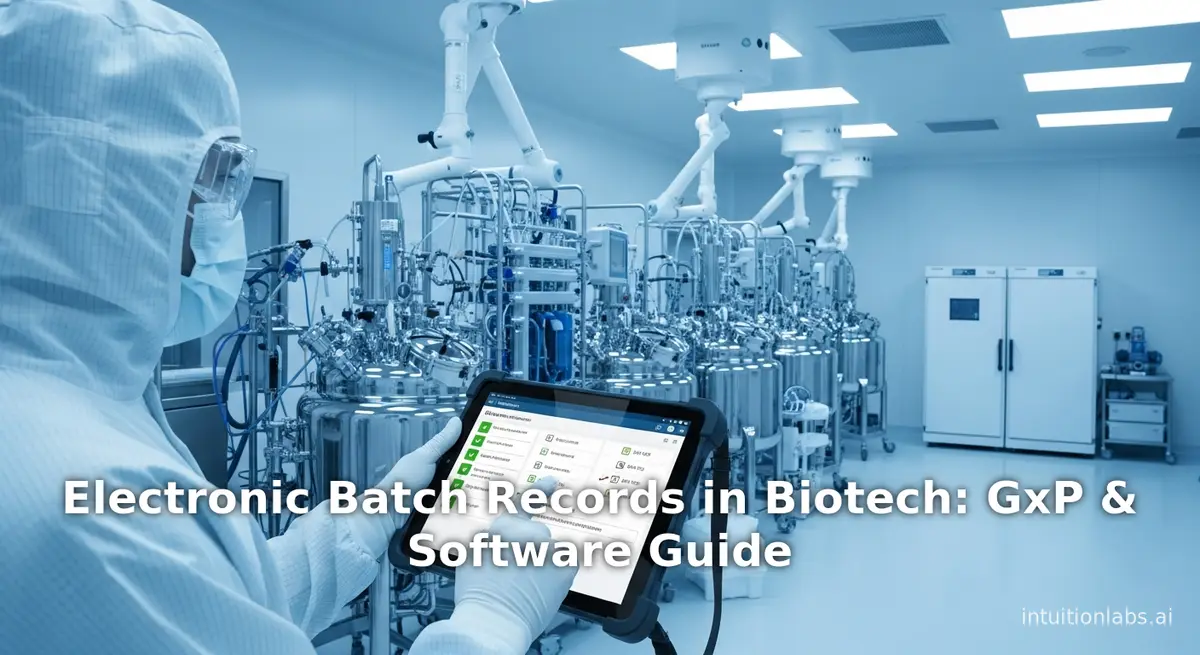
Electronic Batch Records in Biotech: GxP & Software Guide
Explore GxP requirements for Electronic Batch Records (EBR) in biotech. Covers FDA 21 CFR Part 11 compliance, validation, and current software options.
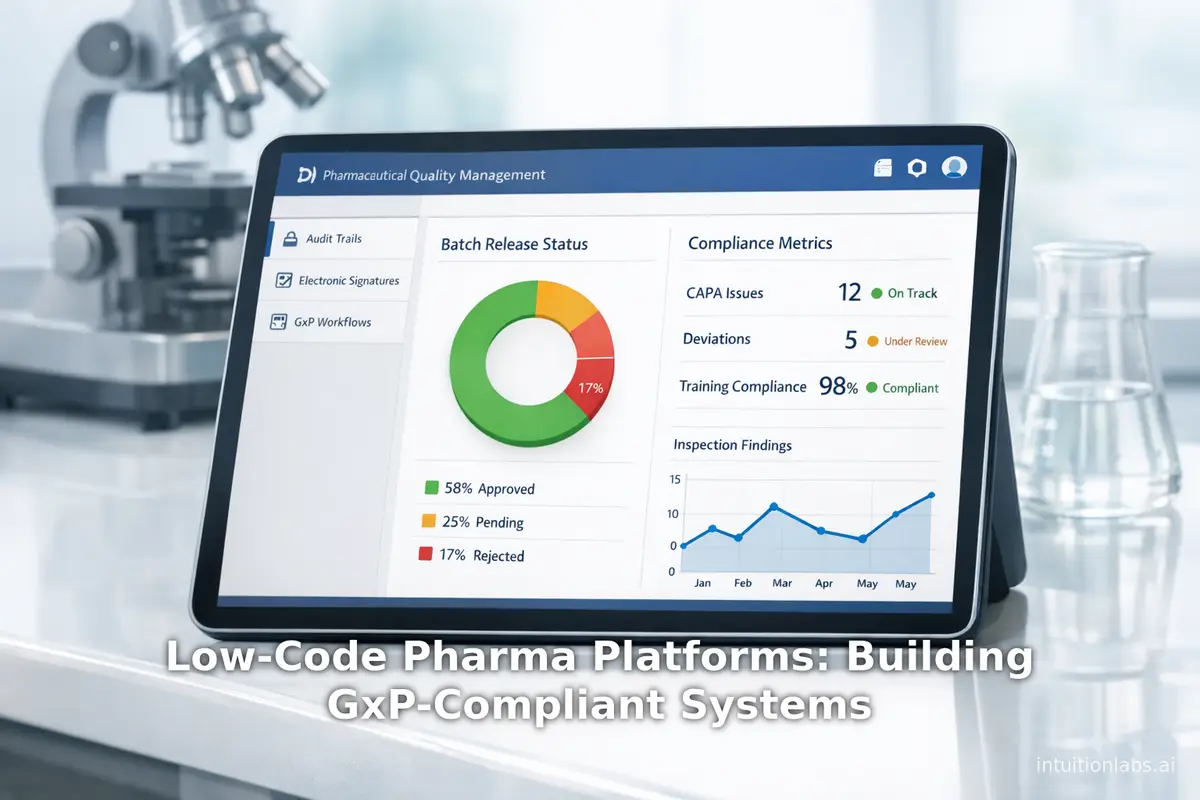
Low-Code Pharma Platforms: Building GxP-Compliant Systems
Explore how pharmaceutical companies use low-code platforms to build GxP-compliant MES and QMS applications while meeting strict 21 CFR Part 11 standards.
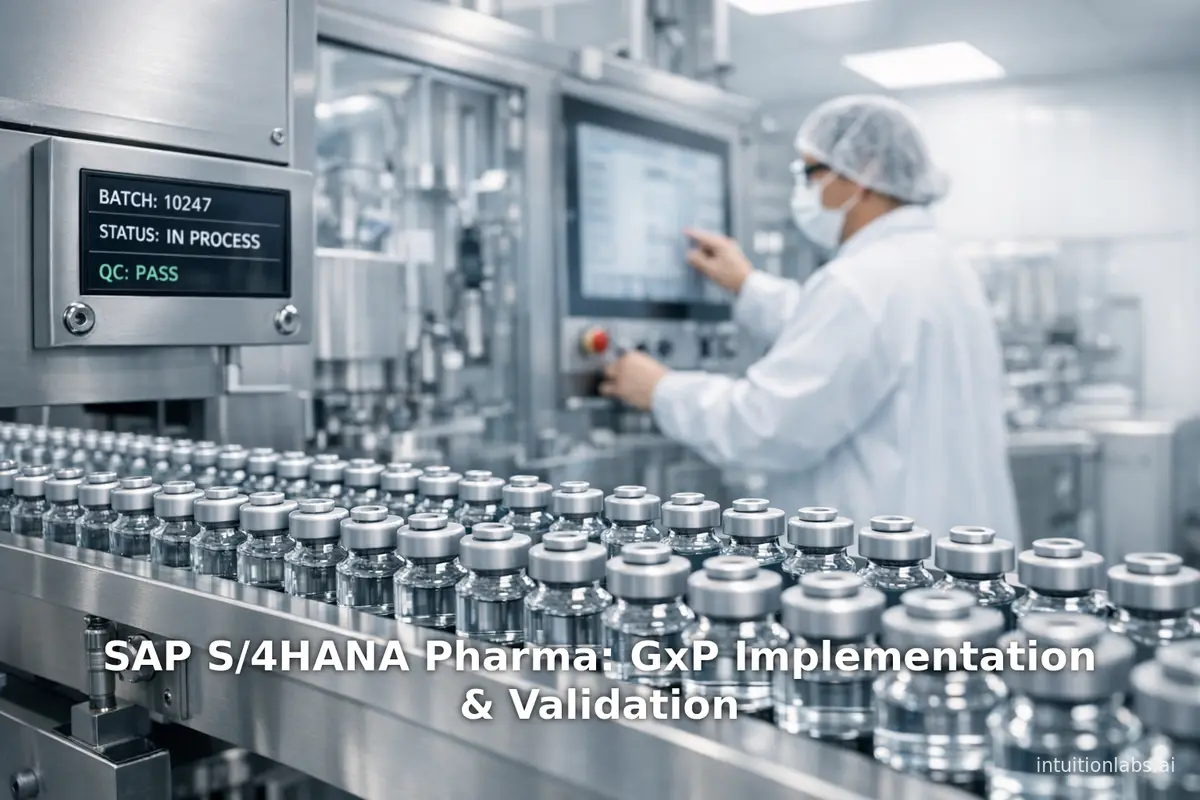
SAP S/4HANA Pharma: GxP Implementation & Validation
Explore SAP S/4HANA implementation in pharmaceutical manufacturing. This guide details GxP compliance, module selection, and computer system validation.