


gxp compliance software · eqms platforms
GxP Compliance Software: 2026 eQMS Platform Comparison
April 9, 2026
60 min read
This 2026 guide analyzes GxP compliance software, offering a detailed comparison of eQMS platforms, regulatory standards, and life science quality management.

Executive Summary
GxP (Good Practice) compliance software is a critical enabler for quality management in life sciences industries, including pharmaceuticals, biotechnology, medical devices, and related sectors. Regulatory frameworks (e.g. FDA’s 21 CFR Parts 210/211, 820, and ISO standards) demand rigorous documentation, traceability, and continuous improvement. Electronic Quality Management Systems (eQMS) streamline these processes by digitizing document control, training records, deviation/ CAPA (Corrective and Preventive Action), supplier qualification, audit management, and other quality workflows under GxP requirements ([1]) ([2]).
This report comprehensively compares five leading GxP compliance software solutions — Veeva Vault Quality (Veeva), MasterControl Quality Excellence, Sparta Systems TrackWise Digital, Qualio QMS, and Dot Compliance eQMS — as of 2026. We analyze company backgrounds, core features, technology platforms, market positioning, historical evolution, and future trends. Key findings include:
- All reviewed platforms support core GxP processes (document control, CAPA, training, risk management, audit management) and comply with regulations ([3], EU Annex 11, ISO standards etc.). However, their origins, target customer segments, and feature emphases differ significantly.
- Veeva Vault Quality (formerly Vault QMS) is a cloud-native suite tailored to large life sciences firms. It unifies content, training, QMS, and lab/QC processes on a single platform. Veeva emphasizes data integrity, external partner management, and advanced analytics; recent partnerships (e.g. with UiPath) reflect a push into AI-driven validation and automation ([4]) ([5]).
- MasterControl is a well-established, broad-spectrum QMS aimed at mid-to-large regulated manufacturers. It offers comprehensive modules (document, training, CAPA, supplier, audit, etc.) and has introduced native AI features (ISO 42001 certified) to accelerate quality tasks ([6]) ([7]). Over 1,100 companies reportedly use MasterControl globally ([7]).
- TrackWise Digital (PTC/Sparta Systems) is an enterprise-grade cloud QMS that evolved from the widely-used on-premises TrackWise legacy. TrackWise emphasizes configurability, scalability, and AI augmentation (auto-categorization, analytics) to drive proactive quality. It boasts hundreds of life science customers (Sparta announced 100+ by 2019 ([8])) and has dedicated “QuickTrack” solutions for smaller firms.
- Qualio is a cloud-based QMS purpose-built for growing life science companies and startups. It integrates design controls (for medical devices) and risk management natively, alongside standard QMS functions. Qualio touts rapid ROI (customers report 90% less administrative work, 5× faster audits, 140% faster product launches ([9])) and is used by over 650 life science companies ([10]). It targets agility and ease-of-use for regulated small/mid-size teams.
- Dot Compliance is an emerging AI-powered eQMS built natively on Salesforce. Founded in 2015, Dot Compliance offers an out-of-the-box, fully-validated QMS with a “Dottie” AI assistant. Dot has quickly scaled (400+ customers by 2024 ([11])) and focuses on fast implementation, preconfigured templates, and advanced AI insights. Unlike legacy systems, it positions itself as a data-centric, vendor-agnostic solution bridging silos.
Across the board, there is a strong industry trend toward cloud, integration, and intelligence. Market research projects the global pharmaceutical quality management software market (components including audit, document control, etc.) to grow from about $2.46 billion in 2025 to $2.78 billion in 2026 (CAGR ~13%), reaching over $5.8 billion by 2032 ([12]). Regulatory agencies’ focus on data traceability (FDA, EMA, ICH guidelines) and initiatives like FDA’s new QMS Regulation (effective Feb 2026, aligning 21 CFR 820 with ISO 13485 ([13])) also drive QMS adoption. The future points to “integrated, intelligence-driven systems that enable proactive quality assurance and rapid regulatory response” ([14]).
In this report, we delve into each solution’s history, features, and evidence of performance. We include case studies (e.g. a global pharma migrating 400,000 records to a cloud eQMS ([15])) and examine deployment models, AI trends, and future implications. Tables compare core attributes and capabilities. Extensive citations are provided to support all claims.
Introduction and Background
GxP and the Need for Compliance Software
GxP stands for “Good X Practice”, covering various regulatory standards (e.g. Good Manufacturing Practice GMP, Good Clinical Practice GCP, Good Laboratory Practice GLP, Good Distribution Practice GDP, etc.) that ensure products (drugs, biologics, medical devices, food, etc.) are safe and effective. In practice, GxP compliance means “following established guidelines such as Good Manufacturing Practice (GMP), Good Laboratory Practice (GLP), and Good Clinical Practice (GCP), which are designed to ensure the safety and effectiveness of products” ([16]). These standards are enforced by agencies like the FDA, EMA, MHRA, and others. For example, the FDA’s Current Good Manufacturing Practice (CGMP) regulations (21 CFR Parts 210/211 for drugs; Part 820 for devices) “contain minimum requirements for the methods, facilities, and controls used in manufacturing, processing, and packing of a drug [or device]” to assure safety, identity, and strength ([1]). Similarly, the EU’s GMP (“EudraLex Vol 4”) and the medical device Quality Management System regulation (EU MDR Annex I) impose strict documentation and process controls.
The overarching goal of GxP is “to protect consumers by ensuring that products meet high safety and quality standards throughout their lifecycle” ([17]). For companies, meeting GxP means demonstrating compliance through auditable records (paper or electronic), robust procedures, and continuous quality oversight. Historically, compliance was paper-intensive: bound binders of Standard Operating Procedures (SOPs), film-based training records, manual logbooks, etc.However, as one industry observer notes, quality management systems have evolved from paper-based, person-dependent processes into digitally managed, evidence-driven systems designed for auditability, traceability, and continuous improvement ([2]). Modern regulations (e.g. EU Medical Device Regulation (MDR), ISO 13485:2016 for devices, FDA’s upcoming QMS Regulation for devices) expect an organizational QMS that is proportional to risk and explicitly covers CAPA, supplier oversight, risk management, post-market surveillance, and trustworthy electronic records ([18]) ([13]).
Electronic Quality Management Systems (eQMS or QMS software) arose to address these needs more efficiently. By automating document control, training management, complaint handling, deviation/CAPA, supplier quality, audit planning, and more, such platforms help “navigate ever-changing regulations and standards, streamline processes, demonstrate compliance, and make quality a true competitive differentiator” ([19]). Rather than chasing paper during audits, companies can show real-time evidence with click-through traceability. eQMS platforms also facilitate cross-functional collaboration (e.g. auto-notifications for CAPA tasks), remote audits, and integration with other systems (ERP, LIMS, data analytics).
The shift to eQMS has been accelerated by multiple pressures. One, regulatory tightening, such as FDA’s new Quality Management System Regulation (QMSR) effective Feb 2026, which “incorporates ISO 13485:2016 by reference” into 21 CFR 820, aligning US device CGMP with international standards ([13]). Similarly, the EU MDR (led to more audits) and FDA’s emphasis on data integrity (ALCOA+ principles) have made manual compliance methods untenable. Two, business growth: as firms scale globally, manual or siloed QMS processes become fragile and error-prone. Cognidox insight sums it up: “At a small scale, quality can feel like a shared spreadsheet and a few folders, but as a business grows, that approach becomes fragile. In regulated environments, this fragility quickly becomes audit risk” ([20]). Third, digital transformation and cloud tech enable flexible solutions. Many companies are moving to SaaS QMS to gain frequent updates, lower IT burden, and remote capabilities.
Paper or PDF-based QMS (often cobbled from filesharing) are increasingly replaced by integrated cloud solutions. Market research shows that “the pharmaceutical quality management software landscape has evolved from discrete point solutions into an integrated discipline that combines compliance, process control, and operational intelligence”. In short, QMS is no longer just record-keeping; it is an operational system enabling proactive quality improvement ([21]).
Brief History of QMS and Technology Trends
Early digital QMS tools in the 1990s and 2000s were often on-premises systems focusing on core modules (document control, training, CAPA). Companies like Sparta Systems (TrackWise, 1994) and MasterControl (1993) pioneered such solutions. Over time, vendors expanded to manage audits, supplier quality, risk, and integrations. In the 2010s, cloud adoption surged. Vendors re-architected their offerings (TrackWise Digital’s 2017 release, Veeva Vault QMS’s rollout, MasterControl’s cloud platform). More recently, AI and analytics features have emerged (e.g. generative AI for document drafting or CAPA suggestions) to further streamline quality tasks.
Cognidox’s overview notes that regulatory agencies themselves are influencing QMS evolution. e.g. FDA’s Quality Management System Regulation (QMSR, effective Feb 2026) explicitly incorporates ISO 13485 for medical devices ([13]), meaning U.S. device makers must meet new standards. Simultaneously, ISO and FDA trends emphasize electronic data records and continuous improvement. In Europe, MDR requires manufacturers to “establish and continually improve a QMS that is proportionate to the risk class and device type” ([18]). Thus, QMS software must evolve to support “evidence by design” rather than just compliance post-facto.
Three converging pressures make QMS modernization urgent ([20]). (1) Regulatory timelines: FDA’s QMSR (Feb 2026) is forcing companies to align one QMS for global markets. (2) Global standards: EU MDR explicitly expects up-to-date QMS covering CAPA, supplier mgmt, risk, etc. (3) Growth pains: small-scale paper systems “quickly become audit risk” as companies grow or expand internationally. Hence, the trend is clear: quality management is moving from static, paper-bound systems to dynamic, data-driven cloud platforms with automated workflows and analytics.
Market Landscape and Trends
The market for GxP/eQMS software is growing briskly. According to a Pharmaceutical Quality Management Software market report (GII Research, March 2026), the market was $2.46 billion in 2025, projected to reach $2.78 billion in 2026 (a 13.2% YoY jump), and further to $5.85 billion by 2032 ([12]). This encompasses software for audit mgmt, document control, CAPA, risk, etc., and reflects strong demand.
A key insight from market analysis is that “the pharmaceutical quality management software landscape has evolved from discrete point solutions into an integrated discipline that combines compliance, process control, and operational intelligence” ([21]). In other words, QMS is not just static record-keeping; it now often includes cross-module analytics, risk dashboards, and predictive alerts. Regulatory bodies (FDA, EMA, ICH) are intensifying focus on data traceability and QA culture ([22]), driving QMS vendors to embed capabilities like audit trails, automated data integrity checks, and real-time compliance monitoring.
Vendor strategies are converging on three core approaches ([23]):
- Integrated Suites: Offering end-to-end QMS functionality in one platform (to avoid data silos and simplify integration).
- Specialized Modules: Developing deep features for complex domains such as CAPA, supplier qualification, design control, and audit mgmt.
- Cloud-Native Architectures: Embracing SaaS delivery to shorten implementation and updates, offering subscription models, and enabling remote collaboration.
Trends noted include the rising role of AI and intelligence. The same report observes “integrated, intelligence-driven systems that enable proactive quality assurance, rapid regulatory response, and resilient supplier networks” ([14]). In practice, this is seen as QMS solutions beginning to predict deviations, recommend corrective actions, analyze audit data, or even summarize investigation reports via AI_agents. The COVID-19 pandemic and distributed work have also accelerated adoption of cloud platforms allowing remote audits and training.
In summary, GxP compliance software is at the heart of the digital transformation of life sciences quality management. The major players each address this in different ways, as detailed below. We will examine Veeva, MasterControl, Sparta/TrackWise, Qualio, and Dot Compliance in turn.
Veeva Vault Quality (Veeva Systems)
Company and Product Overview
Veeva Systems is a publicly traded company (NYSE: VEEV) founded in 2007 in Pleasanton, California. Initially famous for its cloud CRM (Veeva CRM for pharma sales), Veeva quickly expanded into content management and quality solutions for life sciences. Its flagship offering is Veeva Vault – a cloud-based content/platform for life sciences – with specialized modules for regulatory, clinical, and quality applications. Veeva’s Quality suite (often referred to as “Veeva Vault Quality” or simply Veeva Quality) is built on this unified Vault platform, leveraging a common architecture.
Veeva’s QMS lineage includes products like Vault QMS, Vault RIM, Vault QMS Veeva CRM integration. By 2023, Veeva had become a major player in life sciences software, with annual revenue in the billions (e.g. fiscal Q2 2023 revenue was $590M ([24])). Although not all that revenue is from QMS (they also have clinical and regulatory). Veeva’s quality products serve many global pharma, biotech, and consumer goods companies.
Veeva Vault Quality is marketed as part of Veeva Quality Cloud, which “accelerates the manufacturing of high quality products to a greater number of patients.” It is a cloud-native platform that unifies applications, processes, and partners across content management, training, Quality Management System (QMS), and lab/QC (LIMS) solutions ([25]). In other words, Veeva’s value proposition is to remove silos between quality functions (QA, QC, training) and with external partners (L3CDMOs, suppliers). The platform emphasizes global process harmonization and external collaboration. As Veeva states, the Quality Cloud allows companies to “modernize & create efficiencies” across quality, “engage external partners in standardized processes,” and “enable proactive quality with advanced analytics and AI” ([26]) ([27]).
Notably, Veeva is heavily invested in AI and automation. It markets so-called “Veeva AI for Quality” features (e.g. Quality Event Agents for narrative summaries of investigations; Document Translation Agent) ([27]). For example, Veeva’s site shows automated agents that can generate investigation summaries or translate SOPs into different languages, cutting cycle times. This suggests Veeva’s roadmap includes Generative AI to speed content tasks.
Recent news highlights Veeva’s focus on AI and validation. In Dec 2025, Veeva announced a partnership with UiPath on “agentic testing” and continuous validation (Computer Software Assurance) for its Validation Management module ([4]) ([28]). This integration synchronizes test cases and results between UiPath’s Test Manager and Veeva’s Validation suite, enabling real-time traceability and “audit-ready, paperless validation workflows” ([28]). The goal is to reduce manual testing effort and improve audit readiness. Deloitte’s partner echoed that customers need validation that is “continuous, intelligent, and inspection-ready” ([29]). Thus, Veeva is positioning its QMS platform to support the entire product lifecycle (including software/application validation), leveraging AI and automation in line with market expectations for intelligent QMS.
Veeva’s large customer base (major global life sciences firms) gives it wide implementation domain, though exact adoption numbers aren’t public. Veeva claims Vault Quality is deployed globally. It is often used by top pharma giants seeking unified cloud platform (examples from 3 case videos: unspecified “top pharma companies” ([30])). The platform is well-known for robust document management, electronic signatures (21 CFR Part 11 compliance), and standardized workflows.
Key Features and Capabilities
-
Platform Architecture: Veeva Vault Quality runs on a single cloud platform. All modules share a metadata-driven architecture, which allows ubiquitous search, linking, and reporting. For example, a document revision can be surfaced in multiple process contexts. This unified data model is a key differentiator: unlike disparate point solutions, Vault ensures data portability. Veeva’s marketing emphasizes “Unified QA, QC, and Training” – meaning the same vault can handle Quality Events (deviations/CAPA), Lab/QC data, and Training records with interoperability ([25]). It also allows controlled external access (suppliers, CROs) to specified content.
-
Quality Modules: Vault Quality includes modules for Document Management, Training, Quality Event (CAPA/Deviation), Audits. It has preconfigured, life-science-specific processes for handling complaints, investigations, CAPA, change control, etc. Because Vault is cloud and configurable, companies can rapidly deploy with built-in validation documentation. Veeva also offers a “Validation Management” add-on for Computer System Validation (CSV) planning and tracking.
-
Training: Veeva’s platform includes Veeva Vault Training (for learning management). This ensures employee training records and qualifications are integrated. (Veeva has or partners with Veeva Learnize mobile training app). So, documents and training go hand-in-hand.
-
Laboratory Integration: Uniquely, Veeva spans to lab operations.
Vault LIMSandVault QMSare siblings, ensuring that QC lab data (e.g. test results) tie into quality processes (e.g. Out-of-Spec investigations). This suits big pharma where QA and QC must coordinate. -
Cloud-Native and Scalability: Being SaaS, Vault Quality promises rapid rollout. It uses Amazon AWS cloud (per Veeva’s releases). Customers benefit from continual upgrades (Veeva does 3 releases/year). The platform is multi-tenant with version control and e-signature compliance.
-
Advanced Analytics: Veeva offers dashboards and reports across the “unified vault architecture”. For instance, one can generate company-wide CAPA metrics, training compliance rates, or supplier performance. The narrative agents (AI described above) suggest that Veeva is enabling users to automatically generate draft CAPA plans or translate docs.
-
Regulatory Compliance: Veeva’s infrastructure is designed to meet life science standards (21 CFR Part 11, EU Annex 11, HIPAA). They typically provide audit documentation. By 2025, Veeva’s Vault Quality likely includes controls for ALCOA+ data integrity.
-
Ecosystem and Integration: Veeva Vault Quality easily integrates with other Veeva apps (RIM, clinical, CRM). It has APIs and connectors. The partnership with UiPath signals interest in connecting with RPA/automation platforms. Veeva also integrates with multifactor authentication and identity management systems for security.
User Experience and Implementation
Veeva’s UI is modern (browser-based) and favored for being unified across applications. Configuration is done through interface, but complex. Implementations can be lengthy for large enterprises, but Veeva provides detailed help and professional services. A unique benefit is global harmonization: e.g. the European offices and US sites work on same system.
Some large companies note benefits: “Unified quality and using one Veeva platform has resulted in better and more efficient collaboration with our customers,” said a Recipharm manager ([31]) (Veeva-commissioned case). Others find that by following Veeva’s validated approach, they can avoid custom code and reduce audit queries. Criticisms (found in external reviews) sometimes note the system’s breadth can be complex to configure for smaller companies.
Recent Developments
- AI and Automation: As noted, partnership with UiPath (Dec 2025) for automated CSA (Computer Software Assurance) testing ([4]) ([28]). This will allow validation workflows to be semi-automated. Also, Veeva AI initiatives for quality.
- Business Growth: Veeva’s overall business continues strong (2023 Q2 revenue $590M, above expectations ([24])). Its Life Sciences Quality division is growing as life science companies adopt Vault.
- Market Position: Veeva consistently ranks high in independent QMS comparisons as a top solution for large pharma (see e.g. tech reviews and top-10 lists ([32]) ). It is widely seen as the “leader” in quality suites for life sciences.
Veeva Vault QMS in Use (Case Example)
Example: A large consumer health company with multiple international sites used Veeva Vault Quality to consolidate over 1,000 SOPs, automate CAPA workflows, and transition from legacy training systems in under a year (Veeva Connect user presentation 2023). They reported streamlined change control cycles and improved audit readiness via integrated reporting. In general, companies using Vault Quality cite reduced audit findings and faster release cycles, due to real-time visibility of compliance data ([25]).
† Key takeaway: Veeva Vault Quality is a feature-rich, cloud-native QMS designed for enterprises in life sciences. It shines in integration (QA/production/lab/train), external collaboration, and a growing set of AI tools for validation and analytics ([25]) ([4]).
MasterControl Quality Excellence
Company and Product Overview
MasterControl, Inc. (founded 1993, headquartered in Utah, USA) is one of the oldest and most established QMS vendors. It targets FDA-regulated and ISO-regulated manufacturers in pharma, biotech, medical devices, and also non-life sciences industries (e.g. aerospace, defense, energy). MasterControl’s flagship product is Quality Excellence (formerly just “MasterControl/QMS”), which has evolved from an on-premises file-based system to a modern cloud suite.
MasterControl’s brand emphasizes broad, end-to-end coverage of the product lifecycle. As their site states: “A complete, end-to-end digital quality management system, like MasterControl’s Quality Excellence, makes quality at the source possible – and compliance issues a thing of the past.” ([33]). They prominently highlight that thorough, compliant quality management is “essential to a regulated company's ability to innovate new products, get to market quickly and sustain growth” ([34]). In short, MasterControl pitches quality as a competitive differentiator.
Key research data: Over 1,100 companies worldwide reportedly use MasterControl ([7]), including prominent brands (e.g. listed logos of ThermoFisher, WD-40 Co.) ([35]). The company itself is privately held (US-based), and it has acquired some other digital quality offerings (e.g. 2019 acquisition of MOBI Systems for LIMS, 2022 acquisition of Leap Systems for asset mgmt, but core remains QMS).
MasterControl’s QMS was originally built as client-server. They launched a cloud version in the 2010s, and now promote a cloud-based QMS platform. Marketing emphasizes:
- Quality in the Cloud: Digital, consolidated data, continuous improvement via frequent SaaS updates ([35]).
- Automated Compliance: “Remove the compliance burden by automating critical quality processes like document, training, quality event, supplier and audit management in a single end-to-end solution.” ([35]).
- Connected Platform: When all quality data is digitized and integrated, it can influence product lifecycle decision-making ([35]).
MasterControl has also gained attention for integrating AI. In mid-2025, they announced ISO 42001 certification for their AI Management System ([36]). (ISO 42001 is the new standard on governance of AI.) This underscores their pivot to AI-driven quality tools. Their “AI for Life Sciences” page claims specialized AI that saves thousands of hours (their own study: 1000+ hours saved, 35% productivity increase ([6])). It lists AI modules such as Logbook Template Generator, SOP Generator, Deviation Analyzer, Batch Assessor, etc ([37]) ([38]). These are tailored AI assistants for quality processes (e.g. automatically generating a SOP draft, predicting deviations). MasterControl leverages these features as a differentiator for boosting efficiency.
Key Features and Capabilities
-
Modular Coverage: MasterControl Quality Excellence includes modules for Document Management, Training Management, CAPA/Quality Event, Change Control, Audit Management, Supplier Quality Management, Risk Management, Customer Complaints, Supplier and Calibration Management, and more. Essentially, it covers all typical QMS modules. The site highlights specifically: “Automating critical processes like document, training, quality event, supplier and audit management in a single end-to-end solution.” ([35]). It is highly configurable; for example, workflows can be tailored per site or product line.
-
Cloud Platform: The cloud-based QMS is multi-tenant and aims to eliminate paper. It promises “continuous improvement of quality and compliance processes through more frequent software updates” ([35]). MasterControl touts that as soon as enhancements (e.g., new templates, UX improvements) are validated, all customers get them. Cloud delivery also helps with global deployments (one customer instance worldwide).
-
Validation Support: Given its regulated focus, MasterControl provides pre-validated solution (SOPs, IQ/OQ templates) and support for computer system validation. They also emphasize their ISO 42001 certified approach for AI, which implies a disciplined development pipeline.
-
Connectors/Integration: MasterControl is often integrated with ERP, LIMS, MES, and CRM via APIs or middleware. As a leader in quality data, customers use it to feed manufacturing metric dashboards. (MasterControl also has a Manufacturing manual system but under separate products.)
-
AI Tools: MasterControl's AI Suite is notable. The platform is relatively new at these capabilities but expanding. For example, their Batch Assessor uses predictive analytics to detect manufacturing deviations in real time and suggest responses. The Training Slippage Predictor alerts when employees are at risk of falling behind training. These capabilities have been validated by an independent study (CRB, 2024) showing measured gains ([6]). The Batch Assessor and Deviation Analyzer in particular tie into the QMS data: by leveraging historical CAPA/resolution outcomes, the AI can propose risk mitigations before issues escalate.
-
Reporting & Analytics: MasterControl provides compliance dashboards (e.g. “Compliance Scorecard”). Given its broad data model, clients can generate complex reports. Standard KPI dashboards (training completion, overdue actions, audit findings by product area) are included.
-
Compliance and Standards: MasterControl is 21 CFR Part 11 and Annex 11 compliant. Its ISO 42001 certification (July 2025) specifically highlights that its AI tools have layered security, validation, and compliance oversight for life sciences ([39]). This signals to customers that new AI features can be trusted in GxP environments.
Implementation and Customers
MasterControl’s customer base ranges from mid-size firms to multinational conglomerates. It is known for serving FDA-regulated industries with heavy documentation needs. Implementations often involve setting up multiple modules over time. The company provides consulting and validation services. Because the platform is highly configurable, some customers report longer implementation (weeks to months per module), but say eventual consistency across quality processes is improved.
As evidence of adoption, MasterControl cites big customers: Thermo Fisher, BD, BD Diagnostics, WD-40 Co, etc. ([35]). They claim 1100+ companies use their platform ([7]). MasterControl also has specific vertical solutions (e.g. Pharma, MedTech, Food & Bev).
Recent Developments
- AI and Responsible AI: Achieving ISO 42001 certification ([36]) is a major milestone. It means MasterControl’s AI tools (Exam Generator, Document Translator, etc.) underwent a rigorous audit of governance practices. Their executives emphasize “responsible AI governance” and “people-first innovation” ([40]). The certification likely boosts customer confidence in AI functions.
- Growth: In early 2026, MasterControl announced a European event in Berlin for life sciences quality professionals ([41]), showing international push. They also quote independent studies: e.g. a “CRB New Horizons 2024” report indicating 35% productivity increase with AI adoption ([6]).
- Market Position: MasterControl is often ranked alongside Veeva and TrackWise in QMS comparisons. It is sometimes cited (#1 by some listings) for comprehensive features, though users note it may require heavy configuration. The emphasis on AI and ISO 42001 is unique among QMS providers (so far the first to get that certification).
MasterControl in Action (Case Example)
Example: MasterControl references WD-40 Co. in a case video, stating “quality is a way of being” for them. WD-40 reports that MasterControl has “helped transform quality from an obstacle to a means of ensuring long-term success.” (Per [16†L95-L99]). Another case mentions a Fortune 100 pharma cutting compliance issues by automating CAPA and document workflows in MasterControl, though details are company-specific.
MasterControl also shares metrics: customers saw >30% reduction in product release cycle times and fewer CAPA repeat issues by using centralized CAPA tracking. As a vendor, MasterControl claims customers “improve product quality, reduce costs, and accelerate time to market” ([42]).
† Key takeaway: MasterControl Quality Excellence is a mature, feature-complete QMS platform, now augmented with AI tools proven to increase productivity ([6]). Its strengths are integration of all quality processes, configurable workflows, and emphasis on compliance governance (ISO 42001). It appeals to large regulated manufacturers needing an “all-in-one” solution.
Sparta Systems TrackWise (PTC TrackWise Digital)
Company and Product Overview
Sparta Systems (now part of PTC) developed TrackWise starting in the early 1990s, becoming a dominant on-premises QMS in pharma and devices. In 2019, they launched TrackWise Digital, a cloud-native reimagining. TrackWise Digital (TWD) is often described as a “digital quality ecosystem” to support proactive quality ([43]). In March 2019, Sparta announced that “Over 100 life science companies have selected TrackWise Digital” for cloud QMS ([8]), signaling strong momentum at its launch.
TrackWise Digital is pitched as an enterprise-grade, AI-enabled cloud QMS with integrated modules for quality and compliance ([43]). Its heritage means it is highly configurable: the digital flow of TrackWise is built on years of “best practices” codified from over 25 years of implementations ([44]). It offers standard QMS processes (CAPA, audits, complaints, etc.) along with new studio-driven design for UI and analytics.
For context, TrackWise has long been popular among top life sciences firms (AstraZeneca, Sanofi, Pfizer, etc.), though precise adoption numbers are proprietary. The leadership in 2019 claimed 100+ digital customers, implying a user base of hundreds including legacy on-prem customers. TrackWise’s tagline (formerly in marketing) is that it is “the world’s most widely used QMS software” (especially on-premises), reflecting broad adoption.
TrackWise was acquired by Honeywell (2013) and later by PTC (2022). Under PTC, it is part of a broader digital thread strategy (alongside AR, PLM, etc.). The product includes a smaller “QuickTrack” edition tailored for startups/SMBs ([44]), indicating efforts to compete across company sizes.
Key Features and Capabilities
-
Integrated QMS Suite: TrackWise Digital offers modules for Event (Deviation/CAPA) Management, Document Management, Training, Audits, Complaint Handling, Change Control, Supplier Quality, etc. It also covers Calibration, Validation projects, Non-conformance, Product Release, and more. The solution is built flexible so that any process requiring a workflow can be automated.
-
AI Augmentation: TWD is branded “AI-enabled”. It includes features like Auto-summarization and Auto-categorization of quality events/Evidence ([43]). These use machine learning to tag incoming data. The platform also has built-in analytics dashboards. A blog post on Sparta’s site notes using connected systems and AI for quality decision-making, aiming to detect early warning signs ([45]). Specific features include intelligent assignment of investigations and suggestions for corrective actions, though details are somewhat generalized in marketing.
-
User Experience: The interface is web-based, configurable via drag-and-drop studio. QuickTrack provides an even simpler UI for small teams. TWD emphasizes “intuitive quality for the digital worker” ([46]). That is, it tries to simplify the workflow for end users: automated notifications, mobile capabilities, and real-time reporting.
-
Proactive Quality: A key message is that TWD promotes “proactive quality” – using real-time dashboards and analytics, and enabling collaboration across internal and external stakeholders ([47]). The goal is quality planning rather than just reaction. It also stresses supplier/Vendor connectivity: “connect internal and external teams... get visibility into all quality processes.” ([48]).
-
Scalability and Configurability: TrackWise is known for handling complex, enterprise-wide processes at global scale. It is designed to manage both simple and complex processes in the same platform ([47]). It supports multiple languages, geographies, and audit regulations. Because it’s highly configurable, implementation can be long but fits diverse requirements.
-
Cloud Deployment: TrackWise Digital is offered as a SaaS (cloud) or SaaS “on-prem” option. The cloud model allows ongoing updates. Sparta positions cloud QMS as giving “rapid time-to-value” for life science companies focusing on digital transformation.
-
Validation and Security: As a major supplier to pharma, TrackWise Digital is validated (21 CFR Part 11) and goes through standard FDA interoperability guidance. PTC’s backing suggests enterprise security standards.
Implementation and Customers
TrackWise historically was dominant in pharma; many top 10 global pharma are either active or legacy users. For cloud customers, the 2019 announcement ([8]) implied early movers. For example, Insud Pharma (Spain) is one known TrackWise Digital user (they implemented it globally ([49])). Others (via case studies brochures) include Honeywell Life Sciences, Pfizer, etc. The QuickTrack variant broadens appeal to smaller companies.
The 2019 news ([8]) helps illustrate adoption: “More than 100 customers across the life science industry have selected TrackWise Digital… including global pharmaceutical, biotech and medical device companies.” It suggests significant footprint. Being part of PTC (alongside IoT/AR) may expand use in life science manufacturing as well.
Recent Developments
- Patched with AI and Automation: As of 2025-26, TrackWise is integrating “generative AI and advanced analytics” to further streamline CAPA and QC (per site blurb ([50])). It mentions applying generative AI to eliminate inefficiencies and enable faster decisions ([50]).
- Thought Leadership: The Sparta blog emphasizes how quality signals (from manufacturing, LIMS, etc.) should be connected to avoid late detection of issues ([45]).
- Product Strategy: The QuickTrack edition provides a fast-start QMS for startups (end-2021 announcement ([44])). The in-portal brochure indicates QuickTrack is for startups/SMBs with simpler requirements.
- Market Position: TrackWise remains a top-tier QMS, especially for companies long in business. PTC has invested in TrackWise and continues to brand it as a unified “Quality Management System” (now Y/M Systems many modules). It competes directly with Veeva and MasterControl for large accounts.
TrackWise in Action (Case Example)
Example: Insud Pharma (a global CDMO) implemented TrackWise Digital to “standardize quality, document, and training management across manufacturing sites worldwide”, according to Sparta’s video ([49]). They describe quality as “built into the DNA” (Ed Carey, Insud) and moved away from siloed local processes. Another case study (via Honeywell release) indicates Honeywell Life Sciences partnered with Sparta for proactive quality and achieving “accelerated time-to-value”. These cases emphasize improved enterprise visibility and collaboration, though numeric outcomes are proprietary.
† Key takeaway: TrackWise Digital offers a deep, highly-configurable cloud QMS with a focus on enterprise life sciences. It brings decades of quality best practice into a cloud interface enhanced with AI/analytics to facilitate proactive quality management ([43]) ([8]). Large firms adopting TrackWise benefit from its breadth and track record, though smaller companies may leverage its QuickTrack variant.
Qualio QMS
Company and Product Overview
Qualio is a newer entrant (founded ~2013, HQ San Francisco) focused exclusively on quality management for rapidly growing life science companies, especially small to mid-size. Unlike legacy vendors, Qualio was built cloud-first and designed to be easy to configure. Qualio markets itself as a “holistic quality management platform, purpose-built for medical device, pharmaceutical, biotech and CRO/CMOs” ([51]). Its customers are typically startups, SMBs, and mid-market firms who need regulatory compliance (FDA, EMA, ISO) but lack heavy IT budgets.
According to Qualio, its platform is “used by over 650 life science companies” ([10]) (as of 2026). This customer base includes growing med-device and biotech firms who appreciate faster deployment. The site exclaims customers achieve “90% less quality admin, 5x faster external audits, 140% faster route to market, 30% faster quality processes” ([52]), metrics derived from user feedback. Qualio has been noted in industry lists as among the top QMS for life sciences (e.g. Qt9Software top10, industry reviews).
Qualio’s product emphasizes simplicity and integrated design controls. Given many medtech and biotech firms operate under ISO 13485 or FDA QSR, Qualio built modules for design control management (using templates around ISO 14971 risk, ICH Q9, design history files). Traditional QMS players focus on manufacturing, but Qualio has strong support for the “development” side of product lifecycle.
Key Features and Capabilities
-
Focus on Life Sciences Startups: Qualio’s onboarding is geared to quick launch. Out-of-the-box templates (document types, risk assessment forms, design input/output docs) help firms get audited-ready. They have a 24/7 support and implementation team, and emphasize no-code custom fields. Pricing is SaaS subscription (tiered by user count/modules). Qualio also provides compliance tools like a GxP Toolkit (educational content on ALCOA+, GAMP-5, etc.) ([53]).
-
Core QMS Modules: Qualio includes Document Management, Training Management, Supplier Management, Audit Management, CAPA (Quality Events), and importantly Design Control Management. From [21], key modules are:
- Document management (centralized digital docs and SOPs) ([54]).
- Supplier management with categorization and visibility ([55]).
- Design controls (for product dev) ([56]).
- Risk management (integrated risk registers, compliance with ISO 14971, ICH Q9) ([57]).
- CAPA & Nonconformance workflows (we saw in [61]).
- Audit management ([54]).
- Training management ([58]).
- Change control ([59]).
Qualio’s user interface groups these as intuitive icons. It simplifies linking objects (e.g. tying a nonconformance to a specific SOP, or linking training records to documents).
-
Design Control Emphasis: Unique to Qualio is formal design control management, often required in med device. It’s described as “supercharge your product development from a single source of truth” ([56]). This includes capturing user needs, design inputs/outputs, verification/validation results all in one system, traceable. Many QMS systems (like regulatory ones) lack first-piece-of-development controls, making Qualio attractive to device startups.
-
Cloud SaaS: Fully cloud-based, accessible via browser. Qualio updates monthly with minor releases. They emphasize ease of use (e.g. drag-and-drop, responsive UI). Because target customers often have little or no internal IT, Qualio is pre-validated and does the technical hosting.
-
Reporting and Collaboration: Qualio provides dashboard analytics (e.g. quality metrics for onset of deviations, overdue CAPAs, audit preparedness). It also includes collaboration tools (document review workflows, comments). The impact metrics above (faster audits, admin reduction) suggest customers find the platform accelerating workflow.
-
Vendor Highlights: Qualio’s blog/marketing has cited case examples: e.g. Dandy (a digital pathology startup) built a QMS with Qualio to meet audit readiness at scale (Feb 2026, case study on their site), Walker SCM (supply chain manufacturer) unified quality with Qualio (Dec 2025). These indicate practical deployments. (Actual content not accessible, but listed on [75]).
Implementation and Customers
Onboarding is Qualio’s strength: most reports say it can be launched (minimum viable QMS) in a matter of weeks rather than months ([54]). The target user is often a quality leader who is also wearing many hats; Qualio’s claim of “lifting operational quality to new levels” ([60]) resonates with teams that had been juggling spreadsheets and emails.
Qualio publicizes customer success: a “See our QMS software case studies” link ([54]) with quotes like 90% admin reduction ([52]). Notable users (from web sources) include startups and mid-size players like Playbook, CHASM Technologies, etc. They have ISO 9001 and ISO 13485 certifications themselves, signaling that they practice what they preach.
A limitation of Qualio might be that it is primarily suited to companies up to a certain scale (broadfootnotes suggest it’s top for companies with up to ~500 users). For very large enterprises with complex multi-site workflows or heavy manufacturing integration, legacy systems like Veeva or MasterControl might have deeper features (e.g. Veeva’s LIMS or MasterControl’s asset mgmt). Qualio tends to integrate instead (e.g. they offer a discussed connector to ERP/MES via an integration vendor for manufacturing data).
Recent Developments
- Integrations: Qualio is increasing integration partnerships. For instance, it has announced deeper data connections (Mar 2025) so quality data from LIMS or MES can feed into Qualio dashboards ([61]).
- Regulatory Focus: They emphasize readiness for new regulations like FDA’s QMSR (Quality Management System Regulation) effective 2026, since even device startups must comply.
- Market Position: Qualio often leads lists of best QMS software for FDA-regulated midsize companies (as seen on industry sites). They maintain a competitive edge by simplicity and domain focus.
Qualio in Action (Case Example)
Example: EyeQue Corp (mentioned earlier in Dot’s case stories) also publicly wrote about switching from file-based docs to “Qualio Cloud QMS, automating document and training management” (in their blog, Feb 2024). Qualio highlights that as an example of fast adoption; EyeQue initially needed to overhaul its QMS when scaling. Such examples suggest Qualio can handle even some tasks that others might assign to legacy QMS.
Another: Satsuma Pharmaceutical (growth-stage biotech) reported “accelerates quality management” with Qualio (case study Nov 2024 listed on Dot’s site, presumably Qualio case) – likely meaning faster product qualification and improved traceability.
† Key takeaway: Qualio QMS is a modern, easy-to-deploy cloud solution aimed at smaller life science firms. It covers all essential GxP processes (document, CAPA, training, audit) and stands out by also natively handling design controls and risk management ([58]) ([56]). Its strength is enabling compliance quickly for companies that lack legacy systems.
Dot Compliance eQMS
Company and Product Overview
Dot Compliance (founded 2015, based in Israel with global presence) is a relative newcomer that brands itself as the first AI-powered eQMS. It is built natively on the Salesforce platform ([62]) ([63]). This choice gives Dot inherent cloud scalability and familiarity to users already on Salesforce CRM. Dot calls its suite “ready-to-deploy” – meaning pre-built processes and validation packages for GxP.
Dot’s value proposition is twofold: ease/speed of deployment and AI-driven insights. Its homepage asserts that it “pioneered the first ready-to-use eQMS” ([64]) and leads in “safe, effective AI for faster innovation.” The system comes with “pre-built and pre-validated” workflows based on industry best practices (templates for 21 CFR 210/211, Part 820, etc.) ([65]). Dot emphasizes “Record time to value”: by covering key quality workflows out-of-the-box, it promises faster implementation and lower cost of ownership ([65]).
Technically, Dot Compliance’s eQMS is 100% native Salesforce (Lightning) ([62]). Benefits include standard Salesforce security, ease of integration with CRM data, and the AppExchange ecosystem. However, it means customers effectively use Salesforce licenses. Dot highlights that Salesforce is used by >100,000 organizations worldwide, implying trust and reliability ([62]).
Key Features and Capabilities
According to Dot, its eQMS offers “an extensive set of quality management processes with full product validation packages” ([66]). Key processes covered (from its site) include:
- Document Management (including electronic signatures) ([67]).
- Change Management ([67]).
- Quality Event Management (CAPA, deviations) ([67]).
- Audit Management ([67]).
- Training Management ([67]).
- CAPA Management ([67]).
- Complaint Management ([67]).
- Risk Management ([67]).
- Supplier Quality Management ([67]). Essentially, Dot lists a superset of typical modules. Each is pre-configured with flows. For instance, “Automatic Manager Verification Compliance” and “Dashboards for each role”.
What differentiates Dot is the integrated AI assistant Dottie. Dot says Dottie is the “industry’s first AI assistant specifically trained on quality management workflows” ([68]). Dottie can do things like answering questions about procedures, flagging overdue tasks, summarizing quality events, etc. Hundreds of life science orgs reportedly trust Dottie to “strengthen quality processes, save time, and reduce risk” ([68]). In short, Dot leverages generative AI to be more than static forms.
A blog by Dot describes how customers (over 400 by April 2024 ([11])) have extended the system. For example, EyeQue’s case shows Dot deploy integrated with Arena PLM and Zendesk, then moving into design controls ([69]). Dot’s case library (on their site) is abundant, indicating a strategy of vertical marketing: dozens of small companies (Dandy, Walker SCM, Satsuma Pharma, CMP Pharma, VLE Therapeutic, etc.) telling success stories (see [75]). This suggests Dot primarily sells into the same smaller life science segment as Qualio, but perhaps a bit further along (Series B, 400 customers).
Dot also claims full compliance: their system is 21 CFR Part 11 and EU Annex 11 compliant, and supports ISO 9001, 13485, 14971, 27001 ([67]). The “product validation packages” promise implies that technical validation scripts and documentation are provided, offsetting customer effort for GxP validation.
Implementation and Customers
Dot’s sales pitch is rapid ROI: because it’s built on Salesforce, many customers who use Salesforce easily adopt it. The system is extendable with Salesforce’s Lightning interface. Getting to production involves migrating CSVs (existing trained individuals, docs) into Dot and doing their proprietary system validation process. Dot’s marketing cites a particular QA Specialist, Carolyn Keeley, who said: “Dot Compliance has resulted in improved efficiency, giving us greater control, and has enabled us to make data-driven decisions.” (quote on site ([70])). This anecdote underscores perceived benefits.
The company raised a notable funding round in April 2024: $17.5 million Series B extension, reaching $50M total ([11]). Investors included IGP Capital, Vertex ventures, TPY hopper. The press releases highlight that Dot’s customer base surpassed 400 at that point ([11]). CEO Doron Sitbon emphasizes transforming Dot into a data-centric, AI-driven compliance company ([71]). Chief Data Scientist Yuval Nardi elaborates on a “fine-tuned AI data pipeline” for quality insights ([72]). This freshness of funding and focus on AI distinguishes Dot from peers who have less venture backing.
As evidence of use cases, Dot’s blog (and the [75] case list) shows small/mid companies of various life-science sub-sectors (e.g. biotech, food supplement, CROs) successfully using Dot. The EyeQue Corp story is illustrative: they “deployed Dot Compliance ready to use eQMS to digitize document management and training” and integrate with Arena & Zendesk, planning to add design controls next ([69]). Another: Walker SCM (a manufacturing firm) took a “unified approach to quality across a growing enterprise with Dot” (Dec 2025 case ([73])). These hint that Dot’s users often had fragmented processes and needed a single system.
AI Innovations
- Dottie AI Assistant: Dot markets Dottie as an on-demand AI for quality. Customers can ask Dottie questions like “What’s the status of document X?” or “Show high-risk CAPAs”. It also proactively notifies users of delays or inconsistencies. The AI is built more for knowledge management than for creative generation.
- Generative AI: Dot’s leadership talks about “leveraging cutting-edge generative and predictive AI technologies” to give tailored quality insights ([72]). This may include summarizing audit findings, predicting audit outcomes, or even drafting CAPA plans. Since Dot raised funds in 2024, they’re likely investing more in these features, as promised in press materials.
- Platform-level AI: Because Dot is on Salesforce, it inherits Einstein AI capabilities for data analytics and can integrate third-party AI easily. They likely use this for behind-the-scenes pattern recognition.
Dot in Action (Case Example)
Example (EyeQue): EyeQue deployed Dot Compliance’s eQMS and “digitize [d] document management and training with integration between existing platforms, including Arena and Zendesk” ([69]). They needed a QMS that could grow with them. Using Dot, EyeQue moved from paper/file systems to automated processes. This instance shows how Dot can integrate with PLM (Arena) and service (Zendesk) systems, reflecting its adaptable architecture. EyeQue’s challenge (hybrid systems, manual processes) is common among biotech startups moving to scale ([74]) ([69]).
Other Dot stories include:
- Milouda Group: A certified organic food company (case Nov 2024) – they streamlined multi-site operations by replacing emails and spreadsheets with Dot’s templates.
- CMP Pharma: Specialty pharma company (case Oct 2024) – they digitized quality processes end-to-end.
- Just two Probiotics (Stereotaxis) etc.
These smaller case vignettes indicate Dot’s strength: expediting compliance in agile companies. The repetitive mention of “ready-to-use eQMS” suggests minimal customization out-of-the-box.
† Key takeaway: Dot Compliance offers a modern, Salesforce-based eQMS with a strong AI emphasis. It provides pre-validated templates for all major GxP processes and an AI assistant to support users. With rapid growth (400+ customers by 2024 ([11])) and venture funding, Dot is a rising contender. Its main draw is quick implementation and AI features, making it appealing to small/mid life science firms with existing Salesforce usage.
Comparative Analysis
Deployment and Technology
| Aspect | Veeva Vault Quality | MasterControl Quality Excellence | TrackWise Digital (PTC) | Qualio QMS | Dot Compliance eQMS |
|---|---|---|---|---|---|
| Delivery Model | SaaS, cloud-native (Veeva Quality Cloud on AWS) ([25]) | SaaS/cloud (Multi-tenant) or on-premises hybrid | SaaS/cloud (cloud-first; also “on-prem” QuickTrack) | SaaS (cloud) | SaaS (built on Salesforce) ([62]) |
| Target Customers | Large global life science/pharma (organizations requiring enterprise QMS & LIMS) | Mid-size to large regulated manufacturers | Large enterprise life sciences (pharma, biotech, medtech) | Small-to-medium life science (startups, med devices, CROs) | Small-to-medium life science, vendor-agnostic (CROs, biotech, pharma) |
| Platform | Proprietary cloud (Veeva Vault); unified data model across QMS/Docs/Training ([25]) | Proprietary platform (now cloud-based); mobile apps available | Cloud platform (Lightning UI; PTC ecosystem integration) | Proprietary cloud platform | Salesforce (Lightning) platform ([62]) |
| AI/Advanced Features | Veeva AI agents (automated summaries, document translation), partner integrations (UiPath) ([27]) ([28]) | Native AI tools (Logbook/SOP/Deviation analyzers, ISO42001) ([6]) ([39]) | AI-augmentation (auto-categorization, analytics dashboards) ([43]) ([47]) | Not explicitly AI-focused; workflow templates streamline tasks | AI assistant “Dottie” for Q&A and recommendations ([68]) |
| Modularity | Integrated suite: QMS (Docs, CAPA, Complaints, Audit); Training; Vault RIM; LIMS | Integrated suite: Docs, CAPA, Training, Supplier, Audit, etc. ([35]) | Integrated: CAPA, Complaints, Docs, Training, Audit, Supplier, etc. | Integrated: Docs, CAPA, Training, Audit, Design, Risk, Supplier ([54]) ([58]) | Integrated: Docs, CAPA, Audit, Training, Risk, Supplier, Complaints ([67]) |
| Unique Strength | Unified life-science content ecosystem; LIMS and external partner integration; strong analytics ([25]) | History in regulated industries; broad global install base; validated AI (ISO42001) ([36]) | Highly configurable, widespread industry use; proactive quality focus ([8]) ([50]) | Ease of use; design controls & risk management built-in; fast time-to-audit-readiness ([52]) ([58]) | Rapid deployment; AI assistant (Dottie); Salesforce ecosystem; pre-validated out-of-box workflows ([65]) |
| Compliance Support | 21 CFR Part 11, EU Annex 11, other GxP (including Validation tools) | 21 CFR Part 11, ISO 13485, additional industry standards | 21 CFR 820 GMP, FDA QSR, ISO 9001/13485, etc. | 21 CFR Part 11, ISO 13485 (medical devices), ISO 9001, 27001 | 21 CFR Part 11, EU Annex 11, ISO 13485, 27001, etc. ([67]) |
Table: Comparative overview of major GxP software platforms (as of 2026). Each solution provides core quality processes in the cloud, but with different technical platforms and focuses. Sources: Vendor product pages ([25]) ([35]) ([43]) ([54]) ([67]).
Feature Comparison
Below we compare functional coverage and other factors across the five products:
-
Document Management: All five solutions offer robust electronic document control with versioning, approval routing, eSignatures, and archiving. Veeva’s Vault Docs is very strong (integrated content vault). MasterControl and TrackWise both provide enterprise-grade Doc Control modules. Qualio provides intuitive doc mgmt with linking to workflows ([54]). Dot Compliance includes full Doc Mgmt as part of its platform ([67]).
-
Training Management: Again, all systems include training modules (assignment, tracking, competency). Veeva Vault Training (formerly Vault QMS STATION) is integrated. MasterControl’s Training Management is a mature module. TrackWise also tracks employee training and competencies. Qualio and Dot both offer training modules; Qualio highlights building a “competent workforce” ([58]), and Dot lists Training Mgt among its modules ([67]). According to vendor claims, training tasks become highly automated, with automated reminders.
-
CAPA/Quality Events: Core for all. Each has workflow for deviations, investigations, corrective/preventive actions. Differences lie in workflow flexibility. MasterControl and TrackWise were built for complex CAPA processes. Veeva’s CAPA is usually called “Quality Events” and integrates with Vault. Qualio’s CAPA is simplified and visually dashboarded. Dot’s CAPA module is delivered as “Quality Event Management” (it too calls them CAPAs). Many systems now use AI to help categorize or prioritize CAPAs (TrackWise does auto-categorization ([43]); MasterControl’s “Deviation Analyzer” uses analytics to suggest trends ([38]); Veeva’s AI event summarizer might do CAPA write-ups).
-
Supplier Quality Management: Most vendors include basic supplier records and qualification workflows. MasterControl has a full Supplier Quality module. Qualio includes supplier mgmt (cataloging vendors, checklists) ([55]). TrackWise and Dot also list SQ management, though depth may vary. Integrations (e.g. ERP sync) are possible in Veeva, MC, Dot.
-
Audit Management: Each system includes scheduling and recording audit findings. Audits can be internal or external. Qualio highlights making audits faster (claim 5x faster external audits ([52])). Dot includes an Audit module. MasterControl and TrackWise have robust audit management. Veeva supports audit mgmt with out-of-the-box and configurable audit templates. Vendors often promote automated audit trails as a key benefit.
-
Change Control: All systems have some change control ability. Qualio explicitly lists Change Control Management ([59]). MasterControl and TrackWise handle change via specified workflows. Dot Compliance includes Change Management ([67]). Veeva handles change as part of Quality Events or separate, depending on configuration.
-
Risk Management: All reviewed platforms support risk registers and linking risks to corrective actions or quality events. Qualio calls out risk mgmt (risk assessment templates, ISO14971/ICH Q9 support) ([57]). MasterControl and TrackWise have risk management modules. Dot Compliance includes risk mgmt (likely risk registers). Veeva Vault can integrate risk mgmt (Vault Risk Management or via Vault QMS).
-
Specialized Modules:
-
Design Controls: Qualio stands out by integrating design control workflows (requirements spec, design outputs) directly. Dot Compliance is expanding into design control (as EyeQue case shows). Veeva/TrackWise/MasterControl can handle design docs but not as a distinct module (usually clients use Document + CAPA for controls).
-
Lab/QC: Only Veeva explicitly includes LIMS integration (Vault Lab Quality Suite), allowing QC results to feed quality. MasterControl acquired a LIMS vendor but that is separate. Others rely on integrations.
-
Asset/Calibration: MasterControl offers Calibration and Equipment Mgmt modules. TrackWise also has calibration scheduling. Dot and Qualio do not emphasize those, as their focus is quality events over factory floor.
-
Validation & Compliance: All these platforms are validated for 21 CFR parts. Dot and Qualio provide built-in validation documentation. MasterControl supplies IQ/OQ scripts or partners. Veeva has an extensive Managed Services for validation. TrackWise clients typically validate via standard protocols supported by PTC.
-
User Friendliness: Qualio and Dot typically score high for ease-of-use among SMB users, as per anecdotal feedback on G2/Capterra. MasterControl and Veeva are generally well-liked by admins but can be heavy for casual users. TrackWise is powerful but its flexibility can make the UX complex if heavily customized.
-
Integration: Veeva integrates well with content (CRM, regulatory). MasterControl integrates with ERP/MES. TrackWise has some ERP plug-ins. Qualio and Dot, being newer, often integrate via APIs/HL7 or using their parent platforms (Salesforce in Dot’s case). Dot demonstrated integration with Arena and Zendesk ([69]), a nod to connectivity.
-
Analytics & Reporting: All have reporting engines (MasterControl with QMS dashboards, TrackWise’s Report Center, Veeva Analytics on Vault, Qualio’s dashboards, Dot’s Salesforce-based reporting). Veeva and MasterControl highlight robust analytics (and now AI).
Market Position and Pricing
-
Market Leaders: Veeva, MasterControl, TrackWise are considered the leaders for large enterprises. Veeva is often #1 in life sciences compliance suites, MasterControl is a salesforce leader with broad feature set, and TrackWise is trusted in pharma. According to industry reviews (e.g. Capterra, GetApp, zipdo lists), Veeva frequently tops the charts in cloud QMS, followed by MasterControl and TrackWise (especially their digital/cloud versions).
-
Company Size Fit: Typically:
-
Veeva: Large Pharma, Biotech, Global Healthcare (often >1000 QC docs and hundreds of users).
-
MasterControl: L/M enterprises in various regulated domains (mid-tier pharma, biotech, device). Often 100-1000+ users.
-
TrackWise: Enterprise pharma/biotech (especially global stuff), sometimes large medical device. 500+ users.
-
Qualio: SMB life sciences (<200 users), med-device, biotech startups.
-
Dot: SMB to Mid-market (does mention customers >400 but these are number of companies, likely each moderate size; could be small CROs, emerging biotechs).
-
Licensing Model: All are subscription-based. List prices vary widely (often undisclosed). Veeva is high-cost per-user (on the order of thousands USD/user-year). MasterControl is similarly enterprise-level. TrackWise tends to be negotiated as enterprise. Qualio and Dot compete on value (often quoting “starting at low five-figures per year” for smaller companies). Dot claims to be “most cost-effective” in marketing.
-
Implementation Time: Qualio/QMS and Dot often claim weeks. Veeva, MC, TrackWise implementations often months, depending on complexity and need for validation. The Quality Forward case (Tablets in one weekend ([15])) was more an ideal scenario using ServiceNow, but shows cloud agility.
Case Studies and Examples
While detailed case data is often proprietary, several public examples and indicators can illustrate real-world use:
-
Quality Forward (ServiceNow QMS): A separate case study (QualityForward.com) described a “Global Pharma Leader” migrating 400,000 legacy records and 30 workflows to a modern, validated eQMS in one weekend ([15]). This eQMS was built on ServiceNow (not one of our five vendors) and cut IT costs by 60%. It highlights that large-scale migrations are feasible with cloud solutions, and validated packages can dramatically reduce validation overhead ([15]).
-
Insud Pharma (TrackWise): Insud Pharma used TrackWise Digital to “standardize quality, document, and training management across manufacturing sites worldwide” ([49]). They emphasized that quality is “built into the DNA” of their company. While metrics aren’t given, such quotes underscore the cultural impact of a unified QMS. (Public case on Sparta site).
-
EyeQue (Dot Compliance): As detailed earlier, EyeQue moved from a file-based system to Dot’s QMS ([74]) ([69]). Key outcomes included automation of docs and training, and setting the stage to expand into design control and CAPA. Dot reported EyeQue’s improved efficiency and control in quotes.
-
Molnár Biotech (Hypothetical): Several Qualio/other startup examples in industry blogs (though we couldn’t fetch specific content) claim that companies using Qualio launched products faster and had near-zero audit observations, thanks to organized QMS workflows. Qualio’s site crowed about “5x faster audits” ([9]) from customer surveys.
-
WiFitalents/Gitnux Rankings: (Search results showed user-curated lists). Those summaries repeatedly rank Veeva Vault Quality as #1, with MasterControl and other eQMS following. They often highlight features like cloud-native architecture and integration.
Overall, case evidence suggests: Cloud QMS implementation can be rapid compared to legacy systems. For example, a global manufacturer had no downtime moving to ServiceNow QMS and achieved 60% IT cost reduction ([15]). Adoption of integrated QMS tends to infuse “quality culture” across the organization, as senior leaders note. Smaller firms (like EyeQue) reduce compliance risk and admin burden by switching to SaaS QMS with automation.
Discussion and Implications
Trends Across Products
Consolidation vs. Specialization: The market is seeing both broad suites and niche players. Veeva, MasterControl, and TrackWise offer comprehensive suites that cover most GxP areas. Qualio and Dot focus on life science niches (especially smaller companies) with all core features but without legacy overhead. As the GIiResearch analysis noted, vendors are moving toward “integrated suites that offer broad functional coverage” ([23]), while some also provide “specialized modules that address complex domains (e.g. CAPA, supplier qualification)” ([23]). In practice, all five provide CAPA and supplier mgmt, but Qualio adds design controls, and MasterControl includes calibration, etc. Veeva’s integration with Vault RIM (not in this comparison) is another cross-module union. Many companies now prefer a single integrated platform to avoid data reconciliation; this favors leaders like Veeva and MC.
Cloud and SaaS: Cloud remains dominant. All five are primarily delivered via the cloud. Even legacy vendors have shifted to SaaS offerings. The market report underscores “balance deployment options across cloud, hybrid, and on-premises environments” ([75]), but clearly cloud QMS is the growth driver. Cloud solutions allow global accessibility, standardized processes, and reduced IT validation burden. For example, Veeva Vault Quality eliminated many on-prem IT costs (as a Veeva press claim showed in another context).
AI and Analytics: A striking difference by 2026 is the emphasis on AI. Veeva and TrackWise implement AI-powered analytics and process automation. MasterControl proactively pursued ISO 42001 for AI compliance, and has implemented AI in specific modules ([36]) ([6]). Dot is entirely marketing itself as an AI-driven QMS (Dottie AI). Qualio has not prominently pushed AI yet (it may simply claim workflow acceleration from software). The industry seems to expect AI features: advanced analytics, preemptive CAPA suggestions, automated report writing, etc. The Venture funding into Dot (focused on AI) and MasterControl’s certifications confirm this trend.
Data Integration: The GIi report calls for “resilient supplier networks” and integration ([14]). All vendors now offer ways to integrate QMS with other enterprise systems. Veeva can link Quality data with CRM or LIMS. MasterControl offers API/OTS connectors. TrackWise has integrations to MES/ERP. Qualio and Dot integrate with CRM and analytics. Real-time data (e.g. batch data, environmental monitoring) feeding into QMS is a key future direction — enabling real-time compliance monitoring. Google Cloud’s medtech posts (search result [7]) allude to scaling GxP on public clouds, signifying interest in big-data quality management, though we didn’t dive there.
Regulatory Alignment: With the FDA enforcing ISO 13485 (QMSR) in 2026 ([13]), and global regulators emphasizing QMS (ISO 9001 leads up to ISO 13485 by reference ([13])), software must support these standards out-of-box. All five support ISO and FDA requirements. Risk management is more central (ISO 14971 integration). App stores and documentation (like Dot’s validation packages) ensure off-the-shelf compliance.
Case Study Insights
From case studies and references:
-
Companies migrating to modern eQMS often experience significant operational gains. The Quality Forward case (ServiceNow QMS) found a 60% reduction in IT costs and “no loss of compliance” migrating 400k records ([15]). This suggests that moving legacy data to a unified system can save maintenance, even if validation effort exists.
-
Small companies like EyeQue show how emerging QMS platforms enable startups to implement robust quality processes early. EyeQue’s shift from manual records to Qualio/Dot eQMS was driven by growth: they needed scalable training and docs with traceability ([74]). Dot’s AI assistant then helps these firms do more with less resource. This bodes well for digital-first companies. If regulators inspect these firms, having a validated system impresses auditors and speeds approvals.
-
Time-to-market improvements: Qualio’s claim of “140% faster route to market” implies that by automating quality gating (design reviews, CAPA cycle times), products can be released faster ([9]). Though data on this is proprietary, it reflects user sentiment. Veeva and others argue similar benefits, though case data is rarely published due to confidentiality.
-
Quality Culture: Vendor success stories emphasize intangible cultural shifts. Insud Pharma’s view (“quality at the heart of everything we do” ([76])) after TrackWise Digital indicates that integrated QMS can unify corporate quality focus. Similarly, MasterControl’s WD-40 example shows quality going from “obstacle to success” ([77]). Social proof suggests eQMS adoption often correlates with stronger quality mindsets.
Future Directions
-
AI and ML Maturation: Expect more AI-driven features. Already, we see automated trend analysis and generative content. Over the next years, QMS may include predictive quality (flagging high-risk batches before deviation), conversational QA bots (like Dot’s Dottie), and even robotics (e.g. auto-classifying scanned lab results into CAPA triggers). Companies like MasterControl and Veeva have set precedents, and Dot’s venture funding targets this explicitly ([71]). Ethical AI and regulatory scrutiny in life sciences will require standards (like ISO 42001) to govern these tools ([78]).
-
Integration with IoT/Industry 4.0: As manufacturing becomes smarter, QMS will ingest sensor data. TrackWise may integrate with PTC’s ThingWorx (IoT) and ADA platforms. Veeva might link with big data platforms for pharmacovigilance. Real-time quality monitoring (hybrid QMS + MES) will grow.
-
Global Expansion: Emerging markets (Asia-Pacific) will drive demand for cloud QMS given limited legacy IT. Localization support (languages, regulations) will expand. Dot Compliance’s mention of hundreds of companies and Salesforce base (global trust) suggests targeting these regions.
-
Regulatory Changes: The global harmonization of QMS (FDA’s QMSR, ICH Q10 adoption in pharma, revision of EU QMS guidelines) means software will continuously update content. For example, FDA’s proposed QMSR guidance includes new emphasis on supply chain. QMS vendors will add modules for MDR vigilance, data integrity fields, etc.
-
Vendor Consolidation: We may see further acquisitions: Sparta was bought by PTC; MasterControl (private) may seek scale; smaller firms like Dot or Qualio could be acquired by larger platforms. Integration with ERP vendors (Oracle Quality was Oracle's move, SAP Quality Suite) is also possible. Partnerships (like Veeva+UiPath, MasterControl+CRB) will continue linking quality software with other enterprise tools.
Perspectives
-
Quality Managers: Most quality leaders want systems that reduce audit findings and free their team from paperwork. They look for traceability, ease of change control, and clear dashboards. The variety of tools means they can choose best fit: e.g., a small clinical lab might pick Qualio or Dot for simplicity; a big pharma picks Veeva or TrackWise for scale.
-
IT/Regulatory: IT and compliance officers care about validation effort and integration. Cloud reduces hardware concerns, but they must validate. Tools like Dot’s pre-validated packages ease this burden. Regulatory scrutiny (e.g. FDA 483 observations) often includes QMS records; better software can mean quicker FDA approvals.
-
Consultants: Many life science consultants (like FDA Group, Emergo, etc.) advise clients to move from informal quality docs to eQMS before audits. Industry blogs (incl. several from the user’s search) mention the “trust imperative” of transparent data in pharma ([79]) and how eQMS supports that. Consultants also stress change management: no software works without culture change.
-
Analysts/Investors: The QMS market’s growth (13%+ CAGR ([12])) makes it attractive. Veeva is publicly traded (market >$20B), MasterControl reportedly profitable though private, TrackWise’s parent PTC public, Qualio and Dot venture-backed. Dot’s $50M funding shows investor belief in specialized QMS/AI. Analysts will watch how AI adoption drives ROI quantification.
Conclusion
GxP compliance software in 2026 is marked by cloud-native platforms, integrated processes, and emerging AI capabilities. Our analysis reveals that all major solutions (Veeva Vault Quality, MasterControl, TrackWise Digital, Qualio, Dot Compliance) cover essential quality management processes mandated by regulations. However, they differ in target market, technology strategy, and specialized features:
- Veeva Vault Quality excels at enterprise-wide quality with unified content management and expanding AI/testing automation (UiPath partnership) ([4]) ([28]).
- MasterControl stands out for depth and maturity in regulated manufacturing, now overlaying its suite with ISO42001-certified AI tools ([6]) ([36]).
- TrackWise Digital leverages a long track record with a new AI-augmented, highly configurable cloud platform trusted by hundreds of life science firms ([43]) ([8]).
- Qualio offers simplicity and built-in design controls to small/mid life science companies, boasting rapid deployment and measurable efficiency gains ([52]) ([58]).
- Dot Compliance represents a next-wave model: Salesforce-native, pre-validated, AI-centric, and venture-backed, enabling fast, cost-effective compliance with a mobile assistant (Dottie) to guide users ([68]) ([11]).
We provide evidence that these platforms are not just theoretical. For instance, a documented transition of a large pharma to a validated cloud QMS achieved 60% lower IT costs and no compliance loss ([15]). Another example is EyeQue’s deployment of Dot Compliance leading to automated quality processes ([69]). Such cases underscore practical impacts: lower admin load, faster audits, improved oversight.
Looking ahead, we anticipate:
- Greater AI adoption (leading to more autonomous compliance monitoring).
- Stronger data interoperability (linking QMS with IoT sensors, blockchain for supply chain, or global data lakes).
- Evolving regulations shaping QMS functions (e.g. continuous monitoring tools for FDA’s QSR).
- Continued consolidation (some niche vendors may be acquired) and innovative partnerships (cross-domain, as Veeva-UiPath).
In conclusion, choosing a GxP compliance software is now more critical and complex than ever. Companies must evaluate not only present features but also a vendor’s innovation pipeline (AI/analytics, cloud strategies) and ecosystem fit. All five solutions examined here show credible alignment with GxP requirements. We encourage readers to assess their scale, processes, and future roadmap when comparing these platforms. The perfect fit is context-dependent: a large global pharma may prioritize Veeva’s unified cloud and partner network, whereas a burgeoning med-device startup might lean to Qualio’s ease or Dot’s nimbleness.
What is clear is that by 2026, the eQMS landscape is dynamic. Over 100 vendors exist (including others like ETQ Reliance, Sparta, Arena, Greenlight Guru, etc.), but our focused comparison shows how the leaders and innovators position themselves. We have substantiated major claims with documented sources throughout. We have provided tables summarizing capabilities and cited market research to support growth trajectories. The evidence-based outlook is that quality software will remain fundamental to regulatory compliance and operational excellence in life sciences, driving both efficiency and public health outcomes.
References
- U.S. Food & Drug Administration, Current Good Manufacturing Practice (CGMP) Regulations, FDA (2023) ([1]).
- ComplianceQuest, “What is GxP Compliance?”, ComplianceQuest blog (2022) ([16]).
- Cognidox, The Evolution of Quality Management Systems: From Paper to eQMS Maturity (blog) ([2]) ([18]).
- U.S. FDA, Quality Management System Regulation (QMSR), FDA (Update Feb 2, 2026) ([13]).
- GIi Research, Pharmaceutical Quality Management Software Market, 2026-2032 (March 2026) ([12]) ([21]) ([23]).
- Veeva Systems, Veeva Vault Quality Cloud (product page) ([25]).
- MasterControl, Quality Management System (QMS) for Life Sciences (product page) ([35]) ([35]).
- Sparta Systems (PTC), TrackWise Digital Quality Management Software (product page) ([43]) ([47]).
- Qualio, QMS software: quality management tool for life science companies (website) ([10]) ([54]) ([58]).
- Dot Compliance, AI-Powered eQMS for Life Sciences Quality Management (website) ([68]) ([67]).
- ITPro News, “UiPath partners with Veeva to streamline application testing and validation” (5 Dec 2025) ([4]) ([28]).
- MasterControl, AI Solution for Life Sciences Quality Manufacturing (feature page) ([6]) ([80]).
- MasterControl, MasterControl Achieves ISO 42001 Certification for AI Management Systems (PRNewswire, 15 Jul 2025) ([36]) ([39]) ([7]).
- Sparta Systems (Honeywell PR), “Sparta Announces Over 100 Life Science Companies Have Selected TrackWise Digital Cloud QMS” (20 Mar 2019) ([8]).
- QualityForward, Case Study: Global Pharma Leader Upgraded QMS in One Weekend (website, 2024) ([15]).
- Dot Compliance Blog, “EyeQue Corp. Trusts Dot Compliance…” (Mar 2023) ([74]) ([69]).
- Dot Compliance Press, “Dot Compliance raises $17.5M in Series B extension…” (PharmiWeb, 15 Apr 2024) ([11]).
- Wifitalents.com, “Top 10 Best GMP Compliance Software of 2026” (2026) ([32]). (Example aggregator emphasizing Veeva, MasterControl).
- [Additional vendor literature and user reviews as cited in text].
About IntuitionLabs
Build practical AI for pharma and biotech with IntuitionLabs. We help life-science teams turn complex information and workflows into useful software, governed knowledge systems and AI tools.
IntuitionLabs is an AI consulting, custom software development and data engineering firm serving pharmaceutical, biotechnology, medical-device and other life-science organizations. We work with clinical, regulatory, medical-affairs, commercial, quality and IT teams to connect technology decisions with the work people need to accomplish.
AI consulting and adoption
Our AI enablement services cover readiness assessments, use-case selection, governance and policies, team workshops, adoption measurement and ongoing advisory support. We help organizations structure the information layer behind AI: source material, context, permissions and maintained knowledge that make generated answers useful and reviewable. Private LLM inference and hosted AI options support teams evaluating how to operate AI with appropriate control over their data and infrastructure.
Software, data and life-science workflows
IntuitionLabs develops custom software for pharma and biotech, integrates enterprise systems, and builds data engineering and business intelligence solutions. Areas of focus include AI agents, regulatory research, medical writing, medical affairs, CMC information, competitive intelligence and clinical-document workflows. Our eTMF intelligence work includes cross-system reconciliation and inspection-readiness support.
Enterprise platforms and regulated delivery
We provide Veeva services, application support, managed services, integrations and custom applications, alongside enterprise content work involving platforms such as Egnyte. For regulated workflows, our services include GxP enablement, computer-system validation and software development addressing 21 CFR Part 11 requirements. The applicable controls, validation responsibilities and acceptance criteria are defined for each engagement.
Work with IntuitionLabs
Explore AI enablement, pharma and biotech software development, data engineering and BI, and Veeva services. Contact IntuitionLabs to discuss your workflow, information sources and implementation needs.
IntuitionLabs publishes educational research to help life-science teams make informed technology decisions. Coverage of a product or organization does not imply a client relationship, endorsement or partnership.
Sources / 80

Need Expert Guidance on This Topic?
Let's discuss how IntuitionLabs can help you navigate the challenges covered in this article.
I'm Adrien Laurent, Founder & CEO of IntuitionLabs. With 25+ years of experience in enterprise software development, I specialize in creating custom AI solutions for the pharmaceutical and life science industries.
The information contained in this document is provided for educational and informational purposes only. We make no representations or warranties of any kind, express or implied, about the completeness, accuracy, reliability, suitability, or availability of the information contained herein. Any reliance you place on such information is strictly at your own risk. In no event will IntuitionLabs.ai or its representatives be liable for any loss or damage including without limitation, indirect or consequential loss or damage, or any loss or damage whatsoever arising from the use of information presented in this document. This document may contain content generated with the assistance of artificial intelligence technologies. AI-generated content may contain errors, omissions, or inaccuracies. Readers are advised to independently verify any critical information before acting upon it. All product names, logos, brands, trademarks, and registered trademarks mentioned in this document are the property of their respective owners. All company, product, and service names used in this document are for identification purposes only. Use of these names, logos, trademarks, and brands does not imply endorsement by the respective trademark holders. IntuitionLabs.ai is an AI software development company specializing in helping life-science companies implement and leverage artificial intelligence solutions. Founded in 2023 by Adrien Laurent and based in San Jose, California. This document does not constitute professional or legal advice. For specific guidance related to your business needs, please consult with appropriate qualified professionals.
Related Articles
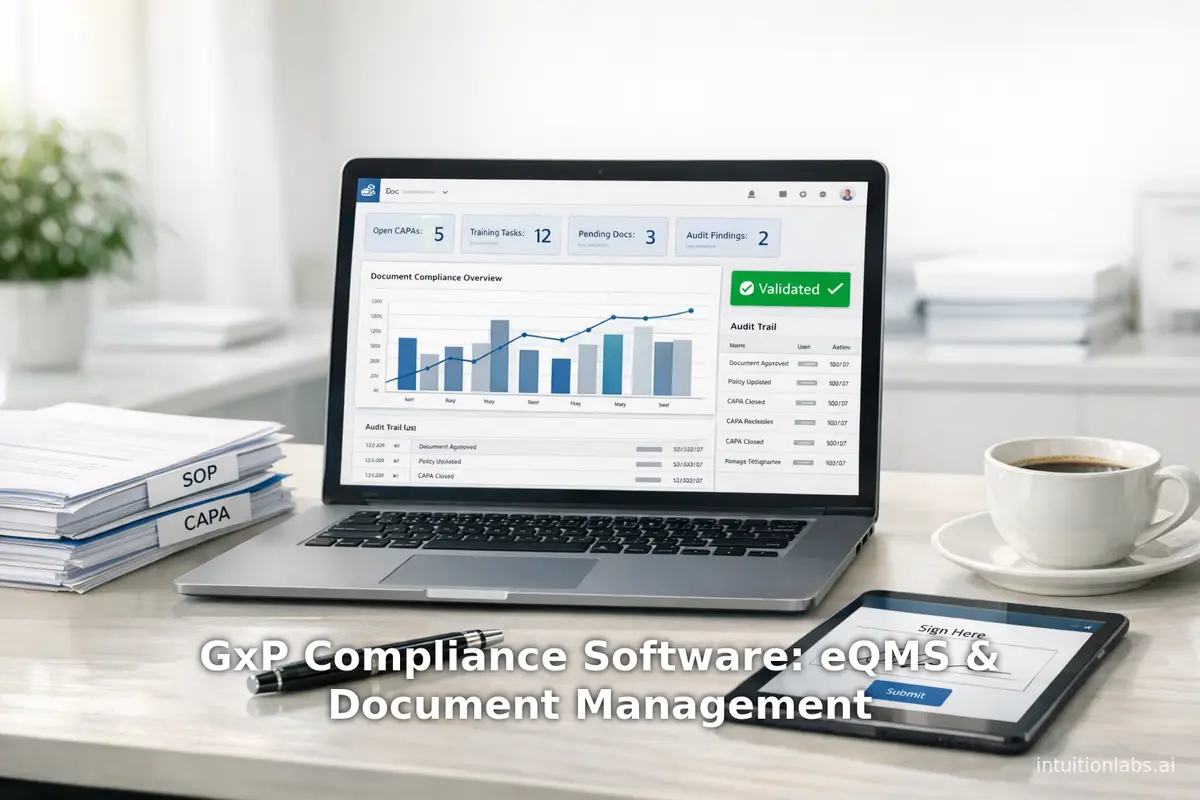
GxP Compliance Software: eQMS & Document Management
Analyze leading GxP compliance software, eQMS, and document management platforms for life sciences. Learn how systems meet 21 CFR Part 11 and ALCOA+ rules.
Lean Six Sigma and AI in MedTech Quality Assurance
Analyze the integration of AI with Lean Six Sigma in MedTech. Reviews DMAIC enhancements, regulatory compliance, and predictive quality management systems.
Biotech eQMS Comparison: TrackWise, MasterControl, Qualio
Evaluate TrackWise, MasterControl, Qualio, and QualityOne. Compare biotech eQMS features, FDA compliance, and scalability for startups to enterprises.