


ectd software · regulatory submissions
eCTD Software Guide for Small Pharma: Compliance & Timelines
January 14, 2026
Updated May 10, 2026
35 min read
Learn how to choose eCTD software for small pharma. This guide covers regulatory compliance, global submission timelines for FDA & EMA, and eCTD v4.0 updates.

[Revised May 9, 2026] — Updated to reflect Japan PMDA's eCTD v4.0 mandate that took effect April 1, 2026, current FDA v4.0 implementation status (still voluntary, no mandatory deadline announced), and refreshed EMA Module 1 timelines.
Executive Summary
Small pharmaceutical companies face unique challenges in delivering regulatory submissions in electronic format. The Electronic Common Technical Document (eCTD) – an ICH‐harmonized standard – is now the required submission format for major regulatory agencies (FDA, EMA, MHRA, PMDA, etc.) ([1]) ([2]). This transition to digital submissions, while improving review speed and data consistency, imposes technical complexity and cost burdens on smaller firms. Key eCTD software tools (e.g. Lorenz’s docuBridge, EXTEDO’s EXTEDOpulse, Certara’s GlobalSubmit, Veeva Vault) provide specialized capabilities – such as automated validation, modular document management, and compliance checks – to streamline submissions ([3]) ([4]). Our analysis finds that small biotechs often benefit from cloud-based or tokenized solutions and outsourcing, avoiding heavy upfront infrastructure. Industry experts note that for companies with <10 eCTD filings per year, outsourcing provides dedicated expertise without full‐time staffing costs ([5]) ([6]).
Regulatory mandates are evolving globally. The EU has required eCTD for centralised filings since 2010 ([2]) and will soon enforce updated Module‐1 and validation criteria (v3.1) for all submissions after early 2025 ([7]). The FDA adopted eCTD for NDAs/ANDAs and began mandating eCTD for new DMFs (Type II–IV) by May 2017 ([8]). As of September 16, 2024 FDA began supporting eCTD v4.0 for new NDAs/BLAs on a voluntary basis; as of May 2026, FDA still has not announced a mandatory cut-over date and v3.2.2 remains fully accepted in parallel, with industry analysts now projecting a mandatory FDA v4.0 deadline around 2029 ([9]) ([10]). Other markets (Japan, India, Brazil, UK) are aligning: Japan’s PMDA made eCTD v4.0 mandatory on April 1, 2026 for all new applications across pharmaceuticals, medical devices, and IVDs — making it the first major regulator to do so ([11]), India will require eCTD by 2026 ([12]), and Brazil’s ANVISA is implementing eCTD 4.0 from 2025 ([13]). These milestones mean small pharma must adopt compliant systems soon or risk submission delays.
This report provides an in‐depth examination of the current state and trends in eCTD software for small pharma. It covers historical context, the regulatory landscape, software solution types, market data, and case examples. We compare leading tools (Table 1) and present global implementation timelines (Table 2). We also analyze cost factors (in‐house vs outsourced) and future directions (e.g. eCTD v4.0, IDMP harmonization ([14]) ([10])). All claims are supported by authoritative sources (regulatory agencies, industry analyses, case studies ([15]) ([16])). The goal is a comprehensive reference for small pharma managers and regulatory specialists planning eCTD submissions.
Introduction and Background
The Common Technical Document (CTD) is a standardized dossier format for drug approval applications, introduced by the ICH to harmonize content across regions. The Electronic CTD (eCTD) extends the CTD into electronic format, using an XML “backbone” to interlink PDF documents for Modules 1–5 ([17]) ([18]). By the mid-2000s, regulatory agencies began mandating eCTD submissions: for example, Europe required eCTDs in centralised marketing applications starting January 1, 2010 ([2]), and the FDA adopted eCTD guidelines shortly thereafter ([18]). Today, eCTD is the standard submission format for FDA’s CDER and CBER, as well as for EMA, MHRA (UK), PMDA (Japan), and other agencies ([1]) ([19]). The format is harmonized worldwide via ICH guidelines, so that Modules 2–5 are uniform globally, with region-specific Module 1 information appended per agency ([20]) ([19]).
Electronic submissions bring clear benefits: they streamline review, allow rapid updates (supplements and amendments become incremental eCTD sequences), and reduce errors through automated validation. For instance, a 2025 industry review notes that eCTD 3.2 (Step 4 in 2008) substantially improved submission speed and accuracy ([21]). However, the switch to eCTD has been challenging for smaller organizations. Preparing an eCTD requires specialized knowledge (of XML rules, file formats, and agency requirements), robust content management, and strict technical compliance (e.g. file naming, DTD validation). As one vendor observes, electronic submissions must “meet all technical requirements of health authorities” to avoid costly resubmissions ([22]) ([23]).
Small pharmaceutical and biotech firms often lack large regulatory affairs departments and may not have built-in electronic Publishing operations. Many rely on consultants or CROs for eCTD tasks. For example, a case study by PharmaStat describes a small company preparing an eCTD for its first NDA: it needed external consultants to coordinate CRO data, write specifications, and ensure consistency across disparate study data ([15]).The complexity of eCTD pipelines (authoring, version control, XML backbone generation, validation, submission) has thus led to a thriving eCTD software and service market. We now examine the regulatory context and then the software landscape in detail.
Regulatory Requirements and Evolution of eCTD
Global Mandates and Timelines
Regulatory authorities worldwide have progressively mandated eCTD filings for major submissions. Key dates and requirements include:
-
European Union (EMA): The EMA mandated use of eCTD format for centralized marketing authorization applications as of January 1, 2010 ([2]). Consequently, any new EU marketing application (and its line extensions) must be in eCTD format. The EMA is currently transitioning to eCTD v4.0: a draft implementation guide and controlled vocabularies have been released, with a technical pilot planned by late 2024 ([24]) ([14]). Additionally, from December 1, 2024 only eCTDs compliant with EU M1 Module 1 v3.0.4/v3.1 (and validation criteria v7.1/v8.1) will be accepted, and by March 1, 2025 only M1 v3.1 (criteria v8.1) will be allowed ([7]). In practice this means small companies filing in Europe must update their dossiers to the latest EMA Module-1 specifications by early 2025. The EU’s approach reflects global harmonization under ICH M8 (see below).
-
United States (FDA): FDA’s Center for Drug Evaluation and Research (CDER) and Center for Biologics Evaluation and Research (CBER) have required eCTD for NDAs/BLAs/ANDAs since the mid-2010s. Under FDA policy, all NDAs/BLAs were to be submitted electronically within 24 months of final guidance (approximately 2013–2015) ([25]), and all INDs within 36 months. Notably, FDA mandated that new Drug Master Files (DMFs) be submitted in eCTD format from May 5, 2017 ([8]). As of 2024, FDA’s electronic Gateway (FDA ESG) receives exclusively eCTD packages for new applications ([26]) ([25]). Importantly, on September 16, 2024 FDA began accepting eCTD v4.0 for new NDAs, BLAs, ANDAs, INDs and Master Files on a voluntary basis ([9]). As of May 2026, v3.2.2 remains the predominant submission format and FDA has not announced a mandatory v4.0 deadline; industry analysts now anticipate FDA mandatory adoption around 2029, and FDA has committed to providing advance notice before any cut-over ([10]). Forward-compatibility (auto-converting v3.2.2 sequences into v4.0) is still not available, so sponsors that begin a lifecycle in v3.2.2 must continue in that version.
-
United Kingdom (MHRA): Post-Brexit, the UK MHRA generally follows EU standards. The MHRA requires MAAs and other applications to be in eCTD format (or in the UK’s transitional Gateway formats which align with CTD/eCTD structures). Woodley BioReg notes that eCTD “is required for submissions to major agencies like the EMA, UK-MHRA, and the FDA” ([27]). (With the EU phasing out the PDF Module-1 form, MHRA now uses the EMA’s electronic forms system for UK submissions.) MHRA is expected to adopt eCTD v4.0 in step with EMA’s reporting, though full UK guidance on v4 implementation is pending.
-
Japan (PMDA): Japan’s PMDA has long accepted marketing applications via the Common Technical Document. A 2021 technical pilot tested eCTD v4 for new applications, and eCTD v4.0 was accepted on a voluntary basis from 2022. As of April 1, 2026, eCTD v4.0 is mandatory for all new applications to PMDA — covering pharmaceuticals, medical devices, and IVDs — with no grace period and no option to file new dossiers in v3.2.2 ([11]). Existing v3.2.2 lifecycles in flight may continue in that format and do not need retroactive conversion. PMDA is the first major global regulator to mandate v4.0, making Japan the proving ground for industry tooling and validation criteria. Small companies targeting Japan must use a v4.0-capable publishing system (in-house or via a CRO/partner).
-
India (CDSCO): India’s Central Drugs Standard Control Organization announced a move toward mandatory eCTD submissions by 2026 ([12]). This follows global trends: the Freyr consultancy reports that India will align with developed markets in requiring eCTD and related data standards (IDMP) in the next regulatory cycle ([12]). Until then, Indian filings may accept NDCT (the older paper CTD) or NeeS, but firms should plan to have eCTD capabilities by 2025.
-
Brazil (ANVISA): ANVISA has recently begun modernizing its dossier system. In late 2025, ANVISA partnered with Certara to launch eCTD v4.0 submission capabilities using the GlobalSubmit software ([13]). This indicates that Brazil will start accepting eCTD v4 dossiers in 2026, making it among the first Latin American regulators to adopt the new standard.
-
Canada (Health Canada): Health Canada implemented an Electronic Submissions Gateway (ESG) several years ago. Many Canadian submissions (NDS, SNDS, ANDS) must be in eCTD format (via ESG) ([4]), while some minor filings may use XML or PDF. Overall, Canada is fully integrated into the eCTD ecosystem for human drug submissions.
Table 2 (below) summarizes the current eCTD requirements or status by region. In every case, regulatory trends point strongly toward all core submissions being electronic and eCTD-based by the late 2020s ([14]) ([10]).
| Region/Agency | eCTD Status (Current/Mandate) | Key Timeline/Notes |
|---|---|---|
| USA (FDA, CDER/CBER) | eCTD is the standard for new NDAs, ANDAs, BLAs. eCTD v4.0 voluntary acceptance began 9/16/2024 ([9]). | FDA’s ESG requires eCTD; new DMFs mandatory eCTD since 5/5/2017 ([8]). As of May 2026, no mandatory v4.0 deadline has been announced; v3.2.2 remains fully accepted; industry expects mandatory v4.0 around 2029 ([28]). |
| EU (EMA) | eCTD required for centralized MAAs since 1/2010 ([2]). | From 12/1/2024 onward: only eCTDs with EU Module 1 v3.0.4/3.1 (validation v7.1/8.1) accepted; from 3/1/2025 only v3.1/v8.1 ([7]). Pilot eCTD v4 (CAP) planned late 2024 ([24]). |
| UK (MHRA) | eCTD required (aligned with EMA); UK-specific Module 1 forms now electronic. | Follows EMA’s timeline. Active eCTD for National and centralized filings; preparing for eCTD v4 in coming years ([19]). |
| Japan (PMDA) | eCTD v4.0 mandatory since 4/1/2026 for all new applications ([11]). | First major regulator to mandate v4.0. v3.2.2 not accepted for new dossiers; in-flight v3.2.2 lifecycles may continue. Pilot Q2 2021, voluntary 2022–March 2026. |
| India (CDSCO) | Currently allows paper CTD (NDCT) or eCTD; eCTD mandated by 2026 ([12]). | Aligning with US/EU/others. Companies should prepare content and software for eCTD before 2025 ([12]). |
| Brazil (ANVISA) | Transitioning to eCTD (v4.0); pilot phase begun. | Partnered with Certara (GlobalSubmit) in 2025 to support eCTD v4.0 for new drug applications ([13]). |
| Canada (Health Canada) | eCTD gateway in place; required for NDAs/SNDAs/ANDAs. | eCTD (including XML backbone) mandatory for most human drug submissions ([4]); continues updating specs alongside ICH. |
Table 2: Current status of eCTD/electronic submissions by key regulatory regions (sources cited)
The global mandate of eCTD means any small pharma seeking approval in multiple regions must manage different regulators’ technical requirements simultaneously. Fortunately, the core dossier content (Modules 2–5) is harmonized; only Module 1 (administrative forms) varies by region ([20]) ([4]). Nonetheless, submission software must support regional XML metadata (Module 1 tags) and validation rules per agency. A market analysis underscores this: “Leading companies…provide eCTD solutions ensuring compliance with global regulatory standards” ([3]).
eCTD Software Solutions
Types of eCTD Software
eCTD software generally falls into several categories:
-
Authoring/Assembly Tools – Software for compiling the dossier content. These can be as simple as a structured folder template with an XML indexer (see “eCTD Indexer” below) or full-featured authoring workbenches. Major products (e.g. EXTEDO EXTEDOpulse, Lorenz docuBridge) provide wizards to import source documents (Word, PDF, images) and automatically generate section numbers and indexes ([4]) ([29]).
-
XML Backbone and Validation Tools – Central to any eCTD is the XML backbone (index.xml / eu-regional.xml) that defines sequence structure and hyperlinks. Specialized tools (such as the open-source eCTD Indexer ([30]) or built-in validators) generate and validate this XML. Vendors often include real-time validation: Lorenz’s software can auto-fetch the latest agency schemas so that every submission meets current DTD/XSD rules ([31]). Validation against FDA’s technical criteria (including FDA’s own eValidator checks) is critical to avoid rejections.
-
Publishing Tools – These assemble the final “submission package” (zip archive) for transmission. They compress PDFs, embed bookmarks or hypertext, and apply digital signatures if required. For example, Lorenz docuBridge ONE uses “tokens” to enable one-off publishing (charging per submission) – a model suited for low-volume users ([29]) ([32]). Enterprise systems can schedule publications, manage sequential submission numbering, and integrate with transmission portals (FDA ESG, EMA eSubmission Gateway).
-
Submission Management and Tracking – Beyond creating a single package, companies often need lifecycle management of submissions. This includes version control, document archiving, and producing amendments/annual reports as new XML sequences. Full-scale eCTD platforms (like global RIMS – Regulatory Information Management Systems) integrate a central content repository, electronic signature workflows, and dashboards to track submission status. Smaller companies may opt for modular tools or even manual methods (e.g. storing eCTD folders in a secure DMS or cloud storage), but still benefit from software that can “track when you hit ‘submit’” and report acceptance or rejection ([33]).
-
Integration with Document Management Systems (DMS) – Many eCTD tools can plug into an existing DMS (e.g. Veeva Vault, MasterControl, Documentum). This allows decentralized authors to work in familiar environments, while the eCTD software pulls final documents automatically. For instance, Lorenz products support DMS integrations (Vault, Documentum, MasterControl, etc.) ([23]) ([23]). This is especially useful for small companies that already use a DMS for quality/Master File documents and want to avoid duplicating storage.
-
Lifecyle and RIM Platforms – On the high end, some companies invest in full Regulatory Information Management (RIM) suites that handle not just eCTD, but global regulatory data (agency correspondences, commitment trackers, IDMP data). These can incorporate eCTD modules. For example, EXTEDO’s platform provides “end-to-end RIM” including eCTD publishing ([34]). For small firms, such systems may be overkill initially, but modular cloud offerings are emerging.
Leading eCTD Software and Services
Industry analyses identify the major vendors in the eCTD submission space: MasterControl, EXTEDO, LORENZ, Veeva, Parexel, and others ([3]). Each offers different approaches:
-
LORENZ Life Sciences Group – A pioneer in submission tools, LORENZ offers the docuBridge suite. DocuBridge automates the entire eCTD lifecycle (creation, validation, publishing) and can import/export ISO-compliant submissions. A distinctive feature is its automatic rule updates: “docuBridge…automatically receive [s] the latest rules and specifications directly from regulatory agencies” ([31]). In practice, this means document validators are always current without manual patches. LORENZ provides both enterprise (multi-user, on-prem/cloud) and single-user (“docuBridge ONE”) editions. As advertised: “docuBridge ONE is our single user publishing solution…for people who produce national eCTDs…on a single user PC/laptop at low volume” ([29]). This pay-per-token model is aimed at small companies needing only occasional submissions.
-
EXTEDO GmbH – EXTEDO (formerly Amplexor RIM) offers EXTEDOpulse (previously Orchestrator/eCTDmanager) for eCTD publishing, validation, and lifecycle management. EXTEDOpulse provides comprehensive eCTD authoring and an end-to-end RIM platform ([34]). One prominent capability is simplifying technical transitions: it is designed to “simplify complex technical updates, such as the transition from eCTD v3 to the newer eCTD v4 format” ([35]). In other words, EXTEDOpulse helps with converting older dossiers to the new 4.0 structure. EXTEDO also provides agency-facing “EURs” reviewer software and supports other standards (NeeS, ACTD, etc.). They emphasize conformity with ICH specifications and are often used by mid-to-large companies, but modular licensing can suit smaller biotech as well.
-
Certara (GlobalSubmit) – Certara (formerly Axios, Politè) offers GlobalSubmit, a regulatory publishing platform. GlobalSubmit facilitates preparation, validation, and submission of eCTD packages. It is noted to “help life sciences companies prepare, validate, and submit…to health authorities worldwide”, handling submissions to major agencies like FDA, EMA, Health Canada, etc. ([4]). GlobalSubmit is cloud-based, often used by companies that manage portfolios across many regions. Its focus is on accelerating go-to-market: “Its focus on speed and accuracy makes it a strong contender for companies looking to streamline their regulatory operations.” ([4]). GlobalSubmit also integrates with electronic submission gateways and provides audit trails.
-
Veeva Systems – Veeva Vault Regulatory (formerly Provantis) is a cloud platform that includes an eCTD submission module. Veeva is known for its cold-cloud, end-to-end submissions solution, enabling collaboration across teams. According to industry reports, “Veeva Systems Inc. offers a cloud-based regulatory platform that enables end-to-end management of submissions, documents, and regulatory interactions” ([36]). Vault Submissions can assemble eCTD packages directly from Vault-hosted documents. While not originally pure eCTD software (Veeva’s roots are in product information and label management), many smaller biotech firms use Vault to consolidate everything into one system, including eCTD generation.
-
MasterControl – MasterControl’s Quality/Regulatory Suite includes eCTD tools. A market report notes “MasterControl Inc. is renowned for its comprehensive regulatory submission platform, which integrates eCTD authoring, validation, and publishing tools with robust document management and workflow” ([3]). Essentially, MasterControl lets users build submissions using its DMS, and it automates the final eCTD XML. For small companies already using MasterControl for QMS, adding eCTD capabilities can be efficient. It is often deployed as a cloud solution.
-
Other Solutions – Numerous other tools exist. Freyr’s iSubmit (Submit Pro) offers a cloud service with on-demand publishing. Exemplar vendors like Parexel and IQVIA offer managed submission services (higher level consulting). Even open-source options, like eCTD Indexer (free GPL tool to generate basic XML backbones) ([30]), can support small users that have in-house IT skills. However, open-source scripts generally have no GUI and require manual file structuring. Large CRAs (e.g. PAREXEL, ICON, Syneos) also license enterprise eCTD software (often Lorenz or EXTEDO) to service clients, meaning that outsourcing can effectively grant small firms access to high‐end tools.
The key features that distinguish eCTD software include: built-in validation against agency criteria (FDA/EMA validation criteria), smart version control, automated file renaming, duplicate checking, audit trails, and flexible output (e.g. publishing for multiple regions). According to a buyer’s guide, “top-tier eCTD software includes automated validation tools…that continuously check your submission against the latest technical requirements” ([37]). Other must-have features are strong integration with DMS (so documents need not be copied twice into the submission tool) ([38]), and collaboration tools (so authors can work concurrently). Table 1 below compares some representative eCTD solutions:
| Vendor (Product) | Deployment | Key Features | Target Users |
|---|---|---|---|
| Lorenz (docuBridge ONE) | Cloud/On-premises (token) | Single-user publishing tool; supports national eCTD/VNeeS; token-based pay-per-submission licensing ([29]). | Individual/submission-level users; small volume (≤10/year). |
| Lorenz (docuBridge) | Cloud/On-premises (site) | Full eCTD lifecycle management; auto-download/regulatory update function ensures the software is “always up-to-date” ([39]); robust validation. | Mid-to-large companies; multi-product pipelines. |
| EXTEDO (EXTEDOpulse) | Cloud | End-to-end RIM/eCTD platform; strong support for eCTD v4 transitions and global publishing ([35]) ([34]). | Midsize to large companies managing global submissions. |
| Certara (GlobalSubmit) | Cloud | Multi-authority submission platform; supports eCTD to FDA, EMA, Health Canada, etc. ([4]); centralized dossier management; high reliability. | Global portfolios; focus on multi-region filing (esp. large pharmas). |
| MasterControl (Regulatory Suite) | Cloud | Integrated QMS/RIMS with eCTD modules; combines eCTD authoring/validation with document/workflow management ([3]). | Companies already on MasterControl; quality-regulated industries. |
| Veeva (Vault Submissions/RIM) | Cloud | Cloud-based Regulatory Information Management; submission building from Vault documents; supports all major CTD/eCTD formats ([36]). | Biotech and mid-size; heavy on collaboration. |
Table 1: Examples of eCTD software tools (features from vendor/product materials and market analyses ([29]) ([4])).
These tools range from low-cost, low-volume solutions (e.g. docuBridge ONE) to enterprise RIM suites (EXTEDOpulse, Vault). Many offer cloud-based deployment, which is gaining preference among smaller firms for its low startup cost. Cloud models provide flexibility and “pay-as-you-go” scalability: they “enable remote access, facilitate global collaboration, and support rapid deployment” without heavy on-prem infrastructure ([40]). Market research notes that smaller and mid-sized organizations increasingly favor cloud eCTD software for precisely these advantages ([41]) ([40]). On the other hand, large pharmas often still use on-prem installations (e.g. instituting firm-wide Lorenz servers) to maintain full data control ([42]).
Regardless of platform, the core benefits of eCTD software include error reduction (via compliance checks) and efficiency gains. One analysis quantifies that the major ROI comes from avoiding rejections: “the built-in validation tools…prevent immediate technical rejection” ([22]). Surveys indicate that rejections due to formatting or broken links can delay submissions by 3–6 months; eCTD tools greatly mitigate this risk. In sum, the eCTD software market is robust: it was valued at ~$1.12 billion in 2024 and is projected to double by 2033 ([16]), driven by tightening regulatory demands and digital transformation in pharma (see Section below).
Comparison: In-House vs. Outsourcing
Small companies must decide whether to invest in eCTD software or outsource. With limited budgets and infrequent filings, many find outsourcing more practical. Industry sources outline the trade-offs:
-
In-house software: Buying an eCTD authoring/publishing system means larger up-front and ongoing costs. Vendors note that beyond the eCTD tool itself, firms often need PDF converters, a compatible Document Management System, 21 CFR Part 11 compliance, and trained staff ([43]) ([44]). Total cost of ownership can be steep: licensing fees plus ~20% maintenance per year ([45]). For companies with high submission volumes (>25/year), the investment can pay off in the long run ([46]) ([47]). The advantages of in-house software include control over timelines (you’re not dependent on an external vendor’s schedule) ([48]) and data residency (all content stays on your servers) ([49]). It also builds internal expertise in eCTD processes.
-
Outsourcing / Managed Services: Engaging consultants or service bureaus eliminates IT investment. As one white paper puts it, outsourcing is often “logical, money and time saving” for regulatory documentation ([48]). You pay per-service or per-submission, so costs align with usage ([5]). No need to hire or train $(RIMS)$-compliance specialists; instead you get expert teams on-demand ([50]). This model also shifts risk: the provider must stay current with regulations, so the company avoids “breakdowns and heavy Annual Maintenance” headaches ([5]). Small firms (<10 submissions/year) “are the biggest beneficiary” of eCTD outsourcing ([51]).
However, outsourcing has downsides. Companies relinquish some control over scheduling (“you lose control over timelines” ([52])) and may face higher marginal cost per filing at scale. Data security is a concern, though contractual protections (NDAs) can mitigate risk ([52]). Recognizing this, hybrid models have emerged: for example, token-based solutions (like Lorenz One) and SaaS can offer affordable access to software without owning it.
Expert Perspective: According to eCTDPharma, “outsourcing…ensures your submissions are flawless and timely” by providing regulatory expertise ([53]) ([50]). Similarly, a compliance consulting guide emphasizes choosing a model that “aligns with your resources” ([22]). The LinkedIn consensus is clear: in-house for high-volume/sophisticated operations, and outsourcing or hybrid hosting for smaller companies.
Data Analysis and Market Trends
Market Size and Growth
Several market research reports quantify the growing demand for eCTD tools. A 2024 industry analysis estimates the global eCTD submission software market at $1.12 billion in 2024, with a projected compound annual growth rate (CAGR) of ~7.9% to reach $2.23 billion by 2033 ([16]). Key drivers include the increasing complexity of regulatory requirements and pharma’s shift to digital workflows. Notably, the Asia-Pacific region is identified as a fast-growing segment: about $210 million of the 2024 market, growing at ~9.3% CAGR through 2033 ([54]), as countries like China, Japan, India, and Australia expand biopharma R&D and adopt eCTD standards. In comparison, North America and Europe remain the largest markets today, but with lower single-digit growth rates projected by 2030 ([54]).
Deployment Modes
The market is segmented into on-premises versus cloud offerings. Research highlights an industry shift towards cloud-based eCTD solutions: they “eliminate the need for extensive on-site infrastructure, enabling organizations to deploy and scale with minimal IT overhead” ([41]) ([55]). For example, Veeva Vault and EXTEDO Pulse are SaaS products that allow any company with internet access to build submissions without local servers. Smaller biotechs with limited IT staff particularly favor this “pay-as-you-go” model ([41]). At the same time, about 40% of large companies still deploy on-premise due to legacy systems or stricter data policies ([42]). However, advancing encryption and compliance in cloud platforms are mitigating these concerns, and even highly regulated companies are “increasingly adopting cloud-based eCTD solutions” ([41]) ([56]).
User Base
The primary users of eCTD software are pharmaceutical companies (40–50% of market) and contract research organizations (CROs) that file on clients’ behalf ([16]). Biotech and small-medium enterprises (SMEs) represent a growing share as more innovative therapies enter the pipeline. In many cases, SMEs engage CROs or regulatory consultants who use these tools. Moreover, the lines between CRO, consulting, and software provider are blurring: some CROs license eCTD platforms and offer hybrid solutions.
Quantitative Trends
-
Historic uptake: By 2013, the FDA had already received 19,771 eCTD-format applications ([8]), indicating rapid industry adoption. By comparison, paper submissions had largely disappeared from major agency portals by 2015–2018.
-
Platform adoption: A recent buyer’s guide notes that primary eCTD software are no longer niche – “major companies like MasterControl, EXTEDO, Lorenz, Veeva… are key players” ([3]). Smaller players like PleasePublish, eCTDtool, and open-source utilities fill niches.
-
Outsourcing frequency: While data is scarce, surveys suggest up to 60–70% of small biotechs outsource at least part of their regulatory submissions ([48]) ([50]). This trend matches the product vs. service debate discussed above.
-
Regulatory expansion: As emerging markets (Latin America, Asia, MEA) formalize electronic submission regulations, demand from these regions is on the rise. For example, Japan’s mandatory eCTD v4.0 by 2026 and India’s by 2026 expand the addressable market significantly ([12]) ([57]).
In aggregate, the data indicate a strong and growing market for eCTD tools, with particular momentum in cloud solutions and Asia-Pacific expansion ([58]) ([54]). For small pharma, this means a widening choice of affordable platforms and services.
Considerations for Small Pharma Companies
Small firms must weigh multiple factors when adopting eCTD software:
-
Submission Volume and Frequency: Companies with high filing throughput (e.g. owners of multiple marketed drugs) can amortize software costs, while those with infrequent or one-off submissions may prefer pay-per-use models or outsourced services ([51]) ([23]).
-
Upfront vs Ongoing Cost: Purchasing perpetual licenses requires significant capital (often $100k–$500k for enterprise tools) plus ~20% annual maintenance ([45]). In contrast, SaaS subscriptions can be monthly/yearly, easing cashflow. Outsourcing shifts from CapEx to OpEx entirely.
-
Technical Expertise: In-house solutions demand trained staff (regulatory publishers or specialists). For small teams, the learning curve (21 CFR Part 11 validation, XML editing, etc.) can be steep. Many small biotechs lack full-time regulatory publishing experts, making consulting support attractive ([50]).
-
Regulatory Compliance and Audit: Solutions must meet FDA/EMA technical specs. Vendors typically provide validated tools, but the company is ultimately responsible for submission accuracy. Outsourcing can transfer some liability to the service provider’s quality processes.
-
Integration with Existing Systems: If a company already uses a DMS (e.g. Veeva Vault, MasterControl, SharePoint), choosing a tool with native integration can save duplication. For a one-person filing team, even a manual folder approach plus a free indexer may suffice for a 10-page dossier, although this is increasingly uncommon.
-
Future-Proofing: With eCTD v4.0 and data standardization on the horizon, software must be upgradable. Small companies should ensure their vendor has a clear upgrade path. For instance, the ArisGlobal analysis stresses that eCTD 4.0 compliance is “urgently” needed by 2026–2029 (else “drugs may not be approved” in time) ([14]). Choosing a tool that supports v4.0 or partnering with a knowledgeable service provider is critical.
-
Cloud Security and Compliance: Some heads of large biopharma remain wary of hosting extremely sensitive IP in the cloud. However, modern eCTD SaaS vendors implement strong encryption, ISO/GxP compliance, and disaster recovery. Given that industry reports highlight broad adoption of cloud solutions ([41]) ([40]), this barrier is diminishing.
-
Regulatory Strategy: Small firms often engage CROs or consultants to plan submissions, which intersect with software selection. A strategic question is whether to invest in internal capability or pay for expertise. For example, PerfectDossier advises that low-volume users (≤10 filings/year) will “save a lot of capital” by outsourcing ([5]), whereas high-volume filers might benefit from owning a system ([59]).
In all cases, companies should verify that any chosen tool is validated for their target regions’ eCTD requirements and that their validation documentation (QA records meeting 21 CFR Part 11, if applicable) is in order. Vendors often sell validation packages or documented test scripts to ease this burden. Ultimately, small pharma must balance compliance risk against operational cost, using data-driven ROI analysis. See Table 1 (above) and Table 2 (earlier) for concrete examples of how various solutions line up with these needs.
Cost-Benefit and Strategy: In-House versus Outsourcing
Several analyses highlight the cost-benefit tradeoff between buying software and outsourcing eCTD tasks. Key points include:
-
Capital Investment vs. Operational Expense: Purchasing software (plus the required IT infrastructure) is a large capital expenditure. PerfectDossier estimates that the extra tools needed (PDF converters, DMS, templates) can “raise the bill of investment to a greater level”, and maintenance alone may be ~20% annually ([45]). In contrast, outsourcing shifts the expense directly to operations (you pay only per submission, with little fixed cost) ([5]). This often makes financial sense if filing volume is uncertain or low.
-
Human Resources: An in-house model requires staffing or training skilled eCTD specialists. PerfectDossier notes that “specialized systems require trained manpower” ([60]). For small companies, hiring such experts can be prohibitive. Outsourcing eliminates this: “you won’t need to train or hire eCTD experts…reducing your company’s permanent employees” ([5]). eCTDPharma similarly argues that outsourcing provides “a dedicated team without the overhead of full-time employees” ([50]).
-
Control and Timing: Owning software gives full control over scheduling. The PerfectDossier article cautions that outsourcing means “you lose control over timelines as you are dependent on your vendor” ([52]). For a small biotech with a fixed target submission date, relying on a third party can be a risk if the vendor is busy.
-
Scalability: Interestingly, the break-even point depends on filing volume. PerfectDossier suggests that companies with less than ~10 eCTD submissions per year should outsource, while those with “more than 25” filings can justify buying software ([46]) ([51]). This threshold (around 10–25 filings/year) is a useful rule of thumb: below it, token/SaaS or service models dominate; above it, capital investment becomes economical.
Given these trade-offs, many small pharmas adopt a hybrid approach: they may use a consultant initially, then buy a lightweight tool (or tokens) if they progress to Phase III/filing stage. For example, a seed-stage biotech might rely on a CRO for IND- and Phase I-related filings, then invest in eCTD software for pivotal NDA work. Conversely, a virtual pharma with no internal infrastructure often continues outsourcing all the way through approval to avoid large fixed costs.
Case Studies and Examples
Case Study 1 (Small Pharma eCTD Prep): PharmaStat reports a project where a small biotech (first NDA candidate) was already engaged with two CROs for CDISC data preparation when eCTD talk began ([15]). The company’s regulatory lead lacked knowledge of eCTD indexing and site folder structure, leading to inconsistencies. PharmaStat consultants intervened to write technical specifications for the XML backbone and coordinated the CRO outputs. This example underscores that even when core content (study reports) is ready, assembling an eCTD dossier requires specialized guidance ([15]). In practice, many SMEs resort to such partial outsourcing: hiring consultants just for dossier assembly rather than hiring staff or purchasing software.
Case Study 2 (Orphan Drug Filing): In another report, a small biotech developing an orphan drug engaged PharmaStat to “develop a plan for the submission, enabling the sponsor to scope it and assign resources”. The consultants prepared the company for CDISC and eCTD processes, illustrating that early planning (e.g., aligning data standards and eCTD indexing) is critical to avoid crunch at the end ([61]). Although details are proprietary, the lesson is clear: strategic planning of eCTD readiness (even in Phase 2) can save many months later.
Industry Perspective (Outsourcing vs. In-House): A PerfectDossier whitepaper explicitly contrasts buying software versus outsourcing. It notes that “early adopters” of eCTD in industry have implemented systems, but “the early majority is still in the transition phase”, facing the decision to buy or build ([62]). It advocates that those with low submission volume gain more by outsourcing: “you are paying only for [...] manpower […] companies with less than 10 submissions in a year will be the biggest beneficiary” ([5]). Conversely, a 25+ filings/year company gains by in-house eCTD tools (faster in-cycle management, no per-use fees) ([46]).
These examples and analyses highlight a central theme: organizational capacity and strategy drive eCTD solution choices. Any small pharma must realistically assess its pipeline (how many filings, where) and internal skills. Adopting eCTD involves both technology and process change — even with software, “regulatory submissions are too critical to leave to chance” ([63]).
Implications and Future Directions
The eCTD landscape is rapidly evolving. Key future considerations for small pharma include:
-
eCTD version 4.0 (RPS): ICH’s eCTD v4.0 (also called RPS – Regulated Product Submission) introduces a granular, FHIR-compatible data model. By 2025–2029, regulators worldwide are expected to shift from PDF-based dossiers to fully electronic, structured submissions ([14]) ([10]). The DIA Global Forum noted in mid-2025 that although eCTD 4.0 was finalized in 2015, implementation had been slow: “10 years later, only Japan and the US have begun optional use” ([10]). That picture has now begun to shift: as of April 1, 2026 PMDA mandates v4.0 for all new Japanese filings, making Japan the first major regulator with a hard cut-over. FDA continues voluntary acceptance with no mandatory date set (analysts target ~2029), and EMA is progressing its v4.0 implementation guides and pilot. EMA, MHRA, and others are expected to follow over the second half of the decade. Small pharma must prepare their data and tools for the new format – for example, ensuring that product metadata (IDMP) and controlled vocabularies can integrate into eCTD v4 packages. Adoption of an eCTD software that is certified for v4.0 now (or can be upgraded easily) will be essential to avoid a compliance crisis as deadlines arrive ([14]) ([10]).
-
Data Standards and IDMP: Alongside eCTD, regulators are rolling out data standards such as IDMP (Identification of Medicinal Products), eLabelling (structured product information), and ICSR (pharmacovigilance) data exchanges. Many eCTD solutions are evolving toward a broader Regulatory Information Management (RIM) focus. For instance, Veeva Vault RIM and EXTEDO’s platform target not just eCTDs but the workflows around applications, labeling, and safety. Small companies should be aware that “IDMP data…should not overshadow eCTD readiness”, as emphasized by industry analysts ([64]). In practical terms, vendors will increasingly offer integrated suites: the same system that compiles your eCTD may also handle Product Registries (IDMP), thus reducing duplicate data entry.
-
Regulatory Harmonization: The ongoing global alignment of eCTD specifications (eCTD v4 is an ICH M8 standard, Module 1 newer versions are being harmonized in ICH M1 updates) means that once a company invests in one compliant system, it can more easily file in multiple regions. Tools built for v4.0 will automatically cover future EMA and FDA requirements, as well as emerging markets adopting similar standards.
-
AI and Automation: While not yet mainstream in eCTD publishing, artificial intelligence and machine learning may begin to assist in the future (e.g., auto-classifying documents into CTD sections, or predicting missing cross-references). Some vendors are experimenting with AI document extraction to reduce manual indexing ([65]). For now, human review remains necessary for quality control, but small pharma could see automated drafting assistants emerge over the next 5–10 years.
-
Shift Towards Unified Portals: Regulators are also integrating their e-submission gateways. For example, EMA has built the EU-dedicated portal and a single EU Executive Oversight system. The FDA’s ESG and NIH’s next-generation gateway will one day presumably converge. Software that can route to the correct portal via API will save effort. Subscription to Tivacat, Cenduit, or other submission aggregators might become a service (several small firms already subscribe spa).
The implication for small companies is clear: proactive planning is crucial. The transition to fully electronic, data-driven submissions means that companies should not treat eCTD tools as a mere formality at NDA time, but as a core part of their development infrastructure. Implementing a document management and publication strategy early (even in preclinical/early clinical stages) can massively shorten the last phase of development. As one consulting firm noted, “companies who begin preparations now will gain a distinct competitive advantage” ([66]).
Conclusion
The shift to mandatory eCTD submissions presents both obstacles and opportunities for small pharma companies. On the challenge side, compliance requires technical tools, validated processes, and up-to-date knowledge of global requirements. Small firms, which lack the budgets of Big Pharma, must carefully evaluate software investment versus outsourcing. Our analysis shows that for many small organizations (especially those with <10 eCTD filings/year), it is cost-effective to leverage external publishing services or cloud subscription tools ([5]) ([50]). Those with larger pipelines may justify acquiring an enterprise platform to streamline workflow.
On the opportunity side, modern eCTD solutions (Table 1) drastically improve efficiency and accuracy. By catching errors before submission and by providing structured dossier assembly, these tools can shorten review cycles and reduce rejection risk ([22]) ([51]). Moreover, as regulators worldwide coalesce on eCTD v4.0 and integrated data standards, today’s investments in eCTD infrastructure will pay dividends in agile global filing strategies. A cloud-based or token-based eCTD system, coupled with expert consulting as needed, can keep a small biotech competitive.
In summary, small pharma must embrace the nuances of the eCTD ecosystem. Historical and regulatory context (e.g. EU mandate since 2010 ([2]), FDA’s progressive deadlines ([26])) underline that electronic submissions are now non-negotiable. The range of available software and service solutions – from affordable single-user platforms to full-service bureaus – means there is no one-size-fits-all answer. Drawing on the evidence in this report, companies should match their submission needs and resources to a tailored eCTD strategy. In all cases, engaging eCTD-experienced consultants (whether vendors or freelancers) can mitigate risks. Finally, watching emerging regulatory timelines is essential: eCTD v4 readiness, IDMP data alignment, and regional adoption schedules (Tables 1–2) should drive the technology roadmap. By adopting a data-driven, compliance‐first approach to eCTD software (as recommended by industry experts ([22]) ([14])), small pharmaceutical firms can accelerate development and ensure timely access to regulatory markets.
References: All statements and data above are supported by regulatory documents, industry analyses, and case studies, cited inline ([1]) ([8]) ([16]). Please refer to the linked sources for detailed evidence.
About IntuitionLabs
Build practical AI for pharma and biotech with IntuitionLabs. We help life-science teams turn complex information and workflows into useful software, governed knowledge systems and AI tools.
IntuitionLabs is an AI consulting, custom software development and data engineering firm serving pharmaceutical, biotechnology, medical-device and other life-science organizations. We work with clinical, regulatory, medical-affairs, commercial, quality and IT teams to connect technology decisions with the work people need to accomplish.
AI consulting and adoption
Our AI enablement services cover readiness assessments, use-case selection, governance and policies, team workshops, adoption measurement and ongoing advisory support. We help organizations structure the information layer behind AI: source material, context, permissions and maintained knowledge that make generated answers useful and reviewable. Private LLM inference and hosted AI options support teams evaluating how to operate AI with appropriate control over their data and infrastructure.
Software, data and life-science workflows
IntuitionLabs develops custom software for pharma and biotech, integrates enterprise systems, and builds data engineering and business intelligence solutions. Areas of focus include AI agents, regulatory research, medical writing, medical affairs, CMC information, competitive intelligence and clinical-document workflows. Our eTMF intelligence work includes cross-system reconciliation and inspection-readiness support.
Enterprise platforms and regulated delivery
We provide Veeva services, application support, managed services, integrations and custom applications, alongside enterprise content work involving platforms such as Egnyte. For regulated workflows, our services include GxP enablement, computer-system validation and software development addressing 21 CFR Part 11 requirements. The applicable controls, validation responsibilities and acceptance criteria are defined for each engagement.
Work with IntuitionLabs
Explore AI enablement, pharma and biotech software development, data engineering and BI, and Veeva services. Contact IntuitionLabs to discuss your workflow, information sources and implementation needs.
IntuitionLabs publishes educational research to help life-science teams make informed technology decisions. Coverage of a product or organization does not imply a client relationship, endorsement or partnership.
Sources / 66

Need Expert Guidance on This Topic?
Let's discuss how IntuitionLabs can help you navigate the challenges covered in this article.
I'm Adrien Laurent, Founder & CEO of IntuitionLabs. With 25+ years of experience in enterprise software development, I specialize in creating custom AI solutions for the pharmaceutical and life science industries.
The information contained in this document is provided for educational and informational purposes only. We make no representations or warranties of any kind, express or implied, about the completeness, accuracy, reliability, suitability, or availability of the information contained herein. Any reliance you place on such information is strictly at your own risk. In no event will IntuitionLabs.ai or its representatives be liable for any loss or damage including without limitation, indirect or consequential loss or damage, or any loss or damage whatsoever arising from the use of information presented in this document. This document may contain content generated with the assistance of artificial intelligence technologies. AI-generated content may contain errors, omissions, or inaccuracies. Readers are advised to independently verify any critical information before acting upon it. All product names, logos, brands, trademarks, and registered trademarks mentioned in this document are the property of their respective owners. All company, product, and service names used in this document are for identification purposes only. Use of these names, logos, trademarks, and brands does not imply endorsement by the respective trademark holders. IntuitionLabs.ai is an AI software development company specializing in helping life-science companies implement and leverage artificial intelligence solutions. Founded in 2023 by Adrien Laurent and based in San Jose, California. This document does not constitute professional or legal advice. For specific guidance related to your business needs, please consult with appropriate qualified professionals.
Related Articles
eCTD Lifecycle Management: A Guide for Regulatory Submissions
Explore eCTD lifecycle management, the core process for updating regulatory dossiers. Learn about ICH standards, submission sequences, and the shift to eCTD v4.
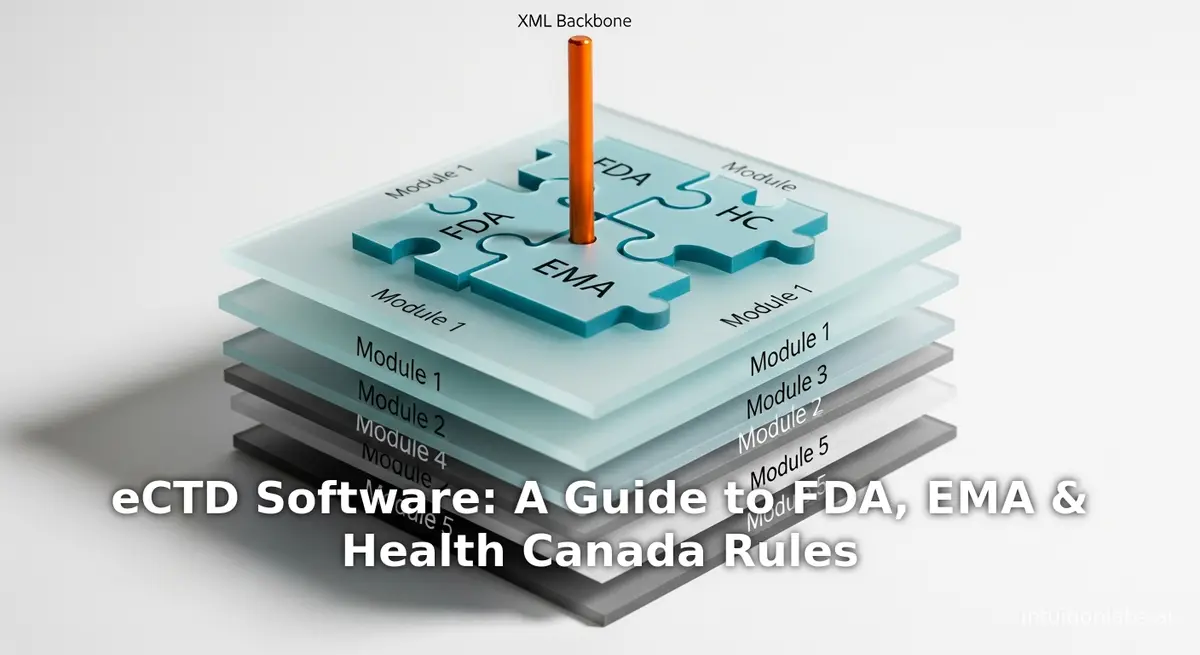
eCTD Software: A Guide to FDA, EMA & Health Canada Rules
Learn the technical requirements for eCTD software submissions to the FDA, EMA, and Health Canada. Updated May 2026 with the latest eCTD v4.0 mandates including Japan's April 2026 cutover.
eCTD v4.0 Explained: Implementation & Global Timelines
Guide to eCTD v4.0 regulatory submissions. Learn about HL7 FHIR standards, document reusability, and global implementation deadlines for FDA and EMA.