


Zero Data Retention for Gemini and Vertex AI: A Life Sciences Deep Dive
Executive Summary
Google's zero data retention story spans what were, until recently, three separately branded products, and is now, following a 2026 consolidation, effectively two. The self-serve Gemini Developer API is one path. The contractually gated Gemini Enterprise Agent Platform, the current name for what was Vertex AI's generative AI offering, is the other; Vertex AI's own zero data retention documentation now redirects into the Agent Platform's page, not a separate policy. Reaching genuine zero retention on either surface means working through a longer, more granular checklist than any other platform in this series: a standard abuse-monitoring tier, a stricter mandatory-retention tier for specific "Advanced AI" models, two separate grounding features with two different, non-optional retention windows, an API parameter that defaults to the wrong setting if left unspecified, and a data residency model with a global-endpoint trap that provides no residency guarantee unless a buyer actively pins a region. This guide walks through each of these, the current governance story for Google's coding-agent CLI, and closes with a platform-specific version of this series' buyer checklist.
What Zero Data Retention Means
Zero data retention, as this series uses the term, is not one feature. It ranges from a self-serve API parameter to a sales-gated enterprise agreement to a contractual data processing addendum, and it differs by platform and by which product tier a team actually uses. If you're arriving at this guide directly rather than from the first piece in this series, the short version is: naming this spectrum upfront prevents the common buyer mistake of assuming "does this vendor offer zero data retention" has a single yes-or-no answer. The full walk-through of that spectrum, and how it compares across ChatGPT, Claude, Copilot, and Gemini, lives in the series' opening guide.
Google's version of this spectrum is unusually granular. Where ChatGPT's system resolves into three named tiers and Copilot leans on real-time processing that avoids logging by design, Google's own current documentation lists eight distinct areas a customer has to individually address before they can honestly claim zero retention. That is the shape of the rest of this guide.
One Policy, Not Two: Vertex AI's Consolidation into Gemini Enterprise Agent Platform
If you have an old bookmark or a vendor quote that references Vertex AI's zero data retention page, it is worth checking where that link actually goes today. As of this guide's research, Vertex AI's own generative AI data governance and zero data retention page redirects into Gemini Enterprise Agent Platform's current zero data retention page.[1] These are not two policies under two names. They are the same document under two historical URLs. A related, smaller finding: the legacy Vertex AI abuse monitoring page still resolves and carries a banner stating "Vertex AI documentation is no longer being updated... See the most up-to-date information in the Agent Platform documentation," last updated June 1, 2026.[2] It repeats the same standard-tier numbers as the current page but omits the newer Advanced AI tier described below, a checkable, real example of documentation drift worth watching for on any platform, not just citing as trivia.
What remains genuinely distinct is not two products but two routes. The Gemini Developer API is the self-serve, individual-developer-facing surface.[3] Gemini Enterprise Agent Platform is the contractual, account-team-gated enterprise surface, the current identity of what was Vertex AI's generative AI offering.[1] A buyer's first internal question should be which of these two their team is actually using, since the defaults and approval paths differ between them.
The Full Zero Data Retention Checklist
Google's own documentation lists eight areas that together determine whether a workload is genuinely at zero retention. None of them is optional to check; several default to the wrong setting if left untouched.
| Area | Default state | Retention window | Opt-out available |
|---|---|---|---|
| Standard abuse-monitoring logging | On, for standard Cloud Platform ToS customers | Up to 90 days | Yes, via request form; automatic exemption under a Master Agreement |
| Advanced AI tier logging | On for named models | Up to 30 days | Not always; contact your account team |
| Grounding with Google Search | On if feature is used | Up to 3 days | No direct opt-out; use Web Grounding for Enterprise instead |
| Grounding with Google Maps | On if feature is used | 30 days | None |
| Request-response logging | Off by default | N/A unless enabled | Already off; do not enable |
Interactions API store parameter | Defaults to true if unspecified | Until deleted | Yes, set store=false explicitly |
| CodeMender agent sessions | On during active session | 7 days (encrypted), deletable early | Yes, delete the session |
| Live API session resumption | Off by default | Up to 24 hours if enabled | Already off; do not enable |
Standard abuse-monitoring logging is the baseline every customer starts from. Google's own language: automated safety classifiers that detect suspicious activity trigger logging "solely for the purpose of examining whether a violation... has occurred," stored "for up to 90 days in the same region or multi-region selected by the customer."[2] Customers with a Google Cloud Master Agreement are exempt from this by default, a real, checkable contractual distinction. Everyone else can request an exception through a Google-hosted form; if approved, "Google won't store any prompts associated with the approved Google Cloud account."[2]
The Advanced AI tier is easy to misread as a looser, more permissive tier because of the name. It is the opposite. Under this tier, "all prompts and responses will be logged and securely stored for up to 30 days for the sole purpose of monitoring for abuse," and "it may not be possible to opt-out of prompt-response logging when using some Advanced AI features."[2] Google's own list of in-scope models includes Claude Mythos, Claude Fable 5, and, in principle, Claude Opus 4.7 and later or Sonnet 5 and later when used under Anthropic's Cyber Verification Program, though Google's documentation notes that program "is not supported on Google Cloud" today, making that last carve-out mostly theoretical for now.[2]
Two grounding features carry their own non-optional windows, and they are not the same window. Grounding with Google Search stores derived queries and context for up to three days, with no direct way to disable it beyond switching to a distinct alternative feature, Web Grounding for Enterprise.[1] Grounding with Google Maps is stricter still: prompts, context, and generated output are stored for thirty days, and "there is no way to disable the storage of this information if you use Grounding with Google Maps."[1] If your use case touches location-based grounding, there is no configuration path to zero retention for that specific feature, full stop.
The Interactions API's store parameter is this platform's version of a trap other platforms in this series also have in different forms: "if you do not specify a value for store, it defaults to true for all models. To achieve zero data retention, explicitly set store = false in your API requests."[1] A team that assumes zero retention is the default, and never explicitly sets this parameter, is wrong.
The two more agent-specific rows round out the table. CodeMender's session data, source code snippets, diffs, and analysis checkpoints, is stored encrypted for up to seven days from session creation, cleared within seconds once a session ends, with the remaining record auto-deleted at the seven-day mark; customers can also delete a session outright before that window closes.[1] Live API session resumption caches prompt and output data, including audio and video, for up to 24 hours if a customer turns it on, but it is off by default.[1] One additional area, in-memory data caching, does not appear in the table above because Google's own documentation states it explicitly does not violate zero data retention as-is (the cache is in-memory only, isolated per project, with a 24-hour TTL), though it can be disabled at the project level via documented API calls if a buyer wants to remove it anyway.[1] Separate from all eight rows above: "Google won't use your data to train or fine-tune any AI/ML models without your prior permission or instruction," a training restriction, not a retention window, worth keeping distinct in your own internal notes.[1]
Claude on Google Cloud: Same Company, Different Terms
Google's Gemini Enterprise Agent Platform also hosts Anthropic's Claude models, and the terms that apply to them there are worth a buyer's attention independent of whatever Anthropic's own direct API terms say. For most Claude versions running on Google Cloud, "use of Anthropic models on Gemini Enterprise Agent Platform is governed by Anthropic's Commercial Terms of Service or other applicable agreement with Anthropic," and the retention exposure is the same standard 90-day, Master-Agreement-exempt regime described above, not a Claude-specific term.[4]
Two named exceptions are stricter, not looser, and non-optional. Google's documentation states plainly: "for Anthropic Claude Fable 5 on Google Cloud and Mythos 5, prompts and responses are retained for up to 30 days. To use Claude Fable 5 on Google Cloud and Mythos 5, as required by Anthropic, you must enable sharing this data with Anthropic for abuse monitoring."[2] That last clause matters: this retention is imposed by Anthropic's own requirement as a condition of Google hosting these specific models, not by a Google platform choice. A buyer running Claude Fable 5 or Mythos 5 on Google Cloud is working under different terms than one running the same model family directly through Anthropic, a brand-versus-infrastructure distinction that extends the same trap this series' pillar guide already names for brand-versus-product-tier comparisons. Separately, "accessing Claude on Google Cloud models through Agent Platform meets the FedRAMP High requirements," worth one line for any buyer with government-adjacent research contracts, independent of HIPAA.[4]
Data Residency and the Global-Endpoint Trap
Data residency and zero data retention are related questions but not the same one. Residency is about where processing happens; retention is about how long data is kept. Google's current model defines three endpoint tiers. Jurisdictional multi-region endpoints keep "ML processing... within that specific geographical region." Locational endpoints keep processing "entirely within the broader multi-regional or country jurisdiction associated with that region." Global endpoints are the trap: they "route and process data anywhere globally, without restricting it to a specific geographic region," and Google states directly that they "don't provide regional isolation or data residency guarantees."[5] Global is also the path of least resistance for a developer who never actively pins a region, which means a buyer who assumes residency is guaranteed by default is working from a false assumption.
The EU multi-region endpoint has its own carve-out worth flagging before a European buyer over-trusts it: "the European Union multi-region (eu) endpoint strictly covers data residency within EU member states. Geographies outside the European Union political boundary, including the United Kingdom and Switzerland, are excluded from this endpoint."[5] As of this guide's research, Google's own native-model residency table covers the US and EU multi-regions plus Brazil, Canada, France, Germany, the Netherlands, the United Kingdom, Australia, India, Japan, Singapore, and South Korea. The partner-model table, which covers Claude and other third-party models, is narrower: US and EU multi-region, Belgium, the Netherlands, Singapore, Taiwan, and a global option.[5] A buyer running Claude on Google Cloud has fewer residency choices than one running native Gemini models, worth knowing before assuming parity across model families.
One correction worth stating plainly rather than fixing silently: an earlier pass on this guide carried an assumption, sourced from a search-result summary rather than Google's own primary table, that Gemini 3.7 Flash and 3.6 Flash ran only on the global endpoint with no residency option. Direct verification against Google's own current residency table found both models listed with data residency support in the US and EU multi-regions. That correction is stated here plainly, because catching and stating a sourcing error is part of this series' own verification standard, not something to quietly paper over.
For any buyer with a workload touching government isolation requirements rather than general enterprise compliance, one more distinction matters: "models not explicitly listed as supporting US multi-regions don't meet DoD IL5 commitments," and workloads requiring frameworks like DoD IL5 or ITAR "should be deployed on jurisdictional endpoints," not locational ones.[5] Most life sciences buyers will not need this distinction, but it is worth naming for completeness, since IL5/ITAR commitments and general data residency are sometimes conflated in procurement conversations.
HIPAA and the BAA: Which Products Are Actually Named
This section is deliberately short. IL already has a full platform-by-platform HIPAA comparison, and it covers Google's BAA scope in more depth than this section will repeat here. What is worth stating directly: Google Cloud's current HIPAA compliance page, last updated August 11, 2026, names a specific list of covered products relevant to Gemini and Vertex, including "Gemini Enterprise," "Gemini Enterprise Agent Platform," "Gemini Code Assist," "Gemini in BigQuery," "Gemini in Colab Enterprise," "Gemini Notebook Enterprise," "Generative AI on Gemini Enterprise Agent Platform," and "Agent Search on Gemini Enterprise Agent Platform."[6] Bare "Vertex AI" no longer appears as a standalone named entry, consistent with the consolidation already described above. Two carve-outs worth naming plainly for anyone handling protected health information: "when using Agent Search on Gemini Enterprise Agent Platform, use regional APIs and resource locations for PHI," and pre-GA offerings should not be used for PHI at all.[6] Google's HIPAA page points to a linked support article for the actual BAA acceptance steps rather than describing a clearly self-serve or clearly sales-gated process on the page itself; verify the exact mechanism directly with your Google Cloud account team rather than assuming either.
From Gemini CLI to Antigravity CLI
Engineering teams evaluating Google's platforms need to know that the command-line tool itself has changed, and changed recently. Google announced Antigravity CLI at I/O 2026 on May 19; Gemini CLI stopped serving requests for Google AI Pro, Google AI Ultra, and free-tier individual accounts starting June 18, 2026.[7][8] Enterprise accounts on Gemini Code Assist Standard or Enterprise, or with paid Gemini Enterprise Agent Platform API keys, retained Gemini CLI access through the transition, but the free and individual path is closed.
This is not just a rename. On August 20, 2026, Google Cloud published a post folding Antigravity into eligible Gemini Enterprise subscriptions with real governance features attached: "central audit logging: enable comprehensive audit logging with a single toggle, capturing prompts, agent responses, and metadata for compliance reporting," configurable security policies covering "workspace sandboxing, and browser and MCP server access," and a data privacy commitment to "maintain data ownership under Google Cloud's Terms of Service, ensuring all agent activity executes strictly within your secure cloud boundary."[9] That is the freshest and most directly relevant asset in this entire guide's sourcing. The exact console location for the audit-logging toggle is documented in prose, and the required IAM role and log stream name are named directly, but no console screenshot of the toggle itself has surfaced yet, worth stating honestly rather than implying more visual confirmation exists than actually does.[10]
Antigravity CLI itself is a real, working tool today, not a placeholder. Google's own official Codelab, last updated June 17, 2026, walks through installation and basic usage with genuine command examples:
mkdir agy-cli-projects
cd agy-cli-projects
A sample interaction from the same source: typing a prompt returns a normal conversational response, and typing /help opens a three-tab command reference (general, commands, shortcuts) listing the tool's full command set, including /permissions for managing tool access and /config for opening settings.[11] This is first-party, current, and independently verified, not a screenshot description taken on faith.
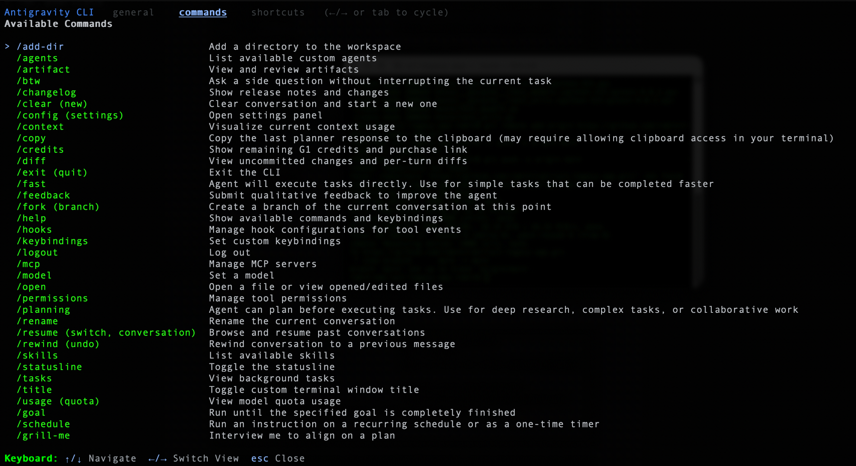 Antigravity CLI's
 /help command reference, from Google's official Codelab. Source: codelabs.developers.google.com/antigravity-cli-hands-on
What the Admin Console Actually Shows
Not every control in this guide has a matching console screenshot, and this series holds itself to a standard of saying so plainly rather than implying otherwise. No screenshot of Gemini Enterprise Agent Platform's own zero-retention console screen has surfaced in this guide's research; the exact navigation path and required role are documented in prose in the sections above instead.
What does exist, and closes most of a gap this guide's own drafting process initially left open, is a set of genuine console screenshots from a Google Cloud engineer's own Terraform deployment walkthrough, published February 22, 2026 and updated July 8, 2026.[12] It shows a per-region authentication settings table (global, US, EU, each marked with an identity provider or "not set up"), a Gemini Enterprise overview screen with setup cards for Workforce Identity Federation, IAM permissions, and license management, and the same overview screen after Workforce Identity Federation is actually wired up, with a live URL path referencing a workforce pool and OIDC provider. None of these is a pure "configure your identity provider" form screenshot, but together they are genuine, current, first-party evidence that identity federation is a real, visible, configurable state in this console, not just a documented promise. The same source includes complete, working Terraform configuration for setting this up, a workforce pool resource, an OIDC provider block, and IAM bindings, useful for any engineering team that wants to see the actual infrastructure-as-code rather than click through an admin UI by hand.
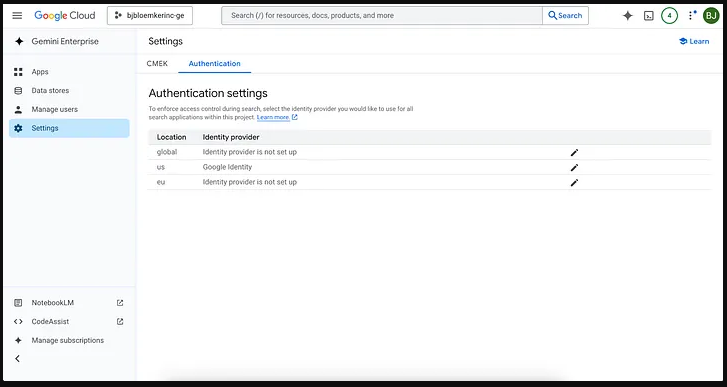 Per-region authentication settings table (global, US, EU). Source: medium.com/google-cloud/deploying-gemini-enterprise-using-terraform
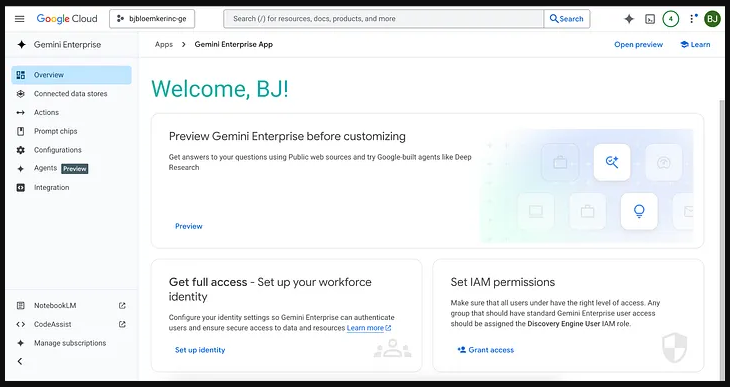 Gemini Enterprise overview screen, pre-setup, showing Workforce Identity setup, IAM permissions, and license management cards. Source: medium.com/google-cloud/deploying-gemini-enterprise-using-terraform
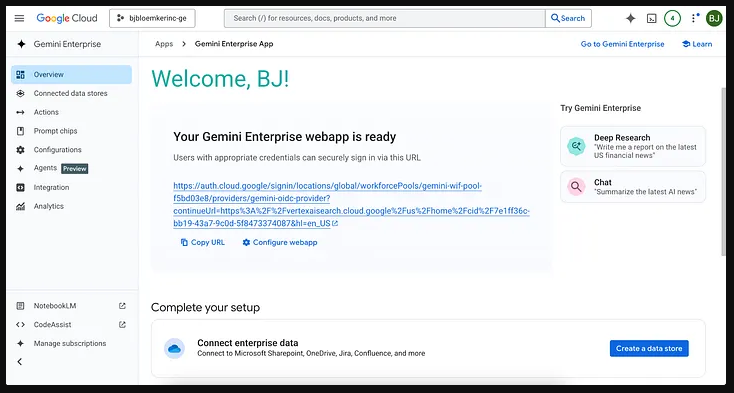 The same overview screen after Workforce Identity Federation is wired up, showing the live workforce pool/OIDC provider URL path. Source: medium.com/google-cloud/deploying-gemini-enterprise-using-terraform
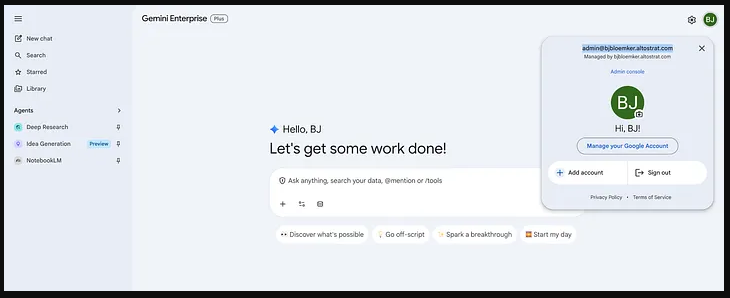 The signed-in Gemini Enterprise chat interface under both Google Identity and Workforce Identity Federation. Source: medium.com/google-cloud/deploying-gemini-enterprise-using-terraform
A separate, smaller finding worth noting for anyone auditing terminology drift: the current IAM role name for granting access still reads roles/discoveryengine.agentspaceUser, carrying the product's old "Agentspace" name inside a role identifier even after the product itself was renamed, a small, concrete example of the same naming consolidation already described in this guide's opening sections.[12]
Three further genuine screenshots, from dated Google Workspace product update posts, show adjacent admin surfaces relevant to a compliance team's own internal monitoring, not zero data retention directly, but worth knowing about: a Gemini Enterprise settings panel covering service status and data-sharing controls (April 2026),[13] a per-feature usage and threshold report an admin can pull to see who is using which Gemini capabilities (February 2026),[14] and a simple user-access toggle controlling whether the Gemini app is available org-wide (originally documented October 2024).[15]
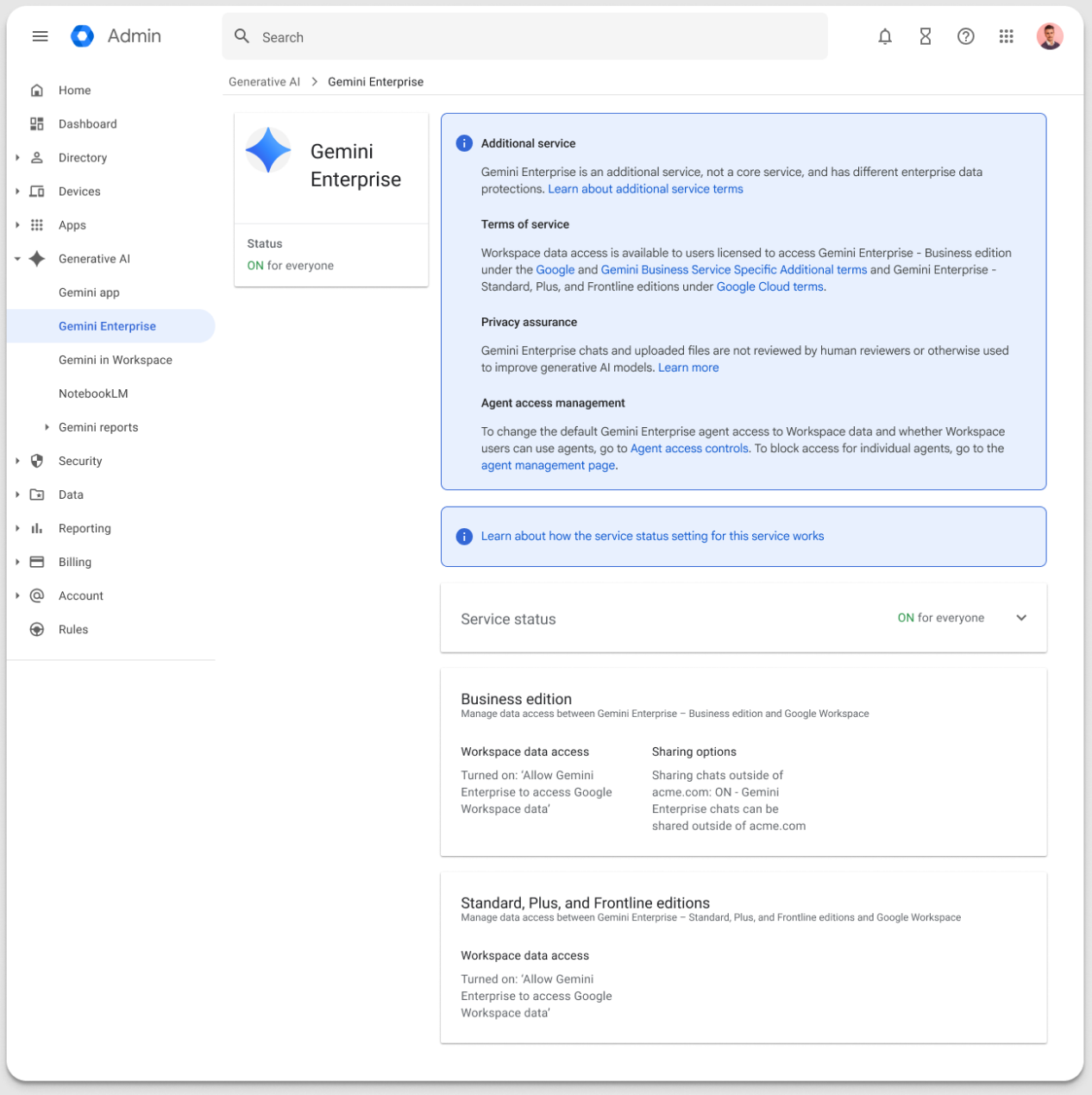 Gemini Enterprise admin settings panel: service status and data-sharing controls (April 2026). Source: [1]
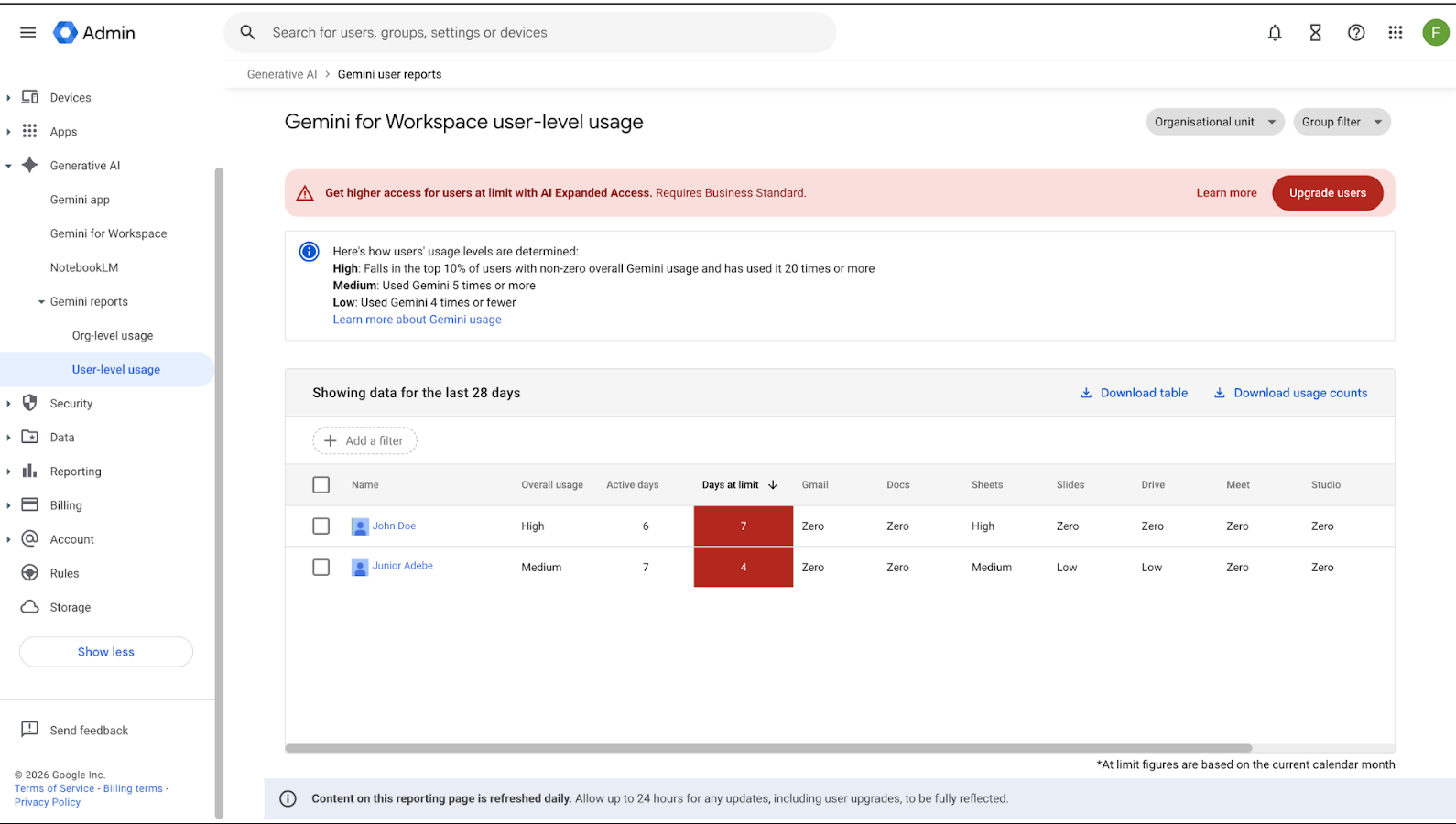 Per-feature usage and threshold report (February 2026). Source: [2]
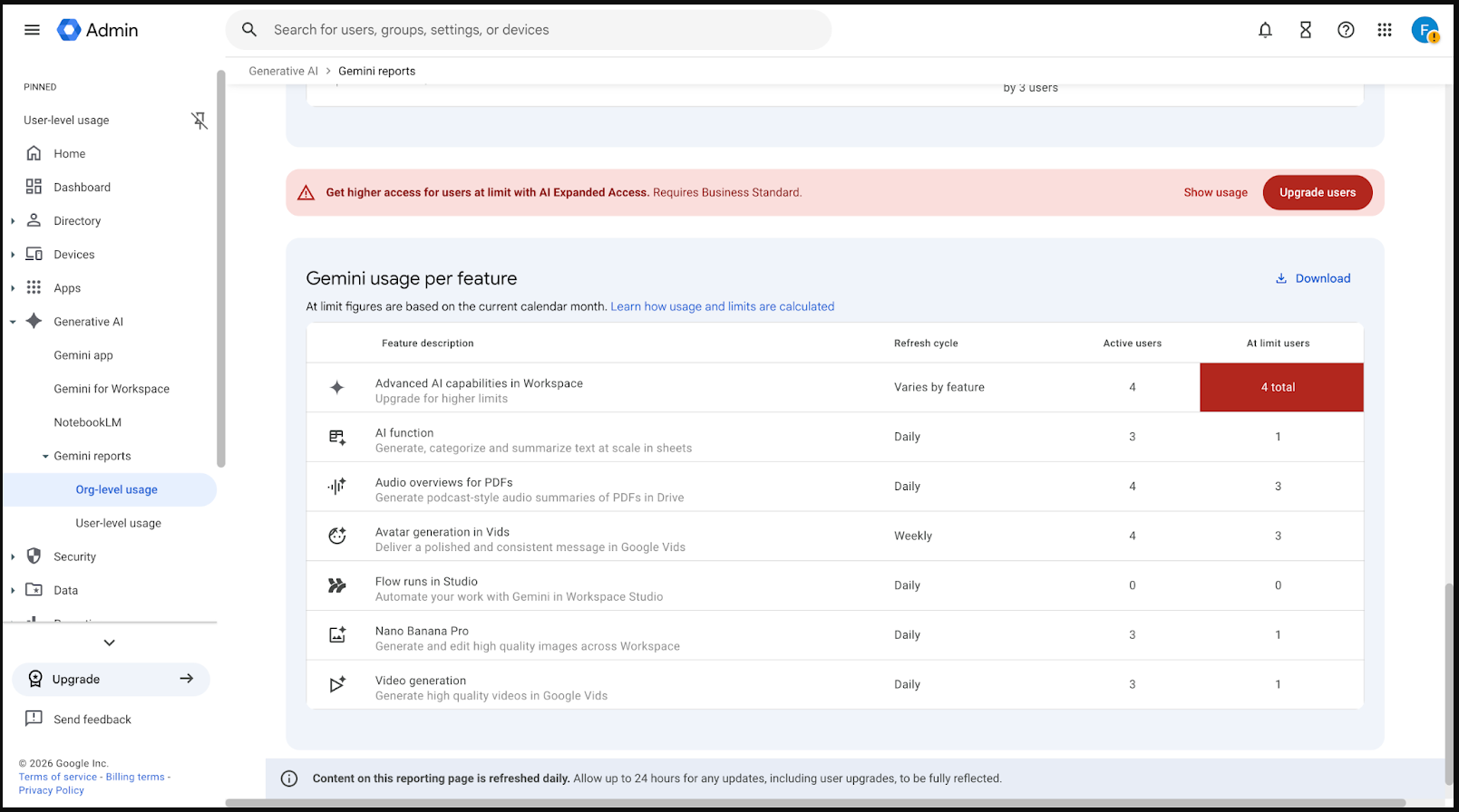 User-level usage report, same post as above (February 2026). Source: [2]
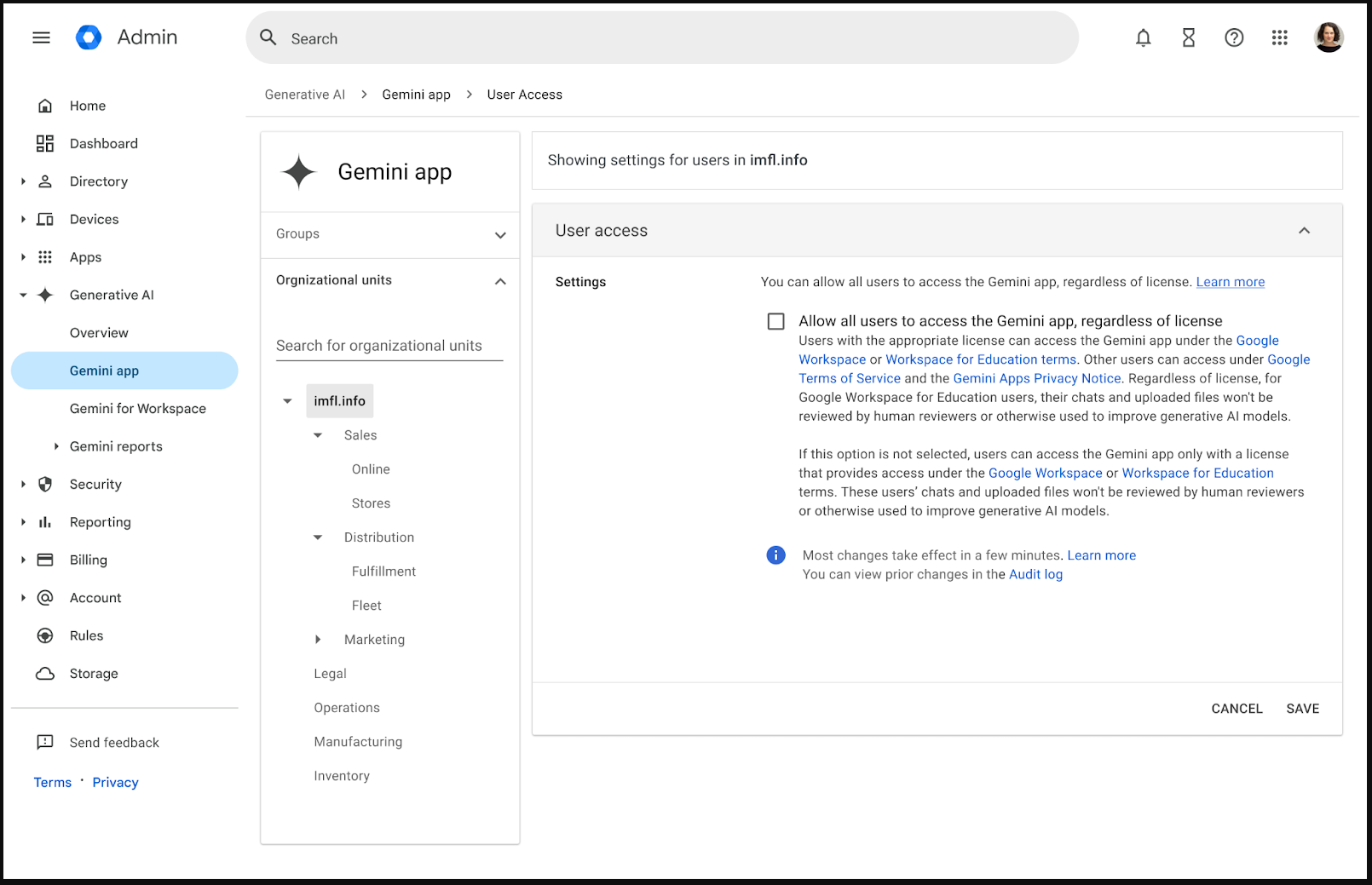 Admin console toggle controlling whether the Gemini app is available org-wide (originally documented October 2024). Source: [3]
What to Ask Before You Sign
Before signing, a life sciences buyer evaluating Gemini or Vertex AI should be able to get a straight answer to each of the following:
| Question | Why it matters |
|---|---|
| Are we using the self-serve Gemini Developer API or the contractually gated Gemini Enterprise Agent Platform? | The mechanics and defaults differ between the two routes described above. |
| Do we have a Google Cloud Master Agreement? | It changes your default abuse-monitoring exposure automatically. |
| Does our use case touch Grounding with Google Search or Google Maps? | Neither offers a true opt-out; Maps offers none at all. |
| If we're running Claude models on Google Cloud, which versions? | Mythos and Fable 5 carry a mandatory 30-day retention distinct from Anthropic's own direct ZDR terms. |
| Is our traffic pinned to a jurisdictional or locational endpoint, or defaulting to global? | The global endpoint provides no residency guarantee at all. |
| If HIPAA applies, is the specific product we're using named on Google's current BAA-covered list? | "Gemini" as a brand is not the same statement as a specific named, covered product. |
For the fuller platform-by-platform HIPAA comparison behind that last question, see IL's existing guide. For the general version of this checklist across all four major platforms, see the series' opening guide.
What's Next in This Series
This is one of four platform-specific deep dives in IL's zero data retention series, alongside the pillar's four-platform overview. The four deep dives are complementary, not sequential, and can be read in any order: the ChatGPT and OpenAI API deep dive, the Copilot and Azure OpenAI deep dive, and the Claude and Anthropic deep dive, covering console navigation for privacy controls and Claude Code's own zero data retention scope. Readers who have not yet read the series' opening guide should start there. Readers evaluating an AI vendor specifically for a validated GxP environment should also read IntuitionLabs' existing platform-by-platform HIPAA comparison, which covers ground this guide deliberately does not repeat.
No vendor relationship with Google informed this guide's research. IntuitionLabs is a member of the Claude Partner Network, disclosed here for transparency since Claude on Google Cloud is discussed above.
External Sources (15)[1]https://docs.cloud.google.com/gemini-enterprise-agent-platform/resources/zero-data-retention
[2]https://docs.cloud.google.com/vertex-ai/generative-ai/docs/learn/abuse-monitoring
[3]https://ai.google.dev/gemini-api/docs/zdr
[4]https://docs.cloud.google.com/gemini-enterprise-agent-platform/models/partner-models/claude
[5]https://docs.cloud.google.com/vertex-ai/generative-ai/docs/learn/data-residency
[6]https://cloud.google.com/security/compliance/hipaa
[7]https://developers.googleblog.com/an-important-update-transitioning-gemini-cli-to-antigravity-cli/
[8]https://github.com/google-gemini/gemini-cli/discussions/28017
[10]https://docs.cloud.google.com/gemini-enterprise-agent-platform/models/enable-audit-logs
[11]https://codelabs.developers.google.com/antigravity-cli-hands-on
[12]https://medium.com/google-cloud/deploying-gemini-enterprise-using-terraform-79677d97c574
[14]https://workspaceupdates.googleblog.com/2026/02/view-gemini-feature-usage-and-threshold.html
External Sources (3)

Need Expert Guidance on This Topic?
Talk to IntuitionLabs about how to put this guide into practice on your team.
I'm Adrien Laurent, Founder & CEO of IntuitionLabs. With 25+ years of experience in enterprise software development, I specialize in creating custom AI solutions for the pharmaceutical and life science industries.
DISCLAIMER
The information contained in this document is provided for educational and informational purposes only. We make no representations or warranties of any kind, express or implied, about the completeness, accuracy, reliability, suitability, or availability of the information contained herein. Any reliance you place on such information is strictly at your own risk. This document may contain content generated with the assistance of artificial intelligence technologies. AI-generated content may contain errors, omissions, or inaccuracies. Readers are advised to independently verify any critical information before acting upon it. All product names, logos, brands, trademarks, and registered trademarks mentioned in this document are the property of their respective owners.