



Hosted Claude Science, Ready in Any Browser
Anthropic ships Claude Science for macOS and Linux only. We give every scientist a dedicated, powerful Linux server with their workbench already running — reached from any browser on any laptop, Windows included, with shared project storage and managed infrastructure behind it.
Why research teams ask us to host it
Claude Science is a desktop application with a hard platform requirement and an appetite for compute. Three things stop teams from adopting it on their own, and all three are infrastructure problems rather than science problems.
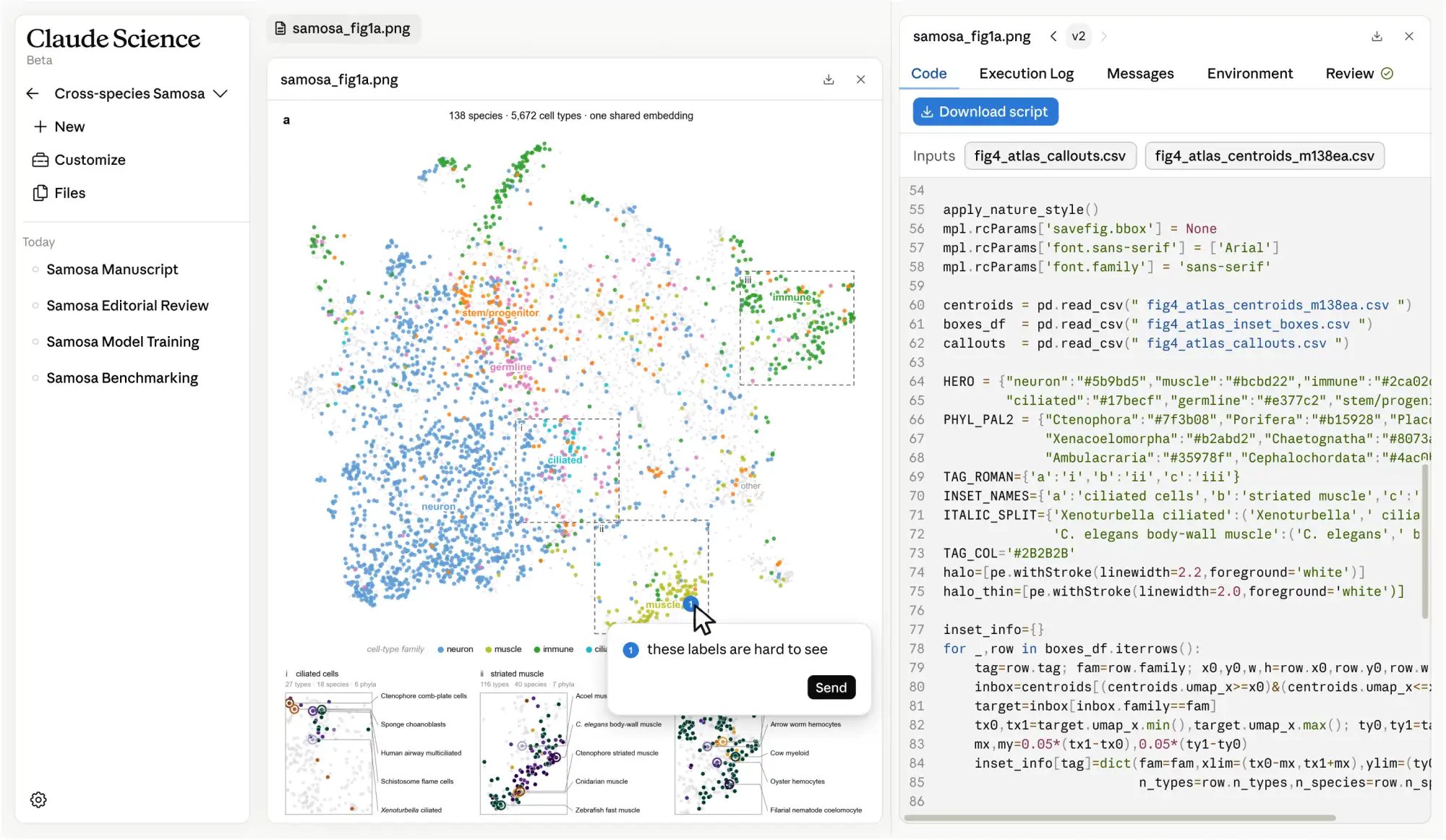
A workbench where every result carries its own provenance
- Provenance is the feature that changes how a research organisation can use an AI tool at all. A chat transcript is not evidence. An artifact bound to the code that generated it, the package versions it ran against, and the reasoning that led there is something a second scientist can inspect, a supervisor can sign off, and a reviewer can challenge.
- That matters twice over in a regulated setting. It gives you a defensible answer to "how did you get this number", and it gives you a practical answer to the staff-turnover problem that quietly destroys institutional knowledge in computational groups — the analysis leaves with the person who wrote it. Work produced on a hosted pod inherits this by default, and the pod adds an infrastructure-level audit trail underneath it.
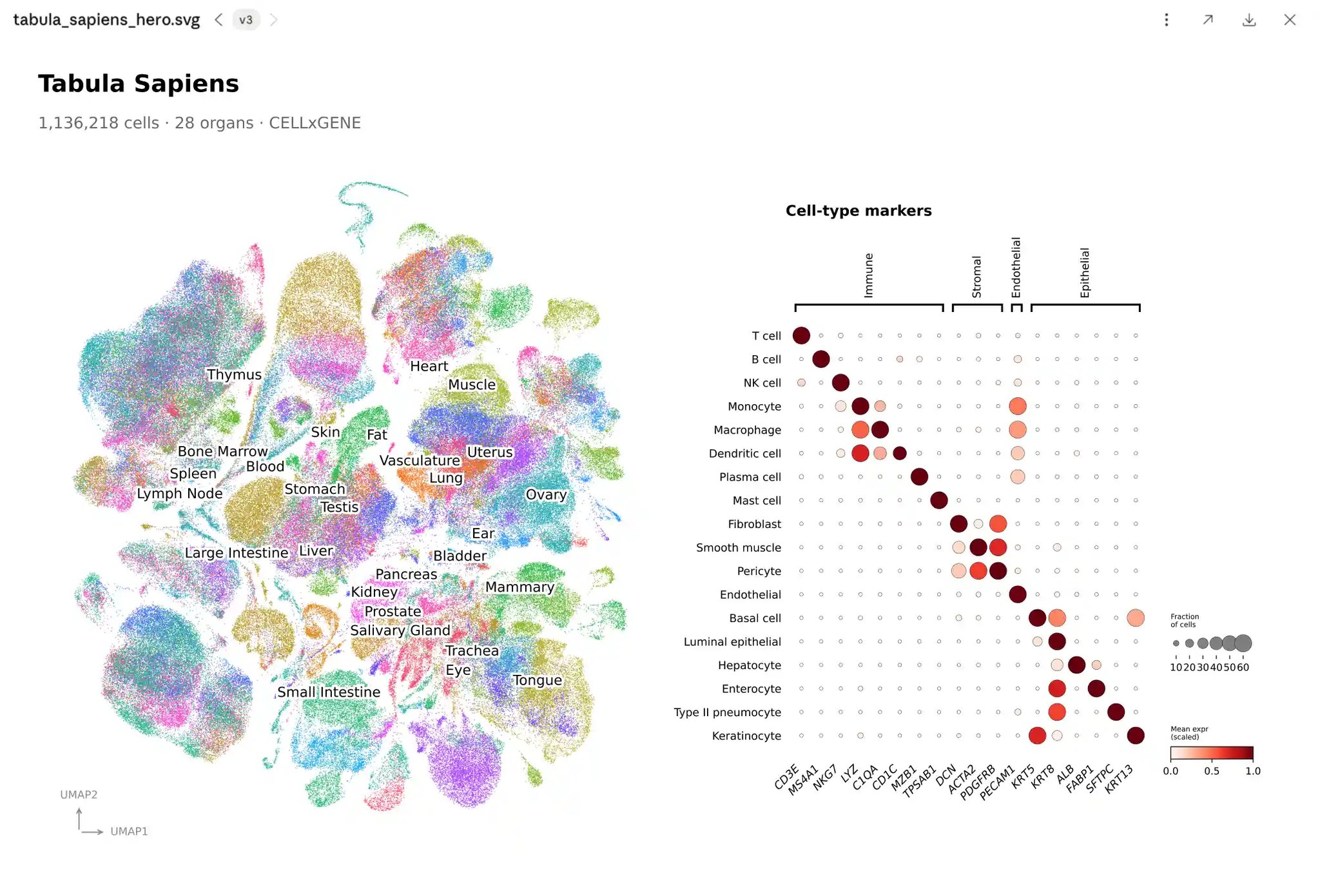
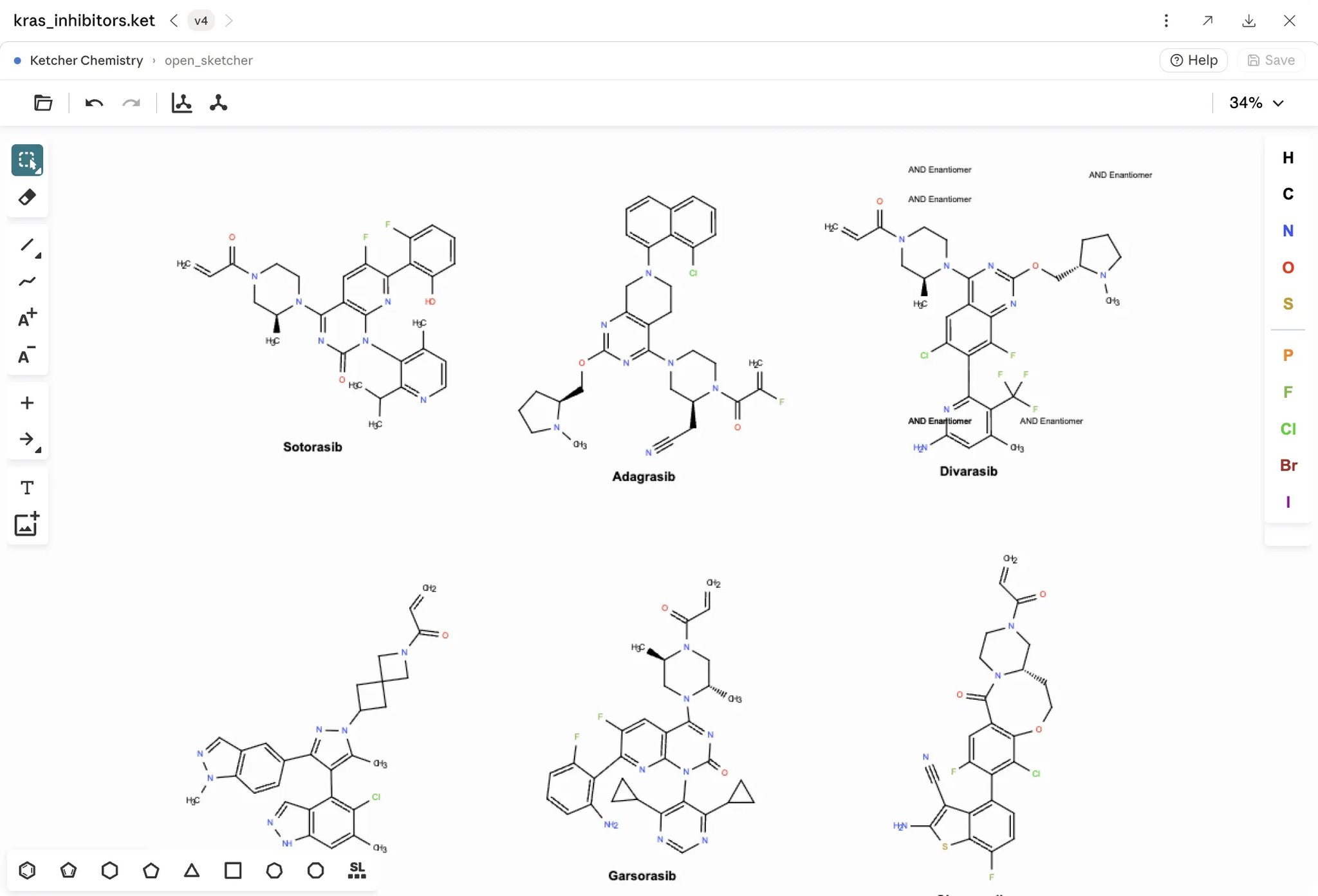
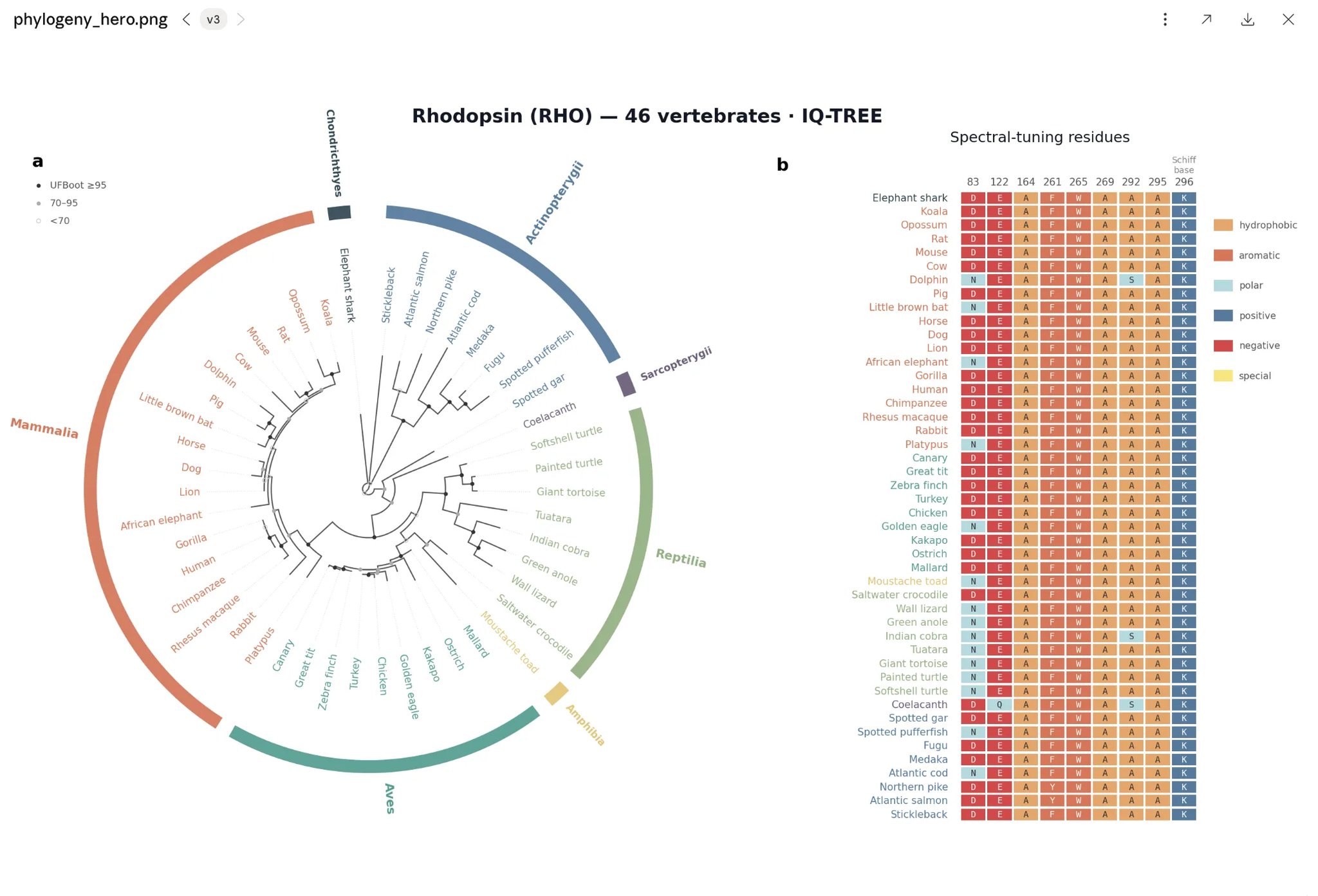
- Screenshots on this page are Anthropic's own published product images, reproduced to illustrate the application we host.
A reviewer agent that checks the work before you see it
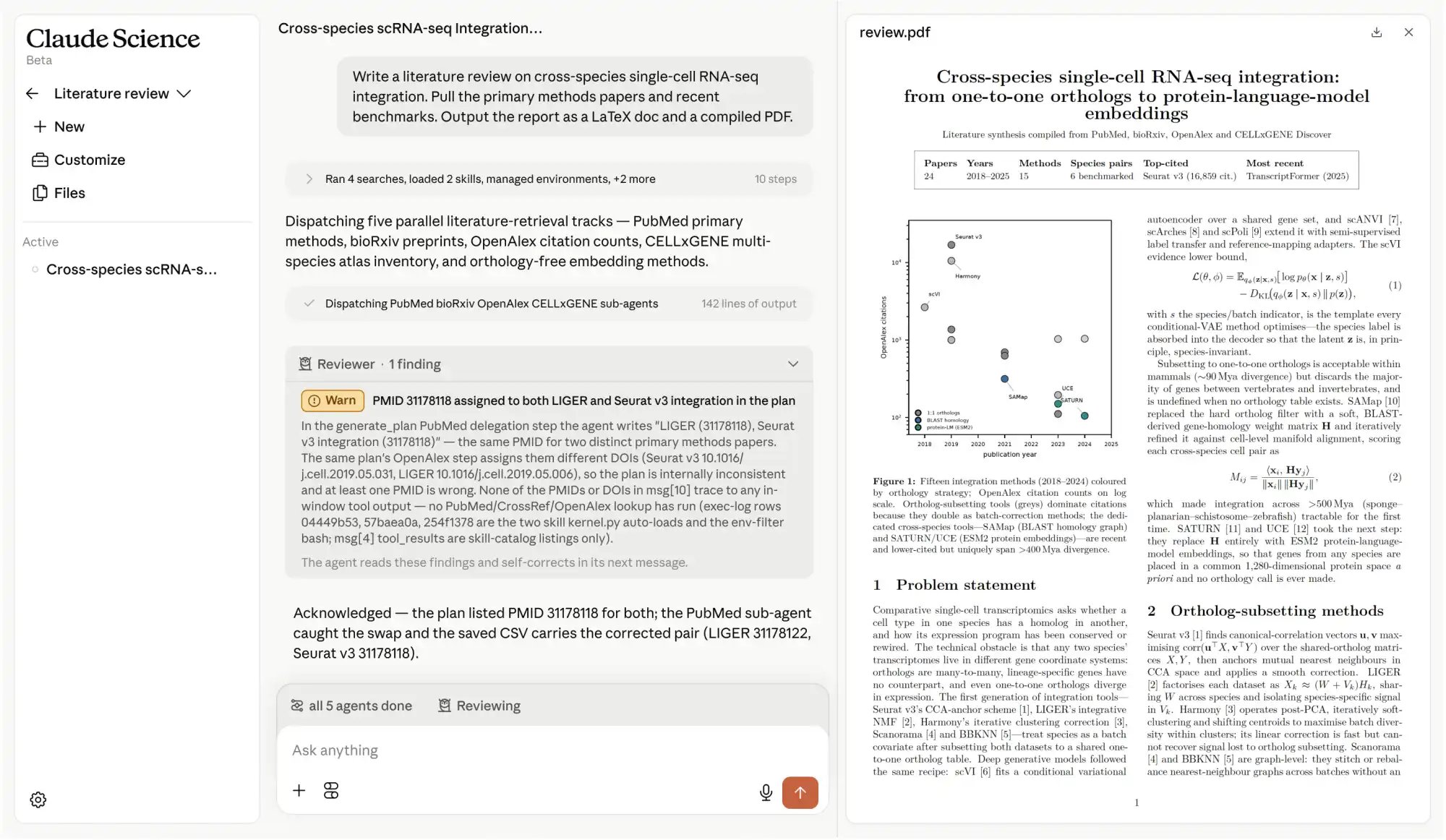
- The failure mode everyone fears with AI in research is the confident, well-formatted, wrong answer — a mis-assigned PMID, a statistic with no traceable source, a figure caption describing a chart that says something else. Those errors are expensive precisely because they look finished.
- The reviewer agent attacks that directly. In Anthropic's own example the reviewer catches the same PubMed identifier being assigned to two distinct methods papers, explains why the plan is internally inconsistent, and hands the finding back for correction before the result surfaces. It is not a guarantee of correctness and it does not remove the scientist from the loop, but it moves a whole category of mistake from invisible to flagged.
- Teams doing medical review, triage, or evidence synthesis tend to weight this capability more heavily than raw analytical speed, because their bottleneck was never generating text.
Cluster jobs and live kernels, driven from the same session
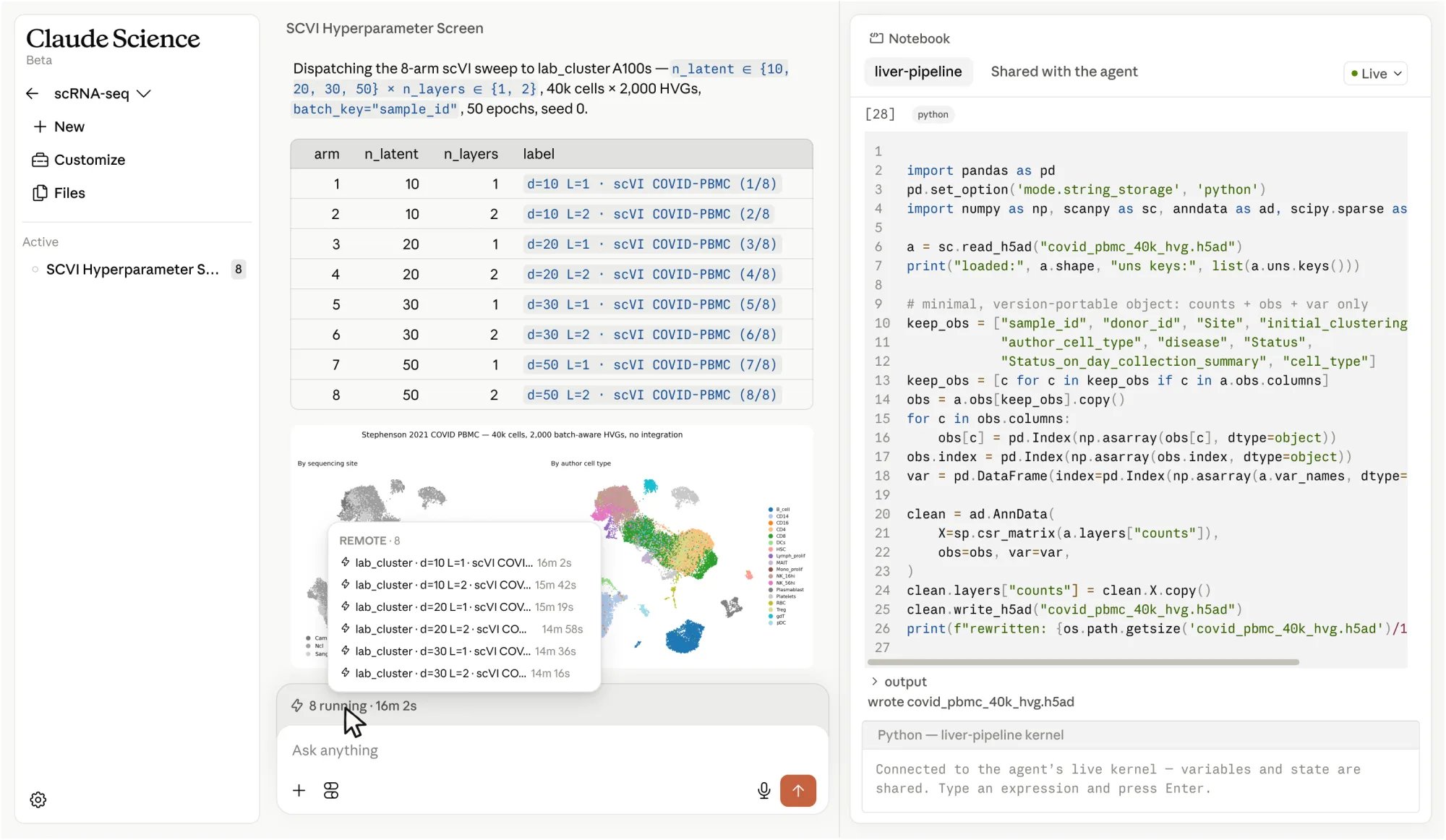
- This is where hosting stops being a workaround for Windows and starts being the better architecture. A pod sits inside your network, close to your storage and adjacent to your cluster, so submitting an eight-arm parameter sweep to your own GPUs is a local operation rather than a VPN-mediated one.
- It also means the expensive compute never has to be bought twice. Claude Science orchestrates the resources you already own — your Slurm queue, your object storage, your reference data — and the pod is the controlled front door to them. Groups that already run <a href="https://www.nextflow.io/" target="_blank" rel="noopener noreferrer">Nextflow</a> pipelines or a <a href="https://bioconductor.org/" target="_blank" rel="noopener noreferrer">Bioconductor</a> stack keep all of it.
- For teams without a cluster, the same mechanism scales out to on-demand GPUs, so a group of six scientists can run structural or model-training work without a capital purchase.
Native rendering for the objects scientists actually work with
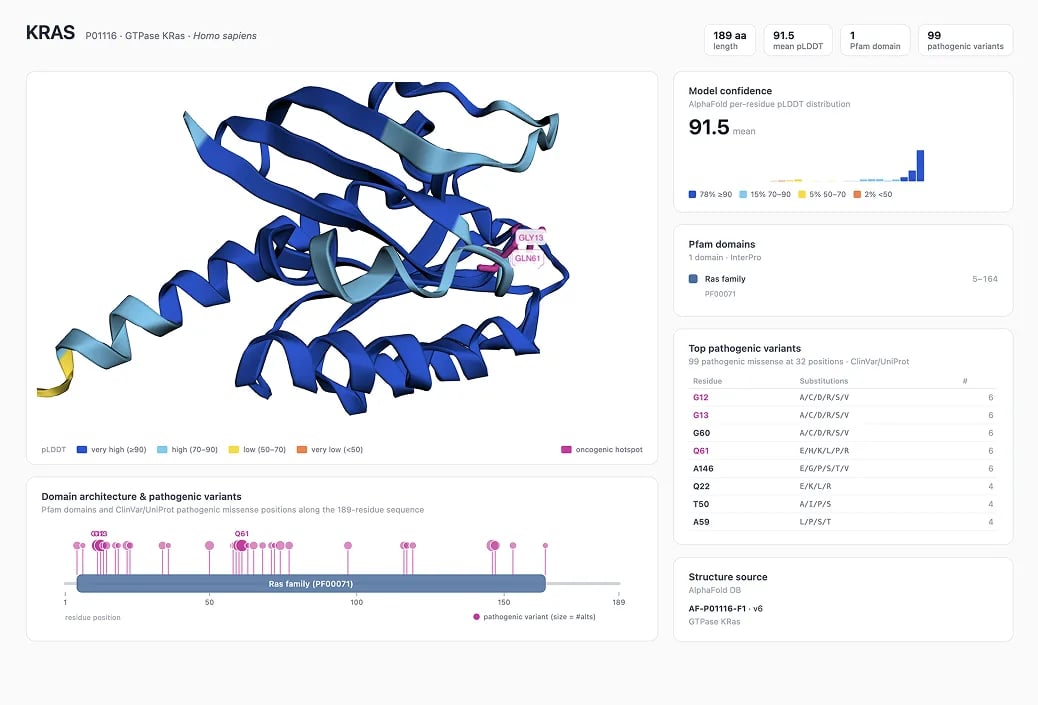
- The practical effect is that a scientist stops context-switching between a chat window, a viewer, a notebook, and a plotting script. Pulling a predicted structure from <a href="https://alphafold.ebi.ac.uk/" target="_blank" rel="noopener noreferrer">AlphaFold DB</a> or the <a href="https://www.rcsb.org/" target="_blank" rel="noopener noreferrer">RCSB Protein Data Bank</a>, layering on domains and clinical variants, and exploring it in 3D all happen in the same place as the analysis.
- On a hosted pod this is also the reason the browser experience holds up. The heavy rendering and the data both stay on the Linux machine; the laptop is a display and a keyboard. A structural session that would stall a thin corporate laptop behaves the same on a Chromebook as it does on a workstation.
Four honest ways to run Claude Science
Hosting is not always the right answer. This is how the realistic options compare for a research organisation, including the two that do not involve us at all.
| Approach | Works for Windows users | Compute ceiling | Who operates it | Typical blocker |
|---|---|---|---|---|
| Install on the scientist's own Mac | No — requires buying Macs | Laptop RAM and CPU | Your IT endpoint team | Procurement cycle and a second endpoint fleet to manage |
| Install on an existing lab Linux box | Yes, over SSH or the browser | Whatever that box has | Whoever already runs it | Shared state, no isolation between users, nobody formally on call |
| Install on your HPC login node | Yes, over SSH or the browser | Full cluster via Slurm | Scientific computing team | Login-node policy, change control, and queue contention |
| Hosted pods from IntuitionLabs | Yes, from any browser | Sized per user, plus your cluster or on-demand GPUs | IntuitionLabs, as a managed service | Security review and data classification, which we start on day one |
How a hosted Claude Science pod is built
Every scientist gets one dedicated Linux virtual machine — not a shared login server and not a container that several people take turns using. Per-user isolation is a deliberate choice: scientific sessions are long-running and stateful, so one colleague's runaway memory allocation should never be able to kill another's eight-hour analysis, and access review is far easier to evidence when one machine maps to one named person.
Isolated compute does not mean isolated people. Alongside each private pod, project teams get shared volumes mounted into every member's machine, so a reference dataset is stored once and read by everyone, and a colleague's analysis is a path rather than an email attachment.
1. Placement and residency
We deploy into your AWS, Azure, or Google Cloud tenancy, into your on-premises virtualisation platform, or into infrastructure we operate — whichever your data residency and procurement rules require. Running inside your own tenancy keeps compute, storage, network logs, and billing under the cloud governance and contracts you already have, with us operating the environment on top.
2. Identity and access
Sign-in runs through your existing identity provider — Okta, Microsoft Entra ID, Google Workspace, or any standard SAML or OIDC service — so there is no second password and no orphaned account. On the Anthropic side, the Enterprise plan adds single sign-on, SCIM provisioning, custom roles, and usage analytics. When your directory disables an account, pod access ends with it.
3. The browser session
Anthropic supports connecting to a Claude Science installation from your browser; we make that connection a managed, authenticated, TLS-terminated endpoint instead of a hand-rolled SSH tunnel. The scientist opens a URL, authenticates as they would for any internal system, and lands in their own running workbench with their files and kernels exactly where they left them.
4. Data and compute attachment
We mount the storage that person is entitled to reach, configure credentials for internal systems, and wire up job submission to your Slurm cluster over SSH or to on-demand GPUs. Reference data and public resources such as NCBI, UniProt, Ensembl, and ChEMBL are reachable from the pod.
5. Shared project storage
Shared team volumes mount into every pod on the project, so reference genomes, cohort data, and intermediate results are stored once and read by everyone entitled to them — no duplicated copies per laptop and no versions quietly diverging. Group membership is driven by the same directory groups you already manage, and permissions are set per volume, so a collaborator on one study does not gain visibility into another. When someone leaves, the work stays with the project instead of leaving in a personal home directory.
6. Baseline, patching, and change control
Pods are built from a documented, version-controlled image rather than configured by hand, so every machine in your estate is the same machine and we can tell you exactly what is on it. Operating system and application updates run on a defined cadence under change control, with the configuration baseline and its history available as evidence for your quality organisation.
7. Right-sized hardware
Pods are sized against the actual workload rather than sold in fixed tiers, and resized as projects change. A literature and metadata pod is modest; a single-cell pod holding a multi-million-cell atlas in a persistent kernel needs an order of magnitude more memory than any laptop can address. That gap is the most common reason teams come to us. GPUs can be attached directly for structural and model work, or reached by dispatching jobs to your cluster.
8. Backup and continuity
Home directories, shared project volumes, and working data are backed up on an agreed schedule with a tested restore path — the single largest practical gain over the status quo of analyses living on individual laptops. A pod can be rebuilt from its image and its backup, so a lost machine is an inconvenience rather than the loss of three months of a project.
Claude Science itself remains Anthropic's application, updated by Anthropic and governed by your own Claude plan. What we take responsibility for is everything underneath and around it — the machine, the network, the identity integration, the data plumbing, the monitoring, and the person who answers when a job fails at an inconvenient hour.
Controls that make a security review survivable
The security questionnaire is usually the longest pole in adopting a new research tool. These are the controls we implement as standard, and the evidence we hand your information security and quality teams.
Per-user isolation
One scientist, one virtual machine, one set of credentials. Private home directories with no lateral visibility, while shared project volumes are mounted explicitly and permissioned per group — so least-privilege access is demonstrable rather than asserted.
Federated identity and MFA
Authentication delegated to your identity provider, inheriting your existing multi-factor and conditional access policies. Joiner, mover, and leaver processes work unchanged, and deprovisioning is immediate rather than a ticket.
Network containment
Pods sit in defined network segments with explicit egress rules, private connectivity to your data sources, and no general-purpose inbound access. Encrypted transport for the session and encryption at rest for pod storage.
Audit logging
Authentication events, session activity, and administrative changes are logged and retained to your policy, and can be forwarded to your own SIEM so this environment appears in the same monitoring as the rest of your estate.
Documented baseline
A version-controlled build with a known package inventory, change control over modifications, and installation and operational qualification evidence available for regulated environments as a documented deliverable.
Defined data boundary
Raw datasets and compute stay on infrastructure you control; prompt and response content is processed by Anthropic under your plan terms. We document that boundary explicitly so your privacy team can assess it properly.
Single-cell and transcriptomics at dataset sizes laptops cannot hold
- A pod sized for this work removes the ceiling without asking the scientist to learn cluster job submission first. Reference atlases from <a href="https://cellxgene.cziscience.com/" target="_blank" rel="noopener noreferrer">CELLxGENE Discover</a> and tooling such as <a href="https://scanpy.readthedocs.io/" target="_blank" rel="noopener noreferrer">Scanpy</a> are available in the environment, and heavier sweeps dispatch to your cluster or to on-demand GPUs from the same session.
- Because every figure stays welded to the code and environment that produced it, the iterate-revert-fork cycle that defines this kind of analysis stays reproducible instead of becoming a folder of undated PNGs.
Cheminformatics and molecular design in a live session
- The databases that matter here — <a href="https://www.ebi.ac.uk/chembl/" target="_blank" rel="noopener noreferrer">ChEMBL</a> for bioactivity, <a href="https://pubchem.ncbi.nlm.nih.gov/" target="_blank" rel="noopener noreferrer">PubChem</a> for compound data — are among the 60-plus scientific sources the workbench can query directly, so a medicinal chemist is not writing API clients before doing chemistry.
- On a hosted pod the whole toolchain is installed once, in a build we control and can reproduce, rather than negotiated separately with endpoint security on each chemist's machine.
Phylogenetics, evolution, and comparative genomics
- Alignment and tree inference results depend on tool versions and parameters in ways that are easy to lose track of and painful to reconstruct at review time. A pod built from a version-controlled image, combined with artifacts that carry their own environment metadata, means a tree produced in March can still be explained in November.
- Sequence and annotation resources including <a href="https://www.ensembl.org/" target="_blank" rel="noopener noreferrer">Ensembl</a> and <a href="https://www.ncbi.nlm.nih.gov/" target="_blank" rel="noopener noreferrer">NCBI</a> are reachable directly, and literature retrieval across <a href="https://pubmed.ncbi.nlm.nih.gov/" target="_blank" rel="noopener noreferrer">PubMed</a> and <a href="https://www.biorxiv.org/" target="_blank" rel="noopener noreferrer">bioRxiv</a> runs in the same session as the analysis.
What you bring, and what we bring
Your Claude plan
Your data and compute
Our managed pods
What the managed service covers
A fixed scope so you can tell what you are buying, and so your procurement and security teams can review it without a discovery call for every question.
Provisioning and sizing
Pod build, per-user sizing against real workloads, and resizing as projects change. Machines are created from a version-controlled image, so the estate stays uniform and reproducible rather than drifting into snowflakes.
Scope your pilotIdentity integration
SAML or OIDC integration with Okta, Microsoft Entra ID, Google Workspace, or your provider of choice, plus support for configuring single sign-on, SCIM provisioning, and roles on the Anthropic side for Enterprise plans.
AI governanceData and cluster connectivity
Mounting entitled storage, configuring credentials for internal systems, and wiring job submission to your Slurm cluster over SSH or to on-demand GPUs, so the workbench reaches the compute you have already paid for.
Discuss integrationInternal system connectors
Connecting electronic lab notebooks, internal APIs, and bespoke pipelines through connectors and the Model Context Protocol, prioritising the two or three systems that will actually be used rather than everything at once.
AI enablementOperations and support
Patching under change control, monitoring, backup with a tested restore path, and a named engineer who understands both the infrastructure and the science, so an escalation does not start with explaining what a kernel is.
Talk to usValidation support
Qualification evidence for the pod build, documented configuration baselines, and access logs to support your own validation activities. Full computer system validation is available as a separate, scoped engagement.
CSV servicesHow we start, and where the boundaries are
A pilot that tests adoption, not just installation
We start with three to eight scientists working on real projects, because the only reliable way to learn whether a computational workbench earns its place is to point it at work someone genuinely needs finished. Demo datasets prove the software installs; they tell you nothing about whether people will still be using it in week six.
A pilot runs on three parallel tracks from day one: the technical build, the security and data classification review, and the administrator enablement on your Claude plan. Running those in sequence instead of in parallel is the single most common reason a pilot that should take two weeks takes two months. At the end we review honestly, including the case for stopping — if the pilot group did not adopt it, a wider rollout will not fix that, and we would rather say so than sell you forty pods that go idle.
Where this fits alongside your validated systems
A research workbench is not a validated system of record, and it should not quietly become one. We help teams draw that line explicitly: exploratory and hypothesis-generating work on the pod, regulated records in the systems built to hold them, and a documented handoff between the two rather than an accidental one.
For work that touches regulated records, validation is an activity performed against your intended use, your procedures, and your risk assessment — not a property a vendor can ship. We supply the qualified infrastructure layer and its evidence; your quality organisation defines intended use and runs acceptance testing, guided by GAMP 5 and, where electronic records and signatures are in scope, 21 CFR Part 11. Our computer system validation team can run that engagement, and it is deliberately scoped and priced separately from hosting so neither one hides inside the other.
Working with a life sciences specialist
IntuitionLabs works exclusively in pharmaceutical, biotechnology, and life sciences, and is a member of the Claude Partner Network. That matters mainly in what we do not need explained: what a GxP boundary is, why a bioinformatician cares about environment drift, and why "just give them local admin" is not an available answer in your organisation.
We are not an Anthropic reseller, and nothing here should be read as an Anthropic endorsement of this hosting service. Claude and Claude Science are Anthropic products; for authoritative product information, supported platforms, and terms, go to Anthropic's own documentation. The product screenshots on this page are Anthropic's published material, reproduced to show what the application looks like. If your situation genuinely does not need us — you have a Linux fleet, a platform engineer, and a completed security review — we will say so on the first call. Related work we do: AI enablement, AI readiness assessment, and computer system validation.
Hosted Claude Science: common questions


Give your scientists the workbench their laptops cannot run
Tell us how many scientists, what they analyse, and which constraints you are working under. We will tell you honestly whether hosted pods are the right answer — and what a pilot would take.
Book a Meeting