



Private Inference for Open-Weight Models
Give your scientists DeepSeek, Kimi, Qwen and the rest of the open-weight field in a private workspace — signed in through your own identity provider, reached with no inbound ports, with no training on your data.
Why life science teams run their own
Open-weight models are now genuinely competitive for research work, and they change the economics of using AI at volume. What stops most regulated organisations is not the models — it is everything around them.
A private workspace your scientists recognise immediately
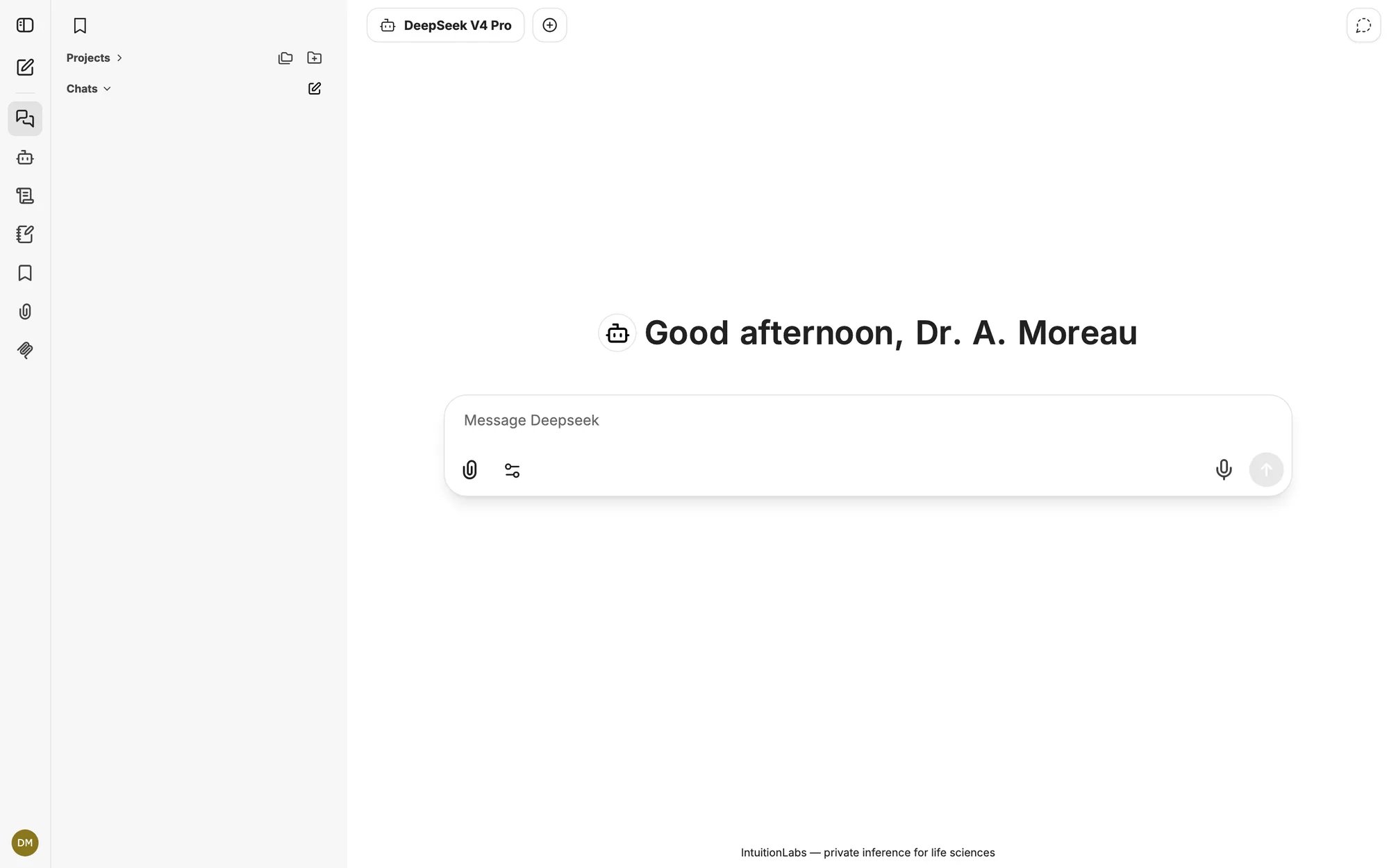
- Adoption in a research organisation is decided by the first five minutes. If a scientist has to install a client, request a licence, generate an API key, or read documentation, the tool loses to the consumer product they already have open in another tab. The point of hosting this properly is that the compliant option is also the easiest one.
- Because it runs in the browser, the operating system on the endpoint stops mattering. Windows-managed laptops, locked-down virtual desktops, Macs, and tablets all reach the same workspace, which matters in organisations where the standard build is deliberately restrictive.
Pick the right open-weight model for the task
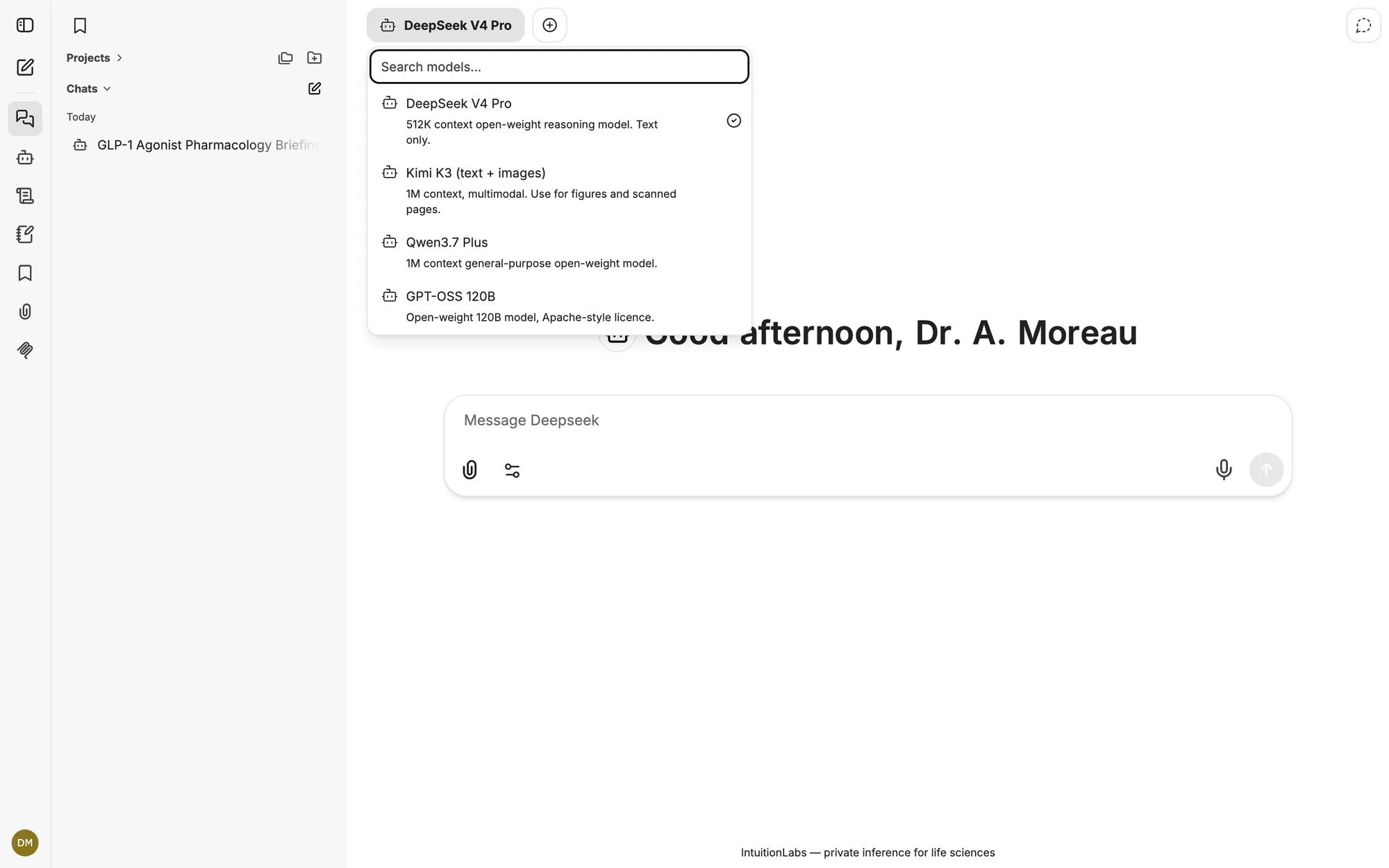
- Curation is deliberate. The upstream catalogue runs to hundreds of models, and exposing all of them produces inconsistent output quality, avoidable spend, and support tickets about which one to use. A short list with honest descriptions — including the limitations, such as which models cannot read images — is far more useful than an exhaustive dropdown.
- The list is configuration, not architecture, so it tracks a field that moves monthly. When a materially better open-weight model ships, we evaluate it against your actual workload and swap it in; nothing about your data, your identity integration, or your users changes.
Real pharmacology and regulatory work, not demo prompts
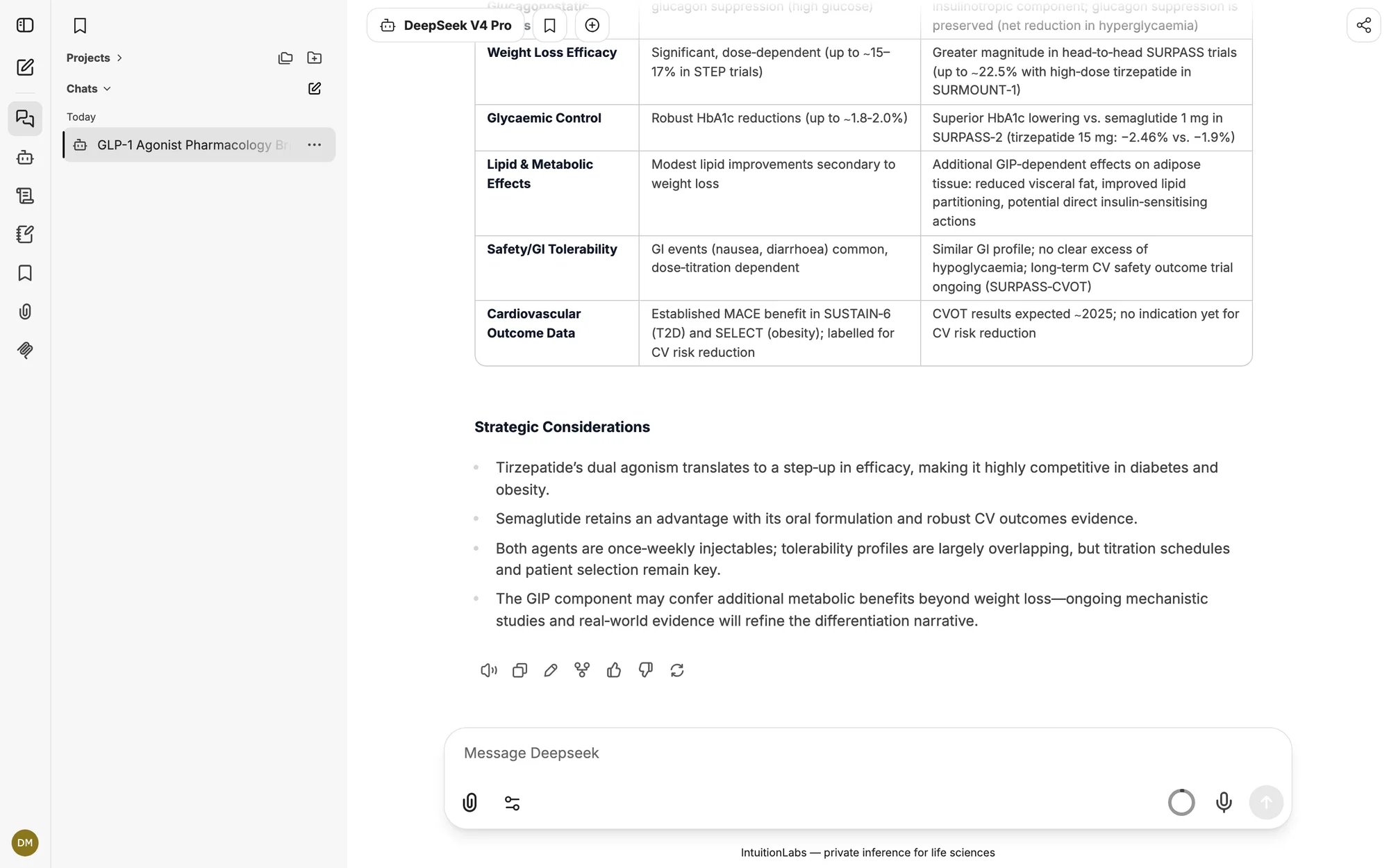
- The realistic value is drafting and triage rather than final answers. A briefing that would take a medical writer half a day arrives in a minute at perhaps eighty per cent quality, and the expert time goes into checking and sharpening rather than assembling. That is a genuine productivity change, and it is also why the workspace should sit inside your governance rather than outside it.
- Nothing here removes the need for verification. Models still get citations wrong and state plausible numbers with unwarranted confidence, which is exactly why the output belongs in a controlled environment where provenance and review are part of the workflow.
Visible reasoning on clinical development questions
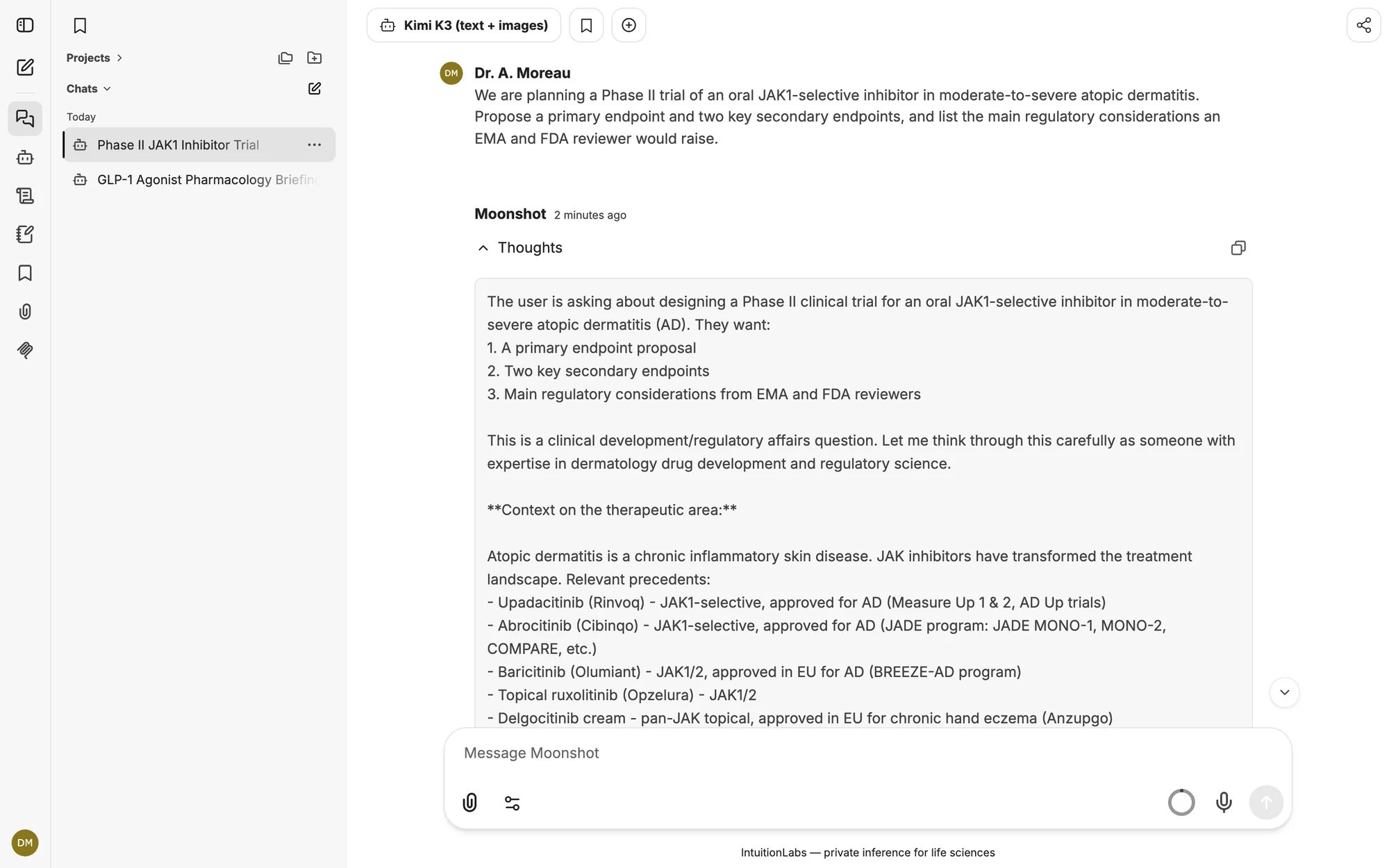
- For regulated work this transparency is worth more than raw fluency. When you can read the chain — which approved products the model treated as precedent, which endpoints it considered standard, where it hedged — you can judge whether to trust the conclusion, and you can spot the specific step where it went wrong rather than discarding the whole answer.
- It also makes the tool teachable. A junior team member reading how an experienced-sounding chain of reasoning is constructed learns the shape of the argument, which is a different and often more durable benefit than the answer itself.
Four ways a life science team can use large language models
Each of these is the right answer for some organisation. This is where the trade-offs actually fall, including the two that do not involve us.
| Approach | Where your text goes | Model choice | Identity & access | Typical blocker |
|---|---|---|---|---|
| Consumer AI accounts | A personal multi-tenant account | One vendor | Personal logins, no oversight | Ungoverned; usually banned, often used anyway |
| Commercial frontier API | Vendor infrastructure, enterprise terms | One vendor | Whatever you build around it | Per-token cost at volume; you still build the workspace |
| Private workspace, hosted inference | Your database; inference under no-retention terms | Any open-weight model | Your identity provider, policy-gated | Security review and data classification |
| Fully self-hosted GPUs | Never leaves your network | Any open-weight model | Your identity provider | Capital cost and permanent specialist staffing |
How the deployment is put together
The design goal is that there is nothing on the public internet to attack, and that identity is decided by your directory rather than by a list we maintain. Everything below is standard in every deployment, not an upgrade tier.
1. Single sign-on through your identity provider
Staff authenticate with Okta, Microsoft Entra ID, Google Workspace, or any standard SAML or OIDC provider, inheriting your existing multi-factor and conditional-access rules. Self-service registration is disabled outright — finding the URL grants nothing. Login method can be pinned per email domain, so employees must come through your corporate directory while a named set of external collaborators uses a separate, narrower route.
2. Secure tunnelling via a web application proxy
No public IP, no inbound firewall rule, no exposed port. A connector inside the environment opens an outbound-only tunnel to an edge network that publishes your private hostname, and every request is authenticated at the edge before it is forwarded. There is no login page on the open internet to brute-force and no service banner to fingerprint — and no VPN client for staff to install, because the browser is the access path.
3. A second, fail-closed identity check
Inside the environment a small proxy independently validates the signed identity token on every request and rejects anything unsigned, expired, or issued for another application. If the edge policy were ever deleted or misconfigured, the application still refuses rather than serving. The application binds the loopback interface only, so it is not reachable on the network even from inside our own infrastructure.
4. Your own data stores
Conversations, users, uploaded files, the search index, and the vector embeddings live in a dedicated database on a dedicated machine — no shared multi-tenant store, no other client's data alongside yours. Placement follows your residency obligations: infrastructure we operate, your own cloud tenancy, or your datacentre.
5. Verified no-retention inference
The inference organisation account is configured with prompt and response storage off and training on submitted data off. We additionally verify that each model you use is served natively rather than relayed to a third-party upstream, because a relayed model would place your text under a different provider's policy. That check is repeated whenever a model is added or changed.
6. Documented build, backups, and change control
The environment is built from a documented, version-controlled configuration rather than assembled by hand, so we can tell you exactly what is running and reproduce it. Updates run under change control, and the whole environment is snapshotted nightly to a separate backup server with a tested restore path.
What we deliberately switch off
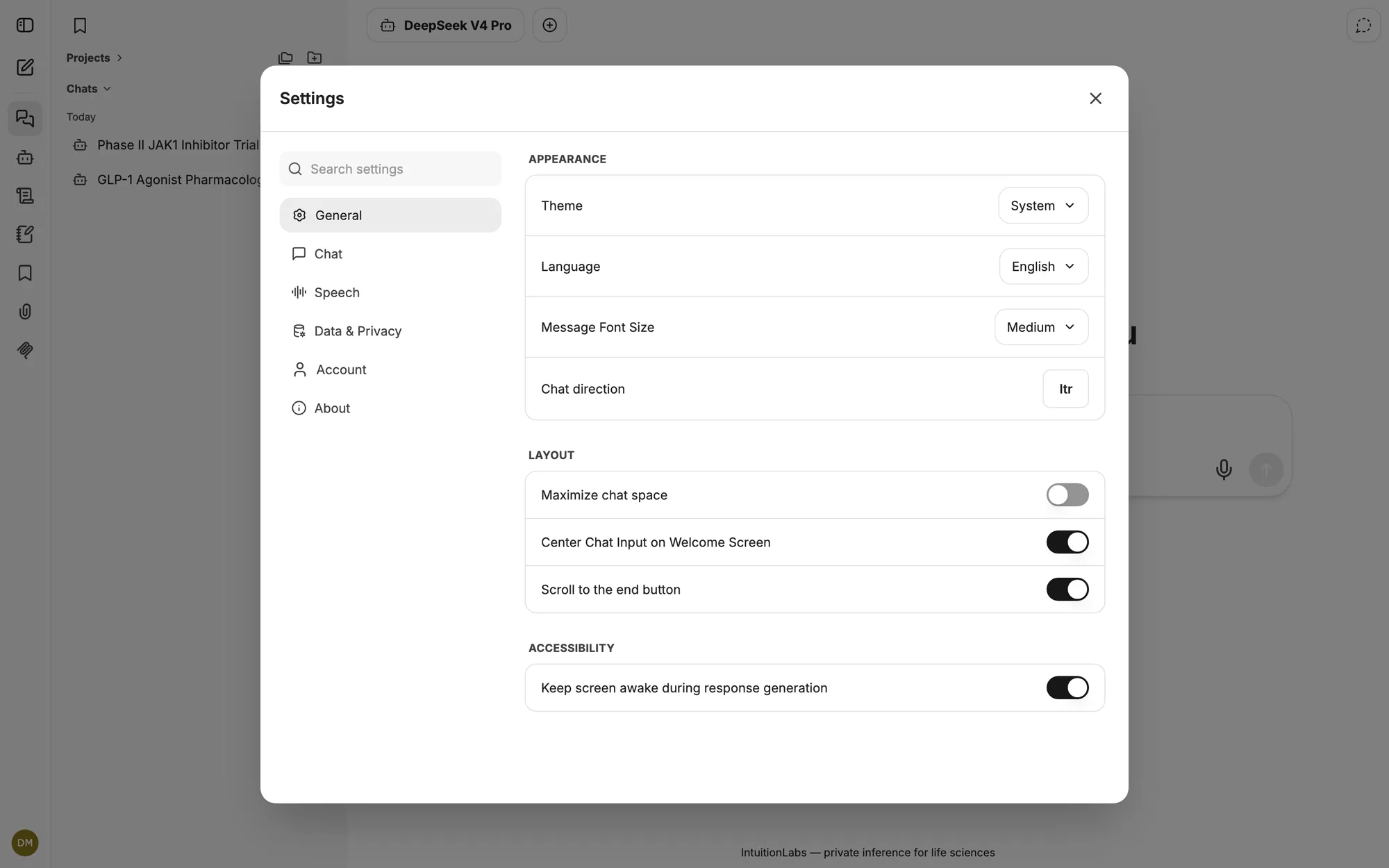
A research workspace should be narrower than a consumer product. These defaults are closed; opening any of them is a decision with a documented reason, made with you.
Long-term memory
The system does not accumulate a persistent profile of what each user has asked across conversations. Context stays inside the conversation where the user put it, which keeps the data footprint predictable and reviewable.
Public link sharing
A conversation cannot be published to the open internet by a single click. Sharing works only between authenticated users of your own instance — the most common accidental-disclosure path in consumer AI tools is simply removed.
Arbitrary code execution
The workspace does not run generated code in a sandbox by default. Teams that genuinely need computational execution are better served by a purpose-built scientific environment than by a chat tool quietly gaining an interpreter.
Self-service registration
No account can be created by discovering the URL. Access is granted by identity policy on domain and group membership, so the user list is a consequence of your directory rather than a separate thing to audit.
Personal API keys
Users are never prompted to supply their own model or search credentials. Everything is centrally credentialled, so keys do not end up pasted into personal notes, shared between colleagues, or left active after someone leaves.
Image generation
Picture generation is disabled. It adds cost, moderation exposure, and a category of output with no research value here, while inviting exactly the kind of casual use that makes a governance conversation harder later.
Open-weight models available through hosted inference
A representative selection of the open-weight models we can expose in your workspace, served through Together AI. Context is the maximum window; prices are the provider's published serverless rates per million tokens, verified against their live model API on 12 August 2026. Rates and available models change frequently — treat this as a snapshot for comparison, not a quotation, and confirm current pricing before budgeting.
| Model | Publisher | Context | Input / 1M | Output / 1M | Licence |
|---|---|---|---|---|---|
| DeepSeek V4 Prodeepseek-ai/DeepSeek-V4-Pro | DeepSeek | 512K | $1.74 | $3.48 | Open weights |
| DeepSeek V4 Flashdeepseek-ai/DeepSeek-V4-Flash-0731 | DeepSeek | 1.05M | $0.14 | $0.28 | Open weights |
| DeepSeek V3.1deepseek-ai/DeepSeek-V3.1 | DeepSeek | 131K | $0.60 | $1.70 | MIT |
| DeepSeek R1deepseek-ai/DeepSeek-R1-0528 | DeepSeek | 163K | $3.00 | $7.00 | MIT |
| DeepSeek R1 Distill Llama 70Bdeepseek-ai/DeepSeek-R1-Distill-Llama-70B | DeepSeek | 131K | $2.00 | $2.00 | MIT |
| Kimi K3moonshotai/Kimi-K3 | Moonshot AI | 1.0M | $3.00 | $15.00 | Open weights |
| Kimi K2.7 Codemoonshotai/Kimi-K2.7-Code | Moonshot AI | 262K | $0.95 | $4.00 | Open weights |
| Kimi K2.6moonshotai/Kimi-K2.6 | Moonshot AI | 262K | $1.20 | $4.50 | Open weights |
| Kimi K2.5moonshotai/Kimi-K2.5-fp4 | Moonshot AI | 262K | $0.50 | $2.80 | Open weights |
| Qwen3.7 MaxQwen/Qwen3.7-Max | Alibaba (Qwen) | 1.0M | $1.25 | $3.75 | Open weights |
| Qwen3.7 PlusQwen/Qwen3.7-Plus | Alibaba (Qwen) | 1.0M | $0.32 | $1.28 | Open weights |
| Qwen3.5 397B A17BQwen/Qwen3.5-397B-A17B | Alibaba (Qwen) | 262K | $0.60 | $3.60 | Apache 2.0 |
| Qwen3 Next 80B ThinkingQwen/Qwen3-Next-80B-A3B-Thinking | Alibaba (Qwen) | 262K | $0.15 | $1.50 | Apache 2.0 |
| Qwen3 Coder 480BQwen/Qwen3-Coder-480B-A35B-Instruct-FP8 | Alibaba (Qwen) | 262K | $2.00 | $2.00 | Apache 2.0 |
| Qwen3-VL 32B (vision)Qwen/Qwen3-VL-32B-Instruct | Alibaba (Qwen) | 262K | $0.50 | $1.50 | Apache 2.0 |
| Qwen2.5 72B InstructQwen/Qwen2.5-72B-Instruct-Turbo | Alibaba (Qwen) | 131K | $1.20 | $1.20 | Qwen licence |
| Llama 4 Scout (17Bx16E)meta-llama/Llama-4-Scout-17B-16E-Instruct | Meta | 1.05M | $0.18 | $0.59 | Llama 4 |
| Llama 3.3 70B Instructmeta-llama/Llama-3.3-70B-Instruct-Turbo | Meta | 131K | $1.04 | $1.04 | Llama 3.3 |
| GPT-OSS 120Bopenai/gpt-oss-120b | OpenAI | 131K | $0.15 | $0.60 | Open weights |
| GPT-OSS 20Bopenai/gpt-oss-20b | OpenAI | 131K | $0.05 | $0.20 | Apache 2.0 |
| GLM 5.2zai-org/GLM-5.2 | Z.ai | 512K | $1.40 | $4.40 | Open weights |
| GLM 4.7zai-org/GLM-4.7 | Z.ai | 202K | $0.45 | $2.00 | MIT |
| GLM 4.5 Airzai-org/GLM-4.5-Air-FP8 | Z.ai | 131K | $0.20 | $1.10 | MIT |
| MiniMax M3MiniMaxAI/MiniMax-M3 | MiniMax | 524K | $0.30 | $1.20 | Open weights |
| Ministral 3 14B Instructmistralai/Ministral-3-14B-Instruct-2512 | Mistral AI | 262K | $0.20 | $0.20 | Apache 2.0 |
| Gemma 4 31B Instructgoogle/gemma-4-31B-it | 262K | $0.39 | $0.97 | Apache 2.0 | |
| Nemotron 3 Ultra 550Bnvidia/nemotron-3-ultra-550b-a55b | NVIDIA | 512K | $0.60 | $3.60 | NVIDIA open model |
| Nemotron Nano 9B v2nvidia/NVIDIA-Nemotron-Nano-9B-v2 | NVIDIA | 131K | $0.06 | $0.25 | NVIDIA open model |
The full catalogue is considerably larger — several hundred models spanning chat, vision, code, embeddings, reranking, transcription, and image and video generation. Health-domain open models such as Google's MedGemma 27B are also available for dedicated deployment rather than shared serverless capacity. We expose a curated subset per deployment rather than the whole list, for the reasons set out above.
What you bring, and what we operate
Your identity provider
Your governance calls
Our managed environment
What the engagement covers
A defined scope your procurement and security teams can review without a discovery call for every question.
Environment build
A dedicated, documented, version-controlled deployment sized to your team, with its own database, search index and vector store. Placed in infrastructure we operate, your cloud tenancy, or your datacentre as residency requires.
Scope a pilotIdentity integration
SAML or OIDC integration with your provider, domain and group-scoped access policy, per-domain login-method enforcement, and deprovisioning that follows your directory rather than a support ticket.
AI governanceSecure exposure
Outbound-only tunnelling through a web application proxy, edge authentication, an independent fail-closed token check inside the environment, and an application bound to loopback with no listening public port.
Discuss architectureModel curation
Selection and configuration of the open-weight models that suit your workload, verification that each is served natively under no-retention terms, and periodic review as better models are published.
Talk modelsDocument retrieval
Retrieval over your own documents with citations back to the source page, embeddings generated and stored inside the private environment, and guidance on the document preparation that determines answer quality.
AI enablementOperations and support
Upgrades under change control, nightly backups with a tested restore path, and a named engineer who understands both the infrastructure and the science, so an escalation does not start from first principles.
Talk to usWhere the honest limits are
Private workspace is not the same as private inference silicon
Your conversations, documents, embeddings and user records stay in your own database on a machine dedicated to you. The prompt and the model response still travel to a hosted inference provider, under an organisation account configured for no retention and no training. That is a meaningful and contractually grounded boundary, and it is not the same claim as "nothing ever leaves our network." If your requirement is genuinely the latter, the honest answer is dedicated accelerators — with the capital and staffing that implies — and we will help you cost it properly rather than blur the distinction to win the work.
Model output still needs a human
Open-weight models are strong enough for serious drafting and triage, and they still fabricate citations, misattribute trial results, and state uncertain numbers with unwarranted confidence. Nothing in this deployment changes that. What it changes is where the work happens: inside an environment with your identity controls, your data boundary, and a reviewable trail — instead of a personal account on a device you do not manage. Treat output as a first draft from a fast, well-read, occasionally wrong colleague.
Working with a life sciences specialist
IntuitionLabs works exclusively in pharmaceutical, biotechnology and life sciences. That mainly shows up in what does not need explaining: why a GxP boundary matters, why "just let them use the consumer app" is not available to you, and why a CRO analyst and an employee should not be governed by the same access rule. We have built and now operate this architecture in production for a life science client. Related work: AI enablement, AI readiness assessment, AI policy and governance, and hosted scientific workbenches. For background reading, see our article on private LLM inference in biotech.
Private inference: common questions


Give your scientists the models without giving away the data
Tell us how many people, what they work on, and which constraints you are under. We will tell you honestly whether a private workspace, a frontier API, or your own hardware is the right answer.
Book a Meeting