


Zero Data Retention in AI: A Life Sciences Buyer's Guide to ChatGPT, Claude, Gemini, and Copilot

Executive Summary
Zero data retention, often shortened to ZDR, is not a single feature every AI vendor either has or lacks. It is a spectrum of arrangements that ranges from a self-serve API parameter to a sales-gated enterprise agreement to a contractual amendment on a data processing agreement, and the mechanics differ by platform and by which specific product tier a team actually uses. All four major enterprise AI providers, OpenAI, Anthropic, Google, and Microsoft, now offer some form of ZDR or a ZDR-equivalent arrangement, but a life sciences buyer evaluating any one of them needs a platform-specific, product-specific answer, not a brand-level assurance. This guide lays out what ZDR actually means, why it is a live and moving question rather than a settled one, the verification standard this editorial series holds every platform to, a side-by-side snapshot of how ChatGPT, Claude, Gemini, and Copilot each handle it today, and a practical checklist for what to ask a vendor before signing.
What Zero Data Retention Actually Means
Zero data retention describes an arrangement in which an AI provider does not persist a customer's prompts or model outputs after a request finishes processing, or persists them for a sharply limited window rather than indefinitely. The phrase gets used loosely across the industry, which is part of the problem for a buyer trying to compare vendors: two providers can both claim "we support ZDR" while meaning structurally different things.
The spectrum, not a single feature. At one end sits a self-serve request parameter: Google's Gemini Developer API lets a caller set store=false on individual API requests, defaulting to true, meaning stored, if the parameter is left unspecified.[1] At the other end sits a sales-gated enterprise agreement: Anthropic's ZDR for the Claude API and Claude Code is enabled per organization through Anthropic directly, not toggled from a self-serve dashboard.[2] In between sits a contractual route: Vertex AI's enterprise ZDR is arranged as a data processing agreement amendment through a customer's Google Cloud account team, not a console setting a customer flips on their own.[3] And Microsoft's Copilot has effectively no customer-facing ZDR toggle at all in the ordinary consumer sense: Microsoft 365 Copilot is described as using real-time anomaly processing that achieves what Microsoft calls near-zero retention, rather than logging conversations and offering a separate opt-out.
Naming this spectrum before comparing any two vendors head to head matters, because the question "does this vendor offer ZDR" does not have a single yes or no answer across the market. It has four different answers depending on which of these four mechanisms is actually in play.
The abuse-monitoring exception nearly every provider carries. Even under a ZDR agreement, most providers retain a narrow slice of data, typically bounded to 30 days, specifically to support safety or abuse-monitoring systems, unless a customer has taken additional steps to disable or reconfigure that separate layer. This is the single most misunderstood point buyers raise when comparing vendors, and it recurs in some form across all four platforms covered in this guide, which is why it is worth establishing once here rather than repeating four separate times in the platform snapshot below.
Why this is a live question in 2026, not settled history. Anthropic's own Privacy Center confirms a policy that took effect June 9, 2026, requiring temporary 30-day retention specifically for what Anthropic calls "covered models," meaning Mythos-class models and any future model of similar capability, even inside organizations that already have a ZDR agreement in place.[4] The stated reason is safety review: some attack patterns, such as best-of-N jailbreaking, where an attacker sends hundreds of slight variations of a prompt hoping one succeeds, or coordinated misuse campaigns, only become visible when a safety system can examine multiple requests together rather than one at a time. Anthropic states that access to this retained data is restricted to a small set of approved reviewers, every access is logged in a tamper-proof record, and the data is deleted after 30 days unless flagged or legally required to be kept longer.
The same week, per this guide's own research, OpenAI reaffirmed zero data retention for eligible API customers while previewing a new capability it calls Private Safety Processing, a pattern-detection approach intended to identify misuse across related interactions without giving OpenAI personnel direct access to the underlying content, with a rollout OpenAI describes as beginning in September 2026.[5] Reading these two developments together is the clearest illustration in this entire guide of a point worth internalizing before evaluating any vendor: ZDR terms are not fixed once a contract is signed. A provider's own safety policy can narrow what "zero retention" means in practice, sometimes for reasons a customer would consider legitimate, and a buyer needs a way to find out when that happens, not just an assurance that it will not.
Why This Matters for Regulated Life Sciences Workloads
The audit-trail and PHI angle. For a life sciences organization, zero data retention intersects directly with two separate concerns that are easy to conflate: whether a system's own operation creates a defensible audit trail, and whether patient or HCP data flowing through an AI system is being retained or used in ways that create HIPAA exposure. IntuitionLabs' own guide to what counts as protected health information when using AI walks through the de-identification standard, the 18 Safe Harbor identifiers, and how BAA coverage for tools like ChatGPT and Claude actually works in practice. IntuitionLabs has also published a direct platform-by-platform comparison of HIPAA compliance and BAA availability across ChatGPT, Claude, Copilot, and Gemini, which sits closer to this guide's own subject than any other existing IntuitionLabs content and is worth reading alongside this piece rather than as a substitute for it.
The brand-level-versus-product-level trap. This is the single most important distinction in this entire guide, and it recurs in the platform snapshot below for a reason: a platform being described as HIPAA-ready or ZDR-capable at the brand level does not mean every product tier under that brand carries the same terms. IntuitionLabs' own deep dive on Claude's HIPAA status documents this exact trap using Anthropic's own support documentation. Anthropic's support center states plainly that Claude Cowork is not an eligible BAA service in any configuration, while Claude Enterprise and the first-party API are BAA-eligible once a primary account owner signs the BAA and activates HIPAA compliance settings.[6][7] Two products, same overall brand promise, sitting on opposite sides of a compliance line. The only reliable way to know which side a specific use case falls on is to ask which named product and tier is actually covered, not whether the vendor as a whole says it does HIPAA.
GxP and CSV framing, briefly. Zero data retention connects to the same evaluation discipline IntuitionLabs' compliance-vendor-evaluation framework guide lays out in full: whether a vendor's audit trails meet 21 CFR Part 11's scope, whether its risk-based validation approach is consistent with GAMP 5, and whether its data-handling terms are contractual and specific rather than a marketing adjective. That guide covers the full eight-pillar checklist; this guide does not repeat it, and readers evaluating an AI vendor for a validated GxP environment should read both.
The Verification Standard This Series Holds Every Platform To
This guide is the first in a series covering ChatGPT, Copilot and Azure OpenAI, Claude, and Gemini and Vertex AI individually in more depth. Before comparing any of them, it is worth stating the standard every piece in this series is held to, since it shapes what does and does not appear as evidence below.
No screenshot of a retention control switched on, anywhere, ever. No article in this series shows any platform's zero-data-retention or data-sharing control in the enabled, turned-on position. Every screenshot used shows a control in its default, disabled state, or is genuinely adjacent admin, console, or command-line material, captioned honestly as such rather than presented as if it were the retention setting itself.
Independently verified, not summary-sourced. Every image referenced in this guide and the deep dives that follow it was opened and visually confirmed directly, not accepted on the word of a search result's description. During this guide's own sourcing process, at least one candidate screenshot was set aside specifically because it had only ever been described in a search summary and never independently fetched, and a set of video-frame stills initially considered for the Claude deep dive were dropped after a closer review found they did not hold up as usable, on-topic material. Stating this discipline plainly is a small thing, but it is also exactly the kind of transparency this guide is asking AI vendors themselves to provide.
Screenshots and text coverage are scored separately. A platform having fewer, or no, first-party screenshots available does not mean that platform gets a shallower analysis. It means that platform's section relies more heavily on the provider's own written documentation, which in the case of both Claude and Gemini is extensive and precise, and less on visual confirmation. The platform snapshot below covers all four providers with comparable depth on defaults, contractual mechanics, and verification paths, regardless of how many images exist for any one of them today.
Platform Snapshot: How Each Provider Handles It Today
| Platform | Self-serve or sales-gated | Default retention window | Where it is configured | Abuse-monitoring carve-out |
|---|---|---|---|---|
| ChatGPT Enterprise | Self-serve, admin console toggles | Data-sharing toggles (model feedback, evaluation and fine-tuning data, inputs and outputs) and memory all disabled by default | ChatGPT Enterprise admin console, Data Controls | Logs may be kept longer where required by law or to protect the service from harm |
| OpenAI API / Platform | Sales-gated for eligible endpoints | 30 days for standard API use absent ZDR | Requested through OpenAI sales for eligible use cases | Logs may be kept longer where required by law or to protect the service from harm |
| Microsoft Copilot (M365) | Not a ZDR toggle; governed by Microsoft Purview retention policies | Follows an organization's own configured Purview retention policy, not a single fixed default | Microsoft Purview, retention policies for Copilot data | Not applicable in the abuse-monitoring sense; discoverable and auditable through Purview eDiscovery and communication compliance instead |
| Azure OpenAI / Foundry | Approval-gated, requires an Enterprise Agreement or Microsoft Customer Agreement | 30 days for abuse monitoring by default; modified or full zero data retention available on approval | Azure portal JSON view, ContentLogging attribute (absence of the field, not just its value, means monitoring is still active) | Abuse-monitoring data store can be turned off for approved customers, verifiable via the Azure portal or CLI |
| Claude / Anthropic | Sales-gated, enabled per organization | Standard retention absent ZDR; ZDR-enabled workspaces still subject to the 30-day covered-models exception since June 9, 2026 | Console, Settings, Workspaces, Privacy Controls; separate ZDR agreement required for eligibility | 30-day retention for covered models even under ZDR, restricted-access review, tamper-proof access logging |
| Gemini API / Vertex AI | Self-serve (store=false parameter) for the Gemini Developer API; contractual DPA amendment for Vertex AI enterprise | Defaults to stored (store=true) if unspecified on the Developer API; Vertex enterprise ZDR is contractual, not a default | Request-level API parameter for the Developer API; Google Cloud account team for Vertex enterprise DPA amendment | 30-day retention specifically for prompts and outputs used with Grounding with Google Maps, a named, narrow exception |
ChatGPT / OpenAI
ChatGPT Enterprise and the OpenAI API are two separate products with two separate data-handling mechanisms, and treating them as one is the most common mistake a buyer can make when evaluating this platform. ChatGPT Enterprise's own admin console gives an administrator direct, self-serve control over three separate data-sharing toggles, covering sharing of model feedback, sharing of evaluation and fine-tuning data, and sharing of inputs and outputs with OpenAI, all three set to Disabled by default, plus a separate memory setting also disabled by default on the desktop app. None of this requires a sales conversation; it is visible and configurable directly in the admin console as soon as an organization is on an Enterprise plan.
Zero data retention in the fuller sense, meaning OpenAI not persisting prompts and outputs at all rather than simply not sharing them for training, is a separate and narrower arrangement that applies to the OpenAI API, not to the ChatGPT Enterprise chat product itself. Enterprise customers request this for eligible API endpoints through OpenAI's sales team; it is not an automatic or self-serve setting.[8] Absent that arrangement, standard API inputs and outputs are retained for 30 days and then removed, unless OpenAI is legally required to retain them longer.[9] OpenAI's own documentation on enterprise privacy states that customer content is not made available to OpenAI personnel for review under these arrangements and is not used to train models unless a customer explicitly opts in.[9]
Two verified visual assets illustrate what the ChatGPT Enterprise admin toggles look like in the product itself, both independently confirmed this guide's research. Harmonic Security's guide to securing ChatGPT Enterprise deployments includes real screenshots of exactly those three data-sharing toggles, all shown set to Disabled by default, plus the memory-disabled screenshot below.[10] Separately, OpenAI's own Help Center article on the Global Admin Console, which covers both ChatGPT workspace administration and API Platform organization settings in a single interface, includes seven official screenshots covering identity and access domains, tenant management, and both ChatGPT and API Platform SSO settings, a useful illustration of how closely the two products' administration is linked even though their data-retention mechanics differ.[11] For teams working from the command line, OpenAI's Codex CLI documentation shows the terminal interface directly.[12]
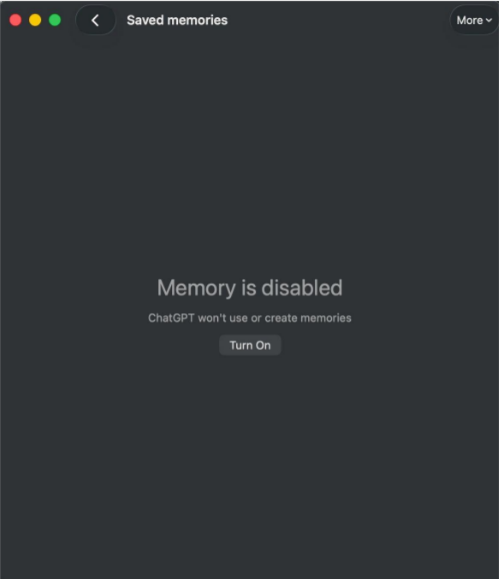 Memory is disabled by default on the ChatGPT Enterprise desktop app. Screenshot source: Harmonic Security, "Securing ChatGPT Enterprise Guide."[10]
Copilot / Azure OpenAI
Azure OpenAI's standard configuration retains prompts and completions for 30 days to support abuse monitoring, a setting that eligible customers can have turned off through Microsoft's approval process. Microsoft's own architecture documentation walks through exactly how a customer can verify, after approval, that this abuse-monitoring data store has actually been turned off: navigate to the resource's Overview page in the Azure portal, open the JSON view, and check for a ContentLogging attribute set to false, which only appears in the JSON output when logging has genuinely been disabled.[13] This guide independently confirmed this exact verification screen, including the JSON view link and the resulting attribute, live in the Azure portal documentation.
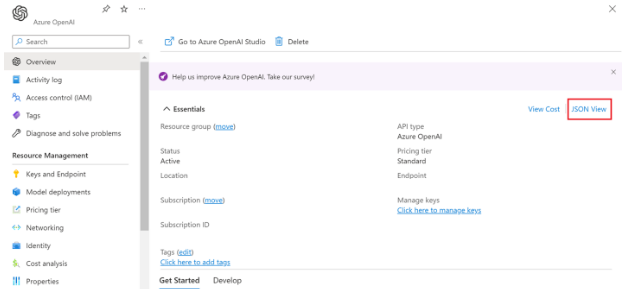 The Azure portal path a customer uses to verify abuse-monitoring status: Overview page, then JSON View. Screenshot source: Microsoft Learn, "Data, privacy, and security for Foundry Models sold by Azure."[13]
 The resulting JSON attribute,
 "ContentLogging":"false", which appears only when abuse-monitoring data storage has actually been turned off. Screenshot source: Microsoft Learn, "Data, privacy, and security for Foundry Models sold by Azure."[13]
Microsoft Copilot itself (renamed this year from Microsoft 365 Copilot) works differently from the Azure OpenAI layer beneath it. Rather than logging conversations with an opt-out, Copilot data is stored within Microsoft 365 services themselves and governed by an organization's own Microsoft Purview retention and eDiscovery policies, not by Azure OpenAI's abuse-monitoring mechanics. A verified ContentLogging check on an organization's Azure OpenAI resource says nothing about that same organization's Copilot deployment; the two are separate verification questions answered in separate places.
On the HIPAA question specifically, both layers are covered, but not through a separate signing step. Microsoft's own compliance documentation states that Microsoft Copilot and Microsoft Copilot Chat are in-scope services under the same Business Associate Agreement made available by default through the Microsoft Product Terms and the Products and Services Data Protection Addendum, no separate BAA signature required.[27] Azure OpenAI is treated the same way under that same default DPA-based BAA, with a caveat worth stating precisely: Microsoft's own guidance points to text-based interactions as the covered modality, and a buyer should not assume image or realtime audio inputs carry the same coverage until Microsoft states otherwise.[28]
Separately, and worth flagging because it complicates any simple "pick one vendor" framing, Microsoft's own subprocessor documentation lists Anthropic as a subprocessor for Microsoft Copilot as of January 7, 2026, and that arrangement itself splits into two distinct modes: a standard subprocessor mode governed by Microsoft's own Product Terms and DPA, and a separate "Preview Models with Data Retention" mode, for specific advanced models, where Microsoft's own admin center states directly that Anthropic does not guarantee zero data retention and that these particular models fall outside Microsoft's own data residency and audit commitments.[14] Both modes are default-off for European Union, EFTA, and UK tenants specifically. In practical terms, a life sciences buyer standardizing on Copilot may already have Claude models operating somewhere in that supply chain under Microsoft's own data terms, not Anthropic's, a detail worth surfacing to a compliance reviewer rather than assuming away. This series' Copilot and Azure OpenAI deep dive covers all of this in full.
For teams using GitHub Copilot's command-line tooling, GitHub's own changelog post announcing general availability of Copilot CLI includes a verified screenshot of the CLI welcome screen.[15]
Claude / Anthropic
Anthropic's zero data retention arrangement for the Claude API and Claude Code is sales-gated and enabled per organization, not a self-serve dashboard setting. Anthropic's own documentation specifies that ZDR applies to the Messages API and Token Counting API, but explicitly does not extend to Batch processing, the Files API, Managed Agents, or the Console and Workbench interfaces, a scope distinction worth stating precisely rather than assuming ZDR is an all-or-nothing organizational setting.[2] Claude Code carries its own separate ZDR documentation for teams evaluating the CLI specifically.[16]
The most consequential and most current fact for this platform, already introduced above, is Anthropic's June 9, 2026 policy requiring 30-day retention of covered-model interactions even inside existing ZDR workspaces, for safety-classifier review.[4] Anthropic's documentation names the exact console navigation a customer would use to manage retention settings: Console, Settings, Privacy; Console, Settings, Workspaces, Privacy Controls tab; and on claude.ai itself, Organization Settings, Data and Privacy.[17] No image of Claude's actual retention-configuration screen has surfaced anywhere in this project's sourcing to date, across an extensive search, which is worth stating directly rather than glossing over. What this guide's research did independently verify are two genuinely adjacent, honestly framed assets: Anthropic's own blog post on new admin analytics and cost controls, showing a real screenshot of the Claude Analytics dashboard with usage and spend broken down by team and user,[18] and a third-party SSO setup guide showing the actual claude.ai sign-in page with a visible "Continue with SSO" option.[19] For the CLI angle, two community-recorded Claude Code terminal sessions on asciinema, independently reviewed and cross-checked against their linked GitHub repositories, show real usage of the tool in practice.[20][21]
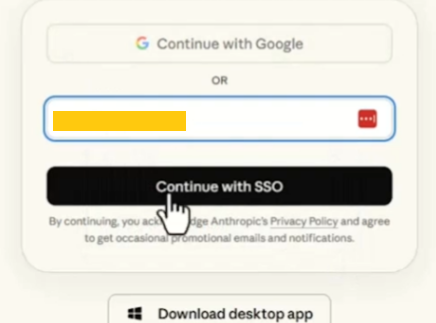 The actual claude.ai sign-in screen, showing the "Continue with SSO" option (not the retention settings screen itself, included here as genuinely adjacent admin-relevant material, honestly captioned per this guide's verification standard). Screenshot source: T-Minus365, "How to Set Up Claude SSO with Microsoft Entra ID."[19]
Gemini API / Vertex AI
Google splits zero data retention across two distinct routes that are easy to conflate and worth naming separately. The Gemini Developer API supports a self-serve store=false request parameter that a caller sets on individual API calls; if the parameter is left unspecified, the default is true, meaning the interaction is stored.[1] Vertex AI's enterprise route works differently: zero data retention there is arranged as an amendment to a customer's data processing agreement, negotiated through a Google Cloud account team, not flipped as a console setting.[3] A third surface, the Gemini Enterprise Agent Platform, documents its own separate zero-data-retention resource, distinct from both of the above.[22]
One narrow, named exception is worth flagging on its own: Google states that prompts and outputs used with the Grounding with Google Maps feature specifically are retained for 30 days to support that one feature, a scoped carve-out rather than a blanket exception across all of Vertex AI.
Two genuinely verified visual assets exist for this platform, both adjacent rather than a direct retention-screen screenshot. A community how-to guide on setting up ZDR with Gemini includes one authentic screenshot of Google Cloud's own "Apply for an Invoiced Billing Account" form, the offline-billing route a customer uses to opt out of prompt logging for abuse monitoring.[23] Separately, Google Cloud's own blog post on enhanced tool governance in Vertex AI Agent Builder includes a real animated GIF of the tool-governance console.[24]
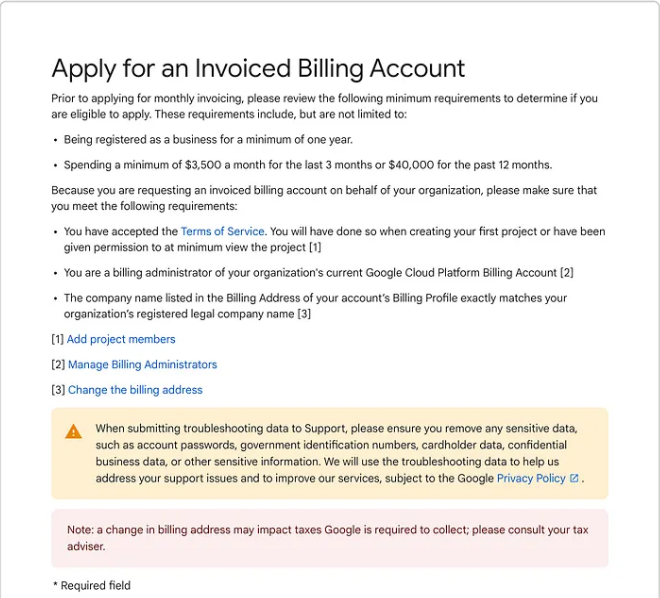 Google Cloud's invoiced-billing application form, the offline-billing route required to opt out of prompt logging for abuse monitoring on non-invoiced Vertex AI accounts (not a retention-toggle screen itself, included as genuinely adjacent material). Screenshot source: Abraham Gomez, "How to Setup ZDR for Gemini Pro," Medium.[23] On the CLI side, two genuine Gemini CLI terminal screenshots exist, one showing the session picker and list-sessions feature,[25] one showing the interactive shell,[26] both worth a framing caveat: Google's own developer blog describes Gemini CLI being sunset in favor of a new Antigravity CLI over the course of a mid-2026 transition, so these should be read as showing the current generation of the tool rather than a permanent interface.
What to Ask Before You Sign
The platform-by-platform detail above resolves into a short, portable checklist any life sciences buyer can bring to a vendor conversation, regardless of which of the four platforms is under discussion.
| Question | Why it matters |
|---|---|
| Is zero data retention self-serve, or does it require a sales conversation and approval? | Determines whether your team can configure it directly or needs a procurement cycle to activate it at all. |
| Which specific products and API endpoints are covered, and which are explicitly excluded? | Anthropic's own ZDR terms exclude Batch, Files API, and Managed Agents even when the Messages API is covered, an easy detail to miss. |
| What is the abuse-monitoring carve-out, and can it be independently verified? | Azure OpenAI's ContentLogging attribute is directly checkable in the portal JSON view; ask every vendor for an equivalent verification path, not just a written assurance. |
| Where, geographically, is data actually processed, and does that match your residency requirement? | Contractual ZDR and data residency are two separate questions that are easy to conflate; both need a direct answer. |
| Does the BAA, if HIPAA applies to your use case, cover the specific product tier you will actually use? | Claude Cowork is not BAA-eligible in any configuration even though Claude Enterprise and the API are, a brand-versus-product distinction that recurs across every vendor in this space. |
| Has this provider changed its retention terms in the past 12 months, and how were existing customers notified? | Anthropic's June 9, 2026 covered-models policy is direct proof that ZDR terms can be narrowed by a provider's own safety policy after a contract is already in place. Ask what happens the next time that happens. |
A useful discipline borrowed from IntuitionLabs' own compliance-vendor-evaluation framework applies directly here: ask for the artifact, the specific contract clause, the specific console screen, the specific documentation page, not the adjective. "We support zero data retention" is not, by itself, a verifiable claim. A named endpoint, a named exclusion, and a named verification path are.
What's Next in This Series
This guide is the pillar overview in IntuitionLabs' five-part zero data retention series: this piece plus four platform-specific deep dives. The four deep dives are complementary, not sequential — each stands on its own and can be read in whatever order matches your platform mix, once you've read this pillar guide for the shared verification standard and four-platform comparison the rest of the series builds on:
- ChatGPT and OpenAI's API, covering the Global Admin Console, enterprise SSO configuration, and the Codex CLI in more depth.
- Copilot and Azure OpenAI, covering the Azure portal verification path, the two distinct Anthropic subprocessor arrangements, and GitHub Copilot CLI's training-data tier split.
- Claude and Anthropic, covering the console navigation for privacy controls, the covered-models retention policy in full, and Claude Code's specific ZDR scope.
- Gemini and Vertex AI, covering the Developer API's
storeparameter, Vertex's contractual DPA route, and the Gemini CLI to Antigravity CLI transition.
Readers evaluating an AI vendor specifically for a validated GxP environment should also read IntuitionLabs' framework for evaluating AI vendor compliance in life sciences, which covers 21 CFR Part 11, EU Annex 11, GAMP 5, and BAA scope in full.
Separately, and disclosed here for transparency since Claude is one of the four platforms under review: IntuitionLabs is a member of the Claude Partner Network. This guide's assessment of Claude's zero-data-retention terms was held to the same sourcing standard as the other three platforms.
External Sources (28)[1]https://ai.google.dev/gemini-api/docs/zdr
[3]https://cloud.google.com/vertex-ai/generative-ai/docs/vertex-ai-zero-data-retention
[4]https://privacy.claude.com/en/articles/15425996-data-retention-practices-for-covered-models
[5]https://openai.com/index/offering-zero-data-retention-for-frontier-models/
[8]https://openai.com/index/offering-zero-data-retention-for-frontier-models/
[9]https://openai.com/enterprise-privacy/
[10]https://harmonic.security/resources/securing-chatgpt-enterprise-guide
[11]https://help.openai.com/en/articles/12289294-global-admin-console
[12]https://developers.openai.com/codex/cli
[14]https://learn.microsoft.com/en-us/microsoft-365/copilot/connect-to-ai-subprocessor
[15]https://github.blog/changelog/2026-02-25-github-copilot-cli-is-now-generally-available/
[16]https://code.claude.com/docs/en/zero-data-retention
[17]https://platform.claude.com/docs/en/manage-claude/api-and-data-retention
[18]https://claude.com/blog/giving-admins-more-visibility-and-control-over-claude-usage-and-spend
[19]https://tminus365.com/how-to-set-up-claude-sso-with-microsoft-entra-id-10-minute-guide/
[20]https://asciinema.org/a/732644
[21]https://asciinema.org/a/767284
[22]https://docs.cloud.google.com/gemini-enterprise-agent-platform/resources/zero-data-retention
[23]https://goabego.medium.com/no-data-left-behind-how-to-setup-zdr-with-gemini-a9ff5caf1c71
[25]https://dev.to/proflead/gemini-cli-hidden-features-automatic-session-saving-1267
[26]https://developers.googleblog.com/say-hello-to-a-new-level-of-interactivity-in-gemini-cli/
[27]https://learn.microsoft.com/en-us/compliance/regulatory/offering-hipaa-hitech
[28]https://learn.microsoft.com/en-us/azure/compliance/offerings/offering-hipaa-us

Need Expert Guidance on This Topic?
Talk to IntuitionLabs about how to put this guide into practice on your team.
I'm Adrien Laurent, Founder & CEO of IntuitionLabs. With 25+ years of experience in enterprise software development, I specialize in creating custom AI solutions for the pharmaceutical and life science industries.
DISCLAIMER
The information contained in this document is provided for educational and informational purposes only. We make no representations or warranties of any kind, express or implied, about the completeness, accuracy, reliability, suitability, or availability of the information contained herein. Any reliance you place on such information is strictly at your own risk. This document may contain content generated with the assistance of artificial intelligence technologies. AI-generated content may contain errors, omissions, or inaccuracies. Readers are advised to independently verify any critical information before acting upon it. All product names, logos, brands, trademarks, and registered trademarks mentioned in this document are the property of their respective owners.