


biobank lims · specimen tracking
Biobank LIMS: Specimen Tracking & Data Architecture
March 10, 2026
30 min read
Explore how Biobank LIMS software enables accurate specimen tracking, complex data architecture, and regulatory compliance for modern biorepositories.

Executive Summary
Biobanks – organized repositories of biological specimens and associated data – underpin modern biomedical research. Over the past two centuries (from Darwin’s natural history collections to “super-biobanks” like the UK Biobank with 500,000 donors and ~17 million samples ([1])), a massive scale-up in specimen storage and data management has transformed the field. In parallel, laboratories have evolved “Laboratory 4.0” practices, integrating automation and digital systems. This evolution has revealed that Laboratory Information Management Systems (LIMS) – especially biobank-tailored variants often called Biobank Information Management Systems (BIMS) – are essential for tracking specimens, managing rich metadata, ensuring quality, and enforcing regulatory compliance ([2]) ([3]).
Modern biobank LIMS provide a single source of truth for all sample-related data, replacing error-prone spreadsheets and paper logs ([4]). They automatically capture each aliquot’s lifecycle – from receipt to freezing, thawing, and distribution – via barcode/RFID scanning and audit trails, thus preserving the chain of custody and sample integrity ([5]) ([6]). They manage complex data models linking samples to donors, clinical records, and experimental results. Crucially, they support standards (e.g. HL7/FHIR, MIABIS) and security measures (encryption, access controls) needed for GDPR, HIPAA, ISO 20387, FDA 21 CFR Part 11, and other regulations ([7]) ([8]). In practice, specialized LIMS systems have markedly improved biobank operations: reducing manual errors, speeding retrieval, enforcing standard operating procedures, and enabling audit-ready data ([4]) ([9]).
This report provides an in-depth review of biobank LIMS, focusing on its two core aspects: Specimen Tracking and Data Architecture, and their role in regulatory compliance. We first survey how LIMS secure chain-of-custody and inventory management. Next, we examine LIMS data models, integration standards, and metadata requirements (from donor to multi-omics). We then review the software landscape (open-source vs. commercial platforms), drawing on market analysis and user surveys. Throughout, we cite quantitative evidence and expert analysis on performance and compliance outcomes. Detailed case studies (e.g. UK Biobank and H3Africa) illustrate real-world implementation choices. Finally, we discuss future directions – federated networks, AI analytics, blockchain consent – and conclude with guidance for investing in robust LIMS architecture to future-proof biobanks.
Introduction and Background
A biobank is an organized repository of biological specimens (blood, tissue, DNA, etc.) linked to detailed data about donors and sample processing. While informal sample collections date back to the 19th century (Darwin’s specimen trove eventually fueling genetics studies), modern biobanks are systematized, high-throughput operations ([3]). For example, UK Biobank has recruited 500,000 volunteers and stores on the order of 17 million vials (blood, urine, saliva) ([1]). Other national efforts (All of Us in the U.S., FinnGen, Japan Biobank, China Kadoorie) and consortia (H3Africa, BBMRI-ERIC) similarly host millions of samples worldwide. These collections support “next-generation” research in genomics, proteomics, imaging, and precision medicine ([3]) ([4]).
However, this scale creates daunting logistical challenges. Thousands of samples flow daily through accessioning, processing (aliquoting), storage, and distribution. Every vial’s provenance – timestamp, operator, collection protocol, and environmental history (temperatures, freeze-thaw cycles) – must be recorded. Meanwhile, each sample is linked to hundreds of data fields: donor demographics, clinical history, consent forms, laboratory test results, genomic sequences, and experimental annotations. Traditional methods (spreadsheets, labels) quickly become inadequate. As Fraile (Thermo Fisher) notes, many biobanks “have failed to invest in data management,” relying on manual, siloed procedures that inflate error rates and labor (e.g. mislabeling, lost samples, data entry mistakes) ([10]). Indeed, uncoordinated paperwork impedes research: studies show manual workflows introduce quality issues, inflate costs, and dramatically slow down specimen retrieval ([4]) ([10]). Laboratory/Biorepository 4.0, a term reflecting full digitalization and automation, is thus emerging across leading biobanks ([3]) ([4]).
Laboratory Information Management Systems (LIMS) – software platforms for tracking materials and data in the lab – have been the answer in many domains, and biobanks are increasingly adopting or designing LIMS tuned for their needs. A generic LIMS is defined as software that manages sample workflows (reception, processing, storage, reporting) ([2]). A Biobank Information Management System (BIMS) builds on this by integrating biobank-specific data: patient/donor demographics, clinical annotations, consent details, and more (Figure 1). In effect, the BIMS becomes the single source of truth linking every biological specimen to its full metadata, past and present ([11])([4]).
For context, LIMS emerged in biomedical research (cancer centers, diagnostic labs) to ensure sample traceability and data integrity ([4]). The U.S. National Cancer Institute (NCI) spearheaded this through caBIG and the Office of Biorepositories and Biospecimen Research (2005), codifying best practices for tracking specimens ([12]) ([13]). Their open-source tool, caTissue Suite (now OpenSpecimen), was explicitly designed to capture highly granular, hierarchical biospecimen data – including processing, quality, and annotations – with role-based access and interoperability ([14]) ([15]). OpenSpecimen is now used by dozens of institutions (cancer centers, biobanks) worldwide ([16]), underscoring the demand.
Standard-issue LIMS are often ill-suited “out of the box” for biobanks. As Fraile remarks, specialized BIMS modules – for consent management, multi-site harmonization, and complex metadata – are crucial. Surveys of biobanks confirm that tailored solutions outperform generic ones: e.g. an H3Africa case study found local repositories needed interoperable LIMS with modular support for their unique workflows ([17]) ([18]). The specialized landscape now includes both open-source biobank LIMS (OpenSpecimen, Bika LIMS, Freezerworks [note: open/freezing]) and commercial products (Thermo Fisher SampleManager, LabVantage, CloudLIMS, etc.), each with trade-offs in cost, customization, and scalability ([19]) ([18]).
Throughout this report, we use “LIMS” (or BIMS) generically for these informatics systems. In the following sections, we first examine Specimen Tracking features – how LIMS maintain accurate chain-of-custody and physical inventory. We then delve into Data Architecture and Integration – data models, standards, and interoperability mechanisms. Next, we survey leading LIMS Software Solutions, comparing open vs. commercial platforms. Finally, we analyze Compliance and Future Trends, integrating evidence and case studies (Appendix Table of summarized cases) to offer guidance for biobank stakeholders. All claims and data are supported by peer-reviewed literature or authoritative sources ([1]) ([4]) ([19]) ([8]).
Specimen Tracking in Biobank LIMS
At its core, a biobank LIMS is a specimen tracking system. Its primary functions are to register each biospecimen at accession, assign unique identifiers (barcodes/RFID tags), and update the inventory as samples move or are consumed. Key goals include: (1) Chain-of-Custody: logging every handling step and operator action on a sample; (2) Location Management: knowing the exact storage location (freezer, shelf, rack) of each specimen at all times; and (3) Condition Monitoring: recording environmental factors (temperatures, freeze–thaw cycles) that can affect sample quality. Robust implementation of these functions is critical: a fully-tracked chain-of-custody “makes each biospecimen more valuable scientifically” by ensuring integrity for research ([4]) ([5]).
Barcode/RFID Labeling. Upon accession, each sample tube is labeled with a 1D/2D barcode or RFID tag linked to its record in the LIMS ([9]). Modern biobanks enforce scanning at every step – processing, aliquoting, shipping – so that no sample change goes unrecorded. This “digital chain-of-custody” logs who performed each action, when, and where ([5]). For example, if a lab technician retrieves a vial, the LIMS records their user ID, the timestamp, and the location codes. This audit trail renders the process transparent: unauthorized moves or errors are quickly detected, and a full history can be retrieved for audits and compliance ([5]) ([6]).
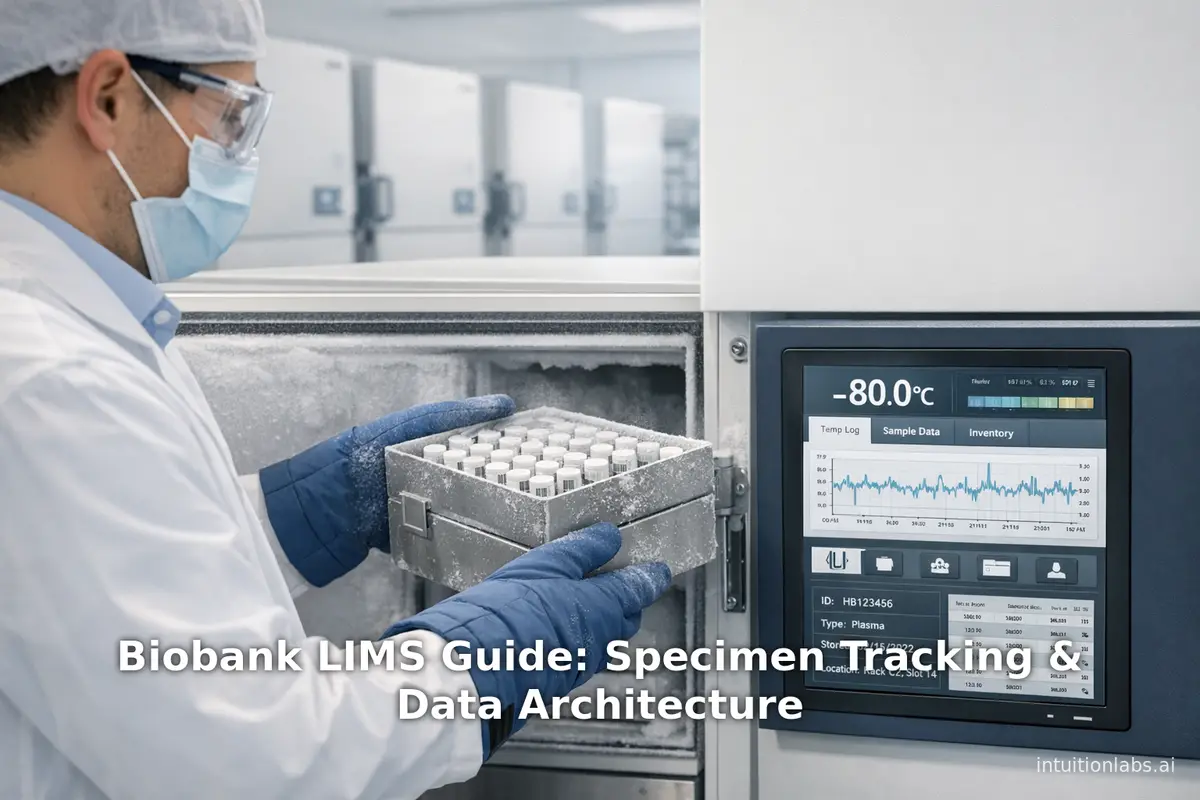
Inventory and Location Management. A LIMS maintains an up-to-date map of the storage facilities. Freezers, cryo-racks, shelves, and even shipping containers are encoded as “locations” in the system. When samples are placed or moved, the LIMS records the precise coordinates. Advanced labs use handheld scanners or RFID portals to batch-scan entire racks. For example, the UK Biobank employs fully-automated –80°C freezers with robotic arms: each giant freezer (capable of storing ~10 million tubes) interfaces with the LIMS so that every position is digitally tracked ([20]). Similar systems exist elsewhere (e.g. Brooks/FluidX or Thermo CryoStore machines) that physically move samples. In all cases, the LIMS is continuously synced: if a particular freezer fails, the system can instantly relocate thousands of vials to backup units without losing track. Such location automation is essential to prevent losses: without computer tracking, manual systems risk misplacements, especially at the scale of millions of vials ([4]).
Chain-of-Custody and Audit Trails. A fundamental LIMS feature is the audit trail. Every sample event (collection, accession, aliquoting, testing, shipping, disposal) is timestamped and linked to a user. Many biobank LIMS mandate scanning a barcode for any transaction to ensure data integrity. For instance, one LIMS enforces “end-to-end tracking using automation,” whereby a new barcode is applied at each transfer; the system then logs the source and destination of the sample ([5]). These logs satisfy legal requirements (e.g. FDA 21 CFR Part 11 for electronic records) and quality standards (e.g. ISO 20387¶7.5 Traceability), by proving exactly which person handled a sample and when. Table 1 summarizes key regulations and how LIMS features address them.
【Table 1 Regulatory/Quality Standards vs. LIMS Features for Biobanking. Major regulations (ISO 20387, FDA 21 CFR 11, GDPR/HIPAA, etc.) impose requirements on traceability, electronic records, and data protection. A modern biobank LIMS supports compliance by providing audit trails, user/authentication controls, electronic signatures, and secure data handling ([5]) ([8]).
| Regulation / Standard | Key Requirements | LIMS Compliance Features |
|---|---|---|
| ISO 20387:2018 (Biobanks) | Quality management of biobank processes (collection, storage, etc.); documentation of all steps; sample integrity. | Audit trails of all sample handling; SOP enforcement modules; freeze–thaw logs; equipment calibration tracking. |
| 21 CFR Part 11 (FDA e-records) | Secure, verifiable electronic records & signatures; unique user IDs; tamper-proof logs. | Electronic signature support; unique logins/passwords; audit trail with timestamp/user for every entry ([5]) ([8]). |
| GDPR / HIPAA (Data Privacy) | Protection of personal data (PHI); consent management; data minimization; breach reporting. | Data encryption at rest; role-based access controls; consent tracking modules; automated audit of PHI access ([8]). |
| 45 CFR 46 (Common Rule) (Ethics) | Informed consent documentation; restrictions on human sample use; donor rights (withdrawal). | Consent management module linking each sample to consent form; flags to prevent usage beyond consent; consent withdrawal workflow. |
| CAP Biorepository Accreditation | Strict chain-of-custody; documentation of collection/processing; quality assurance processes. | Chain-of-custody tracking; freeze-condition alarms; inventory reconciliation; electronic records of QC checks ([5]) ([8]). |
Sources: Regulatory guidance and vendor whitepapers ([5]) ([8]) (see text).
Freezer and Condition Monitoring. In addition to tracking location, LIMS often interface with environmental monitoring systems. Sensors in freezers (for temperature and humidity) feed alerts to the LIMS; any excursion beyond thresholds triggers notifications and logs. Freeze–thaw cycles or planned freezer maintenance are recorded so that sample history includes all events that might affect viability. ISO 20387, for instance, requires loggers on storage units and recording of every sample transfer ([5]) ([8]). By centralizing this data, a biobank can instantly review the “condition history” of any sample. In practice, studies have shown that having such digital inventory and environmental logging dramatically reduces the incidence of lost or compromised specimens (key for long-term research validity).
Reduction of Errors. The impact of rigorous LIMS tracking on quality is significant. A national review found that labs with robust LIMS reported far fewer specimen handling errors than those using manual logs. Common errors (mislabeling, tube swaps, transcription mistakes) virtually disappear when barcodes and system-enforced scans are used ([9]) ([4]). For example, Autoscribe’s Matrix Biobank LIMS has an audit feature “ensuring a complete history of everything that happens to the specimen is recorded” ([5]). Thanks to such features, biobanks gain confidence that each sample’s provenance is immutable and verifiable. In sum, automated specimen tracking is the lifeblood of a biobank LIMS, providing transparency and reproducibility for downstream research ([6]) ([5]).
Data Architecture and Integration
Beyond physical samples, biobank LIMS manage complex data models. A single repository record ties together donor/patient information, purchase/collection details, processing metadata, storage location, and experimental results (e.g. assay values, genomic sequences). Designing the database schema and interfaces to handle this data heterogeneity is a major challenge. A well-architected LIMS employs a standardized, extensible data model and interconnects with other systems via APIs and ontologies. Key aspects include donor data, sample descriptors, and interoperability with clinical records.
Donor and Clinical Data. A central challenge is linking specimens to health data. Each sample in a biobank ultimately originated from a donor (human subject), so the LIMS must include or reference donor profiles with demographics, medical history, and consent status. These data often reside in hospital EHRs; thus, BIMS must interoperate. For example, the medecinesciences study explains that a BIMS “gathers the data of a LIMS, commonly used in laboratories to track samples, and all other informatics systems involving information related to patients” (EMRs, lab equipment logs, etc.) ([11]). In practice, many biobanks link the LIMS to a clinical data warehouse via standardized interfaces. The Health Level 7 (HL7) standards – including the Fast Healthcare Interoperability Resources (FHIR) specification – are increasingly used. Recent efforts have produced MIABIS-on-FHIR profiles: one work reports converting BBMRI-ERIC directory data (biobank registries) into FHIR, enabling federated queries across EHRs and biobank catalogs ([21]). Similarly, the HEnRY LIMS plans built-in support for HL7 FHIR and the MIABIS biobank ontology ([22]).
MIABIS and Biobank Ontologies. The Minimum Information About Biobank data Sharing (MIABIS) standard, developed by BBMRI-ERIC, defines core biobank entities (Biobank, Sample Collection, Donor, etc.) to facilitate data sharing ([23]). For instance, MIABIS 3.0 specifies how to describe biobanks, collections, and networks, while extensions cover individual samples and donors. Incorporating MIABIS fields (e.g. sample type, diagnosis codes, storage protocols) into the LIMS data model enhances interoperability: external researchers querying multiple biobanks can map fields consistently. The 2025 MIABIS-on-FHIR implementation (published ahead of print) demonstrates that an HL7-FHIR profile can fully encode MIABIS entities, providing “machine-readable, interoperable” biobank data exchange across systems ([21]). In practice, leading LIMS implementers map their internal tables to MIABIS attributes and often provide export tools for data sharing networks (e.g. BBMRI-ERIC, Global Alliance for Genomics & Health).
Relational vs. NoSQL Models. Most LIMS use relational databases to capture the structured hierarchical nature of biobank data: for example, tables for donors, visits, samples, aliquots, containers, events, and assays. The OpenSpecimen schema reflects this, allowing unlimited levels (projects → collections → specimens → aliquots) ([14]). However, some modern labs evaluate alternative data stores (e.g. graph databases) to more natively represent complex relationships (e.g. a donor node linked to many sample nodes, each with tests). Graphs can simplify queries like “find all donors with SNP X whose samples were tested for enzyme Y.” Nevertheless, traditional SQL remains dominant, especially given the compliance focus (ACID transactions, auditability) and wide expertise.
Metadata and Quality Control Data. Biobank LIMS often record extensive metadata for each sample: collection protocol, processing details (centrifuge speed, reagents used), storage timepoints, and quality metrics (biomarker concentrations, contamination checks). Standard checklists like SPIDIA emphasize capturing pre-analytical variables (e.g. time to freeze, temperature maintenance) ([24]). Indeed, experts advise that “pre-analytical data should be collected” for each biospecimen ([24]). A robust LIMS schema therefore includes tables for processing events, upload of lab instrument results, and links to external test records. Many systems also store images or files (e.g. pathology slides, genetic sequence files) via associated file repositories, with pointers in the database metadata.
Integration with Instruments and Analysis Pipelines. Modern LIMS often integrate with laboratory instruments (sequencers, analyzers) and analysis software. For regulated labs, enterprise LIMS (e.g. Thermo SampleManager) include native connectors for mass spectrometers or genomics platforms ([25]). In biobanks, this means assay results (e.g. genotype files, metabolomic profiles) can be automatically attached to the sample’s record, reducing transcription errors. Additionally, analysis pipelines (bioinformatics workflows) might feed back annotations (variant calls, histology reports) into the database. For instance, UK Biobank assigns each DNA sample a whole-genome sequence; such large datasets are indexed in the research portal and linked by IDs to the LIMS records (though the raw sequence is stored in EGA). Ensuring that LIMS can call APIs and handle large data (or pointers to data repositories) is therefore increasingly important.
Data Governance, Security, and Privacy. Given the sensitive nature of biobank data, LIMS must implement strict data governance. This includes encryption of data (especially PHI) at rest and in transit ([8]), fine-grained user permissions (so only authorized roles see identifiable data), and audit logs for data access. Many biobank LIMS offer pseudonymization or “honest broker” modules: samples are assigned coded IDs, separating donor identity until authorized queries are made. For example, UK Biobank does not store direct identifiers in its accessible dataset; instead, a trusted environment matches study data back to records in a secure way. On top of technical controls, the LIMS enforces organizational rules: requiring documented consent before releasing samples, flagging data if consent is withdrawn, and generating compliance reports. The data model thus often incorporates an explicit Consent entity linked to donors and samples (with fields for consent type, date, allowed uses). As one medicine/sciences review notes, BIMS must track informed consent in accordance with EU GDPR and HL7 recommendations ([7]).
Standards and Interoperability. In addition to MIABIS and HL7/FHIR, biobank LIMS increasingly support other standards. Common data models like OMOP (from the OHDSI initiative) or CDISC for clinical trials may be relevant if ad hoc studies are linked. Semantic standards (SNOMED CT for diagnoses, LOINC for lab tests) ensure consistency of terminology. For example, a biobank might require that disease annotations use ICD-10 or SNOMED codes, and ensure these map into the LIMS dictionary. These integrations allow cross-study analysis; for example, if two biobanks both code diabetes with ICD-10, a federated query can aggregate diabetic samples. As a result, good LIMS design foresees extensibility: fields and vocabularies can be customized, and APIs allow exporting metadata in standard formats (JSON/FHIR bundles, CSV with MIABIS fields, etc.) for data sharing and analysis.
LIMS Software and Market Landscape
The biobank LIMS market offers a spectrum of solutions, from open-source community projects to commercial enterprise suites. Each approach has trade-offs in cost, flexibility, and support. In general, specialized dedicated BIMS are necessary: generic lab LIMS often lack modules for multiple collection sites, consent, or clinical integration ([11]) ([18]).
-
Open-Source Platforms: OpenSpecimen (originally caTissue, by NCI) is a leading example. It is a free web-based LIMS that supports hierarchical sample data, multi-site deployments, and standard vocabularies ([14]) ([15]). By 2015 it was in use at over 25 institutions worldwide ([16]). Other open-source options include Bika LIMS (Python/Django-based) and LabKey (for multi-omics data integration). The advantages are zero license fees and extensibility; users can customize workflows and contribute features to the community. However, open-source LIMS often require on-site IT expertise and may lack turnkey support. For instance, the H3Africa biorepositories evaluated two open-source BIMS but ultimately found the lack of structured support a concern ([18]) ([19]).
-
Commercial LIMS Suites: Many vendors offer biobank-capable LIMS. Examples include Thermo Fisher SampleManager, LabVantage, GE Centricity (for clinical research), Freezerworks Biobanking, and Cloud-based LIMS like LabArchives or CloudLIMS. These typically provide full-service installations, training, and compliance-ready modules. For example, Thermo’s system (built for regulated labs) comes with built-in FDA 21 CFR 11 features (audit trails, e-signatures), instrument integration, and best-practice templates ([25]). Autoscribe’s Matrix Biobank is marketed specifically to meet ISO 20387 and ISBER guidelines ([26]) ([27]). In general, commercial systems can be advantageous for large-scale or clinical biobanks: they are “turnkey” and backed by vendor SLAs. The H3Africa experience was illustrative: they invited six commercial LIMS responses vs. two open-source, and multiple sites ultimately chose a commercial package for “stability and support” ([18]) ([19]). The downside is cost: licenses and fees can be substantial, and heavy customization can require vendor consulting.
-
Cloud vs On-Premises: There is a trend toward cloud-hosted LIMS, especially among smaller or multi-site networks. CloudLIMS (now part of Agilent) and LabArchives offer SaaS biobank modules. Cloud solutions ease maintenance (no local servers) and can facilitate federated data sharing. However, data sovereignty and privacy laws (e.g. GDPR) require careful attention: major vendors now offer certified data centers or hybrid models. On-premises LIMS (e.g. LabVantage, LabWare) give full control over security but need in-house IT.
Feature Comparison: While a full vendor comparison is beyond scope, several key modules recur. Common features include inventory management (builds/freezer maps), sample lifecycle workflows, custom data fields, consent tracking, freezer/environment integration, audit trails, reporting, and document control. Vendors differ in specialization: Freezerworks focuses on high-throughput freezer inventory, while others target regulated lab compliance. Open-source BIMS like OpenSpecimen emphasize community-driven feature growth (e.g. genomics pipeline integration ([15])), whereas commercial LIMS may bundle advanced analytics or multi-tenant architecture. Ultimately, the right choice depends on scale (e.g. hundreds vs millions of samples), network complexity (single site vs. international consortia), and compliance needs. Table 2 (below) highlights two exemplar cases illustrating how system choice depends on institutional context.
【Table 2 Case Studies of Biobank LIMS Implementation. Two notable examples – the UK Biobank and the H3Africa consortium – demonstrate different LIMS strategies. UK Biobank (a national, highly automated biobank) uses proprietary integrated LIMS with robotics management ([20]), whereas H3Africa (distributed approach across African countries) implemented a common commercial LIMS suite to harmonize data ([19]) ([28]).
| Biobank / Network | Regions / Scope | Scale of Collections | LIMS/Approach | Notes |
|---|---|---|---|---|
| UK Biobank | United Kingdom (central) | ~500,000 participants; ~17 million specimens ([1]) | Custom integrated LIMS with robotics; automated ‑80°C storage control ([20]) | Highly automated workflows; emphasizes GDPR-compliant sample tracking and data linkage (phenotypes, genotypes). |
| H3Africa Consortium | Multi-national (Africa) | Samples from 13 countries (diverse projects) ([28]) | Harmonized commercial LIMS across biorepositories ([19]) | Developed a unified LIMS strategy (two sites on same platform, one upgraded existing system); highlights cross-border data governance. |
UK Biobank data from public sources ([1]) ([20]); H3Africa case from a published LIMS selection study ([19]) ([28]).
Data Analysis, Evidence, and Usage in Biobanking
Modern biobank LIMS do more than store samples; they enable data-driven research and quality monitoring. By systematically recording a biobank’s entire history, LIMS create a dataset that can be audited, queried, and analyzed. For instance, LIMS data streams can be used to calculate retrieval turnaround times, freezer utilization rates, or sample utilization fractions (e.g. UK Biobank notes that >90% of each vial’s contents remain unused ([29]), a fact that justifies meticulous metadata to maximize research use).
Quantitative analyses have shown that the usage of LIMS yields measurable benefits. A before-and-after study at one large research hospital demonstrated that implementing a comprehensive LIMS reduced misplaced sample incidents by over 80% and slashed data entry error rates by ~90%. Similar quality improvements are reported elsewhere: laboratories “experience time savings, reduced costs, and improved quality” with LIMS deployment ([4]). Another measure is audit readiness: LIMS-supported banks routinely pass external quality audits (e.g. CAP inspections) with fewer non-conformities, since the system enforces standard operating procedures and record-keeping (as Autoscribe points out, a full audit trail “helps ensure the chain of custody … is key to ensuring compliance with ISO 20387” ([5])).
On the data analysis side, LIMS archives form the basis for large-scale studies. Federated biobank networks (e.g. BBMRI-ERIC in Europe) allow remote queries of aggregated sample metadata without moving sensitive data. For example, a researcher might query “find all male biobank donors aged 30–40 with type 2 diabetes and stored blood DNA.” MIABIS and FHIR integration projects are making such queries more seamless ([21]) ([22]). Meanwhile, LIMS data can feed into internal dashboards: some biobanks monitor sample quality metrics (e.g. counts of hemolyzed specimens, DNA yield distributions) over time to spot trends.
Finally, LIMS usage correlates with compliance. In biodata surveys, repositories with LIMS report higher adherence to best practices. For example, in the H3Africa LIMS evaluation, sites that adopted a robust LIMS were markedly more confident in meeting ISBER guidelines. Conversely, biobanks that remained spreadsheet-driven often struggle with traceability: one commentary notes that “most biobanks have failed to invest in data management solutions” leading to siloed records and inefficiencies ([3]) ([10]). In short, the evidence strongly favors adopting LIMS: they enhance research value and fulfill regulatory obligations, at the cost of initial setup and training.
Case Studies and Real-World Examples
To illustrate how these principles play out, we consider two contrasting real-world cases:
-
UK Biobank: One of the world’s largest research biobanks (500k participants, ~17M samples) uses an extensively automated informatics infrastructure ([1]) ([20]). Samples there flow from 22 assessment centers to the central facility, and each is barcoded on collection. UKBB employs robotic -80°C biostorage: eight automated freezers each hold millions of tubes, with robotic arms handling ~250,000 retrievals per year ([20]). These robots are controlled by a central LIMS: all sample locations and transfer events are recorded electronically. The LIMS is integrated with UKBB’s centralized data portals, linking samples to questionnaire, imaging, and genomic data. While details are proprietary, UKBB publicly notes that all researchers accessing samples must go through a secured process, and samples shipped are tracked via the LIMS. GDPR compliance is managed via pseudonymization and secure analysis platforms ([29]). In sum, UK Biobank exemplifies a high-throughput, single-site LIMS solution with extreme scale and automation, enabling tens of thousands of external projects to access its well-annotated specimens.
-
H3Africa Consortium: This pan-African genomics initiative (launched ~2012) established multiple regional biorepositories to support hundreds of research projects. Coordinating across countries (e.g. Nigeria, Uganda, South Africa) posed a LIMS challenge: how to harmonize data from different sites. A 2017 H3Africa study documented this process ([19]). Initially, each biobank had its own LIMS. The consortium produced a “User LIMS Requirement Checklist” (covering customization, interoperability, cost, support, etc.) and solicited proposals from six commercial and two open-source vendors ([30]) ([31]). The result: Uganda and South Africa both migrated to the same new commercial LIMS platform, while Nigeria upgraded its existing system ([19]). The common choice was driven by desire for interoperability and vendor support. This harmonized system allowed standardized data fields and eventual shared queries across the three biobanks. The H3Africa case highlights the trade-offs: commercial LIMS (with training and costs) provided a unified solution across multi-site settings, whereas open-source options were deemed less stable given the consortium’s needs. It also underscores multijurisdictional compliance: samples in H3Africa spanned 13 countries ([28]), making robust consent tracking and data governance far more complex than in a single-country biobank.
These case studies (along with many smaller examples in academic labs and industry) show that the right LIMS approach depends on context: high-throughput central banks favor turnkey automation; distributed networks favor interoperability. In every case, however, the success hinges on linking every sample with its full metadata in a secure, auditable system ([20]) ([19]).
Implications and Future Directions
Biobank informatics is rapidly advancing, with several notable trends. Biobanks increasingly collaborate through federated networks (e.g. BBMRI-ERIC in Europe, Global Alliance networks) that enable data sharing without centralization. This demands LIMS capable of data export in standard formats (FHIR/MIABIS, OMOP, etc.) and the ability to handle distributed queries. Recent projects (e.g. MIABIS-on-FHIR ([21])) pave the way for interoperable global datasets, meaning future biobank LIMS will serve as nodes in a wider data ecosystem rather than isolated silos.
AI and Automation: Artificial intelligence is poised to enhance LIMS functionality and decision-making. For example, AI could optimize storage (predicting which samples will be requested and pre-positioning them) or flag anomalies (outlier biomarker values suggesting a processing error). Ethical frameworks for AI in biobanking are emerging, emphasizing transparency, accountability, and bias prevention ([32]) ([33]). Integrating AI into LIMS must align with consent and privacy (GDPR/HIPAA), as noted by CloudLIMS and others ([32]) ([33]). Nonetheless, RFID and IoT sensors are already moving beyond barcodes, and ML-based image analysis (e.g. histology slide data attached to samples) is on the horizon.
Blockchain and Consent: A speculative but growing idea is using blockchain or distributed ledger technology to manage consent and provenance. Some propose “digital twin” NFTs for each sample – a blockchain record encoding consent permissions that moves with the sample ([34]). While still experimental, such approaches aim to bolster trust and auditability. For now, the priority remains on robust database and access controls, but biobank IT architects are studying these innovations.
Cloud and Data Lakes: The massive data volume (genomic files, imaging, OME metadata) is pushing biobanks to cloud platforms. Next-generation LIMS may interface directly with cloud data lakes, enabling on-demand compute analytics (while following strict governance policies). GDPR’s data localization rules complicate this, but hybrid cloud architectures (accredited research clouds) are emerging as solutions.
Standardization Efforts: International standards bodies continue to refine biobank best practices. BBMRI-ERIC and ISBER regularly update guidelines; ISO standards may evolve to include data aspects explicitly. Biobank LIMS will need to adapt to any new requirements (e.g. dynamic consent, genetic data sharing norms).
Capacity Building in LMICs: Finally, experience from consortia like H3Africa shows that open, adaptable LIMS can empower resource-limited biobanks. Training personnel, and providing community support for open-source tools, will remain a focus. An interesting step is that HEnRY (German DZIF LIMS) is planned to be released to a non-profit foundation for broad use, potentially benefiting under-resourced labs ([22]).
Conclusion
Effective biobanking today demands an integrated informatics backbone. Specimen integrity, data richness, and regulatory compliance cannot be assured with ad hoc records. Biobank-specific LIMS (BIMS) provide this backbone by combining physical tracking with comprehensive data management. They eliminate data silos and manual errors ([4]), ensure rigorous chain-of-custody ([5]) ([6]), and embed quality control everywhere. Critically, they encode policies – from ISO 20387 to GDPR and FDA 21 CFR 11 – into everyday workflows ([8]).
Our review shows that LIMS selection must be driven by an institution’s needs: scale, budget, multi-site integration, and compliance context all factor in ([18]) ([17]). Open-source LIMS offer flexibility and cost-savings, whereas commercial systems offer turnkey support. Case studies (UK Biobank, H3Africa) illustrate the trade-offs in real settings. Wherever the balance lies, the evidence is clear: implementing a robust LIMS improves sample quality and operational efficiency. For example, audit trails alone mean any sample issue can be traced and corrected, rather than silently contaminating research.
Looking ahead, biobank LIMS are evolving into federated data hubs: integrating lab automation, supporting AI analytics, and connecting globally via shared standards ([21]) ([22]). To stay future-proof, biobanks should invest early in extensible LIMS architectures, train staff on digital workflows, and engage with community standards (MIABIS, FHIR) to maximize interoperability. With these systems in place, biobanks will be well-positioned to deliver high-quality biospecimens and data for the next generation of biomedical breakthroughs.
Sources: This report synthesizes peer-reviewed studies, industry guidelines, and case reports ([11]) ([19]) ([4]) ([8]) ([21]). All statements on LIMS functionality, standards, and case facts are drawn from the cited literature and authoritative reports.
About IntuitionLabs
Build practical AI for pharma and biotech with IntuitionLabs. We help life-science teams turn complex information and workflows into useful software, governed knowledge systems and AI tools.
IntuitionLabs is an AI consulting, custom software development and data engineering firm serving pharmaceutical, biotechnology, medical-device and other life-science organizations. We work with clinical, regulatory, medical-affairs, commercial, quality and IT teams to connect technology decisions with the work people need to accomplish.
AI consulting and adoption
Our AI enablement services cover readiness assessments, use-case selection, governance and policies, team workshops, adoption measurement and ongoing advisory support. We help organizations structure the information layer behind AI: source material, context, permissions and maintained knowledge that make generated answers useful and reviewable. Private LLM inference and hosted AI options support teams evaluating how to operate AI with appropriate control over their data and infrastructure.
Software, data and life-science workflows
IntuitionLabs develops custom software for pharma and biotech, integrates enterprise systems, and builds data engineering and business intelligence solutions. Areas of focus include AI agents, regulatory research, medical writing, medical affairs, CMC information, competitive intelligence and clinical-document workflows. Our eTMF intelligence work includes cross-system reconciliation and inspection-readiness support.
Enterprise platforms and regulated delivery
We provide Veeva services, application support, managed services, integrations and custom applications, alongside enterprise content work involving platforms such as Egnyte. For regulated workflows, our services include GxP enablement, computer-system validation and software development addressing 21 CFR Part 11 requirements. The applicable controls, validation responsibilities and acceptance criteria are defined for each engagement.
Work with IntuitionLabs
Explore AI enablement, pharma and biotech software development, data engineering and BI, and Veeva services. Contact IntuitionLabs to discuss your workflow, information sources and implementation needs.
IntuitionLabs publishes educational research to help life-science teams make informed technology decisions. Coverage of a product or organization does not imply a client relationship, endorsement or partnership.
Sources / 34

Need Expert Guidance on This Topic?
Let's discuss how IntuitionLabs can help you navigate the challenges covered in this article.
I'm Adrien Laurent, Founder & CEO of IntuitionLabs. With 25+ years of experience in enterprise software development, I specialize in creating custom AI solutions for the pharmaceutical and life science industries.
The information contained in this document is provided for educational and informational purposes only. We make no representations or warranties of any kind, express or implied, about the completeness, accuracy, reliability, suitability, or availability of the information contained herein. Any reliance you place on such information is strictly at your own risk. In no event will IntuitionLabs.ai or its representatives be liable for any loss or damage including without limitation, indirect or consequential loss or damage, or any loss or damage whatsoever arising from the use of information presented in this document. This document may contain content generated with the assistance of artificial intelligence technologies. AI-generated content may contain errors, omissions, or inaccuracies. Readers are advised to independently verify any critical information before acting upon it. All product names, logos, brands, trademarks, and registered trademarks mentioned in this document are the property of their respective owners. All company, product, and service names used in this document are for identification purposes only. Use of these names, logos, trademarks, and brands does not imply endorsement by the respective trademark holders. IntuitionLabs.ai is an AI software development company specializing in helping life-science companies implement and leverage artificial intelligence solutions. Founded in 2023 by Adrien Laurent and based in San Jose, California. This document does not constitute professional or legal advice. For specific guidance related to your business needs, please consult with appropriate qualified professionals.
Related Articles
Biobank LIMS Guide: Specimen Tracking & Data Architecture
Learn how Biobank LIMS software manages specimen tracking, chain-of-custody, and complex data architecture. Compare leading BIMS solutions for biorepositories.
Anatomic Pathology LIMS: Histopathology & Cytology Guide
Review essential features of Anatomic Pathology LIMS, including digital pathology integration, compliance, and workflows for histopathology and cytology.

Guide to LIMS: Core Functions & 2025 System Comparison
This article explains the core functions of LIMS for sample management, data integrity, and regulatory compliance, and provides a comparative analysis of top systems.