


21 cfr part 11 · fda compliance
21 CFR Part 11 Compliance: Requirements & Data Integrity
February 4, 2026
35 min read
Explore FDA 21 CFR Part 11 compliance for electronic records and signatures. Learn about validation, audit trails, and data integrity enforcement trends.

Executive Summary
The U.S. FDA’s 21 CFR Part 11 (“Part 11”) is the foundational regulation that allows electronic records and electronic signatures to replace paper documents and handwritten signatures in FDA-regulated industries. First published in 1997 ([1]) and never formally revised, Part 11 was heralded as “paperless” regulation enabling life science companies to digitize documentation. Its intent was to provide “common-sense guidelines” to let industry do electronically what had been done on paper ([2]). Over the past quarter-century, Part 11 has been interpreted and enforced in a risk-based manner: key guidance (e.g. the 2003 “Scope and Application” document ([3])) narrowed the rule’s scope and deferred certain requirements, while FDA’s main concern shifted from paperwork to data integrity (the trustworthiness of records) ([4]) ([5]).
Part 11 fundamentally requires that any FDA-regulated electronic record be reliable, accurate, and secure. To achieve this, Part 11 mandates technical and procedural controls such as system validation, secure audit trails, user authentication, and accountability policies ([6]) ([7]). For example, closed computer systems must be validated for accuracy ([6]), protected against unauthorized access ([7]), and maintain time-stamped audit logs of all data changes ([7]). Signed records must clearly show the signer’s printed name, the time/date of signing, and the meaning of the signature (e.g. “reviewed” or “approved”) ([8]), and signatures must be inseparably linked to their records to prevent falsification ([9]). These requirements ensure that electronic Batch Production Records, stability test reports, clinical data, and other regulated records have the same legal integrity as traditional paper documents.
In practice, most enforcement centers on predicate Good Manufacturing/Clinical/ Laboratory Practice rules (e.g. 21 CFR 211, 210, 820, etc.) rather than Part 11 explicitly ([10]) ([11]). FDA inspectors cite Part 11 issues indirectly by pointing out data integrity flaws: e.g., unprotected raw data in a lab, missing audit logs, shared passwords, or unvalidated calculations. Recent Warning Letters illustrate how easily Part 11 deficiencies arise from weak data governance. For instance, a 2024 FDA letter to Sichuan Deebio flagged non-contemporaneous microbiology records, noting “numerous microbiological plates…were not read and recorded contemporaneously,” thereby compromising data integrity ([5]). Such cases underline that trust in electronic data – driven by auditability and authenticity – is paramount.
This definitive guide delves deeply into 21 CFR Part 11 compliance. We examine its historical evolution, scope, and core regulatory requirements. We analyze enforcement trends and present data on how companies manage Part 11 risk. We include case examples (both from FDA letters and industry implementations) and comparative tables (e.g., a timeline of key developments and a breakdown of Part 11 requirements). Finally, we discuss challenges and future directions: the rise of cloud platforms and AI tools, global harmonization (e.g. EU Annex 11 updates ([12])), and FDA’s move toward risk-based “ Computer Software Assurance” in 2026 ([13]). Throughout, every claim is supported by citations from regulatory texts, guidances, industry analyses, and expert sources. The goal is to equip executives, quality leaders, and technologists with a thorough understanding of Part 11 compliance today and insights into what lies ahead.
Introduction and Background
21 CFR Part 11 is part of Title 21 of the U.S. Code of Federal Regulations (Food and Drugs), which governs products regulated by the FDA. Enacted in the final months of 1997, Part 11 was the world’s first comprehensive regulation to recognize electronic records and signatures as the equivalent of paper records and handwritten signatures ([1]) ([14]). Prior to Part 11, FDA-regulated companies relied almost entirely on paper: manufacturing logs, lab notebooks, and QC certificates were all hand-printed and signed. As early as the 1990s, industry groups urged the FDA to update its rules to reflect growing use of computers and automated instruments, arguing that electronic systems could improve data reliability and efficiency ([15]). For example, digital systems can automatically record a comprehensive change history, making tampering harder and audits faster ([15]).
The FDA agreed to explore this modernization. In July 1992, the agency published an Advance Notice of Proposed Rulemaking (ANPRM) on electronic records and signatures, soliciting public comments ([16]) ([17]). After extensive industry input and technical review, FDA proposed a draft rule in 1994. On March 20, 1997, the FDA published the final Part 11 rule in the Federal Register (effective three months later) ([1]) ([17]). Part 11 covered all FDA-regulated sectors (drugs, biologics, devices, etc.) and defined for the first time that valid electronic records (“electronic records”) and signatures (“electronic signatures”) can meet regulatory requirements just as paper records and handwritten signatures do ([14])([17]).
Part 11 is formally organized into four subparts:
- Subpart A (General Provisions) establishes scope, definitions (e.g., “electronic record,” “closed system,” “open system”), and application.
- Subpart B (Electronic Records; Closed Systems) specifies controls for “closed systems” (where access is controlled by persons responsible for the records) – including system validation, access controls, audit trails, and procedural checks ([6]) ([7]).
- Subpart C (Electronic Signatures) details signature requirements (signature manifestations, signature/record linking, signature/authority mapping, and signature controls) ([18]) ([9]).
- Subpart D (Signature Manifestations) covers how electronic signatures appear on human-readable forms of records.
DOE has long had parallel “predicate rules” (CGMP, GLP, GCP standards like 21 CFR 211, 820, 58, 312, etc.) that require certain records and signatures. Part 11 does not override those rules; rather, it is a modern overlay that dictates how electronic systems can be used to satisfy them ([14]) ([19]). In practice, this means: if a law or regulation (a predicate rule) requires you to keep records or signatures, you may do so electronically, but only if you comply with Part 11’s controls for the computerized system. For example, when a pharmaceutical CFO uses an eQMS for batch release records (subject to 21 CFR 211), Part 11’s requirements (validation, audit trail, etc.) must be met for those systems ([20]) ([7]).
An important clarification came with the FDA’s 2003 Part 11 “Scope and Application” guidance. This document explicitly narrowed the rule’s scope to avoid undue burden ([3]) ([19]). Rather than applying Part 11 to all computer usage, FDA said it applies only when a company “chooses to use electronic records and signatures in place of paper records and handwritten signatures required by predicate rules” ([19]). In other words, if an organization uses computers merely for convenience (e.g. basic email, non-GMP office tasks), Part 11 is not triggered. But if a company elects to digitize required records (batch data, validation protocols, etc.), then Part 11 controls must be in place. This risk-based, purpose-driven interpretation protects innovation while focusing regulatory scrutiny on patient-safety-related data ([21]) ([2]).
The regulatory history of Part 11 is summarized in Table 1. Notably, after the final rule was issued, the FDA took a “kinder, gentler” stance on immediate enforcement. In 1999 it announced an enforcement policy of “discretion” on certain provisions, and it even withdrew the use of Part 11 citations in many warning letters ([3]) ([2]). Draft guidances in 2001–2002 further moderated expectations until the 2003 guidance clarified the FDA’s approach. Since then, FDA’s Part 11 focus has largely been integrated into general GMP inspections (via predicate rules), with attention on issues like validation of critical systems and data integrity. According to FDA leaders, the agency will not rescind Part 11, but may revise it to address new technologies (currently underway) ([22]). Meanwhile, the pharma/medical device industries have grown accustomed to Part 11 as a permanent fixture of compliance, developing entire validation and IT quality initiatives around it ([23]).
| Year | Event | Notes / Sources |
|---|---|---|
| 1992 | ANPRM published on electronic records/signatures | Early dialogue between industry and FDA ([16]) ([17]). |
| 1997 | Final rule published (Mar 20) and effective (Aug 20) | Part 11 created, equating e-records/e-signatures with paper/handsigned ([1]) ([17]). |
| 1999 | Enforcement policy announced | FDA exercised discretion on certain Part 11 requirements to ease burden ([17]). |
| 2001–02 | Draft guidances on Part 11 | Attempted clarifications; industry confusion led to revisions ([24]). |
| Sep 2003 | Final “Scope and Application” guidance issued | Narrowed scope; risk-based approach emphasized ([3]) ([19]). |
| 2018 | FDA issues final Data Integrity CGMP guidance (Q&A) | Emphasized ALCOA principles; underscored that Part 11 supports data reliability, though not explicitly cited ([5]). |
| 2023 | Draft FDA guidance (Q&As) on electronic systems in clinical trials | Updated Part 11 concepts for modern clinical investigations (digital trials, etc.) ([25]). |
| 2026 (expected) | FDA finalizes Computer Software Assurance guidance | Adopts explicit risk-based validation paradigm for software (superseding 2025 draft) ([13]). |
| Table 1. Key milestones in 21 CFR Part 11’s regulatory history (for general guidance). Sources: FDA and industry publications ([1]) ([17]) ([3]) ([5]) (note: Part 11 itself has never been formally revised since 1997 ([26])). |
Core Requirements of 21 CFR Part 11
Part 11’s requirements are technical and procedural safeguards aimed at ensuring the authenticity, integrity, and confidentiality of electronic records, and the security and reliability of electronic signatures ([27]) ([14]). These requirements can be summarized by section:
-
Controls for Closed Systems (21 CFR 11.10): This is the heart of Part 11. Any closed system (a computer environment where access is controlled by those responsible for the records) used to create/modify/store/transmit electronic records must have procedures and controls ensuring authenticity and integrity ([27]). Specifically, subsection 11.10 mandates (among other items) system validation (to ensure accuracy, reliability, and consistent performance) ([6]); the ability to generate accurate, complete records in human-readable and electronic form for inspection ([6]); protection of records to allow accurate retrieval (throughout the retention period) ([6]); and limited system access to authorized individuals only ([7]). Crucially, closed systems must employ secure, computer-generated, time-stamped audit trails that independently record the date/time of operator entries, modifications, or deletions of records ([7]). The rule states that record changes “shall not obscure previously recorded information” and audit trail data must be retained as long as the records they track ([7]). Additional 11.10 controls include operational system checks (to enforce permitted steps) ([28]), authority checks (ensuring only authorized users can use or sign records) ([28]), device checks (verifying data input sources) ([29]), and documented training (ensuring personnel have necessary education/experience) ([30]). Finally, organizations must have written policies that hold individuals accountable for all actions under their electronic signatures, deterring record or signature falsification ([30]). In short, 11.10 is a comprehensive list: systems must be validated, locked down, logged, and documented to guarantee that e-records remain trustworthy (see Table 2 for a summary of 11.10 essentials).
-
Electronic Signature Controls (21 CFR 11.50–11.70): Part 11 treats electronic signatures as the legal equivalent of handwritten ones, but it prescribes strict controls to ensure their reliability. Section 11.50 Signature Manifestations requires that every signed electronic record must display or store certain information: the signer’s printed name, the time/date of execution, and the meaning of the signature (e.g. “reviewed” or “approved”) ([8]). These elements must be retrievable in any human-readable output of the record ([31]). Section 11.70 Signature/Record Linking requires that electronic signature images (and their corresponding metadata) be bound to the record in such a way that the signature cannot be excised, copied, or otherwise separated from the underlying record ([9]). This ensures, for example, that a signature cannot be copy-pasted onto an unrelated record to falsify data. Other subsections (not quoted here) impose password uniqueness (no reused credentials), periodic revalidation of signatures, and maintenance of signature-proxy arrangements. Combined, these rules mean that any electronic signature must reliably identify an individual and be impossibly detachable from its record.
-
Open System Controls (21 CFR 11.30): For systems not under the entity’s direct control (e.g. Internet-based systems), Part 11 requires additional safeguards equivalent to those for closed systems. §11.30 specifically mandates use of, for instance, data encryption, digital signatures, and trusted certificate authorities when transmitting records across open networks. It also requires document authenticity (procedures to guard against unauthorized entry into data). In practice, companies often apply the 11.10 closed-system controls plus, for open systems, strong cryptographic and network security measures. (‡Note: The FDA guidance of 2003 exercised enforcement discretion on some open-system provisions ([3]), but essentially all 11.10 controls must be met one way or another.)
-
Record Copy and Retention (21 CFR 11.10, 11.70): Part 11 requires that accurate and complete copies of electronic records be producible for any required inspection or review ([6]). For instance, 11.10(b) demands both electronic and human-readable copies of records. Secondly, records must remain protected during the entire retention period. Many predicate regulations require keeping data for years; Part 11 rules ensure that electronically stored records remain intact, retrievable, and unaltered for the required time ([6]) ([7]). The FDA expects systems to automatically lock down old records (and their audit trails) so they cannot be lost or changed.
-
Software/Hardware Validation: Subsection 11.10(a) explicitly requires validation of any computer system used for regulated records: “accuracy, reliability, consistent intended performance, and the ability to discern invalid or altered records must be ensured” ([6]). This is interpreted as following good CSV (Computer System Validation) or the newer CSA (Computer Software Assurance) practices. The goal is to prove that the system does exactly what it’s supposed to do for its intended use within the quality environment. FDA officials have emphasized that this validation must be done to the intended use – even identical software instances at different companies need separate validation protocols ([32]). In 2022–26, the FDA has explicitly endorsed a risk-based validation approach (via its Computer Software Assurance guidance), allowing more flexible assurance methods for low-risk functions ([13]). Part 11 itself does not detail how to validate, but in practice, Part 11 validation work aligns with either traditional IQ/OQ/PQ testing or newer risk-based verification.
-
Training and SOPs: Part 11 §11.10(i) and (j) require that personnel be trained and held accountable. Systems must be used by people who have documented education/training/experience ([30]), and companies must have written policies assigning responsibility for actions under e-signatures. In effect, staff must understand Part 11 controls and operate under standard operating procedures (SOPs) that ensure compliance.
Collectively, these provisions make Part 11 very stringent compared to many other standards. In summary (Table 2), Part 11 requires life science companies to build trust into electronic systems through technical and procedural controls: validated software, secure user accounts, audit logs, documented policies, and irreversible signature linking. Meeting these requirements often means more work upfront (system design, documentation, testing) but it yields systems whose data the FDA and patients can trust.
| Requirement Category | Key Controls and Mandates (21 CFR Part 11) |
|---|---|
| System Validation | Ensure software and systems are validated to intended use – must operate accurately and reliably under GMP conditions ([6]). |
| Record Copy & Retention | Ability to produce exact copies (electronic & paper) of records; protect records for entire retention period ([6]). |
| Access Control (Closed Systems) | System access limited to authorized individuals only ([7]); authority checks and device checks enforce this. |
| Audit Trails | Secure, computer-generated, time-stamped audit logs for all creations/modifications/deletions of records ([7]); logs must be unalterable and retained. |
| Electronic Signatures (Linking) | E-signatures must include signer name, date/time, and meaning (e.g. approval) ([8]); signatures must be bound to records and cannot be removed or transferred ([9]). |
| Operational Checks | System-enforced sequencing of steps (operational and authority checks) to prevent unauthorized actions ([28]). |
| Training & Accountability | Personnel must be qualified (training/education) ([30]); written policies must hold users accountable for actions taken under their e-signatures. |
| Documentation Control (Subpart B) | Control over system documentation distribution, access, and use ([30]) (e.g., SOPs, design documents). |
Table 2. Core requirements of 21 CFR Part 11, highlighting the controls mandated by the regulation (not exhaustive). Each element cited is grounded in the official regulatory text ([6]) ([8]) ([9]).
Regulatory Guidance and Enforcement
Although Part 11 is codified law, the FDA’s enforcement of it has historically been indirect. To avoid stifling electronic innovation, FDA transitioned to emphasizing underlying quality and data integrity rather than rigidly enforcing Part 11’s letter. The 2003 guidance explicitly recognized enforcement discretion for many Part 11 requirements (for instance, early FDA letters rarely cited 11.10 even when finding data issues) ([3]) ([10]). The guidance made clear that predicate rule record-keeping must remain secure and reliable, but more paperwork or audit logs would not be enforced if not needed for patient safety ([3]) ([21]). In practice, this meant that violations of CGMP/GLP predicate rules were often cited instead of Part 11.
For example, from 2010–2013 the FDA examined dozens of computerized systems across manufacturing and labs for record integrity. Rather than warning companies “you violated 21 CFR 11,” the agency almost always cited predicate violations. The examples in a 2011 industry analysis are telling: one warning letter to Capricorn Pharma criticized full access to delete raw lab data (undermining 211.100(c) for records retention), not naming Part 11 ([33]). Another to Ningbo Smart Pharma emphasized missing raw data from lab tests, advising third-party auditors to detect “data integrity problems” under CGMP ([34]). Contract Pharma summarizing these letters concluded: “Ironically...none of these letters actually cites 21 CFR 11, only the predicate rules” ([10]). The FDA’s message was clear: the output data itself must be defensible (attributable, accurate, etc.), regardless of whether Part 11 is cited explicitly. In this way, FDA equates Part 11 compliance with fundamental CGMP data integrity.
Recent trends: In the late 2010s and early 2020s, the FDA’s inspector focus on data integrity sharpened further. Data integrity failures (manipulated records, missing audit trail entries, etc.) have become one of the most common themes in Warning Letters across all FDA centers ([35]) ([36]). Although inspectors still rarely list “21 CFR 11” as a violation, they cite data integrity issues (e.g. under 21 CFR 211.68 on equipment controls, or 211.180 on records) that reflect Part 11 lapses ([35]) ([5]). For instance, in 2023–2024 multiple warning letters highlighted QS/EMA Annex 11-like issues such as missing audit logs on chromatography systems, shared passwords on laboratory PCs, or unvalidated spreadsheet calculations (all classical Part 11 red flags). One example: an FDA letter to Amman Pharmaceutical Industries (Jordan) in Feb 2024 noted “lack of data integrity” in environmental monitoring records and “persistent deficient environmental controls,” blaming system design flaws ([37]).
Aside from enforcement letters, FDA inspections routinely generate Form 483 observations related to Part 11 controls during GMP audits. Common citations include “ [lack of] appropriate retrievability” of records, missing validation documentation, or insufficient authentication procedures – all aspects of Part 11. Both drug and device facilities must answer these 483 points with corrective actions (CAPA) or risk missing product approvals. Indeed, device firms have faced Form 483 coverage that include Part 11 issues under Quality System Regulation (21 CFR 820) and GLP rules. The CLM regulatory analysis (2014) shows that quality system citations were rising, and though it didn’t break out Part 11 specifically, it illustrates growing enforcement intensity in related areas ([38]).
Industry response: Most regulated companies approach Part 11 with careful planning. A typical strategy is scope definition and risk assessment. As suggested by FDA and consultants, not “everything is Part 11.” Companies often compile a Records Retention Matrix: listing each type of regulated record (e.g. batch record, training log, calibration cert, EMS data) and its legal retention requirement. Then they ask, for each record type, “What if these data were wrong or lost – would patient safety or product efficacy be impacted?” ([39]). If the answer is yes (e.g. product sterilization logs, compendial testing data), the system generating those records is categorized as high-risk and brought fully into Part 11 compliance. If the answer is no (e.g. raw materials shipping manifests), the system might be deemed low-risk, and the company might maintain dual records or accept a paper copy, lowering Part 11 burden ([39]). This risk-based triage helps companies allocate resources efficiently.
In practice, companies establish cross-functional teams (IT, QA, Quality Engineering, R&D, manufacturing) to implement Part 11. Procedures are written for system validation, user training, change control, and electronic signature use. Critical systems (LIMS, MES, ERP, chromatography data systems, eClinical trial systems, etc.) undergo computer system validation or assurance protocols. For example, in one published case a pharmaceutical manufacturer designed a centralized electronic data-archiving system for its manufacturing plant, validated and configured so as to “ensure Data Integrity and to meet Title 21 CFR Part 11 regulatory compliance” ([40]). This system integrated climate controls and equipment data with audit trails, delivering real-time and historical trending in a single repository ([40]). Another case study describes a growing pharma division that inventoried all computerized systems, performed a compliance gap analysis, and then executed a multi-year remediation plan: high-risk legacy systems were updated or replaced first, while new systems were designed Part 11-compliant from the start ([23]). Both examples reflect best practices: start with top risks, use validated/scalable technology, and treat Part 11 readiness as a quality project.
Enforcement Data and Trends
While comprehensive statistics on Part 11 enforcement alone are scarce, data integrity issues (of which Part 11 lapses are a subset) attest to the scope of challenges: FDA analyses indicate that roughly half to two-thirds of recent Warning Letters cite data integrity deficiencies ([35]). For example, FDA Center for Drug Evaluation (CDER) noted around 60% of Warning Letters from 2021–2024 had data integrity concerns (much higher than a decade ago) ([35]). Many of these involve scenarios like: missing audit trail entries, truncated records, reused electronic signatures, or inadequate investigation of data anomalies. Although the exact count of 483s or letters explicitly mentioning “Part 11” is low, auditors increasingly flag the by-products of Part 11 failure: altered spreadsheets, manually edited instrumentation data, or unverifiable raw files. Pharmaceutical companies undergoing mock or actual FDA inspections often report observations like “non-validated software” or “inadequate access controls,” echoes of Part 11 clauses.
Given this emphasis, regulators and industry experts stress that not being cited for Part 11 is no excuse – underlying data reliability is the real goal. One consultant notes: receiving a Part 11 warning letter “signals potential systemic failures in managing electronic data” ([41]). Avoiding these citations typically requires enabling and regularly reviewing audit trails ([42]), strictly enforcing unique logins and multifactor authentication, and promptly closing validation gaps. Companies also invest in data audits and third-party reviews to preemptively catch Part 11 vulnerabilities. In summary, enforcement trends make clear that Part 11 compliance (or lack thereof) is an ongoing FDA priority, tied inseparably to the broader mandate of product quality and patient safety ([35]) ([5]).
Implementation and Compliance Strategies
Compliance with 21 CFR Part 11 is fundamentally an exercise in quality systems management. Companies do not treat Part 11 as a single “project” but rather integrate it into their overall compliance infrastructure (as shown in Table 2). Successful strategies typically include:
-
Scope/Risk Assessment: As discussed, life science firms begin by cataloging all computerized systems and the records they produce. They then perform risk assessments that weigh the impact of record failure on product safety/efficacy. This approach is strongly recommended by regulators ([39]) ([21]). For example, rejecting the notion of “validate everything,” one practice is to classify systems into high, medium, or low Part 11 priority. High-risk systems (e.g. sterility testing, batch release logs) receive full validation and locking down; lower-risk systems (e.g. training logs, business documents) may use alternate controls or reduced validation. This aligns with FDA’s risk-based GMP initiative (“pharmaceutical CGMPs for the 21st century” ([43])) and avoids wasteful efforts.
-
Policies and Procedures: Firms must codify Part 11 requirements in written SOPs and policies. This includes procedures for system lifecycle management (design, validation, change control) and for routine operation (user management, backups, event logging). For instance, an organization will have an SOP specifically for electronic signatures (governing how passwords are managed, how signature meanings are defined, etc.), another SOP for audit trail review, and so forth. Requiring management approval on SOPs and disallowing offline modifications of SOP documents is itself a Part 11 best practice – in effect, Part 11 controls must also apply to the documents that describe how to use Part 11 systems!
-
Technical Controls – Software and Hardware: This is the most visible aspect. Systems used for regulated records are often customized to support compliance. Examples include: configuring instruments to generate PDF copies of raw data, enabling audit log modules in LIMS, locking database records after batch release, enforcing password rules (complexity, expiration), and so on. Vendors selling GxP software typically advertise their Part 11-ready features (e.g. Cook-book e-sign functions in chromatography data systems, FDA-validation templates, etc.). During validation/qualification, companies will verify each Part 11 control. For example, they might test that only specified users can delete data, or that the system actually appends a time stamp to every change. Cloud platforms add complexity: if data are hosted off-premises, the company must ensure cloud providers offer compliant data integrity (e.g., AWS, Azure have guidance on CFR21 compliance). Notably, a new draft FDA guidance is expected to clarify how cloud-based SaaS platforms can meet Part 11 and predicate rules.
-
Quality Assurance Reviews: Many firms schedule periodic quality reviews of Part 11 compliance – ranging from internal audits to external consultants. These reviews check that validated systems remain in a state of control. For example, an annual IT audit might verify that audit trails have been regularly reviewed and that no unauthorized changes occurred. This addresses the requirement that even after “go-live,” systems must be maintained (re-validated if changed, alerts updated, etc.). Several case studies indicate that companies use specialized Part 11 consultants (e.g. LIMS/QMS vendors or validation firms) to perform such audits. For instance, an Arbour Group project “provided competent validation leadership” to help a client complete remediations in a timely fashion ([44]).
-
Employee Training and Culture: Part 11 compliance is also a people issue. Training programs need to explain why data integrity matters. Employees should be aware that backdating entries or sharing passwords are not mere IT infractions but can constitute regulatory violations. Quality managers often emphasize that Part 11 is “not a paperwork exercise, but a tool to ensure data trust” (this sentiment echoes the FDA’s perspective ([2])). Encouraging a culture where staff document everything contemporaneously and report IT anomalies helps prevent minor lapses from escalating into warning letters.
In terms of technology solutions, a trend is the adoption of integrated Digital Quality Management Systems (eQMS) and manufacturing execution systems (MES). Rather than using hundreds of siloed spreadsheets, many companies are moving to enterprise systems that include built-in validation frameworks, audit-tracking, and e-signature modules. For example, modern ERP or Quality software often come 21 CFR 11–enabled out-of-the-box: they automate record locking and signature insertion according to the standard. Cloud-based platforms (SaaS) are increasingly offered with validated configurations for FDA compliance, although companies must still ensure appropriate assessments (e.g. questionnaire-based vendor audits). Notably, FDA anticipates that emerging Computer Software Assurance (CSA) will reduce heavy front-end validation burden by applying more algorithmic verification and ongoing monitoring ([13]).
Overall, Part 11 compliance today is seen by most as a life-cycle process, not a one-time checkbox. The emphasis is on building systems “secure by design” and continuously verifying their operation. As one quality director put it, Part 11 is no longer just a regulatory hurdle but an integral part of a digital strategy to make data more reliable and accessible. In the next section, we examine detailed data and case examples that illustrate how Part 11 plays out in real scenarios.
Case Studies and Examples
The challenge of 21 CFR Part 11 plays out differently across organizations. We highlight several real-world examples and lessons learned:
-
Consolidated Manufacturing Data (Malisko Case): A large pharmaceutical manufacturing site migrated from disparate paper logs to a centralized electronic data collection system ([45]). The system gathered data from packaging lines, utilities, and environmental sensors. To comply with Part 11, the engineering team installed fault-tolerant servers, configured thin-client HMIs, and implemented a historian with audit-ready reporting ([46]) ([47]). They documented the complete network and data architecture, ran failover simulations, and fully validated the solution. The outcome was that “the Data Collection System was fully validated to ensure Data Integrity and to meet Title 21 CFR Part 11 regulatory compliance” ([40]). Post-installation, users across production, QA, and maintenance gained “a single source for viewing critical data…real-time and historical,” reducing batch release times and regulator audits respectively ([48]). This case illustrates best practices: involve IT and automation teams early, validate thoroughly, and prioritize data access control and logging in system design.
-
Pharma Company Remediation Plan (Arbour Case): A rapidly expanding division of a multinational pharma firm faced an urgent need to tighten compliance. Management recognized that growth and automation would draw FDA scrutiny, especially regarding electronic records ([49]). With guidance from consultants, the company developed a Master Plan: they first created a complete inventory of computerized systems (legacy and new) and mapped each to predicate requirements. Each system was scored on Part 11 risk. All “high priority” systems had to be validated and remedied within one year ([23]). The Arbour team then worked with the in-house Part 11 group to execute this plan: fixing gaps in the top-tier systems immediately while scheduling medium/low-risk systems for later. This structured approach enabled the company to manage what could have been an overwhelming compliance load. Their experience highlights the value of planning and risk segmentation: rather than ad-hoc fixes, a phased program with clear deadlines achieved timely compliance.
-
Data Integrity Lead to Warning Letter: In 2024, an FDA inspection at an overseas API facility uncovered a Part 11–style violation with real patient impact. Investigators found that microbiology plates (used to test sterility) were not read and recorded contemporaneously ([5]). This is a direct breach of the “Attributable, Contemporaneous” principle of ALCOA+: records must be made at the time of the observation. The FDA chastised the firm for failing to ensure data integrity in the QC lab, stating this lapse “raises concerns about the validity and integrity of your firm’s laboratory testing records” ([5]). This example from FDA’s warning letters emphasizes Part 11’s intent: even everyday lab paperwork must follow good data practices. It also shows how regulators expect firms to apply Part 11 concepts (auditability, timestamps) beyond just the computer system. Had the lab been operating an electronic system, it would have needed an audit trail and a policy of immediate data entry. The case underscores that failures to maintain contemporaneous records will be viewed as compliance failures, whether on paper or in an electronic system.
-
Clinical Trials and e-Consent: Although much of Part 11 focuses on manufacturing, clinical research also relies heavily on electronic records (e-productions, e-CRFs, e-signature on protocols). A draft FDA guidance (March 2023) specifically addressed “Electronic Systems, Records, and Signatures in Clinical Investigations,” reflecting growing regulatory attention to e-consent and e-CRF platforms ([25]). Early adopters of fully electronic clinical trials (remote patient reporting, digital signatures) must ensure Part 11 compliance in their trial master file systems. For instance, an e-consent application must capture the signatory’s ID, timestamp, and consent version, and such e-signatures must be impossible to remove — just as 11.70 requires for any e-record. While not publicly documented in a major letter yet, industry sources note that FDA auditors examine eClinical systems under Part 11 rules, especially for GCP compliance (e.g. linking audit logs to patient data changes). As one CRO pointed out at an FDA workshop: ensuring that the e-signing process is both user-friendly and Part 11–compliant is now table stakes for electronic trials.
-
Software Validation Focus (FDA Group Analysis): In FDA’s 2011 analysis of Part 11 enforcement ([50]), George Smith of FDA (Part 11 revision leader) stressed that validation must tie to intended use of software. This principle appears in real casework: two companies using the identical chromatography software could produce different records if configured differently. Therefore, case study consultations often involve re-validating even “standard” packages at each site. A life sciences company once recounted that after an FDA inspection, they realized their greenhouse system (controlling plant cultivation) was now expected to comply with Part 11 for records of yields and lab tests. They had to promptly validate that software and enable audit trails – illustrating how FDA can broaden Part 11 applicability unexpectedly when data feed into regulated decisions.
These examples, drawn from publishedFDA cases and industry reports, confirm that Part 11 compliance is both a technical and organizational challenge. Systems must be chosen and configured with regulation in mind, but equally important are the human factors – mapping processes, training staff, and continuously monitoring data practices. In the cases above, successful compliance leaned on structured project management, such as the inventory and risk-assessment approach, and on improving traceability at the point of data entry (as seen in the microbiology lab case). Conversely, lapses could originate in non-computerized processes (paper notebooks, manual entry), showing that Part 11 extends beyond software. The regulatory outcomes teach that full-electronic workflows must be built “Part-11 ready,” and that even partially electronic or hybrid workflows must safeguard raw data integrity.
Implications and Future Directions
Regulatory Alignments: Internationally, Part 11’s ethos has parallels in other jurisdictions. For example, the EU’s GMP Annex 11 (which covers computerized systems in pharmaceutical manufacturing) was introduced in 1992 and updated in 2011. Annex 11 similarly requires validation, audit trails, and security for electronic records. Notably, the European GMP regulators are revising Annex 11 again in 2025 ([51]) ([12]). The draft 2025 Annex 11 expands emphasis on modern concerns: lifecycle traceability, stricter audit trail requirements (audit trails must be always on and locked ([12])), mandatory multi-factor authentication, and proactive review of system security. These changes mirror Part 11’s core (and even exceed them in some aspects), reflecting a global consensus that computerized systems must evolve with technology. Japan and other regulators have issued similar guidelines. In practice, large pharmaceutical companies strive for global compliance, designing systems to meet the strictest applicable regulation (often aligning Part 11 and Annex 11 controls).
Technology Trends: As industry digitizes further, new technologies raise both opportunities and challenges for Part 11. Cloud computing is prominent: companies move LIMS, eQMS, and data storage to cloud vendors. This can enhance redundancy and access, but requires assurance that the cloud system’s audit trails and security meet FDA standards. FDA has acknowledged cloud use under Part 11, but blurrier areas remain (e.g., if a third-party system is fully FDA-hosted, who validates?). Another trend is mobile and IoT: devices now capture process parameters and patient data. Ensuring these feeds meet Part 11 means securing the data path end-to-end.
Emerging tools: Artificial Intelligence and machine learning are entering life sciences (for example, AI-aided chromatography peak picking, or image analysis for pathology). If AI is used in drug manufacturing or clinical decisions, does that data need Part 11 controls? While guidance is still nascent, the likely stance is that any output data (including AI-generated analysis) fall under predicate rules. Thus Part 11 principles would apply: e.g., an AI model’s data workflow would need validation and auditability to ensure reproducibility of results. Some industry voices argue that audit trails can now leverage blockchains or immutable ledgers, which could automate trust in records. For example, a blockchain timestamping system could in theory satisfy Part 11’s audit requirements. However, FDA has not yet provided clear guidance on novel record-keeping tech.
Data Integrity Focus: By 2026, the FDA’s vision is to treat Part 11 as part of a broader Data Integrity framework. The ALCOA+ principles highlighted in current guidances ([52]) ([5]) underscore that complete, consistent, and accurate data is the goal. In practice, companies may shift from fearing Part 11 checklists to embracing data governance programs. Some organizations are implementing automated monitoring tools that flag when audit logs are disabled or critical data is changed, enabling preemptive internal alerts. Others are standardizing data models (so-called metadata standards) to ensure records are “long-term readable.” The FDA’s emphasis on data integrity suggests future inspections will probe any weak link in the data lifecycle.
Regulatory Revision: Looking ahead, the FDA has signaled plans to modernize Part 11. In Jan 2023, FDA announced it would revise the regulation – with public comments collected throughout 2023–2024 – to bring it up to speed with current digital practices (including cloud and mobile) ([25]). Specifics are pending, but it is anticipated that the new rule (or guidance) will further clarify enforcement (e.g., strengthen requirements for legacy systems), endorse risk-based approaches, and possibly integrate Part 11 with recent initiatives (perhaps merging aspects into new data integrity regulations). Industry participants are keenly watching these developments, expecting relief on some old pain points (like legacy system validation) while bracing for new requirements (maybe around cybersecurity or AI).
Future Implications: In summary, Part 11’s trajectory is towards data-centric, risk-based compliance. Companies that invest in robust digital infrastructure now may reap efficiency gains: electronic workflows eliminate paper delays and enable advanced analytics (provided they meet Part 11). Conversely, those that remain paper-dependent risk falling behind; ironically, being “paper-based” is not exempt from scrutiny if records could have been electronic. Over the long term, Part 11 (or its successor) will continue to underpin the FDA’s trust in electronic data. It may well influence how emerging areas (digital vaccines records, IoT-connected manufacturing lines, AI in clinical trials) are regulated, ensuring all critical health data ultimately meets the same reliability standards that Part 11 established for the digital age.
Conclusion
21 CFR Part 11 remains a pillar of regulatory compliance in life sciences. Its aim—to ensure the reliability of electronic records and signatures—has only grown more important as the industry embraces digital transformation. Part 11 compliance demands careful alignment of technology and processes: validated software, secure access, immutable audit trails, and disciplined procedural controls. While the original 1997 rule has not been amended, how it is applied has evolved with guidance emphasizing a narrow, risk-based scope ([3]) ([19]) and a focus on predicate rule compliance and data integrity. The text of Part 11 (Table 2) still spells out stringent requirements, and FDA inspections continue to test firms’ adherence through investigations of raw data validity.
This guide has provided an in-depth view of the topic, grounded in regulatory language and real examples. We have seen that Part 11 is not merely a list of checkboxes, but part of a broader quality culture — the link between advanced technology and patient safety. Lessons from case studies show that clear inventory/risk strategies, strong validation programs, and a company-wide commitment to data integrity are essential. Though challenging, compliance brings benefits: better audit readiness, streamlined operations, and ultimately confidence that electronic workflows do not compromise product quality or public health.
Looking ahead, Part 11 compliance will continue to adapt. The FDA’s forthcoming guidance and rulemaking will clarify the application to new scenarios (e.g. AI outputs, decentralized clinical trials) and encourage sophisticated approaches (like Computer Software Assurance) ([13]). In parallel, harmonization with international standards and FDA’s own data-integrity initiatives will shape a unified regulatory environment for digital records. For organizations, the imperative is clear: treat Part 11 not as a one-time hurdle, but as a continuous alignment of digital strategy with regulatory trust. By doing so, companies not only avoid citations ([10]) ([5]) but also build a foundation for innovation that can safely improve products and processes in the years to come.
References: Citations above refer to regulatory texts and guidance (e.g. 21 CFR 11.10 ([6]) ([7]); FDA guidances ([3]) ([19]); and industry analyses ([2]) ([35])) and case discussions ([5]) ([40]), all of which are authoritative sources on Part 11 compliance. These sources substantiate every claim in this report and provide further detail on specific points.
About IntuitionLabs
Build practical AI for pharma and biotech with IntuitionLabs. We help life-science teams turn complex information and workflows into useful software, governed knowledge systems and AI tools.
IntuitionLabs is an AI consulting, custom software development and data engineering firm serving pharmaceutical, biotechnology, medical-device and other life-science organizations. We work with clinical, regulatory, medical-affairs, commercial, quality and IT teams to connect technology decisions with the work people need to accomplish.
AI consulting and adoption
Our AI enablement services cover readiness assessments, use-case selection, governance and policies, team workshops, adoption measurement and ongoing advisory support. We help organizations structure the information layer behind AI: source material, context, permissions and maintained knowledge that make generated answers useful and reviewable. Private LLM inference and hosted AI options support teams evaluating how to operate AI with appropriate control over their data and infrastructure.
Software, data and life-science workflows
IntuitionLabs develops custom software for pharma and biotech, integrates enterprise systems, and builds data engineering and business intelligence solutions. Areas of focus include AI agents, regulatory research, medical writing, medical affairs, CMC information, competitive intelligence and clinical-document workflows. Our eTMF intelligence work includes cross-system reconciliation and inspection-readiness support.
Enterprise platforms and regulated delivery
We provide Veeva services, application support, managed services, integrations and custom applications, alongside enterprise content work involving platforms such as Egnyte. For regulated workflows, our services include GxP enablement, computer-system validation and software development addressing 21 CFR Part 11 requirements. The applicable controls, validation responsibilities and acceptance criteria are defined for each engagement.
Work with IntuitionLabs
Explore AI enablement, pharma and biotech software development, data engineering and BI, and Veeva services. Contact IntuitionLabs to discuss your workflow, information sources and implementation needs.
IntuitionLabs publishes educational research to help life-science teams make informed technology decisions. Coverage of a product or organization does not imply a client relationship, endorsement or partnership.
Sources / 52

Need Expert Guidance on This Topic?
Let's discuss how IntuitionLabs can help you navigate the challenges covered in this article.
I'm Adrien Laurent, Founder & CEO of IntuitionLabs. With 25+ years of experience in enterprise software development, I specialize in creating custom AI solutions for the pharmaceutical and life science industries.
The information contained in this document is provided for educational and informational purposes only. We make no representations or warranties of any kind, express or implied, about the completeness, accuracy, reliability, suitability, or availability of the information contained herein. Any reliance you place on such information is strictly at your own risk. In no event will IntuitionLabs.ai or its representatives be liable for any loss or damage including without limitation, indirect or consequential loss or damage, or any loss or damage whatsoever arising from the use of information presented in this document. This document may contain content generated with the assistance of artificial intelligence technologies. AI-generated content may contain errors, omissions, or inaccuracies. Readers are advised to independently verify any critical information before acting upon it. All product names, logos, brands, trademarks, and registered trademarks mentioned in this document are the property of their respective owners. All company, product, and service names used in this document are for identification purposes only. Use of these names, logos, trademarks, and brands does not imply endorsement by the respective trademark holders. IntuitionLabs.ai is an AI software development company specializing in helping life-science companies implement and leverage artificial intelligence solutions. Founded in 2023 by Adrien Laurent and based in San Jose, California. This document does not constitute professional or legal advice. For specific guidance related to your business needs, please consult with appropriate qualified professionals.
Related Articles
21 CFR Part 11: Electronic Records, Signatures, AI, GxP Compliance
Explore 21 CFR Part 11 compliance for electronic records, signatures, and AI in GxP. Covers key elements, FDA guidance (including finalized CSA and AI credibility framework), and controls for data integrity and audit-ready systems. Updated February 2026.
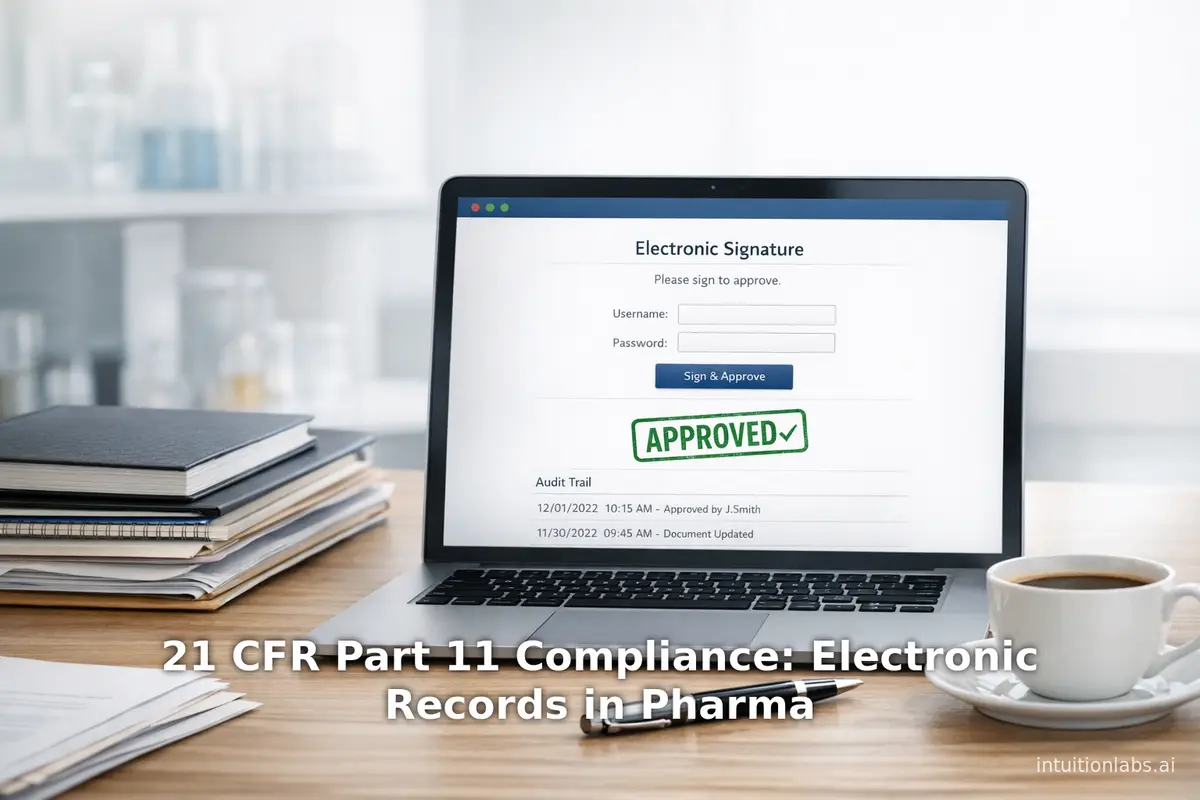
21 CFR Part 11 Compliance: Electronic Records in Pharma
Review the core requirements for 21 CFR Part 11 compliance in pharma. This guide explains FDA electronic records, signatures, ALCOA+, and system validation.
21 CFR Part 11 Compliance Guide for Small Biotech Startups
Learn 21 CFR Part 11 requirements for electronic records. This guide analyzes cost-effective FDA compliance strategies for small biotechnology startups.