


drug patent expirations · patent cliff 2027
Drug Patent Expirations 2027-2030: Market Entry Calendar
September 5, 2026
25 min read
A dated calendar of drug patent, exclusivity, and settlement-based market-entry events for 2027-2030, with a reproducible method and September 2026 sourcing.

- 01The calendar separates patent expiration, regulatory exclusivity, settlement-determined entry, and actual competitive market entry rather than treating them as one date.
- 02The 2027 to 2030 window combines small-molecule patent events with a biologics-led wave whose protections can expire across multiple jurisdictions and years.
- 03Primary company filings and FDA records correct secondary-list claims, including the reported expiration timing for Skyrizi and Rinvoq.
- 04Competitive entry depends on pipeline readiness as well as legal dates, so an expiration alone does not guarantee immediate price effects.
Executive Summary
Between 2027 and 2030, a concentrated set of the pharmaceutical industry's largest small-molecule and biologic franchises face U.S. patent or regulatory-exclusivity events. Independent analysts differ on the aggregate scale: Evaluate estimates more than $300 billion in global prescription drug revenue will lose exclusivity between 2025 and 2030 ([1]), while GlobalData puts U.S.-only exposure at more than $230 billion over the same period ([2]).
Verified, primary-sourced dates confirm the pattern. Regeneron and Sanofi's Dupixent (dupilumab) and EYLEA (aflibercept) both face core U.S. patent dates in mid-to-late 2027. Merck's Keytruda (pembrolizumab), Bristol Myers Squibb's Opdivo (nivolumab), and J&J-licensed Darzalex (daratumumab) each show 2028 or 2029 U.S. exposure dates, according to GlobalData's analysis of top-selling biologics ([3]), and AbbVie's own 10-K corrects widely circulated aggregator claims that Skyrizi and Rinvoq face 2028 expirations, stating the actual composition-of-matter patents run to 2033 ([4]).
This report separates patent, exclusivity, and actual-entry dates into distinct, independently sourced fields rather than a single collapsed date.
Global prescription drug revenue expected to lose exclusivity between 2025 and 2030, according to Evaluate
U.S. revenue exposure over the same period, according to GlobalData
Generic price decline below the pre-competition brand price once six or more competitors are on the market
Healthcare-system savings created by generic and biosimilar medicines in 2024
Introduction and Background
The pharmaceutical industry is entering a concentrated period of intellectual-property expiration widely described in trade and financial-analyst coverage as a "patent cliff." Independent analysts at Evaluate (formerly EvaluatePharma, now part of Norstella) estimate that more than $300 billion in prescription drug revenue will lose exclusivity globally between 2025 and 2030 ([1]). GlobalData, a separate research and analytics firm, puts the U.S.-only figure at more than $230 billion in revenue at risk over the same 2025 to 2030 window ([2]). The two figures are not directly comparable (one is global, one is U.S.-only, and each firm applies its own methodology), and this report treats them as independent, dated estimates rather than a single consensus number.
This report focuses specifically on the 2027 to 2030 sub-window of that broader cliff, the years in which several of the industry's largest small-molecule and biologic products face their principal U.S. patent or regulatory-exclusivity events. IntuitionLabs has previously published a calendar-style review of 2026 expirations (intuitionlabs.ai) and a dedicated 2027 loss-of-exclusivity (LOE) analysis ([5]); rather than restate that material, this report extends the calendar through 2030, and, more importantly, publishes an explicit, reproducible method for distinguishing four categories of date that are routinely conflated in "patent cliff" listicles: the patent expiration date itself, the regulatory exclusivity expiration date, any settlement-determined entry date, and the actual observed date of competitive market entry. As of September 2026 (the observation date for this report), all four categories can diverge for the same product, sometimes by years.
The analysis below draws on primary sources wherever possible: the U.S. Food and Drug Administration's (FDA) Orange Book and Purple Book, audited SEC filings (Form 10-K and Form 20-F) from the affected manufacturers, USPTO patent-term-extension records, and market-research reports from IQVIA, GlobalData, Evaluate, and the Association for Accessible Medicines (AAM). Every date and figure below carries its own source and observation date, because, as this report's method section explains, no single list of "drug patent expirations" is authoritative on its own.
Methodology: Distinguishing Patents, Exclusivity, Settlements, and Entry
A reproducible patent-expiration calendar requires separating four distinct legal and commercial events that popular "patent cliff" lists frequently collapse into one date.
Patents are property rights granted by the U.S. Patent and Trademark Office (USPTO) and, for approved non-biologic drugs, are indexed by the FDA in the Orange Book, which lists a product's associated patents using standardized patent-use codes. The Purple Book has patent information for certain licensed biological products, but biologic patent claims and dates in this calendar should be verified from product-specific patent records, manufacturer disclosures, and litigation or licensing materials ([6]). Critically, the listed Orange Book patent set is not static: the FDA's own database lets users view newly added or delisted patents, and the downloadable Orange Book data files are refreshed on a monthly cycle ([7]), meaning any static "list" of expirations is only accurate as of its own extraction date.
For biologics, the equivalent tool is the Purple Book, which covers biological products regulated by the Center for Drug Evaluation and Research (CDER) and shows the expiration date of reference-product exclusivity once FDA has made a formal determination under Section 351(k)(7) of the Public Health Service Act ([8]).
Regulatory exclusivity is legally distinct from a patent. The FDA states plainly that "patents and exclusivity work in a similar fashion but are distinct" ([9]): exclusivity is a statutory delay on FDA's ability to approve a competing application, independent of any patent. For biologics, the Biologics Price Competition and Innovation Act (BPCIA), enacted March 23, 2010, grants reference biologics a twelve-year period during which FDA cannot approve a competing biosimilar ([10]), with the earliest a biosimilar application can even be submitted set four years after the reference product's first licensure. For small molecules under the Hatch-Waxman framework, a generic applicant may file a Paragraph IV certification stating that a listed patent "is invalid or will not be infringed" by the proposed generic (21 U.S.C. 355(j)(2)(A)(vii)(IV)) ([11]), and the first such filer can earn 180 days of generic exclusivity measured from its own first commercial marketing date, not from the patent's expiration ([12]).
Two further exclusivity types extend the calendar rather than shorten it. Orphan drug exclusivity offers a potential seven years of market exclusivity after approval for products treating rare diseases. Pediatric exclusivity, a six-month extension under Section 505A, does not run concurrently with other protections; it "attaches to the END of all existing marketing exclusivity and patent periods" ([13]), which is why several dated examples below show a base patent date followed by a later, pediatric-extended date for the same patent.
A patent term extension (PTE) under 35 U.S.C. 156 is a third, separate mechanism: it lets a sponsor restore part of a patent's term that was lost while the product awaited FDA approval ([14]); USPTO records separately distinguish patents that have received a full PTE from those "that have only received an interim extension" pending a final decision ([15]).
Finally, and separately from all statutory dates, a brand manufacturer and a generic or biosimilar maker may reach a licensing agreement that sets a specific, publicly disclosed date on which the licensed competitor may enter the market, independent of when the underlying patent or exclusivity period ends. Patent expiration and market entry should not be treated as synonyms.
- Patents and regulatory exclusivity are legally distinct protections.
- Pediatric exclusivity extends existing protection periods rather than running concurrently with them.
- A licensing agreement can set a public competitor entry date separately from statutory dates.
- Patent expiration and market entry should not be treated as synonyms.
The article treats patent, exclusivity, settlement, and actual-entry dates as distinct fields.
2027 Patent and Exclusivity Expirations
2027 is the first of the three years covered by this calendar and includes some of the best-documented events in the entire 2027 to 2030 window, because several of the affected companies disclose exact patent expiration dates (not merely years) in their own SEC filings.
Pfizer's FY2025 Form 10-K lists both Ibrance and Eliquis (apixaban, co-marketed with Bristol Myers Squibb) as having U.S. basic product patents expiring in 2027, with Ibrance's European and Japanese patents running an additional year to 2028 ([16]).
On the biologics side, Regeneron's FY2025 Form 10-K discloses that two U.S. formulation patents covering both EYLEA (aflibercept 2 mg) and EYLEA HD (aflibercept 8 mg), Nos. 11,066,458 and 11,084,865, expire on June 14, 2027 ([17]). The same filing lists Dupixent (dupilumab, marketed with Sanofi) as having a U.S. composition-of-matter patent, No. 8,735,095, expiring October 2, 2027 ([18]).
Table 1 below summarizes these selected 2027 events, drawing exclusively on the manufacturers' own SEC filings and press releases rather than secondary aggregators.
Table 1. Selected U.S. Patent and Exclusivity Events, 2027
| Product (INN) | Company | IP Type | Date |
|---|---|---|---|
| Eliquis (apixaban) | BMS / Pfizer | Basic product patent (year-level disclosure) | 2027 |
| EYLEA / EYLEA HD (aflibercept) | Regeneron | Formulation patents (US 11,066,458; 11,084,865) | June 14, 2027 |
The table illustrates a recurring pattern for 2027: several of the year's most consequential events involve biologics (EYLEA, Dupixent) whose formulation and composition-of-matter patents, not a single "master patent," determine the actual date of exposure,.
“This report separates patent, exclusivity, and actual-entry dates into distinct, independently sourced fields rather than a single collapsed date.
2028 Patent and Exclusivity Expirations
2028 is arguably the most consequential single year in this calendar, because it contains the confirmed or disclosed exposure dates for several of the industry's largest-revenue products, drawn directly from FDA Orange Book patent detail pages and the companies' own SEC filings.
Merck's FY2025 Form 10-K discloses that "biosimilar competition could begin in December 2028 when the primary compound patent expires" for Keytruda (pembrolizumab), the company's top-selling oncology immunotherapy ([19]).
Two widely prescribed SGLT2-inhibitor diabetes drugs also show 2028 dates in the Orange Book. Jardiance (empagliflozin, Boehringer Ingelheim / Eli Lilly) has a drug-substance patent, No. 7,579,449, listed with a base expiration of August 1, 2028, extended to February 1, 2029 by pediatric exclusivity ([20]). Farxiga (dapagliflozin, AstraZeneca) has a drug-product patent, No. 7,851,502, with a base expiration of August 19, 2028, similarly extended to February 19, 2029 ([21]).
A methodological caution belongs in this section as well: aggregator sites circulating "patent cliff" lists frequently cite 2028 as the expiration year for AbbVie's Skyrizi (risankizumab) and Rinvoq (upadacitinib). AbbVie's own FY2025 Form 10-K states directly that the composition-of-matter patents for both products "are expected to expire in 2033" ([4]), a five-year discrepancy that underscores why this report treats primary filings, not secondary listicles, as authoritative.
Table 2 below summarizes the verified 2028 events.
Table 2. Selected U.S. Patent and Exclusivity Events, 2028
| Product (INN) | Company | IP Type | Date |
|---|---|---|---|
| Keytruda (pembrolizumab) | Merck | Primary compound patent | December 2028 |
| Jardiance (empagliflozin) | Boehringer Ingelheim / Eli Lilly | Drug-substance patent (US 7,579,449), PED-extended | Aug. 1, 2028 (base); Feb. 1, 2029 (PED) |
| Farxiga (dapagliflozin) | AstraZeneca | Drug-product patent (US 7,851,502), PED-extended | Aug. 19, 2028 (base); Feb. 19, 2029 (PED) |
| Skyrizi / Rinvoq (correction) | AbbVie | Composition-of-matter patent (per AbbVie's own 10-K, not 2028) | 2033 |
The table also includes the Skyrizi/Rinvoq correction discussed above.
2029-2030 Patent and Exclusivity Expirations and the Biosimilar Wave
The 2029 to 2030 window is dominated by biologics, consistent with the twelve-year BPCIA exclusivity period described in the Methodology section, and by secondary patents on drugs whose primary U.S. patents expired earlier but whose non-U.S. rights or later-filed patents extend into this window.
Genmab's Form 20-F (FY2024) discloses that its issued U.S. patents covering daratumumab, the active ingredient in Darzalex and Darzalex Faspro (marketed by Johnson & Johnson under license), "expire in 2029, 2031 and begin to expire in 2030" across the U.S., Europe, and Japan respectively ([22]), a rare instance in this data set where the same filing also forecasts the financial, not just legal, consequence of the expiration.
Novartis's 2025 Annual Report, filed with the SEC as an exhibit to a Form 6-K, lists Cosentyx (secukinumab) with a U.S. patent expiration year of 2029 and a European expiration year of 2030 ([23]), another example of the jurisdiction-by-jurisdiction divergence this report's method is designed to surface rather than average away.
Regeneron and Sanofi's Dupixent reappears in this window outside the United States: Regeneron's FY2025 Annual Report lists a European composition-of-matter patent, EP 2356151, expiring October 27, 2029 ([24]), roughly two years after the U.S. composition patent's 2027 base date discussed above, illustrating how the same molecule's global patent estate can be exposed on a rolling, multi-year basis rather than a single cliff edge.
Back in the United States, Merck's FY2025 Form 10-K discloses a second layer of Keytruda patent protection beyond the primary December 2028 compound patent: "composition of matter patent family expire in May and November of 2029" ([25]), meaning Keytruda's full U.S. exposure profile spans parts of both 2028 and 2029 rather than a single date.
Table 3 summarizes the verified 2029-2030 events.
Table 3. Selected Patent and Exclusivity Events, 2029-2030
| Product (INN) | Company | IP Type | Jurisdiction | Date |
|---|---|---|---|---|
| Darzalex / Darzalex Faspro (daratumumab) | Genmab / J&J | Issued patents (post-PTE) | US / Japan / EU | 2029 / 2030 / 2031 |
| Cosentyx (secukinumab) | Novartis | Basic patent | US / EU | 2029 / 2030 |
| Dupixent (dupilumab) | Sanofi / Regeneron | Composition-of-matter patent (EP 2356151) | EU | October 27, 2029 |
| Keytruda (pembrolizumab) | Merck | Composition-of-matter patent family | US | May and November 2029 |
- 2027EYLEA / EYLEA HDJune 14, 2027
Two U.S. formulation patents covering both products expire on this date.
- 2027DupixentOctober 2, 2027
The U.S. composition-of-matter patent is disclosed with this expiration date.
- 2028KeytrudaDecember 2028
Merck says biosimilar competition could begin when the primary compound patent expires.
- 2029Keytruda patent familyMay and November 2029
A second layer of U.S. protection extends beyond the primary compound patent.
Analysis of Key Segments
Two structural patterns emerge from the 2027-2030 calendar assembled above, one by molecule type and one by geography.
Small molecules versus biologics. The small-molecule products in this calendar (Ibrance, Eliquis, Jardiance, Farxiga) tend to expose a single, identifiable compound or drug-product patent whose date is comparatively easy to verify in the Orange Book, though pediatric extensions routinely add six months. Biologics (EYLEA, Dupixent, Darzalex, Cosentyx, Keytruda, Opdivo) instead expose a portfolio of formulation, composition-of-matter, and method-of-treatment patents that can expire on different dates years apart, as Dupixent's October 2027 U.S. composition patent and October 2029 European composition patent illustrate. This is consistent with the twelve-year BPCIA exclusivity window described in the Methodology section, which runs independently of, and typically longer than, the small-molecule Hatch-Waxman timeline.
Geographic divergence. In nearly every biologic case examined, U.S., European, and Japanese dates for the same molecule differ, sometimes by several years (Cosentyx: 2029 US / 2030 EU; Darzalex: 2029 US / 2030 Japan / 2031 EU). A calendar that relies only on FDA regulatory-database information will therefore understate the timeline for a globally marketed biologic; readers evaluating ex-U.S. exposure should treat the jurisdiction-specific dates above as illustrative rather than exhaustive, and should consult the European Medicines Agency and equivalent national regulators for full non-U.S. coverage.
A third pattern, cutting across both segments, is the divergence between disclosed patent-expiration years and disclosed commercial-impact years. Keytruda, for example, spans both the primary compound patent (December 2028) and the composition-of-matter family (May and November 2029) documented in Tables 2 and 3 above, precisely because the commercial effect of losing exclusivity is itself a range, not a single date.
“The gap between a patent's expiration date and a competitor's actual market entry is a data point worth tracking, not an error to be averaged away.
Data Analysis and Evidence
Quantifying the aggregate scale of 2027-2030 exposure requires tracing each figure to the research organization that produced it, since trade articles frequently restate one firm's number without attribution. Evaluate's analysis puts global exposure at "over $300bn in prescription drug revenues" losing exclusivity between 2025 and 2030 ([1]), while GlobalData's separate, U.S.-focused analysis puts domestic exposure at "over $230 billion" for the same period ([2]).
On the demand side, the FDA's own Office of Generic Drugs found that generic prices fall more than 95% below the pre-competition brand price once six or more generic competitors are on the market ([26]). A more recent FDA analysis of the 2023 generic-approval cohort found it generated a net $18.6 billion in savings in the twelve months following approval ([27]), a figure well below the 2019 approval cohort's nearly $25 billion, illustrating that savings depend heavily on which specific drugs face competition in a given year rather than on approval volume alone.
At the system level, the Association for Accessible Medicines (AAM) and the Biosimilars Council, using IQVIA data, report that generic and biosimilar medicines created $467 billion in healthcare-system savings in 2024 ([28]), while making up 90% of all U.S. prescriptions filled but only 12% of total drug spending ([29]); biosimilars specifically have generated $56.2 billion in cumulative U.S. savings since their 2015 market entry ([30]). The IQVIA Institute's "U.S. Medicine Use Trends 2026" report states total U.S. net prescription drug spending reached $606 billion in 2025 ([31]), with patient out-of-pocket costs reaching a record $110 billion, up $6 billion year over year ([32]), the backdrop against which the 2027-2030 exposure figures above should be read.
The scale of the individual franchises at stake helps explain why analysts treat 2027-2030 as unusually concentrated rather than a routine annual churn of expirations. Beyond Keytruda, Eliquis, and EYLEA discussed above, Gilead's Biktarvy (bictegravir/emtricitabine/tenofovir alafenamide), whose own core patents fall outside this report's 2027-2030 window, still posted $14.3 billion in FY2025 sales ([33]), and Novo Nordisk's Ozempic reached DKK 127,089 million in the same year ([34]); both figures are included here only to calibrate the size of the market segment in which the 2027-2030 exposed products, such as Keytruda's $31.7 billion in FY2025 sales, compete.
Implications and Future Directions
For biosimilar and generic developers, the twelve-year BPCIA clock and the four-year earliest-filing floor described in the Methodology section mean that development decisions for a 2029 or 2030 U.S. launch needed to begin years before the observation date of this report ([10]); the pipeline-readiness question, rather than the patent-date question, is likely to determine how much of the disclosed $230 billion to $300 billion in exposure actually converts into realized competition on schedule ([1]).
The system-level savings figures cited above are themselves a moving baseline: AAM's and IQVIA's $467 billion 2024 savings estimate ([28]) will be revised as the 2027-2030 cohort of expirations actually reaches the market, and IQVIA's separate $606 billion U.S. net-spending figure for 2025 sets the base against which any future erosion should be measured ([31]).
That readiness question is not guaranteed to resolve favorably. The IQVIA Institute's "Assessing the Biosimilar Void" report, focused on the European market but instructive for U.S. planning, found that only €4.3 billion of biologics faced off-patent competition in Europe between 2021 and 2023, down 45% compared with the prior three-year period ([35]), and separately estimates that a lack of biosimilar pipeline coverage for at-risk products could cost a minimum of roughly €15 billion in lost savings, about 25% of the total European loss-of-exclusivity opportunity through 2032 ([36]). Applied to the U.S. 2027-2030 window, the same logic implies that a patent or exclusivity expiration date is a necessary but not sufficient condition for actual competitive entry and price reduction; a molecule with no biosimilar sponsor actively in development at its exclusivity expiration date will not see the price effects the FDA's own generic-competition data associate with multiple competitors.
For life-sciences organizations tracking this calendar operationally, whether inside a manufacturer's IP or commercial-strategy function, or at an advisory firm supporting one, the practical implication of the Methodology section is that any internal "patent expiration tracker" needs to ingest the Orange Book and Purple Book on their native monthly and continuous update cycles, cross-reference each entry against the relevant company's own SEC disclosures, and store patent, exclusivity, and any disclosed settlement date as separate fields rather than a single collapsed "expiration date" column, mirroring the same restore-lost-term logic the USPTO applies when it extends a patent under 35 U.S.C. 156 ([14]).
Conclusion
This report set out to answer a narrower and more falsifiable question than most "drug patent expirations 2027-2030" content attempts: not simply which drugs are on a list, but which specific patents, regulatory exclusivities, and disclosed entry dates apply to each, and how those categories diverge. FDA has not made a determination of first licensure for each 351(a) biological product included in the Purple Book.
Independent market-research estimates of the aggregate revenue at risk range from roughly $230 billion to more than $300 billion depending on scope and methodology, and none of those estimates should be read as a prediction that every dollar of exposed revenue converts to lost sales on the exact date a patent or exclusivity period ends. The gap between a patent's expiration date and a competitor's actual market entry is a data point worth tracking, not an error to be averaged away. Readers building their own internal calendar from this material should anchor it to the primary sources cited throughout, re-verify against the Orange Book's monthly updates, and treat every date in Tables 1 through 3 as accurate as of the September 2026 observation date stated at the outset of this report, not as a permanent fact.
Frequently Asked Questions (FAQs)
What is a "patent cliff," and is 2027-2030 different from earlier cliffs? The term describes a period in which an unusually large volume of branded-drug revenue is expected to face generic or biosimilar competition for the first time. Analysts differ on the exact figure, Evaluate cites over $300 billion globally and GlobalData over $230 billion for the U.S. alone, both for the 2025-2030 period ([1]) ([2]).
How is a biosimilar market-entry timeline for 2029 determined? It generally follows the BPCIA's twelve-year reference-product exclusivity period from first licensure ([10]), combined with product-specific patent records and manufacturer, litigation, or licensing materials, plus any pediatric extension; the Purple Book should be used for its biological-product, biosimilarity/interchangeability, and applicable exclusivity information. Product-specific patent and FDA records should be assessed separately.
Where can a reader find an authoritative, current list or tracker of small-molecule patent expirations, rather than a static blog post? The FDA's Orange Book is the primary source and updates its downloadable data files monthly ([7]); any third-party "tracker" should be checked against that primary source, since this report documented at least one prominent case (Skyrizi/Rinvoq) where secondary aggregators' claimed dates diverged by five years from the manufacturer's own regulatory disclosure, as noted in the 2028 section above.
Why do blockbuster drug patent-expiry schedules from different sources disagree? Because "patent expiration," "regulatory exclusivity expiration," "settlement-determined entry," and "actual market entry" are four different dates, as the Methodology section explains, and different lists conflate them in different ways, or extract the Orange Book at different times, given its monthly update cycle described above.
How large is the 2027-2030 patent cliff compared with prior years? Trade press has framed the current wave as a cliff on the order of $200 billion to $300 billion in exposed revenue through 2030, consistent with GeneOnline's estimate ([37]) and with GlobalData's and Evaluate's independently sourced figures discussed in the Data Analysis section above.
Why can a generic applicant sometimes enter before a listed patent's expiration date at all? Because a generic manufacturer may file a Paragraph IV certification asserting the listed patent "is invalid or will not be infringed" by its product (21 U.S.C. 355(j)(2)(A)(vii)(IV)) ([11]), which can in principle support market entry ahead of a listed patent's stated expiration date, independent of the settlement and PTE mechanics discussed above.
About IntuitionLabs
Build practical AI for pharma and biotech with IntuitionLabs. We help life-science teams turn complex information and workflows into useful software, governed knowledge systems and AI tools.
IntuitionLabs is an AI consulting, custom software development and data engineering firm serving pharmaceutical, biotechnology, medical-device and other life-science organizations. We work with clinical, regulatory, medical-affairs, commercial, quality and IT teams to connect technology decisions with the work people need to accomplish.
AI consulting and adoption
Our AI enablement services cover readiness assessments, use-case selection, governance and policies, team workshops, adoption measurement and ongoing advisory support. We help organizations structure the information layer behind AI: source material, context, permissions and maintained knowledge that make generated answers useful and reviewable. Private LLM inference and hosted AI options support teams evaluating how to operate AI with appropriate control over their data and infrastructure.
Software, data and life-science workflows
IntuitionLabs develops custom software for pharma and biotech, integrates enterprise systems, and builds data engineering and business intelligence solutions. Areas of focus include AI agents, regulatory research, medical writing, medical affairs, CMC information, competitive intelligence and clinical-document workflows. Our eTMF intelligence work includes cross-system reconciliation and inspection-readiness support.
Enterprise platforms and regulated delivery
We provide Veeva services, application support, managed services, integrations and custom applications, alongside enterprise content work involving platforms such as Egnyte. For regulated workflows, our services include GxP enablement, computer-system validation and software development addressing 21 CFR Part 11 requirements. The applicable controls, validation responsibilities and acceptance criteria are defined for each engagement.
Work with IntuitionLabs
Explore AI enablement, pharma and biotech software development, data engineering and BI, and Veeva services. Contact IntuitionLabs to discuss your workflow, information sources and implementation needs.
IntuitionLabs publishes educational research to help life-science teams make informed technology decisions. Coverage of a product or organization does not imply a client relationship, endorsement or partnership.
Sources / 37

Need Expert Guidance on This Topic?
Let's discuss how IntuitionLabs can help you navigate the challenges covered in this article.
I'm Adrien Laurent, Founder & CEO of IntuitionLabs. With 25+ years of experience in enterprise software development, I specialize in creating custom AI solutions for the pharmaceutical and life science industries.
The information contained in this document is provided for educational and informational purposes only. We make no representations or warranties of any kind, express or implied, about the completeness, accuracy, reliability, suitability, or availability of the information contained herein. Any reliance you place on such information is strictly at your own risk. In no event will IntuitionLabs.ai or its representatives be liable for any loss or damage including without limitation, indirect or consequential loss or damage, or any loss or damage whatsoever arising from the use of information presented in this document. This document may contain content generated with the assistance of artificial intelligence technologies. AI-generated content may contain errors, omissions, or inaccuracies. Readers are advised to independently verify any critical information before acting upon it. All product names, logos, brands, trademarks, and registered trademarks mentioned in this document are the property of their respective owners. All company, product, and service names used in this document are for identification purposes only. Use of these names, logos, trademarks, and brands does not imply endorsement by the respective trademark holders. IntuitionLabs.ai is an AI software development company specializing in helping life-science companies implement and leverage artificial intelligence solutions. Founded in 2023 by Adrien Laurent and based in San Jose, California. This document does not constitute professional or legal advice. For specific guidance related to your business needs, please consult with appropriate qualified professionals.
Related Articles
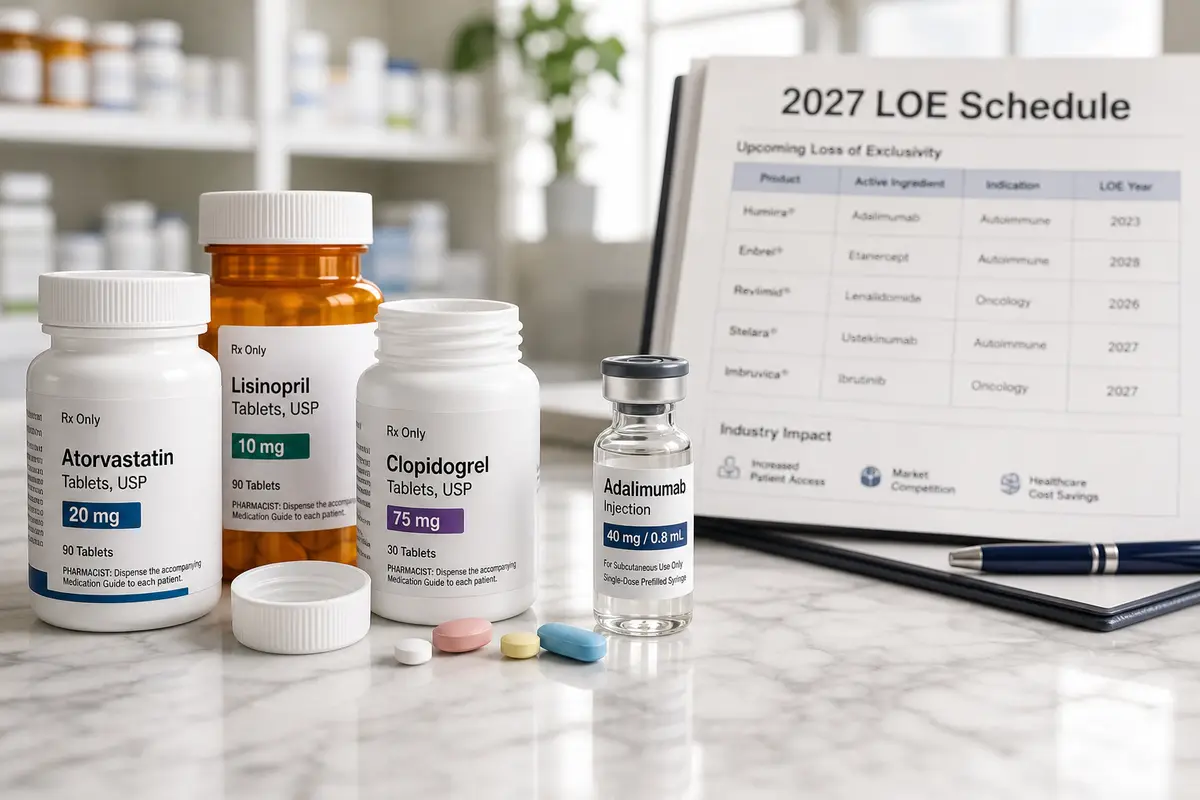
2027 Drug Patent Expirations: LOE Calendar & Pipeline
Analyze 2027 drug patent expirations and the impending patent cliff. Review a detailed loss-of-exclusivity (LOE) calendar for biologics and small molecules.
Patent Cliff Strategy: Role of Competitive Intelligence Software
Learn how pharma firms use competitive intelligence software to mitigate patent cliff risks. Updated April 2026 with the Humira/CVS Caremark biosimilar shift, Stelara LOE, and AI-native CI platforms.
AI Patents in Pharma: Ranking the Top 25 Companies (2025)
Explore our 2025 analysis of the top 25 pharmaceutical companies by AI patent filings. Learn who leads in AI R&D, key technology areas, and strategic trends.