


cdmo · eqms
CDMO Digital Quality Systems: Software Selection Guide
April 9, 2026
35 min read
Read this guide on evaluating digital quality systems (eQMS) for CDMOs. Learn about contract manufacturing software selection, GMP compliance, and integration.

Executive Summary
The contract development and manufacturing organization (CDMO) sector is experiencing a rapid digital transformation, particularly in the domain of quality management. CDMOs and contract manufacturers face unique quality challenges – multi-client responsibilities, stringent regulatory compliance (FDA/EU GMP, 21 CFR 11/Annex 11), and intense sponsor scrutiny – that make digital quality systems (eQMS) essential for competitiveness. Surveys indicate that 92% of CDMOs report that sponsors are raising digital requirements in contracts, yet virtually none have fully integrated systems with their clients ([1]). In practice, life-sciences companies are migrating from paper- or spreadsheet-based QMS to cloud-native eQMS platforms. Leading CDMOs have standardized on single-platform solutions; for example, Recipharm consolidated 12 disparate systems into one Veeva Vault QMS across 14 sites, yielding an estimated 60,000 manual hours saved per year and accelerated change control processes ([2]).
This report provides an in-depth analysis and software-selection guide for CDMOs seeking digital quality systems. It covers the CDMO industry context, the rationale for digital QMS, detailed vendor capabilities, and practical guidance on evaluating and implementing eQMS/IT solutions. We include evidence-based advantages (e.g. Increased automation, data integrity, remote audit readiness ([3])), expert insights (e.g. Quality-4.0 imperatives ([3])), case studies (Recipharm, Gilead, Merck) and quantitative data (e.g. market size growth ([4]), productivity gains ([5])). Emphasis is placed on the specialized needs of contract manufacturers – such as configurability for multiple clients and integration with MES – and on future trends (AI-driven QMS, integrated QMS/MES, Quality 4.0) that will shape the CDMO value proposition. All claims and recommendations herein are supported by industry sources, academic articles, and expert commentary ([2]) ([6]) ([7]) ([3]).
Introduction and Background
Contract Development and Manufacturing Organizations (CDMOs) are specialized service providers that develop and manufacture pharmaceutical and biotech products for sponsoring companies. According to industry data, the European CDMO market alone was valued at $37.17 billion in 2019 and is projected to grow ~7% annually ([4]). This growth is fueled by soaring R&D costs in Big Pharma, the rise of virtual biotech firms, and the desire of companies to outsource production to reduce capital investment ([4]). Small biotech firms are increasingly driving the pipeline (18% of products in development vs. 6% for Big Pharma ([4])) and rely heavily on CDMOs to bring products to market.
Quality assurance is paramount in CDMOs. By regulation (FDA, EMA), CDMOs must maintain full GMP-compliant quality systems for every product. The FDA’s guidance on quality agreements highlights the need for clear delineation of responsibilities between sponsors and contract manufacturers ([8]). In practice, sponsors demand “compliance-first” partners; as one industry expert notes, “quality management maturity is a differentiator, or at least a selection criteria, on the client side” ([9]). This means that CDMOs must not only comply with regulations, but also demonstrate robust, transparent quality processes to win contracts.
Historically, many CDMOs used disparate or paper-based QA systems. Typical quality processes (document control, CAPA, deviation handling, audits, training, etc.) were managed with a combination of spreadsheets, local servers, and manual logs. However, the exponential growth of regulated data (test records, batch records, etc.) is straining legacy methods ([10]). The pharmaceutical industry is at a digital crossroads: traditional, paper-centric QMS have become bottlenecks, causing delays in investigations and eroding agility ([10]). As one industry analysis puts it, “Pharma 4.0 quality management is not optional; it is the core competitive differentiator” ([11]). In response, many firms are embracing Quality 4.0 – applying digital technologies (cloud platforms, mobile, analytics, AI) to revolutionize quality management.
For contract manufacturers, the imperative is stronger. CMOs/CMOs must manage multiple clients and product lines simultaneously, each with distinct specifications and timelines. They require systems that are configurable, scalable, and flexible to accommodate client needs, while providing complete visibility into operations for both internal teams and sponsors ([12]). This has led to the emergence of centralized, electronic quality management systems (eQMS) and integrated IT platforms as strategic tools, not just compliance checklists. The next sections delve into the current state of digital quality, the advantages for CDMOs, and guidance for selecting and implementing the right software solutions.
The CDMO and Contract Manufacturing Landscape
Contract manufacturing is a cornerstone of the modern pharmaceutical supply chain. CDMOs perform development, formulation, and production services under contract, often handling the bulk of manufacturing for final drug products. The market scale is immense and growing: Surveys prior to COVID-19 valued the European contract manufacturing market at $37.17 billion, with projected double-digit growth fuelled by biotech outsourcing ([4]). Globally, the total CDMO market (including development services) now exceeds $80 billion and is expected to nearly double by 2030. This expansion is driven by trends such as personalized medicine (small-batch biologics), a surge in biologics development, and an industry strategy of de-risking core operations by outsourcing to specialized experts ([4]).
CDMOs operate under stringent regulatory frameworks. In the U.S., they must comply with FDA’s 21 CFR Parts 210/211 ([13]), which include detailed record-keeping and process controls. In Europe, EudraLex Volume 4 Annex 11 governs computerized systems. These regulations effectively mandate robust quality systems. For example, Part 11 allows electronic records only if they are secure, auditable, and validated for integrity.Consequently, any digital QMS selected by a CDMO must support electronic signatures, audit trails, version control, and data integrity checks consistent with these regulations.
The relationship between sponsors and CDMOs is formalized through Quality Agreements, which define CGMP obligations for each party. A poorly defined agreement can lead to confusion during audits or inspections ([8]). Sponsors increasingly insist that their CDMO partners have mature quality processes. One MasterControl webinar report observes: “Sponsors now evaluate contract manufacturers through a compliance-first lens. Digital maturity has become a market access criterion…Quality management maturity is a differentiator, or at least a selection criteria, on the client side” ([9]). In practical terms, this means that if two CDMOs offer similar capabilities, the one with a modern, auditable, and transparent quality management system will be preferred. Indeed, leading pharmaceutical companies now use the digital readiness of a CDMO as part of their sourcing decisions. As MasterControl noted, clients want ways to “understand current batch status, inventory levels, review e-batch paperwork,” etc., which requires digital integration ([14]).
In light of these dynamics, CDMOs are no longer just “manufacturers”; they are partners expected to deliver “Quality as a Service.” As Quality Magazine observes, tier-one customers increasingly demand that contract manufacturers provide not just parts, but “the system of processes, controls and documentation that led to parts arriving…with such high confidence in quality” ([15]). This vision of Quality-as-a-Service implies that contract manufacturers actively gate and record every step of production. Manual, paper-based QA is inadequate for this expectation. Instead, customers want near-real-time data and assurance: “...this level of control and visibility is only practical using automated systems that can ensure quality procedures are followed and capture quality control steps and measurements in real time” ([16]).
Digital Quality Systems: Concepts and Evolution
Digital Quality Management Systems (QMS), or eQMS, refer to software platforms that automate and centralize quality processes. At a minimum, such systems track documents, handle deviations, manage corrective/preventive actions (CAPA), and oversee audits and training. Modern eQMS suites typically include modules for document control, change control, training management, complaint handling, CAPA, audit management, supplier quality management, and risk management. For example, Veeva Vault QMS – a leading life-sciences eQMS – offers workflows for handling complaints, deviations, audits, quality risk management, supplier quality management, and change control, all on a cloud platform ([17]). Importantly for CDMOs, Vault QMS can allow external partners (clients) to access selected records (e.g. batch records, investigations) in real time ([17]), enabling sponsor oversight.
The architecture of digital QMS has shifted toward cloud-native, Software-as-a-Service (SaaS) models. Cloud platforms provide several advantages: they reduce IT maintenance, allow rapid updates/upgrades, and are accessible globally (critical for multi-site CDMOs). Leading providers (e.g. Veeva, MasterControl, Sparta Systems) offer 21 CFR Part 11-and-Annex-11-compliant solutions with full audit trails and validation documentation. Today’s best-in-class QMS also integrate with other enterprise systems. For instance, many have APIs or built-in connectors to Manufacturing Execution Systems (MES), ERP, LIMS, and regulatory information management (RIM) systems. A seamless example is Veeva’s Quality Cloud, where the QMS is “unified with other Quality Cloud applications, and connects to RIM to coordinate product change control activities, Safety to manage complaints, and CTMS for study-related data” ([18]).
Industry 4.0 and Quality 4.0: The term Quality 4.0 refers to applying Industry 4.0 technologies (big data, IoT, AI) to quality management. In pharma, this means using sensors, analytic dashboards, and AI to shift from reactive to predictive quality. Digital platforms can stream in-process data (e.g. from equipment sensors) and correlate it with quality events. As one industry commentator states, pharma is at “a digital crossroads…Traditional, paper-based quality systems are turning out to be a critical bottleneck” ([10]). Digital QMS can overcome this by providing real-time analytics: dashboards for quality KPIs, predictive risk alerts, and faster root-cause analysis. Indeed, early adopters of AI-driven QMS report major gains: “Recent industry data show that companies implementing AI-powered quality systems report productivity increases of over 35% while improving investigation effectiveness by 30–40%.”[48†L27-L29]. Such data underscores the potential ROI of digital quality tools.
Standalone QMS vs. Integrated Platforms: Historically, quality management was often siloed in standalone QMS applications. However, recent trends favor integration with production systems. A Quality Magazine article notes that manufacturers are moving toward “fully integrated ERP, MES, and QMS functionality replacing a standalone QMS as the backbone of [their] quality assurance programs.” ([19]). In practice, this can mean buying an ERP/MES suite that includes quality modules, or ensuring the QMS tightly integrates with shop-floor execution data. For CDMOs, integrated QMS/MES can streamline data flows: e.g. linking production batch records with deviation reports and CAPA triggers. MasterControl highlights this integration strategy: “MasterControl’s unified platform ensures data integrity, enhances quality controls, streamlines process control, simplifies review and release procedures, and provides unparalleled data visibility,” enabling efficiency and compliance ([20]).
In summary, digital quality systems for CDMOs are cloud-based eQMS (often with modules for CAPA, audits, training, etc.), commonly integrated with manufacturing systems. They replace error-prone manual processes with automated workflows, enforce compliance in real-time, and create a single source of truth for QA data. The next section examines why CDMOs benefit significantly from adopting these systems.
Benefits of Digital Quality Systems for CDMOs
The shift from legacy to digital quality systems offers tangible advantages for contract manufacturers. Case studies and industry data illustrate major gains in efficiency, compliance, and customer confidence:
-
Operational Efficiency: By automating routine tasks (document approvals, CAPA tracking, training reminders), digital QMS reduces manual workload. Recipharm’s experience is telling: after consolidating 12 disparate systems into one Veeva Vault platform, Recipharm “reduced manual work by 60,000 hours per year” ([2]). Similarly, change control processes collapsed from 14 steps down to 3 ([21]). These efficiency gains are not unique: quality automation often translates to faster release cycles and lower overhead. Indeed, industry surveys suggest AI-enhanced QMS can boost productivity by ~35% ([5]), indicating that even basic digitalization can cut hours and costs.
-
Compliance and Audit Readiness: Digital quality systems inherently improve compliance posture. They maintain complete electronic audit trails, version histories, and access logs, which are critical for 21 CFR 11/GMP examinations. As QualityZe (a QMS vendor) points out, “Digital systems come with automated audit trails, enhanced data integrity, and centralized records to meet cGMP expectations set by FDA, EMA, and WHO” ([3]). In practice, this means a CDMO can respond to an audit request quickly with searchable records, and can better demonstrate control over processes. For example, Gilead used a digital vault system to “onboard all manufacturing partners and collaboratively author product specs, quality agreements, and other critical documents”, ensuring a compliant digital archive across its outsourced supply chain ([6]).
-
Visibility and Transparency: Modern eQMS provide real-time dashboards and reporting. Contract manufacturers can transparently share certain quality metrics or documents with sponsors. According to a CDMO executive in a MasterControl webinar, clients now integrate with CDMO systems to “understand current batch status, inventory levels, review e-batch paperwork, and more” ([14]). This visibility builds trust and may accelerate decision-making (e.g. concurrent reviews rather than waiting for formal reports). One industry writer emphasizes that tier-one customers perceive “quality control data and documentation” as tangible value-adds ([22]), effectively treating quality services as differentiators. Digital QMS make such data-sharing practical.
-
Quality and Risk Management: With all quality events captured digitally, CDMOs can identify trends and risks faster. Integrated systems can signal issues proactively; for instance, linking real-time process monitoring (SPC charts, sensor data) to QMS alerts. Leading-edge implementations are already exploring Quality 4.0 ideas. Contract manufacturers leveraging IIoT (Internet of Things) for in-line quality monitoring can feed those signals into the eQMS to trigger immediate investigations or CAPAs. As one expert notes, the digitalization of quality processes “ensures product safety and efficacy on a global scale” by making operations intelligent and connected ([10]) ([3]).
-
Business Growth and Customer Confidence: Beyond internal gains, a mature digital QMS can be a selling point. Sponsors often assess CDMOs on quality maturity; digital readiness can unlock new contracts. In an era of rapid product cycles (e.g. pandemic responses), speed matters. Digital QMS that streamline validation and release can reduce time-to-market. Recipharm cited faster lead times and harmonized processes across 14 sites as benefits of its unified system ([23]). Likewise, reducing errors and scrap through enforced digital controls improves yield, which is both cost-saving and strengthens the CDMO’s reputation.
In aggregate, digital quality systems transform quality from a “burden to a business advantage” ([24]). They help CDMOs meet regulatory demands more efficiently, convey transparency to clients, and ultimately compete on quality (even offering “Quality as a Service” ([25])). These advantages motivate CDMOs to invest in selecting the right software. The following section outlines the specific requirements and challenges CDMOs face when choosing digital QMS and related IT solutions.
CDMO-Specific Requirements and Challenges
Contract manufacturers have unique requirements that shape their digital QMS needs. Key considerations include:
-
Multi-Client Configurability: Unlike single-product manufacturers, CDMOs must handle different clients’ SOPs, documentation templates, and regulatory requirements simultaneously. The QMS must be highly configurable, allowing separate quality processes or document sets per client or product line if needed, while still operating within one system. For example, workflows for change control or complaint handling may vary by sponsor or product type. MasterControl emphasizes this need: contract manufacturers require “configurability to manage multiple clients and products simultaneously” ([12]).
-
Scalability and Flexibility: CDMOs often have “flexible” production models, scaling up for one product and right-sizing for another. The eQMS must scale with business volumes. A platform should support adding new client modules or sites without requiring complete redevelopment. This also relates to technology: cloud-based QMS can scale storage and users on-demand, which suits growing CDMO operations. As one source notes, contract manufacturing platforms must “support growth and change with a system that scales alongside operations” ([26]).
-
Integration with Production Systems (MES/ERP/LIMS): For maximum effectiveness, a QMS should not operate in isolation. CDMOs benefit from integrating QMS with Manufacturing Execution Systems (MES) and Enterprise Resource Planning (ERP) systems. This connection enables automatic transfer of batch data, equipment logs, and lab results into the quality system. For instance, if an in-process sensor hits a threshold, the MES can automatically log a deviation in the QMS. MasterControl’s unified QMS/MES solution is designed for life-science contract manufacturers, providing “real-time insights and transparency across all processes” ([26]). Similarly, Quality Magazine highlights that integrated ERP/MES/QMS suites are becoming the default backbone of a manufacturer’s QA program ([19]).
-
Regulatory Compliance and Validation: Any chosen software must facilitate regulatory compliance. This includes built-in 21 CFR 11 features (electronic signatures, audit trails, user authentication), GxP-aligned workflows, and robust data security. Vendors targeting the life-science industry typically adhere to Good Automated Manufacturing Practice (GAMP 5) guidelines. During selection, CDMOs should verify that the QMS vendor provides documentation to support system validation (DQ/IQ/OQ/PQ protocols) and that the software can be qualified. The selection process must factor in the cost/time of Computer System Validation (CSV). As one QMS guide advises, “The QMS software shall comply with 21 CFR part 11 requirements” ([27]).
-
Interoperability and Standards: CDMOs may work with global clients; compliance to international standards (ISO 9001, ISO 13485 for medical, ICH Q10) is often needed. The digital QMS should support standardized data exchange if required (some QMS systems allow exporting in IMS/QES formats for audit). For multi-country operations, multi-language and multi-currency capabilities may be relevant. The QMS should also integrate with common enterprise tools (e-mail, ERP/CRM systems, cloud storage) to avoid creating isolated silos.
-
User Adoption and Training: A sophisticated QMS is only effective if used properly. Ease of use and role-based interfaces are important to ensure fast user adoption across shifts and geographies. Many vendors highlight “intuitive UX” and mobile capabilities. The selection should consider how quickly the workforce can learn the system, and whether the vendor provides training materials. Documented training management within the QMS (assigning and tracking GMP training) is also a requirement, so this module’s capability deserves evaluation.
-
Vendor Reliability and Support: Selecting a QMS vendor is making a long-term partnership. CDMOs should vet vendor stability (financial health, years in business, customer references in pharma/CDMO segment). For example, industry leader Sparta Systems (TrackWise) and MasterControl have decades of life-science experience. Newer entrants (e.g. ComplianceQuest on Salesforce, Qualio for startups) may offer innovation but need scrutiny on pharma track record. Customers often ask for case studies from similar firms during RFPs. Post-implementation support, update cadence, and data migration services are also critical.
-
Cost and ROI: Total cost of ownership (TCO) – including licensing, hosting, implementation services, and validation – must be balanced against expected ROI (e.g. reduced paper handling, fewer compliance fines, faster turnaround). CDMOs should develop business cases quantifying expected savings (e.g. reclaimed FTE hours, faster batch release) and new business potential (winning clients by offering digital access) ([2]) ([1]). Subscription models (SaaS) usually have lower upfront cost but be sure to account for recurring fees and data occupancy as operations scale.
These specific requirements should guide the selection criteria when evaluating software. A thorough selection process typically includes defining functional requirements (using an RFP/RFI with detailed use case questions), scoring potential vendors on compliance features, technical fit, cost, and roadmap. Next, practical testing (proof-of-concept) and validation planning should follow. Throughout, CDMOs must also prepare for change management: documenting process changes, migrating legacy data (e.g. active SOP versions, employee records), and training users.
Software and IT Selection Guide
Selecting a digital quality system is a strategic decision. This guide outlines key steps and criteria, backed by best practices and expert advice:
-
Assess Current State and Needs: Begin with a thorough quality process audit. Identify inefficiencies (e.g. delays in CAPA closure), compliance gaps, and future needs. Engage stakeholders from Quality, IT, Operations, and key clients. Define non-functional requirements like expected user load, regulatory certifications, and integration points with existing systems (ERP, LIMS, etc.). Documenting a Quality System Requirements Specification ensures clarity.
-
Prioritize Compliance Requirements: Ensure the QMS software supports all required regulations. Look for built-in compliance to 21 CFR Part 11, EU Annex 11, HIPAA (if applicable), ISO standards, and data integrity guidance (FDA Data Integrity guidance for ALCOA+). The system should allow configurable electronic signatures, have robust audit trails, and both automatic and manual data backup. It should produce documentation (validation test scripts, traceability matrices) to facilitate regulatory inspections.
-
Functional Capability Evaluation: Evaluate core QMS modules:
- Document Control: versioning, approval workflows, periodic review triggers.
- Change Control: routing changes through approval with impact assessment.
- CAPA Management: capturing issues, investigation templates, assigning actions.
- Training Management: course assignment, tracking completion, retraining alerts.
- Audit Management: audit planning, checklists, finding tracking.
- Supplier Quality: supplier audits, performance tracking, nonconformance.
- Risk Management: risk assessments (e.g. FMEA) and integration to change/CAPA.
- Other: complaint handling, calibration logs, eBR/eBatch interfaces, mobile access, etc. Each module should not only document but enforce processes. For instance, a robust QMS can “trigger holds, block releases, require approvals, and... digitally control workflows” ([28]) (see SG Systems Global guide). Tools that merely store documents without enforcing workflow may not meet compliance needs.
-
Integration and Architecture: Consider on-premises vs. cloud. Vendors like Veeva, MasterControl, and ComplianceQuest offer cloud (SaaS), often more cost-effective and scalable. On-premises may be chosen for sensitive IP or existing corporate policy. Ensure the architecture supports network segmentation, data residency (for international operations), and interoperability. Verify strong security: encrypted data storage and transmission, multi-factor authentication, role-based access, and regular audits of penetrations. The QMS should have open APIs or connectors for upstream/downstream data. For CDMOs, integration with MES (to feed QM items from the shop floor) and ERP (for material/spec data) is often vital|MasterControl touts its unified QMS/MES platform for end-to-end traceability ([20]).
-
Vendor Screening and Demos: Prepare an RFP/RFI listing requirements. Shortlist vendors and schedule demos. During demos, present real scenarios (e.g. handling a change request from initial submission to closure with CAPA). Evaluate the user interface and ease of updating workflows or templates. Talk to references – ideally other pharma contract manufacturers. For example, Recipharm’s testimonial on Veeva can be illustrative: after going live, Recipharm saw “a consistent customer experience” and significant maintenance cost savings ([29]).
-
Proof-of-Concept (PoC) or Pilot: If possible, test the leading contender in a controlled environment. Perform a PoC on a non-critical product line or processes, verifying integration with existing systems. This can uncover technical issues or user acceptance hurdles.
-
Cost and ROI Analysis: Perform a detailed TCO calculation. Include licensing, implementation (including validation effort), data migration, training, and ongoing support/subscription fees. Compare to current spending on legacy systems (IT maintenance of old servers, manual processes costs) and project quantifiable benefits (e.g. reduced labor, fewer deviations). Some QMS vendors provide ROI calculators; e.g., MasterControl published tools estimating ROI for their eQMS implementation. For negotiations, cloud vendors often accept multi-year contracts for discounted pricing, which must be weighed against flexibility needs.
-
Implementation and Validation Planning: Once selected, plan the implementation carefully. Key steps include:
- Process Harmonization: Standardize and simplify quality processes before automation. As Merck’s experience suggests, align cross-functional groups (e.g. linking research/manufacturing QMS) ([30]).
- Data Migration: Identify what legacy data to import (active documents, training records, historical incidents). Clean up data to avoid garbage-in in the new system.
- Validation: The software must be qualified as per GMP. Develop design qualification (DQ) to match requirements, installation (IQ), operational (OQ), and performance (PQ) protocols. Many vendors offer validation-accelerator tools.
- Training and Change Management: Train users not just on “how” but also explain “why” of the new system. Leverage vendor training and internal super-users. Early user champions can help drive adoption.
- Governance and Continuous Improvement: Post-launch, establish a governance team (QMS admin, key stakeholders) to oversee the system. Monitor metrics (like on-time CAPA closure rate, audit finding resolution time) to measure impact. Gather user feedback for iterative improvements.
Throughout this selection and implementation process, the mission is to build a QMS that is not merely a cost-of-compliance, but a strategic platform. A modern digital QMS should “transform compliance from a burden to a business advantage,” as one quality expert summarizes ([24]).
Major Digital Quality Platforms and Solutions
The market offers a range of digital quality management solutions. Below is a comparison of several prominent systems used in life sciences and contract manufacturing. This is illustrative – many other vendors exist – but highlights different deployment models and strengths:
| Platform (Vendor) | Deployment Model | Key Modules/Capabilities | Notable Use-Cases / Comments |
|---|---|---|---|
| Veeva Vault QMS (Veeva Systems) | Cloud SaaS (Life Sciences) | Complaints, Deviations/CAPA, Audits, Supplier QMS, Change Control, Training, EQMS unified with RIM/Safety. External partner access for collaborative quality management. | Used by global CDMOs (Recipharm standardized 14 sites ([31])). Veeva Vault enabled Gilead to onboard all contract manufacturers for remdesivir, collaboratively authoring specs and quality agreements ([6]). Veeva’s Quality Cloud offers integrated dashboards and regulatory workflows. |
| Quality Excellence Suite (MasterControl) | Cloud SaaS (Regulated industries) | Document Control, Change Control, CAPA, Training, Audit Mgmt, Risk Mgmt, Quality Event Mgmt. Optional MES integration for CDMOs. | MasterControl’s unified QMS+MES addresses CDMO needs: “configurability to manage multiple clients”, “real-time visibility” ([7]). Over 1,100 life-science companies use it worldwide ([32]). Known for strong 21 CFR 11 compliance and extensive templates. |
| SmartSolve (Pilgrim IQVIA) | Cloud/SaaS or On-prem | Audit Mgmt, CAPA, Nonconformance, Risk Mgmt, Document Mgmt, Training, Supplier Mgmt, eQMS + RIM integration. Often bundled with CAPA, Audit, & Training modules. | Pilgrim (now IQVIA SmartSolve) is established in pharma; uses AI for compliance insights. Featured in quality software comparisons ([33]) ([34]). Common in mid- to large-size firms. Integration with regulatory dossier software available. |
| TrackWise Digital (Sparta Systems, now Pendo Health) | On-Prem/Cloud Hybrid | CAPA, Complaints, Audit, Training, Deviation, Out-of-Spec, Supplier Quality. Graphical Process Change Control Designer. | Industry veteran used by many large pharmaceutical companies. TrackWise Digital offers flexible deployment. Spartan’s QMS historically led pharma; recommended by industry reviews . Suitable for enterprises needing deep customization. |
| ComplianceQuest EQMS (Salesforce-based) | Cloud SaaS (Multi-tenant) | CAPA, Audit, Nonconformance, Document Mgmt, Supplier Mgmt, Training. Built on Salesforce platform with rapid configurability. | Newer entrant; attractive to companies already on Salesforce. QMS features often comparable to legacy systems. Two case studies report smooth transition to eQMS ([35]). Offers global 24/7 support. |
| Qualio (Qualio) | Cloud SaaS | Document Control, CAPA, Change Mgmt, Audit Mgmt, Training, Risk Labs integration with LIMS. Designed for startups/smaller biotechs. Highly intuitive UI. | Focuses on ease of use; claims rapid implementation. Used by growth-stage biotech and some CDMOs for scale-up projects. Cited as a top QMS pick for 2026 ([36]). Simplifies ISO 13485 and FDA-approval workflows. |
Sources: Vendor product literature, user case studies, and industry analyses ([31]) ([6]) ([7]) ([34]). This table is indicative; any selection should verify current features and compliance credentials.
Case Studies: Real-World Implementations
Recipharm (Global CDMO): Recipharm, a leading contract manufacturer, provides an instructive example of digital QMS benefits. The company faced a “patchwork of systems” (12 different QMS, plus paper processes) across 14 global sites for manufacturing and quality operations ([37]). To unify this, Recipharm implemented Veeva Vault Quality Cloud (Docs, QMS, Training) as a single platform. Results were significant: manual workload dropped dramatically (60,000 hours saved per year) ([2]), change control cycle times shrank (14 approval steps reduced to 3) ([21]), and processes were harmonized globally. Recipharm reports that “using one Veeva platform…has resulted in a better and more efficient collaboration with our customers” ([38]). The move gave Recipharm consistent quality procedures, faster document turnaround, and improved cost control on IT maintenance.
Gilead Sciences (Pharmaceutical Sponsor with Heavy Outsourcing): Gilead’s experience with remdesivir (Veklury) highlights the importance of digital systems in a high-stakes, outsourced project. Roughly 70% of remdesivir’s clinical and commercial supply was manufactured under contract, requiring tight coordination across partners ([6]). Gilead deployed Veeva Vault Quality Suite to “onboard all manufacturing partners and collaboratively author product specs, quality agreements, and other critical documents”, plus a compliant digital archive for validation records ([6]). This comprehensive digital infrastructure allowed Gilead to monitor contract manufacturers in real time and implement proactive quality signals (as stated by Gilead’s senior QA VP: “We want to make sure we have signals to detect risks, and plan to mitigate them before they become a huge problem.”[38†L24-L28]). The Vault system standardized formats and provided a single source for changes, audits, and investigations across multiple CMOs, enabling Gilead to scale production rapidly without compromising compliance.
Merck (Pharma Company Integrating QMS): When legacy systems hindered efficiency, Merck undertook a cross-department digital quality transformation. Previously, Merck’s research labs and manufacturing plants used separate QMS. A new initiative merged these domains. Danica Larson, IT leader for quality at Merck, notes that they “came to believe that a unified approach would be better.” Within 10 months – despite remote-working conditions – Merck implemented Veeva Vault QualityDocs across the enterprise ([30]). This quick turnaround demonstrates how larger organizations can successfully migrate to modern QMS. Post-implementation, Merck achieved standardized quality documentation and was better prepared for audits due to language and format consistency (Savvy governance was key, per the case).
Other Examples: Numerous medium and small contract manufacturers have reported similar successes. For instance, two life-sciences companies using ComplianceQuest (Salesforce-based EQMS) reported managing their transition from spreadsheets to a digital system with minimal disruption ([35]). While proprietary details are often confidential, industry conferences and webinars consistently highlight that adopters of digital QMS see shortened audit prep time, fewer CAPA backlogs, and improved supplier quality oversight. Vendor case studies (e.g. MasterControl, Sparta) cite reduced deviations and cost savings, though these are typically vendor-provided.
Collectively, these case studies underscore common themes: migrating to a single platform breaks down silos, automates cumbersome paperwork, and creates consistency – all of which enhance CDMO competitiveness.
Data Analysis and Evidence-Based Insights
Several key data points and trends illuminate the value of digital quality systems in contract manufacturing:
-
Survey Evidence on Digital Expectations: A joint MasterControl–PharmaSource survey (January 2026) found that 92% of CDMOs report sponsors are now demanding digital capabilities in contracts, yet “zero” respondents said they have full digital integration with their sponsors ([1]). This striking gap indicates that almost all CDMOs must urgently modernize to meet partner expectations. It also suggests a business risk of being left behind if sponsors choose digitally-ready competitors.
-
Productivity and Efficiency Gains: Quantitative improvements are reported by adopters. In one industry article, companies using AI-powered QMS saw “productivity increases of over 35%” and “investigation effectiveness” up by 30–40% ([5]). This is consistent with the Recipharm case (60,000 hours saved) and anecdotal evidence from other firms. Such figures imply that automated workflows, smart analytics, and reduced manual data entry can drastically cut time spent on quality tasks.
-
Impact on Quality Outcomes: While hard to quantify, the impact on quality metrics is also favorable. Centralized QMS platforms tend to reduce the incidence of missed tasks and delayed actions. For example, risk management features can curb product deviations before they escalate. Industry publications suggest that integrated digital systems improve audit readiness and compliance: “ensuring full visibility…helps maintain compliance with stringent life sciences regulations” ([20]). The QualityZe analysis (an industry commentary, albeit vendor-sponsored) lists tangible benefits like “improved compliance & audit readiness” through automated trails ([3]) and “faster to market via real-time quality control”.
-
Market Adoption Trends: The QA software market in pharma is expanding. Reports on “top pharma QMS” list dozens of dedicated products ([39]) ([40]). Some surveys (vendor-driven) estimate that a majority of large pharma and biotech companies plan to implement or upgrade digital QMS in the next 3–5 years. The CDMO sector closely follows this curve: MasterControl’s survey observed that most CDMOs are now prioritizing digital projects. Meanwhile, analyst reports on Pharma 4.0 emphasize that legacy paper practices are being rapidly phased out (citing EU and FDA guidance encouraging science- and risk-based, data-driven approaches).
-
Cost-Benefit Considerations: Although comprehensive public data on ROI is scarce, indirect evidence suggests payback. Quality system consolidation (e.g. reducing 12 systems to 1) cuts licensing and IT costs, as Recipharm found ([2]). The elimination of manual errors also reduces scrap and rework costs. In regulated industries, the cost of a compliance lapse can be millions in product recalls and sanctions, so improved controls have potentially huge upside. The investment in digital QMS is often justified by the ability to attract and retain business; competing on quality and data connectivity is increasingly monetizable.
In summary, both qualitative and quantitative evidence favor digital QMS: CDMOs that implement them are likely to see lower operational costs, higher compliance assurance, and a stronger competitive position.
Selection Criteria and Evaluation Checklist
When choosing a digital QMS and related IT systems, CDMOs should evaluate candidates against a detailed checklist. Key criteria include:
-
Regulatory Compliance Features: Does the system support 21 CFR Part 11 requirements (electronic signatures, audit trails, timestamping)? Does it facilitate Annex 11 compliance (e.g. audit of system changes, performance monitoring)? Check for built-in validation documentation (e.g. validation IQ/OQ documents). Vendors often provide audit-friendly reports for reviewers.
-
Quality Functionality: Confirm that all necessary modules are included or available (document control, CAPA, deviations, audit mgmt, supplier quality, training, change mgmt, complaint handling, risk mgmt, etc.). Crucially, verify whether the system enforces processes or merely records them. The system should, for example, automatically block batch release if a CAPA is unresolved, rather than just note the CAPA. A good litmus test is: Can the software automatically trigger holds or quality reviews at key steps? As one QMS guide urges, “does it enforce, or just document?” – true digitization means enforcement and control, not passive archiving ([28]).
-
Client/Partner Access: Since CDMOs interact with client systems, assess how easily the QMS can share data securely. Can external auditors or clients be granted scoped access (read-only) to relevant sections of the system? Veeva Vault, for instance, allows external collaboration on CAPA and audits ([17]). If a sponsor requires portal access to your eBatch records, ensure the system can accommodate that.
-
Ease of Use and Training: The user interface should be intuitive. Check for touchscreen/mobile-friendliness (for on-floor data capture) and configurable dashboards. Evaluate the training workflow and documentation ease. Systems that are too complex may suffer low adoption, negating benefits.
-
Integration and Data Management: Review how the software will integrate with existing IT. Does it offer REST APIs, file import/export, or built-in connectors? A QMS ideally syncs with ERP/MES for batch data, with LIMS for lab results, and with HR systems for training records. Ensure compatibility with your IT infrastructure (e.g. single-sign-on, directory services).
-
Vendor Stability and Support: Screen vendor references. Major vendors like Veeva, MasterControl, and Sparta have long track records (and are largely consolidating in the market). Newer players (Qualio, ComplianceQuest) may innovate faster but require due diligence. Consider support agreements (response times, dedicated teams), data backup policies, system uptime SLAs, and upgrade processes. Also plan for data retention (for FDA, records often must be kept for years).
-
Total Cost and Pricing Model: Compare licensure models (per-user, per-module, site license) and cloud subscription fees. Get clarity on extra costs: number of documents, API access charges, or “extra licenses” for external collaborators. Include implementation/validation services in proposals. Evaluate TCO over a 5-year horizon, factoring in scalability (user growth) and amortization of implementation.
-
Future-Proofing: Since IT moves fast, consider the vendor’s product roadmap. Will they incorporate AI, IoT, or advanced analytics? QualityZe’s Pharma 4.0 vision suggests features like IoT sensor integration and dashboards ([41]). Ensure the system can evolve (e.g., can add modules or third-party apps). High-rated solutions now (2024-2026) include AI-driven insights (as indicated by PwC’s expectation of ML in QMS ([42])) and mobile worker support.
In practice, selection is often aided by a layered approach: must-have criteria (regulatory modules, 21 CFR 11 compliance, multi-tenancy), nice-to-have (predictive analytics, multi-language), and red flags (no audit trail, heavy IT/security risks). Some companies employ an independent consultant to assist this vetting, ensuring they do not miss hidden gaps.
Future Directions and Implications
The convergence of quality management with digital innovation portends several future trends:
-
Artificial Intelligence and Automation: AI/ML will increasingly augment QMS. As noted in recent analyses, machine learning can sift through vast historical QA data to predict problem areas ([43]), while NLP can auto-categorize CAPAs from text notes. Automation dashboards (per [55]) will continue improving, allowing quality leaders to detect inefficiencies in near-real time. Robotic Process Automation (RPA) might handle routine tasks like audit scheduling or report generation.
-
Integrated Quality Ecosystems: We anticipate deeper integration of QMS with downstream and upstream systems. Digital Product Passports, blockchain for supply chain, and digital twins are on the horizon. Systems like Veeva Vault are evolving beyond quality into unified governance (connecting Quality, Regulatory, and Safety data). For CDMOs, this means their QMS could link to clients’ R&D databases or to manufacturing equipment via IoT, closing the loop between quality and production intimately.
-
Quality 4.0: The concept of Pharma 4.0 quality (a strategic framework) will gain traction. Organizations will invest in “connected factories” where continuous monitoring feeds into a central QMS. Regulatory bodies are gradually embracing these notions: guidelines from ISPE/PDA and updates to inspector training emphasize risk-based, data-driven approaches. CDMOs must watch for evolving expectations: for example, inspectors may in future ask for analytics rather than static reports. Those with advanced digital QMS will be better equipped to adapt.
-
Regulatory Evolution: As more data from digital systems accumulates, regulators may update guidance to leverage it (e.g. encouraging real-time product quality monitoring). The FDA’s innovation initiatives (e.g. emerging technology programs) suggest eventual acceptance of new quality paradigms. CDMOs should keep an eye on initiatives like the FDA’s PQS (Pharmaceutical Quality System) system enhancements.
-
Remote and Distributed Auditing: The COVID-19 pandemic established remote inspections and supplier audits as mainstream. Digital QMS will be central to these processes. As noted in industry discussions, “fully remote QMS audits” have become realistic ([44]). Platforms with robust cloud access enable auditors to review documentation from anywhere. This trend reduces travel costs and can speed up oversight cycles.
-
Talent and Culture: Human factors remain critical. As digital systems take over routine tasks, quality personnel will shift toward analysis and oversight roles. Organizations that successfully create a culture accepting of digital QC – driven by early wins and transparent communication – will fare better.
In sum, the transition to digital quality systems is not a transient fad but a structural shift in pharma manufacturing. CDMOs that invest wisely in integrated, intelligent QMS platforms will be positioned as industry leaders, able to meet the next generation of cGMP demands and capture a growing share of outsourced projects.
Conclusion
Digital quality management systems have moved from a “nice-to-have” to an operational imperative for contract manufacturers. The evidence is clear: sponsors expect connectivity and compliance; industry forces demand efficiency and agility. Legacy, paper-based approaches are increasingly untenable in the face of Pharma 4.0 and Quality 4.0 demands ([10]) ([11]).
By standardizing their quality ecosystems on robust eQMS platforms – integrating document control, CAPA, audits, training, and more – CDMOs can achieve multiple benefits: faster throughput, stronger compliance, and greater customer confidence. Leading examples (Recipharm, Gilead, Merck) illustrate that even complex, global operations can successfully implement digital QMS in months ([2]) ([30]). Modern systems bring the promise of up to “80% reduction in downtime and manual effort” (Qualcy report claim — though actual savings vary by organization). More important, they elevate quality from a backend chore to a competitive differentiator.
For CDMOs planning an eQMS adoption, the path involves a thorough selection process, careful change management, and a clear alignment with business goals. This report has outlined the critical factors—regulatory compliance, functional coverage, integration, user adoption, and future readiness—that should guide that journey. As Veeva’s and MasterControl’s thought leaders emphasize, digital maturity in quality can be leveraged as a commercial advantage ([9]) ([20]).
In the near future, we can expect digital quality to intertwine even more closely with manufacturing execution and data analytics. CDMOs that proactively align their IT strategies with these digital trends will not only meet regulatory and client demands but will also transform quality into a driver of innovation and growth. The lessons and evidence presented here should empower CDMOs to make informed, strategic decisions in building their next-generation quality systems.
References: The points and data in this report are sourced from industry publications, expert articles, and case studies across the pharmaceutical and life sciences sectors. In particular, we draw on vendor whitepapers, Quality magazine and online content by MasterControl, Veeva, and others, as well as quality and compliance consulting articles ([2]) ([6]) ([5]) ([7]) ([3]). Specific quotations and figures are cited throughout.
About IntuitionLabs
Build practical AI for pharma and biotech with IntuitionLabs. We help life-science teams turn complex information and workflows into useful software, governed knowledge systems and AI tools.
IntuitionLabs is an AI consulting, custom software development and data engineering firm serving pharmaceutical, biotechnology, medical-device and other life-science organizations. We work with clinical, regulatory, medical-affairs, commercial, quality and IT teams to connect technology decisions with the work people need to accomplish.
AI consulting and adoption
Our AI enablement services cover readiness assessments, use-case selection, governance and policies, team workshops, adoption measurement and ongoing advisory support. We help organizations structure the information layer behind AI: source material, context, permissions and maintained knowledge that make generated answers useful and reviewable. Private LLM inference and hosted AI options support teams evaluating how to operate AI with appropriate control over their data and infrastructure.
Software, data and life-science workflows
IntuitionLabs develops custom software for pharma and biotech, integrates enterprise systems, and builds data engineering and business intelligence solutions. Areas of focus include AI agents, regulatory research, medical writing, medical affairs, CMC information, competitive intelligence and clinical-document workflows. Our eTMF intelligence work includes cross-system reconciliation and inspection-readiness support.
Enterprise platforms and regulated delivery
We provide Veeva services, application support, managed services, integrations and custom applications, alongside enterprise content work involving platforms such as Egnyte. For regulated workflows, our services include GxP enablement, computer-system validation and software development addressing 21 CFR Part 11 requirements. The applicable controls, validation responsibilities and acceptance criteria are defined for each engagement.
Work with IntuitionLabs
Explore AI enablement, pharma and biotech software development, data engineering and BI, and Veeva services. Contact IntuitionLabs to discuss your workflow, information sources and implementation needs.
IntuitionLabs publishes educational research to help life-science teams make informed technology decisions. Coverage of a product or organization does not imply a client relationship, endorsement or partnership.
Sources / 44

Need Expert Guidance on This Topic?
Let's discuss how IntuitionLabs can help you navigate the challenges covered in this article.
I'm Adrien Laurent, Founder & CEO of IntuitionLabs. With 25+ years of experience in enterprise software development, I specialize in creating custom AI solutions for the pharmaceutical and life science industries.
The information contained in this document is provided for educational and informational purposes only. We make no representations or warranties of any kind, express or implied, about the completeness, accuracy, reliability, suitability, or availability of the information contained herein. Any reliance you place on such information is strictly at your own risk. In no event will IntuitionLabs.ai or its representatives be liable for any loss or damage including without limitation, indirect or consequential loss or damage, or any loss or damage whatsoever arising from the use of information presented in this document. This document may contain content generated with the assistance of artificial intelligence technologies. AI-generated content may contain errors, omissions, or inaccuracies. Readers are advised to independently verify any critical information before acting upon it. All product names, logos, brands, trademarks, and registered trademarks mentioned in this document are the property of their respective owners. All company, product, and service names used in this document are for identification purposes only. Use of these names, logos, trademarks, and brands does not imply endorsement by the respective trademark holders. IntuitionLabs.ai is an AI software development company specializing in helping life-science companies implement and leverage artificial intelligence solutions. Founded in 2023 by Adrien Laurent and based in San Jose, California. This document does not constitute professional or legal advice. For specific guidance related to your business needs, please consult with appropriate qualified professionals.
Related Articles
Quality 4.0 in Pharma: A 2026 ROI & Economic Analysis
Explore a 2026 ROI analysis of Quality 4.0 in pharma manufacturing. Learn how technologies like AI & digital twins drive up to 45% cost savings and 40% capacity
Pharma Quality Agreements: What to Include (Sponsor vs CDMO)
Learn what must be included in a pharma quality agreement. This 2026-updated guide covers key clauses, sponsor vs. CDMO responsibilities, and GMP regulatory requirements including FDA 2016 guidance, EU GMP Annex 1 (2023), ICH Q9(R1), and DSCSA.
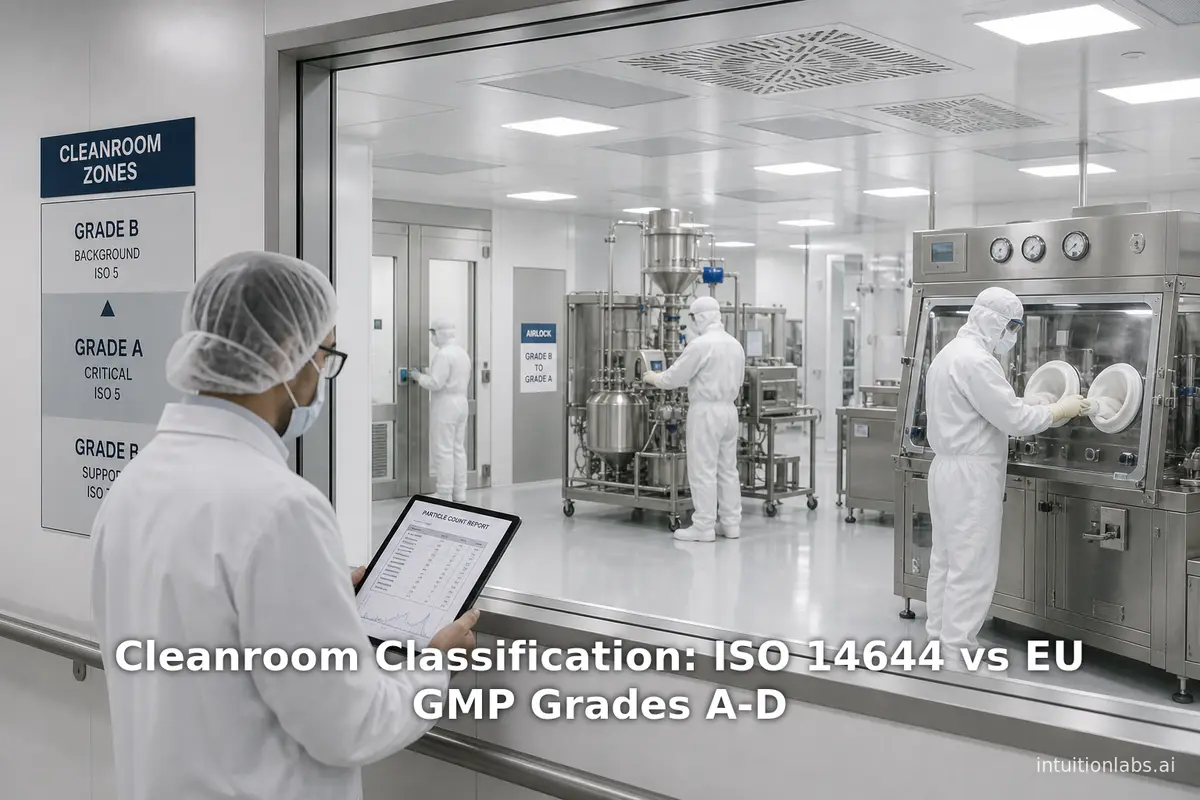
Cleanroom Classification: ISO 14644 vs EU GMP Grades A-D
2026 analyst comparison of ISO 14644-1 cleanroom classes and EU GMP Annex 1 Grades A-D, covering particle limits, viable-monitoring CFU limits, requalification cadence, and four named FDA enforcement and industry cases.