



Continuous eTMF Inspection Readiness
Combine completeness, document quality, cross-system agreement, timeliness, and expiry into an explainable remediation program.
5
Visible inputs
Completeness, quality, cross-system agreement, timeliness, and expiry remain separate.
1
Composite view
A configurable summary supports triage without hiding the underlying evidence.
N/A
No black box
A missing or stale input is shown as missing, not silently replaced or imputed.
Next
Action first
Every priority names the owner, evidence, consequence, and closure condition.
Readiness model
A score you can take apart
The composite is a navigation aid. The real product is the evidence, configuration, and ranked work underneath it.
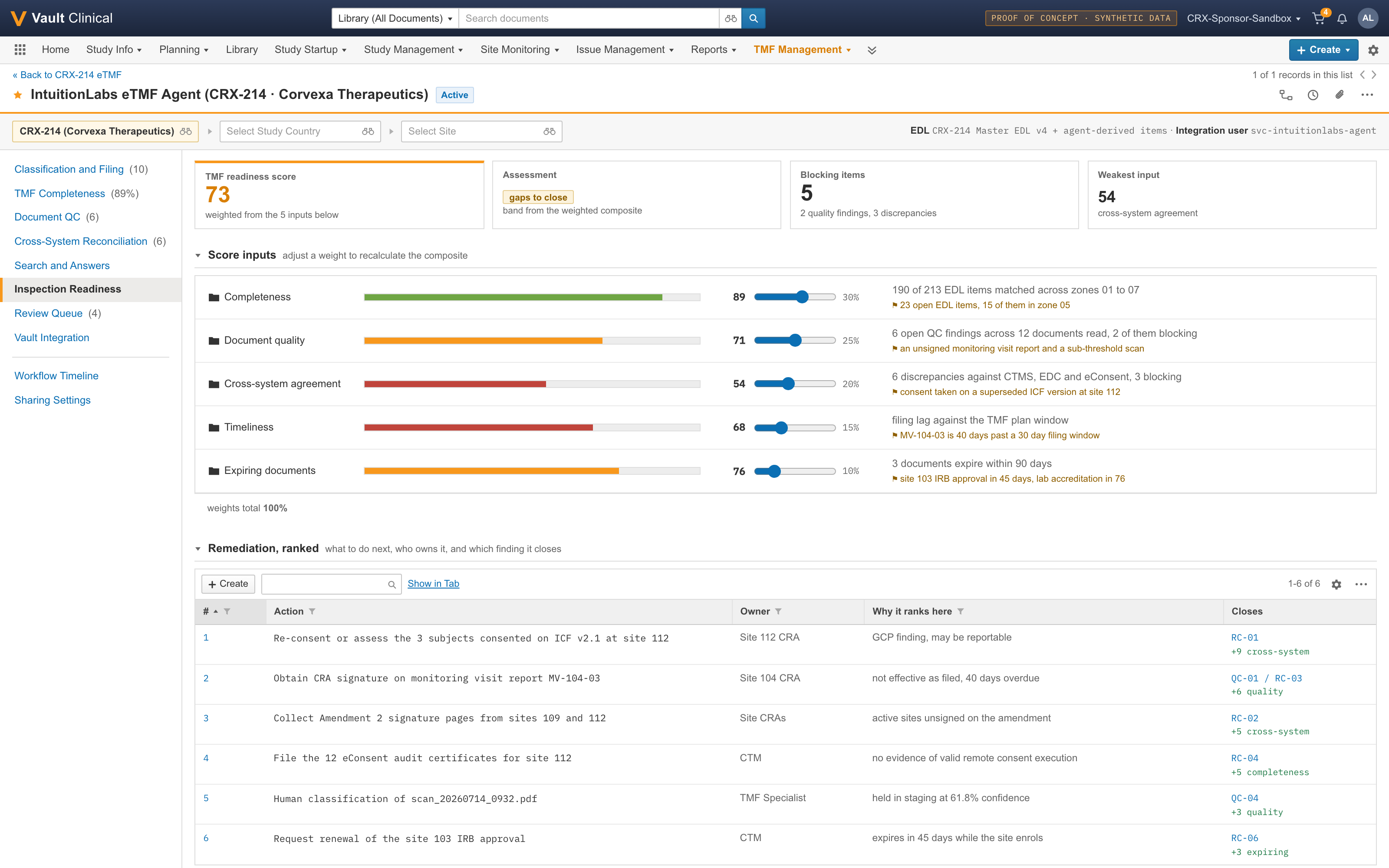
Inspection readiness is often summarized with a red, amber, or green dashboard. The summary is useful for attention, but it can become misleading when the denominator, source freshness, rule coverage, and severity logic are hidden. The IntuitionLabs model keeps the composite deliberately decomposable. A user can see every input, its current measure, configured weight, source coverage, blocking findings, and the actions that would improve it.
The prototype uses five inputs: TMF completeness, document quality, cross-system agreement, timeliness, and expiring documents. Those categories cover different questions. Completeness asks whether expected evidence exists. Quality asks whether the artifact that exists is adequate. Cross-system agreement asks whether the document record agrees with clinical operations and data systems. Timeliness asks whether evidence arrived within the approved window. Expiry looks forward to evidence that will cease to be current.
A composite is calculated only from controlled definitions. The calculation itself should be deterministic and reproducible. Model-assisted components feed structured findings into those inputs, but the arithmetic, weights, thresholds, exclusions, and missing-data behavior are explicit. The system records the readiness-profile version with each result so a score from one date can be interpreted after the configuration changes.
The score is not a regulator’s assessment, a probability of inspection success, or proof that the file is complete. It is a management indicator for the purpose defined by the customer. A study can have a high composite and still contain a blocking item. The interface therefore keeps blocking findings visible and can cap or qualify the aggregate when a critical condition exists.
Scenario analysis is separated from controlled reporting. A user can explore what happens if cross-system agreement receives more weight or if a remediation closes a finding. That helps teams understand sensitivity and allocate effort. It does not rewrite the approved production profile. Publishing a new weight set follows review, testing, approval, and an effective date.
The design supports study and portfolio views. At study level, every input drills into documents, records, and findings. At portfolio level, leaders can compare trends while seeing which readiness profile and rule coverage apply to each study. Non-comparable studies are labelled instead of being forced into a single ranking.
- ■Deterministic composite with visible input definitions
- ■Blocking findings remain visible beside the aggregate
- ■Controlled profile separated from scenario analysis
- ■Study and portfolio views preserve configuration context
Primary references
Input 01
Completeness with a controlled denominator
Readiness begins with expected evidence, but the measure distinguishes template EDL items from study-specific expectations derived from source records.
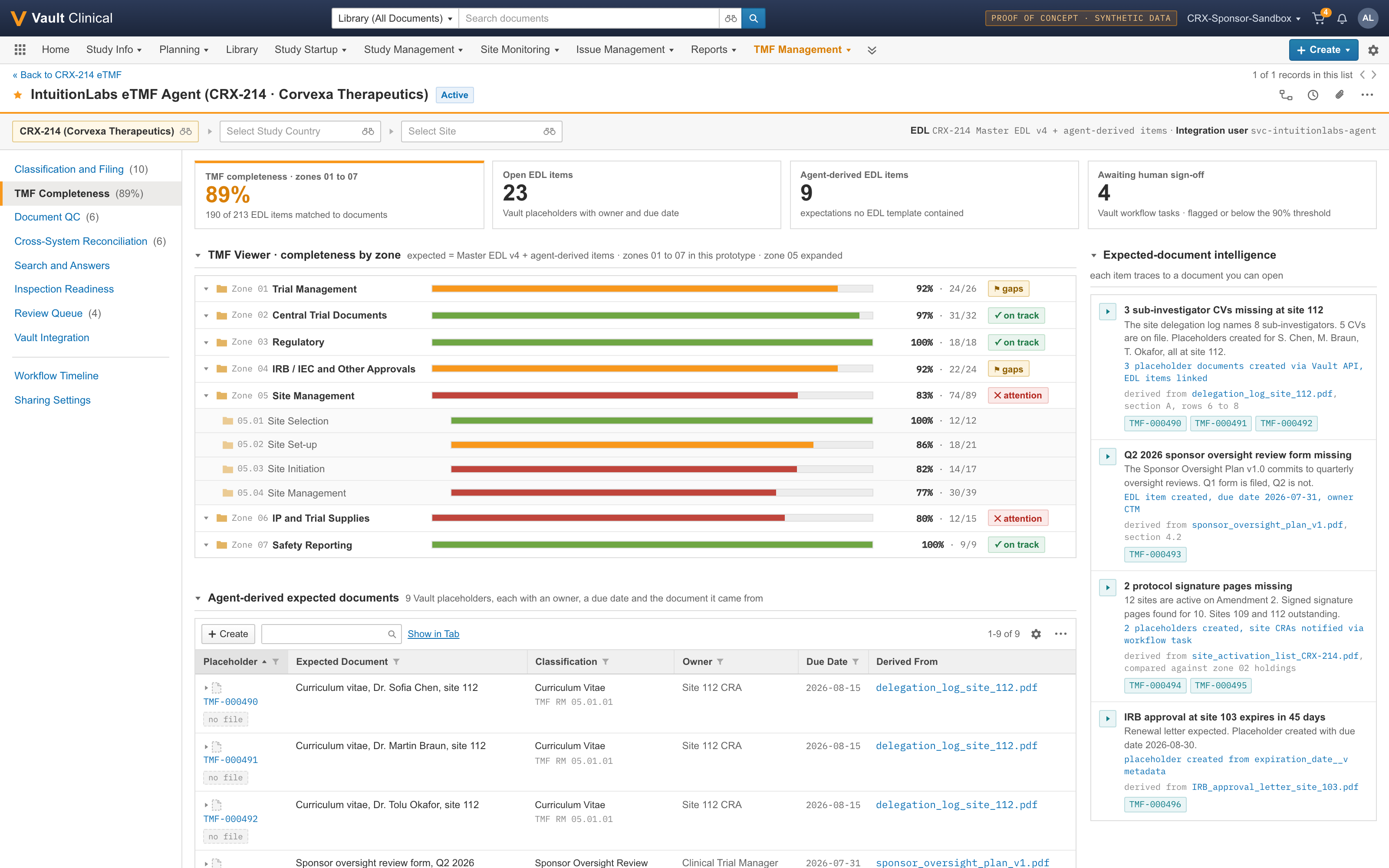
Completeness is a fraction only when the expected set is controlled. The baseline comes from the approved expected document list and its study, country, site, milestone, and document-matching configuration. The product calculates coverage against that baseline without altering it. It then reports study-specific expectations separately so a reader knows which gaps arise from the standard template and which arise from the facts of the trial.
Derived expectations come from approved reasoning patterns. A delegation log can create person-specific CV expectations. A sponsor oversight plan can create quarterly review expectations. An approval expiration date can create a renewal placeholder. A CTMS record showing an active site on an amendment can create an expected signature page. Each item includes the source, page or record, owner, due date, rule version, and matching criteria.
The denominator can change over time as sites activate, milestones occur, documents become applicable, and controlled rules change. The model therefore uses effective-dated expectations and records the denominator snapshot with each score. A historical completeness value remains reproducible because the system knows which items were expected at that time.
Not-applicable decisions are governed. A document is not removed from the denominator merely because it is missing or inconvenient. The reviewer selects an approved reason, supporting evidence, scope, and effective period. The audit history preserves the previous status. This prevents automation from improving the score by silently shrinking the expectation set.
Coverage is reported beyond a single study percentage. Teams can view missing, late, mismatched, draft, rejected, superseded, or awaiting-review items by TMF zone, country, site, milestone, owner, and age. A document can exist but fail to satisfy the expectation because the matching fields, version, lifecycle, or applicability do not align. That distinction prevents false completeness.
For portfolio oversight, the product can show both weighted and raw measures. A study with few applicable items should not appear healthier merely because its denominator is small. Leaders can compare overdue counts, blocking gaps, trend, and rule coverage alongside the percentage. The purpose is to direct attention, not create a league table detached from study context.
- ■Approved EDL baseline preserved
- ■Derived expectations reported as a distinct layer
- ■Effective-dated denominator snapshots
- ■Governed not-applicable decisions and matching logic
Input 02
Document quality that is specific and cited
Quality findings identify the rule, the observed evidence, the location in the document, the consequence, and the required reviewer decision.
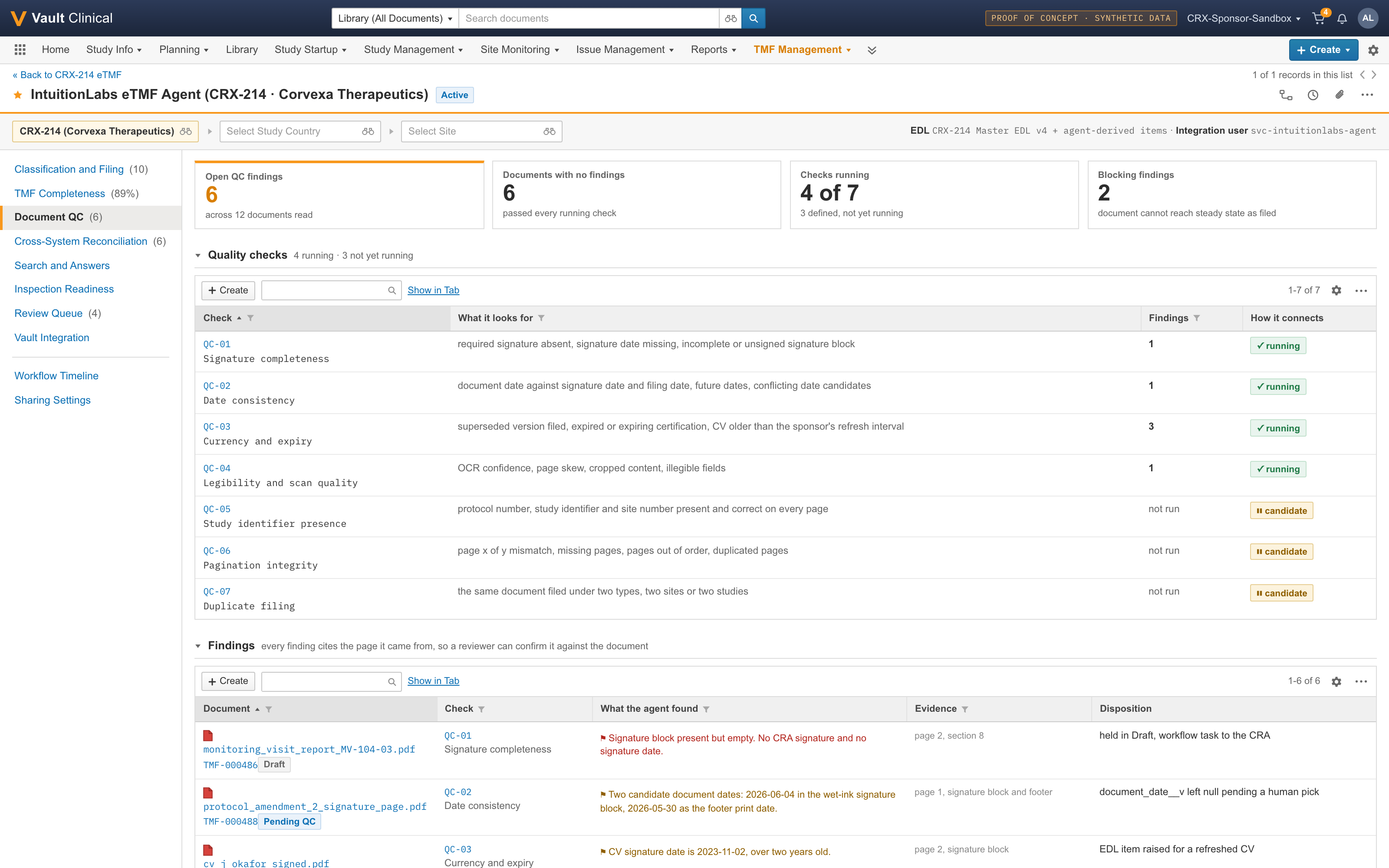
Document quality is not one universal score. It is a collection of checks with different evidence, consequence, and ownership. Signature completeness, date consistency, currency, expiry, legibility, pagination, identifier presence, and duplicate filing each require their own definition and validation. The product preserves that detail and can derive a normalized quality input only after the individual checks are evaluated.
A running check has an approved source rule, scope, method, tolerance, exceptions, severity mapping, and allowed disposition. A candidate check is visible as design work but does not affect readiness. This prevents a demonstration idea from becoming a production control without review. The boundary is especially important when a model recognizes a possible issue but customer policy determines whether it matters.
Findings cite the page, section, field, or visual region. An empty signature block is linked to the relevant page. A date conflict preserves both candidate dates and their locations. A stale CV cites the signature or effective date and the customer rule used to assess currency. A poor scan records the OCR or visual-quality evidence and abstains from automatic filing when the threshold is not met.
The quality input distinguishes blocking and non-blocking conditions. A missing signature required for an effective record may prevent progression. An approaching expiry creates a forward-looking task but may not reduce current quality in the same way. A potential duplicate can remain a watch item until confirmed. The score reflects the customer’s consequence model, while the interface retains the original count and severity distribution.
Document populations matter. A quality rate over twelve clean documents does not represent a study with thousands of artifacts. Production reporting shows coverage: which document types were read, what percentage of the applicable file was evaluated, which documents could not be processed, and which checks apply. Missing coverage reduces confidence or creates a separate data-quality condition rather than being treated as a pass.
Reviewer dispositions feed monitoring. Confirmed-positive rate, false-positive rate, missed-finding rate from quality sampling, amendment rate, abstention rate, and time to evidence can be tracked by document type and rule version. A check that creates noise is revised or retired. A check that finds recurring issues can inform process improvement beyond the individual documents.
- ■Independent, approved rules rather than one opaque quality score
- ■Page-level evidence and explicit abstention
- ■Coverage and unprocessed documents visible
- ■Reviewer feedback monitored by document type and rule version
Input 03
Cross-system agreement exposes the operational truth
The weakest readiness input may sit outside the eTMF, where CTMS, EDC, or eConsent records contradict an otherwise correct document.
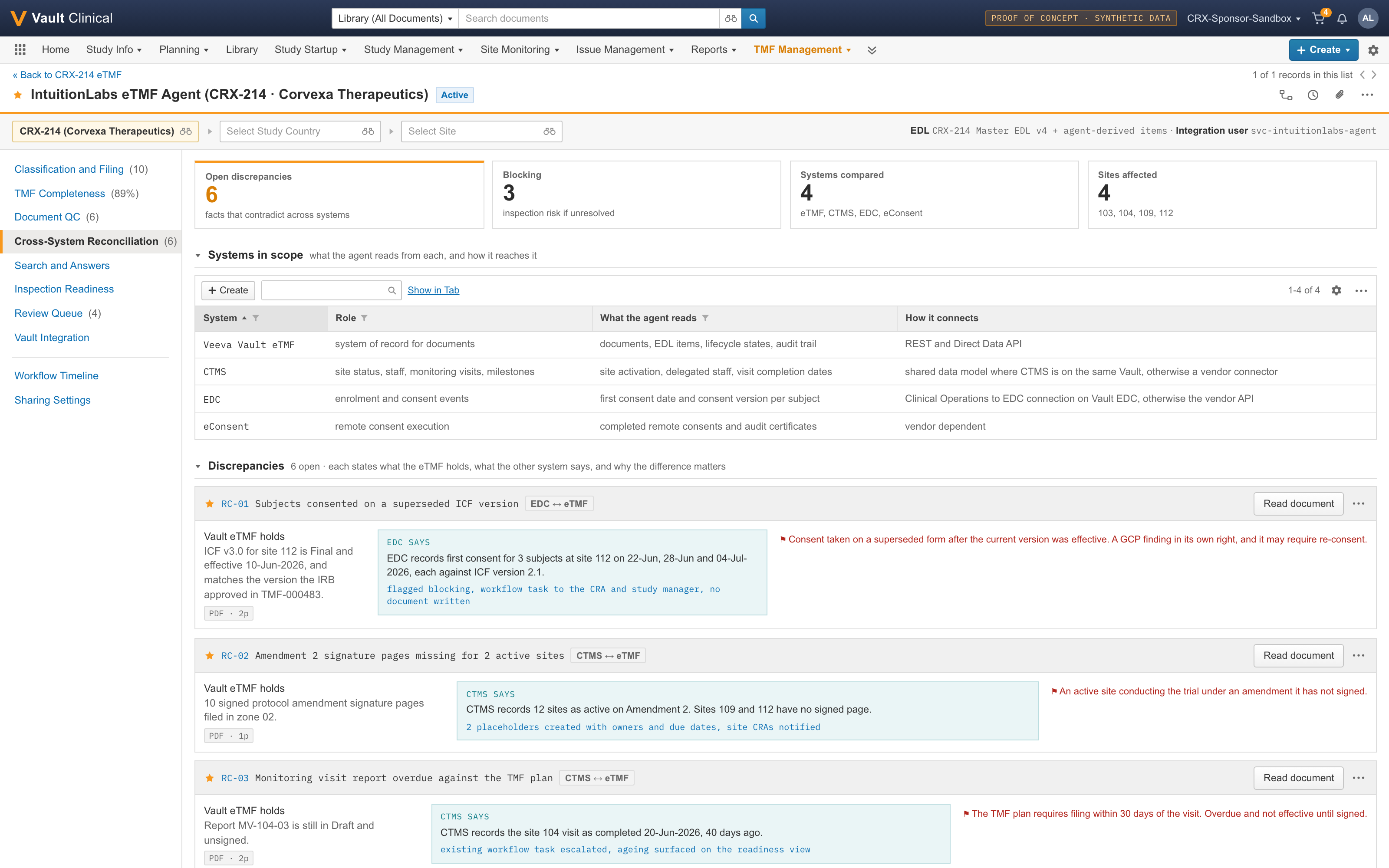
Cross-system agreement measures whether the evidence in the eTMF is consistent with operational facts in connected systems. It does not attempt to reconcile every field. The released rules target relationships with clear clinical or oversight value: consent version against subject events, active-site status against amendment evidence, monitoring completion against report filing, or completed eConsent against required audit artifacts.
Each rule defines the system roles and source precedence for the specific fact. CTMS may be authoritative for site status, EDC for a subject consent event, eConsent for executed-signature evidence, and the eTMF for the approved form and retained record. The product does not declare one platform universally correct. It states what each source contributed and routes contradictory or ambiguous facts for review.
Freshness is part of the result. A delayed nightly extract, failed connector, or pending transfer can create an apparent difference that is not a true process failure. The engine records source timestamps and accepted synchronization windows. A stale input can defer evaluation or lower confidence. It cannot silently support a clean agreement score.
The agreement input reflects rule coverage as well as result. A study connected only to CTMS should not receive the same cross-system interpretation as a study connected to CTMS, EDC, and eConsent. The readiness view identifies which rules are active, which sources are current, which populations were compared, and which planned comparisons are unavailable.
Blocking discrepancies remain visible even if their numerical contribution is diluted by other dimensions. A small number of subject-level consent issues may be more consequential than a large number of low-risk filing delays. The customer’s approved severity logic can cap the composite, create a blocking flag, or require an explicit management acknowledgement while preserving the raw input measure.
The companion cross-system reconciliation page details the evidence model, connector options, mapping controls, and pilot pattern for these rules. Within readiness, the essential principle is that source coverage and contradiction severity are visible, not buried in one color.
- ■Released rules focus on high-value relationships
- ■Source roles and freshness travel with every result
- ■Rule and connector coverage qualify the input
- ■Critical discrepancies cannot disappear inside an average
Inputs 04 and 05
Timeliness and expiry make readiness continuous
One input looks backward at whether evidence arrived when required. The other looks forward at records that will soon cease to be current.
Timeliness measures filing and completion against an approved operational window. A monitoring plan may require a visit report within thirty days. A safety process may require distribution or acknowledgement within a defined interval. An oversight plan may require a quarterly review. The rule records the triggering event, required artifact, deadline calculation, permitted exceptions, and evidence that stops the clock.
Dates come from authoritative sources. CTMS can establish when a monitoring visit completed. The eTMF can establish when the report was filed and when it reached the required lifecycle state. A document’s metadata date is not assumed to be the event date. The rule specifies the relevant timestamps and time zone, and it preserves each one in the finding.
An overdue item can have more than one age. It may be ten days past the expected filing window, three days since the workflow task was assigned, and one day since the owner acknowledged it. The readiness input focuses on the approved measure, while the remediation layer uses operational ages to route and escalate the work.
Expiry is forward-looking. IRB or ethics approvals, CVs, training records, licenses, certifications, laboratory accreditation, insurance, and other evidence may have validity periods or sponsor refresh expectations. The product extracts or receives the relevant date, applies the approved lead time, and creates a renewal watch or placeholder with an owner and due date.
Not every old document is expired. Currency rules vary by artifact, role, country, sponsor, and process. A model can identify a date, but the customer supplies the rule that makes the date actionable. The product records whether the assessment is based on an explicit expiry, a policy refresh interval, a milestone relationship, or a manual reviewer decision.
Together, timeliness and expiry turn readiness from a periodic cleanup exercise into continuous control. Teams can see what is already late, what will become due, which owners have concentrated workload, and how planned remediation changes the forecast. The readiness trend then reflects both closure and emerging obligations.
- ■Trigger event, deadline, evidence, and stop condition defined per rule
- ■Authoritative dates preserved from each source
- ■Expiry and policy-based currency kept distinct
- ■Forward-looking workload supports continuous control
Ranked remediation
Translate evidence into the next best action
Priority is calculated from approved consequence, urgency, affected scope, dependency, and expected risk reduction, then shown with the owner and closure evidence.
A readiness program succeeds when it changes the work, not when it produces a dashboard. The product therefore converts each confirmed or reviewable gap into an action record. The record states the action, accountable role, supporting finding, affected study scope, due date, rationale, expected readiness effect, dependency, and evidence required for closure.
Ranking is deterministic where possible. The customer defines the relative treatment of blocking GCP-relevant conditions, overdue evidence, approaching milestones, repeated findings, broad site impact, and low-risk administrative gaps. The model can summarize the situation and propose a plain-language action, but it does not invent the consequence score. If the policy lacks enough information, the item is routed for classification.
The highest-ranked action is not always the easiest score improvement. A consent-version discrepancy affecting subjects may outrank several missing administrative artifacts even if closing the artifacts would move completeness more. The interface shows why an item ranks where it does so teams do not mistake optimization of the metric for management of the risk.
Dependencies are explicit. A missing site signature page may depend on confirming CTMS amendment status. A stale CV may depend on verifying the individual is still delegated. An eConsent evidence gap may first require resolution of a connector failure. The remediation plan can group linked tasks and avoid assigning contradictory work to different teams.
Closure is evidence-based. Filing a document, changing a lifecycle state, correcting a source mapping, receiving a renewal, or approving a documented exception can satisfy the closure rule. The system reruns the affected check, stores the new evidence, and preserves the original finding and disposition. A task completion without source resolution does not silently improve the readiness input.
Scenario planning shows the estimated effect of accepted actions without pretending that the result is already achieved. Teams can compare workload, owner capacity, milestone timing, and expected input movement. Once evidence closes the finding, the production value updates through the ordinary controlled calculation.
- ■Action, owner, evidence, due date, rationale, and closure condition
- ■Risk logic outranks easy score improvement
- ■Dependencies and shared causes grouped
- ■Readiness changes only when closure evidence is verified
Governance
Control the model that controls the score
The readiness profile, source mappings, checks, thresholds, AI components, and release evidence are versioned as one governed product.
A readiness score is a configured computerized function. Its intended use, users, decisions, inputs, exclusions, and limitations should be documented before validation begins. The team identifies which parts are deterministic calculations, which rely on source-system configuration, which use model-assisted extraction or reasoning, and which remain manual judgments.
Each readiness profile has a version. The version binds input definitions, calculation, weights, thresholds, severity rules, missing-data behavior, cap rules, source contracts, and applicable study scope. A change produces a new version with an impact assessment and effective date. Historical scores retain the profile used at the time rather than being silently recalculated under today’s logic.
Model-assisted checks have their own controlled configuration: model identifier, prompt or instruction version, extraction schema, deterministic post-processing, thresholds, evaluation set, performance results, known limitations, and monitoring plan. The product records that configuration with the finding. A model update cannot silently change the readiness trend.
Source changes are equally important. A Vault field, CTMS status, EDC export, or identifier mapping can change without any model change. Connector contracts include schema validation and fail closed when required fields disappear or types change. The readiness interface shows unavailable or stale inputs instead of carrying forward the last good value as current.
Access is role-based. A portfolio viewer may see aggregate readiness without subject-level evidence. A TMF specialist may review documents and placeholders. A clinical data manager may see consent events. A quality reviewer may approve severity or closure. The evidence graph enforces source permissions and minimizes sensitive data in derived views.
The operational package includes audit history, backup and recovery, incident handling, periodic review, rule-performance monitoring, user training, support, and decommissioning. Validation is not a one-time document set around the first release. It is the maintained state of control over a changing product and its sources.
- ■Versioned readiness profile and historical interpretability
- ■Model, rule, connector, and mapping changes assessed independently
- ■Fail-closed behavior for stale or incompatible inputs
- ■Role-based access down to underlying evidence
Inspection use
Retrieve the oversight story, not just the latest number
The product preserves how a gap was detected, assessed, remediated, verified, and governed while the original source records remain authoritative.
During inspection preparation, teams need to know whether the file can be reconstructed and whether oversight was effective. The product can retrieve the readiness history for a study, explain changes in the inputs, list blocking and aged findings, show remediation and closure evidence, and identify periods when source coverage or rules were incomplete.
A finding package includes the source records or governed links, extraction and comparison times, rule and configuration version, evidence cited, reviewer decisions, assigned actions, status changes, exception approvals, and closure verification. The package supports review of the oversight process. It does not replace the eTMF, CTMS, EDC, eConsent, or their native audit trails.
Trend is more informative than a snapshot. A score can improve because documents arrived, quality findings closed, mappings were corrected, weights changed, or a rule was removed. The history distinguishes those causes. Configuration changes appear as configuration changes rather than operational improvement.
Sampling can target risk. Reviewers can select studies, countries, sites, rules, document types, or periods with repeated findings, low coverage, poor model performance, or high override rates. That supports focused quality review while retaining the option for broader independent sampling outside the automated model.
The product also records its own limitations. Unsupported document types, inaccessible sources, processing failures, abstentions, and untested configurations remain visible. A readiness claim that hides where the tool did not look is weaker than a modest indicator with complete coverage disclosure.
The output is an organized oversight narrative: what was expected, what evidence existed, what differed, who assessed it, what action followed, and whether the evidence ultimately agreed. That narrative is what makes the readiness layer useful before, during, and after an inspection-related review.
- ■Finding package links detection through verified closure
- ■Trend separates operational change from configuration change
- ■Risk-based sampling supported without replacing independent review
- ■Unsupported and unobserved scope remains visible
Build readiness from traceable evidence
The readiness view is the final layer. Its inputs come from cited document intelligence and governed comparisons across the clinical systems that hold the underlying facts.
eTMF Intelligence Agent
See how classification, derived expectations, document QC, human review, and source-system integration create the evidence base.
View the solutionCross-System Reconciliation
Go deeper on eTMF comparisons with CTMS, EDC, and eConsent, including mappings, timing, lineage, and remediation.
Explore reconciliationGxP Enablement
Connect the product to a broader operating model for validated AI, procedures, roles, evidence, monitoring, and change control.
Explore GxP enablementeTMF intelligence questions

Define the readiness question before defining the score
We will map the current oversight process, choose controlled inputs, and design a read-only study pilot with transparent acceptance criteria.
Book a Working Session