



Find the Gaps Between Clinical Systems
Reconcile the documents filed in the eTMF with site status, milestones, consent events, and execution evidence from CTMS, EDC, and eConsent.
4
System roles
eTMF, CTMS, EDC, and eConsent contribute different parts of the clinical record.
1
Evidence model
Study, country, site, person, document, subject event, milestone, and source lineage align.
0
Silent corrections
A discrepancy becomes a cited decision item, not an unexplained background rewrite.
N
Vendor paths
Use delivered connections, APIs, warehouse feeds, or governed exports according to the stack.
The hidden gap
A complete document can describe an inconsistent trial
Document review proves what is filed. Reconciliation tests whether the filed evidence agrees with the operational facts recorded elsewhere.
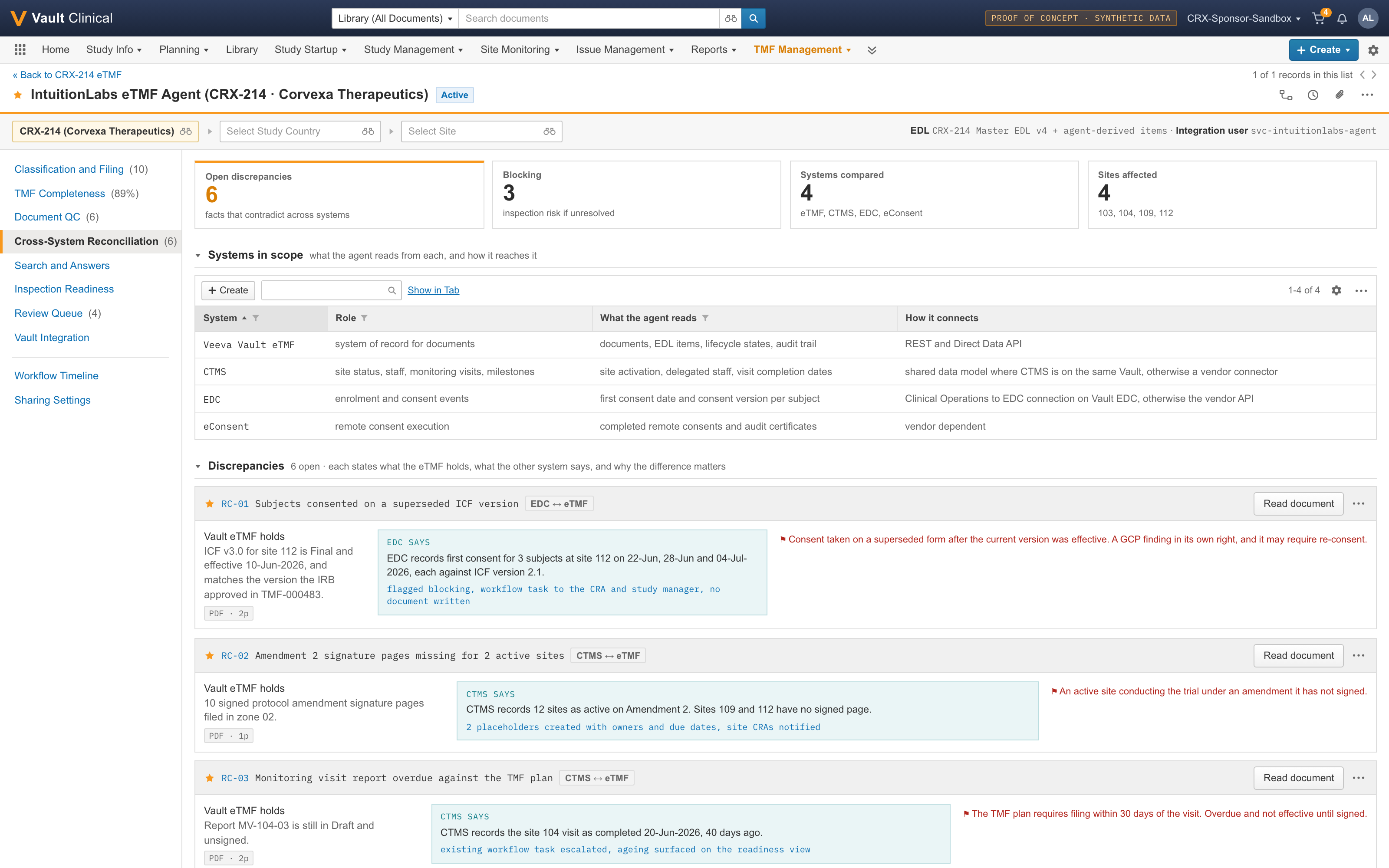
Clinical trial systems divide responsibility by process. The eTMF preserves essential documents and their metadata. CTMS records sites, staff, monitoring visits, milestones, and oversight activities. EDC records subject-level data and consent events. An eConsent platform may hold the executed consent, version, timestamp, signature evidence, and audit certificate. Each system can be internally consistent while the trial record is inconsistent across them.
That condition is difficult to detect with a conventional completeness report. The eTMF can show a current informed consent form for site 112, filed under the correct classification, in the Final lifecycle state, and matched to the approved version. A document-only review sees no problem. If EDC then records three subjects who consented against version 2.1 after version 3.0 became effective, the discrepancy exists in the use of the document, not in the filing of the document.
Cross-system reconciliation converts that hidden relationship into a controlled test. The rule identifies the sources, joins the relevant study and site, aligns document and event versions, applies the effective-date logic, considers permitted synchronization delay, and produces a discrepancy only when the evidence satisfies the approved condition. The output preserves each source record and timestamp so the reviewer can reproduce the comparison.
The product does not collapse every difference into an error. A difference can be expected, pending synchronization, stale, ambiguous, contradictory, or blocking. Those states matter because clinical systems update at different times and may use different identifiers or data ownership conventions. A reliable reconciliation program makes source freshness, mapping confidence, and rule applicability as visible as the discrepancy itself.
This is the capability that most clearly extends an eTMF beyond a document repository. It creates a longitudinal evidence layer across systems without making the agent the new system of record. The original platforms retain their authoritative records. The agent records the comparison, cites the evidence, and coordinates remediation through the customer’s established process.
- ■Compare facts that should agree, not entire databases indiscriminately
- ■Preserve source timestamps, identifiers, lineage, and mapping confidence
- ■Separate expected lag from true contradiction
- ■Route a cited finding while source systems remain authoritative
Primary references
Reconciliation pattern 01
Informed consent version versus subject consent event
The eTMF proves which form was approved and effective. EDC or eConsent proves which version a subject used and when.
Consent-version reconciliation begins with a precise statement of intent: for each subject consent event, confirm that the recorded form version was approved and effective for the subject’s site and country at the event time. That sentence already exposes the required data. The rule needs the study, subject, site, country, consent date and time, form version, approval status, effective date, retirement date if applicable, and the relationship between a central template and any localized form.
The eTMF side may contain several related documents: the master informed consent form, country adaptation, translated version, IRB or ethics approval, site activation evidence, and superseded versions. The rule must select the authoritative approval and effective period for the specific site. A filename match is not enough. The source record’s metadata, lifecycle, version, approval reference, and site or country association are part of the evidence.
The EDC side may record first consent date, re-consent date, consent version, and subject status. An eConsent system may provide stronger execution evidence, including the exact presented version and signature audit trail. When both sources exist, the rule defines their roles rather than treating them as interchangeable. EDC may be the operational subject-event source while eConsent is the execution source. The reconciliation output can state which source established each fact.
Timing logic requires care. A newly approved form may have a future effective date. A site may need documented activation before use. A subject may sign shortly before a synchronization job completes. A protocol amendment may trigger re-consent rather than invalidate the original consent. The rule therefore includes effective-date semantics, time zone handling, allowed synchronization lag, re-consent requirements, and exceptions documented by the customer.
A positive discrepancy is presented in clinical language: the current site form, the subject event, the conflicting version, the relevant dates, and the affected subjects. The agent can create a task for the site CRA and study manager, but it does not decide whether re-consent is required or whether the event is reportable. Those conclusions depend on the protocol, sponsor procedure, ethics requirements, facts of the event, and authorized clinical or quality judgment.
The validation set for this rule includes current-version consents, valid historical consents, re-consents, events during an allowed transition, localized forms, missing versions, incorrectly mapped sites, delayed source updates, and known superseded-version use. Performance is reported at the event level. The most important measures are not only detection rate but also whether every flagged event contains enough evidence for a reviewer to reach the correct next step.
- ■Site and country specific version resolution
- ■Effective-date, retirement-date, and transition-window logic
- ■Separate operational event evidence from executed-signature evidence
- ■Reviewer determines remediation and reportability
Reconciliation pattern 02
Active site status versus amendment evidence
CTMS says which sites are active on the amendment. The eTMF shows whether the corresponding approval and signature evidence is filed and effective.
Site and amendment reconciliation tests a different type of relationship. CTMS records the operational status of the study, country, and site, including milestone dates and amendment adoption. The eTMF holds protocol amendments, approvals, acknowledgements, and signature pages. The rule asks whether every site represented as active on a given protocol version has the required evidence for that status.
The join cannot rely on display names alone. Site identifiers may differ across sponsor, CRO, CTMS, EDC, and eTMF configurations. Countries may be represented by codes, controlled terms, or localized names. Investigators can change. Protocol version values can include punctuation or local suffixes. A governed crosswalk maps these identifiers, records the source of the mapping, and exposes any unresolved or low-confidence match before the rule evaluates the evidence.
Milestone semantics also vary. “Active” can mean selected, initiated, activated for enrollment, open to recruitment, or active on a specific amendment. A production rule must use the customer’s actual status model and the event that gives it meaning. It can then determine whether the expected protocol signature page, IRB or ethics approval, training evidence, and acknowledgement exist in the right state for the applicable milestone.
When the eTMF is missing evidence, the agent can propose a site-specific placeholder with the owner, due date, source CTMS record, amendment, and matching fields. That action is more useful than a generic “missing document” alert because it is anchored to an active operational fact. The accepted placeholder can participate in native matching when the document arrives, provided the eTMF platform and configuration support that model.
The reverse comparison matters too. A signature page may be filed for a site that CTMS marks as withdrawn or never activated. That does not automatically mean the document is wrong; it may reflect history, a status lag, or a filing association issue. The result is an investigation item with both records visible. Reconciliation remains bidirectional because choosing one system as universally correct would hide legitimate data-quality problems in the chosen source.
Portfolio reporting can aggregate these findings by study, country, amendment, CRO, and age. Clinical operations leaders can see whether the gap is concentrated in a connector delay, site process, filing team, or policy ambiguity. TMF operations receives a concrete document expectation, while study management receives the operational context that made the gap important.
- ■Governed site, country, investigator, and protocol-version crosswalks
- ■Customer-specific definitions of active, initiated, and amendment-effective
- ■Bidirectional comparison rather than automatic trust in one source
- ■Native placeholder or workflow task with source CTMS evidence
Reconciliation pattern 03
eConsent execution versus filed audit evidence
The consent platform records the event. The eTMF should preserve the required artifact, version, and evidence according to the sponsor’s filing model.
Remote and electronic consent workflows create evidence across several layers. The consent application may record presentation, acknowledgement, signatures, identity steps, timestamps, version, and audit history. EDC may record the subject’s consent date and version. The eTMF may hold the approved form, site-level approval, certificates, close-out package, or a reference to the authoritative repository. The required filing pattern depends on the sponsor’s process and applicable system design.
A reconciliation rule should therefore begin with the records-management decision. Which eConsent artifacts are essential records? Which remain in the validated consent system, which are transferred to the eTMF, and which are referenced? At what milestone should transfer occur? What evidence demonstrates completeness? Without those answers, a generic agent cannot responsibly declare a missing document.
Once the filing model is defined, the product compares executed events with expected evidence. It can identify a completed consent that lacks the required audit certificate, a certificate associated with the wrong site, a version mismatch between the execution record and approved form, or a transfer that has not completed after the accepted window. Each finding preserves the event identifier, subject pseudonym or approved key, site, version, execution time, source-system status, and expected artifact.
Privacy and minimum necessary access are central. Subject identity may not be required for the TMF operations use case. The reconciliation layer can operate on pseudonymous subject keys and retain only the fields needed to establish the discrepancy. Direct identifiers should remain in the source system unless the approved workflow requires them. The architecture documents where protected or personal data is decrypted, processed, logged, and retained.
The product does not convert a technical transfer failure into a clinical conclusion. A missing audit certificate may be caused by a connector backlog, source-system configuration, withdrawn event, or genuine evidence gap. The finding identifies what was expected and what each source reported. The accountable team then determines whether to retry transfer, correct mapping, request source evidence, document an exception, or initiate a broader quality process.
This pattern can be extended to other event-driven evidence such as eCOA end-of-study media, safety-letter distribution, monitoring visits, and final data packages. The reusable structure is an event in one system, an expected record or reference in another, an accepted timing window, identity mapping, and a cited exception workflow.
- ■Start with the sponsor’s approved filing and retention model
- ■Use pseudonymous keys when direct identity is unnecessary
- ■Distinguish transfer failure, mapping issue, and true evidence gap
- ■Reuse the event-to-evidence pattern across clinical applications
Connector architecture
Reach each system through its governed path
The architecture uses platform capabilities already available, introduces the smallest new interface necessary, and records freshness and lineage for every comparison.
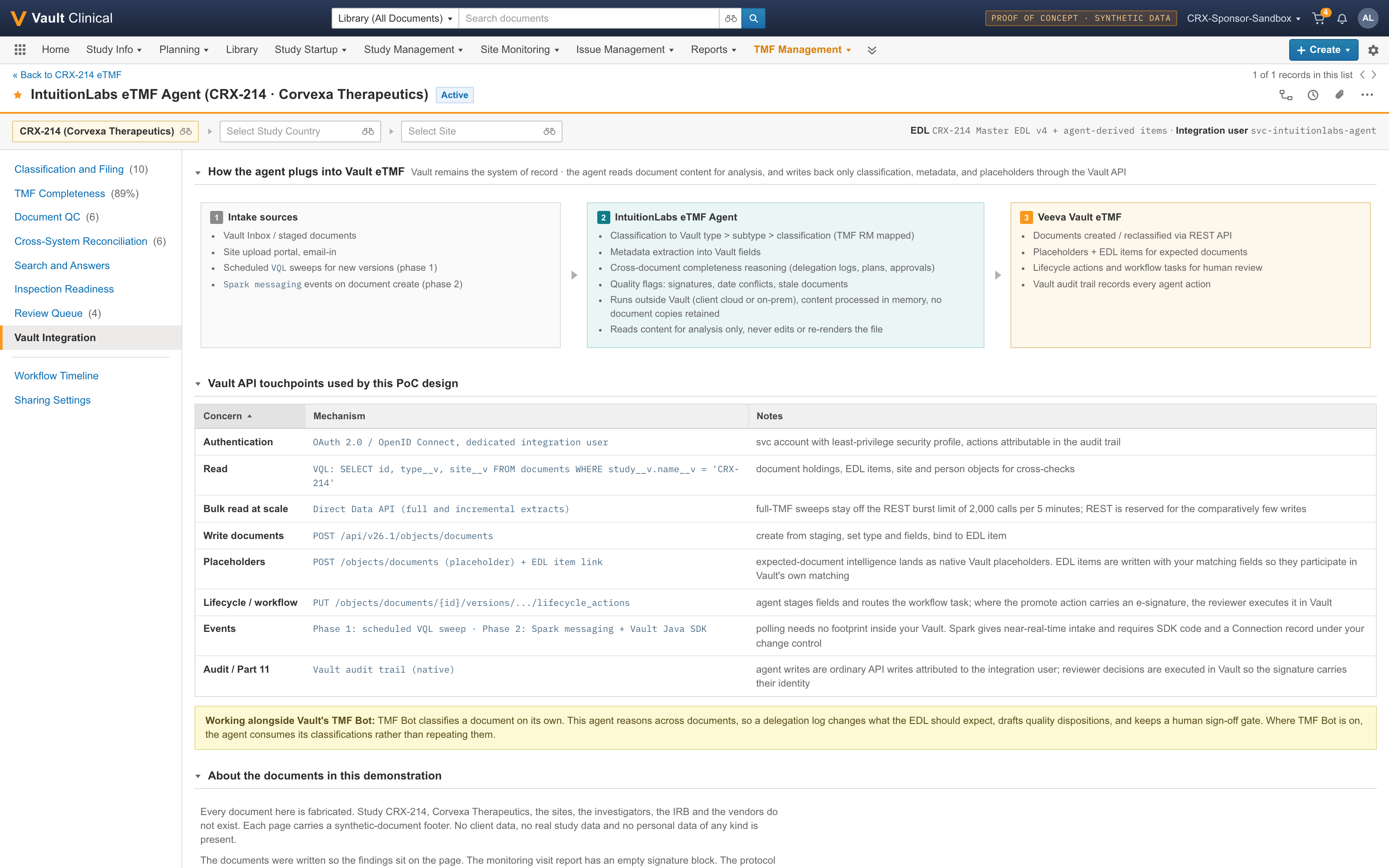
Connector design follows the actual system landscape. A Veeva Vault eTMF source can expose metadata and objects through VQL or REST and large-scale extracts through Direct Data API. Direct Data API is designed for full and incremental Vault data access and can reduce the need to perform large read sweeps through transactional REST calls. Document content access, lifecycle actions, placeholders, and workflow behavior remain subject to the customer’s Vault configuration and permitted interfaces.
When CTMS and EDC share the Veeva ecosystem, a delivered Clinical Operations connection may already synchronize core study, site, enrollment, monitoring, or document data. The reconciliation layer should consume the connected model when it contains the required facts rather than create a redundant point-to-point transfer. The design records which application originated the fact and which connection delivered it so lineage is not lost.
External CTMS, EDC, and eConsent systems may require vendor APIs, secure file exchange, change-data capture, a customer data platform, or an approved warehouse. The connector contract normalizes only the fields required for the released rule. It does not ingest every available table because broad extraction increases privacy, validation, and operational burden without improving a bounded use case.
Every input carries freshness metadata. A reconciliation run records the source system, extraction or event time, connector version, query or file identifier, schema version, row or document key, and checksum where applicable. If one source is stale or unavailable, the result can be deferred or marked incomplete. It is not represented as a clean comparison. This prevents an infrastructure issue from becoming a clinical false positive.
Write-back uses a narrower path than read. A finding can first remain in the evidence layer, then create a task in an existing workflow system, then create a native eTMF placeholder or workflow task when approved. Each write is idempotent and tied to the locked source evidence used for the decision. A changed document version or source event invalidates the pending action and requires reevaluation rather than writing against stale context.
The deployment boundary can be a customer cloud account, private network, managed isolated environment, or on-premise runtime according to data-residency and security requirements. Document content may need to be retrieved from the source for processing; the architecture should state that plainly. It then specifies encryption, memory handling, persistence, model endpoint, retention, logging, and deletion rather than claiming that content never leaves the source system.
- ■Use Direct Data API for governed high-volume Vault extracts where appropriate
- ■Reuse Veeva-delivered connections when they already carry the needed facts
- ■Normalize the minimum data required for each released rule
- ■Treat source freshness and lineage as part of every result
Primary references
Evidence model
Make identity, time, version, and lineage explicit
Most reconciliation failures are mapping failures. The product treats the semantic crosswalk as governed configuration, not invisible prompt context.
A reconciliation result is only as reliable as the mapping between its sources. The evidence model therefore represents study, country, site, person, subject key, document, document version, artifact class, lifecycle, milestone, event, rule, finding, disposition, and remediation as explicit entities. Each source record maps into that model with its native identifier preserved.
Identity mappings are versioned. A site can change investigator, a country code can be normalized, a study can have aliases, and a subject key can differ across systems. The crosswalk records the effective period and the authority that established the relationship. Where a mapping is ambiguous, the rule abstains or routes a mapping review before evaluating clinical consistency.
Time is represented with the same care. Event time, source entry time, last modification time, extraction time, and comparison time are distinct. Time zone and daylight-saving behavior are controlled. Rules define whether they compare dates or timestamps and which clock is authoritative. A consent event at a site near midnight should not change status merely because one system stored local time and another stored UTC.
Version semantics are domain-specific. “3,” “3.0,” “Version 3,” a Vault major version, a document lifecycle version, and a protocol amendment number may or may not mean the same thing. The mapping layer records normalized values and the transformation used. The original display value remains visible in the finding so a reviewer can recognize the source record.
Lineage connects the final statement back to each query, extract, file, page, field, and transformation. A reviewer should be able to answer: which source established the effective consent version, which source established the subject event, which mapping joined the site, which rule compared them, which tolerance applied, and which version of the rule produced the result? That chain is the real product.
The evidence model also supports replay. If a rule changes, the system can identify affected historical results and rerun them against locked source snapshots where permitted. If a source record changes, impacted findings can be invalidated or updated. This behavior supports investigation, regression testing, and controlled release without turning an LLM transcript into the only audit artifact.
- ■Native identifiers preserved beside normalized entities
- ■Effective-dated crosswalks for study, site, person, and subject keys
- ■Separate event, entry, extraction, and comparison times
- ■Replayable rule and evidence versions
Operational workflow
From discrepancy to owned remediation
A useful finding names the evidence, consequence, accountable role, next action, and closure condition without making an unauthorized clinical decision.
The reconciliation engine produces a structured finding rather than a generic alert. The finding includes the rule, severity, study scope, involved systems, records compared, statement of agreement or contradiction, source freshness, evidence links, policy reference, proposed owner, due date, and allowed dispositions. The narrative shown to the user is generated from those locked fields so the explanation cannot drift away from the evidence.
Ownership follows the process. A missing protocol signature page may belong to the site CRA. A consent-version discrepancy may require the study manager, data management, and quality input. A connector mapping failure may belong to clinical systems. The product can route work to different systems while keeping one reconciliation record that links the related tasks and final decision.
Severity is not a model sentiment score. It is derived from the customer’s approved risk logic, including subject impact, GCP relevance, inspection impact, recurrence, affected scope, and time. The model can summarize the facts, but the rule determines whether a condition is informational, a watch item, a workflow task, or a blocking escalation. If the required context is absent, the system states that severity cannot be resolved.
Closure requires evidence. A task marked complete in a work-management system does not automatically close the discrepancy. The rule reruns or verifies that the source records now agree, records the new evidence, and preserves the original state and disposition. A documented exception can close the item when policy allows, but the exception reason and approver remain attached.
Metrics distinguish detection from resolution. Useful measures include open findings by age, source, rule and study; time to acknowledgement; time to evidence; reopen rate; recurring mapping failures; confirmed discrepancy rate; false-positive rate; and contribution to readiness. Those measures show whether the system improves oversight or merely creates another queue.
At inspection time, the team can retrieve the finding history, source evidence, rule version, reviewer decisions, remediation, and closure proof. The product is not a substitute for the original records, but it makes the oversight process reconstructable. That is the standard a cross-system intelligence layer should meet.
- ■Structured finding with evidence, rule, ownership, and closure condition
- ■Customer risk logic determines severity
- ■Closure requires re-verification or approved documented exception
- ■Metrics separate alert production from resolved oversight
Pilot design
Prove one relationship before scaling the graph
A small, labelled, read-only reconciliation establishes value and control faster than connecting every clinical system at once.
A reconciliation pilot should be deliberately narrow. The team selects one study and one relationship with known operational value. Consent version, site activation evidence, amendment signatures, monitoring report timeliness, and eConsent audit certificates are strong candidates because the compared facts and responsible roles can be stated clearly.
Discovery maps the current process. Who performs the comparison today? Which systems and exports are used? How often? Which identifiers are trusted? What lag is normal? What constitutes a true discrepancy? Who decides the disposition? Which evidence is retained? The answers become the rule specification and acceptance criteria rather than informal context buried in a model prompt.
The data phase uses the minimum source set. Read-only credentials or approved extracts are configured for the selected study. Field mappings and crosswalks are reviewed with system owners. A labelled set includes true agreements, known discrepancies, timing boundaries, identifier mismatches, source delays, withdrawn events, and records that should cause the rule to abstain.
The engine runs in shadow mode. Findings are compared with the existing process, and reviewers record whether each result is confirmed, incorrect, incomplete, or not actionable. The team measures recall for known discrepancies, confirmed-positive rate, false-positive cost, evidence completeness, mapping coverage, and reviewer time. The result should demonstrate a specific operational improvement, not only model fluency.
Only after the read-only result is accepted does the pilot test workflow integration. The first integration may create a task or case outside the regulated source record. Native eTMF placeholders or workflow tasks follow when attribution, permissions, idempotency, and change control are accepted. Clinical conclusions and electronic signatures remain with authorized people.
The production plan then scales by rule, study, and connector, not by a big-bang enterprise switch. Each new relationship has a source contract, mapping review, evaluation set, approved tolerance, owner, monitoring measure, and rollback path. Shared connectors and evidence models create reuse while the release decision remains specific to the risk of the use case.
- ■One study, one relationship, minimum source set
- ■Existing process becomes the baseline and acceptance specification
- ■Shadow-mode comparison before workflow integration
- ■Scale through independently released rules and connectors
Primary references
Continue through the eTMF evidence stack
Cross-system agreement is one input to a broader model that begins with cited document intelligence and ends with owned remediation.
eTMF Intelligence Agent
See the complete solution for classification, derived completeness, document QC, reconciliation, and governed review.
View the solutionInspection Readiness
Roll reconciled evidence into an explainable readiness model and a ranked remediation plan with accountable owners.
Explore readinessClinical Operations
Explore IntuitionLabs capabilities across clinical systems, data, automation, oversight, and regulated software delivery.
Explore clinical operationseTMF intelligence questions

Choose one cross-system fact worth reconciling
We will define the source contract, mapping, timing tolerance, evidence package, and read-only acceptance test for one study.
Book a Working Session