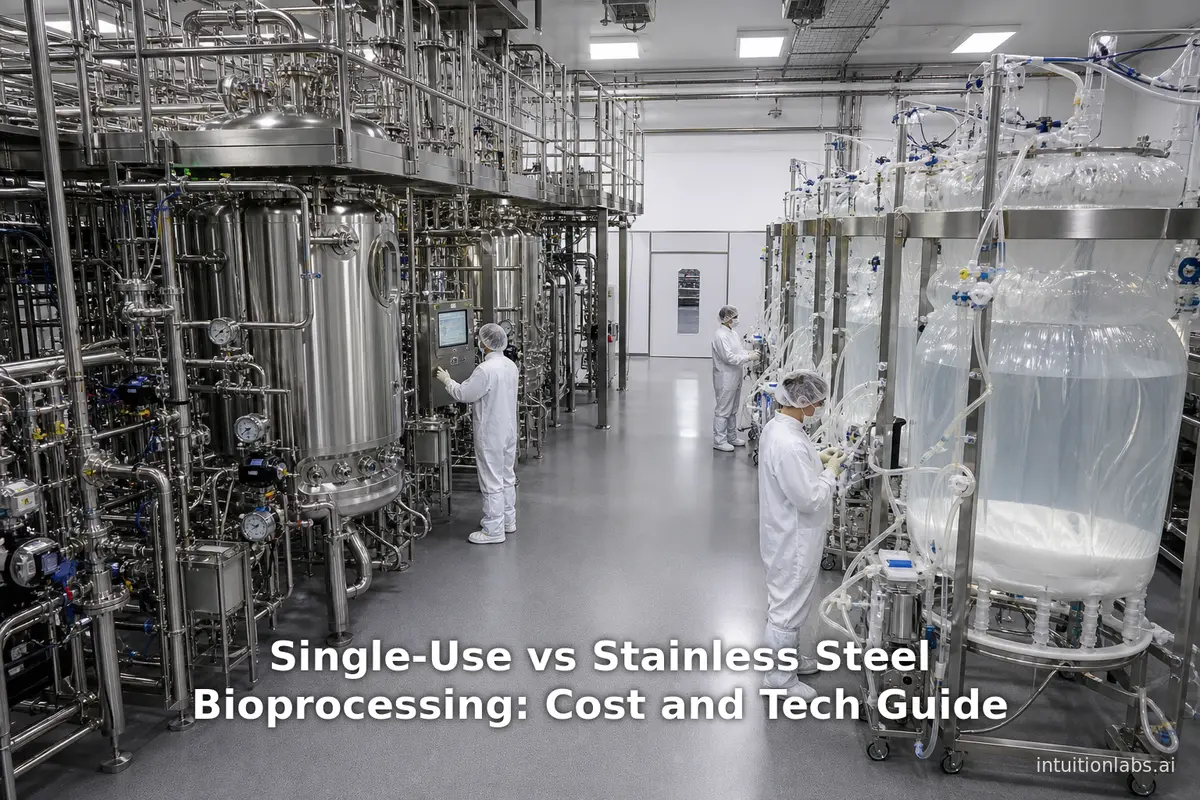
single-use bioreactor manufacturers · single-use bioreactor suppliers
Top 10 Single-Use Bioreactor Manufacturers in 2026
August 8, 2026
Updated August 9, 2026
24 min read
A 2026 analyst comparison of the top 10 single-use bioreactor manufacturers, covering Sartorius, Thermo Fisher, Cytiva, Merck KGaA, and Eppendorf, with scale ranges, market share data, and single-use vs stainless-steel cost analysis.

Executive Summary
The global single-use bioreactor (SUB) market, disposable stirred-tank, rocking-motion, and vertical-wheel systems that replace cleaned-in-place stainless steel vessels, was estimated at $4.58 billion in 2024 by Grand View Research ([1]), with independent forecasts diverging on pace: MarketsandMarkets projects growth from $5.43 billion (2026) to $9.58 billion by 2031 ([2]), while Precedence Research puts 2025 revenue at $7.26 billion en route to $38.99 billion by 2035 ([3]). Four companies, Sartorius AG, Danaher Corporation (via Cytiva), Thermo Fisher Scientific, and Merck KGaA (via MilliporeSigma), collectively hold an estimated 70 to 75 percent of the market as of 2025 ([4]).
This report compares ten manufacturers relevant to a 2026 procurement decision; it is not a market-share ranking. The profiled companies are Sartorius (Biostat STR and Biostat RM, 2 to 2,000 liters), Thermo Fisher Scientific (HyPerforma and DynaDrive, now reaching 5,000 liters), Cytiva (Xcellerex XDR and X-platform, 25 to 2,000 liters), Merck KGaA/MilliporeSigma (Mobius, 3 to 2,000 liters, plus a dedicated antibody-drug-conjugate reactor launched in September 2024 ([5])), Eppendorf (BioBLU, 65 milliliters to 40 liters), Getinge/Applikon Biotechnology (AppliFlex and the 2024-launched SUPR production reactor), Distek (BIOne, 2 to 10 liters), PBS Biotech (Vertical-Wheel technology, up to 80 liters), ABEC (Custom Single Run platform to 6,000 liters, plus a 2025 cell-therapy-focused Advanced Therapy Bioreactor), and Cellexus (CellMaker single-use airlift bioreactors, 1.5 to 50 liters).
Quantitatively, single-use systems carry roughly 42 percent lower capital investment than stainless-steel equivalents and remain capped near 6,000 liters for standard formats, above which stainless steel retains an advantage ([6]). BioPlan Associates' 21st Annual Report found single-use system usage reached 87 percent among surveyed facilities in 2024, even as the same survey recorded slowing overall market growth and notable cost dissatisfaction among respondents ([7]). North America holds the largest regional share, estimated at 36.11 percent as of 2025 ([8]). No single vendor dominates every scale or modality; selection depends on target production volume, cell line and process (monoclonal antibody, cell and gene therapy, or antibody-drug conjugate), and integration with existing control automation. Readers evaluating vendors should also weigh the extractables-and-leachables documentation associated with United States Pharmacopeia (USP) chapters <665> and <1665>. USP <665> became official May 1, 2026, but is informational and not compendially applicable; USP <1665> provides an informational framework for characterizing and qualifying plastic components and systems ([9]; USP extractables and leachables resources).
Introduction and Background
A single-use bioreactor is a cell-culture or fermentation vessel whose product-contact surfaces, typically a pre-sterilized plastic bag or liner, are discarded after a single production run rather than cleaned and reused. The Bio-Process Systems Alliance (BPSA), formed in 2005 as the industry's primary trade association ([10]), defines a single-use process as equipment with removable, non-reusable product-contact elements ([11]), in contrast to a "durable process" built from permanent, cleanable, and reusable stainless-steel equipment ([12]). The International Society for Pharmaceutical Engineering (ISPE) describes single-use technology as offering increased operational flexibility while significantly reducing contamination risk relative to fixed equipment ([13]).
The category is younger than it may appear. The first disposable components used in biopharma, small filter capsules, reached the market in the late 1970s ([14]), and the first commercial rocked-bag bioreactor was released by Wave Biotech US in 1996 ([15]). Single-use stirred-tank bioreactors, now the dominant format, did not arrive until the mid-2000s, pioneered by Hyclone ([16]). Twenty years later, the peer-reviewed literature classifies commercial SUBs into three broad geometries: bag-based (including rocking-motion designs), stirred-tank, and hollow-fiber systems ([17]), with vertical-wheel and orbitally shaken variants as further subtypes; orbitally shaken systems avoid internal baffles or rotating stirrers entirely ([18]) and have been scaled to cubic-meter working volumes ([19]).
Adoption has been driven by capital and operating economics. Facility construction costs for single-use lines are significantly lower than for installing stainless-steel equipment, and operating expenses can fall by as much as a quarter ([20]). Batch-to-batch changeover is also measured in hours rather than the weeks a cleaning-validation cycle can require for a stainless vessel ([21]). This report evaluates and compares ten manufacturers cited in current procurement and market-research coverage, without assigning an overall rank, and situates the technology within the broader single-use-versus-stainless-steel decision that most biomanufacturers now face at the design stage. Life-sciences consultancy IntuitionLabs, which works exclusively with pharmaceutical and life-sciences organizations on data and AI systems ([22]), does not manufacture bioprocessing hardware; its perspective here concerns the compliance and data-management systems that surround equipment procurement, not the equipment itself.
Sartorius AG
Capabilities
- The Biostat STR stirred-tank platform and its Flexsafe STR single-use bags span from bench to commercial scale, with the vendor citing a working range of 50 to 2,000 liters ([23]) and a rated span down to 12.5 liters ([24]).
- Generation 3 of the Biostat STR integrates Repligen's XCell ATF perfusion technology for intensified, continuous processes ([25]).
- The rocking-motion Biostat RM line covers 2 to 200 liters and is validated across cell lines including CHO and CAR-T cultures ([26]).
Adoption
Sartorius' Bioprocess Solutions division, which houses its single-use bioreactor lines, reported 2024 sales revenue of approximately \€2,690.2 million ([27]). The company completed a multi-year expansion of its Aubagne, France, single-use bag manufacturing and research campus in June 2025, nearly doubling cleanroom space for 2D and 3D bag production ([28]), and announced a new pallet-tank production line at its Bengaluru, India, facility in March 2025 ([29]). Along with Danaher, Thermo Fisher, and Merck KGaA, Sartorius is one of four vendors that industry analysts identify as holding the large majority of global single-use bioreactor revenue as of 2025.
Strengths and Limitations
Sartorius offers one of the widest documented volume ranges in the category, from bench-scale rocking systems to 2,000-liter stirred tanks, and its European and Asian manufacturing footprint supports regional supply continuity. Prospective buyers evaluating volumes above 2,000 liters, however, will need to look to a competing platform or a hybrid stainless-steel line.
Thermo Fisher Scientific
Capabilities
- The HyPerforma Single-Use Bioreactor uses a patented crossflow sparger for efficient culture at lower working volumes ([30]) and is offered as an integrated 5:1-turndown system in 50, 100, and 250-liter configurations ([31]).
- The newer DynaDrive platform extends from 5 liters to 5,000 liters and is described by Thermo Fisher as the first 5,000-liter single-use bioreactor on the market ([32]).
- In April 2025 Thermo Fisher added a 5-liter benchtop DynaDrive unit, extending platform scalability from 1 to 5,000 liters on a single design lineage ([33]).
Adoption
Thermo Fisher reported consolidated full-year 2024 revenue of $42.88 billion ([34]), a figure corroborated in its SEC filing ([35]), across its full instrument and consumables portfolio, of which bioprocessing is one segment. The 5-liter DynaDrive launch was announced by Ray Mercier, president of Thermo Fisher's single-use technologies business ([36]).
Strengths and Limitations
Thermo Fisher reports the following performance figures for DynaDrive, including up to 25 percent lower production cost relative to legacy single-use bioreactor designs ([37]), plus a 27 percent productivity increase for the 5-liter benchtop unit versus glass bioreactors ([38]). These figures are vendor-reported rather than independently peer-reviewed, and buyers should request head-to-head validation data for their specific cell line before relying on them for a business case.
Cytiva (Danaher Corporation)
Capabilities
- The Xcellerex XDR stirred-tank line combines single-use bags with a stainless-steel jacketed vessel in a modular, turnkey platform ([39]), scaling from 25 to 2,000 liters ([40]) with a bottom-mounted, magnetically coupled drive rather than a top-entry shaft ([41]).
- In March 2025 Cytiva broadened the newer X-platform to include 500-liter and 2,000-liter vessels, allowing customers to scale from 50 to 2,000 liters on the same control architecture ([42]).
Adoption
Cytiva, Danaher's bioprocessing brand, employs nearly 16,000 people in more than 40 countries ([43]). Danaher's Biotechnology segment, led by Cytiva, posted 8 percent core revenue growth in the fourth quarter of 2024 ([44]). Cytiva has committed $1.6 billion since 2019 toward global manufacturing capacity, including doubling single-use consumable production in Duncan, South Carolina, and tripling it in Beijing ([45]).
Strengths and Limitations
Cytiva's dual-track lineup, the established XDR and the newer X-platform, gives buyers a choice between a longer field-proven design and more recent automation. Because the XDR vessel body itself is stainless steel with a single-use liner rather than a fully disposable bag system, facility planners should confirm cleaning and changeover expectations differ slightly from bag-only competitors.
Merck KGaA (MilliporeSigma)
Capabilities
- The Mobius bioreactor family spans benchtop (3 liters), pilot (50 and 200 liters), and clinical/commercial scale (1,000 and 2,000 liters) on one control philosophy ([46]) with a 5:1 turndown ratio for flexible seeding ([47]).
- The 2,000-liter Mobius unit introduced a pull-out drawer loading mechanism the company describes as the world's first for a bioreactor of that class ([48]).
- In September 2024 the company launched the Mobius ADC Reactor, described as the first single-use reactor built specifically for antibody-drug-conjugate manufacturing ([5]), which the company states is up to 70 percent more efficient than stainless-steel or glass methods ([49]).
Adoption
MilliporeSigma, Merck KGaA's life-science business in the United States and Canada, operates more than 55 manufacturing and testing sites worldwide with over 28,000 employees ([50]). The Process Solutions business unit that houses Mobius, however, reported an organic sales decline of 6.4 percent for 2024 ([51]), a sign of the broader bioprocessing demand softening discussed in the Data Analysis section below.
Strengths and Limitations
Merck KGaA is the only vendor in this comparison with a bioreactor purpose-built for antibody-drug conjugates, a fast-growing modality, giving it a differentiated position for that specific application. The 2024 revenue softness in its Process Solutions unit suggests buyers should confirm current lead times directly, since demand and capacity utilization across the sector have been uneven.
Eppendorf
Capabilities
- The BioBLU c single-use bioreactor portfolio, aimed at cell culture, enables up to 400-fold cell expansion across 100 milliliters to 40 liters ([52]).
- BioBLU c HNQ ("Harmonized for Next-Generation Quality" ([53])) targets clinical and commercial manufacturing with more than 100-fold expansion capability and harmonized qualification documentation across scales.
- The BioBLU 5p packed-bed format ships preloaded with Fibra-Cel disks as a solid growth-support matrix for adherent or perfusion processes ([54]).
Adoption
Eppendorf states it pioneered rigid-wall single-use bioreactor design more than 15 years ago ([55]), a claim consistent with its early move into the rigid-vessel single-use category. The company's most recent disclosed facility investment, a planned \€40 million plant in Penang, Malaysia, targets its centrifuge and instruments portfolio rather than bioreactors specifically ([56]).
Strengths and Limitations
The BioBLU family's rigid-wall design and 400-fold expansion range make it well suited to process development and clinical manufacturing up to 40 liters, but it does not extend to the pilot or commercial scales (hundreds to thousands of liters) offered by Sartorius, Thermo Fisher, or Cytiva, so larger-scale production typically requires a technology transfer to another vendor's platform.
Getinge (Applikon Biotechnology)
Capabilities
- The lab-scale AppliFlex ST is available in 500 milliliter, 3-liter, and 15-liter sizes ([57]), with headplates and impellers that can be 3D-printed to match a specific process ([58]).
- The autoclavable glass MiniBio is marketed as a true scale-down of a classic laboratory bioreactor ([59]).
- In March 2024 Getinge launched the Single-Use Production Reactor (SUPR), extending its line to pilot and GMP production scale, initially in 50-liter and 250-liter working volumes ([60]), featuring a collapsible 3D-printed plastic impeller ([61]); a 1,000-liter version was planned for subsequent years ([62]).
Adoption
In June 2024, contract development and manufacturing organization Aragen Bioscience announced it had validated Getinge's 50-liter and 250-liter SUPR units for large-scale recombinant antibody production ([63]), an early third-party production deployment of the platform.
Strengths and Limitations
Getinge's single-use AppliFlex and SUPR platforms cover bench-scale development through early production scale; the reusable MiniBio is a complementary scale-down system. The 3D-printed impeller approach is distinctive among the vendors compared here. As of this report's research window, no public source confirmed a completed launch of the planned 1,000-liter SUPR container, so buyers needing that volume should confirm current availability directly with Getinge.
Distek
Capabilities
- The BIOne single-use bioreactor is offered in 2-liter, 5-liter, and 10-liter working volumes ([64]), assembled in an ISO-7 cleanroom and gamma-sterilized before shipment ([65]).
- A disposable headplate and liner assembly can convert an existing autoclavable glass vessel into a single-use bioreactor within seconds ([66]).
- In May 2025 Distek highlighted integration between BIOne and Repligen's XCell ATF and KrosFlo TFDF perfusion technologies for intensified upstream processing ([67]).
Adoption
Distek is a privately held instrumentation manufacturer with no public financial filings; its BIOne line is positioned as a process-development and small-scale production tool rather than a commercial-scale platform, and Distek continues to market the 2, 5, and 10-liter range as its core offering as of its most recent 2025 product update ([68]).
Strengths and Limitations
BIOne's ability to retrofit an existing glass vessel into a single-use format is a low-cost entry point for laboratories transitioning away from reusable glass, but its 10-liter ceiling means it serves process development rather than pilot or commercial manufacturing.
PBS Biotech

Capabilities
- PBS Biotech's product line is built entirely around Vertical-Wheel technology, from the small-scale PBS-MiniPRO through the PBS-80 ([69]), with the PBS-80 recommended for 40 to 80-liter working volumes ([70]).
- The Vertical-Wheel impeller is designed to provide low-shear, uniform mixing conditions ([71]), a design goal shared with other gentle-agitation formats used for shear-sensitive cell types.
Adoption
PBS Biotech was named "Single-Use Bioreactors Company of the Year" for 2025 by industry publication Life Sciences Review ([72]), a trade-press recognition rather than an independent market-share measurement.
Strengths and Limitations
PBS Biotech's Vertical-Wheel geometry differentiates it technically from the stirred-tank designs used by most of the larger vendors in this comparison, and its low-shear profile is frequently cited for stem-cell and other sensitive cell-culture applications. Its current commercial product line tops out at 80 liters, well below the multi-thousand-liter ceilings offered by ABEC, Thermo Fisher's DynaDrive, or Cytiva's XDR.
ABEC
Capabilities
- The Custom Single Run (CSR) platform scales mammalian cell-culture bioreactors up to 6,000 liters working volume, with microbial fermenters to 1,000 liters ([73]), making it the largest single-use working volume among the vendors profiled in this report.
- ABEC states it enables more than 400,000 liters of installed single-use GMP manufacturing capacity worldwide ([74]).
- In March 2025 ABEC introduced the Advanced Therapy Bioreactor (ATB), a hollow-fiber single-use platform for cell-therapy manufacturing spanning 0.2 to 10 liters with a constant ratio of fiber surface area to volume across scales ([75]).
Adoption
ABEC states it was first to market in 2016 with large-scale, customizable single-use systems ([76]) and, in August 2023, introduced what it describes as an industry-first five-year warranty on CSR products.
Strengths and Limitations
ABEC's 6,000-liter mammalian-culture ceiling is the largest single-use volume documented among the manufacturers in this comparison, positioning it as the primary option for organizations seeking to displace large stainless-steel trains with single-use equipment. The 2025 ATB launch also gives ABEC a dedicated cell-therapy format, a category most of the stirred-tank-focused vendors above do not directly address.
Solaris Biotech (Donaldson Life Sciences)
Capabilities
- Solaris Biotech, acquired by Donaldson Company in November 2021, designs and manufactures bioreactors, fermenters, and tangential flow filtration systems spanning benchtop, pilot, and industrial scale ([77]).
- The company positions itself around tailored bioprocessing products and cross-industry process expertise rather than a single standardized product line ([78]).
Adoption
As part of Donaldson's broader filtration and life-sciences portfolio, Solaris Biotech's positioning emphasizes customized pilot and production bioreactor and fermenter configurations rather than a fixed catalog platform, a model distinct from the standardized, named product lines (Biostat, Mobius, XDR, DynaDrive) used by the four largest vendors in this comparison.
Strengths and Limitations
Solaris Biotech's engineering-led, tailored approach can suit biomanufacturers with non-standard process requirements, but the absence of a single, widely documented flagship single-use bioreactor product (unlike the named platforms of Sartorius, Thermo Fisher, Cytiva, or Merck KGaA) makes like-for-like specification comparison harder for procurement teams working from a standard request-for-proposal template.
Feature Comparison
Table 1 below summarizes the flagship single-use bioreactor platform, core mixing technology, documented scale range, and a distinguishing feature for each of the ten manufacturers profiled above.
| Manufacturer | Flagship Platform(s) | Mixing/Vessel Technology | Documented Scale Range | Distinguishing Feature |
|---|---|---|---|---|
| Sartorius AG | Biostat STR, Biostat RM | Stirred-tank (STR); rocking-motion (RM) | 2 L to 2,000 L ([23]) | Repligen XCell ATF perfusion integration on Gen 3 STR |
| Thermo Fisher Scientific | HyPerforma, DynaDrive | Stirred-tank with crossflow sparger | 1 L to 5,000 L ([32]) | First 5,000 L single-use bioreactor on the market (vendor claim) |
| Cytiva (Danaher) | Xcellerex XDR, X-platform | Stirred-tank, bottom-mounted magnetic drive | 25 L to 2,000 L ([40]) | X-Station console runs up to 4 bioreactors simultaneously |
| Merck KGaA (MilliporeSigma) | Mobius, Mobius ADC Reactor | Stirred-tank, SensorReady sensors | 3 L to 2,000 L ([46]) | Only vendor here with a reactor purpose-built for ADC manufacturing |
| Eppendorf | BioBLU c, BioBLU c HNQ, BioBLU f | Rigid-wall stirred vessel | 0.065 L to 40 L | Rigid-wall single-use design pioneered by the vendor |
| Getinge (Applikon) | AppliFlex ST, SUPR | Stirred-tank, 3D-printed impeller options | 0.5 L to 250 L ([60]) | Collapsible 3D-printed plastic impeller on SUPR |
| Distek | BIOne | Stirred-tank, glass-to-single-use retrofit | 2 L to 10 L ([64]) | Converts an existing autoclavable glass vessel to single-use |
| PBS Biotech | Vertical-Wheel line (PBS-Mini to PBS-80) | Vertical-Wheel impeller | Bench scale to 80 L ([70]) | Low-shear Vertical-Wheel mixing geometry |
| ABEC | Custom Single Run (CSR), Advanced Therapy Bioreactor | Stirred-tank (CSR); hollow-fiber (ATB) | 0.2 L to 6,000 L | Largest documented single-use mammalian-culture volume in this comparison |
| Cellexus | CellMaker | Single-use airlift bioreactor with disposable bag | 1.5 L to 50 L ([79]) | Airlift mixing without mechanical agitation |
The matrix shows substantial differences in documented scale range. Thermo Fisher states that DynaDrive offers seamless scalability from 1 to 5,000 liters with a consistent reactor design and film, making it an exception among the profiled standardized platforms for bench-to-commercial scale-up. Buyers using Eppendorf, Distek, PBS Biotech, or other smaller-scale systems may nevertheless plan a technology-transfer step as a process moves toward commercial scale, since consistency of mixing and mass-transfer characteristics across that transfer is itself a validation exercise.
Performance and Benchmarks
Vendor-published performance figures in this category should be read as marketing claims validated internally rather than as independently peer-reviewed benchmarks, a distinction this report maintains throughout. Thermo Fisher's DynaDrive literature reports up to 190 percent higher oxygen mass transfer relative to legacy single-use bioreactor designs ([80]). Merck KGaA reports its Mobius ADC Reactor is up to 70 percent more efficient than stainless-steel or glass conjugation methods ([49]). ABEC cites more than 400,000 liters of installed single-use GMP capacity as a proxy for platform reliability at scale ([74]).
Independent, peer-reviewed comparative data are scarcer but exist. A peer-reviewed study of single-use bioreactor conversion found that set-up and disposal times were dramatically reduced relative to conventional stainless-steel and glass vessels ([81]), and a single 1,000-liter single-use bioreactor run using a high-intensity fed-batch process generated 7.5 kilograms of antibody with quality comparable to larger-scale stainless-steel runs ([82]). A 2026 life-cycle assessment published in the Journal of Cleaner Production found the single-use bioreactor produced lower baseline carbon dioxide emissions than a comparable stainless-steel system ([83]), quantified at 8.7 kilograms of carbon dioxide equivalent per gram of protein for the single-use system versus 14.9 kilograms for the stainless-steel comparator under a landfill end-of-life scenario ([84]). None of these independent studies name or rank the ten commercial vendors against each other directly; they measure the single-use category as a whole against stainless steel, which is the comparison buyers most often need for a capital-expenditure business case.
Data Analysis and Evidence
Market-sizing estimates for single-use bioreactors vary meaningfully by research firm, methodology, and base year, and this report presents the range rather than a single figure to avoid false precision. Table 2 summarizes five independent estimates gathered during this report's research window.
| Research Firm | Base-Year Estimate | Forecast Year and Value | CAGR |
|---|---|---|---|
| Grand View Research | $4.58 billion (2024) ([1]) | $18.65 billion by 2033 | 17.12% (2025 to 2033) ([85]) |
| MarketsandMarkets | $5.43 billion (2026) | $9.58 billion by 2031 ([2]) | 12.0% (2026 to 2031) |
| Fortune Business Insights | $5.46 billion (2025) ([86]) | $23.17 billion by 2034 | 17.43% |
| Precedence Research | $7.26 billion (2025) ([3]) | $38.99 billion by 2035 | 18.3% |
| Mordor Intelligence | $6.28 billion (2026) ([87]) | $13.07 billion by 2031 | 15.78% |
The spread, from a 2031 projection of $9.58 billion to a 2035 projection of $38.99 billion, reflects differing base-year scope (some firms include accessories and consumable bags in "single-use bioreactor" revenue, others count only vessel hardware) and differing views on how quickly cell and gene therapy and antibody-drug-conjugate production will scale. Multiple firms agree directionally on structure: stirred-tank designs account for the large majority of the category, estimated at 82 percent of revenue by Precedence Research ([88]) and 57.26 percent by Mordor Intelligence ([89]); North America leads regionally, at 32 percent per Precedence Research ([90]) and 36.11 percent per Mordor Intelligence ([8]); and mammalian cell culture dominates application share at 81 percent ([91]).
Adoption survey data tell a more nuanced story than headline market-growth figures. BioPlan Associates' 21st Annual Report of biopharmaceutical manufacturing found single-use system usage reached 87 percent in 2024, with 85.2 percent of surveyed facilities reporting use of single-use bioreactors at every manufacturing stage ([92]) and more than 60 percent of bioprocessing professionals reporting dissatisfaction with single-use system cost ([93]). Overall market growth slowed to a 1.6 to 3.5 percent CAGR range in 2024, and the average largest bioreactor size in use at surveyed facilities declined from 4,718 liters in 2017 to 3,664 liters in 2024 ([94]), a sign that uptake has plateaued among facilities that have already converted rather than that the category is shrinking.
Table 3 compares core operating characteristics of single-use and stainless-steel bioreactors, drawing on the peer-reviewed and industry-association sources cited throughout this report.
| Characteristic | Single-Use Bioreactor | Stainless-Steel Bioreactor |
|---|---|---|
| Capital investment | Approximately 42% lower than stainless-steel equivalents ([6]) | Higher upfront capital cost; facility build-out is more extensive |
| Changeover between batches | Hours, since the product-contact bag is discarded ([21]) | Cleaning validation and sterilization cycles can extend to weeks |
| Practical scale ceiling | Approximately 6,000 liters for standard commercial single-use formats ([95]) | No comparable ceiling; historically built to 15,000 liters and above |
| Environmental profile (illustrative study) | 8.7 kg CO2-equivalent per gram of protein under a landfill baseline scenario | 14.9 kg CO2-equivalent per gram of protein in the same study ([84]) |
| Contamination and cross-contamination risk | Reduced, since surfaces are single-use ([13]) | Managed through validated cleaning-in-place and sterilization-in-place cycles |
| Extractables and leachables documentation | USP <665> is official as of May 1, 2026, but informational and not compendially applicable; USP <1665> provides an informational framework for assessing plastic components and systems ([9]; USP extractables and leachables resources) | Established cleaning-validation protocols with decades of precedent |
Industry commentary broadly frames the choice as coexistence rather than replacement: trade press covering the topic concludes that "stainless steel and SU can and will coexist" within the same facility ([96]), with the practical decision driven by production volume, cross-contamination risk tolerance, and plastic-waste disposal considerations at each specific site ([97]).
Implications and Future Directions
Three trends are likely to shape single-use bioreactor procurement through the remainder of 2026 and beyond. First, regulatory documentation requirements are tightening: USP chapters <665> (plastic materials of construction) and <1665> (risk-assessment guidance for polymeric single-use components) were approved in 2024, with the compliance deadline extended to May 1, 2026 ([98]), requiring biomanufacturers to review the polymeric materials of construction for every single-use component in their process train ([99]). This shifts part of the vendor-selection decision toward documentation completeness and extractables-and-leachables data packages, not just mixing performance or price.
Second, process intensification and perfusion integration are becoming standard rather than optional. Sartorius, Distek, and other vendors profiled above now build compatibility with Repligen's alternating-tangential-flow perfusion hardware directly into their single-use bioreactor lines, reflecting demand for continuous and semi-continuous processing that increases titer per unit of bioreactor volume. Third, modality diversification, particularly cell and gene therapy and antibody-drug conjugates, is prompting purpose-built formats: ABEC's hollow-fiber Advanced Therapy Bioreactor and Merck KGaA's Mobius ADC Reactor both launched in 2024 to 2025 specifically because standard stirred-tank geometry does not suit those processes well.
For biomanufacturers, the underlying data-management burden created by these trends, tracking extractables and leachables documentation, batch records, and supplier qualification files across a growing mix of single-use component vendors, is increasingly a software and systems problem as much as an engineering one. IntuitionLabs, a consultancy that works exclusively with pharmaceutical and life-sciences organizations, builds AI and data systems with built-in compliance features for FDA, European Medicines Agency (EMA), and other global regulatory requirements ([100]). That kind of documentation and validation-record infrastructure sits alongside, rather than competes with, the equipment decisions covered in this report; it does not manufacture bioreactor hardware and is not evaluated as a vendor option here.
Looking ahead, expect continued consolidation of market share among the four largest vendors given their scale advantages in manufacturing capacity and global supply chains, while smaller specialists such as PBS Biotech, ABEC, and Distek compete on specific technical differentiation (vertical-wheel mixing, very large single-use volumes, and glass-to-single-use retrofits, respectively) rather than on breadth.
Frequently Asked Questions (FAQs)
What is the single-use bioreactor market size in 2026? Estimates vary by research firm: MarketsandMarkets puts the 2026 market at $5.43 billion, while Mordor Intelligence estimates $6.28 billion for the same year ([87]); see Table 2 for the full comparison.
Which company leads the single-use bioreactor market? No single firm holds a majority. Sartorius, Danaher (Cytiva), Thermo Fisher Scientific, and Merck KGaA collectively account for an estimated 70 to 75 percent of global revenue as of 2025 ([4]), with the remainder split among specialists such as Eppendorf, Getinge, Distek, PBS Biotech, ABEC, and Cellexus.
Are single-use bioreactors better than stainless-steel bioreactors? Neither is universally better; the choice depends on scale, risk profile, and facility strategy. Single-use systems offer roughly 42 percent lower capital investment and faster changeover, but stainless steel remains standard above roughly 6,000 liters ([6]); most large biomanufacturers now operate both in the same facility ([96]).
What are the main types of single-use bioreactor systems? The peer-reviewed literature groups them into bag-based (including rocking-motion), stirred-tank, and hollow-fiber designs ([17]), with vertical-wheel (PBS Biotech) and orbitally shaken formats as further subtypes.
How large can a single-use bioreactor scale? As of 2026, ABEC's Custom Single Run platform documents the largest single-use mammalian-culture working volume among the vendors in this report, at 6,000 liters ([73]).
Conclusion
Ten manufacturers now define the practical choice set for single-use bioreactor procurement: Sartorius, Thermo Fisher Scientific, Cytiva, and Merck KGaA supply the majority of global volume and cover the widest scale ranges; Eppendorf, Getinge, and Distek serve process development and smaller-scale production with distinctive design approaches; and PBS Biotech, ABEC, and Cellexus compete on specific technical differentiation rather than breadth. The commercial market-research forecasts summarized in Table 2 project double-digit growth, although BioPlan’s facility-survey finding of 1.6% to 3.5% growth in 2024 measures a different indicator and should not be treated as directly comparable. Cost dissatisfaction and a practical scale ceiling around 6,000 liters keep stainless steel in the picture for the largest production trains.
Selection among these vendors should rest on documented scale range, mixing technology suited to the specific cell line or modality, control-system compatibility with existing facility automation, and the extractables-and-leachables documentation each vendor provides. USP <665> became official May 1, 2026, while USP identifies <1665> as a framework chapter; USP states that <665> is informational and not compendially applicable ([101]; USP <665>). Thermo Fisher states that its DynaDrive platform supports scale-up from 1 to 5,000 liters with a consistent reactor design and film, so it is an exception to the need for a cross-vendor transfer from bench scale to multi-thousand-liter production. Other organizations may still operate multiple vendors’ equipment across their development-to-commercial pipeline and should plan technology-transfer validation accordingly.
About IntuitionLabs
Build practical AI for pharma and biotech with IntuitionLabs. We help life-science teams turn complex information and workflows into useful software, governed knowledge systems and AI tools.
IntuitionLabs is an AI consulting, custom software development and data engineering firm serving pharmaceutical, biotechnology, medical-device and other life-science organizations. We work with clinical, regulatory, medical-affairs, commercial, quality and IT teams to connect technology decisions with the work people need to accomplish.
AI consulting and adoption
Our AI enablement services cover readiness assessments, use-case selection, governance and policies, team workshops, adoption measurement and ongoing advisory support. We help organizations structure the information layer behind AI: source material, context, permissions and maintained knowledge that make generated answers useful and reviewable. Private LLM inference and hosted AI options support teams evaluating how to operate AI with appropriate control over their data and infrastructure.
Software, data and life-science workflows
IntuitionLabs develops custom software for pharma and biotech, integrates enterprise systems, and builds data engineering and business intelligence solutions. Areas of focus include AI agents, regulatory research, medical writing, medical affairs, CMC information, competitive intelligence and clinical-document workflows. Our eTMF intelligence work includes cross-system reconciliation and inspection-readiness support.
Enterprise platforms and regulated delivery
We provide Veeva services, application support, managed services, integrations and custom applications, alongside enterprise content work involving platforms such as Egnyte. For regulated workflows, our services include GxP enablement, computer-system validation and software development addressing 21 CFR Part 11 requirements. The applicable controls, validation responsibilities and acceptance criteria are defined for each engagement.
Work with IntuitionLabs
Explore AI enablement, pharma and biotech software development, data engineering and BI, and Veeva services. Contact IntuitionLabs to discuss your workflow, information sources and implementation needs.
IntuitionLabs publishes educational research to help life-science teams make informed technology decisions. Coverage of a product or organization does not imply a client relationship, endorsement or partnership.
Sources / 101

Need Expert Guidance on This Topic?
Let's discuss how IntuitionLabs can help you navigate the challenges covered in this article.
I'm Adrien Laurent, Founder & CEO of IntuitionLabs. With 25+ years of experience in enterprise software development, I specialize in creating custom AI solutions for the pharmaceutical and life science industries.
The information contained in this document is provided for educational and informational purposes only. We make no representations or warranties of any kind, express or implied, about the completeness, accuracy, reliability, suitability, or availability of the information contained herein. Any reliance you place on such information is strictly at your own risk. In no event will IntuitionLabs.ai or its representatives be liable for any loss or damage including without limitation, indirect or consequential loss or damage, or any loss or damage whatsoever arising from the use of information presented in this document. This document may contain content generated with the assistance of artificial intelligence technologies. AI-generated content may contain errors, omissions, or inaccuracies. Readers are advised to independently verify any critical information before acting upon it. All product names, logos, brands, trademarks, and registered trademarks mentioned in this document are the property of their respective owners. All company, product, and service names used in this document are for identification purposes only. Use of these names, logos, trademarks, and brands does not imply endorsement by the respective trademark holders. IntuitionLabs.ai is an AI software development company specializing in helping life-science companies implement and leverage artificial intelligence solutions. Founded in 2023 by Adrien Laurent and based in San Jose, California. This document does not constitute professional or legal advice. For specific guidance related to your business needs, please consult with appropriate qualified professionals.