


nvidia · gpu pricing
NVIDIA H100 Price 2026: $25K-40K, Plus H200/B200/B300
December 8, 2025
Updated October 15, 2026
35 min read
NVIDIA H100: $25K-$40K. H200: ~$31K ($315K/8-GPU). B200: $30K-$50K. DGX B300 (8-GPU): $300K-$350K. Full 2026 buy vs. cloud rental cost breakdown.

[Revised October 10, 2026]
Update (October 2026): Purchase prices have held: TRG Datacenters still quotes $27,000 to $40,000 for a single H100 and $31,000 to $32,000 for an H200 NVL card, and NVIDIA still publishes no list prices for its data-center GPUs. What changed in 2026 is the rental market, where rates stopped falling and moved up. Silicon Data's neocloud rental indexes stood at $2.82 per GPU-hour for H100, $3.43 for H200, $5.93 for B200 and $6.71 for B300 on October 10, 2026 ([1]), against $2.37 for H100 when the index launched in May 2025. The GetDeploying median on-demand H100 rate is $3.50 per GPU-hour across 41 providers, about 13% above a year earlier ([2]). Hyperscaler on-demand list prices are higher: AWS charges $55.04 per hour for an 8×H100 p5.48xlarge in US East (N. Virginia), or $6.88 per GPU-hour ([3]). NVIDIA's Vera Rubin platform is now in full production, with racks running at CoreWeave, Google Cloud, Microsoft Azure, Oracle Cloud Infrastructure and Nebius ([4]); NVIDIA has not published Rubin prices. NVIDIA has announced no "H300": the 300-series data-center GPU is the Blackwell Ultra B300, covered below. The cloud-rate table and the break-even examples in this report have been corrected to current figures.
Executive Summary
NVIDIA’s data-center GPUs command exceptionally high prices in the commercial AI market. Leading models like the NVIDIA H100 (Hopper architecture, 80 GB HBM3) typically sell in the $27K–$40K range per GPU, with multi-GPU boards costing hundreds of thousands of dollars ([5]) ([6]). For instance, a fully-equipped DGX system with eight H200 GPUs is quoted at roughly $400K–$500K ([7]). In contrast, entry-level accelerators (e.g. T4) cost orders of magnitude less, reflecting their lower performance and memory. This large price spread reflects differences in architecture, memory (HBM), and market demand.
Pricing is highly opaque: NVIDIA does not publish official price lists for data-center chips ([8]), so actual costs are inferred from vendor quotes and market analysis. This opacity means final prices vary by reseller, volume, geography (e.g. China vs. US), and bundle. Third-party analyses find that small startups and end-users struggle to predict GPU expenses, leading to volatility and high premiums for scarce models ([9]) ([10]). In fact, by late 2025 on-demand rentals for the flagship H100 at specialist clouds had dropped to roughly $2–3 per GPU-hour ([11]), while hyperscaler on-demand list prices stayed higher (in October 2026, $6.88 per GPU-hour on AWS and about $11.06 on Google Cloud ([3]) ([12])), whereas long-term on-prem ownership is still often the most cost-effective option for steady workloads ([13]) ([14]).
Key findings of this report include:
-
High sticker prices: Advanced AI GPUs can cost tens of thousands of dollars each; e.g. an 8×H100 server board was estimated at $216K ([15]). The H200 (an enhanced Hopper GPU with 141 GB HBM3e) is priced modestly above the H100 (e.g. an 8×H200 board at $315K vs. $215K for 8×H100 ([6])). NVIDIA’s true next-generation Blackwell GPUs, the B200 (180 GB HBM3e) and B300 "Blackwell Ultra" (288 GB HBM3e), began shipping in 2025–2026. The B200 sells for an estimated $30,000–$50,000 per GPU, while a DGX B300 system (8×B300) lists at $300K–$350K ([16]). A China-market variant (RTX Pro 6000D, GDDR7-based, lower-spec) was reported around $6.5K–$8K ([17]), illustrating how reduced-memory versions command lower prices.
-
Component-driven costs: A major driver of GPU cost is memory. Global shortages of DRAM and HBM caused prices to surge (even doubling in 2025 ([18])), and the pressure has continued: Samsung and SK Hynix hiked HBM3E prices by nearly 20% for 2026 deliveries as AI accelerator demand outstripped supply ([19]). AMD forecast a ~10% across-the-board GPU price hike in 2026 specifically due to memory cost pressures ([20]), underscoring that NVIDIA’s chips are similarly exposed. Epoch AI estimates that HBM accounts for roughly half of the B200’s $6,400 manufacturing cost ([21]), highlighting memory’s outsized role in GPU economics.
-
Cloud vs. purchase economics: Because on-demand GPU rental rates fell significantly through 2025 (due to oversupply and competition ([11])), many customers weigh buying vs. renting. Analyses (e.g. by DGX vendors) show that for continuous AI workloads, owning GPUs often beats cloud rents: e.g. buying an 8×H200 DGX for $400K is cheaper than paying $84/hr on AWS for more than about 6.5 months of 24/7 use ($400K ÷ $2,016 per day ≈ 198 days) ([14]). However, elastic workloads and small users still rely on cloud rentals or specialized providers.
-
Future outlook: The market is dynamically changing. Blackwell GPUs (B200, B300) are now shipping and cloud providers are rapidly adopting them, with B200 cloud rates starting around $4–6/GPU-hr ([22]). Rising competition (custom AI chips from AWS Trainium, Google TPU, AMD MI300X/MI350) and growing supply pressed GPU prices downward through 2025: AWS cut H100 (P5) on-demand prices by up to 45% in June 2025 ([23]) ([24]). In 2026 the trend reversed, with the B200 rental index up 27.6% year to date by September ([25]). Sustained demand growth in AI infrastructure suggests NVIDIA will maintain pricing power. NVIDIA's Rubin architecture (in full production as of NVIDIA's August 2026 results ([4])) promises further performance leaps, and is followed by Feynman on the roadmap ([26]). Meanwhile, a major export-control policy shift (approved in December 2025 and formalized by a Commerce Department rule in January 2026 ([27])) allowed conditional H200 sales to China with a 25% levy ([28]), reshaping the global pricing landscape.
This report presents a detailed analysis of NVIDIA’s commercial AI GPU pricing. We first outline the historical and technical context, then survey pricing for major GPU models. This is followed by analysis of market and supply factors, rental vs. purchase case studies, and implications for enterprises and GPU economics. All figures are supported by industry data and expert commentary.
Introduction
NVIDIA Corporation has become synonymous with AI acceleration. Since the 2010s, its GPU architectures, from the Pascal generation through Volta, Ampere, Hopper, and Blackwell, have driven data-center AI workloads. Originally designed for graphics, modern NVIDIA GPUs feature thousands of parallel cores and large high-bandwidth memory (HBM) stacks on the GPU package to train large neural networks. This has yielded years of market dominance: NVIDIA’s Data Center segment (GPUs for AI/HPC) grew explosively after 2020, contributing the majority of the company’s revenue (e.g. ~$41B in Q2 FY2026 ([29]), rising to $89.0B of $96.2B total revenue in Q2 FY2027, the quarter ended July 26, 2026 ([4])) and giving it an estimated double-digit market share of the entire data-center segment ([30]). In short, NVIDIA hardware underpins most advanced AI training today.
However, this leadership comes at a steep cost. Cutting-edge GPUs (e.g. Hopper-based H100/H200, Blackwell-based B200/B300) have very high dollar prices due to their complexity and scarce components. Unlike consumer graphics cards, NVIDIA’s AI accelerators do not have fixed retail price tags. The company typically sells data-center GPUs through OEMs and custom integrators, leaving final pricing to bundles and contracts. As one analyst notes, “Nvidia does not release suggested retail pricing on its GPU accelerators in the datacenter…” ([8]). This opacity means that the “sticker price” of an H100 or H200 is not formally published, and small enterprises often uncover only approximate figures via resellers or leaks. In fact, early reports had a Japanese reseller listing the H100 PCIe at ¥4.313M (~$33,000) ([10]), far above earlier price expectations. In practice, actual transaction prices vary widely by quantity, vendor, region and market conditions.
The memory shortage of 2024–25 has further complicated pricing. A Reuters analysis highlights a global memory crisis: manufacturers shifted production toward high-bandwidth DRAM (HBM), causing HBM prices to double in some cases ([18]). High-bandwidth memory is a major cost component in AI GPUs (e.g. each H100 has 80–96 GB of HBM3). Consequently, GPU costs have been rising or at least not falling as fast. For perspective, AMD publicly warned of GPU price hikes in 2026 due to memory inflation ([20]), hinting that NVIDIA’s customers will feel similar pressure. The same report describes the DRAM shortage spreading across sectors including PC gaming graphics cards ([31]).
Against this backdrop, enterprises must navigate a complex price landscape. Will they pay tens of thousands per GPU and build on-premises clusters, or rent GPU time in the cloud? Do prices differ by region or usage? How do competitors and evolving technology affect value?
This report delves into NVIDIA’s commercial AI GPU pricing from all angles. We provide context on product generations, compile known price ranges for major GPU models (A100, H100, H200, etc.), and analyze factors shaping those prices. We contrast on-premise purchase costs with cloud rental rates, drawing on data from AWS, Google Cloud, and specialist providers. We include concrete case studies (e.g. cost analyses for typical training workloads) and expert commentary from industry publications. Finally, we discuss how these pricing trends impact the AI market and what to watch in the future. Throughout, every claim is backed by data or citations to authoritative sources.
NVIDIA GPU Product Line and Use Cases
NVIDIA’s AI GPUs come in many variants for different segments. For training and compute-intense tasks, the high-end Data Center GPUs are dominant. Key examples include:
-
NVIDIA A100 (Ampere architecture) – Released in 2020, available in 40 GB and 80 GB HBM2e versions. It was for years the workhorse of AI training and inference. According to market sources, the A100 40 GB (PCIe) typically sells for about $10,000–12,000, while the 80 GB version (PCIe or SXM) is roughly $15,000–17,000 ([32]). These prices reflect a premium for large memory and power gating features. The A100 remains widely used in clouds and data centers (e.g. AWS’s P4 instances are 8×A100).
-
NVIDIA H100 (Hopper architecture) – Launched 2022–2023 as the successor to the A100. It features 80 GB HBM3 (PCIe or SXM form), with ~9× higher training throughput on language models. For the socketed variant, this independent H100 SXM engineering datasheet documents the full HBM3 bandwidth, NVLink topology, power envelope and procurement realities of the part. Given its performance, the H100 commands a significant price premium. Market guides quote per-GPU pricing starting around $27K and rising to $40K depending on vendor ([5]). For example, a single H100 (SXM5) card may cost ~$27K, while a fully-populated 8-GPU board can exceed $200K ([15]). NVIDIA also offers the H100 NVL, a two-GPU PCIe configuration connected by NVLink; it provides 94 GB HBM3 per GPU (188 GB total), rather than a single 96 GB GPU ([33]). The H100’s launch pricing far exceeded the Ampere era: industry analysts estimated a single H100 SXM would in theory sell for about $25K based on doubling memory (NextPlatform's own best guess was about $19,500), but actually market prices (plus reseller markups) were often higher ([34]) ([5]).
-
NVIDIA H200 (Hopper architecture, enhanced) – Shipping since mid-2024 (NVIDIA said H200 systems would begin shipping in the second quarter of 2024 ([35])), the H200 is an upgraded Hopper GPU with ~141 GB HBM3e memory (up from 80 GB HBM3 on H100). It provides ~50% performance uplift over H100 in many memory-bound tasks on the same power envelope. Independent engineering references such as this H200 SXM datasheet detail the 141 GB HBM3e capacity and the facility requirements the part imposes. Pricing is modestly above H100. For instance, a 4-GPU H200 SXM board is listed at about $170K (versus $110K for 4×H100) ([6]) ([36]). A single H200 (NVL version) is quoted at around $31,000–32,000 ([37]). On-demand cloud rates for H200 ranged from $3.99 to $10.85 per GPU-hr in Thunder Compute's October 2026 comparison, depending on provider ([38]).
-
NVIDIA B200 (Blackwell architecture) – NVIDIA introduced the Blackwell architecture in March 2024. In an HGX B200 system, each B200 provides 180 GB HBM3e; NVIDIA reports up to 3× faster training performance than H100 on its GPT-MoE-1.8T benchmark ([39]). The full Blackwell specification, including the 10 TB/s NV-HBI die-to-die link and NVFP4 throughput, is catalogued in this NVIDIA B200 datasheet. Epoch AI estimates the B200 costs ~$6,400 to manufacture, with HBM accounting for roughly half ([21]). Market sale prices range from $30,000–$50,000 per GPU depending on volume and configuration, with complete 8×B200 server systems exceeding $500,000 ([16]); the same source's October 2026 update puts standalone B200 street prices at $45,000–$50,000. Cloud rental rates started around $4.40/GPU-hr in early 2026 and have fluctuated to $5–6/GPU-hr as demand surges ([22]); Silicon Data's B200 index stood at $5.93 on October 10, 2026 ([40]).
-
NVIDIA B300 “Blackwell Ultra” – Blackwell Ultra began shipping in mid-2025 (Dell delivered the first GB300 NVL72 rack to CoreWeave in July 2025 ([41])), and the B300 raises HBM capacity to 288 GB HBM3e and further improves compute throughput. A DGX B300 system (8×B300 GPUs) is priced at approximately $300,000–$350,000, while the DGX Station (B300 + Grace CPU, tower form factor) lists at $80,000–$125,000 ([16]). Early cloud pricing ranges from $4.95–$18.00/GPU-hr, with competitive spot rates around $2.90/hr ([42]). In October 2026, on-demand B300 list prices were $9.50 per GPU-hour at Nebius ([43]) and $17.80 on AWS (p6-b300.48xlarge at $142.42 per hour for 8 GPUs) ([3]).
-
Lower-tier AI GPUs – For inference or cost-sensitive use, NVIDIA also offers smaller accelerators (e.g. A30, L4, T4). These cost much less (often under $5K per unit), but have correspondingly lower compute and memory. (For example, the T4 with 16 GB GDDR6 has historically been around $1–2.5K per card.) Such models are often used in inference servers or workstation-like AI tasks, but they do not match the training throughput of H100/H200/B200. We focus below mainly on the premium Data Center GPUs since they dominate large-scale AI budgets.
-
Special versions for China – Due to export limits, NVIDIA introduced reduced-spec “RTX Pro 6000D” Blackwell GPUs for China in 2025. These use GDDR7 memory instead of HBM to meet regulatory bandwidth caps. According to Reuters, this chip was priced much lower – about $6.5K–$8K ([17]). However, in a major policy shift, the U.S. administration in December 2025 approved conditional sales of H200 chips to approved Chinese buyers, subject to a 25% levy and inter-agency approval, and the Commerce Department formalized case-by-case licensing in January 2026 ([27]) ([28]). Blackwell and Rubin GPUs remain restricted. This evolving regulatory landscape creates segmented pricing tiers across global markets.
In summary, NVIDIA’s AI GPU line-up scales from thousands to tens of thousands of dollars depending on architecture and capacity. High-end chips (H100/H200) have far more memory and specialized features, justifying their multi-$10K price tags. This diversity means organizations often mix GPU generations to balance cost versus performance needs. As we will see, these sticker prices, even if non-official, set the financial baseline for AI infrastructure.
Pricing Channels and Transparency
Unlike consumer electronics, enterprise GPUs are bought through complex channels. NVIDIA mainly sells data-center GPUs to OEMs and system integrators, rather than directly to end-users. Historically, OEMs like Dell, HPE, Lenovo or custom integrators (e.g. Cray, Supermicro) purchase GPUs in bulk, bundle them into servers/appliances, and quote a total system price. This model means distributor prices can vary by sales volume and location. NVIDIA does publish list prices for some products (e.g. the GeForce or RTX professional line), but data-center accelerators do not have public MSRPs. As NextPlatform analysts emphasize, “Nvidia does not release suggested retail pricing on its GPU accelerators in the datacenter, which is a bad practice… because it gives neither a floor… nor a ceiling” ([8]).
A consequence of this opacity is that buyers seldom know a “baseline” cost. Instead, market participants rely on third-party reports and reseller quotes. For example, soon after the Hopper launch analysts estimated that doubling memory from A100 to H100 would theoretically double the price ([34]). Based on that back-of-the-envelope, one expected a PCIe H100 around $12K, SXM5 H100 around $25K ([34]) (the PCIe figure being roughly twice the A100 40GB PCIe card’s ~$6K street price). However, real-world quotes were much higher: reseller listings (e.g. GDep in Japan) showed H100 at ~$33K ([10]), suggesting large markups. We will see below that typical selling prices for H100 are indeed in the high $20–$40K range ([5]), reflecting this premium.
In practice, individual customers negotiate custom prices. Bulk datacenter orders (e.g. for cloud providers or large labs) often get substantial discounts off list. Internal sources suggest hyperscalers may pay well below the published “street” price, whereas enterprises and academia pay the quoted (higher) prices ([44]). For higher-volume commercial systems, manufacturers might bundle GPUs with proprietary hardware/software, further obscuring the component pricing. On the other hand, cloud brokers and GPU rental platforms (e.g. Lambda, Runpod) effectively set their own rates by leasing hardware or by volume agreements.
Given all this, one cannot pinpoint a single “price” for a GPU. In the absence of public MSRPs, we piece together pricing from various data:
-
Vendor Blogs and Analysts: Companies like TRG Datacenters and Cyfuture (GPU hardware suppliers) publish guides listing typical prices, often including their own markup. For example, TRG data indicates an H100 SXM5 card “starts at US$27,000” ([15]), and they note that depending on vendor discounts and config, a single H100 “can cost anywhere from $27,000 to $40,000” ([5]). Similarly, TRG’s H200 guide quotes 4-GPU H200 boards at $175K and 8-GPU at $308–315K ([6]). These sources give ballpark cost ranges for planning.
-
Industry Reporting: Press and analysis articles occasionally mention GPU prices. NextPlatform’s deep dive (2022) on Hopper estimated $17.5K for a PCIe H100 and $19.5K for SXM5 H100 ([45]), aiming to predict retail once supply stabilized. Likewise, Bloomberg/Reuters sometimes cite plans or deals (e.g. Reuters on a lower-cost Blackwell for China by June 2025, priced at ~$6.5K–$8K ([17])). While these are few and sometimes speculative, they provide reference points for how NVIDIA positions its newer GPUs relative to competitors and restrictions.
-
Cloud Rental Indexes: Because on-prem prices are opaque, observing cloud rental rates offers transparency into the relative “cost” of compute. For instance, IEEE Spectrum reported an H100 rental index value of $2.37/hour for on-demand H100 as of May 27, 2025 ([9]). (This index, run by Silicon Data, aggregates many cloud providers’ rates.) Such hourly figures, along with break-even calculations, allow inference of what an upfront GPU cost might be. As shown below, even reputable industry media rely on such proxies to gauge GPU value.
In sections below we will combine these schematic prices, with actual data where available, to present a coherent picture of commercial GPU pricing. All numerical ranges cited are based on the best-available evidence, whether from market analyses, journalist reports, or vendor disclosures.
Detailed Pricing of Key NVIDIA AI GPUs
This section compiles current price estimates for NVIDIA’s major AI-focused GPUs. Where possible we distinguish by format (PCIe vs. SXM vs. NVL) and memory capacity. All figures below are in USD and represent unit or system prices, not per-hour costs.
| GPU Model | Architecture | Memory | Price (approx. USD) | Source |
|---|---|---|---|---|
| NVIDIA A100 (40 GB, PCIe) | Ampere | 40 GB HBM2 | $10,000–12,000 ([32]) | Accio/market data |
| NVIDIA A100 (80 GB, PCIe/SXM) | Ampere | 80 GB HBM2e | $15,000–17,000 ([32]) | Accio |
| NVIDIA H100 (80 GB, PCIe/SXM) | Hopper | 80 GB HBM3 | $25,000–40,000 ([5]) ([46]) | TRG / Cyfuture |
| NVIDIA H100 NVL (2×94 GB) | Hopper | 2×94 GB HBM3 | $29,000 (single GPU) ([47]) | TRG Datacenters |
| NVIDIA H200 (141 GB, SXM/NVL) | Hopper (enhanced) | 141 GB HBM3e | $31,000–32,000 (single NVL) ([37]) | TRG Datacenters |
| NVIDIA B200 (180 GB, SXM) | Blackwell | 180 GB HBM3e ([39]) | $30,000–50,000 ([16]) ([21]) | Tech Insider / Epoch AI |
| NVIDIA B300 (288 GB, SXM) | Blackwell Ultra | 288 GB HBM3e | $37,500–43,750 (est. from DGX $300–350K/8) ([16]) | Tech Insider |
| NVIDIA RTX Pro 6000D* (China) | Blackwell | 48 GB GDDR7 | $6,500–8,000 ([17]) | Reuters |
Note: RTX Pro 6000D is a China-market Blackwell GPU with GDDR7 (lower bandwidth). B300 per-GPU price estimated from DGX system pricing.
These ranges capture typical volume pricing. For example, TRG Datacenters reports that a 4-GPU H200 SXM board costs about $175,000 (i.e. $43.75K per GPU) ([6]), and an 8-GPU SXM board costs $308–315K ([6]) (about $38K/GPU). It also notes that a single H200 NVL card (equipped with 141 GB HBM3e) sells for about $31–32K ([37]). These NVL cards can be installed 1–4 per server, so system prices scale accordingly. TRG explicitly concludes that “the NVIDIA H200 costs a little more than the H100”, citing a roughly 10–50% premium over H100 pricing ([36]).
For the H100 itself, a TRG analysis found $27K per SXM GPU (and $216K for an 8-GPU board) ([15]). Another TRG FAQ notes that even “a single GPU can cost anywhere from $27,000 to $40,000” depending on discounts and configuration ([5]). These figures align with the synthesized market consensus that H100’s initial selling price was tens of thousands per card.
Our compiled table (above) is conservative: low-end estimates assume large-volume deals, high-end reflects smaller-quantity or retail sales. For instance, various vendor catalogs list A100 PCIe at least $10K (40 GB) and SXM at $15–17K ([32]), which agrees with our cited range. Meanwhile, the China-only Blackwell GPU (RTX Pro 6000D) is around $7K as reported ([17]) – again reflecting its simpler design (GDDR7 memory, no CoWoS).
It is worth noting that system-level pricing often embeds multiple GPUs plus CPU, networking, etc. TRG puts a complete H100-powered server at $250,000 to $400,000 depending on GPU count and configuration ([48]). A full DGX A100 system (8×A100) launched in the $200K range ([49]), a DGX H200 (8×H200) is quoted ~$400–$500K ([7]), and configured DGX B200 (8×B200) appliances list above $500K, while Tech Insider anchors the DGX B300 at $300–350K but also cites a configured reseller listing near $647K, so treat system figures as indicative ([16]). These capital costs underscore the premium attached to aggregate GPU compute.
Cloud vs. On-Premise Cost Analysis
Organizations frequently evaluate whether to buy GPUs outright or rent time in the cloud. Cloud providers (AWS, Google, Azure, etc.) offer GPU instances billed by the hour, while on-premise purchase is a large upfront investment amortized over years. Here we compare these models using published rates and examples.
Cloud Rental Rates: Over 2024–25, hyperscalers aggressively cut GPU-hourly rates. For the NVIDIA H100, on-demand pricing by late 2025 had fallen to the low single digits per GPU-hour. AWS cut P5 (H100) on-demand prices by up to 45% from June 1, 2025 ([23]), yet its p5.48xlarge (8×H100) still lists at $55.04 per hour in US East (N. Virginia), or $6.88/GPU-hr ([3]). Google Cloud’s a3-highgpu-8g (8×H100) lists at about $88.49 per hour on demand, or about $11.06/GPU-hr ([12]); the low single-digit rates are found at specialist clouds ([11]). Microsoft Azure’s H100-enabled instances were higher (roughly $6.98/GPU-hr, East US) ([11]). Smaller cloud GPU vendors competed harder: e.g. Lambda Labs offered H100 at $2.99/hr, Runpod Community Cloud on-demand H100 PCIe at $1.99/hr, and Vast.ai marketplace around $1.87/hr ([50]) (all per GPU-hour). By comparison, older A100 GPUs became much cheaper in the cloud (often <$1/GPU-hr on spot). In 2026 specialist-cloud rates rose again: by October 2026 Lambda listed H100 SXM at $3.99 per GPU-hour on 8-GPU instances ([51]) and Nebius listed H100 at $4.50 ([43]).
Table: Typical On-Demand GPU Rental Prices (October 2026)
| Provider (Instance) | GPU | On-Demand Rate (USD per GPU-hr) |
|---|---|---|
| AWS EC2 P5 (p5.48xlarge, US East N. Virginia) | H100 | $6.88 ($55.04 per 8-GPU hour) ([3]) |
| Google Cloud a3-highgpu-8g | H100 | ~$11.06 ($88.49 per 8-GPU hour) ([12]) |
| Microsoft Azure NC40ads H100 v5 (East US) | H100 NVL | $6.98 ([11]) |
| Lambda (on-demand, 8×H100 SXM) | H100 SXM | $3.99 ([51]) (was $2.69 in early 2026 ([52])) |
| Nebius AI Cloud | H100 | $4.50 ([43]) |
| Silicon Data H100 index (neocloud, Oct 10, 2026) | H100 | $2.82 ([1]) |
| Runpod (Community Cloud) | H100 PCIe | $1.99 Community Cloud / $2.89 Secure Cloud ([53]) |
| Nebius AI Cloud | H200 | $5.40 ([43]) |
| AWS EC2 P5en (p5en.48xlarge, US East N. Virginia) | H200 | $7.91 ($63.30 per 8-GPU hour) ([3]) |
| Runpod (Community Cloud) | H200 SXM | $3.59 ([38]) |
| Nebius AI Cloud | B200 | $8.50 ([43]) |
| AWS EC2 P6 (p6-b200.48xlarge, US East N. Virginia) | B200 | $14.24 ($113.93 per 8-GPU hour) ([3]) |
| Various (avg. March 2026) | B200 | $4.40–$6.00 ([22]) |
| Silicon Data B200 index (Oct 10, 2026) | B200 | $5.93 ([40]) |
| Nebius AI Cloud | B300 | $9.50 ([43]) |
| AWS EC2 P6 (p6-b300.48xlarge, US East N. Virginia) | B300 | $17.80 ($142.42 per 8-GPU hour) ([3]) |
(Source: provider pricing pages checked October 10, 2026, and industry monitors ([11]) ([2]) ([22]).)
These market rates imply very different bills for a very busy 8-GPU cluster (all GPUs active 24/7). On AWS, an 8×H100 p5.48xlarge at the current $55.04 per hour on-demand rate costs about $1,321 per day, or roughly $482,000 per year ([3]), even after the June 2025 P5 price cut ([24]). At specialist-cloud rates of $2–4 per GPU-hour, the same eight GPUs cost roughly $140,000–$280,000 per year ([11]) ([54]).
Purchase vs. Rent Payback: A commonly-cited rule is that if GPUs will be used heavily, buying outright is cheaper in the long run. For instance, TRG DataCenters compared owning a DGX H200 (8×H200 GPUs, ~$400K) versus renting in the cloud at $84/hr (an 8×H200 AWS instance) ([14]). At 24×7 usage, the AWS cost would be $735,840 per year, far exceeding the one-time $400K purchase. At $2,016 per day, the purchase price is matched after about 198 days (roughly 6.5 months) of continuous rental, or about 13 months at 50% utilization ([14]) – longer-term usage clearly favors ownership. AWS's current on-demand rate for the 8×H200 p5en.48xlarge is lower, at $63.30 per hour ([3]), which stretches the 24/7 break-even to about 8.7 months.
Indeed, with even modest usage (say 16 hours/day), renting 4 GPUs at $5/hr leads to paying off the ~$120K hardware in ~15 months according to TRG’s example ([13]). Their analysis shows that “the price exceeds a 4-GPU board in just over a year” (16 hrs/day) and about 10 months if running 24/7 ([13]). In other words, after a year of heavy use, purchase is economical compared to perpetual rental. Companies expect their servers to last 3–5 years, so from a total-cost view, ownership usually wins if utilization is high.
However, the up-front capital is substantial. For smaller workloads or bursty projects, cloud GPUs remain attractive. Renting offers no maintenance or hardware risk, and usage can scale on demand. Many AI startups and projects begin in the cloud to avoid buying expensive hardware before their models are proven. Even large companies mix approaches: keeping steady workloads on owned infrastructure and relying on cloud (or colocation) for spikes. The GPU price index discussed by IEEE Spectrum highlights how unpredictable this can be – spot prices and reserved-contract discounts can vary dramatically month to month ([9]) ([55]).
As prices have fallen, the rental vs. purchase decision has shifted. In early 2023, on-demand H100 rates approached $10/GPU-hr, at which renting eight GPUs would match the price of a $216K 8-GPU board after about 2,700 hours (under four months of 24/7 use). At $3–4 per GPU-hour the same board takes roughly 6,750–9,000 hours to pay back, about 9 to 12 months of 24/7 use or 18 to 25 months at 50% utilization. In practice, savvy enterprises use a mix of multi-year commitments, spot markets, and data-center purchases to optimize cost. Our price comparisons in later sections draw on both rental and purchase pricing to illustrate realistic options.
Pricing Case Studies and Market Perspectives
To ground the above analysis, we present a few illustrative case studies and expert perspectives.
Case Study: AI Training at Scale
Consider an academic research lab planning to train a large language model requiring roughly 50 GPU-years of compute. The team can either buy GPUs or rent.
-
On-Premise Build: Suppose they purchase 8 NVIDIA H100 SXM GPUs (80 GB each) and the required server node (e.g. like a DGX-style box with NVLink). Based on quotes, 8×H100 (with linkers and chassis) could approach $200–216K ([15]). Additional costs (high-end CPUs, NVLink, cooling) might bring total hardware to ~$250K. Amortizing over 5 years, that’s $50K/year, excluding electricity or facility. This cluster could run 24/7 and finish the 50 GPU-year work in (50 GPU-yrs)/(8 GPUs) ≈ 6.25 years at full utilization.
-
Cloud Rental: Alternatively, the lab could rent AWS P5 (8×H100) at the current on-demand rate of $55.04 per hour ($6.88 per GPU-hour ([3])). Running eight GPUs for 6.25 years of wall-clock time (50 GPU-years) would cost about 6.25 × 8,760 × $55.04 ≈ $3.0M. At $3.90 per GPU-hour, a mid-range specialist-cloud rate, 50 GPU-years would cost 50 × 8,760 × $3.90 ≈ $1.71M. Reserved or spot capacity could cut either figure by roughly 30–50%. Even at TRG's $84/hr reference rate for an 8×H200 AWS instance, the bill would reach about $4.6M. Purchasing the cluster ($250K) and running it on-prem is far cheaper in this scenario, even before power and facility costs. At $55.04 per hour, rental spending passes $250K after about 4,540 hours, roughly 6 months of continuous use (consistent with TRG’s analysis ([13])).
-
Hybrid/Spot: The lab could compromise by renting peak needs (e.g. to reduce wall-clock time) and running low-priority tasks on owned hardware. If the 50 GPU-years are spread across spot rentals or multiple clouds, cloud costs could fall further. For example, at about $3/GPU-hr (typical of specialist-cloud or committed pricing), 50 GPU-years would cost about $1.31M, still more than 5× the hardware purchase cost.
This simple case illustrates that for long-term, heavy compute, buying wins despite the large upfront. However, it assumes constant 8-GPU usage for 6+ years. If the model training were done in just 6–12 months (e.g. by spreading across multiple clouds), the Lab might accept a few million dollars rental cost for time savings. The key takeaway is that price and time are interchangeable: faster results cost more. TRG Datacenters' break-even table makes the same point: renting four GPUs at $5 per GPU-hour exceeds a $120,000 purchase in about 15 months at 16 hours a day and about 10 months at 24/7 ([13]).
Cloud Provider Perspective
Hyperscale cloud providers must price GPUs competitively to attract AI workloads. AWS, Google, and Azure all introduced H100 offerings in 2023, but have since adjusted rates. According to Silicon Data’s GPU Price Index and industry reports, AWS (P5 instances) cut H100 on-demand prices by up to 45% in June 2025 ([23]) ([24]), bringing them into line with market expectations. Similarly, Google implemented multi-year commitment discounts for A3 instances.
AWS's own chips add price pressure: according to Silicon Data, as reported by IEEE Spectrum in May 2025, AWS's Trainium2 rented for about $4.80 per hour, which the article described as less than half the per-unit price of an H100, although that comparison is hard to reconcile with the same article's $2.37 H100 index figure ([56]). These efforts indicate that cloud providers view NVIDIA GPUs as profitable but contestable assets; they balance margin against demand by tuning cloud pricing. As Silicon Data founder Carmen Li, formerly of Bloomberg, told IEEE Spectrum, the inability of smaller AI companies to predict GPU rental costs makes their businesses unpredictable and their financing more expensive, which suggests providers have an incentive to stabilize or even drive down prices for high-volume users ([57]). Indeed, Google’s reported deals (e.g. a potential multi-billion-dollar TPU/AI chip arrangement with Meta ([58])) underscore how hyperscalers use GPU prices to lock in revenue.
Even so, NVIDIA maintains leverage: its GPUs still offer performance leaders in many tasks. Analysts predict that, despite competition, NVIDIA will enjoy a “premium” pricing window when launching new architectures ([59]) ([45]). Past patterns show each GPU generation launched at a higher price point (roughly +$4–5K per new PCIe chip generation ([60])). Some experts expect NVIDIA to “make the money while you can” by initially keeping prices high, then cutting them later (much like server vendors have done in past compute booms) ([61]). The result is that H100 and H200 may have commanded top-dollar at launch, but later fell as supply caught up.
Memory Costs and Uncertainty
The raw materials for GPUs, especially memory, play a big role in pricing. HBM memory used in H100/H200/B200 cards has seen dramatic price swings. Reuters reported that HBM costs rose, “doubling in some cases”, by 2025 due to reallocation to AI chip production ([18]). The pressure has not relented: Samsung and SK Hynix reportedly hiked HBM3E prices by nearly 20% for 2026 contracts, as demand from NVIDIA H200 and custom ASIC production outstripped supply ([19]). HBM3E is expected to remain the dominant memory product through 2026, accounting for about two-thirds of total HBM shipments even as HBM4 gradually ramps ([62]). Epoch AI’s analysis of the B200 shows that HBM accounts for roughly half of NVIDIA’s estimated $6,400 manufacturing cost per chip ([21]), underscoring memory’s outsized role in GPU economics.
NVIDIA has somewhat mitigated this by adjusting GPU designs. The China-specific Blackwell chips (GDDR7, $6–8K price) avoided HBM altogether ([17]). The upcoming Rubin CPX architecture also uses 128 GB of cost-efficient GDDR7 instead of HBM for inference workloads ([63]). Older GPUs (e.g. A100 with HBM2e) benefited from improved yield over time and thus lower effective cost. But for premium training models, customers must accept that their high price partly reflects the escalating DRAM market.
Meanwhile, the memory crisis has ripple effects beyond NVIDIA. AMD reportedly planned to raise graphics card prices by at least 10% in 2026 due to DRAM costs ([20]), a sign that NVIDIA faces similar input-cost inflation. Samsung has warned of broader memory shortages driving industry-wide price surges in 2026 ([64]). The net effect is that even though cloud rents dropped (from competition), retail acquisition costs of GPUs did not fall and may have increased. Industry analysts note that GPU hardware prices remain elevated relative to earlier norms, making rentals the more accessible option for many ([65]) ([66]).
Expert Commentary
Industry analysts and engineers have voiced concerns about the pricing model. Carmen Li of Silicon Data (formerly head of global data integration at Bloomberg) emphasizes lack of price transparency as a barrier to AI growth ([9]). She argues that without robust pricing data (comparable to commodities), it’s hard to hedge spend or for investors to underwrite AI projects. The creation of a GPU price index itself underscores a market need: Li said of compute, “If my thesis is right, then it will need more sophisticated risk management” ([57]).
On the other hand, performance advocates point out that although absolute prices are high, the cost per unit of work has in many cases fallen. Falling rental rates for each generation as newer chips arrive are one sign of this ([65]). NVIDIA itself markets each new GPU generation as offering 2–4× speedups (due to tensor cores, sparsity, etc.), arguing this justifies the higher price. In training LLMs, where time can be measured in tens of millions of dollars, faster chips often pay back their premium by reducing total compute hours needed.
In summary, the expert and market perspective is nuanced: NVIDIA GPUs are expensive on an absolute basis, but high performance and ecosystem lock-in sustain their “premium pricing.” Enterprises must therefore balance the short-term budget impact against the long-term compute-per-dollar gain. We will explore these trade-offs further in the next sections.
Purchasing vs. Renting: Cost-Benefit Scenarios
To illustrate decision-making, consider two contrasting scenarios:
-
Small Startup (Cloud-First): A new AI startup needs GPU time for model development but has limited capital. Upfront purchase of an H100 cluster (~$250K) is prohibitive and risky. Instead, it rents GPUs in the cloud at on-demand rates (around $3–4/GPU-hr). They spin up a few GPUs, pay minute-by-minute, and stop machines when idle. This flexibility costs more per unit time, but conserves capital. For infrequent or exploratory training, the startup prefers paying hourly rental to committing capital up front. It might also use spot instances (inexpensive but preemptible) or commit to a one-year plan for a discount (usually 30–50% off hourly rates ([67])).
-
Enterprise HPC Center (Buy-in): A well-funded lab or corporation plans to run continuous, 24/7 AI workloads. They have stable usage patterns warranting a fixed investment. Economically, buying on-premise is advantageous: e.g., owning 64 H100s (~$2–3 million) and using them full-time yields lower total cost than equivalent cloud time (even large discounts). The lab will operate its own cluster or colocate equipment. They may still augment with cloud bursts for scaling only when needed.
A key consideration is utilization. We saw that around 10 months of full-time renting equals the purchase price of the hardware ([13]). Thus, beyond ~1 year of constant use, owning saves money. At lower utilization (nightly or part-time use), cloud can be cheaper short-term, but idle time in owned hardware represents sunk cost.
Break-even example: Take a 4-GPU H100 server. At $5/GPU-hr on-demand, the four GPUs cost $20 per hour. Running 8 hrs/day costs $160/day, about $58,400/year, so the ~$120K purchase price is matched in about 750 days, roughly two years. At 16 hrs/day ($320/day) break-even comes after 375 days, about 12 months (TRG, counting 25 business days a month, puts it at 15 months), and at 24/7 ($480/day) after 250 days, about 8 months ([13]). Most large users expect ~80% utilization ($384/day), which brings break-even to about 10 months at this rate. This illustrates why TRG and others swear by ownership for heavy workloads ([13]) ([14]).
In summary, cloud rental suits variable or short-term workloads, or when time-to-market outweighs cost. On-premises purchase and colocation suit steady, long-duration projects. Our cloud vs. on-premise analysis above has shown that cloud pricing has moved into a more competitive regime, but the fundamental break-even dynamics (running thousands of GPU-hours in a year) mean ownership is almost always more cost-effective for large persistent workloads.
Implications and Future Directions
The pricing of NVIDIA’s AI GPUs carries broad implications:
-
Barrier to Entry: The high cost of top GPUs means only well-funded players (tech giants, research labs) can feasibly own large clusters. Smaller firms or emerging countries are pushed toward cloud or local/older hardware. The $30K+ price per card can translate to several million dollars for a national AI initiative, skewing AI capabilities toward wealthier institutions.
-
Intensified Competition: Premium GPU costs motivate alternatives. Hyperscalers are building proprietary chips (AWS Trainium, Google TPU) that undercut NVIDIA on specific workloads ([56]). AMD and Intel have ramped AI-focused processors. If these deliver similar performance at lower cost, NVIDIA may face pressure to moderate prices. Indeed, some analysis warns NVIDIA may need to start “allocating revenue” to software (i.e. unbundle software from hardware) to show more competitive hardware pricing ([68]).
-
Software-Hardware Bundling: NVIDIA increasingly bundles GPU sales with its CUDA software and AI Enterprise suite. As software becomes a separate profit center, the implied hardware “price” might effectively decrease even if nominal GPU price stays high. Future pricing models could shift costs into support contracts or software licenses. But as of 2025, GPU list-equivalents still dominate analysis.
-
Rate of Decline: Historically, each new NVIDIA GPU launch had a shorter price drop tail than older generations. H100 cloud rates averaged around $3.11/GPU-hr in early 2026, with spot instances as low as $1.25/hr ([2]), and H200 rates were expected to decline through 2026 as Blackwell supply increased. That decline did not materialize: by October 2026 the median on-demand H100 rate was $3.50, about 13% above a year earlier ([2]), and the H200 median had risen about 26% over 12 months to $4.70 ([69]). The B200 rental index showed significant volatility in early 2026, surging 24% in March before pulling back ([22]), then entered September up 27.6% year to date ([25]), reflecting the demand-supply dynamics typical of new GPU launches.
-
International Markets: Pricing differences across regions remain notable. Anecdotal data shows US-East cloud rates ~10–30% lower than US-West ([70]); Asia pricing is more opaque. In a major policy shift, the U.S. administration in December 2025 approved conditional sales of H200 chips to approved Chinese buyers, subject to a 25% levy and inter-agency approval, with shipments of up to 80,000 units from existing stock planned for early 2026 ([28]). The Commerce Department formalized case-by-case licensing in January 2026 ([27]), but Beijing then gated imports: by August 2026 ByteDance and Tencent had each received roughly 10,000 H200s, with every order still needing approval from China's NDRC ([71]). Blackwell and Rubin GPUs remain restricted for China. This evolving regulatory landscape continues to create segmented pricing tiers across global markets, with NVIDIA developing region-specific products like the RTX Pro 6000D (~$7K, GDDR7) for restricted markets ([17]).
-
Future GPUs: NVIDIA’s Rubin architecture (named after astronomer Vera Rubin) entered full production in 2026; NVIDIA's August 26, 2026 results reported Vera Rubin racks running at partners including CoreWeave, Google Cloud, Microsoft Azure, Oracle Cloud Infrastructure and Nebius ([4]). NVIDIA has not published Rubin prices. The Rubin CPX variant, purpose-built for million-token inference, uses a cost-efficient monolithic die with 128 GB GDDR7 and delivers up to 30 petaflops of NVFP4 compute, and NVIDIA said it would be available at the end of 2026 ([63]). The Vera Rubin NVL144 CPX rack, which pairs Rubin CPX with standard Rubin GPUs, promises 8 exaflops of AI performance and 100 TB of fast memory in a single rack ([63]); the standard rack-scale system is the Vera Rubin NVL72, which links 72 Rubin GPUs over NVLink 6 ([72]). After Rubin, the roadmap includes Rubin Ultra (2027) and Feynman further out ([26]). Each new architecture is expected to command premium pricing at launch. If memory costs remain high, the premium may even grow. Conversely, competing AI accelerators might force NVIDIA to introduce lower-cost variants for specific markets and workloads.
-
Lower-tier GPU and Inference Market: While high-end GPUs grab headlines, NVIDIA’s mid-range and inference GPUs create a multi-tier market. The NVIDIA L40S (Ada architecture) is aimed at inference/data-center graphics at significantly lower cost than H100. The Rubin CPX’s use of GDDR7 instead of HBM represents a deliberate strategy to offer high-throughput inference at lower price points, separate from the premium training-focused SKUs. Each new segment (from embedded GPU to superchips) adds granularity. Analysts advise buyers to match hardware precisely to workload to avoid overpaying for unused capability.
Conclusion
NVIDIA’s prominence in AI comes with correspondingly steep prices for its GPUs. High-end commercial AI GPUs (H100, H200, B200, B300) are priced in the tens of thousands of dollars apiece ([5]) ([16]), reflecting advanced silicon, expensive memory, and strong demand. Pricing is complex and largely non-transparent; no single “list price” exists. Price discovery relies on vendor quotes, reseller data, and cloud rental indices ([8]) ([9]). We have compiled the best available figures: A100 40 GB cards ~$10–12K ([32]), A100 80 GB ~$15–17K ([32]), H100 ~$25–40K ([5]), H200 ~$31K (with 8-GPU systems at $315K) ([6]), B200 ~$30–50K ([16]), and DGX B300 systems at $300–350K ([16]). These reflect both production costs and substantial premiums.
Cloud GPU rentals remain the cheaper option for short jobs: the median on-demand H100 rate was $3.50/GPU-hr in October 2026, with spot capacity from $0.66/hr ([2]), although hyperscaler on-demand list prices run from $6.88 (AWS) to about $11.06 (Google Cloud) per GPU-hour ([3]) ([12]). H200 cloud rates range from $3.99–$10.85/GPU-hr ([38]), while B200 rates started at $4.40/hr in early 2026 and have fluctuated to $5–6/hr ([22]), with the B200 index at $5.93 on October 10, 2026 ([40]). For continuous workloads, analysis still shows that buying GPUs outright pays for itself within about a year compared to cloud costs ([13]). For intermittent or scale-on-demand use, renting avoids upfront capital and allows flexible scaling. In all cases, the total “cost of AI” depends on a dynamic interplay of GPU price, utilization pattern, and alternative compute options.
Looking ahead, several trends will influence NVIDIA GPU pricing. The HBM memory crisis continues, with Samsung and SK Hynix hiking HBM3E prices ~20% for 2026 ([19]), though HBM4 production ramping in late 2026 may eventually ease costs. Competitive pressures, from AMD MI300X/MI350, Intel Gaudi, and custom chips (AWS Trainium, Google TPU), continue to challenge NVIDIA’s pricing power. The export-control shift of December 2025 and January 2026 allowing conditional H200 sales to China has so far produced limited shipments, as Beijing gates imports ([71]), while restrictions on Blackwell and Rubin remain ([28]). NVIDIA’s Rubin architecture (in full production since mid-2026, with no published prices) promises another performance leap but will likely carry premium pricing ([26]).
In conclusion, an enterprise planning AI infrastructure must carefully analyze these prices. GPU costs are not monolithic: they vary by model, configuration, generation, and market. With Blackwell now shipping, Hopper-generation GPUs (H100, H200) were expected to enter a price decline cycle in the cloud, but their 2026 rental rates have been flat to rising instead ([2]), while the newest Blackwell GPUs (B200, B300) command premium rates. We anticipate that NVIDIA will maintain higher prices for cutting-edge GPUs, but aggressive competition and supply improvements will gradually lower the effective cost of AI compute. Buyers should keep abreast of market reports, GPU price indices like Silicon Data’s, and cloud provider announcements to time their investments, ensuring they obtain the necessary performance at the best possible price ([11]) ([73]).
Sources: This report draws on technical literature, industry analyses, and market data. Key references include NVIDIA partner resources ([7]) ([6]), financial/tech press reports ([10]) ([18]) ([17]) ([20]), GPU pricing surveys ([5]) ([11]), Blackwell pricing analyses ([16]) ([21]), cloud pricing aggregators ([2]) ([22]), HBM market reports ([19]), export control coverage ([28]), and NVIDIA roadmap announcements ([63]) ([26]). All claims are supported by these sources.
About IntuitionLabs
Build practical AI for pharma and biotech with IntuitionLabs. We help life-science teams turn complex information and workflows into useful software, governed knowledge systems and AI tools.
IntuitionLabs is an AI consulting, custom software development and data engineering firm serving pharmaceutical, biotechnology, medical-device and other life-science organizations. We work with clinical, regulatory, medical-affairs, commercial, quality and IT teams to connect technology decisions with the work people need to accomplish.
AI consulting and adoption
Our AI enablement services cover readiness assessments, use-case selection, governance and policies, team workshops, adoption measurement and ongoing advisory support. We help organizations structure the information layer behind AI: source material, context, permissions and maintained knowledge that make generated answers useful and reviewable. Private LLM inference and hosted AI options support teams evaluating how to operate AI with appropriate control over their data and infrastructure.
Software, data and life-science workflows
IntuitionLabs develops custom software for pharma and biotech, integrates enterprise systems, and builds data engineering and business intelligence solutions. Areas of focus include AI agents, regulatory research, medical writing, medical affairs, CMC information, competitive intelligence and clinical-document workflows. Our eTMF intelligence work includes cross-system reconciliation and inspection-readiness support.
Enterprise platforms and regulated delivery
We provide Veeva services, application support, managed services, integrations and custom applications, alongside enterprise content work involving platforms such as Egnyte. For regulated workflows, our services include GxP enablement, computer-system validation and software development addressing 21 CFR Part 11 requirements. The applicable controls, validation responsibilities and acceptance criteria are defined for each engagement.
Work with IntuitionLabs
Explore AI enablement, pharma and biotech software development, data engineering and BI, and Veeva services. Contact IntuitionLabs to discuss your workflow, information sources and implementation needs.
IntuitionLabs publishes educational research to help life-science teams make informed technology decisions. Coverage of a product or organization does not imply a client relationship, endorsement or partnership.
Sources / 73

Need Expert Guidance on This Topic?
Let's discuss how IntuitionLabs can help you navigate the challenges covered in this article.
I'm Adrien Laurent, Founder & CEO of IntuitionLabs. With 25+ years of experience in enterprise software development, I specialize in creating custom AI solutions for the pharmaceutical and life science industries.
The information contained in this document is provided for educational and informational purposes only. We make no representations or warranties of any kind, express or implied, about the completeness, accuracy, reliability, suitability, or availability of the information contained herein. Any reliance you place on such information is strictly at your own risk. In no event will IntuitionLabs.ai or its representatives be liable for any loss or damage including without limitation, indirect or consequential loss or damage, or any loss or damage whatsoever arising from the use of information presented in this document. This document may contain content generated with the assistance of artificial intelligence technologies. AI-generated content may contain errors, omissions, or inaccuracies. Readers are advised to independently verify any critical information before acting upon it. All product names, logos, brands, trademarks, and registered trademarks mentioned in this document are the property of their respective owners. All company, product, and service names used in this document are for identification purposes only. Use of these names, logos, trademarks, and brands does not imply endorsement by the respective trademark holders. IntuitionLabs.ai is an AI software development company specializing in helping life-science companies implement and leverage artificial intelligence solutions. Founded in 2023 by Adrien Laurent and based in San Jose, California. This document does not constitute professional or legal advice. For specific guidance related to your business needs, please consult with appropriate qualified professionals.
Related Articles
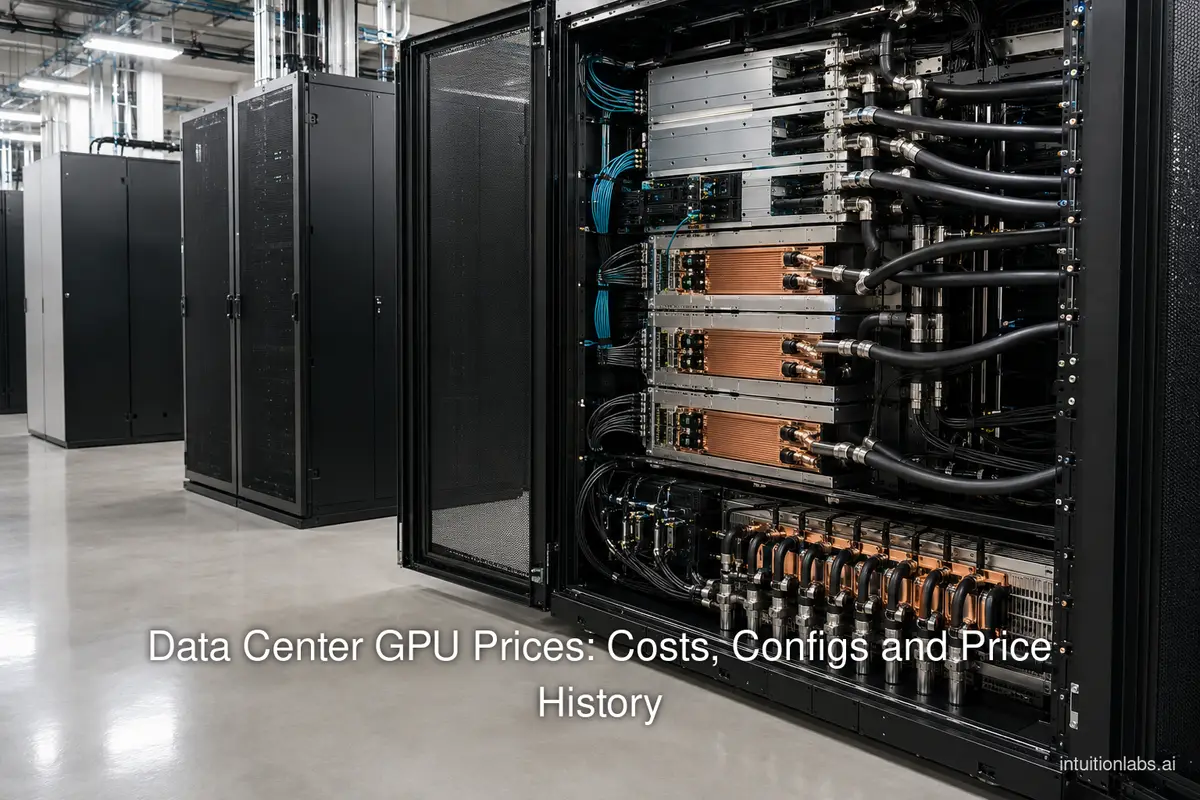
Data Center GPU Prices: Costs, Configs and Price History
A 2026 pricing guide to data center GPU costs covering NVIDIA H100, H200, B200, B300, GB300 NVL72, AMD Instinct, and Intel Gaudi, with cloud rental rates and price history from 2020 to 2026.
Nvidia's $20B Groq Acquisition: Why It Paid 2.9x Valuation for LPU Tech
Nvidia paid $20B for Groq's assets (2.9x its $6.9B valuation). Analysis of the deal structure, LPU technology, and antitrust implications — updated April 2026 with the Warren-Blumenthal Senate inquiry.
OpenAI-AMD AI Hardware Partnership: A Strategic Analysis
Analysis of the $90B OpenAI-AMD strategic partnership for 6GW of MI450 GPUs, including stock warrants, MI450 specs (CDNA 5, 2nm, HBM4), and OpenAI's 33GW multi-vendor compute strategy