


ai adoption in biotech · life sciences ai strategy
AI Adoption in Biotech: A Playbook for Internal Champions
July 10, 2026
35 min read
A 2026 data-driven playbook for AI adoption in biotech covering Bain, ZS, KPMG, and Deloitte survey data, change-management frameworks, training programs, and named cases from Moderna, AstraZeneca, Pfizer, and Insilico Medicine.

Executive Summary
Artificial intelligence (AI) adoption in biotech has crossed a threshold in 2026: nearly every large biopharmaceutical company now runs AI pilots, but only a minority have converted that activity into measurable enterprise value. Bain & Company's Q4 2025 survey of 133 life sciences executives, conducted with the Mayfield Fund, found that just 20% of organizations are consistently deploying AI at scale and capturing measurable value, while the remaining 80% remain stuck in fragmented pilots ([1]). ZS's October 2025 survey of 115 pharma and biotech technology executives found that 68% cite weak data quality and governance as the top reason AI initiatives fail, and 67% say launching an initiative without clear goals is a mistake ([2]). This report is a playbook for the internal champions, IT leaders, and R&D managers tasked with closing that gap.
The data converge on a single conclusion: technology is rarely the constraint. KPMG's 2026 Global Tech Report on Life Sciences, based on 124 technology leaders, found that 87% of organizations have already integrated AI agents into workflows, yet 97% still allocate less than 1% of annual revenue to digital technology, and only 48% report significant value realization ([3]). Deloitte's 2026 State of AI in the Enterprise research, drawing on roughly 4,000 respondents, found that employee trust in AI declines by approximately 39% once it is introduced into daily workflows, and that a corresponding drop in generative AI trust (down 34%) and agentic AI trust (down 65%) likely drove a 15% decline in workplace AI usage ([4]) ([5]). The people problem, not the model problem, is what separates the 20% of scalers from the 80% stuck piloting.
Companies that have cracked this problem share a common pattern: heavy, sustained investment in change management, tiered AI literacy programs, and named internal champions networks. Moderna's generative AI rollout, built with OpenAI, targeted 100% employee adoption within six months by combining individual training, a curated cohort of the top 100 power users organized as internal "Generative AI Champions," and structural sponsorship from the CEO and executive committee ([6]). Within two months of adopting ChatGPT Enterprise, Moderna had 750 custom GPTs in active use, and mChat, its earlier internal chatbot, had already reached over 80% adoption ([7]). AstraZeneca has certified more than 17,000 employees in AI competencies under a mandatory Bronze-Silver-Gold-Platinum-Diamond framework tied to its $80 billion 2030 revenue ambition ([8]). Johnson & Johnson has mandated generative AI training for its entire workforce, training over 56,000 employees ([9]).
The financial stakes are large and increasingly well quantified. PwC's Strategy& estimates that fully industrializing AI use cases could add $254 billion in annual operating profit to the global pharmaceutical industry by 2030, effectively doubling operating profit at companies that scale it across the enterprise ([10]). KPMG's Q1 2026 Pulse Survey found that average projected AI investment nearly doubled year over year, from $114 million to $207 million per organization, while 67% of leaders call AI a recession-proof investment priority ([11]). At the workforce level, however, a persistent skills gap remains the top barrier: GlobalData's late-2024 survey of 109 pharmaceutical leaders found 49% cite a shortage of specialized digital talent as the leading challenge to digital transformation ([12]).
Real-world case evidence, from Moderna and AstraZeneca to Pfizer and Insilico Medicine, confirms that scaled AI adoption in biotech is achievable but requires treating adoption as an "always-on" organizational transformation rather than a one-time software rollout. As Bain's research bluntly puts it, AI value depends on workforce adoption as much as technical deployment, and organizations that involve human resources (HR) early and build future-back workforce plans are nearly three times more likely to succeed ([13]). This report lays out the evidence, the frameworks, and the case studies internal champions need to build that always-on model inside their own organizations.
Introduction and Background
Biotech and pharmaceutical companies entered 2026 having moved decisively past the "should we try AI" question. The industry-wide consensus, according to ZS's survey of 115 US-based pharma and biotech technology executives, is that leaders are no longer asking "where can AI work," but "where will AI drive the growth that matters" ([14]). Nine in ten of ZS's respondents see competitive and regulatory pressures as active threats to growth, and top priorities for AI investment include accelerated discovery (52%), patient engagement (43%), and portfolio diversification (36%) ([15]).
Yet the gap between activity and impact remains stark. Benchling's November 2025 survey of roughly 100 biotechnology and pharmaceutical organizations actively using AI in research and development (R&D) found that adoption clusters around a handful of "killer apps": literature and knowledge extraction (76% adoption), protein structure and property prediction (71%), scientific reporting (66%), and target identification (58%) ([16]).Adoption drops sharply, however, in more complex, regulated science such as generative molecular design, biomarker analysis, and absorption, distribution, metabolism, and excretion (ADME) modeling, where data is scattered and hard to validate ([17]).
This unevenness is the central puzzle facing internal AI champions: the people responsible for driving adoption inside a specific function, business unit, or site. It is not enough to procure a large language model (LLM) license or a drug-discovery platform; adoption requires a deliberate, resourced program of change management, training, and governance. KPMG's Global Tech Report on Life Sciences, surveying 124 technology function leaders at pharmaceutical, biotechnology, and medical device companies, found the sector "has progressed beyond experimentation into broad adoption of core technologies," yet "remains in the early phases of maturity and value realization, with most benefits concentrated primarily towards operational efficiency rather than transformational growth" ([18]).
This report addresses ai adoption in biotech as a management and organizational challenge, not a purely technical one. It synthesizes 2025 and 2026 survey data from Bain, ZS, KPMG, Deloitte, Benchling, GlobalData, and PwC Strategy&, alongside named case studies from Moderna, AstraZeneca, Pfizer, Novartis, and Insilico Medicine, to give internal champions, chief digital and information officers (CDIOs), heads of R&D informatics, and learning-and-development (L&D) leaders a concrete playbook: how to build the case for AI investment, how to design training and change management programs, how to identify and empower champions networks, and how to overcome the specific forms of resistance that arise in regulated, safety-critical science. As of July 2026, the biotech industry has enough deployment history, both successes and setbacks, to make this playbook evidence-based rather than speculative.
Key Changes: The Shift From Pilots to Enterprise-Scale AI
From Isolated Pilots to Strategic Bets
The defining organizational change of 2025 to 2026 has been the move away from what Bain calls "sprinkling AI" across isolated use cases, toward a small number of transformative, enterprise-tied bets. Bain's research describes one major medtech firm that ran more than 100 AI initiatives yet projected only about 2% earnings-before-interest-and-taxes (EBIT) improvement, until leadership stopped asking "how do we deploy AI" and instead asked "where can AI fundamentally reshape our competitiveness" ([19]). Successful scalers, by contrast, embed AI key performance indicators (KPIs) directly into core business reporting rather than tracking activity metrics alone ([20]).
This shift shows up in budget allocation patterns too. ZS found that pharma and biotech AI investment is now splitting along two paths: a "fast track" where nearly half of respondents already demonstrate measurable value in enterprise technology and data operations (49%) and commercial sales and marketing (47%), and a "long game" in R&D discovery and clinical development, where only 17% can prove value today but 42% expect it within a year ([21]). CIOs are backing this with infrastructure spending: 88% are increasing investment in cloud and infrastructure, 86% in data products and platforms, and 84% in AI platforms specifically over the next 12 months ([22]).
From IT-Owned Projects to Shared Executive Accountability
A second structural change is the redistribution of ownership away from information technology (IT) departments alone. ZS's survey found that 55% of technology executives now have direct authority to reshape their enterprise operating model, and 86% are testing or actively changing roles and team structures to deploy resources more effectively ([23]) ([24]). Bain's data show that successful scalers report institutionalized C-suite sponsorship for AI initiatives at nearly ten times the rate of early explorers (roughly half versus 4%) ([25]). At Moderna, this shift went further still: the company merged its human resources (HR) and technology functions under a single Chief People and Digital Technology Officer, Tracey Franklin, explicitly to "architect the flow of work" as AI reshapes roles ([26]).
From Static Workflows to Redesigned, Agentic Processes
Successful scalers are far more likely to redesign entire workflows around AI rather than bolting AI onto legacy steps: Bain found 69% of successful scalers report strong process redesign capabilities, versus just 5% of early explorers ([27]). This is compounded by the arrival of agentic AI, systems capable of autonomous, multi-step reasoning and action, which KPMG's Q1 2026 Pulse Survey shows has grown from just 11% of organizational adoption in Q1 2025 to 54% one year later ([28]). ZS found agentic automation is most advanced in information technology operations (45% planning agentic workflows) and R&D discovery (41%), while patient- and customer-facing functions remain cautious, favoring human-in-the-loop task automation ([29]).
From Reactive Compliance to Proactive Governance-as-Accelerator
The fourth shift concerns the relationship between AI governance and speed. Modus Create's 2026 survey of 119 healthcare and life sciences product leaders found that 79% had slowed an AI deployment in the past year due to unresolved regulatory or ethical questions, even though 51% already maintain a centralized data governance policy ([30]) ([31]). Deloitte's Scott Holcomb, principal and US Enterprise Trust AI leader, argues the fix is to stop treating governance as a bolt-on: "for AI to deliver on its promise for organizations, trust isn't something that can be layered on later. It should be engineered in from the start" ([32]). Sanofi's Dustin Holloway, VP and head of Responsible Innovation, describes the historical default as scattering "an AI analyst in this part of the value chain," only recently giving way to a holistic, multi-year, end-to-end strategy ([33]).
From Ad Hoc Tools to a Formal Digital Transformation Framework
The fifth structural change is the move from scattered software purchases toward a documented digital transformation framework with explicit maturity stages. IntuitionLabs' analysis of pharmaceutical digital transformation found that approximately 80% of pharmaceutical companies already use cloud computing, with 95% expected to be fully cloud-operational within two years, against a pharmaceutical digital platform market projected to grow from $4.92 billion in 2024 to $34.12 billion by 2032, a compound annual growth rate (CAGR) of 24.35% ([34]) ([35]). Within that broader digital footprint, AI-driven engagement represents only 27% of patient-engagement technology, trailing web-based solutions at 72%, evidence that AI adoption still lags general digitization even as it accelerates ([36]).
KPMG's maturity model gives this framework more granularity, rating organizations across a five-stage scale from "initial/ad hoc" to "optimized." The research found life sciences technology functions are heavily weighted toward the "managed" stage, meaning disciplined governance exists but true continuous improvement, instrumented operations, and reusable platforms remain rare; enterprise data management shows the weakest maturity of all core technology functions surveyed, with just 1% of organizations reaching "optimized" status ([37]) ([38]). KPMG's Anand Sekhar, Principal Advisory and Head of Life Sciences Technology, Data and AI, frames the emerging framework as a departure from the traditional build-or-buy binary: "organizations are partnering with niche, hyper-focused firms to accelerate value, buy or borrow proven solutions and wrap minor enhancements on top of them with AI" ([39]). Decision rights in this framework tend to follow a federated hub-and-spoke model rather than full centralization: KPMG found 48% of organizations use federated technology governance, allowing each business domain flexibility within central standards, while only 10% are fully decentralized ([40]). This layered structure, cloud and data infrastructure as the base, a federated governance layer above it, and AI use cases deployed on top, gives internal champions a concrete framework to benchmark their own organization's digital transformation stage rather than treating "digital transformation" as an undifferentiated aspiration.
The FDA's regulatory posture reinforces this. Its January 2025 draft guidance, "Considerations for the Use of Artificial Intelligence To Support Regulatory Decision-Making for Drug and Biological Products," establishes a risk-based credibility assessment framework for evaluating an AI model within a specific "context of use" (COU) ([41]). This means governance and adoption speed are not opposites in biotech; regulatory-grade validation is a prerequisite for scaling AI into GxP-regulated (good practice-regulated) workflows at all.
Implementation Considerations and Process Changes for AI Champions
Internal champions, whether a designated "AI lead" in R&D informatics, a digital transformation officer, or a grassroots power user promoted into a formal role, face a specific set of implementation choices. The evidence points to five concrete levers.
Anchor the business case in a small number of transformative bets, not a use-case inventory. Bain's data show that leaders who begin from "future-back" planning, designing from the AI-enabled enterprise they want to become rather than extrapolating from today's pilots, outperform those chasing broad use-case coverage ([42]). One pharma chief information officer (CIO) told ZS that the strongest teams "balance skills evenly, half focused on technology execution, half on business process expertise," underscoring that champions need domain fluency, not just technical fluency ([43]).
Build a cross-functional coalition, deliberately including HR and compliance from day one. Successful scalers are nearly three times more likely to involve HR in workforce planning and upskilling, and 80% engage in future-back workforce planning versus just 7% of early explorers ([44]). Champions should:
- Recruit a guiding coalition spanning R&D, IT, compliance, quality, and commercial functions, not just technologists.
- Secure a named executive sponsor with the standing to resolve cross-functional handoff problems; Bain's data show these frictions, gaps in system integration, unclear ownership, breakdowns in handoffs, only surface once a redesigned workflow reaches production ([45]).
- Deploy cross-functional agile pods built around a product-manager role that owns workflow redesign end to end; AI leaders are roughly five times more likely to use this structure than laggards ([46]).
Fix the data foundation before scaling agentic workflows. ZS found 68% of pharma and biotech leaders say neglecting data quality and governance early is the primary reason AI initiatives fail ([47]). Benchling similarly reports that among biotechs with low AI adoption, only 9% describe their R&D data integration as "advanced," compared with 33% among high-adoption biotechs ([48]).
Design tiered, role-based training rather than a single course. IntuitionLabs' analysis of pharma AI training programs finds that effective curricula separate core modules (statistics, programming, machine-learning fundamentals), specialized domain tracks (chemoinformatics, bioinformatics, clinical natural language processing), and regulatory and ethics modules covering GxP data-integrity practices and FDA and European Medicines Agency (EMA) AI guidelines ([49]).
Measure and communicate ROI relentlessly, using both quantitative and qualitative indicators. GlobalData's survey found skills shortages are cited by 49% of pharma leaders as the top digital-transformation barrier, ahead of insufficient funding ([50]), which means champions need a training-ROI narrative, not just a technology-ROI narrative, to secure ongoing budget.
Biotech AI Training Programs: Curriculum, Delivery, and Return on Investment
Because the skills gap consistently outranks funding as the top adoption barrier, the design of the training program itself deserves its own workstream rather than being treated as a line item inside a broader change-management plan. IntuitionLabs' guide to pharma AI training programs recommends role-based customization as the first design principle: data scientists need advanced modeling skills plus drug-domain context, lab technicians need basic AI literacy tied to specific applications such as image analysis, and senior leaders need AI strategy and risk-management awareness rather than technical depth ([51]). Layered curricula typically combine core modules (statistics, programming, machine-learning fundamentals), specialized domain tracks, and a dedicated regulatory-and-ethics track covering GxP data integrity, FDA and EMA AI guidance, and data-privacy regimes such as the Health Insurance Portability and Accountability Act (HIPAA) and the General Data Protection Regulation (GDPR) ([52]).
Named corporate programs illustrate the range of approaches available to champions designing their own curricula. Johnson & Johnson has mandated generative AI training across its entire workforce, training more than 56,000 employees ([9]). Merck built an internal generative AI platform called GPTeal that more than 50,000 staff actively use after completing dedicated upskilling boot camps ([53]). Beyond individual companies, universities have built dedicated executive education around this need: Harvard Medical School's Executive Education offers an 18-week "AI-Driven Health Care Transformation" program combining AI strategy and digital-transformation leadership tracks ([54]), while MIT's executive education runs a six-week self-paced course specifically titled "Artificial Intelligence in Pharma and Biotech" ([55]).
On measuring return, IntuitionLabs' report recommends established training-evaluation frameworks, Kirkpatrick's levels of training evaluation and Phillips' ROI methodology, paired with both quantitative metrics (completion rates, time and cost savings, error reduction) and qualitative indicators such as employee engagement and voluntary tool adoption ([56]). This measurement discipline matters because, as the same report notes, the skills gap is well documented at the industry level: a GlobalData survey found 49% of pharmaceutical executives cite a shortage of specialized digital talent as a barrier to transformation, and the Pistoia Alliance separately found 44% of life-sciences R&D groups lack sufficient AI and machine-learning expertise ([57]). Absent a resourced training program that champions can point to as a concrete deliverable, boardroom urgency about AI risks translating into technology purchases that the workforce is not equipped to use.
Overcoming AI Resistance in Biotech
Resistance to AI in biotech takes a distinctive shape compared with other industries, because scientists and clinical staff are trained to be skeptical of unvalidated claims, and because errors in drug discovery, manufacturing, or clinical trials carry patient-safety consequences that a marketing chatbot error does not. Deloitte's TrustID survey, covering roughly 4,000 respondents between May and July 2025, found that trust in generative AI fell 34% and trust in agentic AI fell 65% over that period, with a corresponding 15% decline in workplace AI usage ([58]). Michael Crowthers, a managing director at Deloitte & Touche, notes the inverse is equally powerful: when organizations get trust right, employees are about two and a half times more likely to report feeling comfortable using the AI tools provided ([59]).
Pfizer's chief executive officer (CEO), Albert Bourla, has framed the resistance problem directly: "It is not a question of technology, it is a question of organizational ability to adjust and transform itself through AI," identifying "fear of the unknown" as the biggest barrier to AI adoption at scale ([60]). As life sciences organizations scale from software prototypes to dedicated high-performance computing clusters for proprietary molecular models, teams must evaluate hardware platform trade-offs; see the NVIDIA DGX vs HGX vs NVL72 Platform Comparison for an engineering breakdown of interconnect topologies and cooling architectures. Pfizer's response has been to build "awareness, curiosity, and comfort with the new technology before asking colleagues to change how they work," rather than mandating tool use first ([60]).
Bench-level sentiment corroborates that resistance is often rooted in legitimate scientific caution rather than technophobia. On the r/biotech community on Reddit, a self-identified Director of Upstream Process Development commented that "AI can help with data analysis, visualization, and reports but the in-lab work still needs to happen to generate the data" ([61]), reflecting a widely shared view that AI augments rather than replaces the experimental method. Other practitioners in the same thread named "AI, chemical engineering, ability to work on and empower teams" among the most desirable skills for entering the field, suggesting resistance coexists with recognition that AI literacy is now a career requirement ([62]).
Deloitte's practical recommendations for converting resistance into adoption center on five moves: embedding AI risk management into strategy from the outset rather than as a post-launch compliance step; codifying a clear, cross-functional AI risk appetite with fast lanes for low-risk uses; prioritizing education and upskilling that is honest about limitations such as hallucination and bias; streamlining governance with self-service, technology-enabled processes instead of serial committee reviews; and championing a visible culture of transparency and shared accountability from the top ([63]). Notably, the framework differentiates risk by context of use: Novartis's director of data science and AI, Zhong Lu, observed on the Emerj podcast that adverse-event detection in clinical trials is a GxP-regulated process requiring strict validation because "any error could jeopardize patient safety," while demand forecasting carries only business risk and can move faster ([64]).
Finally, resistance is not confined to the shop floor. Becker's Hospital Review's 2026 reporting on health-system technology executives found some of the most effective AI champions are not C-suite mandates at all but the "bedside clinicians who are actually using the technology, such as nurses," a pattern equally applicable to bench scientists in biotech who become informal champions once they see AI save them real time ([65]).
Below, Table 1 summarizes the primary resistance drivers documented across the surveys reviewed in this report, alongside the countermeasure each source associates with overcoming it.
| Resistance Driver | Evidence | Documented Countermeasure |
|---|---|---|
| Trust decline on first exposure | Employee trust in AI drops approximately 39% on introduction; agentic AI trust down 65% ([4]) | Engineer trust and governance into deployment from day one rather than bolting it on later ([66]) |
| Digital and AI skills shortage | 49% of pharma executives cite a skills shortage as the top digital transformation barrier ([50]) | Mandatory, tiered upskilling; AstraZeneca certified 17,000+ employees under a Bronze-to-Diamond framework ([8]) |
| Fear of job displacement / "unknown" | Pfizer's CEO identifies "fear of the unknown" as the biggest adoption barrier ([60]) | Build awareness and comfort before mandating tool use; frame AI as augmentation, not replacement ([60]) |
| Fragmented governance ownership | 79% of healthcare and life sciences organizations slowed a deployment due to unresolved governance questions ([30]) | Adopt a risk-tiered, self-service governance model with fast lanes for low-risk use cases ([67]) |
| Legitimate scientific skepticism | Bench scientists note AI supports analysis but "in-lab work still needs to happen" ([61]) | Ground AI outputs in verifiable, clean data; prioritize use cases with clear validation paths ([68]) |
Table 1 makes clear that resistance in biotech is rarely irrational: it tracks specific, addressable gaps in trust engineering, skills, communication, governance clarity, and data quality. Internal champions who treat each row as a distinct workstream, rather than a single "communications problem," are more likely to convert skeptics into advocates. The pattern that recurs across every row is that resistance recedes once employees can see, concretely, that an AI tool has been validated against the same standards, safety, accuracy, auditability, that apply to any other tool in a GxP environment.
Data Analysis and Evidence
The quantitative record on ai adoption in biotech is unusually rich for 2025 and 2026, spanning at least six independent, named surveys. Bain's survey of 133 life sciences executives (Q4 2025, with the Mayfield Fund) found only 20% of organizations scaling AI with measurable value ([1]). ZS's survey of 115 US-based pharma and biotech technology executives (Harris Poll, fielded July 2025) found 62% of respondents hold executive-level titles such as Chief Digital and Information Officer (CDIO), CIO, or Chief Technology Officer (CTO) ([69]). KPMG's Global Tech Report on Life Sciences surveyed 124 technology function leaders and found 97% of organizations allocate less than 1% of annual revenue to digital technology, even as 87% report AI agents are integrated into workflows ([70]) ([71]). Separately, KPMG's Q1 2026 US AI quarterly pulse survey shows average projected AI spending nearly doubling to $207 million per organization from $114 million a year prior, with AI agent adoption rising from 11% to 54% ([72]).
Benchling's survey of roughly 100 biotechnology and pharmaceutical organizations found 50% report faster time-to-target today and 56% expect cost reductions within two years as automation and agentic workflows scale ([73]). On talent, the same survey found internal upskilling of existing scientific staff is the leading source of AI talent (67%), far outpacing hires from technology companies (21%) ([74]). Modus Create's survey of 119 healthcare and life sciences product leaders (fielded with Ascend2 in August 2025) found 63% achieve measurable AI return on investment (ROI) within six months of deployment, even as 79% report governance-related delays ([75]).
Table 2 below consolidates the headline figures from these six independent surveys, which together anchor the quantitative case for treating AI adoption as an organizational, not purely technical, initiative.
| Survey (Sponsor, Sample, Field Date) | Headline Adoption/Value Statistic | Headline Barrier Statistic |
|---|---|---|
| Bain & Mayfield Fund, n=133 life sciences executives, Q4 2025 | Only 20% scaling AI with measurable value ([1]) | Human adoption/behavior change ranks as the top-ranked barrier across all deployment archetypes ([76]) |
| ZS (Harris Poll), n=115 pharma/biotech tech executives, July 2025 | 88% of leaders back cloud/data platform investment increases ([77]) | 68% cite weak data quality/governance as top failure cause ([78]) |
| KPMG Global Tech Report, n=124 life sciences tech leaders, 2026 | 87% have integrated AI agents into workflows ([71]) | 97% allocate under 1% of revenue to digital technology, a scale/value gap ([3]) |
| KPMG US AI Pulse Survey, US life sciences, Q1 2026 | Projected AI spend nearly doubled to $207M ([72]) | 63% mandate human validation of AI outputs ([79]) |
| Benchling / independent research firm, n≈100 biotech/biopharma R&D orgs, Nov 2025 | Literature review reaches 76% adoption ([80]) | Generative design and ADME modeling lag due to fragmented data ([81]) |
| Modus Create / Ascend2, n=119 healthcare/life sciences product leaders, Aug 2025 | 63% achieve ROI within six months ([75]) | 79% slowed deployment due to governance issues ([30]) |
The consistency across these independently sponsored, independently fielded surveys is itself a data point: whichever consultancy or research firm is asking, roughly three in four biotech and pharma organizations report meaningful AI activity, yet only a minority (typically 20% to 50%, depending on the metric) convert that activity into measurable enterprise value, and governance and human-adoption factors, not model quality, are the overwhelmingly cited reasons for the gap. On the financial upside, PwC's Strategy& analyzed more than 200 AI use cases with 25 industry experts and found operations account for 39% of the potential impact, R&D 26%, commercial 24%, and enabling functions 11%, for a total of $254 billion in additional annual operating profit by 2030 if AI use cases are fully industrialized ([82]).
Case Studies and Real-World Examples
Moderna: Democratizing Generative AI Through Champions and Structural Change
Moderna's partnership with OpenAI, formalized in April 2024, is the most extensively documented AI-adoption case in the industry, including a January 2025 Harvard Business School case study titled "Moderna: Democratizing Artificial Intelligence" ([83]). Moderna's objective was 100% employee adoption and proficiency in generative AI within six months, achieved through a three-tiered change management strategy: individual training (including AI-taught AI courses), collective mechanisms (an internal prompt contest identifying the top 100 power users, organized as "Generative AI Champions," plus local office hours across business units), and structural sponsorship (CEO and executive committee town halls and incentive programs) ([6]) ([84]). Moderna's internal chatbot, mChat, reached over 80% employee adoption prior to the ChatGPT Enterprise rollout ([85]). Within two months of full ChatGPT Enterprise deployment, the company had 750 custom GPTs in active use, 40% of weekly active users had created their own GPTs, and each user averaged 120 ChatGPT Enterprise conversations per week ([86]). CEO Stéphane Bancel has said the ambition is to run a company that would traditionally require 100,000 employees with only a few thousand, using AI as the multiplier ([87]). Reflecting the organizational scope of this transformation, Moderna subsequently merged its HR and technology functions into a single "People and Digital Technology" department under Chief People and Digital Technology Officer Tracey Franklin ([88]).
AstraZeneca: Tiered Certification Tied to a Corporate Revenue Ambition
AstraZeneca has structured its AI upskilling as a formal, tiered accreditation program (Bronze, Silver, Gold, Platinum, and Diamond) launched in 2024 in partnership with Global IT, HR, Compliance, and business functions, available to all employees in 12 languages ([89]) ([90]). By April 2025, over 12,000 employees had participated ([91]); by April 2026, that figure had grown to more than 17,000 certified employees, with the program mandating that all staff above a certain grade reach at least silver-level certification ([92]). Chief Financial Officer Aradhana Sarin described roughly 1,000 active AI pilots running across the company, with finance's role being to prioritize which pilots convert into production workflows ([93]). Sarin also noted that initial hesitancy gave way to enthusiasm as employees saw the executive team's investment reflected in real resources: "I think people are really embracing AI and learning and developing their own skills" ([94]). This upskilling program is explicitly tied to AstraZeneca's public "Ambition 2030" target of $80 billion in revenue and 20 new medicines, set in May 2024 against a Wall Street consensus estimate of roughly $67 billion, a target the company was on track toward with Q1 2026 revenue of $15.29 billion ([95]) ([96]).
Pfizer: Pairing Cloud-Scale Infrastructure With an "AI-Fluent" Culture Program
Pfizer's Pfizer-Amazon Collaboration Team (PACT) initiative, launched in 2021 with Amazon Web Services (AWS), pursued 14 prototyping projects that saved scientists up to 16,000 hours of annual search time and cut related infrastructure costs by 55% ([97]). Vijay Bulusu, Pfizer's head of data and digital innovation for Pharmaceutical Sciences Small Molecule, explained that a PACT prototype typically reaches minimum viable product (MVP) stage in no more than six weeks, versus at least three months if Pfizer teams tried to build it alone, and that five of the initial 14 projects have moved into production ([98]) ([99]). Beyond infrastructure, Pfizer CEO Albert Bourla has directed the company's broader adoption strategy toward building "AI fluency," arguing organizational adjustment, not the technology itself, is the true bottleneck ([60]). Separately, an MIT Sloan Management Review case study on Pfizer's manufacturing transformation found that decades of paper-based batch records resisted digitization until Pfizer paired a modern manufacturing execution system (MES) with electronic batch records (EBRs), concluding that "the hard part was not the technology" but the organizational discipline required to retire legacy, "paper on glass" workflows ([100]).
Novartis: Cross-Functional AI Platforms From Clinical Development to Commercial Insights
Novartis has pursued a portfolio approach across functions. In market research and insights, Novartis's Sherlock platform, built with Market Logic Software and embedding the DeepSights generative AI capability, won the 2025 EMEA Paragon "AI Pacesetter" Award for its integration into knowledge management and decision-making ([101]). Novartis's Dataiku implementation, meanwhile, reduced time-to-insight for a generative AI use case by 90% and accelerated data ingestion in a spreadsheet-based workflow by 600%, addressing the tedious manual analysis of hundreds of 20-page healthcare-provider interview transcripts ([102]). In clinical development, Zhong Lu, Novartis's director of data science and AI, has described a shift from basic digitization (electronic data capture, eConsent) toward genuinely intelligent, connected data platforms that unite structured and unstructured data across traditional and decentralized trials ([103]).
Insilico Medicine: An End-to-End AI Drug Discovery Program Reaching Phase III
Insilico Medicine (Hong Kong Stock Exchange (HKEX): 3696) offers the industry's clearest evidence that AI-originated drug candidates can reach late-stage clinical testing. On July 7, 2026, the company announced the initiation of a Phase III trial for rentosertib, an oral TNIK (a serine/threonine kinase) inhibitor for idiopathic pulmonary fibrosis (IPF), whose target was identified by the company's PandaOmics AI-powered biology engine and whose molecule was designed with the Chemistry42 generative chemistry platform ([104]). The preceding Phase IIa GENESIS-IPF study, published in Nature Medicine, showed the 60 mg once-daily dosing arm produced a mean forced vital capacity improvement of +98.4 mL at 12 weeks, versus a decline of -20.3 mL for placebo ([105]). The Phase III trial is designed to enroll 320 patients across sites in China and will evaluate once-daily rentosertib over 52 weeks ([106]). Company founder and CEO Alex Zhavoronkov called the program "a testament to the ability of AI to create truly novel therapeutics with novel target, novel molecule, not just discover me-better molecules for known targets" ([107]). This case matters for adoption strategy specifically because it demonstrates that the same organizational discipline required for conventional drug development, peer-reviewed validation, rigorous trial design, and regulatory engagement, applies equally to AI-originated assets: the technology accelerates discovery, but does not exempt a program from the clinical and regulatory rigor that governs adoption everywhere else in biotech.
As a contrasting data point on organizational risk, Recursion Pharmaceuticals, a publicly-traded "TechBio" company built around its automated, AI-driven Recursion Operating System (OS), announced in mid-2025 a reduction of approximately 20% of its workforce, about 160 jobs, citing pipeline pruning and capital-markets pressure rather than AI underperformance per se ([108]). The episode is a useful reminder for internal champions that AI-native operating models still face the same capital-markets and portfolio-prioritization discipline as any biotech, and that adoption strategy must be paired with realistic financial planning rather than presented as an automatic hedge against biotech's structurally high failure rates.
Implications and Future Directions
Several forward-looking implications follow from the evidence assembled in this report. First, the gap between the roughly 87% of organizations reporting some level of AI agent integration ([71]) and the roughly 20% consistently capturing measurable value ([1]) is unlikely to close through further tool procurement alone. It will close, per the evidence reviewed here, only through sustained investment in "always-on" change management, KPI-linked governance, and workforce planning conducted jointly by technology and HR functions.
Second, agentic AI's rapid growth, from 11% to 54% adoption in one year according to KPMG's pulse survey ([28]), raises the stakes on governance discipline specifically, since autonomous, multi-step systems are harder to audit than single-turn generative tools. The FDA's risk-based credibility framework, requiring sponsors to establish and document a model's credibility for a specific context of use ([109]), is likely to become the template other regulators and internal quality functions adopt for agentic systems touching regulatory decision-making.
Third, the workforce implications are structural, not incremental. Benchling's finding that internal upskilling, not external hiring, is the dominant source of AI talent (67% versus 21% from technology companies) ([74]) suggests biotech's AI talent strategy will diverge from the broader technology sector's hire-first approach; leading organizations are instead building "hybrid scientists" who bridge domain science and machine learning through internal sprint groups and applied training ([110]). This is consistent with KPMG's finding that AI leadership is most often housed within R&D (30%) or distributed across functions (22%) rather than centralized under a single Chief AI Officer (16%) ([111]).
Fourth, life sciences organizations weighing whether to build proprietary AI tooling, buy commercial platforms, or partner with specialist advisers face a genuinely hybrid market: Benchling found 60% of biotechs buy commercial AI applications, 55% build in-house, and 43% adapt open-source or third-party tools, figures that do not sum to 100% because most organizations pursue more than one path simultaneously ([112]). Advisory firms with life-sciences domain expertise, including consultancies that are Veeva Vault CRM X-Pages implementation partners, occupy a specific niche in this ecosystem: helping regulated organizations translate enterprise platforms such as Veeva CRM and Vault into AI-enabled commercial and regulatory workflows without duplicating the governance burden that KPMG and Deloitte's data show is the single biggest source of deployment delay. IntuitionLabs, for instance, documents this integration work directly in its published case study on building custom Veeva MyInsights dashboards, powered by Veeva Nitro, for Scilex Holding Company's field sales analytics, unifying prescription, claims, and CRM data into daily automated reporting ([113]).
Fifth, and finally, the same tension documented across the independent surveys reviewed in this report, technical capability outrunning organizational absorption, shows up consistently across every data source examined, from the largest global consultancies to individual company disclosures. That pattern is likely to persist through at least 2027, making the change-management and training disciplines described throughout this report a durable, not transitional, competency for biotech leaders rather than a temporary response to a single generation of generative AI tools.
Frequently Asked Questions (FAQs)
What is the current state of AI adoption in biotech as of mid-2026? Adoption of discrete AI tools is widespread, KPMG found 87% of life sciences technology leaders report AI agents integrated into workflows ([71]), but Bain found only about 20% of organizations are converting that activity into measurable, scaled enterprise value ([1]).
What does a life sciences AI strategy need to include beyond technology procurement? The evidence points to five components: a small number of enterprise-tied strategic bets rather than a broad use-case inventory ([114]); a modernized, integrated data foundation, since 68% of leaders cite weak data quality as the top reason AI fails ([115]); role-based training; risk-tiered governance; and executive sponsorship extending to HR.
How should a biotech implement AI without triggering compliance risk? By adopting a risk-based framework similar to the FDA's, which ties the rigor of validation to the specific context of use for each AI model rather than applying a uniform governance standard to every application ([116]).
What does effective AI change management in pharma look like in practice? Moderna's model combined individual training, a curated champions cohort of top power users, and structural sponsorship from the CEO down ([6]); AstraZeneca's model relies on mandatory, tiered certification linked to a public corporate revenue target ([117]).
What do biotech AI training programs typically cover? Effective programs layer core AI and data-science fundamentals, domain-specific tracks (bioinformatics, chemoinformatics, clinical natural language processing), and regulatory/ethics modules covering GxP data integrity and FDA/EMA AI guidance, customized by role rather than delivered as a single generic course ([49]).
How are AI champions identified and empowered inside biotech organizations? Rather than appointing champions purely from IT or the C-suite, effective programs identify power users through open competitions or observed usage, as Moderna did with its top-100 power-user cohort ([118]), and health systems more broadly report that some of the most effective champions are bedside staff rather than executives ([65]).
What is a realistic timeline for scaling AI in life sciences? ZS's data suggest commercial and enterprise-technology functions can demonstrate measurable value within roughly a year, while R&D discovery and clinical development, the "long game," typically require multi-year investment before value is provable, with only 17% able to prove value today versus 42% expecting to within the next year ([21]).
Conclusion
By mid-2026, ai adoption in biotech has clearly moved past the experimentation phase, with the overwhelming majority of pharmaceutical and biotechnology organizations reporting active AI deployments across research, clinical development, manufacturing, and commercial functions. What separates the small minority converting that activity into measurable enterprise value from the larger majority still stuck in fragmented pilots is not model sophistication or compute access, it is the depth and discipline of the organizational change program surrounding the technology. The evidence from Bain, ZS, KPMG, Deloitte, Benchling, GlobalData, and PwC Strategy& converges on the same diagnosis: data foundations, governance clarity, workforce trust, and sustained executive sponsorship determine whether AI scales or stalls.
The named cases reviewed here, Moderna's champions-and-culture model, AstraZeneca's mandatory certification framework, Pfizer's blend of cloud infrastructure and AI-fluency programming, Novartis's cross-functional platform portfolio, and Insilico Medicine's demonstration that AI-originated molecules can withstand the full rigor of Phase III development, show that scaled adoption is achievable using approaches that are documented, replicable, and increasingly well quantified. For the internal champion tasked with driving this work inside a specific biotech organization, the playbook is consistent across every source reviewed in this report: treat AI adoption as an always-on organizational transformation with a named executive sponsor, a cross-functional coalition that includes HR and compliance from the outset, a tiered and role-specific training curriculum, a risk-based governance model that accelerates rather than blocks low-risk use cases, and relentless measurement of value against a small number of enterprise-tied strategic bets rather than a sprawling inventory of disconnected pilots. Organizations that internalize this playbook are positioned to join the 20% capturing real value from AI in life sciences; those that treat AI purely as a software procurement decision are likely to remain part of the 80% still waiting for their pilots to pay off.
About IntuitionLabs
Build practical AI for pharma and biotech with IntuitionLabs. We help life-science teams turn complex information and workflows into useful software, governed knowledge systems and AI tools.
IntuitionLabs is an AI consulting, custom software development and data engineering firm serving pharmaceutical, biotechnology, medical-device and other life-science organizations. We work with clinical, regulatory, medical-affairs, commercial, quality and IT teams to connect technology decisions with the work people need to accomplish.
AI consulting and adoption
Our AI enablement services cover readiness assessments, use-case selection, governance and policies, team workshops, adoption measurement and ongoing advisory support. We help organizations structure the information layer behind AI: source material, context, permissions and maintained knowledge that make generated answers useful and reviewable. Private LLM inference and hosted AI options support teams evaluating how to operate AI with appropriate control over their data and infrastructure.
Software, data and life-science workflows
IntuitionLabs develops custom software for pharma and biotech, integrates enterprise systems, and builds data engineering and business intelligence solutions. Areas of focus include AI agents, regulatory research, medical writing, medical affairs, CMC information, competitive intelligence and clinical-document workflows. Our eTMF intelligence work includes cross-system reconciliation and inspection-readiness support.
Enterprise platforms and regulated delivery
We provide Veeva services, application support, managed services, integrations and custom applications, alongside enterprise content work involving platforms such as Egnyte. For regulated workflows, our services include GxP enablement, computer-system validation and software development addressing 21 CFR Part 11 requirements. The applicable controls, validation responsibilities and acceptance criteria are defined for each engagement.
Work with IntuitionLabs
Explore AI enablement, pharma and biotech software development, data engineering and BI, and Veeva services. Contact IntuitionLabs to discuss your workflow, information sources and implementation needs.
IntuitionLabs publishes educational research to help life-science teams make informed technology decisions. Coverage of a product or organization does not imply a client relationship, endorsement or partnership.
Sources / 118

Need Expert Guidance on This Topic?
Let's discuss how IntuitionLabs can help you navigate the challenges covered in this article.
I'm Adrien Laurent, Founder & CEO of IntuitionLabs. With 25+ years of experience in enterprise software development, I specialize in creating custom AI solutions for the pharmaceutical and life science industries.
The information contained in this document is provided for educational and informational purposes only. We make no representations or warranties of any kind, express or implied, about the completeness, accuracy, reliability, suitability, or availability of the information contained herein. Any reliance you place on such information is strictly at your own risk. In no event will IntuitionLabs.ai or its representatives be liable for any loss or damage including without limitation, indirect or consequential loss or damage, or any loss or damage whatsoever arising from the use of information presented in this document. This document may contain content generated with the assistance of artificial intelligence technologies. AI-generated content may contain errors, omissions, or inaccuracies. Readers are advised to independently verify any critical information before acting upon it. All product names, logos, brands, trademarks, and registered trademarks mentioned in this document are the property of their respective owners. All company, product, and service names used in this document are for identification purposes only. Use of these names, logos, trademarks, and brands does not imply endorsement by the respective trademark holders. IntuitionLabs.ai is an AI software development company specializing in helping life-science companies implement and leverage artificial intelligence solutions. Founded in 2023 by Adrien Laurent and based in San Jose, California. This document does not constitute professional or legal advice. For specific guidance related to your business needs, please consult with appropriate qualified professionals.
Related Articles
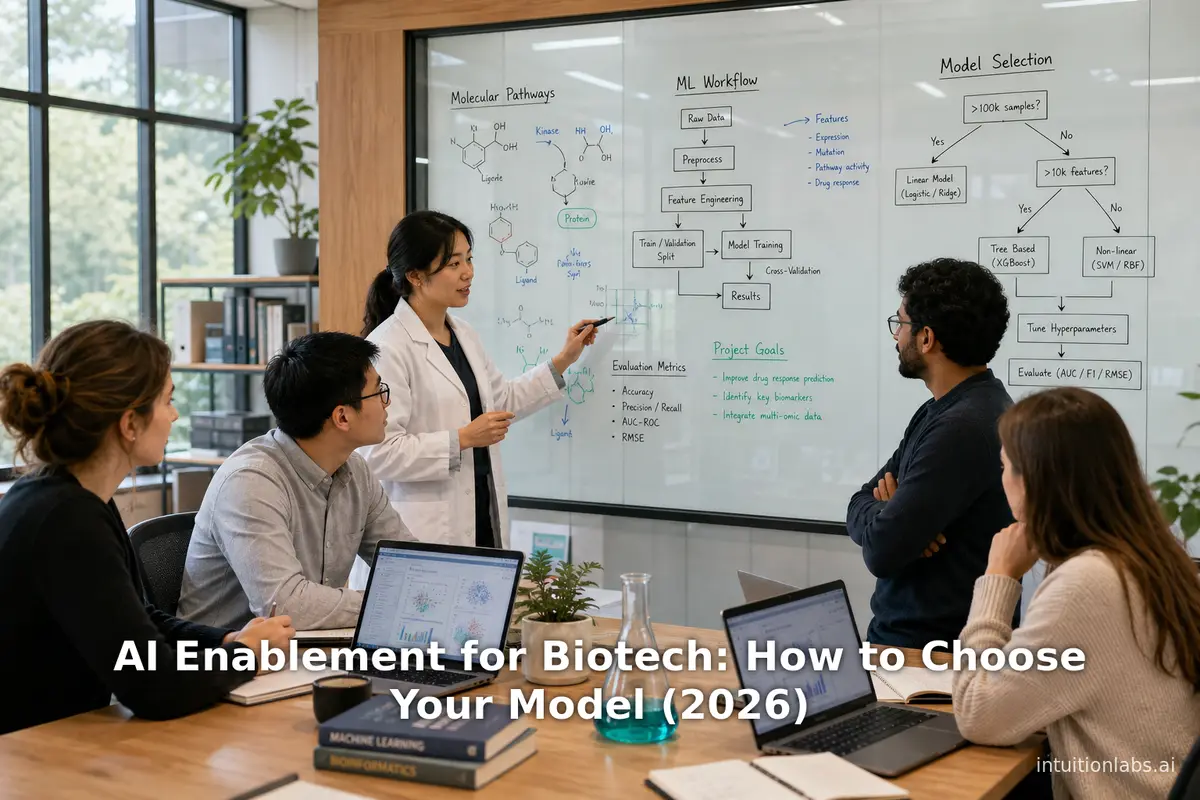
AI Enablement for Biotech: How to Choose Your Model (2026)
Compares AI enablement models for biotech in 2026: Big Four consultancies, McKinsey QuantumBlack, IQVIA, boutique firms, training providers, and building an internal AI team, with pricing, adoption data, and 6 case studies.
Guide to AI Enablement for Biotech: 12-Week Roadmap
A 2026 guide to AI enablement for biotech covering a 12-week implementation roadmap, workshop pricing from $3,500 to $5,500, a $2.9 billion drug discovery AI market, and FDA and EU AI Act compliance requirements.
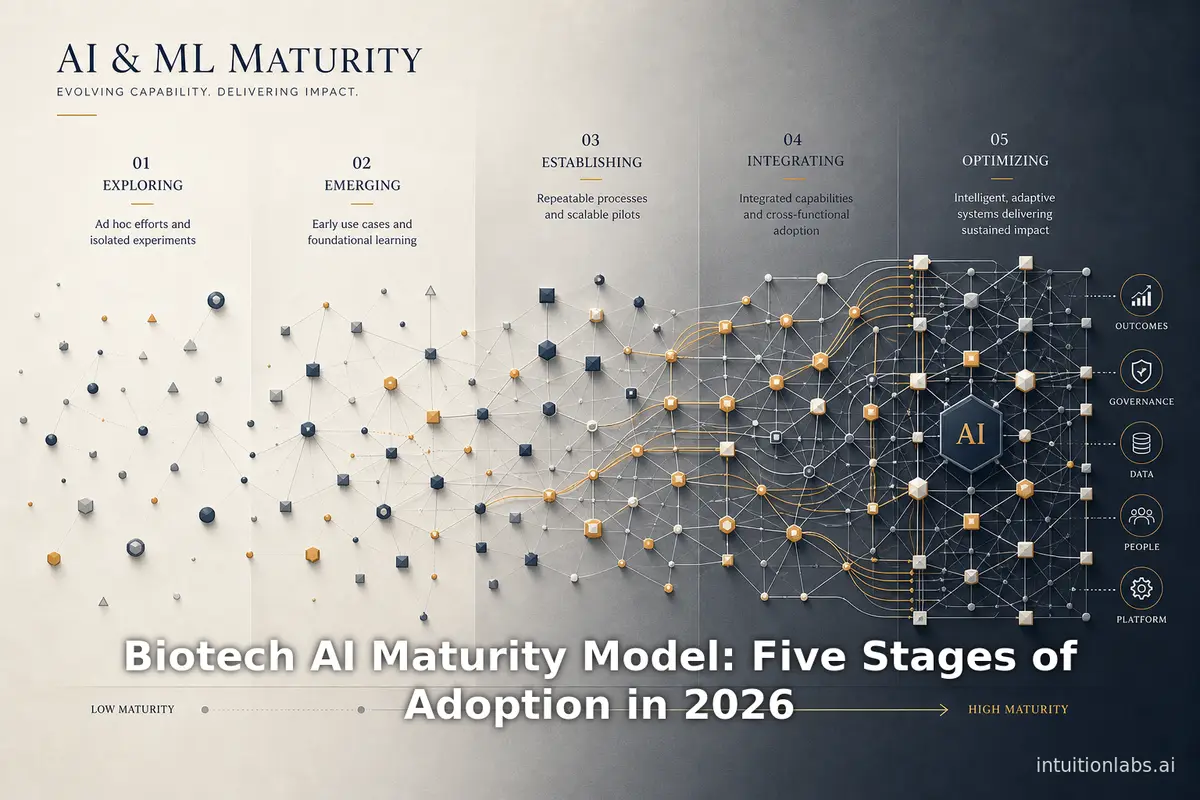
Biotech AI Maturity Model: Five Stages of Adoption in 2026
A 2026 analyst framework mapping biotech and pharma AI adoption across five maturity stages, from shadow AI use to autonomous agentic systems, with governance, GxP validation, and regulatory benchmarks.