


Veeva · X-Pages
Veeva Vault CRM X-Pages Development Services: What to Know Before You Start
December 17, 2025
Updated September 16, 2026
20 min read
2026 guide to Veeva Vault CRM X-Pages development services. Covers X-Pages Studio vs custom code, Veeva AI Agent integration, Nitro data, timelines, costs, and how to select a certified development partner.
Independent editorial content produced with AI assistance. This article is written by IntuitionLabs and is not endorsed by Veeva Systems Inc. Veeva and its product names are trademarks of Veeva Systems Inc. All information is drawn from public sources with citations linked inline. AI-generated text may contain errors or omissions; verify any critical claim against the linked sources before acting on it.

- 01X-Pages is the embedded custom interface framework for Vault CRM, included in the standard subscription at no additional cost.
- 02Choose X-Pages Studio for simple dashboards and quick prototyping. Use custom HTML and JavaScript development for complex integrations, workflows, analytics, and tailored interfaces.
- 03Offline-first design, validation documentation, Vault CRM data-model migration, and AI Agent surface planning are recurring requirements, not final-stage additions.
- 04Legacy Veeva CRM support ends December 31, 2029, so X-Pages decisions should be treated as multi-year platform work.
- 05Implementation pricing is not standardized publicly. Comparable partner estimates should separate discovery, design, development, integrations, validation, deployment, training, and support.
Executive Summary
Veeva Vault CRM X-Pages is the next-generation embedded pages framework for custom interface development inside Vault CRM, replacing MyInsights for Vault CRM customers. Unlike its predecessor, which required a separate MyInsights license on the legacy Salesforce-based Veeva CRM, X-Pages comes included in the standard Vault CRM subscription at no additional cost. As of March 2026, more than 125 customers worldwide are live on Vault CRM, and Veeva's fourth-quarter fiscal 2026 results show 10 of the top 20 biopharmas globally committed to the platform, with the company targeting roughly 14 of the top 20 over time ([1]). Veeva has set December 31, 2029 as the legacy Veeva CRM end-of-support date. This guide covers what pharmaceutical companies should know when evaluating X-Pages development services in 2026, including capabilities, the platform's Salesforce lineage, Veeva AI Agent integration, implementation approaches, typical costs, partner selection, common pitfalls, and the regulatory obligations that attach to any custom CRM interface code.
Customers worldwide live on Vault CRM as of March 2026
Legacy Veeva CRM end-of-support date
Typical total X-Pages development timeline
Timeline for simple X-Pages Studio dashboards
What is Veeva X-Pages?
X-Pages (formerly MyInsights on Vault CRM) is a framework for custom user-experience development embedded within Vault CRM. Veeva positions it as "a no-code platform in Vault CRM for the creation of highly tailored user experiences," enabling pharmaceutical field teams to access real-time, contextual, and historical information directly within their CRM workflow, online and offline, across iPad, iPhone, and browser. Vault CRM itself carries full offline support on iPad and iPhone, with data, configurations, and content synchronized automatically once connectivity returns ([2]); some connected features, such as Events Management, run in a documented hybrid mode where certain functions require an internet connection and others do not ([3]). Any custom X-Pages build has to account for that connected/disconnected split from the design stage, not bolt it on afterward.
The Salesforce Platform Lineage
Understanding X-Pages requires understanding where Vault CRM came from. Veeva Systems was founded in 2007 by Peter Gassner (a former Salesforce executive who had helped architect its multi-tenant platform), Matt Wallach, and Doug Ostler, and the original Veeva CRM product was built as a managed package on Salesforce's Force.com platform, distributed through the Salesforce AppExchange ([4]). For roughly a decade and a half, that meant legacy Veeva CRM inherited Salesforce's underlying data model, Apex logic layer, and Visualforce/Lightning UI conventions, and legacy MyInsights customization for that platform frequently touched the same Visualforce and Apex constructs Salesforce documents for its own developers ([5]). Salesforce itself now steers new development toward Lightning Web Components rather than Visualforce ([6]), a shift that had already made long-lived Visualforce-based MyInsights customizations increasingly dated even before the Veeva-Salesforce split.
Veeva announced in December 2022 that it would not renew its Salesforce agreement. The agreement expired on September 1, 2025, and its terms provide a wind-down period through September 1, 2030; Veeva’s current Form 10-K states that legacy Veeva CRM and related Salesforce-platform applications will be supported until December 31, 2029 ([7]). Vault CRM became available for all new customers in April 2024 and X-Pages is its non-Salesforce successor to MyInsights ([8]).
Key Capabilities
| Capability | Description |
|---|---|
| No-Code Development | X-Pages Studio allows business users to build dashboards without coding |
| Custom Code Development | Full HTML/JavaScript development for complex requirements using the Veeva JS library |
| Offline Support | Works across all devices with full offline functionality |
| AI Integration | Native surfaces for Veeva AI Agents (Pre-call, Voice, Free Text, Media) plus connectors for Veeva AI and GenAI solutions |
| Nitro & External Data | Combine real-time CRM data with large historical/aggregated datasets from Veeva Nitro and external APIs |
| Cross-Platform | Runs on iPad, iPhone, and desktop browsers |
Veeva's own developer documentation describes the underlying build process: a Content Developer writes HTML, CSS, and JavaScript using the Veeva JS library, packages it as a .zip bundle, and uploads it into Vault CRM as an X-Pages package, with an index.html entry point required for every custom build ([9]). The framework's own conceptual overview and Studio walkthroughs live in Veeva's Vault CRM Flightpath documentation ([10]), which is the most current public reference for the product; the wider Vault developer portal covers the platform-level APIs that sit underneath it ([11]).
X-Pages vs MyInsights: Which Do You Need?
| Your Platform | Product Name | License Required |
|---|---|---|
| Vault CRM (Veeva's new platform) | X-Pages | Included at no cost |
| Veeva CRM (Salesforce-based, legacy) | MyInsights | Separate license required |
If you're migrating to Vault CRM or starting fresh, you'll work with X-Pages. If you're still on the legacy Salesforce-based Veeva CRM, you'll continue using MyInsights, but Veeva has accelerated end-of-support for the legacy platform to December 31, 2029 (pulled in from the original September 2030 target). MyInsights itself dates to 2017, when it was introduced to give reps tailored dashboards, pre-call planning views, and territory summaries directly inside the CRM ([12]); its evolution into X-Pages in 2025 turned what was originally a paid add-on into a standard, no-additional-cost part of Vault CRM. Both products use similar development patterns and a shared JavaScript library, so existing MyInsights code and skills carry over well to X-Pages, though any migrated bundle should be re-tested against Vault CRM's data model rather than assumed to be a drop-in port.
X-Pages Development Approaches
1. X-Pages Studio (No-Code)
X-Pages Studio is a no-code, browser-based tool that allows business analysts and admins to create dashboards without technical skills. Veeva's own documentation describes it as letting content creators "build and manage interactive, no-code X-Pages" from scratch or from a pre-built template ([13]), and the Vault CRM Flightpath guide walks through importing and customizing those templates step by step ([14]).
Best for:
- Simple data visualizations
- Quick prototyping
- Teams without dedicated developers
- Dashboards with standard components
Limitations:
- Limited customization options
- Cannot integrate complex external data sources
- Restricted to pre-built components
2. Custom Code Development (HTML/JavaScript)
For complex requirements, X-Pages supports full custom development using HTML5, JavaScript, and the Veeva JS library. Veeva's step-by-step build guide for X-Pages Studio itself confirms the underlying pattern: a working page is assembled from an HTML shell plus JavaScript calls into the Veeva JS library, then packaged and uploaded as a Vault CRM content bundle ([15]).
Best for:
- Complex data integrations (Veeva Nitro, external APIs)
- Custom UI/UX requirements
- Advanced analytics and calculations
- Multi-step workflows
- Integration with AI/ML models
Requirements:
- JavaScript development expertise
- Understanding of Veeva data models
- Knowledge of offline-first architecture
- Familiarity with the Veeva JS library API
Common Technical Pitfalls
Development teams moving from Salesforce-era Visualforce/MyInsights code, or building X-Pages fresh, tend to run into the same handful of problems repeatedly:
- Treating offline as an edge case rather than the default. Because Vault CRM's iPad and iPhone clients are designed to work fully offline with later sync ([2]), an X-Page that assumes a live network call for every data lookup will silently break in the field. Data and API calls that depend on connectivity need an explicit fallback state, not just a loading spinner.
- Underestimating data volume from Nitro. Veeva Nitro is built on a cloud data warehouse (historically Amazon Redshift) with a purpose-built Common Data Architecture star schema covering sales, claims, formulary, and field activity data ([16]); pulling large Nitro extracts directly into a device-rendered X-Page without pre-aggregation is a frequent cause of slow load times on mobile hardware.
- Skipping validation documentation until the end of the project. Assess each intended use and record type early. Whether an X-Page is subject to Part 11 or other GxP controls depends on the applicable predicate rules, whether the electronic record is relied on for regulated activities or submitted to FDA, and the documented risk assessment—not simply on its HCP-interaction context. Building the appropriate documentation alongside development is more efficient than retrofitting it after go-live (see the Security, Compliance, and Validation section below).
- Hard-coding assumptions from the legacy Salesforce object model. Vault CRM does not expose Salesforce's Apex/Visualforce object graph, so ported MyInsights logic that referenced Salesforce-specific fields or triggers needs to be rewritten against Vault CRM's own data model rather than patched.
- Not planning for the AI Agent surface layer. X-Pages built before Veeva's December 2025 AI Agents launch ([17]) sometimes need retrofitting to host or complement Pre-call, Voice, Free Text, or Media Agent output; designing the layout with an agent-content region from the start avoids a second redesign cycle.
- A no-code, browser-based tool for business analysts and admins to create dashboards without technical skills.
- Best suited to simple data visualizations, quick prototyping, teams without dedicated developers, and dashboards with standard components.
- Supports full custom development using HTML5, JavaScript, and the Veeva JS library for complex requirements.
- Best for complex data integrations, custom UI/UX requirements, advanced analytics, multi-step workflows, and AI/ML integration.
Migrated MyInsights bundles should be re-tested against Vault CRM's data model rather than assumed to be a drop-in port.
“Any custom X-Pages build has to account for that connected/disconnected split from the design stage, not bolt it on afterward.
Typical X-Pages Development Timeline
| Phase | Duration | Activities |
|---|---|---|
| Discovery | 1-2 weeks | Requirements gathering, data source mapping, user interviews |
| Design | 1-2 weeks | Wireframes, UI/UX design, technical architecture |
| Development | 2-6 weeks | Coding, integration, unit testing |
| Validation | 1-2 weeks | UAT, performance testing, compliance review |
| Deployment | 1 week | Production deployment, training, documentation |
Total timeline: 6-13 weeks depending on complexity
Simple X-Pages Studio dashboards can be completed in 2-4 weeks. Complex custom-coded solutions with integrations typically take 8-12 weeks. Projects that integrate Veeva Nitro or third-party claims and market-research feeds tend to sit at the long end of that range, since Nitro's own data model documentation shows multiple star schemas (sales, claims, formulary, HCP/account 360, field activity, digital marketing, territory alignment) that a custom X-Page may need to reconcile against ([16]). Validation timelines also expand for GxP-regulated use cases; a dashboard that only displays already-approved content generally requires lighter validation than one that captures data used in regulatory submissions or promotional review.
Selecting an X-Pages Development Partner
When evaluating X-Pages development services, consider these factors:
1. Veeva Partner Certification
Veeva maintains a Vault CRM X-Pages Partner Program that trains and enables partners to deliver custom user experiences and solutions within X-Pages, sitting alongside Veeva's broader partner ecosystem and its dedicated AI partner track for GenAI-related implementation work. The program includes a partner locator covering the U.S., U.K., Canada, Japan, Spain, Belgium, and Greece, and Veeva invites customers to contact [email protected] for help selecting a qualified partner. Veeva's public become-a-partner page describes the review and verification process partners go through to earn a given certification, which is a useful checklist when vetting a vendor's claimed status. When evaluating certified partners, look for:
- A documented track record of production X-Pages and MyInsights implementations
- Completion of Veeva's X-Pages technical enablement and assessments
- Active participation in the Veeva Connect community
- Demonstrated customer satisfaction and reference-able case studies
2. Pharmaceutical Industry Experience
X-Pages development requires understanding of:
- Pharmaceutical sales and medical affairs workflows
- Regulatory compliance requirements (21 CFR Part 11)
- HCP/HCO data governance
- Field force effectiveness metrics
3. Technical Capabilities
Evaluate partners on their ability to:
- Integrate with Veeva Nitro for enterprise analytics
- Connect external data sources (claims data, market research)
- Build offline-capable solutions
- Implement proper security and access controls
4. Support Model
Consider ongoing support needs:
- Bug fixes and maintenance
- Veeva platform updates compatibility
- Feature enhancements
- Training and documentation
5. Questions Worth Asking Before You Sign
Beyond the certification checklist, a short reference-check conversation with a prospective partner should cover: how many production X-Pages (not just MyInsights) builds they have shipped since the Vault CRM Suite went generally available in April 2024 ([18]); whether their proposed team has hands-on experience with Veeva Nitro's Common Data Architecture schemas rather than only CRM-native fields; how they document computer system validation artifacts; and what their change-management process looks like for Veeva platform updates. Veeva announced a planned phased 2026 AI Agent availability schedule—April, August, and December, following the planned December 2025 commercial availability ([19]). A partner should be able to explain how it will monitor that roadmap and assess any implications for an X-Page design.
Common X-Pages Use Cases
Pre-Call Planning Dashboard
Provides field reps with a consolidated view before each HCP meeting:
- Last interaction date and key messages delivered
- Prescription history and trends
- Formulary status and access restrictions
- Open samples and inventory
Territory Performance Dashboard
Gives managers and reps visibility into territory KPIs:
- Call activity vs. targets
- Reach and frequency metrics
- Sales trends by product
- Team comparisons and benchmarks
KOL Engagement Analytics
Supports medical affairs teams with Key Opinion Leader insights:
- Publication and trial participation history
- Engagement timeline across channels
- Influence metrics and network mapping
- Scientific exchange tracking
Next-Best-Action Guidance
Delivers AI-powered recommendations within the workflow:
- Suggested content based on HCP profile
- Optimal call timing recommendations
- Cross-sell opportunities
- Compliance-approved messaging
Veeva AI Agent and CRM Bot Surfaces
Veeva's GenAI push into Vault CRM began in November 2024 with the announcement of Vault CRM Bot and Vault CRM Voice Control at Veeva Commercial Summit Europe: CRM Bot embeds a large language model into Vault CRM for engagement planning, suggested actions, and recommended content, while Voice Control uses Apple Intelligence for hands-free operation ([20]; [21]). That work matured into Veeva AI Agents generally available for Vault CRM as of December 3, 2025, with initial agents covering Free Text, Voice, and Pre-call use cases for CRM plus Quick Check and Content agents for PromoMats ([22]). X-Pages can embed AI tools and business-intelligence dashboards in Vault CRM. Where a customer needs a tailored AI experience, a content developer can also use X-Pages' supported external-application integration or prompt-overlay capabilities, subject to the applicable Vault CRM release and configuration. Teams should validate the intended workflow, data access, authentication, and human-review requirements before deployment.
Veeva has committed that the core Vault CRM AI agents will be available at no cost through 2030, with additional agents for safety and quality following in April 2026, clinical operations/regulatory/medical in August 2026, and clinical data in December 2026 ([19]). Veeva's own commercial blog reports that in early deployments, a majority of agent-assisted interactions are generating actionable insight about prescribing blockers rather than just a logged call record ([23]), and industry coverage frames 2026 as the year agentic AI in pharma commercial moves from analysis toward taking action inside the workflow rather than just summarizing it after the fact ([24]; [25]). For X-Pages developers, the practical implication is that dashboards increasingly need a defined region for agent-generated content and a clear UI distinction between agent-suggested and human-verified information.
Security, Compliance, and Validation Considerations
The regulatory and validation obligations for custom X-Pages code depend on its intended use and the specific records it creates, modifies, maintains, or displays. HCP-interaction context alone does not establish Part 11 or GxP scope; organizations should document the applicable predicate-rule, electronic-record, and risk assessment for each use case.
- 21 CFR Part 11. The FDA's Part 11 rule governs when electronic records and electronic signatures are considered trustworthy and legally equivalent to paper records and handwritten signatures ([26]); the regulation itself, including its requirement that non-biometric electronic signatures use at least two distinct identification components (for example, an ID and a password), is codified at 21 CFR Part 11 ([27]). Any X-Page that captures or displays data feeding a regulatory submission, or that records rep sign-offs, should be evaluated against Part 11's audit trail and access-control expectations before go-live.
- EU Annex 11. For companies operating in the EU, EudraLex Volume 4 Annex 11 sets out GMP requirements for computerised systems, including risk-based validation, audit trails, personnel competence, and data management ([28]). As of September 2026, the European Commission’s EudraLex index identifies the binding Annex 11 text as the January 2011 revision; validation plans should apply that current text and monitor official Commission publications for any future revision ([29]).
- ICH E6(R3) GCP. Where an X-Page touches clinical data capture or trial-related HCP engagement, the relevant standard is the ICH's Good Clinical Practice guideline, finalized as E6(R3) on January 6, 2025 and adopted by EMA with a July 23, 2025 effective date for its general principles and Annex 1 ([30]); the FDA maintains its own E6(R3) guidance page tracking US adoption ([31]).
- GAMP 5 computer system validation. ISPE's GAMP 5: A Risk-Based Approach to Compliant GxP Computerized Systems (Second Edition) was published in July 2022. ISPE describes it as a good-practice framework intended to help ensure computerized systems are effective, high quality, fit for intended use, and compliant with applicable regulations; it updates the first edition for modern service providers, software-development approaches, software tools, and automation ([32]). Organizations should determine the validation approach appropriate to the intended use and applicable requirements.
In practice, this means a custom X-Pages project's validation deliverables (a risk assessment, a traceability matrix from requirements to test cases, and signed UAT evidence) should be scoped during Discovery, not treated as a final-week checkbox. Partners who propose a fixed validation-effort line item as part of their initial estimate, rather than an open-ended "compliance review" bucket, are generally further along this learning curve.
“That also means treating regulatory validation, offline architecture, and AI Agent surface design as first-class requirements rather than afterthoughts.
Cost Considerations
Veeva includes X-Pages in the standard Vault CRM license at no additional cost, but implementation pricing is not standardized in Veeva's public X-Pages materials. Do not use generic custom-CRM benchmarks as a proxy for an X-Pages engagement. Instead, obtain written, comparable estimates from qualified partners that separate discovery, design, development, data integrations, testing and validation, deployment, training, and post-launch support.
The final scope and commercial terms can vary materially with the number of pages, offline requirements, data sources, security and access controls, regulated-use validation, and the support model. Request explicit assumptions, exclusions, change-control terms, and the proposed team’s relevant X-Pages experience before selecting a provider.
Getting Started with X-Pages
Step 1: Assess Your Current State
- Are you on Vault CRM or legacy Veeva CRM?
- What dashboards do you currently have?
- What data sources need to be integrated?
Step 2: Define Requirements
- What decisions should the dashboard enable?
- Who are the primary users?
- What KPIs matter most?
Step 3: Evaluate Build vs. Buy
- Can X-Pages Studio meet your needs?
- Do you have internal development resources?
- What's your timeline and budget?
Step 4: Select a Partner
- Review certified X-Pages partners
- Evaluate pharmaceutical industry experience
- Request case studies and references
Step 5: Plan for the Vault CRM Roadmap, Not Just the Current Release
Because Veeva announced a planned phased AI Agent availability schedule through December 2026 ([19]) and continues to add customers toward its 125-plus Vault CRM base ([33]), an X-Pages build commissioned today should be scoped against expected platform changes over the next 12 to 18 months, not just capabilities at kickoff. A partner should provide a specific plan for monitoring upcoming releases and assessing their effect on the solution rather than treating the current release as a fixed target.
Conclusion
Veeva X-Pages represents a significant evolution in embedded interfaces for pharmaceutical CRM users. With no-code options for simple use cases, full custom development capabilities for complex requirements, and native integration points for Veeva AI Agents and Veeva Nitro data, X-Pages can deliver the contextual insights field teams need to be more effective.
With more than 180 customers currently live on Vault CRM, 10 of the top 20 global biopharmas committed to the platform as of March 4, 2026 ([1]), and the legacy Veeva CRM sunset firmly set for December 31, 2029, X-Pages investment decisions made now should be treated as multi-year platform work, not one-off dashboards. That also means treating regulatory validation, offline architecture, and AI Agent surface design as first-class requirements rather than afterthoughts. For companies planning X-Pages implementation in 2026 and beyond, the key is matching the development approach to your requirements: X-Pages Studio for quick wins and simple dashboards, custom development for complex integrations, offline-first workflows, and AI-agent-powered experiences, delivered by a partner who can demonstrate both Veeva certification and a track record of production GxP-validated work.
To discuss IntuitionLabs' services, contact us or view our case studies.
Sources / 33

Need Expert Guidance on This Topic?
Let's discuss how IntuitionLabs can help you navigate the challenges covered in this article.
I'm Adrien Laurent, Founder & CEO of IntuitionLabs. With 25+ years of experience in enterprise software development, I specialize in creating custom AI solutions for the pharmaceutical and life science industries.
The information contained in this document is provided for educational and informational purposes only. We make no representations or warranties of any kind, express or implied, about the completeness, accuracy, reliability, suitability, or availability of the information contained herein. Any reliance you place on such information is strictly at your own risk. In no event will IntuitionLabs.ai or its representatives be liable for any loss or damage including without limitation, indirect or consequential loss or damage, or any loss or damage whatsoever arising from the use of information presented in this document. This document may contain content generated with the assistance of artificial intelligence technologies. AI-generated content may contain errors, omissions, or inaccuracies. Readers are advised to independently verify any critical information before acting upon it. All product names, logos, brands, trademarks, and registered trademarks mentioned in this document are the property of their respective owners. All company, product, and service names used in this document are for identification purposes only. Use of these names, logos, trademarks, and brands does not imply endorsement by the respective trademark holders. IntuitionLabs.ai is an AI software development company specializing in helping life-science companies implement and leverage artificial intelligence solutions. Founded in 2023 by Adrien Laurent and based in San Jose, California. This document does not constitute professional or legal advice. For specific guidance related to your business needs, please consult with appropriate qualified professionals.
Related Articles
LMS for Life Sciences: Compliance Requirements and Evaluation
Evaluate LMS platforms for life sciences. Understand key compliance requirements: FDA 21 CFR Part 11, GxP, electronic records, and audit trails for validated training.
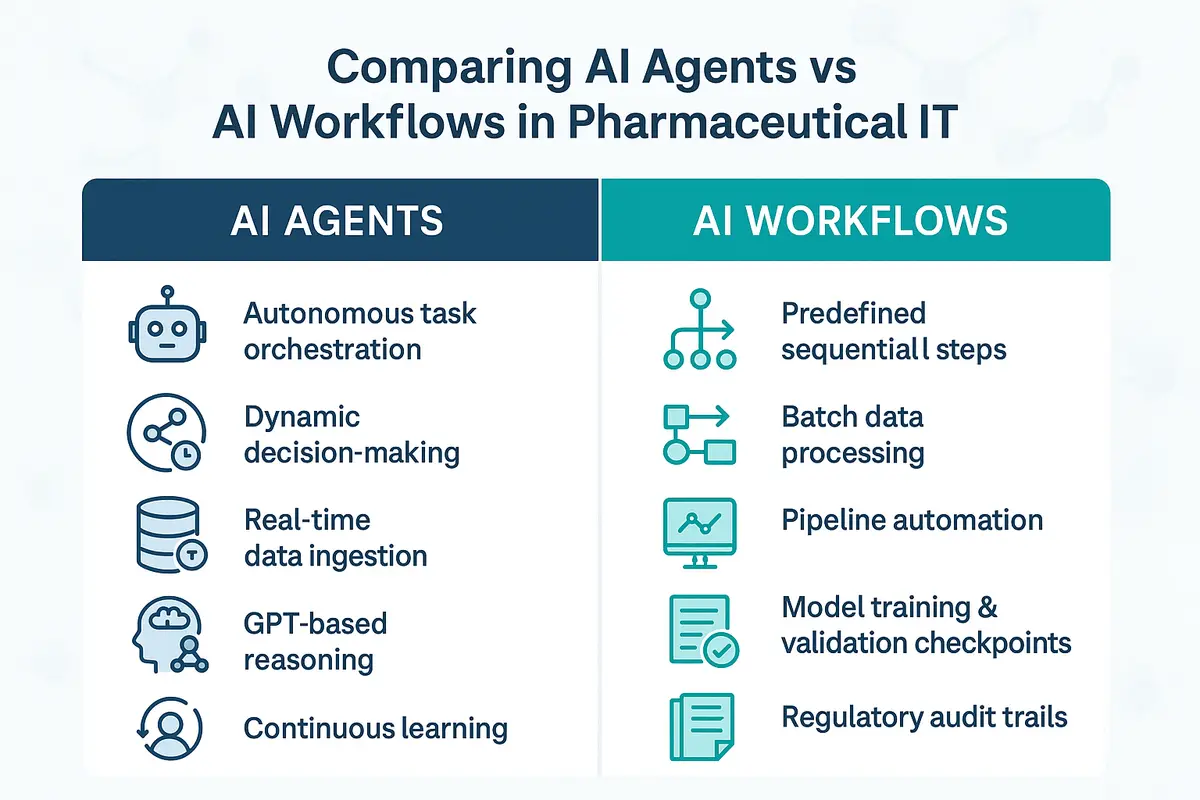
AI Agents vs Workflows in Pharma IT: Technical Comparison
A technical comparison of AI agents and AI workflows in pharmaceutical IT, with use cases, pros and cons, and adoption trends for U.S. pharma.
Veeva Vault CRM: Zero to Hero
A comprehensive training manual for pharmaceutical sales representatives on using Veeva Vault CRM, covering account management, call logging, CLM presentations, sample distribution, Veeva AI Agents, and data synchronization on iPad, Android, and desktop. Updated for the 2025-2026 Vault platform transition.