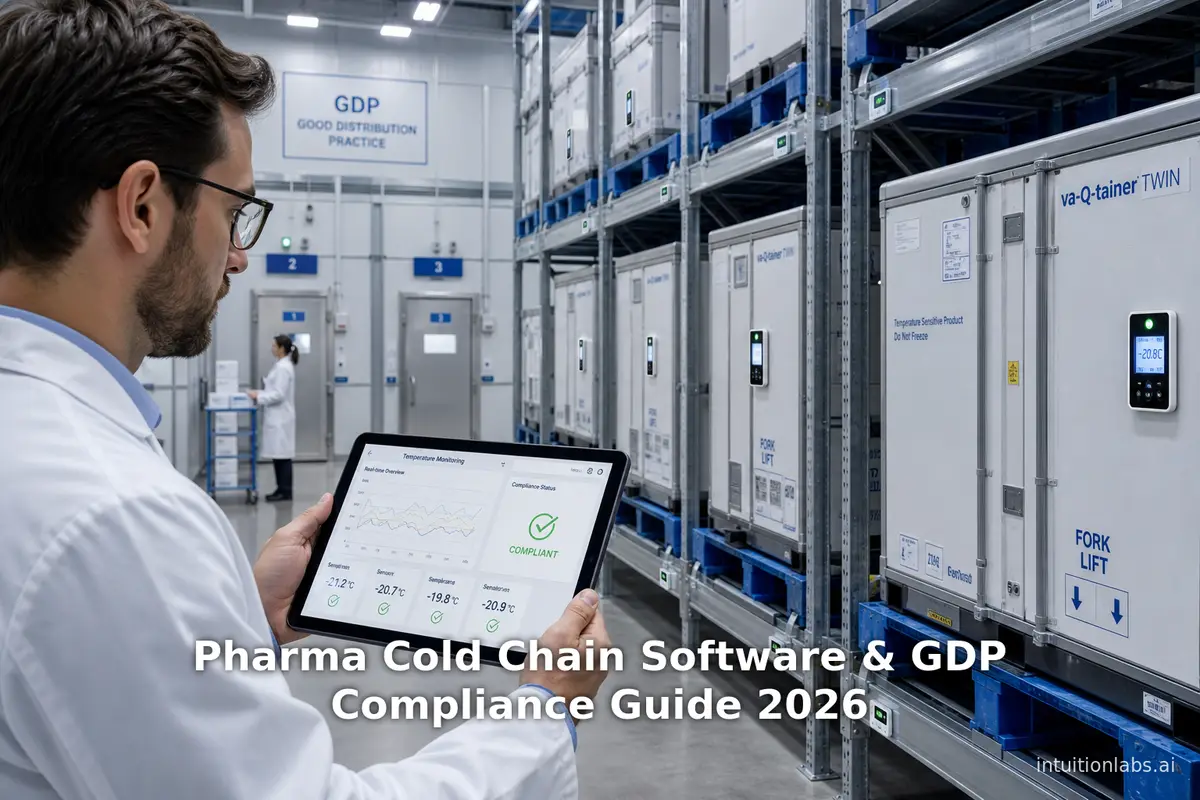
pharma cold chain logistics · cold chain logistics companies
Top 10 Best Pharma Cold Chain Logistics Companies (2026 Ranked)
August 9, 2026
Updated August 9, 2026
21 min read
A 2026 analyst ranking of the top pharma cold chain logistics companies, covering DHL, UPS Healthcare, FedEx, Kuehne+Nagel, Cryoport, Envirotainer, market size data, and GDP/IATA CEIV Pharma certification standards.

- 01The global biopharmaceutical cold chain 3PL market was valued at $30.59 billion in 2024 and is projected to grow to $74.46 billion by 2033, a 10.54% CAGR, according to Grand View Research.
- 02DHL Group leads with a EUR2 billion strategic investment in DHL Health Logistics and 120+ sites across more than 40 countries.
- 03No independently audited league table of pharma cold chain providers exists; this article's ranking of 10 providers is an editorial assessment based on publicly documented capability as of August 2026.
- 04Providers cluster into three business models: global integrated carriers (DHL, UPS, FedEx, Kuehne+Nagel, DSV), pharma-only specialists (Cencora/World Courier, Marken, Biocair, PHSE), and equipment providers (Envirotainer).
- 05Demand growth is driven by the expanding biologics pipeline: 2,041 gene, cell, and RNA therapies were in active development as of Q4 2025.
- 06Company claims such as 'largest fleet' or 'No. 1' are attributed to the companies themselves and not independently verified by this report.
10 Pharma Cold Chain Logistics Companies to Consider in 2026
Executive Summary
The pharmaceutical cold chain logistics market reached an estimated $30.59 billion in 2024 and is projected to grow to $74.46 billion by 2033, a compound annual growth rate (CAGR) of 10.54%, according to Grand View Research ([1]). This report compares ten providers as of August 2026 using publicly documented capacity, certification, network, temperature-range, and investment information. It is not an independent measure of shipment performance, pricing, safety outcomes, or suitability for every shipment. The providers represent two main models: global integrated carriers that layer pharma-specific capabilities onto broad freight networks, and specialists focused on temperature-sensitive biologics and clinical trial materials.
DHL Group reports operating over 120 life sciences and healthcare sites across more than 40 countries and announced a EUR2 billion strategic investment in its DHL Health Logistics division in February 2026, including an expanded airfreight cold chain network spanning more than 30 GDP-compliant aviation hubs ([2]). UPS Healthcare, parent of clinical logistics specialist Marken, invested $48 million in 27 new IATA CEIV Pharma-certified cross-dock facilities in June 2026 and operates more than 19.2 million square feet of current good manufacturing practice (cGMP) and Good Distribution Practice (GDP) compliant distribution space ([3]). FedEx launched a dedicated FedEx Life Sciences organization in July 2026 atop a healthcare business generating approximately $10 billion in global revenue ([4]).
Among specialists, Envirotainer operates what it describes as the industry's largest fleet, over 11,000 pallet-sized active and passive containers ([5]), while Cryoport Systems has supported more than 950,000 shipments across 20 commercialized cell and gene therapies under ISO 21973 compliance ([6]). The market's growth is driven substantially by biologics and advanced therapies: 2,041 gene, cell, and RNA therapies were in active development as of Q4 2025 ([7]). Selecting among these providers increasingly requires evaluating not just physical network reach but the quality and compliance data systems, such as electronic batch records and GDP documentation platforms, that sit behind the shipment.
Global biopharmaceutical cold chain 3PL market size, 2024
DHL Group's strategic investment in DHL Health Logistics, Feb 2026
UPS Healthcare's investment in 27 new cross-dock facilities, Jun 2026
Envirotainer's fleet of pallet-sized temperature-controlled containers
Introduction and Background
Pharmaceutical cold chain logistics is the discipline of transporting and storing temperature-sensitive drug products, biologics, vaccines, and cell and gene therapies within validated temperature bands from manufacturing sites to patients, without interruption. As of August 2026, this function has become a strategic priority for manufacturers and contract logistics providers alike, driven by the expansion of biologic and advanced-therapy pipelines that require far tighter environmental control than traditional small-molecule tablets and capsules.
The category spans Good Distribution Practice (GDP), the minimum quality standard that the European Medicines Agency (EMA) requires wholesale medicine distributors to meet, covering "the sourcing, storage and transportation of active" pharmaceutical ingredients as well as finished products ([8]). In air cargo specifically, the International Air Transport Association's CEIV Pharma (Center of Excellence for Independent Validators in Pharmaceutical Logistics) certification programme was created "to help organizations and the entire air cargo supply chain to achieve pharmaceutical handling excellence" ([9]), reflecting the scale of the stakes: IATA notes the pharmaceutical industry moves "over one trillion dollars worth of cargo every year" ([10]).
This report compares ten providers with publicly documented pharma cold chain capabilities as of 2026, spanning global parcel and freight integrators, dedicated clinical trial logistics specialists, and cryogenic equipment and container providers. The listed organizations perform different functions in the cold chain. The report situates them against the underlying market data, certification landscape, and near-term investment trends shaping the category.
Methodology and Selection Criteria
No independently audited league table of pharma cold chain logistics providers is publicly available. This article therefore presents an editorial ranking, based only on publicly documented capability as of August 2026, rather than a performance league table. Rankings prioritize geographic network reach, documented temperature-control capability, documented quality or regulatory credentials, and capacity investment, acquisition, or expansion announced from 2024 through 2026. The provider profiles and Table 1 are ordered from rank 1 through rank 10 using those criteria.
The ten featured organizations include global integrators, clinical and specialist logistics providers, and equipment providers. A provider was included when company-published information substantiated at least two of those attributes. The ranking assesses disclosed capability, not shipment performance, pricing, safety outcomes, or suitability for a particular medicine, lane, or patient need. Because the providers perform different cold-chain functions, a higher rank does not establish that one provider is best for every shipment profile. Company claims such as "largest fleet" or "No. 1" remain attributed to the company and are not independently verified.
A provider was included only when company-published information substantiated at least two key attributes.
Rankings prioritize network reach, temperature-control capability, regulatory credentials, and 2024 to 2026 capacity investment.
The provider profiles and comparison table are ordered from rank 1 through rank 10 using those criteria.
Result: an editorial ranking of disclosed capability, not an independently audited performance league table.
“Company claims such as "largest fleet" or "No. 1" remain attributed to the company and are not independently verified.
Featured Pharma Cold Chain Logistics Provider Profiles
DHL Group (DHL Supply Chain and CRYOPDP)
DHL reports a life sciences and healthcare logistics footprint of "over 120 sites in more than 40 countries" ([11]). Its temperature-controlled specialist subsidiary, CRYOPDP, operates directly in more than 15 countries with a "network reaching more than 150 countries" through partner agents ([12]). In February 2026, DHL Group announced a EUR2 billion strategic investment in DHL Health Logistics that includes an expanded Airfreight Cold Chain Network built on "more than 30 GDP-compliant aviation hubs and gateways" ([13]) as of 2026-02-19. DHL Global Forwarding CEO Oscar de Bok described the network as combining "DHL Aviation's global air connectivity, our GDP-compliant station network" ([14]) with regional expertise. DHL positions itself for both distribution and clinical-grade transport, stating it provides "temperature-controlled GxP-compliant transportation and proactive intervention in the event" of an excursion ([15]).
UPS Healthcare (Marken, Polar Speed, MNX)
UPS Healthcare combines its own cold chain infrastructure with clinical trial logistics specialist Marken, following the 2026 integration of expedited carrier MNX, which "has officially joined Marken under one global brand" ([16]), and in-network specialty pharmacy operator Polar Speed. In June 2026, UPS announced a $48 million investment in 27 new temperature-controlled freight cross-dock facilities across Europe, Asia, and the Americas, spanning bands of "15˚C to 25˚C, 2˚C to 8˚C, and frozen" storage ([17]) of 2026-06-22, all of which "carry IATA CEIV Pharma certification" ([18]). UPS Healthcare states it operates "19.2+ million square feet of cGMP and GDP-compliant healthcare distribution" space globally ([19]). In August 2026, Marken added over 300,000 square feet of Asia-Pacific storage capacity, including three GMP and GDP-compliant Singapore facilities ([20]) as of 2026-08-04.
FedEx Life Sciences
FedEx consolidated its pharmaceutical and clinical trial logistics into a dedicated FedEx Life Sciences organization in July 2026, "a dedicated organization created to support" the increasingly complex movement of biologics and cell and gene therapies ([21]), atop a healthcare business that has grown to "approximately $10 billion" in global revenue ([4]). FedEx operates six dedicated Life Sciences Centers globally, including a Veldhoven, Netherlands facility with temperature-controlled rooms and freezers ranging "from -80 °C to +25 °C" ([22]). In May 2025, FedEx became the first global integrator to achieve IATA CEIV Pharma Corporate Certification for ground handling, with "over 90 percent" of its global healthcare volume moving through certified facilities ([23]). Business press reporting on FedEx's earnings commentary cited a "$80 billion healthcare transportation" market opportunity described by FedEx's Chief Commercial Officer ([24]).
Kuehne+Nagel
Swiss logistics group Kuehne+Nagel operates its healthcare vertical through a "global network of experts across 240+ logistics locations" ([25]). Its certified sub-network, HealthChain, claims reach to "95+% of the world's population" ([26]) through GDP- and CEIV Pharma-aligned sites. A separate industry roundup notes that Kuehne+Nagel's "KN PharmaChain platform offers GDP-compliant pharmaceutical transportation" by air, sea, and road ([27]) as of 2026-06-04, positioning the company as a multimodal alternative to air-freight-centric competitors for manufacturers seeking broader routing flexibility across temperature-controlled ocean and ground lanes.
DSV (incorporating DB Schenker Life Science and Healthcare)
DSV, which absorbed DB Schenker's logistics network, inherits a healthcare-dedicated infrastructure that had achieved GDP certification across "157 of its stations" spanning the Americas, Europe, and Asia as of January 2024 ([28]), a network the company said would "cover 80% of the world's healthcare flows" once certification was complete ([29]), with plans to extend GDP certification to "over 180 of its stations" ([30]) within twelve months. DSV's cold chain logistics service offers "secure storage and transport at all temperatures" spanning ambient conditions down to -80°C ([31]). This GDP-certified station network documents DSV's substantial healthcare logistics coverage across the Americas, Europe, and Asia.
Cencora / World Courier
World Courier, the specialty logistics unit of pharmaceutical distributor Cencora, states its "global network spans across more than 50 countries" ([32]) supported by 22 strategically positioned depots ([33]) and holds regulatory credentials including a Drug Enforcement Administration license "for distribution and importation" ([34]). In December 2025, Cencora announced expansion of its 3PL cold chain footprint, including a "dedicated specialty unit equipped with cryogenic technology in the Netherlands" ([35]) and plans for a 500,000 square-foot Texas 3PL facility to open in 2028 ([36]) as of 2025-12-03, having "more than tripled its ultra-low and cryogenic storage capacity" ([37]) to support cell and gene therapy demand. Cencora's U.S. Healthcare Solutions segment reported $284,964 million in FY2025 revenue ([38]).
Envirotainer
Container specialist Envirotainer does not move freight itself but leases the active and passive temperature-controlled containers many carriers above rely on, stating it helps "safeguard 2 million doses of essential medicines" ([39]) daily via what it calls the "largest fleet in the industry of over 11,000 pallet sized units" ([5]), with precision temperature control "from -150°C to +37°C" ([40]). In September 2024, Envirotainer completed its "strategic integration with va-Q-tec" ([41]), combining active and passive cold chain technologies, and in August 2025 it invested in Swiss Airtainer, gaining "exclusive global rights to offer the innovative Swiss Airtainer" ([42]). By November 2025, its E-Tech RAP e2 digitally connected fleet had expanded to over 3,800 units ([43]).
Cryoport Systems
Cryoport Systems specializes in the coldest and most sensitive end of the market: cryogenic shipping for cell and gene therapies, maintaining a "fully-segregated fleet of cryogenic, ultra cold, refrigerated, and controlled room temperature shipping systems" for advanced therapies ([44]), with its Advanced Therapy Shippers holding "full ISO 21973 compliance" for human cell transport ([45]). The company states it has supported "more than 950,000 successful shipments and in support of 20 commercialized therapies" ([6]), with its Cryomax Palletized Shipper holding "28 k+ vials" and a 21-day hold time ([46]). In October 2025, Cryoport opened a 55,000-square-foot Global Supply Chain Center near Paris, France, described as "the latest addition" to its network ([47]) as of 2025-10-01, funded partly by an Île-de-France regional grant.
Biocair
Life sciences specialist Biocair, founded in 1986, operates a "global network" that "operates 24/7 in 124 countries" ([48]) and defines five distinct temperature-controlled shipping bands, including "cryo frozen: -150ºC and below" ([49]). Biocair created a dedicated cell and gene therapy (CGT) logistics team in 2022 ([50]) and expanded into Ireland while opening a new India office in 2024 ([51]). Its UK Global Headquarters holds a Medicines and Healthcare products Regulatory Agency (MHRA) Wholesale Distribution Authorisation and GDP certificate ([52]). Biocair's parent company, Geopost, reported €15.8 billion in group sales for 2024 ([53]), giving the specialist carrier access to broader parent-company logistics infrastructure than a standalone forwarder of comparable size would typically have.
PHSE
French-founded PHSE focuses on the most time-critical and radioactive segment of pharma logistics, describing itself as the "No. 1 in global radiopharmaceutical logistics with deliveries" across the United States, Central and South America, Europe, the United Kingdom, and Asia ([54]), spanning temperature bands "from -80°C to -180°C cryogenic" through ambient ranges ([55]). PHSE avoids subcontracting, relying on "exclusive use of own personnel and vehicles" ([56]) for chain-of-custody control. In April 2026, PHSE acquired The Courier Company (UK) Ltd, a radiopharmaceutical specialist operating a "fleet of over 30 vehicles and approximately 40 employees" ([57]) as of 2026-04-16, following an earlier acquisition of an 80% stake in Optimize Courier Sweden AB to enter the Nordic market ([58]).
Other Notable Providers
Several additional providers merit consideration depending on a shipper's specific geography or modality needs. CEVA Logistics operates dedicated pharma warehouses and temperature-controlled facilities "at strategic locations worldwide, including Belgium, Brazil" ([59]), the Czech Republic, France, Germany, and the UK, and states it is "fully compliant and can provide GDP and GMP services" ([60]). DACHSER renewed GDP certification at four Americas branches in February 2025 and holds IATA CEIV Pharma certification at its "Atlanta, Frankfurt, Mumbai, Hyderabad and Shanghai" sites ([61]) as of 2025-02-07. Smaller specialist Biopharma Logistics GmbH covers the full ambient-to-cryogenic spectrum, from "+2/+8 °C, +15/+25 °C, −25/−15 °C, dry ice and liquid nitrogen" ([62]), with "50+ partners worldwide" ([63]) despite its comparatively small scale.
Feature and Capability Comparison
Table 1 below summarizes the ten featured providers by network reach, temperature coverage, stated credentials, and the most significant capacity investment each has publicly disclosed for 2024 through 2026.
| Rank | Company | Provider Type | Network Reach | Temperature Range | Key Certifications | Notable 2024 to 2026 Development |
|---|---|---|---|---|---|---|
| 1 | DHL Group | Global integrator | 120+ sites, 40+ countries ([11]) | Ambient to deep frozen via CRYOPDP | GDP, 30+ GDP-compliant aviation hubs and gateways | EUR2 billion Health Logistics investment (2026) |
| 2 | UPS Healthcare / Marken | Global integrator + clinical specialist | 19.2M+ sq ft cGMP/GDP space ([19]) | 15 to 25°C, 2 to 8°C, frozen | IATA CEIV Pharma (27 new sites) | $48M, 27 cross-docks (Jun 2026) |
| 3 | FedEx Life Sciences | Global integrator | 6 Life Sciences Centers | -80°C to +25°C (Veldhoven) | CEIV Pharma Corporate (ground handling) | Dedicated org launched Jul 2026 |
| 4 | Kuehne+Nagel | Global integrator | 260+ HealthChain-certified locations ([64]) | Transportation, handling, and storage | HealthChain-certified network | 95%+ of world population reach claimed |
| 5 | DSV / DB Schenker | Global integrator | 157+ GDP-certified stations | Ambient to -80°C | GDP (157 stations, 180+ planned) | Post-merger network integration |
| 6 | Cencora / World Courier | Pharma specialist | 50+ countries, 22 depots | Ambient to cryogenic | DEA license, C-TPAT, GDP | Texas 3PL facility announced in 2025; planned 2028 opening |
| 7 | Envirotainer | Container/equipment provider | 300+ airports, 3,300 trade lanes | -150°C to +37°C | ISO 9001:2015 | va-Q-tec and Swiss Airtainer integration |
| 8 | Cryoport Systems | Cryogenic specialist | 950,000+ shipments | Below -150°C to CRT | ISO 21973 | New Paris Global Supply Chain Center (2025) |
| 9 | Biocair | Life sciences specialist | 124 countries | Ambient to below -150°C | MHRA WDA(H), GDP | Ireland and India expansion (2024) |
| 10 | PHSE | Radiopharma specialist | US, Americas, Europe, UK, Asia | -80°C to -180°C | GDP (own-fleet model) | UK and Nordic acquisitions (2026) |
This comparison illustrates that no single provider dominates on every axis. Global integrators such as DHL, UPS Healthcare, FedEx, Kuehne+Nagel, and DSV compete primarily on network density and multimodal reach, layering pharma-specific certification onto freight infrastructure built for broader commerce. Specialists such as Cryoport Systems, Biocair, and PHSE instead compete on the depth of a narrower capability, cryogenic cell and gene therapy handling or radiopharmaceutical chain-of-custody, that general freight carriers rarely match. Equipment providers like Envirotainer occupy a distinct category entirely, supplying the validated containers that many of the carriers above use rather than operating the transport network themselves.
Data Analysis and Evidence
The pharma cold chain sector's growth is well documented across several independent market research firms, though estimates vary by scope and methodology. Grand View Research values the global biopharmaceutical cold chain third-party logistics market at $30.59 billion in 2024, projecting growth to $74.46 billion by 2033 at a 10.54% CAGR from 2025 to 2033 ([65]), with North America holding the "largest share of 38.33% of the global market in 2024" ([66]). MarketsandMarkets separately sizes the narrower cold chain monitoring market (sensors and tracking technology, not the logistics service itself) at $8.31 billion in 2025, growing to $15.04 billion by 2030 at a 12.6% CAGR ([67]), and its combined food-and-pharma cold chain market estimate reaches $276.5 billion in 2026 ([68]). Growth Market Reports offers a third data point specific to biologics logistics, sizing that segment at $19.7 billion in 2024, forecast to reach $39.1 billion by 2033 at an 8.3% CAGR ([69]). These figures are not directly comparable since each firm scopes "pharma cold chain" differently, but they indicate strong projected growth through the early 2030s; the biologics-logistics estimate is 8.3%, while the other cited CAGRs are double-digit.

Table 2 below consolidates the market-size figures collected during this research alongside their originating source, illustrating the range of estimates depending on segment definition.
| Market Segment | Base Year Value | Forecast Value (Year) | CAGR | Source |
|---|---|---|---|---|
| Biopharmaceutical cold chain 3PL | $30.59B (2024) | $74.46B (2033) | 10.54% | Grand View Research |
| Cold chain monitoring (technology) | $8.31B (2025) | $15.04B (2030) | 12.6% | MarketsandMarkets |
| Cold chain (food + pharma, combined) | N/A | $276.5B (2026) | N/A | MarketsandMarkets |
| Cold chain logistics for biologics | $19.7B (2024) | $39.1B (2033) | 8.3% | Growth Market Reports |
Demand growth traces directly to the expanding biologics and advanced-therapy pipeline. Grand View Research notes that biologics "typically" require handling "between 2°C and 8°C, with some requiring ultra-low" temperatures ([70]), and industry tracking body ASGCT, working with data provider Citeline, counted 2,041 gene, cell, and RNA therapies in active clinical development as of Q4 2025, alongside three new approvals in that quarter spanning gene and RNA modalities ([71]). This pipeline is the principal driver behind the cryogenic and ultra-low capacity expansions documented above at Cencora, Cryoport, and Envirotainer. On the regulatory side, older peer-reviewed research underscores why validated handling matters: a 2007 systematic review found that, across cold chain segments studied, "between 14% and 35% of refrigerators or transport shipments were found" to expose vaccines to freezing temperatures ([72]), a historical figure that predates today's IATA CEIV Pharma and expanded GDP certification regimes but illustrates the baseline problem those frameworks were built to address.
Analysis of Key Segments
The ten providers profiled above cluster into three distinct business models, each answering a different shipper need. Global integrated carriers (DHL, UPS Healthcare, FedEx, Kuehne+Nagel, DSV) offer the broadest geographic reach and the deepest linehaul infrastructure, since pharma logistics is layered onto express parcel, freight forwarding, or contract logistics networks built for general commerce. Their scale advantage shows in absolute investment figures: DHL's EUR2 billion Health Logistics commitment and UPS's $48 million cross-dock buildout both dwarf what a pure-play specialist could self-fund. The tradeoff is that pharma remains one vertical among many for these carriers, even where dedicated organizational units (such as FedEx Life Sciences) exist.
Pharma-only specialists (Cencora/World Courier, Marken, Biocair, PHSE) build their entire operating model, staffing, and often their entire fleet, around regulated healthcare shipments. World Courier, for instance, holds "global certification against three major good distribution practice (GDP)" frameworks ([73]) as a core identity rather than an add-on service line, and describes itself as more than "just a logistics company" ([74]). PHSE's decision to rely on "exclusive use of own personnel and vehicles" rather than subcontractors reflects the same specialist logic applied to chain-of-custody risk for radioactive materials.
Equipment and container providers (Envirotainer, and to a lesser extent Cryoport's shipper hardware line) occupy a third category: they do not typically move freight themselves but supply the validated, temperature-controlled containers that carriers in the first two categories lease and operate within their own networks, working with an "extensive global network of 150+ logistics partners" ([75]) to place containers where shipments need them. A shipper's choice among these three segments depends less on which model is objectively superior and more on shipment profile: a commercial biologic moving high volumes through established lanes is well served by an integrator's scale, while a single cell therapy batch moving to a clinical trial site often requires a specialist's white-glove, chain-of-custody handling.
- Offer the broadest geographic reach and deepest linehaul infrastructure since pharma is layered onto general commerce networks.
- DHL's EUR2 billion Health Logistics commitment and UPS's $48 million cross-dock buildout dwarf what a specialist can self-fund.
- Build their entire operating model, staffing, and often their entire fleet around regulated healthcare shipments.
- PHSE relies on exclusive use of its own personnel and vehicles rather than subcontractors for chain-of-custody risk control.
Equipment providers such as Envirotainer form a third category, supplying containers that carriers in both other groups lease and operate.
“As of August 2026, this article's editorial selection reflects publicly documented capability and is not a universal determination of which provider is best for every shipment profile.
Implications and Future Directions
- 2024Envirotainer
Completed strategic integration with va-Q-tec, combining active and passive cold chain technologies.
- 2025Cryoport Systems55,000 sq ft
Opened a new Global Supply Chain Center near Paris, France.
- Feb 2026DHL GroupEUR2 billion
Announced strategic investment in DHL Health Logistics division.
- Jun 2026UPS Healthcare$48 million
Invested in 27 new temperature-controlled freight cross-dock facilities.
- Jul 2026FedEx
Launched a dedicated FedEx Life Sciences organization.
- Apr 2026PHSE
Acquired The Courier Company (UK) Ltd, a radiopharmaceutical specialist.
Three trends are likely to reshape provider selection through the remainder of the decade. First, cryogenic and ultra-low capacity is being built out aggressively in direct response to advanced-therapy pipeline growth, evidenced by Cencora's move to more than triple its ultra-low and cryogenic storage capacity and Cryoport's new Paris-area supply chain center. Second, the profiled providers show an emphasis on network-wide quality programs, including CEIV Pharma and GDP-related programs. This article does not establish that standards are consolidating or becoming harder to achieve; IATA states that CEIV Pharma is accessible to small and medium-sized enterprises. Third, consolidation among specialists continues, illustrated by MNX's merger into Marken, Envirotainer's September 2024 integration of va-Q-tec and subsequent investment in Swiss Airtainer, and PHSE's acquisitions in the UK and Nordic markets.
For life sciences manufacturers, vendor selection is no longer purely a logistics decision; it increasingly intersects with the quality and regulatory data systems that document GDP compliance, temperature-excursion records, and chain-of-custody data across a multi-provider network. Consultancies advising pharmaceutical and life sciences organizations on digital transformation, including IntuitionLabs, note that solutions built for regulated environments should be "compliant by design, integrated with your existing stack, and secured to enterprise standards" ([76]), a principle that extends to how a manufacturer's quality management and Veeva Vault systems ingest and reconcile temperature and custody data supplied by third-party cold chain partners. IntuitionLabs, an official Veeva Vault CRM X-Pages partner, describes its role as providing "strategic guidance on digital transformation, AI adoption, and technology roadmapping" ([77]) for exactly this kind of cross-system integration challenge, rather than operating logistics networks itself. As GDP and CEIV Pharma documentation requirements grow more granular, the ability to integrate multiple carriers' excursion and custody data into a single validated quality record is likely to become as important a selection criterion as physical network reach.
Frequently Asked Questions (FAQs)
What is pharma cold chain logistics? It is the set of processes, packaging, equipment, and monitoring systems used to keep temperature-sensitive pharmaceutical products, including vaccines, biologics, and cell and gene therapies, within validated temperature ranges from manufacturing through delivery, typically governed by Good Distribution Practice (GDP) standards ([78]).
Which pharma cold chain logistics companies should shippers consider in 2026? This article profiles DHL Group, UPS Healthcare (including Marken), FedEx Life Sciences, Kuehne+Nagel, DSV, Cencora/World Courier, Envirotainer, Cryoport Systems, Biocair, and PHSE using the selection methodology above. They serve different roles and shipment profiles, so this selection is not a substitute for provider qualification for a particular product or lane.
What certifications should a pharma cold chain provider hold? For EEA wholesale distribution, verify the provider's applicable wholesale distribution authorisation and compliance with EU GDP. National competent authorities may issue GDP certificates following inspection. IATA CEIV Pharma certification can be relevant to air-cargo handling, while ISO 21973 may be relevant to providers handling human cells for advanced therapies; applicability depends on the shipment and jurisdiction.
What temperature ranges do pharma cold chain providers manage? Providers profiled in this report collectively span controlled room temperature (+15°C to +25°C), refrigerated (+2°C to +8°C), deep frozen (-25°C to -15°C), ultra-low (-60°C to -80°C), and cryogenic (below -150°C) bands. Cryogenic ranges are often used for cell and gene therapies and may also be required for other products or shipment modalities, including radiopharmaceutical logistics.
How is the pharma cold chain logistics market expected to grow? Grand View Research projects the biopharmaceutical cold chain 3PL market will grow from $30.59 billion in 2024 to $74.46 billion by 2033 ([1]), a CAGR of 10.54%.
What is the difference between integrated carriers and specialist pharma logistics providers? Integrated carriers (DHL, UPS, FedEx, Kuehne+Nagel, DSV) layer pharma-specific certification onto broad freight and parcel networks, offering greater geographic reach; specialists (World Courier, Marken, Biocair, Cryoport, PHSE) build their entire operating model around regulated healthcare shipments, typically offering deeper chain-of-custody control for higher-risk shipments such as clinical trial materials or radiopharmaceuticals.
Conclusion
As of August 2026, this article's editorial selection reflects publicly documented capability and is not a universal determination of which provider is best for every shipment profile. DHL Group, UPS Healthcare and Marken, FedEx, Kuehne+Nagel, and DSV offer integrated networks; Cencora/World Courier, Cryoport Systems, Biocair, and PHSE focus on specialist healthcare logistics; and Envirotainer supplies temperature-controlled equipment rather than freight transport. Manufacturers selecting among them should weigh shipment profile, required temperature band, applicable credentials, geographic reach, and how well a provider's excursion and compliance data can integrate with the manufacturer's own quality systems.
About IntuitionLabs
Build practical AI for pharma and biotech with IntuitionLabs. We help life-science teams turn complex information and workflows into useful software, governed knowledge systems and AI tools.
IntuitionLabs is an AI consulting, custom software development and data engineering firm serving pharmaceutical, biotechnology, medical-device and other life-science organizations. We work with clinical, regulatory, medical-affairs, commercial, quality and IT teams to connect technology decisions with the work people need to accomplish.
AI consulting and adoption
Our AI enablement services cover readiness assessments, use-case selection, governance and policies, team workshops, adoption measurement and ongoing advisory support. We help organizations structure the information layer behind AI: source material, context, permissions and maintained knowledge that make generated answers useful and reviewable. Private LLM inference and hosted AI options support teams evaluating how to operate AI with appropriate control over their data and infrastructure.
Software, data and life-science workflows
IntuitionLabs develops custom software for pharma and biotech, integrates enterprise systems, and builds data engineering and business intelligence solutions. Areas of focus include AI agents, regulatory research, medical writing, medical affairs, CMC information, competitive intelligence and clinical-document workflows. Our eTMF intelligence work includes cross-system reconciliation and inspection-readiness support.
Enterprise platforms and regulated delivery
We provide Veeva services, application support, managed services, integrations and custom applications, alongside enterprise content work involving platforms such as Egnyte. For regulated workflows, our services include GxP enablement, computer-system validation and software development addressing 21 CFR Part 11 requirements. The applicable controls, validation responsibilities and acceptance criteria are defined for each engagement.
Work with IntuitionLabs
Explore AI enablement, pharma and biotech software development, data engineering and BI, and Veeva services. Contact IntuitionLabs to discuss your workflow, information sources and implementation needs.
IntuitionLabs publishes educational research to help life-science teams make informed technology decisions. Coverage of a product or organization does not imply a client relationship, endorsement or partnership.
Sources / 78

Need Expert Guidance on This Topic?
Let's discuss how IntuitionLabs can help you navigate the challenges covered in this article.
I'm Adrien Laurent, Founder & CEO of IntuitionLabs. With 25+ years of experience in enterprise software development, I specialize in creating custom AI solutions for the pharmaceutical and life science industries.
The information contained in this document is provided for educational and informational purposes only. We make no representations or warranties of any kind, express or implied, about the completeness, accuracy, reliability, suitability, or availability of the information contained herein. Any reliance you place on such information is strictly at your own risk. In no event will IntuitionLabs.ai or its representatives be liable for any loss or damage including without limitation, indirect or consequential loss or damage, or any loss or damage whatsoever arising from the use of information presented in this document. This document may contain content generated with the assistance of artificial intelligence technologies. AI-generated content may contain errors, omissions, or inaccuracies. Readers are advised to independently verify any critical information before acting upon it. All product names, logos, brands, trademarks, and registered trademarks mentioned in this document are the property of their respective owners. All company, product, and service names used in this document are for identification purposes only. Use of these names, logos, trademarks, and brands does not imply endorsement by the respective trademark holders. IntuitionLabs.ai is an AI software development company specializing in helping life-science companies implement and leverage artificial intelligence solutions. Founded in 2023 by Adrien Laurent and based in San Jose, California. This document does not constitute professional or legal advice. For specific guidance related to your business needs, please consult with appropriate qualified professionals.