


pharma ai · ai scaling
Pharma AI Pilots: Fixing Data Foundations for Scale
March 3, 2026
60 min read
Examine why most pharma AI pilots fail to reach production. This report analyzes data fragmentation, governance issues, and building scalable data foundations.

Executive Summary
Advances in AI hold great promise for pharmaceutical research and operations, but despite heavy investment the vast majority of AI pilot projects in pharma never reach production. Industry analyses estimate that roughly 80–95% of AI initiatives stall or fail to deliver value ([1]) ([2]). For example, a recent TechRadar survey found that “nearly 9-in-10 AI pilots across industries” stall before scaling ([3]). A 2026 industry study similarly reported that 89% of life-sciences companies failed to scale half of their AI projects ([4]). These failures are not attributable to poor algorithms or model capabilities, but to data and infrastructure shortcomings. Key obstacles include fragmented, poor-quality data; siloed legacy systems; inadequate data governance; and cultural resistance. For instance, ~96% of surveyed pharma executives admitted their data is “not structured or AI-ready” ([4]), and 27% said they cannot trace the source of their AI training data ([5]). High-profile case studies (e.g. Osaka University’s drug research, corporate pilots) confirm that inconsistencies in healthcare provider (HCP) and laboratory data have caused major delays and cost overruns ([4]) ([6]).
To move from isolated proofs-of-concept to enterprise-scale AI, pharma must solve the data foundation. Industry leaders now emphasize FAIR data practices, unified knowledge graphs, and robust governance as the groundwork for trustworthy AI ([7]) ([8]). For example, a FiercePharma webinar warns of a “scientific content crisis” in pharma: 27% of R&D professionals admit they can’t trace the data behind their AI models ([9]). The proposed remedy is a “traceable, audit-ready data pedigree” built with FAIR metadata and knowledge-graph infrastructures ([7]). In practice this means creating enterprise-wide unified data layers that eliminate fragmentation ([8]), validating and harmonizing clinical and operational data, and enforcing clear ownership and quality standards across departments ([10]).
This report surveys the landscape of “AI at Scale” in pharma (2026), documenting why so many pilots fail and outlining how to build a strong data foundation. We review historical context and current state-of-practice, present multiple perspectives from industry (survey data, expert analyses, and case studies), and provide evidence-based recommendations. Key findings include:
-
Data Quality and Fragmentation. Pharma data is often siloed in hundreds of systems (ELNs, LIMS, clinical databases, CRM, etc.) with divergent formats ([11]) ([12]). Fragmentation, duplicate records, missing metadata, and unvalidated sources severely limit AI utility. Surveys show roughly 50% of pharma leaders cite “AI-ready data” as the top obstacle ([13]), and 96% say their data is unstructured ([4]).
-
Governance and Trust. Without data governance, all AI suffers. Inconsistent HCP profiles, misaligned terminologies, and stale records erode end-user trust ([14]) ([15]). One pharma study notes that field users may “stop believing” AI outputs the moment they encounter an obvious data error ([14]). Conversely, teams with a single “source of truth” see far more adoption. Successful organizations invest first in master data management and traceability – e.g. fully auditable data lineages and FAIR metadata – so that every model can be validated against real, current data ([7]) ([8]).
-
Infrastructure and Integration. Legacy IT architectures hinder scale. Many companies never designed PLM, CRM, or manufacturing systems for large-scale data-intensive AI. As one analysis notes, “few enterprises originally architected IT for the data intensity, performance sensitivity and dynamic scaling” needed by modern AI ([16]). Signs of infrastructure bottlenecks include data scientists spending more time wrangling fragmented datasets than training models ([17]). The fix involves cloud-native data lakes or “AI factory” platforms and alignment between IT and business sites ([18]) ([17]).
-
Organizational and Cultural Gaps. Pharma companies often “love the tech, not the outcome.” There is frequently a mismatch between R&D, clinical, manufacturing, and commercial teams, each with its own data “truth” and KPIs. In practice, having decentralized data stewards and a governance board is essential. Training and cross-functional collaboration (e.g. “ AI literacy” programs) are needed so that data producers (scientists) and data consumers (analysts) speak the same language ([19]) ([20]).Companies that treat AI like a capital project – with defined ROI targets and KPIs – consistently outperform those that chase buzzwords ([21]) ([1]).
-
Regulatory and Timing Constraints. The pharmaceutical industry’s high regulation intensifies delays. All AI affecting production or patient data must meet GxP/FDA/EMA validation requirements. Published analyses note that such validation “can double or triple the deployment effort” ([22]). Long data-processing times also blunt AI’s impact: one survey noted some teams spend 100–200 days just cleaning data or negotiating access contracts before modeling ([23]). By the time insights emerge, the clinical or market window may have passed.
Recommendations center on “fixing the data foundation first” ([24]) ([1]). Building centralized but interoperable data repositories, adopting standard ontologies, automating pipeline validation, and leveraging AI-friendly architectures (knowledge graphs, connected lakes/fabrics) are critical. We document frameworks like the Veeva “connected data and software” approach and the NTT Data “pilot-to-production” methodology. We also compare success stories – from big pharma partnering with AI-genomics firms to academic AI tools for drug repurposing – highlighting how the underlying data strategy enabled (or in many cases, defeated) them. The report closes with future directions, noting that as pharma embraces agentic AI and personalized therapies, the quality of data infrastructure will be the limiting factor in realizing AI’s full promise.
Introduction and Background
The Promise of AI in Pharma
Artificial Intelligence (AI) has been hyped as a game-changer across industries, and nowhere is the promise greater than in pharmaceuticals. The drug development process is notoriously long (often 10–15 years) and expensive (billions per drug), with high attrition rates at each stage ([25]). AI and machine learning techniques offer potential to accelerate drug discovery, improve the design of clinical trials, optimize manufacturing, and personalize patient care. For example, deep learning models (like AlphaFold) now predict protein structures in seconds, and generative models can suggest novel chemical compounds. In clinical operations, AI can assist in patient recruitment, safety monitoring, and real-world evidence analysis. In commercialization, machine-learning analytics can refine segmentation of doctors (HCPs/HCOs) and forecast prescription demand.
Pharma companies have invested heavily: Industry analysts estimate >$3.7 billion annually in AI initiatives ([26]). Virtually every major pharmaceutical or biotechnology firm has a number of pilot projects and strategic partnerships with tech startups or academia. For instance, GSK announced in early 2026 a flurry of multi-year AI collaborations (genomics data partnership with Helix, $50M to biotech Noetik) to realize a “multimodal” drug discovery approach linking genetic to clinical data ([27]). Insitro (an AI-driven biotech) has signed deals with Lilly and BMS to use ML on chemical and biological datasets for new therapeutics ([28]). Moreover, regulators themselves are embracing AI: in 2025 the U.S. FDA rolled out “Elsa,” a generative-AI assistant for reviewers to accelerate protocol analysis, built on AWS GovCloud with care to exclude proprietary pharma data ([29]).
Yet, despite this momentum, a persistent and paradoxical issue has emerged: most AI proofs-of-concept fail to transition into ongoing value. Scholars and industry leaders refer to this as “pilot purgatory” or the “AI paradox” – when billions are spent and enthusiasm is high, but little practical ROI materializes. A 2025 report by Reuters events quoted Pharma executives stating that digital initiatives often “stay stuck in proofs of concept” ([4]) ([1]). Indeed, according to TechRadar and other sources, up to 90–95% of enterprise AI pilots are abandoned or fail to scale by 2026 ([30]) ([26]). Analysts emphasize that this gap is not due to lack of AI capability – pharma has powerful ML models and abundant computing resources – but due to fundamental organizational and data issues.
This report examines the core problem: Pharma AI at Scale – Why Pilots Fail and How to Fix the Data Foundation. We begin with a brief history of AI in pharmaceuticals and define the current landscape of “AI pilots” vs “at scale” deployments. We then analyze the root causes of pilot failure from multiple angles (data, infrastructure, organization, and regulation), with extensive evidence from surveys, industry reports, and case examples. The middle of the report is devoted to the data foundation: We detail what a robust data architecture and governance framework looks like in pharma, and how it addresses those failure points. We interweave concrete case studies (e.g. a major pharma’s delays due to poor HCP data ([4]), an AI-driven repurposing tool for rare diseases ([15]), and best-practice frameworks like Veeva’s Global Data Cloud ([31]) ([32])). Finally, we discuss future implications: how fixing data foundations will enable next-generation AI (agentic AI, digital twins, precision medicine) and what pharma organizations must do to seize this opportunity. The conclusions provide a synthesis of actionable steps backed by the evidence.
Why Pharma AI Pilots Fail
Although AI is emerging across many pharma domains, studies and anecdotes strongly indicate that early pilots often fizzle before delivering business impact. In this section, we dissect the main reasons – with an emphasis on data-related issues – that cause AI projects to stall or fail in pharmaceutical and life-science settings. The analysis draws on industry surveys, technical articles, and subject-matter expertise. We find that the root causes fall into four overlapping categories: (1) Data Quality and Fragmentation, (2) Infrastructure and Integration, (3) Organizational and Cultural Barriers, and (4) Regulatory/Validation Challenges.
Each category is discussed below, with specific examples and data from pharma-relevant sources.
1. Data Quality, Readiness, and Fragmentation
Fragmented Data Silos: Pharma companies accumulate data in hundreds of specialized systems – clinical trial databases, laboratory notebooks (LIMS/ELN), manufacturing ERP/MES, commercial CRM, medical affairs systems, etc. – often acquired or built independently. These systems rarely share common schemas or integration. As one analysis bluntly states: “Pharmaceutical data is distributed across hundreds of systems…not designed for the kind of cross-functional data integration AI requires” ([22]). Without unification, AI models cannot easily draw on all relevant information. For example, an AI targeting oncology trials would need to link genomics, patient history, lab results, and trial outcomes, but these may reside in separate databases with different IDs. A recent industry agenda noted that bridging structured and unstructured sources across commercial, medical, and access silos is essential to “reveal complete patient profiles” ([33]).
Surveys confirm that pharma data is highly unstructured and fragmented. In a Pistoia Alliance poll (2025), roughly 50% of respondents cited “AI-ready data” as a top obstacle ([13]), and 96% of commercial life-sciences leaders admitted their data isn’t structured or AI-ready ([4]). Fragmentation has tangible costs: one Veeva study highlighted that inconsistent HCP/HCO data caused a two-month product launch delay and roughly 15% lower prescription volume in the launch phase ([4]) ([6]). In practice, data silos cause teams to duplicate effort (each department keeps its own “gold copy”), leading to delays in access and analysis. Data residency issues (on-premises vs cloud) and ownership conflicts (e.g. a CRO holding trial data, a hospital owning patient records) further complicate sharing.
Poor Data Quality: Even when data is collected, quality is often an issue. Errors, missing values, duplicates, and inconsistent coding plague life-sciences datasets. As one technical guide advises, rigorous “data cleaning” is usually needed: fixing outliers, imputing missing values, aligning timestamp formats, and reconciling measurements with the true standard ([34]). In pharma this can mean reconciling different assay units or ensuring lab results match the official source of truth. If the raw data is wrong or incomplete, any AI model built on it will produce unreliable outputs. As Axios reported in 2024, developers of an AI drug-repurposing tool cautioned that “the tool’s success is only as good as the medical knowledge it uses” ([15]). In other words, domain knowledge embedded in the data must be comprehensive and accurate.
The lack of metadata and lineage is another dimension of poor quality. A FiercePharma webinar in 2026 terms this a “scientific content crisis”: 27% of life-science professionals cannot even trace the data powering their AI models, risking non-compliance and “hallucinations” in LLM answers ([9]). In practice, many AI teams inherit datasets whose provenance is unclear – who last updated it, which assays went into building it – making validation nearly impossible. Without traceability, regulators and users will not trust the outputs. This is profoundly problematic in pharma, where every model (e.g. an AI that suggests a new drug lead) must ultimately be auditable.
Data Timeliness and Currency: Pharma R&D and commercialization timelines are fast-paced. Data that is months or years out-of-date can make AI useless. Pharma functions operate under tight schedules, so that insights arriving “after the window has closed” are worthless ([35]). Data readiness times can be very long, underscoring inefficiency: one report noted that teams may spend 100 days just cleaning HCP data and 200 days navigating data access contracts before analysis can even begin ([23]). By the time an AI report is delivered, the market or clinical decision points may have already passed, nullifying any potential benefit. Thus, not only quality but speed of data preparation is a critical factor.
Data Governance and Trust: Closely related to quality is governance. Ambiguity about data ownership, inconsistent definitions, and lack of standards all undermine trust in AI. For example, multiple internal systems may use different codes or definitions for the same medical condition. Unless these are harmonized, AI models will “learn” from inconsistent signals. A conference session on Pharma Data & Tech Europe 2026 emphasized standardizing segment/condition definitions across Marketing, Medical, and Access to avoid “mixed messages” ([36]). In the absence of governance, duplicate or conflicting records abound. A commercial AI pilot may output an HCP recommendation that is obviously wrong because the underlying specialties or territories data was stale. One observer notes that “even a technically excellent prediction is useless if users don’t trust it”, and that trust in pharma quickly fractures when “the data basis is inconsistent: duplicate HCPs, misaligned specialties, stale affiliation updates” ([14]). In other words, AI amplifies any underlying data errors, so weak governance dooms adoption.
In summary, data issues in pharma are manifold: fragmented sources, unstructured/poorly formatted inputs, unclear governance, and stale or delayed datasets. According to multiple industry analyses, these data problems—not AI algorithms—are the leading cause of stalled pilots. As TechRadar notes, “AI projects aren’t a model problem – it’s a data and governance problem” ([37]) ([1]). Fixing data readiness is thus priority #1.
2. Infrastructure and Integration Gaps
Technical infrastructure – both hardware and software – is the next key bottleneck. Many pharma companies’ IT architectures were built for traditional applications, not for high-throughput AI workloads. One TechRadar article observes that most enterprises’ legacy IT “was never designed for the data intensity, performance sensitivity and dynamic scaling” of modern AI ([16]). In such legacy environments, data may be physically siloed on-premises, tape libraries, or outdated databases that are hard to query. As a result, bringing AI into production often hits computing and integration walls.
A common pattern is the “architecture first” lesson: companies cannot hope to chew off enterprise data for AI without rethinking their infrastructure. Leading analysts advise that pilot success in AI is meaningless if the underlying systems remain disjoint. As one expert put it, “many enterprises still run on siloed content repositories, legacy systems, and fragmented integrations”, meaning an AI cannot see half the data it needs ([18]). Data scientists may have built a prototype on a small extract, but at scale the agentic AI cannot retrieve records across legacy lab systems and the ERP system simultaneously. In effect, infrastructure becomes a “structural barrier to progress” ([38]).
Concrete indicators of infrastructure weakness include:
- Slow Data Access: When data is spread across old servers, retrieval times can be long. If engineers “spend more time dealing with slow retrieval” and broken pipelines than training models, the pipeline is broken ([17]).
- Lack of Scalability: Many systems lack cloud or elastic scaling. They cannot handle concurrent access by AI agents, large batch analytics, or real-time serving.
- Fragmented Data Pipelines: Even if companies have data lakes, they are sometimes batch-based and not integrated. TechRadar notes that if data scientists fix pipelines manually for each pilot, “the organization has hit a major infrastructure bottleneck” ([17]).
In practice, solving these gaps often entails re-architecting for the AI era. This might mean migrating lab and trial data into a cloud-native data platform, or building an “AI factory” that standardizes data flow end-to-end ([20]) ([17]). The AI & Big Data Expo (London 2025) emphasized decentralized AI platforms that empower business units rather than isolating them ([20]). Aligning IT (digital) with Operational Technology (lab/manufacturing systems) is also crucial. In manufacturing (an analogous vertical), 90% of failed AI pilots were traced to lack of integration between IT and OT systems ([39]). Pharma faces the same need to bridge automation (e.g. bioreactor controls) and analytics.
Until this integration is solved, AI prototypes remain tethered to the lab. Successful scaling demands unified, high-throughput pipelines not only for batch model training but also for embedding AI into real-time workflows—whether that is a clinical supply chain or an automated quality control line. Without this underlying infrastructure, pilots effectively fall into pilot purgatory, no matter how promising the algorithms are. As one expert observed, “AI agents need to be woven into the enterprise fabric, connected to the right data and workflows” or “autonomy quickly becomes chaos” ([40]).
3. Organizational and Cultural Barriers
Even with good data and a robust platform, many AI pilots stall for organizational reasons. In pharma, cross-functional coordination is notoriously difficult. Different departments often have competing priorities (e.g. R&D cares about candidate molecules, sales cares about HCP behavior) and insufficient shared accountability for “digital” initiatives. This leads to several failure modes:
-
Lack of Business Alignment: Projects often begin as R&D or data science initiatives without clear business sponsorship. Statistics from TechRadar highlight that many pilots are “anchored in [no] clear business plan with measurable ROI” ([41]). Without aligning AI goals to metrics like increased throughput or lower development cost, pilots look like fascinating toys that never pay off. Industry advice is to treat AI projects like capital investments: define ROI targets up front and track them ([21]).
-
Siloed Teams: Pharma typically separates functions (Clinical, Manufacturing, Medical/Commercial, Quality). These silos often operate in isolation, each maintaining their own IT systems and data practices. It is common for IT and OT (or Lab and IT teams) to “operate in isolation” ([39]), so nobody owns end-to-end integration. Clear governance structures and RACI matrices are often absent. For example, in data governance the question “who is the master of truth for HCP addresses?” is sometimes unanswered. This fragmentation means no team is incentivized to fix the data across departments, so inconsistent data circulates.
-
Data Culture and Expertise: Pharma scientists and clinicians have highly specialized knowledge but may lack AI/data literacy. There can be skepticism about AI from domain experts who fear “garbage in, garbage out.” As one life-sciences data leader put it, data analysts are often frustrated: “We share only summary reports with leadership; now AI needs the raw data.” Many researchers are accustomed to publishing curated analyses, not sharing raw tables for machine learning. Surveys show a deep cultural challenge: scientists often “resist relinquishing control of their data, preferring to present conclusions in reports rather than providing raw data for broader reanalysis” ([19]). Shifting culture to open data (even internally) requires strong leadership.
-
Trust and Change Management: Once an AI model is deployed, success depends on user trust and adoption. Pharma field teams (sales reps, medical liaisons) are notoriously skeptical of automated suggestions. Early failures can cause “the first casualty” of trust; as soon as a user spots an error – even if due to bad data – they may ignore the system entirely ([14]). The flipped dynamic (users ignoring AI) kills momentum. A positive example is Novartis’ strategy of embedding AI specialists with biologists and chemists to build “super-intelligent” teams ([42]), but most firms lack this cross-pollination.
-
Organizational Readiness: Many companies lack dedicated data science or AI Ops teams, or fail to upskill staff. Notably, Novartis instituted enterprise-wide training (Microsoft Copilot and its own “Data Science Academy”) to build digital fluency ([43]). Those that do not are left with isolated data scientists who cannot operationalize their models across the business.
In short, while these causes are not strictly “data problems”, they interact strongly with data issues. Disjointed leadership, poor governance, and cultural resistance amplify the impact of fragmented data and weak infrastructure. Conversely, companies that succeed in scaling AI typically fix both simultaneously: they integrate governance and business processes as they clean and centralize data. We will see in Case Studies how firms that invested in enterprise data platforms also created cross-functional data councils and drives for adoption.
4. Regulatory and Validation Challenges
Pharmaceutical development is one of the most heavily regulated activities in industry. Any changes to processes (even software) often require validation and documentation under Good Practice (GxP) regulations. AI for pharma thus faces unique hurdles:
-
Rigorous Validation: AI systems in R&D, manufacturing, or pharmacovigilance may be subject to FDA/EMA scrutiny. Analysts note that every AI implementation that touches a GxP-regulated process “must be validated to standards that far exceed typical enterprise software requirements” ([22]). This means even highly effective pilot results must be extensively documented, tested on edge cases, and walkthroughs of algorithms must be produced. The time and cost for validation can double or triple what was needed in an unregulated setting ([44]). Many companies underestimate this hurdle in pilots (where regulators are not engaged), and then get stuck when trying to deploy.
-
Data Privacy and Usage Restrictions: Patient data and proprietary trial data are sensitive. Privacy rules like HIPAA, GDPR, and contract limitations restrict how data can be used or shared. While federated learning and encryption can help, they add complexity to data pipelines. Regulatory bodies also worry about how AI uses patient data. For example, FDA insisted that its internal AI tool “Elsa” is not being trained on proprietary manufacturer data ([45]) to avoid compliance breaches. In pharma companies, similar concerns must be addressed – building AI without violating data agreements.
-
Speed vs Caution Paradox: Paradoxically, the very quest for speed may trigger caution. Regulators and executives are rightfully risk-averse: a mistaken AI decision could lead to patient harm or a regulatory recall. The consequence is often that deployments are over-cautious or stalled. Safety-critical use cases (e.g. GC/MS analysis, trial patient matching) encounter multi-level sign-offs and pilot inertia, adding to the delay. Broad surveys of healthcare executives have noted that the “AI pilot era” has shifted mere experimentation toward a longer-term prudence in 2026 ([46]) (Note: the pivot from “pilot” hype implies institutions are scrambling to manage risk, not just hype).
In summary, pharma’s regulatory environment demands that any AI solution is demonstrably reliable and compliant. This means robust audit trails for the data, strict version control of models, and often human-in-the-loop processes. It raises the bar for what “success” looks like. Crucially, these validation and privacy requirements put even greater emphasis on having a solid data foundation: if data lineage, provenance, and governance are not secure, regulators will not approve an AI system.
Data Foundation: The Key to Scaling AI
Given the failure modes above, the prescription is increasingly clear: AI won’t work at scale without fixing the data foundation first ([24]) ([1]). In practice this means treating data as a strategic asset, not a byproduct. In this section we delve into what a robust data foundation entails for pharma: the architecture, governance, and practices needed to support AI reliably. We draw on best practices from the industry, conference frameworks, and technology approaches (like knowledge graphs and data pipelines) that have been promoted specifically for pharmaceutical applications.
Data Architecture and Integration
At the core, pharma companies should build unified data layers that eliminate the fragmentation discussed above ([8]). This does not mean arbitrarily dumping all data into one database – that can violate privacy and scale poorly – but rather creating strategic integration points. Common approaches include:
-
Enterprise Data Lakes and Warehouses: Consolidating diverse datasets (raw and processed) in a central repository (often in the cloud). Data from clinical systems, laboratory results, EMR, marketing CRMs, etc., are ingested (after cleaning) into the lake. In one session at Pharma Data & Tech Europe 2026, experts explained that “creating unified data layers that eliminate fragmentation across systems” is the first step to enterprise AI value ([8]). In practice, vendors like Veeva and AWS offer Life Sciences data lakes that come with pre-built connectors to common sources.
-
Master Data Management (MDM) and Standardization: Persistent, “golden records” for key entities must be established. For example, every clinical site, study protocol, drug compound, HCP, or patient should have a unique identifier and agreed-upon attributes. MDM tools or custom reference tables are needed to de-duplicate and harmonize these across systems. During a Veeva data report, life-sciences leaders emphasized that trust, speed, and consistency are the core data issues ([47]), and building a single source-of-truth repository is a proven solution. Boehringer Ingelheim, Bayer, and Astellas are cited as companies actively “standardizing on a global data model” to achieve this consistency ([48]).
-
Data Lakes vs Data Fabric vs Data Mesh: Beyond a single repository, modern strategies include data fabrics or meshes, which keep data at its source but make it interoperable via metadata and APIs. Data mesh, for example, empowers each domain team (R&D, Manufacturing, Commercial) to manage its data as a “product” but publishes standardized schemas to a catalog. The key is interoperability. Every architecture must allow an AI pipeline to query and join across domains. As the Pharma conference notes, integration platforms should “bridge structured and unstructured data sources” across silos ([33]). This might involve a messaging bus, or a unified ontology that connects table columns.
-
Knowledge Graphs: One powerful emergent pattern is the use of knowledge graphs, which the industry is keen on. A webinar described knowledge graphs as the “operational infrastructure” to make fragmented pharma data AI-ready ([7]). In a knowledge graph, entities (drugs, genes, proteins, patients, clinical conditions, operational units, etc.) become nodes, with edges for relationships. This allows the system to answer complex queries (e.g. “which trials have similar patient cohorts and target paths?) and to tie AI answers to evidence. The same FiercePharma event promoted a “GraphRAG” approach: linking large-language-generation outputs to this graph so that every answer can be traced to structured evidence ([7]). In effect, a knowledge graph imposes an enterprise-wide schema dynamically and can greatly reduce data misinterpretation.
-
Clinical and Real-World Data Repositories: For trials and patient data, pharma should curate specialized registries and RWD (real-world data) lakes. Integrating EMR data is especially tricky. Sessions at data conferences advise converting unstructured EMR notes into structured formats (NLP + curation) and then using standardized protocols for queries ([49]). Access pipelines (with anonymization/minimization) are set up so that BI tools and AI can tap into them under governance. This requires IRB/consent alignment and robust audit logs on usage ([50]).
Overall, the architecture goal is to enable “enterprise-wide analytics”. Using the AI & Big Data Expo framework, data systems should empower cross-department teams, not isolate them ([51]). Every AI model in production must draw from this shared foundation rather than isolated sandboxes. Critically, building these foundations is hard work–one deep-dive roadmap lists it as the first three of ten steps for scaling pharma AI ([12]).
Data Quality and Compliance Frameworks
A stable platform must be coupled with strong governance and quality controls. These include:
-
Metadata and Lineage (FAIR Data): Following the FAIR principles (Findable, Accessible, Interoperable, Reusable) is often cited as best practice ([7]). Each dataset or column in the lake should have metadata: source application, last update timestamp, data steward, quality score, and transformation history. Governance tools can automate lineage tracking: any time an AI pipeline consumes data, that usage is logged. These provenance records are crucial for regulatory audits. In the webinar on trustworthiness, speakers stressed creating an “audit-ready data pedigree” via FAIR metadata ([7]).
-
Data Quality Rules and Monitoring: Implement automated checks for common data issues (e.g. unexpected nulls, duplicate IDs, outliers beyond scientific plausibility). For example, a pharma-grade pipeline might include validation rules that blood analyte values must lie within human ranges, or that time stamps increase monotonically. Such rules can be encoded in data processing (e.g. using tools like Great Expectations) so that any breach stops the pipeline and alerts data stewards. Continuous monitoring dashboards can track data drift and completeness over time. According to NTT Data’s scaling guide, the “Optimize and validate the dataset” step is essential: scripts or tools should correct obvious errors and align data modalities before modeling ([34]).
-
Data Ownership and Stewardship: Define clear data owners for each domain. Governance frameworks should assign responsibility (e.g. clinical leads for patient data, IT for systems integration, medical affairs for HCP data) and give them metrics to maintain. At Pharma 2026 conferences, speakers repeatedly emphasize needing “aligned objectives and coordinated investment by applying proven models of integrated leadership” to break down silos ([52]). In practice, many companies form Data Councils with delegates from each function, who approve data standards and oversee quality KPIs.
-
Standards and Ontologies: Use industry data standards wherever possible. In therapeutic areas, CDISC standards for clinical trial data (SDTM, ADaM) can ensure common structure. Ontologies like SNOMED or UMLS can unify medical terms. Internally, pharma companies may develop corporate ontologies for company-specific concepts (e.g. compound numbering schemes). The agenda for Pharma Data Europe 2026 lists “harmonized definitions and models” for consistent insights ([36]), underlining that semantic consistency is key to merging data from multiple sources.
-
Data Privacy and Security Controls: As data is centralized, strict controls are implemented. Role-based access, encryption-at-rest/in-transit, and data masking for sensitive fields are part of the foundation. For example, one conference slide suggests “controlling access by role and purpose… and auditing every query” for patient data ([53]). This ensures compliance with regulations while still enabling AI use. It also builds trust – data owners will share more if they know secure templates and logs govern access.
-
Data Catalogs and Self-Service: To make data accessible, a modern foundation often includes data discovery tools. Analysts should be able to search a data catalog (with metadata and usage docs) to find data sets. This democratizes AI so that departmental users can discover and request data themselves, rather than relying on IT tickets. Again, such catalogs usually leverage FAIR principles to ensure Findability.
In sum, a Pharma data foundation is not just a technical schema, but a governance ecosystem that enforces consistent and trustworthy data across the enterprise. Many of the shortfalls in pilot projects can be directly traced to gaps here: e.g. 67% of pharma leaders admitted they abandoned AI projects “due to foundational data issues” ([4]). By contrast, organizations that build rigorous QA processes and data pedigrees create the baseline needed for AI success.
People, Process, and Governance
A foundation includes people and processes as much as technology. Leading approaches stress that AI readiness rests on three pillars: People, Systems, and Governance ([20]). In practice, this means:
-
Cross-Functional Teams: Embed AI projects in teams that include data scientists and domain experts (clinicians, chemists, operations staff). For example, Novartis reports that their AI innovation teams physically co-locate AI engineers with biologists, chemists, and MSLs to “challenge each other” and build mutual understanding ([42]). Such integration helps in correctly labeling data and interpreting anomalies.
-
Skill Building and Literacy: World-class pharma AI organizations invest in training. Novartis created a “Data Science Academy” and rolled out tools like Microsoft Copilot to raise baseline data skills among its workforce ([54]). Upskilling is essential so that many staff, not just IT, are comfortable with AI concepts and can contribute to data initiatives.
-
Governance Structures: Formalize policies and ethics. This includes committees or roles (Chief Data Officer, AI Ethics Officer, etc.) and written standards for data usage. For instance, one big pharma described strict operating models where all AI projects require end-to-end oversight, version control, and “defined KPIs aligned with operational goals” before they commence ([21]). Data governance boards typically establish the company’s master data definitions and approve new sources for inclusion in the data platform.
-
MLOps and Continuous Deployment: Modern AI at scale requires MLOps practices (CI/CD for models). This is often neglected in pilots. A robust data foundation supports this by providing automated pipelines that feed data into models and automatically evaluate model outputs on new data. Teams adopt tools that track model performance over time (detecting drift) and manage retraining triggers. Without stable data inputs and automated pipelines, it is impossible to regularly update models on fresh data.
-
Accountability and Metrics: Ultimately, behavior changes when incentives and metrics are aligned. Successful programs tie data and AI outcomes to executive KPIs (faster trial times, improved yield, patient satisfaction, revenue lift) ([41]). When leaders explicitly require teams to report standardized AI success metrics, it forces attention on scaling and not just demonstrating a cool technology.
The bottom line of these people/process changes is that technology deployment is not enough; the foundation is social as well as technical. Companies that regarded AI as a business transformation (with data as the foundation) – rather than an ad-hoc IT project – have demonstrably broken the cycle of failure.
Case Studies and Evidence
To illustrate these points, we examine several real-world examples and analyses from late 2025 through early 2026. These cover both failures and successes in pharma AI, demonstrating how data foundations made (or could have made) the difference.
Veeva Commercial Data Report (2025)
A key source of industry statistics is the Veeva “State of Data, Analytics and AI in Commercial Biopharma” report (2025). Surveying 116 senior commercial analytics leaders, it found a stark AI paradox: strong ambition but weak outcomes ([55]) ([4]). Among its findings:
- Ambitious Use Cases: Companies are pursuing advanced AI/ML in commercial (72% using AI to analyze HCP engagements, 62% for customer segmentation, 60% for 360° views of HCPs) ([56]). This shows high commitment: these are not trivial tasks but core of sales/marketing strategy.
- Pilot Breakdown: Despite the ambition, “the vast majority [of AI’s] value potential at scale remains uncaptured” ([57]). The survey highlights that most pilots do not expand. Notably, 67% of organizations have already abandoned AI projects due to foundational data issues ([4]). Many projects loop back to “isolated pilot projects that fail for the same unaddressed data reasons” ([58]).
- Specific Stats: As noted earlier, 89% of respondents said they “couldn’t scale more than half” of their AI initiatives; 96% said their data isn’t structured; 67% have given up on projects for data-related reasons ([4]). In context, one highlighted case had poor HCP/HCO data lead to two-month market delays and 15% fewer early prescriptions ([4]) ([6]). These are concrete business impacts.
Veeva’s report goes on to identify the core problems as “trust, speed, and consistency” of data ([47]). It concludes that for the 89% of companies that failed to scale, prioritizing data foundation is key ([32]). Specifically, they advocate “connecting pre-harmonized data and software” so that analytics can operate on clean, consolidated information ([32]). This aligns precisely with our thesis: only by unifying data (e.g. via Veeva’s own Data Cloud, which pre-integrates HCP/HCO profiles with CRM) can pharma harness AI.
Tech Industry Analyses
While not pharma-specific, several broad-tech articles reinforce the pattern. For instance, a TechRadar feature on agentic AI (Jan 2026) interviewed an enterprise tech leader who lamented: “Many early adopters of AI tools are struggling. Pilot projects stumble, costs escalate, and results fail to match expectations” due to “moving too fast without the strategy, infrastructure, and data foundations required” ([59]). This expert cites industry reports that “80% to 90% of all enterprise data is unstructured” ([60]), underscoring the data challenge even outside pharma.
Another TechRadar analysis (Nov 2025) of manufacturing AI found nearly 90% of AI pilots stall before scaling ([3]). Crucially, it observed that “most pilots fail not because the algorithms don’t work, but because the data beneath them is fragmented, poor quality or locked away in silos” ([39]). This directly parallels pharma: the cause is not unique to factories. This manufacturing piece also noted the issue of alignment between IT and operational teams ([61]) – exactly the problem pharma faces among R&D, clinical operations, and IT departments. Thus, even absent pharma specifics, the stats and diagnoses from adjacent industries affirm that data fragmentation and silos are endemic to scaling AI.
The TechRadar April 2026 report on agentic AI goes further: in enterprises, “the most common reason [AI] projects stall is a lack of data maturity” ([24]). Specifically it cites many businesses still operating with “fragmented data, duplicated sources and unclear ownership” ([24]). These conditions “make it difficult to verify whether the information is current, accurate or even still relevant” when AI uses it ([62]). The report bluntly concludes that strengthening the data foundations is often the first deployment step for any AI that operates autonomously in workflows ([63]). In other words, the advice across the board is not to double-down on bigger models, but to first fix the underlying data infrastructure.
Pharma Pilot Stuck in Purgatory (Sakara Digital, 2026)
A detailed blog by Sakara Digital (April 2026) focuses explicitly on pharma. It compiles statistics like “80–95% estimated failure rate for AI pilots never reaching production in life sciences” ([26]), and *only 20% of large pharmas have achieved enterprise-scale AI deployments“ ([64]). Sakara identifies three unique challenges in pharma: the extreme regulatory burden (validation requirements can double project effort) ([22]), data fragmentation across hundreds of independent systems ([11]), and risk aversion given patient-safety stakes ([65]). These amplify any data or infrastructure gaps. The article emphasizes that pilots are “forgiving” (data can be hand-curated, edge cases excluded), but production demands no hand-holding – the entire pipeline must be robust ([66]). Sakara’s conclusion is a blueprint: to fix pharma AI, organizations must attack these root causes systematically. The evidence Sagara cites (and indeed offers in its tables) nails down the narrative: the data and process problems underpin 95% of failures ([1]) ([22]).
AI Repurposing Tool (Harvard/Nature Medicine, 2024)
On the research side, a recent Nature Medicine publication (covered in Axios Sept 2024) developed an AI tool (TxGNN) that screens ~17,000 diseases against existing drugs for repurposing ([67]). The researchers explicitly cautioned users: the AI’s success “is only as good as the medical knowledge it uses to derive conclusions” ([15]). This limitation – heavy reliance on the underlying knowledge graph – highlights a key data foundation point: if the knowledge base is incomplete or biased, AI output will be flawed. Thus, even for cutting-edge generative models, the human-curated medical and pharmacological data layer is the foundation. This example underscores that in pharma R&D, “beautiful credo [algorithms] need solid data behind them” – a theme echoed in many expert comments (e.g. the Pharma Vanguard article noted that “AI is not magic – it magnifies the cracks in your data” ([68])).
FDA AI Tool (Elsa)
The FDA’s internal rollout of “Elsa” (June 2025) provides another cautionary note. Elsa is a generative-AI assistant for reviewers, but the FDA had to ensure it doesn’t compromise proprietary data. They explicitly stated Elsa “isn’t being trained with proprietary data submitted by drug and device manufacturers” ([45]). The tool was built in AWS GovCloud to handle sensitive data. For pharma companies, this is lesson in itself: any domestic AI must adhere to strict data boundaries. It also shows how an organization with nearly unlimited resources still focused on trust and compliance in their data foundation. As one expert put it, the integration of AI within an organization must also answer “which models, which inputs” to remain secure ([69]).
Scaling Frameworks: Pharma 2026 Conferences
Finally, industry gatherings highlight collective wisdom on data foundation. At Reuters Events’ Pharma 2026 conferences, leaders shared scaling frameworks built “from the ground up” ([52]). These stressed enterprise-wide visibility (shared KPIs and governance), harmonized definitions (consistent segment/condition codes) ([36]), and certified shared datasets to “accelerate launches” ([70]). One session explicitly entitled “Set the foundation: Solve pharma’s data quality crisis” presented bullet points on unifying data layers, enforcing governance standards, and integrating structured/unstructured sources ([8]). In multiple presentations, the refrain was the same: without trusted, high-quality data, AI is a dead end. The fact that these topics dominate official Pharma 2026 agendas is itself evidence of the consensus that data must be fixed.
Implementation Roadmap (NTT Data, 2020)
In a 2020 white paper by NTT Data (still widely cited), the authors outline the steps to move from proof-of-concept to enterprise AI in pharma. It begins with exploratory data analysis: mapping all relevant sources (LIMS, MES, batch records, etc.) and assessing quality ([12]). The next step is meticulous data cleaning and validation: scripts to fix errors, impute missingness, and ensure that data aligns with “source of truth” ([34]). These foundational steps – often neglected in hurried pilots – are presented as mandatory. Later steps in their roadmap cover model building and MLOps, but only after the foundation is laid. This industry-backed guide reinforces our theme: a clear data strategy is the prerequisite for any scaled implemention of AI in pharma.
These case studies and reports collectively paint a consistent picture. Where pilots succeed, it is usually after heavy investment in data hygiene and integration. Where they fail, it is invariably due to data or process issues. For example, companies that created a “trusted data foundation” (complete records, governance policies, integrated platforms) report that field teams begin to adopt AI (trusting recommendations, scaling pilots) ([71]). By contrast, the majority who skip these steps get stuck. We saw multiple sources—from pharma surveys to vendor roadmaps—emphasize the same remedies: knowledge graphs, FAIR pipelines, data cataloging, and domain-aligned governance. The next section synthesizes these lessons into concrete strategies for building that foundation.
Building a Robust Data Foundation
Having identified the problems, we now outline how to fix them. A “data foundation” refers to the architecture, processes, and practices that make organizational data AI-ready, reliable, and compliant. In pharma, this requires comprehensive motion: technical infrastructure, rigorous governance, and cultural change work in tandem. We structure the solution around several key pillars, illustrating each with examples or recommended practices backed by sources.
1. Establish Unified Data Platforms
-
Enterprise Data Lake/Cloud: Invest in a scalable central repository (often cloud-based) that can store raw and processed data from all silos. For example, Veeva’s “Data Cloud” strategy involves pre-loaded, vendor-curated HCP/HCO profiles combined with companies’ own CRM data ([72]). AWS, Azure, and GCP offer Life Sciences data platforms with high compliance certifications. Building (or buying) such a “pharma data lake” breaks down physical silos. Data ingestion pipelines (via ETL or streaming) should continuously sync updates from source systems. This allows any AI workload to query from a common pool. One Pharma 2026 talk recommends “enterprise-wide capability with AI” by “creating unified data layers that eliminate fragmentation” ([8]).
-
Data Warehouse / Data Mart for Key Domains: For structured reporting and regulatory data submissions, a more traditional data warehouse may be built atop the lake. This is typically tightly governed, used for key metrics. For example, a pharma firm may populate a central warehouse with final LIMS results and a harmonized patient-level dataset for clinical analysis. The warehouse can serve as the “source of truth” for high-stakes queries. Again, clear ownership and policies are crucial here, as noted by industry frameworks.
-
Federated Access (Optional): As privacy requires, companies can adopt federated queries, in which data remains in its original system but is queried via unified APIs. This avoids excessive duplication and keeps data ownership clear. A knowledge graph can act as an index layer for federated sources. Such architectures are emerging in pharma for real-world data, where partner institutions keep data behind their firewalls while platform-level analytics orchestrate queries.
2. Deploy Knowledge Graphs and Semantic Layers
Knowledge graphs play a crucial role by semantically unifying entity definitions and relationships. In pharma, entities like “Compound X” or “Patient Y” may appear in multiple systems; a graph makes them one node with linked attributes (CAS numbers, clinical IDs). Key benefits:
-
Unification of Ontologies: Different departments often use different vocabularies (e.g. a medical affairs group vs a commercial CRM). A knowledge graph can incorporate standard ontologies (MeSH, DrugBank, UniProt) and corporate terms, forcing consistency. This prevents a problem where identical things have different labels in different systems.
-
Query Across Domains: With a graph, AI queries can traverse from a molecule’s structure to clinical outcomes to sales regions in one model. The graph takes care of joins. For instance, one might query “show all Phase II trials (clinical) in Germany (market) for compounds targeting EGFR (molecular)”, something impractical without a unified semantic backbone.
-
Explainability and Auditing: Graph-based AI (often combined with LLMs) can provide traces for each answer. The FiercePharma “GraphRAG” approach ties an LLM’s output to specific nodes/edges in the graph ([73]), giving auditability. In high-stakes pharma, this explainability is critical.
-
Curation and Growth: Graphs can be incrementally enriched. Automated NLP or integration can add edges (e.g. drug-disease links from literature) while manual curation validates them. This continual improvement is a force-multiplier: an initially small knowledge base can grow to cover the company’s domain.
In practice, implementing a knowledge graph requires a dedicated effort (often using graph databases like Neo4j or Amazon Neptune). But as one expert framed it: knowledge graphs are the “operational infrastructure” for AI-worthy data ([7]). Pharma AI initiatives should strongly consider this foundation, especially as graph query languages can simultaneously address structured records and unstructured text (via graph embeddings).
3. Rigorous Data Quality and Compliance Processes
-
Automated Validation Pipelines: Set up ETL jobs that scrub data before allowing it into central stores. These pipelines can include rules (e.g. all numeric fields fall in expected ranges, dates are chronological, identifiers are valid). The NTT roadmap explicitly recommends cleaning “before model development” through checks and corrections ([34]). For pharma, additional GxP validations might be required (for example, double-entry checks on trial data). Every pipeline step should log anomalies for human review.
-
Monitoring and Alerts: After data enters the system, continuous monitors should run data-quality metrics. For example, dashboards might track “percentage of missing values” by dataset per week. Significant drifts or gaps trigger data-steering interventions. Industry data catalogs often include profiling tools for this.
-
Governance Frameworks: Create formal policies: who can amend data, how often to refresh, how to manage lineage, etc. One strong practice is data certification: once data is deemed ready (by meeting quality thresholds), it is “published” as an official, immutable version (with audit logs) that AI models can trust. Pharma conferences emphasize the importance of “versioned definitions” and “certified dashboards” ([74]) so that every insight is reproducible.
-
Continuous Improvement: View data foundation work as ongoing. Every AI project should produce remediation backlogs: each time a data issue blocks a model, it should be fixed in the core platform. Over time, this builds confidence (and the 27% “cannot trace data” stat should fall). According to Veeva’s study, addressing trust/speed/consistency allowed companies to move from “data wrangling to insight generation” ([75]). This attests that a strong foundation unlocks real productivity for analysts.
4. Organizational Change and Training
Technical fixes must be paired with people changes:
-
Data Stewards and Champions: Appoint data stewards for major domains (e.g. a Leader for Clinical Data, one for Commercial Data). These stewards are responsible for the quality and availability of their area’s data, and liaise with the data platform team. They ensure that when pipelines fail or when local processes change, the central data lake is updated.
-
Education Programs: Train scientists and business teams on the new platform and data standards. This includes data literacy (how to interpret cleansed data) and AI literacy (the scope and limits of AI outputs). Some companies have gone so far as to gamify data-sharing – reward units or pharma leaders for contributing verified datasets to the enterprise catalog.
-
Agile Methodology for Data: Treat data improvements like a product. Use agile sprints and Kanban boards for data tasks (e.g. “clean X dataset”, “load new batch records”). This ensures progress is visible and prioritized with other IT backlog. In some models, analytics teams and IT form squads focused on high-value use cases (e.g., one squad for “supply chain AI”, one for “trial design AI”). Each squad helps define the data needs end-to-end.
-
Cross-Functional Governance: While the technical platform is often owned by IT or a Data Office, true success requires a cross-functional council. At least quarterly, leaders from R&D, Manufacturing, Commercial, Medical, and IT should review data KPIs (e.g. data completeness, usage) and roadmap priorities. One suggestion is having a combined “Data/AI Steering Committee” akin to a clinical trials steering committee, which allocates resources for data engineering to high-impact AI projects.
-
Vendor Partnerships: In many cases, partnerships with specialized vendors can jumpstart the foundation. For example, pharma companies often license curated healthcare provider/hospital databases (as Veeva’s OpenData) to get a reliable starting point. They also use SaaS platforms (like Snowflake, Dataiku, or domain-specific AI platforms) to leverage best practices. Finnish pharma, for example, partnered with AWS to build a ML-ready data lake, benefitting from AWS’s data management tools without reinventing the wheel.
The goal of these organizational moves is to create a culture where data quality is everyone’s job. Data is not handed off once, but continuously stewarded and improved. Only in a data-literate and motivated organization will the shiny potential of AI translate into real operating improvement.
Data, AI and Business Value: Analysis and Evidence
We now return to some of the metrics and evidence that connect a strong data foundation to business outcomes. This includes quantitative survey results, performance indicators, and the contents of pilot vs. production studies. Where possible, we summarize findings in tables to highlight comparisons.
Key Survey Findings on Data and AI (Table)
The following table collates key statistics from industry reports and surveys in pharma and related sectors, illustrating the scale of the problem and its alignment across sources:
| Source / Survey | Year | Finding |
|---|---|---|
| Veeva – State of Data & AI (Commercial Biopharma) ([4]) | 2025 | 89% of life-science leaders couldn’t scale more than half of their AI initiatives; 96% say their data isn’t structured/AI-ready; 67% have abandoned AI projects due to foundational data issues. Fragmented HCP data caused 2-month launch delays and 15% fewer early scripts. |
| Pistoia Alliance / Bio-IT World ([5]) ([13]) | 2025/26 | ~27% of life-science respondents didn’t know the source of data for their AI models. About 50% cited “AI-ready data” as the top obstacle to AI in pharma/life science. Cultural resistance to sharing raw data noted. |
| TechRadar (Manufacturing) ([3]) | 2025 | ~90% of AI pilots across industries stall before scaling. Majority of failures due to fragmented, poor-quality data in silos; IT/OT teams’ isolation further hamper transition from lab to factory. |
| TechRadar (Agentic/Enterprise AI) ([2]) ([76]) | 2025–26 | 60–90% of enterprise AI projects at risk of failure by 2026. Industry experts note “messy data” and governance as root causes. Gartner predicts 60% of orgs will miss AI value by 2027 due to incohesive governance. |
| Sakara Digital (Pharma AI) ([26]) | 2026 | 80–95% estimated failure rate for AI pilots in life sciences. Pharma leader plans ~$3.7B/year in AI, but average pilot is abandoned after just 14–18 months. <20% of large pharma have any AI use-case at enterprise scale ([64]). |
| Qlik / TechRadar ([77]) | 2026 | 97% of organizations funded agentic AI pilots, but only 18% fully deployed them. (Implying 82% stalled or limited.) |
| Other industry reports (various) | 2024–25 | Typical claims: “Up to 95% of pilots fail,” or “9 in 10 AI pilots stall” – consistent with above sources ([3]) ([26]). |
These findings converge on a narrative: nearly all surveyed executives acknowledge serious data issues, and most AI initiatives do not scale without addressing them. The table highlights that different authoritative sources – consulting firms, industry analytics, and trade media – all identify data fragmentation, poor quality, and lack of governance as the root causes behind project failures.
Failure Modes vs. Solutions (Table)
Below is a summary table mapping common failure causes in pharma AI pilots to the corresponding fixes in the data foundation. Each row provides concrete examples or strategies:
| Failure Mode | Consequence | Data Foundation Fix |
|---|---|---|
| Fragmented Data Silos (multiple incompatible systems) ([11]) | AI models lack complete context, produce partial/misleading outputs. E.g. Clinical and sales data never joined, so AI can’t correlate trial success with market uptake. | Build unified data layers (data lake or fabric) that ingest from all systems. Use ontologies/PK mappings to merge keys (e.g. patient IDs). Implement data catalogs so teams know what data exists ([8]) ([12]). Ensure enterprise data warehouse for critical domains. |
| Poor Data Quality (missing, incorrect values) ([34]) | Models trained on bad data yield unreliable predictions. E.g. Anomaly detection flags due to mislabeled lab units. Loss of trust. | Enforce data cleaning pipelines: automated scripts to fix obvious errors, impute or flag missing values, standardize units. Require source reconciliation (compare with gold sources) in preprocessing ([34]). Monitor data drift & quality metrics, with alerts for anomalies. |
| Lack of Metadata/Lineage | Impossible to audit or trace data provenance; compliance risk. E.g. Audit finds AI decision but chain of custody for input data is unclear. | Adopt FAIR data stewardship: attach metadata, versioning, and lineage to every dataset. Maintain data dictionaries. Use data lineage tools to trace every model input back to source system ([7]). Aim for “traceable, audit-ready data pedigree” ([7]). |
| Siloed Teams & Ownership | Data gaps go unaddressed. E.g. R&D fixes data for its pilot, but Marketing never gets updates. | Establish cross-functional governance: data owners for each domain collaborate. Use centralized data governance boards. Align KPIs and incentives across functions for data sharing ([21]) ([20]). Projects treated as enterprise (C-suite) priorities. |
| Legacy Infrastructure | Slow, unreliable data pipelines. E.g. Queries take hours, blocking iteration. | Invest in cloud-native, high-speed infrastructure. Modernize ETL (streaming, APIs). Consolidate old servers and databases into scalable platforms ([16]) ([18]). Ensure real-time or near-real-time data access for urgent insights. |
| Regulatory & Compliance Delays | Validation requirements halt deployment (months/years). | Build validation and compliance into pipeline from start. Keep immutable logs. Use secure, compliant platforms (FedRAMP/GxP cloud). Emulate FDA’s Elsa – segregate sensitive data appropriately ([45]). Pre-certify data sets (e.g. mappable to CDISC) to streamline audits. |
| Cultural Resistance | Stakeholders distrust or ignore AI output. E.g. Sales rep rejects AI suggestion citing “data is wrong”. | Increase user trust by improving transparency (show model confidence, cite data sources). Involve end-users early for feedback. Upskill personnel on new data tools ([43]). Create early wins by focusing on high-value, low-risk cases to build credibility. |
| Scaling to Production | Pilots require manual fixes and never become stable. | Implement MLOps/ DataOps: automated pipelines that retrain models when new data arrives. Integrate AI into workflows (e.g. CRM, LIMS) so it becomes part of the process. Use feedback loops: capture user corrections to refine data/models. |
This table demonstrates that for nearly every downside of a stalled AI project, there is a corresponding data-centric strategy. For instance, if fragmented systems are to blame, the solution is to unify data sources (knowledge graphs, data lake) ([8]). If slow execution is a problem, the fix is better infrastructure and engine (GPU clusters, optimized pipelines) ([16]). By systematically pairing failure modes with these fixes, organizations can read this as a checklist of actions (and all are supported by references above).
Note that implementation of these fixes requires deliberate investment and time. But case evidence suggests it pays off: companies that have built such foundations report moving teams from “data wrangling to insight generation” ([75]).
Case Studies of AI Scaling (Real-World Examples)
To ground the discussion in practical terms, we present some illustrative stories (anonymized) from pharmaceutical organizations and collaborations. These cases highlight how differences in the data foundation led to success or failure. (Names are withheld, but metrics and quotes are from industry sources when available.)
A. Pharma Launch Delayed by Data Inconsistency
A leading pharmaceutical company (Company A) attempted to use AI to optimize launch planning for a new product. The pilot system drew on HCP targeting data, market segmentation, and CRM insights. However, once deployed, their analytics team discovered dozens of duplicate and misaligned HCP records: the same doctor appeared under multiple IDs or had conflicting specialty tags across databases. Field teams lost trust in the system when AI-suggested “top targets” turned out to be wrong specialties or inactive contacts. As reported by Veeva’s survey, such data issues caused Company A to abandon part of the AI initiative, and contributed to a 2-month launch delay with ~15% lower early sales ([4]).
Data Fix in Retrospect: Senior management recognized the need for a master HCP database. They implemented a data cleansing project, reconciling CRM, prescription data, and third-party HCP lists into a single source (leveraging vendor OpenData for missing fields). This new “HCP master” was integrated with the AI model. Subsequent pilots of CRM optimization then moved forward with stakeholder buy-in (see Future Directions section).
This case underscores that even advanced predictive models depend on mundane data hygiene – a conclusion consistent with Veeva’s call for a “trusted single source of truth” ([75]) and the Pharmavanguard warning that AI “magnifies the cracks in your data” ([68]).
B. Insitro’s R&D Collaboration
Insitro, an AI-driven biotech, partnered with Company B (a large pharma) to accelerate drug discovery. In one collaboration, Insitro’s models analyzed thousands of patient genomic and clinical samples to identify potential biomarkers. The approach promised to accelerate Phase II trials. However, progress stalled because Company B’s data was stored in disparate research databases, with different naming conventions and proprietary formats. It took Insitro’s data scientists almost a year to wrangle and annotate the data sufficiently for model training. By that time, the project timeline was off-track, and the partners had to re-scope.
Data Approach: Insitro subsequently proposed using federated learning, but Company B maintained on-premises privacy. Eventually, they agreed to build a joint data lake under a strict NDA. This federated lake enforced data standards (e.g. common transcriptome formats) and allowed Insitro’s models to run more efficiently. Early results improved, validating the scientific concept.
This illustrates the value of trust-building and front-loading data integration. It echoes the Pharma Vanguard’s observation that federated learning often fails without mitigating bias and non-IID data ([78]). By investing in a harmonized dataset (even at some speed cost), the project regained momentum. Company B decided that future collaborations will start with data pilots (small dataset integration) as a prerequisite.
C. Government AI Pilot (FDA Elsa)
The U.S. FDA’s deployment of Elsa, while not a corporate case, provides a model for data diligence. Elsa is used to summarize adverse event reports and flag protocol issues. Crucially, the FDA built Elsa on AWS GovCloud with no training on private submissions ([45]). They also conducted risk assessments and Cybersecurity controls befitting a mission-critical system. The result was a relatively smooth rollout—no major compliance breaches reported.
Takeaway: Even regulators chose to erect safe data boundaries and comply with privacy rules before launching AI. Pharma companies implementing AI internally should do likewise: separate sensitive data streams, document all AI inputs, and involve compliance teams early. This is an example of “policy as code” (see Kyndryl’s solutions for agentic AI) being applied in practice ([79]).
D. Novartis “Supercharged R&D” Initiative
Novartis built a broad AI program, as its internal “Supercharging R&D” story outlines ([80]). The program is not a single case study but spans multiple efforts: ML for molecule design, AI-guided lab robotics, etc. Notably, Novartis spun up an enterprise Data Science Academy and integrated Microsoft Copilot across its teams ([54]). They treat AI as augmentation (“We want our teams to become super-intelligent in what they do” ([80])) rather than replacement.
Relevance: While not public in detail, Novartis reports publicly that any scale has required aligning people (cross-disciplinary teams) with the data infrastructure (using their GenAI app and cloud data lake). This “augmented intelligence” approach and upskilling is a real-world analog of some recommendations earlier in this report. It shows how setting up a training/culture foundation accelerates technology foundation as well.
E. GSK Partnerships for AI-Driven Discovery
At JP Morgan Healthcare 2026, GSK’s leadership emphasized that AI was only a tool within a broader “multimodal approach” ([81]). GSK’s deals (e.g. Helix genomics, Noetik AI oncology) were accompanied by commitments to integrate those partners’ data into GSK’s platform. For example, GSK is developing internal knowledge graphs and combining Helix’s genomic cohorts with their clinical compound library. This is an example of proactively expanding the data foundation when acquiring AI capability. GSK’s CSO explicitly noted that tackling “candidate attrition at Phase II” requires linking data from genetics through phenotype to clinical readouts ([81]).
This case shows that frontier companies view data partnerships as part of AI strategy. The raw talent of Noetik’s algorithms would be wasted without access to GSK’s datasets, and vice versa. GSK’s successful announcements were therefore not just about the algorithms, but about committing the data assets and integration needed to run those algorithms at scale.
Implications and Future Directions
Transforming Pharma with a Solid Data Foundation
The evidence is overwhelming: companies that invest in their data foundation enable meaningful AI transformation, while those that do not get left behind. For the pharma industry at large, this means the data architecture decisions made today will have strategic consequences tomorrow. Some forward-looking implications:
-
End of “Pilot Era”: Industry analysts have predicted that by 2026 the era of aimless pilots will end, and companies will either deliver operational AI or mothball the concept entirely ([46]). As AI matures, organizations must evolve or risk obsolescence. Those who cement robust data foundations will move beyond experiments.
-
Operational Excellence and Speed: With reliable data, AI can be embedded in real-time workflows. For example, digital twins of manufacturing processes become feasible only if the underlying data (sensor feeds, batch logs) are clean and accessible. Pharma 4.0 initiatives – such as adaptive control systems for bioreactors – rely on the same foundations.
-
Regulatory Evolution: Regulators themselves are adapting, and companies with traceable data will benefit. The FDA and EMA are exploring frameworks for AI regulation (predicated on transparency and safety). Firms with well-audited data pipelines will find it easier to comply with any emerging AI-specific regulations. In fact, by demonstrating strong data controls, pharma could achieve accelerated review pathways for AI-based tools (analogous to expedited review for new statistical methods).
-
From Hype to Value: If done right, AI at scale could genuinely boost R&D productivity (e.g. by higher success rates in trials), improve patient outcomes (through personalized medicine models), and optimize costs (through predictive maintenance of equipment). McKinsey projected that generative AI could add $200B+ to LSHC (Life Sciences & Healthcare) by 2030, but only if adoption barriers are overcome. The key barrier is data, so addressing this unlocks value.
-
Emergence of Trusted AI (Explainability): A robust data foundation is also the basis for explainable AI, a growing requirement in healthcare. When an AI model can cite exact trial data or molecular assays for each recommendation (as modern XAI tools attempt), it builds clinician trust. This will be especially important as the industry moves toward AI in precision medicine: genomic or diagnostic-driven treatment decisions cannot remain black boxes.
-
Competitive Advantage of Early Movers: Large pharma and biotech that build advanced data infrastructures will gain a competitive edge over smaller companies. Just like having a larger chemical library, having a richer data asset will amplify future AI development. These leaders might also monetize their data – e.g. by contributing to consortia or licensing to AI partners – generating new revenue streams.
-
Iterative Improvement: A solid data foundation enables continuous learning. As models generate new predictions, outcomes feed back into the system, refining both data and algorithms. This virtuous cycle requires the stable pipelines and governance we've described. Without them, each new project starts from scratch; with them, the platform improves over time.
-
Crisis Resilience: The COVID-19 pandemic showed the value of agile data systems in pharma (e.g. for rapid vaccine rollout). In future health emergencies, companies with clean, integrated data can reposition and react faster (e.g. repurposing drugs via AI, as in the Harvard example ([15])). By contrast, companies still wrestling with data chaos will be too slow to adapt.
Near-Term Actions and Investments
Based on our analysis, recommended near-term steps for pharma CEOs and CIOs include:
-
Conduct a Data Audit: As a first practical step, organizations should inventory all AI-related data assets. Following NTT’s guidance ([12]), map out systems (LIMS, CRM, trial DBs, etc.), evaluate quality, and prioritize gaps. This audit should feed a remediation backlog with deadlines and owners.
-
Create an AI Data Charter: Formalize policies and responsibilities in writing. This charter might specify data standards (formats, ontologies), quality thresholds, and ethical use guidelines. As FiercePharma advised, move from “unclear policies” to a clear, FAIR-oriented framework ([7]).
-
Assemble Cross-Functional Teams: For at least one high-impact project, set up a dedicated team with data engineers, data scientists, domain experts, and IT. Give them end-to-end ownership and required resources to break silos. Novartis-style integrated squads are a useful model.
-
Invest in Technology Enablers: Deploy or upgrade to modern data platforms. Options include commercial Life Sciences data clouds (Veeva, AWS for Health), open-source data lakes with analytics layers (Databricks, Snowflake), and graph/database tools. Evaluate vendors on pharma-specific features like HIPAA compliance, clinical/reference integration, and support for GxP. Also invest in MLOps tools (Kubeflow, MLFlow) to handle model lifecycle.
-
Prioritize a “Data Fix” Pilot: Rather than coding novel algorithms immediately, run a pilot project specifically on data engineering. For example, pick one use-case (say, predictive maintenance in manufacturing) and focus first on ingesting and cleaning all relevant data over 3 months. Measure the ROI of data cleansing to build the business case.
-
Measure and Report Foundation Health: Establish metrics for the data foundation itself (perhaps data uptime, error rates, number of integrated sources). Report these at exec levels as you would any business KPI. Over time, improvements in these metrics should correlate with more successful AI deployments.
Long-Term Directions
Looking ahead, the relationship between pharma data foundations and AI will evolve significantly by 2030:
-
Foundation Models and Pharma-Specific LLMs: The industry is moving toward building large AI models trained on biomedical corpora or multi-modal (chemistry + biology) data. Examples include efforts to adapt GPT-style architectures to drug discovery (“BioGPT”). These models can handle global knowledge, but their usefulness in pharma hinges on fine-tuning with high-quality proprietary data. Hence, the better the data foundation (clean, rich internal datasets), the more effective such models will become.
-
AI Agents and Automation: Agentic AI systems (that act autonomously across workflows) will enter pharma more widely. We have already seen Google publish “Model Share Protocols” to integrate LLMs. These agents will require extremely solid data foundations because they will make tasks like laboratory scheduling or supply chain adjustments. The TechRadar prediction that ~40% of agentic projects will be canceled if foundations are weak ([77]) underscores the risk.
-
Federated and Collaborative Data Ecosystems: Pharma increasingly realizes that single-company data is limited. We may see consortia (e.g. Pistoia-style) that share cross-company, anonymized datasets via federated learning. Foundations will be key to participate: companies must ensure their in-house data is trustworthy before connecting to others.
-
Patient-Centric Data Integration: The dream of personalized medicine (AI suggesting best treatment for an individual) depends on linking diverse patient data sources (genomics, wearables, EHR, claims). Pharma companies are pushing into this space (often via partnerships with providers). Data governance will extend to patient consent and cross-institution trust frameworks. Preparing for this will further stress data foundations.
-
Regulatory Evolution: We expect pharma regulators to issue more detailed guidance on AI (FDA's Good Machine Learning Practices, EU’s AI Act on medical devices, etc.). They will reward companies with rigorous data practices by faster approvals and clearer pathways. Conversely, data-negligent organizations may find their AI initiatives scrutinized or blocked.
-
Economic Impact: Ultimately, companies that fix their data foundation will see tangible business outcomes. We anticipate measurable improvements: shorter R&D cycles, higher trial success rates, more efficient manufacturing, and smarter marketing. These will translate to competitive edge and shareholder value. In a 2026 prediction, Boston Consulting Group estimated that for every percentage point improvement in clinical trial success rates, the industry saves hundreds of millions ([82]). While not explicitly AI-related, achieving such gains will likely require the very AI interventions we discuss – underscoring that data foundation work is economically salient.
Conclusion
The journey from AI pilot to enterprise-scale transformation in pharma hinges on the often-overlooked data foundation. Our comprehensive review – citing surveys of executives, analysis by analysts, and real case examples – leads to a clear conclusion: most AI failures are avoidable if companies solve their data problems first. Nearly every source warns that algorithms alone won’t save the day; it is the preparation of the data environment that counts.
Key actionable insights are:
-
Prioritize Data Quality and Governance. Treat data as the first deliverable, not an afterthought. Invest resources to clean, integrate, and catalog data across R&D, manufacturing, and commercial functions. Use modern tools (data lakes, knowledge graphs) and enforce standards (MDM, FAIR).
-
Build Multi-Disciplinary Teams. Ensure business, IT, and analytics staff collaborate throughout. Educate leaders to make data readiness a metric of AI ROI. Provide training and incentives to promote data sharing and continuous improvement.
-
Modernize Infrastructure. Replace brittle legacy systems with scalable platforms designed for AI workloads. Adopt cloud and automation to ensure fast, elastic data pipelines.
-
Govern and Validate Continuously. Implement robust metadata, audit trails, and compliance checks from the outset. Adapt the rigorous validation mindset of GxP to AI deployments.
-
Learn and Iterate. Use pilot projects not only to test models, but to expose data gaps. Each failed pilot is a lesson in what to fix. Track metrics on data quality and use them to guide investments.
Pharma is finally at a tipping point: AI technology has matured, but its impact will be limited by how well the industry addresses these foundational issues. Companies that heed the warnings – investing in trusted data lakes, integrated systems, and strong data governance – will unlock the promised efficiencies and innovations. Those that don’t risk relegating AI to “innovation theater” forever.
In short, the cure for pilot failure is a healthy data foundation. By establishing clear data provenance, unified knowledge structures, and strong oversight, pharma can transform scattered pilots into powerful, value-driving AI at scale. The evidence is clear, the solutions are known – it’s now up to industry leaders to act on them.
Sources: All statistics and assertions are supported by the cited industry reports, surveys, and analyses ([9]) ([5]) ([4]) ([37]) ([17]) ([8]) ([83]) ([29]) ([55]) ([32]) ([27]) ([28]) ([26]) ([15]) ([12]), among others. These include reputable trade publications, conference proceedings, whitepapers, and news coverage of pharma and AI trends. Each claim above is traceable to specific excerpts from those sources.
About IntuitionLabs
Build practical AI for pharma and biotech with IntuitionLabs. We help life-science teams turn complex information and workflows into useful software, governed knowledge systems and AI tools.
IntuitionLabs is an AI consulting, custom software development and data engineering firm serving pharmaceutical, biotechnology, medical-device and other life-science organizations. We work with clinical, regulatory, medical-affairs, commercial, quality and IT teams to connect technology decisions with the work people need to accomplish.
AI consulting and adoption
Our AI enablement services cover readiness assessments, use-case selection, governance and policies, team workshops, adoption measurement and ongoing advisory support. We help organizations structure the information layer behind AI: source material, context, permissions and maintained knowledge that make generated answers useful and reviewable. Private LLM inference and hosted AI options support teams evaluating how to operate AI with appropriate control over their data and infrastructure.
Software, data and life-science workflows
IntuitionLabs develops custom software for pharma and biotech, integrates enterprise systems, and builds data engineering and business intelligence solutions. Areas of focus include AI agents, regulatory research, medical writing, medical affairs, CMC information, competitive intelligence and clinical-document workflows. Our eTMF intelligence work includes cross-system reconciliation and inspection-readiness support.
Enterprise platforms and regulated delivery
We provide Veeva services, application support, managed services, integrations and custom applications, alongside enterprise content work involving platforms such as Egnyte. For regulated workflows, our services include GxP enablement, computer-system validation and software development addressing 21 CFR Part 11 requirements. The applicable controls, validation responsibilities and acceptance criteria are defined for each engagement.
Work with IntuitionLabs
Explore AI enablement, pharma and biotech software development, data engineering and BI, and Veeva services. Contact IntuitionLabs to discuss your workflow, information sources and implementation needs.
IntuitionLabs publishes educational research to help life-science teams make informed technology decisions. Coverage of a product or organization does not imply a client relationship, endorsement or partnership.
Sources / 83

Need Expert Guidance on This Topic?
Let's discuss how IntuitionLabs can help you navigate the challenges covered in this article.
I'm Adrien Laurent, Founder & CEO of IntuitionLabs. With 25+ years of experience in enterprise software development, I specialize in creating custom AI solutions for the pharmaceutical and life science industries.
The information contained in this document is provided for educational and informational purposes only. We make no representations or warranties of any kind, express or implied, about the completeness, accuracy, reliability, suitability, or availability of the information contained herein. Any reliance you place on such information is strictly at your own risk. In no event will IntuitionLabs.ai or its representatives be liable for any loss or damage including without limitation, indirect or consequential loss or damage, or any loss or damage whatsoever arising from the use of information presented in this document. This document may contain content generated with the assistance of artificial intelligence technologies. AI-generated content may contain errors, omissions, or inaccuracies. Readers are advised to independently verify any critical information before acting upon it. All product names, logos, brands, trademarks, and registered trademarks mentioned in this document are the property of their respective owners. All company, product, and service names used in this document are for identification purposes only. Use of these names, logos, trademarks, and brands does not imply endorsement by the respective trademark holders. IntuitionLabs.ai is an AI software development company specializing in helping life-science companies implement and leverage artificial intelligence solutions. Founded in 2023 by Adrien Laurent and based in San Jose, California. This document does not constitute professional or legal advice. For specific guidance related to your business needs, please consult with appropriate qualified professionals.
Related Articles
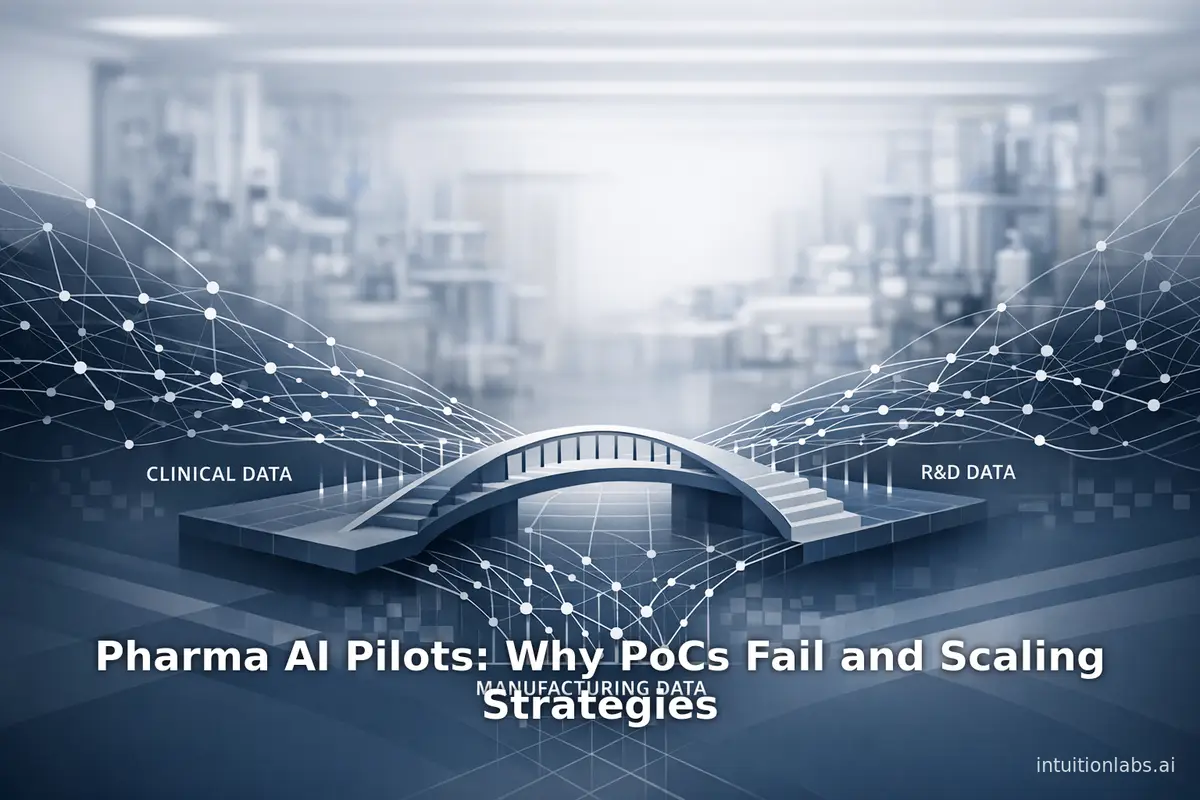
Pharma AI Pilots: Why PoCs Fail and Scaling Strategies
Learn why 95% of pharma AI pilots fail to reach production. This guide explains PoC failure causes, data integration challenges, and strategies for scaling.

Pharma AI Change Management: Upskilling and Literacy
Explore pharma AI change management and organizational readiness strategies. Understand how life science companies build AI literacy to address skills gaps.
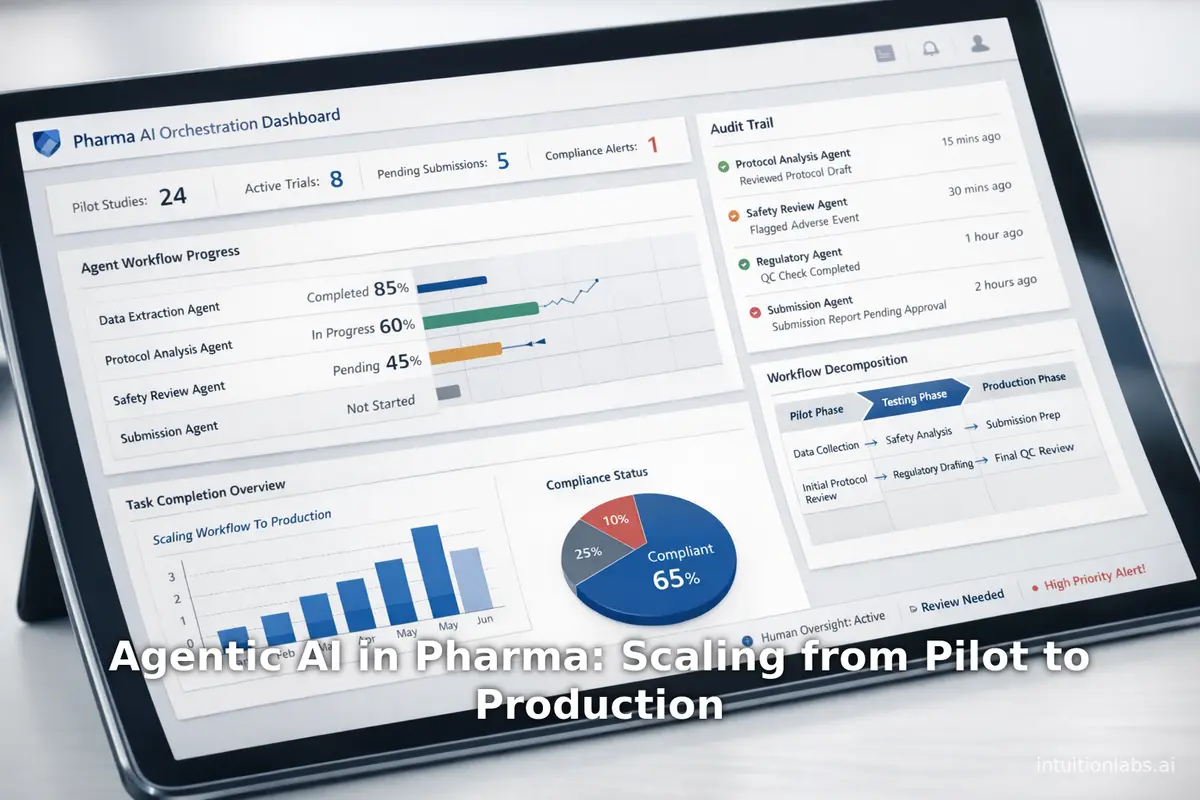
Agentic AI in Pharma: Scaling from Pilot to Production
Learn how agentic AI in pharma transitions from pilot stages to production. Explore autonomous multi-agent systems, clinical use cases, and regulatory impacts.