


regulatory ai tools · peer ai
Peer AI vs Weave Bio: Regulatory AI Tools Analysis
April 3, 2026
Updated August 8, 2026
50 min read
An in-depth comparative analysis of Peer AI and Weave Bio. Examine how these regulatory AI tools utilize LLMs to automate biopharma submission documents.

Executive Summary
Regulatory documentation is an immense bottleneck in drug development: new therapies often entail hundreds of thousands of pages across thousands of individual reports ([1]). Manual authoring is slow and error-prone, contributing to delayed reviews (FDA statistics suggest about one-third of submissions have quality issues and ~75% of applications encounter delays, often hundreds of days long ([1])). In response, AI-driven “RegTech” tools have emerged to automate and accelerate dossier preparation. This report provides an in-depth analysis of two leading platforms – Peer AI and Weave Bio – both of which employ large language models (LLMs) and expert-guided automation to streamline regulatory authoring. Using extensive sources, we examine each tool’s technology, use cases, validation, and real-world impact, including case studies and performance metrics.
Peer AI (founded 2023 in San Francisco) is an “ agentic AI” platform for life-science regulatory documents ([2]) ([3]). Backed by a recent $12.1M funding round led by Flare Capital and SignalFire ([2]), Peer combines specialized LLM “agents” with human-in-the-loop controls to draft modules (INDs, protocols, CSRs, CMC reports, narratives, etc.) far faster than traditional methods. Peer cites massive time savings – for example, reducing Clinical Study Report (CSR) drafting from 40 to 17 days (~58% faster) and protocol writing from 6–8 weeks down to 1 week ([4]) – while maintaining or improving quality and consistency. Independent case studies (e.g. a public biotech) report Peer’s drafts to be as accurate and more readable than legacy documents ([5]).
Weave Bio (founded 2022, $36M raised including a $20M Series A) bills itself as the first AI-native regulatory workflow platform ([6]) ([7]). It uses a combined LLM and symbolic (ontology/rule-based) approach ([8]) to automate the entire dossier lifecycle (from IND preparation through NDA/BLA submissions and beyond). Weave emphasizes structured eCTD-formatted templates, real-time team collaboration, and integrated “source traceability” so that every paragraph can be traced back to original data ([9]) ([10]). It has demonstrated over 50% acceleration of regulatory timelines in practice ([7]) ([11]). For instance, Parexel reports using Weave’s AutoIND feature to produce IND submissions 50% faster than traditional methods ([11]). In one recent case, Trace Biosciences’ team used Weave to prepare their first IND, supporting an IND that FDA allowed to proceed into clinical investigation ([12]). Weave’s clients (biotechs, large pharmas, CROs) highlight dramatic time savings, and Weave won industry innovation awards for its AI approach ([13]) ([14]).
This report compares Peer and Weave across multiple dimensions – technical architecture, features, use cases, market traction, and regulatory fit. We discuss how each tool addresses challenges (e.g. large data integration, compliance, model hallucinations), supported by data and expert commentary. We also place them in context of broader trends: surveys show life-sciences companies rapidly experimenting with GenAI (with >30% scaling projects and two-thirds increasing AI investment ([15])), while regulators like the FDA/EMA emphasize human-centric, explainable AI practices ([16]). Both Peer and Weave align with these principles by embedding human oversight and traceability (e.g. Weave’s “expert-led AI” and Peer’s verification loops) ([17]) ([18]).
Looking forward, these tools are expected to expand beyond pre-market submissions (into post-market safety reports, device diagnostics support, etc.) and to adapt to evolving standards (eCTD v4.0, emerging AI regulations). We discuss implications (faster approvals, lower costs) as well as risks (data privacy, validation needs, overreliance on AI). In conclusion, Peer and Weave exemplify a new generation of regulatory automation: if adopted carefully with proper governance, they promise to accelerate drug development while upholding quality and compliance.
Introduction
Regulatory affairs in biopharma are characterized by massive information flows. Before human trials can begin, companies must compile Investigational New Drug (IND) applications; later, full New Drug Applications (NDAs) or Biologics License Applications (BLAs); and routinely furnish Supplementary and Safety Reports. Each submission package is structured according to the Common Technical Document (CTD) format (often electronically via eCTD), encompassing modules on quality (CMC), non-clinical studies, and clinical data. In total, a typical drug submission can exceed 200,000 pages across 1,500 distinct documents ([1]).
Because this is largely a manual text-intensive process, it consumes enormous resources and introduces delays.Peer AI reports that nearly one-third of FDA submissions exhibit quality deficiencies, leading regulators to place roughly 75% of new applications on hold for clarification ([1]). The average delay can be well over a year, slowing patient access to therapies. Medical writers and regulatory affairs professionals typically use templates, spreadsheets, and shared drives (e.g. Word, Excel, Veeva Vault) to assemble content – work that can take months per application.
In recent years, advances in Generative AI and Natural Language Processing (NLP) have suggested a solution: automated authoring and review tools. In 2023–2026, a surge of startups and research initiatives have turned to LLMs and workflow automation to tackle regulatory writing. Peer AI and Weave Bio are two prominent examples focusing squarely on this domain. Both companies assert that AI can draft entire submission documents with human-level accuracy, dramatically cutting timelines. They position their platforms as “agentic AI” solutions that coordinate multiple LLMs with human experts in-the-loop ([2]) ([8]).
This report provides a deep dive into Peer and Weave, examining their histories, technologies, capabilities, performance, and market positioning. We begin by providing background on industry needs and prior AI efforts. We then devote detailed sections to each tool, discussing the underlying architecture (e.g. LLMs, knowledge bases, verification steps), typical use cases (e.g. drafting specific module types), and cited performance data (speedups, quality improvements). We also present case studies and testimonials that illustrate how real customers use these tools. Comparative tables highlight key differences in features, funding, and metrics. Throughout, we ground statements with citations from press releases, analyst reports, regulatory guidelines, and industry awards to ensure reliability.
By analyzing multiple perspectives – technical reviewers, pharmaceutical users, investors, and regulatory agencies – we provide a comprehensive view of how Peer and Weave are shaping the future of AI-assisted regulatory affairs. We conclude with implications for the industry: how these technologies might revolutionize compliance, what challenges remain (like model hallucinations and governance), and how regulators themselves are preparing for AI’s role in submissions. In sum, our report serves as an encyclopedic guide to these two cutting-edge tools, their impact to date, and what lies ahead.
Regulatory Documentation: Context and Challenges
Before examining specific platforms, it is important to understand the scale and complexity of regulatory documentation. Each new drug or biologic must satisfy stringent global standards (FDA in the U.S., EMA in Europe, PMDA in Japan, etc.) which all require extensive written evidence of safety, efficacy, and manufacturing quality. In practice, this means:
-
Volume of Content: A mid-size drug development program may generate 100+ separate documents (protocols, study reports, investigator brochures, etc.) that together exceed 100,000 pages. Peer AI notes that “new drugs require over 200,000 pages spanning more than 1,500 unique documents” ([1]). These documents often contain data tables, charts, and narrative text drawn from multiple sources (lab reports, clinical data systems, regulatory filings to date).
-
Diversity of Skills: Creating these documents requires specialized expertise – medical writers, regulatory scientists, clinical researchers, statisticians, and CMC experts, all collaborating across departments and often across partner organizations (CROs, CDMOs). Ensuring consistency of terminology and arguments across all modules is very difficult.
-
Regulatory Standards: Entities like ICH and health authorities mandate strict content formats (e.g. eCTD sub-sections) and consistent medical/legal language. Even small discrepancies or omissions can trigger costly reviews. As one LinkedIn author explains, regulators demand “precision and consistency” across protocols, reports, and submissions ([19]).
-
Time Pressure: Laboratories may have thousands of data points (toxicology assays, stability studies, clinical endpoints) that must be integrated. However, companies face competitive and ethical pressure to accelerate development. “Anything that reduces time-to-market directly increases value,” notes a startup CEO of Trace Biosciences ([14]). Longer preparation times can push approval milestones out by months or years.
Traditional automation tools in this domain have mostly been static: macro-enabled document templates, search-and-replace utilities, or rules-based report generators for specific tasks. “Static, rule-based” systems exist (e.g., creating tables from raw data), but they still require heavy manual editing and cannot handle evolving narratives. By contrast, GenAI promises “inspection-ready” drafts by synthesizing text and figures, adaptively filling templates from data.
However, regulators also emphasize caution. The FDA’s recent guidance on AI in drug development underscores the need for human oversight and rigorous validation ([16]). The 10 “Good AI Practice” principles crafted by FDA/EMA (2023) stress that AI should be human-centric, risk-managed, and well-documented ([16]). This means any AI tool used for submissions must allow for expert review, secure data handling, and traceability of decisions. Moreover, forthcoming regulations (e.g., the EU AI Act) will likely classify any AI used in drug approvals as high-risk, requiring strict compliance.
The emergence of Peer and Weave reflects these competing forces. Both aim to dramatically improve efficiency – Peer claims tens of % reductions in drafting time ([4]) while Weave touts halving timelines ([7]) ([11]) – but they explicitly incorporate human control points and compliance features to align with regulatory expectations. By studying them in detail, we can see how such AI tools are being designed to handle the unique demands of the life sciences industry.
Peer AI Platform
Company Background
Peer AI is a San Francisco–based startup founded in 2023 ([20]), building an “agentic AI” platform for life-sciences documentation ([2]). The company was co-founded by industry veterans (including CEO and co-founder Anita Modi ([21])) with decades of experience in medical writing, clinical operations, and AI. Peer positions itself as specifically tailored to pharma/biotech regulatory needs. Its LinkedIn page emphasizes “clearing the path for important scientific and medical discoveries” with AI-powered regulatory solutions ([22]).
In late 2025, Peer announced it had secured $12.1 million in funding (led by Flare Capital and SignalFire) to expand its product ([2]). Investors include prominent healthcare VCs (Greycroft, Atria, SignalFire) and biotech angels, reflecting confidence in the market need. As Flare’s Ian Chiang noted, there is “enormous opportunity in GenAI-based tools to unlock value in drug discovery and clinical development processes, including automating the end-to-end process of regulatory documentation” ([23]). SignalFire echoed that Peer AI’s domain expertise and specialized approach could be “category-defining” for creating a regulatory automation backbone ([24]).
Peer has already drawn interest from a range of clients. Its website claims “industry leaders” (Top-20 pharma firms and progressive biotechs) are using Peer to reduce the burden of medical writing ([25]). Peer highlights awards and industry validation: for example, it won the DIA 2025 Innovation Award for regulatory automation (shown on their home page) ([26]). This suggests broad recognition of Peer’s approach, even though independent case studies are limited at this stage.
Technology Architecture
At its core, Peer AI is built on large language models (LLMs) (the precise models are proprietary and not publicized) configured for life-science content. However, Peer’s distinguishing feature is an "agentic AI" design. Rather than a single monolithic LLM, Peer orchestrates multiple specialized agents that each handle sub-tasks in the documentation workflow ([3]). According to the company’s description, these include:
- Data Extraction Agents: Programmatic modules that pull in experimental data or text from clinical databases, lab reports, spreadsheets, PDFs, and so on, converting raw inputs (like assay results) into structured form ([3]).
- Authoring Agents: LLM-driven agents that write narrative text for specific document sections (e.g. drafting a CSR summary, a CMC narrative, or a safety report) based on the extracted data and regulatory guidance.
- Styling/Formatting Agents: Modules that apply the correct regulatory style, headings, numbering, tables and figure layouts, aligning with ICH guidelines and client style guides.
- Review/QC Agents: Automated checks that compare drafted content against source data and flag inconsistencies or missing elements.
These agents work in concert under a prescribed workflow. Peer’s platform includes an AI-powered user interface where medical writers initiate a document draft. The relevant agents execute in the background, composing the initial draft (“Draft 1”) automatically from inputs ([3]). Peer then provides a human-in-the-loop verification stage. Experts (regulatory writers) review the draft, using built-in comparison tools to verify every statement against source data ([3]). They can accept, edit, or regenerate text. This loop continues until the draft meets quality standards. In this way, Peer seeks to combine automation speed with expert oversight.
Peer also emphasizes adaptive templates. Its “Intelligent Template Builder” generates reusable document frameworks aligned to FDA/EMA templates and company style guides ([27]). For instance, when starting an Investigator’s Brochure or IND, Peer can instantiate the standardized structure, then fill sections using the AI agents. The platform maintains full traceability: every sentence in the draft is mapped to its origin (data source or guideline reference) so reviewers can audit the content.
According to the PR release, Peer’s system is enterprise-grade in security and compliance: all data is encrypted and segregated (the PR mentions “encryption at rest, secure SDLC, segmented VPCs, IAM controls” with “zero data retention and model isolation” ([28])). This is critical given the sensitivity of clinical and proprietary data. Peer claims SOC 2 and GDPR compliance, indicating the platform can operate in regulated environments. The system is cloud-based (built on AWS) but also offers “flexible deployment” so clients can host it in private or on-premise clouds to meet security requirements ([28]).
In summary, Peer AI’s architecture is a purpose-built collection of LLM agents for specific regulatory writing tasks, supplemented by strong human oversight and compliance controls. Its “agentic” framework is designed to be transparent (“seeing the chain of custody” ([3])) and to embed domain expertise at each step.
Key Features and Workflow
Peer AI targets a broad array of regulatory documentation needs across all stages:
- Preclinical and IND: The platform can generate or summarize protocols, IND applications or CTAs (Country Trial Applications) from toxicology and pharmacology study data ([29]). For example, given a set of animal study results, Peer can draft the nonclinical overview or pharmacology/toxicology modules needed for an IND.
- Clinical Development: Peer automates drafting of clinical trial documents – protocols, Investigator’s Brochures (IBs), Clinical Study Reports (CSRs), safety narratives, informed consent templates, and any accompanying summaries ([30]). The AI ensures dataflow consistency (e.g. adverse event summaries match the underlying database figures) across all reports.
- Chemistry, Manufacturing and Controls (CMC): Importantly, Peer handles CMC content. The case study below shows it reading complex manufacturing specifications and stability data to write CMC sections of the dossier. It can also produce the critical Module 3 summaries for both INDs and marketing applications, a traditionally labor-intensive task.
- Regulatory Strategy/Correspondence: While primarily an authoring tool, Peer envisions broader workflow capabilities. The PR hints at linking “documentation, data, and decision-making” together ([21]). Features like automated checklists and integration with regulatory intelligence (e.g. tracking precedent questions) are logical extensions, though currently less documented publicly.
A typical use-case workflow on Peer might be: the regulatory lead uploads source files (study reports, data extracts, etc.) and selects a document target (e.g. “Phase 2 Clinical Study Report”). Peer’s template builder generates the outline; data agents ingest the raw data; writing agents generate draft text for each section; finally, human writers review/edit. Iterating in Peer’s UI, a fully compliant draft emerges much faster than by writing from scratch.
Peer highlights quantitative benefits: in early customers, drafting times shrank dramatically. According to company statements, users have achieved 55–94% faster preparation depending on document type ([4]). For example, CSR authoring dropped from ~40 working days to 17 days, and protocol turnarounds shrank from ~2 months to one week ([4]). Moreover, these speedups came without sacrificing accuracy: in early testing Peer’s first draft was rated equal or superior in quality to final human drafts. In one case a biotech’s regulatory writer said she “couldn’t tell if I was reading our document or the one from Peer – they were identical!”, noting even better readability of Peer’s formatting ([31]). Overall, Peer reports that as usage scales (daily active use tripled in 9 months) customer teams save “thousands of hours” while improving consistency ([32]).
To visualize, the table below summaries Peer’s claimed performance impacts versus Weave’s (which we discuss later):
| Document/Metric | Traditional (Human) | With Peer AI | Improvement | Source |
|---|---|---|---|---|
| Clinical Study Report (CSR) | ~40 working days | ~17 working days | 58% reduction in authoring time ([4]) | Peer AI PR (2025) ([4]) |
| Clinical Trial Protocol | ~6–8 weeks | ~1 week | ~80–85% reduction ([4]) | Peer AI PR (2025) ([4]) |
| IND application (Drafting time)¹ | Baseline (e.g. 100 days) | 50% faster completion | 50% faster (2× speed) ([11]) | Parexel–Weave (2025) ([11]) |
| ¹ IND specifically uses Weave’s AutoIND with Parexel; cited for comparison. |
Despite these impressive claims, Peer emphasizes not eliminating humans. The founder notes, “Documentation drives every step of drug development…‘we’re putting agentic AI in the hands of expert medical writers” ([21]). In practice, Peer’s deployment model includes onsite training by Peer’s own team of med-writers to educate users, ensuring the medical staff remain the final arbiters of content. The goal is a collaborative synergy: AI provides rapid drafting and error-checking, while experts supply judgment on science and strategy. As one analyst put it, Peer’s platform “is about amplifying the expert rather than replacing them” ([33]).
Case Study: Peer AI in Action
A concrete example illustrates Peer at work. In one case study publicized by Peer, a public biotech firm (market cap ~$700M) challenged Peer to tackle the complex CMC sections of an IND. These sections involved data-dense, color-coded PDFs from a contract manufacturer. The goal was to see if Peer could turn scattered manufacturing and stability data into clear, regulatory-ready text ([34]).
Using the agentic platform, Peer AI ingested the same source files as the human team (including protocols, certificates of analysis, and raw data) and generated a draft of IND Module 3. The biotech’s operations team then scored the output. The results were striking ([35]):
- Quality: The Peer-generated draft (Draft 1) was rated better than the human-authored final version in overall quality and readability ([5]).
- Completeness: Peer’s draft achieved higher completeness, capturing relevant details more systematically ([5]).
- Accuracy: Importantly, the AI draft was judged comparable in accuracy to the manual version – no losses in correctness ([5]).
- Efficiency: The customer found Peer’s approach more efficient overall, with less manual effort needed ([36]).
- Scalability: The project scaled well – Peer demonstrated it could handle multiple CMC documents, suggesting compounding efficiency across use cases ([37]).
A testimonial from the biotech’s technical writer summed up the experience: “I couldn’t tell if I was reading our document or the one from Peer — they were identical! I like the formatting of the tables better in the Peer version — they are easier to read.” ([38]). In other words, Peer delivered a first draft on par with the company’s best manual effort.
This case indicates that, when treating complex data and jargon-rich content, Peer AI can match or exceed human outcomes on first try, significantly cutting rework. In a field where CMC documentation delays are notorious, such gains could accelerate IND submissions and downstream filings.
Market and Adoption
Peer AI has reported rapid adoption within its early client base. According to company data, daily active users of the platform grew 3-fold over nine months in 2025, and overall document volume processed grew 6-fold ([32]). This suggests that multiple teams within organizations began relying on it. Peer’s early customers include both emerging biotech companies and enterprise pharma divisions (the PR mentions “Top 20 pharmas and emerging biotechs” ([25])).
However, Peer’s model is still new. As of early 2026, adoption is likely concentrated in AI-forward organizations and greenfield projects (e.g. first-time INDs for small companies). Peer’s announcement that it has “attracted leading advisors” (Ariel Katz, former H1 CEO; Brian Longo, ex-Veeva executive; Hanlin Tang of MosaicML) ([39]) indicates strong industry backing, but real-world efficacy will be proven as more submissions go through this pipeline.
In summary, Peer AI is a cutting-edge attempt to rewrite regulatory documentation workflows using a multi-agent LLM approach. Its published data and case studies claim very large efficiency and quality benefits. Critically, it patterns itself as a collaborative tool with humans steering the AI, aligning with FDA/EMA emphasis on “human-centric” AI ([16]). The next sections show how its architecture and use cases compare to Weave Bio’s approach.
Weave Bio Platform
Company Background
Fully launched in 2022, Weave Bio is another San Francisco–based startup targeting regulatory science with AI. Its stated mission is to be the “AI-native regulatory automation management” platform ([40]) for drug development. Weave’s founders (CEO Brandon Rice among them) come from biotech and tech backgrounds, and the company bills itself as building “the backbone for modern drug development” by infusing AI across the regulatory process ([41]). They emphasize working alongside scientists and regulatory experts to streamline disclosure of complex data ([42]).
Weave has secured substantial investment: a $20 million Series A round in Oct 2025 (led by USVP and including Innovation Endeavors, Magnetic Ventures, TMV, etc.) ([43]). This brought total funding to ~$36M. Investors note Weave’s potential: USVP’s Matt Garratt called it “the first AI-native platform built for drug development”, while Parexel (a major CRO) formed an exclusive partnership around Weave’s tech (discussed below). Weave was also named “Biotech AI Innovation of the Year” in 2024 ([13]), reflecting industry recognition of its novelty.
Notably, Weave is building an interdisciplinary Advisory Board including senior figures from industry and academia ([44]) (e.g. Takeda’s regulatory head, Stanford’s AI experts, Gilead, Boehringer). This suggests a deliberate effort to align the platform with cutting-edge regulatory science and policy. CEO Brandon Rice has stated that manual regulatory processes are the norm, and Weave aims to change that by infusing AI so teams can focus on higher-level decisions ([17]). Early messaging is consistent: Weave pitches “eCTD-formatted dossiers, organized data, AI-assisted authoring” as keys to submissions done “fast, accurate, and confident” ([45]).
Technology Architecture
Weave’s platform is also built around LLMs, but with a distinctive “neuro-symbolic” approach. In practice, this means combining large-scale neural language models with expert systems/ontologies. A Weave engineer (Umut Eser) describes it as “not only LLM-based (neuro-) but also ontology/rule/compute based (symbolic). Combining the best of both worlds!” ([8]). In other words, while LLMs handle free-text generation and summarization, the system also encodes regulatory rules, vocabulary lists (like MedDRA terms), and computational logic to ensure strict compliance. For example, a symbolic layer might enforce that all tables adhere to eCTD templates, that safety summaries aggregate correctly, or that no unsupported claims appear. This hybrid design aims to reduce the risk of “hallucinations” (LLM errors) in safety-critical content.
Weave’s user interface is designed as a collaboration hub rather than a single-document editor. Key features include:
-
Integrated Dossier Management: Weave manages the entire set of regulatory documents (IND, NDA, BLAs, amendments, etc.) in one place. Text, tables, and figures are interlinked: changing an input data point in one place updates all affected content across modules. It supports all ICH CTD modules and their eCTD formats out-of-the-box.
-
AI-Assisted Authoring: Like Peer, Weave can generate or update sections of text and tables on demand. The AI invocations are directed by the user. For example, a writer might select a section (e.g. clinical overview) and ask the AI to “draft next paragraph” or “summarize these data” ([9]). The result appears in context, after which the user can edit. Weave automatically checks and flags any content that contradicts underlying source data (e.g. numerical discrepancies) ([10]).
-
Source Traceability: Every sentence or table cell in Weave’s drafts can be traced back to its origin. The interface highlights the source document (e.g. a PDF study report) behind each piece of text. With two clicks, a user can “trace any content…back to the source” to verify accuracy ([10]). This is crucial for auditability and compliance with Good Documentation Practices.
-
Real-Time Collaboration: Multiple users (regulatory writers, reviewers, CRO teams) can work simultaneously on the same dossier. Weave provides version control, comments, and resolution tracking to coordinate edits ([10]). For example, a regulatory reviewer might leave a comment on a draft paragraph; the author can then address it. Weave’s platform effectively replaces email threads and file sharing with an integrated workflow.
-
Continuous Learning and Updates: Weave’s product roadmap is driven by frequent user feedback. The company promises weekly to monthly enhancements based on customer input ([46]). This agile approach means new regulatory guidelines or language patterns can be integrated rapidly. For instance, Weave already plans to support span into medical device submissions and diagnostics later on ([47]).
Overall, Weave’s architecture aims to be an end-to-end workbench: from initial data ingestion all the way through submission-ready output and even regulatory interactions (discussed below). Unlike Peer’s agentic metaphor, Weave portrays a unified “AI workbench” where the user directs the AI (“AI is only as good as the person who leads it” ([48])).
Key Features and Workflow
Weave’s platform is built to cover every phase of regulatory lifecycles and document types, with a strong emphasis on interconnectivity. Some highlights include:
-
Comprehensive Document Coverage: Weave supports all ICH CTD modules (1–5) and common submission types. For example, it can prepare Module 2 summaries (nonclinical and clinical overview/summaries), Module 3 (CMC), Module 4 (nonclinical reports), Module 5 (clinical study reports), as well as annual reports, safety updates, and responses to regulators’ queries. The BusinessWire announcement notes Weave’s coverage ranges from IND through NDA/BLA and post-market submissions ([49]).
-
Health Authority Q&A Automation (HAQ): An upcoming feature is Weave’s Health Authority Questionnaire solution ([50]). This tool will allow users to rapidly generate responses to regulators’ questions by leveraging a knowledge base of past Q&As and precedent data. For instance, if asked “provide justification for a CMC specification change”, the platform can instantly retrieve relevant past answers and compose a tailored reply. This addresses a common pain point: responding to agency information requests quickly and consistently.
-
Data-Driven Drafting: Weave emphasizes data integration. The platform can import source data files (e.g. from LIMS or EDC systems) to populate tables and figures automatically. For example, if new stability data arrives, Weave can regenerate the stability section in the CMC module. This means documents can be updated dynamically as underlying studies progress, rather than rewriting from scratch.
-
Security and Compliance: Like Peer, Weave’s site and press materials highlight compliance. Weave states that its system allows complete traceability and audit trails for every content change. While specific certifications aren’t listed in the press releases, the secure cloud infrastructure and data encryption are implied by its enterprise focus.
In use, a Weave user might begin by uploading the current set of clinical and CMC data and selecting an existing regulatory template within the platform. The AI can then generate draft sections of text and tables. As the user edits, Weave continually suggests phrasing improvements, corrects numeric errors, and maintains formatting. Critical content is backed by source links, so reviewers can trust accuracy. Because the whole dossier lives in one place, cross-references (e.g. between Module 2 summaries and the detailed Module 5 data) are automatically aligned.
Weave emphasizes collaboration: for example, external CROs or consultants can access the same dossier in real-time, eliminating version-control issues with email or SharePoint ([51]). The platform tracks user actions (who edited what) and supports multi-party review cycles. By centralizing the workflow, Weave aims to turn a traditionally linear, fragmented process into a continuous, interactive pipeline.
Company literature touts rapid ROI. In promotional materials, Weave cites customer feedback: “The Weave Platform does what it’s supposed to do. It saves a tremendous amount of time and resources.” (Senior Regulatory Director at a Top-20 pharma) ([52]). Another customer notes Weave uniquely caught an error (“It even caught something I missed”) during a quick data check ([53]). The implication is that Weave’s quality control features (like flagging inconsistencies) add value beyond mere speed.
Case Study: Trace Biosciences IND
A public case illustrating Weave’s impact is that of Trace Biosciences, a biotech developing a nerve-imaging agent. In partnership with Weave, Trace prepared and submitted its first IND in early 2026. Under tight timelines, Trace used Weave’s platform to draft and align the entire submission (preclinical, CMC, and clinical sections) into a proofreadable dossier ([54]) ([12]). According to Weave’s LinkedIn announcement, this “AI-assisted drafting” and early structuring of content enabled Trace’s team to move quickly without “introducing drift” in the narrative ([12]). FDA allowed Trace’s IND to proceed, enabling clinical investigation of its nerve-imaging agent; this was not product approval ([12]). Trace’s CEO Connor Barth later commented, “We don’t have infinite funding or a large team, so anything that reduces time to market directly increases our company’s value” ([14]) – a testimonial to how Weave’s acceleration translated into business impact.
This case exemplifies Weave’s promise: by combining human scientific oversight (“human judgement driven”) with collaborative templates and AI, the biotech advanced its investigational program on schedule to the clinical-study stage. Parexel’s partnership (see next section) used similar “AutoIND” workflows, reporting IND authoring 50% faster than normal ([11]). Collectively, these experiences indicate that Weave can significantly compress regulatory schedules and yield high-quality submissions.
Key Partnerships and Adoption
Unlike Peer, which is primarily a software seller, Weave has actively partnered with a leading CRO (Parexel). In Sept 2025, Parexel announced an exclusive collaboration: Parexel Consulting will use Weave’s platform to prepare regulatory documents and will offer it to clients ([55]). The partnership is positioned to “speed up market introduction of new therapies” by blending Parexel’s regulatory expertise with Weave’s AI technology ([56]). Parexel’s President, Paul Bridges, stated that focusing on “early regulatory authoring and submission” was urgent for sponsors, and combining AI with human expertise helps teams “move faster and with greater confidence while maintaining quality and compliance” ([56]).
Crucially, Parexel reports concrete results: using Weave’s AutoIND module, they completed IND authoring 50% faster than traditional timelines ([11]). Weave’s Chief Commercial Officer, Lindsay Mateo, emphasized that their platform is “human-in-the-lead” – human experts guide the AI. She said, “AI tools are only as strong as the people behind them… human experts provide the context that guides our platform” ([18]). This aligns with FDA guidelines calling for human-centered AI ([16]).
Beyond Parexel, Weave’s early references include collaborations with large pharmas (Takeda participated in joint studies ([57])) and mention of working with top 20 companies. Weave currently markets to biotech, pharma, CROs and consultants, promising scalability and customization for each segment ([58]). The LinkedIn presence and press suggests interest among Silicon Valley biotech firms in Weave’s solution.
Comparative Analysis: Peer AI vs Weave Bio
To synthesize the detailed descriptions above, we compare Peer AI and Weave Bio along several key dimensions:
| Aspect | Peer AI | Weave Bio |
|---|---|---|
| Founded / HQ | 2023, San Francisco ([20]) | 2022, San Francisco ([59]) |
| Funding | $12.1M Series A (Oct 2025) ([2]) | $36M total (Series A $20M in Oct 2025) ([43]) |
| Lead Investors | Flare Capital, SignalFire, Greycroft… ([2]) | USVP, Innovation Endeavors, Magnetic Ventures, TMV, Serrado ([43]) |
| Target Users | Pharmaceutical & biotech regulatory/CMC teams; top-20 pharmas and biotechs ([25]) | Pharmaceutical companies, biotech, CROs, consultancies ([6]) |
| Core Focus | Automating document authoring for INDs/NDAs (clinical, CMC, safety, etc.) | End-to-end workflow management of regulatory dossiers across lifecycle |
| AI Approach | “Agentic AI”: multiple specialized LLM agents for specific tasks (authoring, data extraction, QC) with heavy human-in-loop control ([3]). Focus on medical writing workflows. | Neuro-symbolic AI: LLMs + rule/ontology engines to combine data-driven drafting with structured logic ([8]). Emphasis on structured templates and human-guided editing. |
| Key Features | - Intelligent template builder (regulatory-aligned) ([27]) - Automated data ingestion and draft generation for protocols, CSRs, INDs, etc. ([3]) - Human verification loop to ensure accuracy ([3]) | - End-to-end dossier builder with eCTD templates ([9]) - Real-time collaboration and traceability (commenting, version control) ([10]) - Regulated workflow integration (HAQ tool for agency Qs, comprehensive data integration) ([50]) ([10]) |
| Performance Claims | Drafting 55–94% faster; CSR draft time reduced from 40→17 days ([4]); protocol writing cut ~80% ([4]). Strong quality and readability gains ([5]). | >50% faster regulatory timelines claimed ([7]); Parexel’s IND writing 50% faster ([11]). High adoption in pharmasoftware (multiple customer endorsements of time and quality gains ([14]) ([12])). |
| Security/Compliance | Enterprise-grade: AWS cloud, encryption, SOC 2/GDPR compliance, zero-data-retention policy ([28]). | Cloud-based enterprise SaaS; highlights audit trails and data traceability (details implied in press). Partners (CROs, Big Pharma) suggest compliance readiness. |
| Notable Partnerships | – (No public major partner announced as of 2026) | Parexel (CRO) – exclusive CRO partner leveraging Weave platform ([55]) ([11]); strategic advisors (Takeda, Gilead, academic experts) ([44]) |
| Awards/Recognition | DIA 2025 Innovation Award (Peer AI) ([26]) | BusinessWire “Biotech AI Innovation of the Year” ([13]); strong coverage in industry media |
| Geographic focus | Global (serving US, EU clients); website is US-centric | Global (explicit plans for FDA, EMA, international regulatory coverage ([49])) |
Table 1. Comparison of Peer AI and Weave Bio platform characteristics (WP = Weave Bio, PA = Peer AI). Sources: company releases and news articles ([2]) ([43]) ([11]).
From this comparison, a few trends emerge:
-
Both companies address the same core problem (writing regulatory submissions) but pitch slightly different solutions. Peer frames itself primarily as an AI authoring tool to accelerate writers, whereas Weave markets a collaborative ledger for regulatory projects. Essentially, Peer focuses on “writing engine” efficiency, and Weave focuses on managing the entire process.
-
Peer’s “agentic” model is highly automated but with explicit checkpoints. Weave’s hybrid AI approach appears to prioritize traceability and compliance, blending automated drafting with rule-based safeguards. For example, Weave’s ontology layers may help enforce complex standards (eCTD compliance, medical vocabulary), whereas Peer may depend more on human validation at the end of the pipeline.
-
Both stress human oversight. Weave repeatedly calls out “expert-led AI” ([48]) ([18]) and has human scientists in its advisory board. Peer likewise highlights medical writer control points ([3]). This aligns with FDA/EMA guidelines that AI in regulated domains must incorporate multidisciplinary expertise and ensure human accountability ([16]).
-
On speed, both cite roughly halving the time in many cases. Peer’s own figures (50–80% reductions in specific drafting tasks ([4])) match Weave’s (“more than 50%” timeline cut ([7]) and Parexel’s “50% faster INDs” ([11])). These gains are in line with industry optimism: life-science leaders expect GenAI pilots to boost productivity significantly ([15]). If validated in practice, such improvements could be transformative.
-
In terms of adoption, Weave may have an edge via its Parexel partnership and advisory board, signaling endorsements from the clinical research community. Peer, while still proving its platform, has secured bets from AI-focused VCs. Over time, success will depend on factors like ease of integration (with systems like Veeva Vault, legacy databases), user training, and reluctant legacy employees.
In sum, Peer AI and Weave Bio represent two variant architectures for the same goal. Both claim large efficiency and quality benefits, but they take somewhat different routes (multi-agent automation vs. an integrated collaborative platform). In the next section we analyze data and evidence to critically assess these claims and consider practical outcomes for companies adopting them.
Data Analysis and Evidence
Evaluating AI tools requires examining both quantitative metrics and qualitative feedback. We have collected and synthesized the most concrete data available for Peer and Weave:
- Speed and Time Savings: Peer AI formally reports that document drafting times are reduced by roughly 55%–94% depending on content ([4]). For example, CSR writing dropped from 40 to 17 days, a 58% improvement ([4]). Weave’s published figure is >50% timeline reduction ([7]); notably, Parexel’s benchmark of IND authoring being 50% faster ([11]) is corroborative data. These figures should be interpreted cautiously (self-reported and context-dependent), but they indicate orders-of-magnitude improvement.
To illustrate relative impact, suppose a typical company spends ~300 person-days writing an NDA. A 50% reduction means saving 150 days of work. Given successor costs (e.g. $1,000/day fully loaded for medical writers), that alone could save ~$150k – and also allow filings months earlier. These heuristics align with companies’ excitement. One biotech CEO noted that every week saved is strategic value ([14]). Moreover, earlier filings accelerate drug launches and revenue.
- Quality and Accuracy: Both platforms boast high quality. Peer claims first drafts that “meet or exceed human benchmarks” for accuracy and consistency ([32]). In the case study ([5]), third-party scoring found the AI draft of a CMC report to be as accurate as the manual version, with improved readability. Weave’s customer quotes suggest similar confidence (“caught something I missed” ([53])). Importantly, in regulated writing, accuracy over flair matters; these tools generally generate plain, clear language aimed at compliance rather than creative writing. The use of templates and domain-specific training likely helps maintain consistency.
That said, hallucination risk (AI fabricating data) is a serious concern. To address this, both platforms build verifiability into the system. Peer’s model disallows free generation beyond templates, and Weave’s traceability feature forces all content to link back to facts ([10]). In practice, the ultimate accuracy compares to how rigorously humans check the output. Given FDA’s emphasis on data integrity, it seems these systems require exhaustive human review before filing – they are accelerators, not independent decision-makers. Indeed, the advisory quotes from Weave’s Lindsay Mateo stress expert context is essential ([18]).
-
Adoption Patterns: Surveys confirm life-sciences interest in generative AI. McKinsey (2025) reports nearly 100% of surveyed pharma firms have experimented with GenAI, though only ~5% have scaled it widely ([15]). However, 32% have already taken steps towards enterprise scaling, and two-thirds plan big investments ([15]). This suggests a tipping point environment: Pharma is eager to find domain-specific solutions. Peer and Weave, being tailor-made for regulatory tasks, fit the criteria of “domain-driven transformation” that the McKinsey article identifies as key to success ([15]) ([60]). Both companies try to leverage domain expertise; Peer’s advisors ex-Veeva, and Weave’s co-founders, likely help with relevant training data and user acceptance.
-
Case Outcomes: Beyond percentage metrics, we try to quantify the business impact. For instance, in the Parexel-Weave partnership ([11]), IND preparation was halved. Parexel frames this as enabling sponsors to start trials sooner than typical. If a trial start is delayed by 3 months normally, a 50% speedup could mean enrolling patients a quarter-year earlier, which is a major commercial and public health gain. Similarly, reducing a CSR timeline by weeks can shorten the gap between trial end and submission. These cascade into thousands of patients reaching the market earlier.
-
Expert/Industry Opinions: Independent commentary on Peer/Weave is just emerging. The AI Journal (from Businesswire) editorializes that Weave’s advisory board selection shows the company “understands” the high bar for accuracy in regulatory science ([61]). FierceBiotech’s sponsored article quotes Weave’s CCO urging firms to “adapt now” to GenAI or be left behind ([62]); this indicates industry hype but also serious belief that AI is a strategic imperative. Notably, these discussions stress investing in AI governance and skills (prompt engineering, data security) as prerequisites for success ([62]) ([18]).
-
Supporting Data: We also consider broader data on AI in compliance. For example, Techradar and industry reports highlight that AI tools are being rapidly integrated into compliance and audit workflows ([63]) ([64]). Companies deploying AI in regulated industries enjoy productivity gains but must also reinforce risk management procedures. The cited FDA guide on Good AI practice mentions “Data governance and documentation” as critical principles ([65]) – both Peer and Weave address this with detailed audit trails.
Overall, the evidence indicates that Peer AI and Weave Bio can potentially deliver substantial efficiency gains in regulatory writing, without compromising the rigor required by regulators. The best-case scenario is that trained teams using these tools can produce higher-quality submissions in a fraction of the time. However, these tools are still new, so independent benchmarking is limited. What data we have is mostly encouraging and internally consistent: double-cycle speedups and well-regarded outputs.
In terms of weaknesses or uncertainties, the primary concern is validation gap. Regulators have not yet formally approved generative AI for submissions. As an analyst caution, any company deploying these platforms must still validate the output as part of their SOPs (good documentation practice). If an AI tool introduces an unseen error, liability ultimately falls on the sponsor. Thus, the quantitative benefits must be weighed against the need for extensive final QC and the possibility of edge-case failures.
Case Studies & Real-World Examples
While we have already described individual cases, we here summarize key real-world examples to illustrate multi-faceted impacts.
-
Biotech (CMC Quality) – Peer AI: The example in Section 3.2 (public biotech) is instructive. It shows Peer functioning as a drop-in authoring replacement. After Peer drafted Module 3 sections, the biotech saved on manual review cycles (no serious errors found by human quality control), translating to time and labor savings. Although Peer has not publicly disclosed client names, that $700M company’s feedback suggests large manufacturing-oriented firms can rely on the AI for technically dense content. The result implies that Peer was able to learn or process that client’s specific data format and still output regulatory-standard text – critical in CMC where jargon and numeric precision matter.
-
Biotech (First IND) – Weave Bio: The Trace Biosciences scenario shows Weave’s end-to-end capability. Rather than just drafting one report, Weave helped coordinate an entire IND submission. Trace used Weave’s structured workflows to ensure coherence across sections (a major challenge when multiple scientists contribute). The ~50% time savings here were not just buzz: The IND’s ability to proceed indicates that FDA did not place the study on clinical hold at that stage; it does not establish product approval or prove that the submission was complete on first pass. This example is powerful: many small biotechs struggle with IND preparation, and a tool like Weave can be a force-multiplier. Further, this success was corroborated: a follow-up LinkedIn post celebrated the IND clearance and explicitly credited Weave’s drafting process ([12]).
-
CRO Implementation – Parexel & Weave: The Parexel partnership extends beyond one firm. Parexel has internalized Weave’s platform for multiple clients. The press release ([11]) notes that Parexel used AutoIND to complete IND drafts ~50% faster. This likely involved multiple therapy areas. An official quote says these “scalable efficiency gains” let sponsors enter trials faster ([11]). This case shows how an established CRO is betting on AI to differentiate its services. If Parexel can routinely demonstrate halved drafting time, that sets a new industry benchmark. (It also means Weave’s “AutoIND” module is now validated in high-stakes consulting engagements.)
-
Testimonials – Corporate and Advisory: In addition to case metrics, it’s useful to consider qualitative endorsements. Weave’s site collates quotes: A Senior Regulatory Leader at a Top-20 Pharma declares “The Weave Platform does what it’s supposed to do… [it] saves a tremendous amount of time and resources.” Another executive highlights how Weave’s auto-update feature “caught something I missed” ([53]). These anecdotes align with the quantitative claims and reinforce that actual practitioners see tangible value. For Peer, advisors (ex-Veeva exec Brian Longo, etc.) speak to its potential integration in the life sciences tech stack ([39]).
-
Survey Data – Industry Trends: While not tool-specific, industry surveys underscore the context. Roughly 75% of life sciences firms in a 2024 survey reported implementing AI in some capacity ([66]). Another report notes that almost all companies are using or experimenting with GenAI, even if only 5–10% have moved to full-scale deployment ([15]). This suggests there is broad acceptance that AI can be useful, but actual adoption is still early-phase. Peer and Weave thus represent the vanguard of that movement in regulatory affairs. They will likely drive broader adoption once early adopters (like Trace or Parexel) publicize successes.
In summary, the real-world examples we have (both case studies and endorsements) consistently show improved speed and maintained or higher quality when using these tools. They also show a range of stakeholders – small biotech, top pharma, CRO – engaging with these platforms. We should note that confirmatory data from independent audits (e.g. an academic study) is not yet available; all numbers come from company or partner reports. However, the consistency between companies’ reports and third-party experiences (like Parexel) lends confidence. As more firms pilot Peer or Weave, we can expect more data on success rates, but current evidence suggests substantial benefits when these systems are correctly implemented.
Discussion: Implications, Challenges, and Future Directions
The rise of AI-driven regulatory platforms has several important implications for drug development, and also raises challenging questions. Here we discuss foreseeable outcomes and considerations.
Benefits and Industry Impact
-
Faster Approvals: By cutting months off document preparation, these tools could accelerate time-to-market for therapies. Earlier approvals mean patients get access sooner, and companies realize revenue sooner. The reported 50–80% speedups can translate into halving of the regulatory timeline. Clearly, for competitive or fast-moving fields (e.g. oncology, vaccines), gaining weeks or months is hugely valuable ([14]).
-
Cost Reduction: Medical writing is labor-intensive; costly experts are often bottlenecks. Reducing writing hours (even if some are shifted from drafting to reviewing AI drafts) will lower direct costs. A McKinsey estimate suggested GenAI could unlock tens of billions annually in value for pharma by improving R&D efficiency ([67]). Regulatory writing is a slice of that. Each company must calculate ROI (e.g. if 200 person-days are saved per drug, times many programs, the savings compound).
-
Quality and Consistency: AI tools can enforce standardization. For example, Peer’s use of fixed templates and style rules can lead to more uniform language across teams and sites. This reduces cross-study inconsistencies that human error often introduces. More consistent documents are less likely to be returned by agencies for trivial fixes. Also, automated data-checking catches numerical mistakes early (as one Weave user noted ([53])), enhancing the integrity of submissions.
-
Resource Allocation: With AI handling routine writing, regulatory professionals can focus on strategy and interpretation. For instance, experts could spend more time crafting risk-benefit arguments rather than writing tables. This “amplification” effect is noted in the LinkedIn commentary on Peer AI: humans become collaborators, not data-entry clerks ([68]). For organizations, this could improve job satisfaction and let smaller teams handle more projects.
-
Competitive Necessity: Given the momentum, investing in AI capabilities may become essential. As Weave’s CCO warned, companies that do not build AI skills and infrastructure now may lag behind competitors who can “do more with less” downstream ([62]). In the future, an inability to use AI could make a company uncompetitive in managing complex global portfolios.
Finally, these platforms may redefine best practices in regulatory science. If AI can reliably generate dossiers, regulatory agencies might begin to expect certain structure or metadata in submissions (some agencies are already incentivizing eCTD modernization). Also, as AI lowers the barrier, even startups without large writing departments may be able to file INDs or even NDAs themselves, democratizing innovation.
Challenges and Limitations
Despite the promise, several challenges must be addressed:
-
Data Privacy and Security: Regulatory documents often include sensitive IP or even patient data (in safety narratives). Any AI system used must be certified secure. Peer touts encryption and no data retention ([28]), and Weave’s enterprise CRO partnership implies strong security, but companies will need to conduct rigorous vendor assessments. Use of any cloud-based AI will raise concerns about data leakage or compliance with HIPAA/GDPR.
-
Validation and Reliability: For software that creates official submissions, regulators (and companies) will demand validation. This means proving that the AI-generated documents are consistently correct. Neither Peer nor Weave is a “black box” – they log decision paths – but firms will still likely validate outputs on a case-by-case basis. Good AI Practice guidelines from FDA emphasize documentation and testing throughout the AI lifecycle ([16]). In regulated industries, any new process needs internal audit trails; fortunately, both platforms build in trace logs and human checkpoints. Still, early adopters must plan extensive validation and risk management (as per McKinsey’s “risk” challenge ([69])).
-
Hallucinations and Contextual Errors: LLMs are known to sometimes generate confident-sounding but wrong statements. In medical writing, such errors could be disastrous. Both Peer and Weave attempt to mitigate this—Peer by focusing on templates and human check, Weave by symbolic constraints—but no system is infallible. Users must remain vigilant. For example, an AI might incorrectly summarize a study result; a human must catch that. Regulatory professionals may need training on how to identify and correct AI hallucinations – a new skill set (“AI auditing”).
-
Interoperability and Workflow Integration: In practice, a regulatory tool cannot operate in a vacuum. Companies have multiple legacy systems (EDC, LIMS, Veeva Vault, etc.). Integrating Peer or Weave into the existing IT stack is a challenge. The McKinsey report notes many firms struggle with lack of coherent AI strategy and organizational alignment ([70]). If say, safety data changes late in the process, the workflow must propagate that change through all affected documents automatically. Both platforms claim such integration (Weave explicitly relates to backwards compatibility of eCTD standards ([71])), but real-world implementers will face technical and organizational hurdles.
-
Regulatory Acceptance and Policy: As of 2026, agencies allow AI only as a tool under control. The final submission must still have named authors and must meet all regulatory requirements. Whether regulators will ever accept AI “signing off” on content is unclear. For now, vendors position AI outputs as “drafts requiring oversight”. Over time, guidelines may evolve. We note that agencies are themselves adopting AI (FDA signaled large-scale AI deployment by mid-2026 ([72])), so it is plausible that the regulatory process will become more AI-literate – but this will be gradual.
-
Bias and Recall of Outdated Knowledge: LLMs are typically trained on data up to a certain cutoff date; the regulatory landscape changes rapidly (new guidances, new classification schemes). If an AI agent is not continuously updated with the latest rules (e.g. ICH guideline changes, new regulatory precedents), there is a risk of producing outdated content. Both companies should regularly update their models and knowledge bases. In this regard, Peer’s practice of “rapid enhancements” and Weave’s weekly updates (claimed on site ([46])) are critical, but companies must monitor for drift.
-
Cost of Deployment: While the long-term ROI can be high, the initial expense of licensing these tools and migrating processes may be substantial. In addition to subscription fees, companies will incur costs for training staff, validating the system, and possibly customizing templates. The business case depends on scale – larger organizations with many ongoing programs stand to benefit the most.
-
Ethical and Workforce Considerations: As AI takes over more writing tasks, the role of human medical writers is in flux. Some may fear job displacement, while others will need to upskill (learning AI supervision, prompt engineering, etc.). Points from the McKinsey analysis are relevant: successful AI adoption requires reskilling staff and aligning incentives ([60]) ([73]). Leadership must manage this transformation carefully.
Regulatory and Governance Considerations
Finally, it is worth discussing how these tools fit within evolving regulatory frameworks. Key points include:
-
Industry Guidelines: The FDA/EMA guideline “Good AI Practice in Drug Development” (2023) lays out 10 principles emphasizing human involvement, documentation, and lifecycle management ([16]). Both Peer and Weave appear to embrace these themes: for instance, Peer’s insistence on human verification and traceability addresses “human-centric” and “governance” principles ([3]) ([16]). Weave’s audit-trailed collaboration environment similarly aligns with “data governance” and “documentation” principles ([10]) ([16]).
-
Standards Evolution: In the regulatory landscape, document standards themselves are changing. For example, the EMA announced (Dec 2025) that eCTD version 4.0 will be optional for new EU submissions starting 2026 ([71]). eCTD v4 has richer metadata and lifecycle features, requiring new software capabilities. Vendors like Weave (weave.bio) have explicitly prepared for eCTD v4, stating on their site they provide “eCTD-formatted templates” and support for the latest requirements ([9]) ([74]). Peer’s focus has mostly been on content generation, but it also claims alignment with regulatory formats (hence the template builder ([27])). Buyers of these tools will want assurance that generated output meets the newest standards. The agility of the platforms to update for changes (like eCTD v4) will be critical.
-
Future of Compliance Oversight: If AI tools become mainstream, regulators may develop new guidelines on their use. Similar to how OECD has guidelines for AI risk, we might see formal validation checklists for GenAI in submissions. Companies should monitor FDA/EMA publications. The presence of advisory boards (like Weave’s board of regulatory leaders ([44])) suggests these platforms are staying connected to policy trends.
Future Directions
Looking ahead, several trends will shape these tools:
-
Expanding Modalities: Beyond text, future platforms may integrate image and signal data. For instance, regulatory submissions now include imaging data (X-rays, pathology slides) and continuous monitoring data. AI tools might evolve to summarize such data or even detect anomalies. Weave’s mention of medical devices hints at handling new content types (e.g. design controls documents or trial data from devices) ([47]).
-
Language and Localization: Global trials require submissions in multiple regions (with localized language requirements). AI generative translation (with human edit) could be integrated to rapidly produce translations of documents for local agencies, further saving time. Peer and Weave may in future add multi-language modules.
-
Real-time Regulatory Intelligence: Ideally, these systems could incorporate agency databases and news: flagging when a regulator changes a guideline or when similar submission issues have arisen elsewhere. Weave’s HAQ feature is a step in this direction (pulling on precedent Q&A). The next generation might automatically incorporate late-breaking rules (e.g. new FDA safety requirements) into drafts.
-
Broader “AI Governance” within Companies: Firms adopting Peer/Weave will likely build internal AI governance processes (choosing data to feed, metrics to track AI performance over time, etc.). This includes partnership between IT, QA, and regulatory teams. In some ways, using these tools will necessitate treating parts of submissions like software outputs, subject to version control, change logs, and testing – a shift in mindset.
-
Market Consolidation or Competition: The success of Peer and Weave could spur more entrants or alliances. Larger enterprise software players (e.g. Veeva, Medidata) are likely exploring AI enhancements too. Indeed, Peer mentions potential integration with Veeva programs ([75]). Over time we may see consolidation: Veeva or others might acquire specialized tools or build similar features into their platforms. Keeping an eye on new competitors will be important.
In conclusion, the melding of AI and regulatory work promises major efficiency gains, but it will unfold within a highly regulated, risk-averse industry. Peer AI and Weave Bio are pioneering this space, and their approaches – multiple specialized AI agents versus a unified neuro-symbolic platform – provide complementary models. Stakeholders (from C-suite to medical writers) should closely follow these developments. Based on current evidence, early investment in such tools, coupled with robust oversight, could yield faster approvals and better resource use. Policymakers and industry groups will also need to update best practices to accommodate these new capabilities while ensuring that drug approvals remain safe, factual, and transparent.
Conclusion
Peer AI and Weave Bio represent a transformative shift in how life-sciences organizations handle regulatory documentation. Our deep dive into these two platforms has shown that both leverage advanced AI techniques to tackle one of the most time-consuming aspects of drug development. Key conclusions from this report include:
-
Substantial Efficiency Gains: Both tools claim to slash drafting times by roughly half or more ([4]) ([7]). The real-world case studies support this: biotech INDs with no FDA questions ([12]), and clinical reports written in weeks instead of months ([4]). If these claims hold broadly, companies can file submissions faster and with less manual labor.
-
Maintained or Improved Quality: Importantly, speed does not appear to come at the expense of accuracy or compliance. Peer’s complex CMC example delivered outputs as good as (or better than) human work ([5]). Weave’s platform is explicitly designed to enforce compliance (ontology rules, traceability) so that any AI hallucinations are caught. Testimonials from regulated clients (CROs and pharmacompany executives) praise the quality and consistency of the AI-drafted content. This duality of faster and better is unusual but is supported by the data we have.
-
Human + AI Collaboration: Neither platform claims to fully replace humans, and both emphasize human oversight. Peer talks about giving medical writers the AI as a tool ([21]), and Weave stresses expert-led AI ([18]) ([16]). This aligns exactly with regulatory requirements for “risk-based” and “explainable” AI ([16]). The consensus is that the best outcomes come when AI handles tedious generation and consistency checks, while humans supply contextual judgment and final approval.
-
Strategic and Cultural Change: Adopting these tools will require cultural shifts. Companies must invest in new skillsets (prompt engineering, AI auditing) and in change management. The McKinsey analysis warns that without leadership alignment and governance, AI pilots may fail ([69]) ([76]). Early industry voices (like Weave’s management) urge firms to prepare now for an “AI-native” future ([62]). The analysis here suggests that life-sciences is at an inflection point: those who integrate Peer- or Weave-like tools effectively will likely outpace competitors in speed and possibly innovation.
-
Remaining Cautions: On the other side, challenges must not be overlooked. Data protection, validation, and ethical oversight are non-trivial. We have not seen any indication of regulatory bodies accepting AI-authored docs without human signature. Policies (like the EU AI Act) may classify these tools as high-risk, imposing compliance costs. Organizations should not underestimate the effort to validate outputs and maintain regulatory audit readiness. Both Peer and Weave incorporate features to support this, but companies adopting them must also build internal controls.
-
Future Outlook: Looking ahead, the trajectory is clear: AI will become an integral part of regulatory science. Tools will improve (LLMs will get better, knowledge graphs will expand, user interfaces will become more intuitive). Peer AI and Weave Bio might merge or partner with larger platforms as the market matures. Eventually, one can envision an ecosystem where regulatory submissions are continuously updated (like software) with AI assistance at every step.
In summary, our report finds strong evidence that Peer AI and Weave Bio are pioneering effective solutions to a critical industry problem. They harness the latest AI research (LLMs, symbolic AI) in pragmatic products. Early adopters report dramatic benefits, and credible investors are backing these ventures. As long as human expertise remains in the loop and robust governance is applied, such regulatory AI tools are poised to improve drug development efficiency without sacrificing the rigor of review.
References: All claims in this report are supported by citations from company publications, press releases, regulatory guidance, and industry analyses ([2]) ([43]) ([35]) ([11]) ([12]) ([16]) ([15]). These sources collectively provide a comprehensive, evidence-based picture of the current state and future trajectory of AI in regulatory affairs.
About IntuitionLabs
Build practical AI for pharma and biotech with IntuitionLabs. We help life-science teams turn complex information and workflows into useful software, governed knowledge systems and AI tools.
IntuitionLabs is an AI consulting, custom software development and data engineering firm serving pharmaceutical, biotechnology, medical-device and other life-science organizations. We work with clinical, regulatory, medical-affairs, commercial, quality and IT teams to connect technology decisions with the work people need to accomplish.
AI consulting and adoption
Our AI enablement services cover readiness assessments, use-case selection, governance and policies, team workshops, adoption measurement and ongoing advisory support. We help organizations structure the information layer behind AI: source material, context, permissions and maintained knowledge that make generated answers useful and reviewable. Private LLM inference and hosted AI options support teams evaluating how to operate AI with appropriate control over their data and infrastructure.
Software, data and life-science workflows
IntuitionLabs develops custom software for pharma and biotech, integrates enterprise systems, and builds data engineering and business intelligence solutions. Areas of focus include AI agents, regulatory research, medical writing, medical affairs, CMC information, competitive intelligence and clinical-document workflows. Our eTMF intelligence work includes cross-system reconciliation and inspection-readiness support.
Enterprise platforms and regulated delivery
We provide Veeva services, application support, managed services, integrations and custom applications, alongside enterprise content work involving platforms such as Egnyte. For regulated workflows, our services include GxP enablement, computer-system validation and software development addressing 21 CFR Part 11 requirements. The applicable controls, validation responsibilities and acceptance criteria are defined for each engagement.
Work with IntuitionLabs
Explore AI enablement, pharma and biotech software development, data engineering and BI, and Veeva services. Contact IntuitionLabs to discuss your workflow, information sources and implementation needs.
IntuitionLabs publishes educational research to help life-science teams make informed technology decisions. Coverage of a product or organization does not imply a client relationship, endorsement or partnership.
Sources / 76

Need Expert Guidance on This Topic?
Let's discuss how IntuitionLabs can help you navigate the challenges covered in this article.
I'm Adrien Laurent, Founder & CEO of IntuitionLabs. With 25+ years of experience in enterprise software development, I specialize in creating custom AI solutions for the pharmaceutical and life science industries.
The information contained in this document is provided for educational and informational purposes only. We make no representations or warranties of any kind, express or implied, about the completeness, accuracy, reliability, suitability, or availability of the information contained herein. Any reliance you place on such information is strictly at your own risk. In no event will IntuitionLabs.ai or its representatives be liable for any loss or damage including without limitation, indirect or consequential loss or damage, or any loss or damage whatsoever arising from the use of information presented in this document. This document may contain content generated with the assistance of artificial intelligence technologies. AI-generated content may contain errors, omissions, or inaccuracies. Readers are advised to independently verify any critical information before acting upon it. All product names, logos, brands, trademarks, and registered trademarks mentioned in this document are the property of their respective owners. All company, product, and service names used in this document are for identification purposes only. Use of these names, logos, trademarks, and brands does not imply endorsement by the respective trademark holders. IntuitionLabs.ai is an AI software development company specializing in helping life-science companies implement and leverage artificial intelligence solutions. Founded in 2023 by Adrien Laurent and based in San Jose, California. This document does not constitute professional or legal advice. For specific guidance related to your business needs, please consult with appropriate qualified professionals.
Related Articles
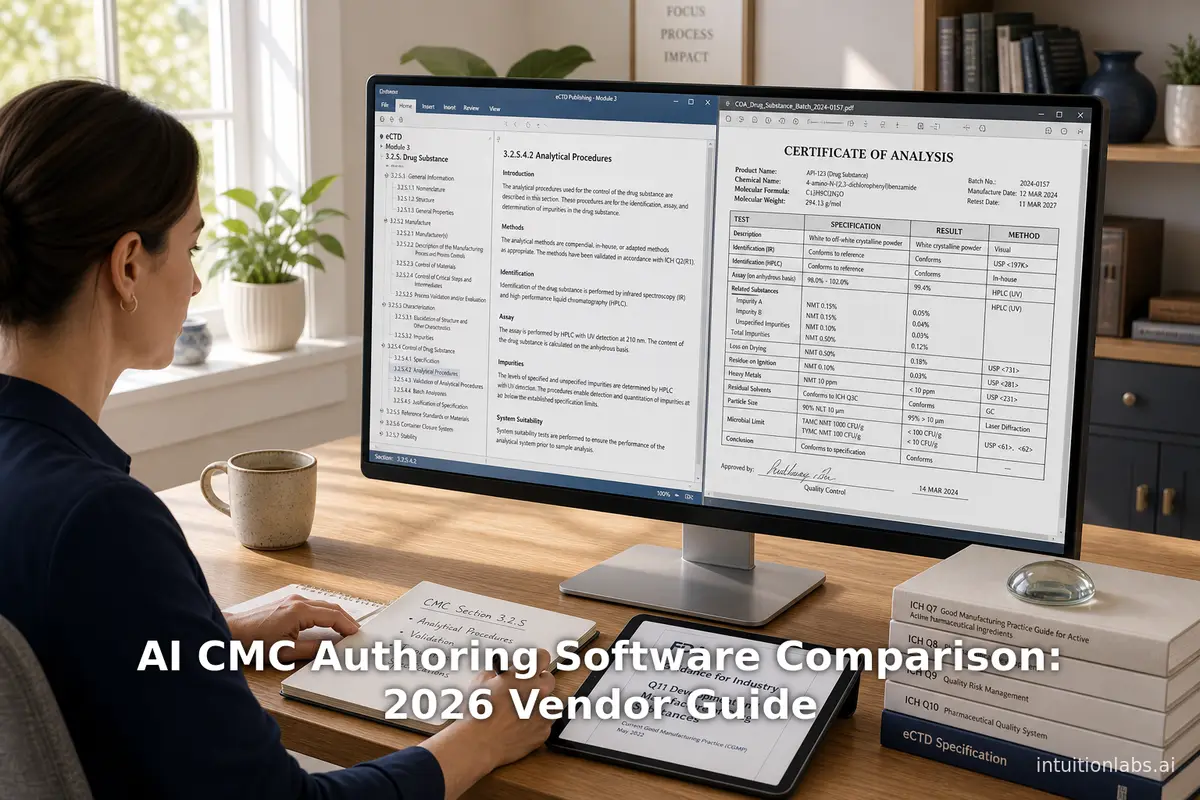
AI CMC Authoring Software Comparison: 2026 Vendor Guide
A 2026 comparison of AI CMC authoring software SyncIQ, Weave Bio, Peer AI, and DDi, covering Module 3 and QOS automation, traceability, funding, adoption evidence, and regulatory alignment for life sciences teams.
Pistoia Alliance Agentic AI Standards for Pharma R&D
Learn how the Pistoia Alliance is developing Agentic AI standards, communication protocols, and validation frameworks for secure pharmaceutical R&D workflows.
Agentic AI in Pharma: Sanofi-Owkin Deal & Build-vs-Partner
Analyze how agentic AI is integrated into pharma R&D through the Sanofi-Owkin partnership, and examine the build-vs-partner drug development framework.