


iqvia.ai platform · agentic ai
IQVIA.ai Platform: Agentic AI for Pharma Operations
April 10, 2026
35 min read
An educational analysis of the IQVIA.ai platform, detailing how NVIDIA-powered agentic AI orchestrates pharmaceutical operations and clinical trial workflows.

Executive Summary
IQVIA.ai is a new, unified agentic AI platform launched by IQVIA (NYSE: IQV) in March 2026 at NVIDIA’s GTC conference ([1]). Designed specifically for the life sciences industry, IQVIA.ai integrates IQVIA’s proprietary data and domain expertise with NVIDIA’s high-performance AI infrastructure (including GPUs, foundation models, and inference microservices) to transform pharmaceutical and healthcare operations. The platform functions as a “digital command center” that orchestrates AI-driven automation, advanced analytics, and decision support across clinical development, commercial operations, and real-world evidence generation ([2]). It leverages a novel “agentic” architecture – combining conversational AI with an extensible catalog of intelligent agents – to embed AI directly into complex workflows. Early tests and announcements indicate significant efficiency gains: for example, IQVIA cites use cases where its AI agents have reduced clinical data review times from ~7 weeks to ~2 weeks ([3]) and accelerated identification of drug targets via automated literature analysis ([4]). The platform is also designed for enterprise-scale, trustworthy AI in regulated environments: it continuously learns from operational feedback while meeting stringent healthcare privacy, quality, and regulatory standards ([5]) ([6]). By the launch date, 19 of the top 20 global pharmaceutical companies had already begun incorporating IQVIA’s AI agents into their workflows, demonstrating broad industry trust ([7]) ([8]).
This report provides an in-depth, evidence-based analysis of the IQVIA.ai platform and its potential impact on pharmaceutical operations. It covers the historical context of AI in life sciences, the architecture and components of IQVIA.ai (including NVIDIA-powered technologies like Nemotron models, NeMo Agent Toolkit, Dynamo inference framework, and NIM microservices), and specific application areas in drug discovery, clinical trials, real-world evidence, and commercialization. We present data-driven insights and case examples (e.g. clinical trial startup acceleration, automated literature review) and incorporate expert perspectives and industry statistics. Challenges and limitations (data quality, regulatory complexity, trust issues) are discussed alongside future directions for agentic AI in regulated healthcare. Tables highlight key platform components and representative use cases. All claims are supported by recent sources, including company press releases, industry reports, and expert analyses ([1]) ([9]) ([10]) ([11]).
Introduction and Background
The Life Sciences Landscape and Need for AI
The pharmaceutical and healthcare industries generate vast quantities of complex data, from clinical trial records and biomedical research to electronic health records (EHRs) and real-world evidence. Managing this data and extracting actionable insights has become increasingly challenging. Historically, bringing a new drug to market is extremely costly and time-consuming – in 2022 the average cost of developing a new drug was estimated at over $2.3 billion ([12]). Tens of billions of euros are spent annually on drug research and development, yet only a few dozen new drugs typically reach market each year ([13]). Traditional manual processes (e.g. reading literature, reviewing trial data, identifying patient cohorts) are labor-intensive and slow. For example, IQVIA notes that initiating a new clinical trial site often takes about 200 days under manual procedures ([14]). In this context, life sciences companies are under intense pressure to accelerate research and development, compress trial timelines, and improve decision-making without sacrificing regulatory compliance or data quality ([15]) ([16]).
Artificial Intelligence (AI), and in particular generative and agentic AI, promises to address these challenges. A 2025 IDC survey found that 73% of respondents – including life sciences organizations – reported “spectacular” or “significant” improvements in core operational processes when using vendor applications embedded with AI ([9]). The top business benefits cited were faster innovation, increased efficiency, and higher profits ([17]). In life sciences, AI has begun to improve every stage of the drug lifecycle:
- In research and development, AI can help identify promising drug targets and indications, design better trials, and reduce R&D risk by suggesting optimal trial strategies ([15]).
- In clinical trials, AI-driven tools can accelerate patient recruitment and site selection, detect data issues early, and compress otherwise lengthy timelines ([14]) ([16]).
- In real-world evidence (RWE), AI can rapidly analyze EHRs and scientific literature to support regulatory submissions and post-market surveillance ([16]).
- In commercial activities, AI can transform marketing and sales by predicting market trends, targeting communications to the right providers and patients, and automating routine commercial analytics ([18]).By acting as both a “research partner” and an “operational companion,” AI increases the likelihood of success for new therapies and brings them to patients faster ([15]) ([19]).
However, life sciences is a highly regulated, complex domain. AI solutions must meet rigorous standards for data privacy (HIPAA/GDPR), patient safety, and regulatory compliance. Most generative AI tools are not tailored for these needs out of the box. IQVIA addresses this with its concept of Healthcare-grade AI® – AI engineered for the “precision, speed, and trust” required by life sciences and healthcare ([6]) ([20]). In this framework, AI systems are built on high-quality data, domain expertise, and integrated into validated workflows to produce outcomes that clinicians and regulators can trust ([6]) ([20]).
Evolution of IQVIA’s AI Strategy
IQVIA (NYSE: IQV) is a global leader in clinical research services, commercial analytics, and healthcare data. For over two decades, IQVIA has invested in data and technology to support pharmaceutical innovation. Its portfolio includes Connected Intelligence™ (massive healthcare datasets and analytics engines) and a range of AI-driven analytics solutions. In recent years, IQVIA has increasingly focused on AI-agent technologies. Notably:
-
In January 2025, IQVIA announced a strategic collaboration with NVIDIA to develop “custom foundation models and agentic AI workflows” for life sciences ([21]) ([6]). This partnership aimed to accelerate IQVIA’s Healthcare-grade AI™ by combining IQVIA’s domain knowledge (“Connected Intelligence”) with NVIDIA’s AI Foundry platform ([6]). They committed to building AI agents for thousands of complex workflows from drug R&D through commercialization ([22]) ([23]).
-
In June 2025, at the NVIDIA GTC Europe event in Paris, IQVIA unveiled initial AI “orchestrator” agents for clinical trials and commercialization ([24]) ([25]). These agents acted like conductors, coordinating specialized sub-agents (for tasks like transcription, coding, data extraction, and reasoning) to streamline trial workflows. For example, IQVIA presented a Clinical Trial Start-up Agent that automatically analyzes trial protocols to extract inclusion/exclusion criteria, dramatically reducing the time needed to prepare trial sites ([26]). Another agent built a knowledge base from scientific literature to identify emerging indication priorities, enabling faster target identification for drug development ([4]).
-
In September 2025, IQVIA continued thought leadership through events (e.g. TechIQ conference) and publications, emphasizing how emerging AI capabilities (especially agentic AI) are reshaping every step of the life sciences pipeline ([27]) ([28]). IQVIA executive surveys and IDC reports showed high enthusiasm: most companies agreed that nearly every pharma process “can do better with AI” and noted dramatic efficiency gains when embedding AI into workflows ([27]) ([9]).
-
Finally, in March 2026, IQVIA formally launched IQVIA.ai, its unified agentic AI platform (see Section IQVIA.ai Platform Overview). This platform brought together all the preceding work into a single, extensible product: combining IQVIA’s data and expertise with NVIDIA hardware/software stacks, and offering customers secure cloud-based deployment. By launch time, IQVIA reported having >150 internal AI agents, over 100 AI-related patents filed, and adoption by 19 of the top 20 pharmaceutical companies ([7]). The platform’s initial release focused on high-value use cases across clinical, commercial, and real-world domains ([29]), with a roadmap for continuous expansion.
This trajectory reflects a broader industry trend: AI (and specifically agentic AI – autonomous AI agents that can plan, act, and learn) is seen as the next frontier in life sciences innovation. As one NVIDIA executive noted, “agentic AI promises to be transformative for life sciences,” acting as “digital companions” to researchers and healthcare professionals ([30]). The continued collaboration between IQVIA and NVIDIA – combining deep domain expertise with cutting-edge AI infrastructure – aims to make that promise a practical reality.
The IQVIA.ai Platform
Platform Vision and Architecture
IQVIA.ai is marketed as “your agentic transformation” for life sciences ([31]). It is fundamentally a workflow-centric AI command center: rather than a single stand-alone AI tool, it embeds AI agents directly into existing business processes. According to IQVIA, the platform “serves as a digital command center” that orchestrates tasks and insights across multiple data sources and functions ([2]). In practice, this means:
-
Unified Interface: Users access IQVIA.ai through a secure, enterprise-grade portal. The system provides conversational AI interfaces (chatbots/assistants) that can handle natural language questions and generate insights. It also offers dashboards and workflow engines to manage ongoing processes.
-
Agent Catalog: At its core is an extensible catalog of intelligent agents. Each agent is an AI-powered workflow or sub-system specialized for a particular life sciences task (e.g. drafting a clinical study synopsis, extracting safety information from reports, mapping healthcare provider networks). IQVIA describes these agents as both “ready-to-use and configurable” ([32]), meaning customers can deploy pre-built agents or customize them using IQVIA’s tools.
-
Data Integration: IQVIA.ai taps into IQVIA’s vast healthcare data assets (the “Connected Intelligence™” database spanning billions of medical records, claims, and research outputs) as well as a customer’s own data (e.g. proprietary trial or commercial data). Secure, governed data pipelines feed the agents, allowing them to reason over rich, up-to-date information.
-
Continuous Learning: The agents are “agentic” in the sense that they do more than answer one-off questions; they can learn over time. The platform is designed to “continuously learn from complex operational feedback” ([5]). For example, an agent that screens clinical data might refine its rules based on user corrections, or a literature analysis agent might incorporate new published studies to improve future answers. Importantly, this learning occurs under strict governance: the system is built to “operate securely and in alignment with healthcare regulatory, privacy and quality standards” ([5]).
-
Scalability and Trust: Unlike many general AI products, IQVIA.ai is built for large enterprises under heavy regulation. It runs on high-availability infrastructure (e.g. cloud-based NVIDIA DGX Cloud) and supports strong encryption, audit logging, and role-based access controls. The platform’s design emphasizes the trust, compliance, and precision needed in pharma environments ([33]) ([34]).
The combination of these elements aims to let life sciences organizations “move faster and smarter” by embedding intelligence into routine processes, rather than depending on isolated point solutions ([33]) ([35]). In practical terms, an end-to-end workflow in IQVIA.ai might involve multiple agents: for example, a Clinical Trial Agent could coordinate sub-agents that handle protocol analysis, site matching, and patient recruitment, all managed via a single interface. The platform’s “agentic architecture” is what enables these multi-step, domain-specific operations.
Technology Stack
IQVIA Connected Intelligence and Healthcare-Grade AI
At the foundation of IQVIA.ai is IQVIA’s domain expertise and data. The platform leverages IQVIA’s proprietary “Connected Intelligence™” – a combination of healthcare databases, analytics algorithms, and industry know-how ([36]). This includes data on 100+ million patients, thousands of drug and disease codes, and real-world evidence from dozens of countries. When the press refers to “IQVIA Healthcare-grade AI,” it signals that AI models are trained on this domain-specific data and validated for clinical quality ([20]) ([6]). In other words, the models underpinning the agents come from a life-sciences-specialized perspective:
- Precision and trust: IQVIA stresses that its AI is engineered for the level of precision, speed, and trust needed in healthcare ([20]) ([6]). This implies rigorous model validation, bias testing, and robustness checks, in line with regulatory guidelines.
- Regulatory Compliance: The platform incorporates best practices for privacy (e.g. HIPAA compliance) and auditing. All AI outputs can be traced back to their data sources, aiding regulatory review.
- Class of Models: IQVIA.ai uses both standard machine learning and domain-specific large language models (LLMs). The initial architecture announcement cites an AI Foundry stack including NVIDIA’s Nemo Megatron (“Nemotron”) LLMs and NeMo custom models ([5]). These models are likely pre-trained on biomedical text and fine-tuned on IQVIA’s data.
NVIDIA Infrastructure
A hallmark of IQVIA.ai is its reliance on NVIDIA’s AI ecosystem for compute and modeling. Key NVIDIA elements include:
- NVIDIA Nemotron (foundation models): The press release explicitly mentions “NVIDIA Nemotron” as part of the stack ([5]). Nemotron is NVIDIA’s open family of large multimodal models tailored for advanced agentic tasks ([37]). Nemotron models (e.g. Llama Nemotron, Cosmos Nemotron) provide advanced reasoning, vision, and speech capabilities. They are “open and efficient” models designed for scalability and transparency ([37]). In IQVIA.ai, Nemotron models likely serve as base LLMs that can be fine-tuned on healthcare data.
- NVIDIA NeMo and NeMo Agent Toolkit: The platform leverages NVIDIA’s NeMo AI toolkit for building and deploying generative AI. Specifically, the NeMo Agent Toolkit is used to create and orchestrate agents. This toolkit is “flexible” and “framework agnostic,” allowing IQVIA to integrate with popular agent frameworks (like LangChain, LlamaIndex, etc.) and enterprise tools ([38]). NeMo provides modules for language understanding, speech, and agent control, which IQVIA wraps into life-sciences workflows.
- NVIDIA Dynamo (distributed inference): GenAI workloads often require serving very large models across multiple GPUs. IQVIA.ai uses NVIDIA’s Dynamo (formerly MLScale), an open-source system for distributed model inference ([39]). Dynamo intelligently partitions tasks across GPUs and data centers to enable high-throughput, low-latency serving of LLMs. This ensures that when many users interact with IQVIA.ai concurrently, the system stays responsive. NVIDIA’s documentation highlights that Dynamo is designed to “deploy models in multi-node environments at data center scale” ([39]), which is critical for a global enterprise platform.
- NVIDIA NIM (NeMo Inference Microservices): To streamline deployment, IQVIA.ai employs NVIDIA NIM. NIM provides cloud-native microservices for AI model serving ([40]). By containerizing IQVIA’s customs models and reference workflows (e.g. PDF extraction), NIM allows plug-and-play scaling of AI features. The IQVIA press release notes use of NIM microservices (including model families like Nemotron) as part of NVIDIA AI Foundry tools for rapid development ([11]).
- NVIDIA AI Blueprints: NVIDIA publishes “AI Blueprints” – pre-designed workflows for common tasks. IQVIA.ai leverages at least the Multimodal PDF Data Extraction Blueprint ([41]). This blueprint efficiently extracts tables, charts, and text from scientific PDFs, unlocking legacy data for AI. Using this, IQVIA can train agents on a wealth of previously inaccessible information (e.g. data locked in scanned documents) ([41]).
- NVIDIA RAPIDS (data science libraries): For processing large datasets, the platform likely uses NVIDIA RAPIDS, a collection of GPU-accelerated data libraries. In fact, IQVIA’s materials explicitly mention using RAPIDS to accelerate the construction of knowledge graphs from healthcare data ([41]). This GPU boost shortens the time needed for tasks like linking medical records, pharmacovigilance reports, and research databases into graph structures.
- NVIDIA DGX Cloud: For heavy-duty training and model development, IQVIA uses NVIDIA DGX Cloud GPU instances ([11]). These clusters (built around latest NVIDIA GPUs) provide the compute horsepower for tuning large models on IQVIA’s datasets.
In summary, IQVIA.ai is NVIDIA-powered at multiple layers: from the raw hardware (GPUs in DGX clusters and cloud) to the software frameworks (AI Foundry, NIM, NeMo, Dynamo) and foundation models (Nemotron). This partnership allows IQVIA to customize AI models at scale and serve them to customers securely. As one IQVIA executive noted, combining IQVIA’s “industry-leading capabilities and a decade of experience in AI” with “NVIDIA’s advanced AI technologies” represents “a significant leap forward in how we apply AI to healthcare and life sciences” ([42]).
Agent Orchestration and Workflow Integration
A distinctive aspect of IQVIA.ai is agent orchestration. Unlike standalone LLM chatbots, IQVIA’s agents are designed to operate as part of structured workflows. The NVIDIA blog explains that IQVIA’s agents act as supervisors for groups of specialized sub-agents, akin to a conductor in an orchestra ([43]). For example, a Trial Start-up Agent might direct sub-tasks like:
- Speech-to-text transcription (using an ASR sub-agent) for meeting notes,
- Clinical coding and data extraction sub-agents for processing patient eligibility forms,
- Summarization sub-agents for condensing regulatory documents.
The orchestrator routes each step to the appropriate tool, ensuring human experts remain “in the loop” for validation. This modularity leverages Nvidia’s NeMo Agent toolkit (which allows reuse of agent “tools” and provides profiling/observability) ([38]) and ties into enterprise data sources. It also employs frameworks like LangChain to build chains of LLM prompts and memory ([5]) ([44]). In practice, an IQVIA agent can take an objective (e.g. “prepare my clinical trial feasibility report”), decompose it into tasks (data query, analysis, report drafting), and execute them via chained calls. This multi-agent design is central to the “agentic” nature of IQVIA.ai.
నివ Table 1. Key Components of the IQVIA.ai Platform (names and roles of main technologies)
| Component / Technology | Description | Role in IQVIA.ai Platform |
|---|---|---|
| IQVIA Connected Intelligence™ | Integrated healthcare data (clinical, claims, real-world, etc.) plus analytics | Provides the rich domain-specific data backbone and analytics expertise for the platform ([36]) ([20]). |
| Healthcare-Grade AI | AI models engineered for precision, privacy, and compliance ([20]) | Ensures all AI outputs meet rigorous life sciences quality and regulatory standards ([6]) ([20]). |
| NVIDIA Nemotron (Foundation Models) | Family of open multimodal LLMs optimized for reasoning, multimodal inputs ([37]) | Forms the base large language models that power IQVIA’s AI agents. These models are fine-tuned on IQVIA data for life sciences tasks ([5]) ([37]). |
| NVIDIA NeMo and NeMo Agent Toolkit | AI development framework and toolkit for building agents ([38]) | Used to create, connect, and deploy custom AI agents. NeMo Agent Toolkit enables integration with tools like LangChain and provides monitoring/profiling ([38]) ([5]). |
| NVIDIA Dynamo (Distributed Inference) | Scalable inference framework for serving LLMs across multiple GPUs ([39]) | Handles multi-node inference so large models can be served at enterprise scale with high throughput ([39]) ([5]). |
| NVIDIA NIM Microservices | Cloud-native AI inference microservices optimized for enterprise deployment ([40]) | Hosts IQVIA’s custom models and NVIDIA blueprint pipelines (e.g., PDF extraction), simplifying production deployment ([40]) ([11]). |
| NVIDIA AI Blueprints (PDF extractor) | Prebuilt workflows (e.g. PDF Text/Chart/Table Extraction) ([41]) | Unlocks data from scientific literature and reports. Allows IQVIA agents to ingest previously unstructured medical content for training and inference ([41]). |
| NVIDIA RAPIDS | GPU-accelerated data science libraries | Enables fast data processing (e.g. building knowledge graphs from healthcare data) to support agent analytics ([41]). |
| NVIDIA DGX Cloud (GPU Compute) | High-performance GPU clusters in the cloud | Provides the computing power for training and fine-tuning the AI models and running large-scale analytics behind the platform ([11]). |
| LangChain (Agent Framework) | Open-source framework for chaining LLM calls and tools | Used for orchestrating LLM-driven tasks and pipelines. IQVIA agents utilize LangChain to sequence prompts, store memory, and connect to APIs ([5]) ([44]). |
(Sources: IQVIA press releases ([2]) ([11]); NVIDIA blogs and docs ([39]) ([38]) ([37]).)
Agentic AI in Pharma Operations
What Is Agentic AI?
“Agentic AI” refers to AI systems that possess autonomy, goal-directed behavior, and the ability to execute multi-step tasks with minimal human intervention ([45]) ([46]). Unlike traditional AI models that simply generate an output for a single query, agentic AI can plan, reason, and act across a sequence of steps. Key characteristics include:
- Task Execution: Agents do not just answer questions; they perform actions (e.g. data extraction, composing documents) autonomously or with human oversight ([46]).
- Reasoning and Chaining: They can break down a complex goal into sub-tasks, execute them in logical order, and integrate results. This may involve calling multiple LLM prompts or tools in sequence (as in LangChain) ([44]) ([46]).
- Learning and Adaptation: Over time agents can learn from feedback and improve their strategies (a “continuous learning” aspect). For IQVIA.ai, this means agents refine their performance as they handle real operational data, subject to healthcare safeguards ([5]).
- Context-Awareness: Agents maintain context about ongoing workflows. They can recall past interactions or data (by using memory modules) and use that context in decision-making ([47]).
As one IQVIA blog explains, agentic AI in life sciences moves beyond static GenAI outputs: “agents don’t just generate; they act—they execute tasks, apply reasoning, and work autonomously toward a defined goal” ([46]). In practice, an agentic system might automatically gather data from multiple sources, apply rules or models, and take subsequent steps without requiring manual intervention at each stage.
In life sciences, this is especially powerful. Organizations deal with vast unstructured data – regulatory submissions, medical literature, market research, physician call notes, etc. Traditional analytics and even standalone LLMs can struggle to fully utilize this data. Agentic AI “bridges the gap” by automating entire workflows: it can navigate complex processes (e.g. planning a trial or analyzing safety reports), make context-aware decisions, and even collaborate with human experts as needed ([47]). However, as IQVIA experts note, successful deployment requires focusing on high-impact use cases: typically those with large data volumes, high manual effort, and clear regulatory support for AI outputs ([48]).
Use Cases in Pharmaceutical Operations
IQVIA.ai is explicitly designed to address critical operational areas across the pharmaceutical lifecycle. Based on IQVIA’s announcements and industry analysis, the platform’s agents target several domains:
-
Clinical R&D and Trials:
-
Target Identification & Prioritization: Agents analyze scientific literature, patent filings, and biomedical databases to identify emerging research trends and potential drug targets. For example, a Target Identification Agent can extract relationships from articles and databases, building a knowledge graph that helps prioritizes indications and suggests drug repurposing opportunities ([4]).
-
Clinical Trial Design: Agents can suggest optimal trial designs by analyzing historical trial outcomes, patient population data, and protocol success factors. This increases the chances of trial success ([15]). (IQVIA notes AI helps choose the “right indications, trial designs, and strategies,” thereby de-risking R&D ([15]).)
-
Site Selection and Recruitment: A Trial Site Startup Agent automates site feasibility analysis. Using NeMo microservices, it reads trial protocols and automatically extracts inclusion/exclusion criteria ([26]). It then matches sites and patient registries to those criteria. Such agentic workflows can reduce the typical 6–9 months of start-up work by pre-screening protocols far faster ([26]).
-
Data Review and Quality Assurance: The Clinical Data Review Agent automatically flags anomalies in trial data. As one report notes, this agent uses automated checks and specialized sub-agents to catch data issues early, slashing data review timelines from ~7 weeks to ~2 weeks ([3]). Fast error detection ensures trial data integrity and accelerates reporting.
-
Real-World Evidence (RWE) and Pharmacovigilance:
-
EHR Analysis: Agents process electronic health records and claims data to generate real-world insights. For instance, an RWE Generation Agent can automatically analyze millions of records to assess a drug’s performance post-launch. This supports faster regulatory submissions and continuous monitoring ([16]).
-
Safety Monitoring: An Adverse Events Agent could continuously scan patient records and external reports for potential safety signals (aided by NLP models). IQVIA has noted agentic AI’s “particular effectiveness in pharmacovigilance and safety operations” ([49]), where timely identification of adverse events is critical. By automating report triage, AI can enhance patient safety and compliance.
-
Commercial Operations and Market Intelligence:
-
Market Assessment: Agents can synthesize market research, competitive intelligence, and sales data to inform strategy. For example, a Market Intelligence Agent might summarize key trends from market reports and identify regions with unmet needs. IQVIA’s announcements explicitly cite “market assessment” as a target use case ([50]).
-
Healthcare Provider (HCP) Engagement: Agents analyze physician databases and communication records to optimize targeting. A HCP Engagement Agent could profile doctors by specialty and prescribing patterns, then suggest personalized outreach content. This aligns with IQVIA’s reference to “HCP engagement” agents in their collaboration with NVIDIA ([50]).
-
Patient Engagement: AI could match patients to appropriate trials or therapies. While not explicitly detailed in IQVIA’s launch materials, IOOTs (trial matching platforms) could be integrated, as patients increasingly access AI-driven chatbots to find trials.
-
Operations and Manufacturing (broader scope):
-
Supply Chain Optimization: Though not highlighted in initial releases, AI agents could be extended to forecast demand or detect supply bottlenecks (given IQVIA’s supply chain practice). The general trend is that intelligent automation in quality and manufacturing is growing (e.g. IQVIA working with Microsoft on Quality Ops ([51])).
-
Quality Assurance: Agents might monitor manufacturing data to spot deviations. One IQVIA/Microsoft webinar hints at AI transforming quality tasks ([51]).
Several of these use cases were demonstrated or piloted by IQVIA in 2025. For instance, NVIDIA’s blog (June 2025) described the trial start-up agent and target identification agent in detail ([4]) ([26]). The June 2025 IQVIA press release also listed agents for literature review, market assessment, and HCP engagement ([50]). Together, these span the drug life cycle “from molecule to market” as IQVIA senior leadership emphasized ([52]).
Table 2. Representative Use Cases for IQVIA.ai Agents
| Use Case (Domain) | Task Description | Representative Agent | Benefits / Impact |
|---|---|---|---|
| Clinical Trial Startup | Automate site initiation (protocol analysis, eligibility extraction) | Clinical Site Startup Agent | Uses NLP to parse trial protocols and pull inclusion/exclusion criteria ([26]); accelerates site selection and trial initiation, reducing start-up timelines. |
| Target Identification | Identify and prioritize new indications from literature and data | Target Identification Agent | Builds a knowledge base from research articles and biomedical data ([4]); enables faster discovery of emerging scientific areas and drug repurposing opportunities. |
| Clinical Data Review | Automated QC checks on trial data (detect inconsistencies, errors) | Clinical Data Review Agent | Applies rule-based and ML checks to patient data ([3]); catches issues early, cutting data review time from ~7 weeks to ~2 weeks. |
| Literature Review | Summarize and extract insights from scientific publications | Literature Review Agent | Uses agentic LLMs to scan papers and summarize key findings (e.g., safety signals, biomarker info); speeds up research analysis for scientists ([50]) ([4]). |
| Market Assessment | Analyze market trends, competitive landscape, and commercial data | Market Intelligence Agent | Ingests market reports and sales data; identifies market shifts and opportunities. (IQVIA notes “market assessment” as a key use case ([50]).) |
| HCP Engagement | Target analysis and communication strategies for healthcare providers | HCP Engagement Agent | Profiles physicians by specialties and prescribing patterns; suggests engagement tactics (one of IQVIA’s planned agents ([50])). |
| RWE Generation | Analyze EHR and claims data to evaluate real-world treatment outcomes | RWE Analytics Agent | Aggregates patient data from various sources; provides evidence for regulatory submissions and safety monitoring ([16]). |
| Pharmacovigilance | Monitor adverse event databases and patient records for safety signals | Safety Monitoring Agent | Continuously scans reports for anomalies; flags potential adverse events rapidly (AI shown effective in PV operations ([49])). |
(Sources: IQVIA and NVIDIA press releases/blogs ([4]) ([50]) ([16]); IQVIA thought leadership ([46]) ([49]).)
Impact and Evidence
The potential impact of agentic AI in pharma is supported by early evidence and analyst projections. IQVIA’s internal data highlights the broad adoption of its agents: as of early 2026, 19 of the top 20 pharma companies had begun using IQVIA’s AI agents in some capacity ([7]) ([8]). This suggests that major industry players trust the approach. Clinically, agents have delivered measurable gains: for example, the Clinical Data Review Agent reduced the manual review workload by roughly 70% (from 7 to 2 weeks) in pilot cases ([3]). Another analysis agent improved patient identification precision by 15× and HCP linkage by 10× in real-world tests (an IQVIA case study in 2023) ([53]).
More broadly, the market outlook for agentic AI in healthcare is robust. A 2025 market report forecasts the Healthcare Agentic AI market growing from about $0.7 billion in 2025 to $4.46 billion by 2030 (a CAGR of ~45%) ([10]). Growth drivers include severe workforce shortages (81% of healthcare leaders report care delays due to staffing gaps ([10])) and the need for autonomous systems that can manage workflows with minimal oversight. Regulatory trends also favor this expansion: in mid-2025, the FDA clarified guidelines for adaptive AI devices, helping to pave the way for clinical AI applications ([54]).
Industry experts emphasize that agentic AI is especially valuable when manual costs are high and processes are well-structured. IQVIA’s internal research notes that successful AI use cases typically have large volumes of structured information and a high cost of manual work ([48]). In these scenarios, AI can handle rote tasks and allow human teams to focus on strategy. PwC and IDC analysts echo this by projecting significant productivity gains as enterprises integrate AI companions into workflows ([9]) ([28]).
NVIDIA Partnership and Technology
The IQVIA.ai platform is the result of a deep, multi-year collaboration with NVIDIA. This alliance has been showcased at investor conferences (e.g. the Jan 2025 J.P. Morgan Healthcare Conference ([55])) and industry events. NVIDIA’s contributions can be categorized into model development, inference infrastructure, and joint research support:
-
Custom Model Development: IQVIA uses NVIDIA AI Foundry to co-develop domain-specific foundation models. The partnership enables IQVIA to leverage NVIDIA’s pretrained models (Llama Nemotron, Cosmos Nemotron) and fine-tune them on healthcare data ([11]). The process is streamlined with NVIDIA tools like NeMo for generative AI and dedicated support on NVIDIA DGX Cloud ([11]). IQVIA also employs NVIDIA’s blueprint for multimodal data extraction to feed valuable information into its models ([41]). The result is a collection of “IQVIA AI agents” that are grounded in billions of data points but costumed for life sciences workflows.
-
AI Infrastructure: NVIDIA provides the hardware and inference frameworks that power IQVIA.ai. NIM microservices encapsulate IQVIA’s models and workflows in secure, scalable containers ([11]) ([40]). Dynamo handles distributed inference across data center GPUs, ensuring the platform can serve complex LLM workloads to many users simultaneously ([39]). These technologies let IQVIA operate compute-intensive AI at enterprise scale, while the IBM and Azure-like cloud integration (NVIDIA AI Enterprise) ensures compliance and reliability. NVIDIA’s blog emphasizes that these tools allow IQVIA to expand the developer pool and “abstract away the complexities of AI model development and packaging for production” ([40]).
-
Joint Research and Support: The collaboration also includes strategic research. For example, IQVIA has access to NVIDIA’s latest hardware and model innovations, while NVIDIA benefits from IQVIA’s domain expertise to validate AI in real healthcare settings. Over 2025–2026, the teams have filed over 100 joint AI-related patents (e.g. for novel data integration techniques and agent algorithms) ([7]). ADCC (NVIDIA’s core conference) has featured technical talks on the IQVIA project, highlighting how generative models and knowledge graphs can cohabit to improve drug discovery pipelines. NVIDIA executives (like VP Kimberly Powell) have publicly lauded the partnership as enabling “AI agents [that] become digital companions to researchers, doctors and patients” ([56]).
Overall, the NVIDIA partnership gives IQVIA.ai state-of-the-art AI capabilities. By building on NVIDIA’s foundation models and enterprise AI stack, IQVIA can deliver cutting-edge performance (e.g. faster training, real-time inference) without starting from scratch. In return, NVIDIA gains a marquee use case and a new vertical in pharma, where its GPUs and software find high-value adoption. As NVIDIA notes, high-volume healthcare data (“30% of the world’s data volume” ([57])) is now being turned into actionable insights via this collaboration – helping to address the chronic inefficiencies of drug R&D.
Data and Evidence-Based Analysis
The IQVIA.ai initiative can be understood not just through the vendor announcements but also through broader data on AI in healthcare:
-
Pharma R&D Costs and AI ROI: The average clinical development process takes ~11 years ([58]), with hundreds of millions spent per trial ([12]). Even small accelerations (e.g. a 10% speedup in trial start-up) can translate to hundreds of millions saved. If IQVIA.ai can shave weeks or months off cohorts of trials, the economic impact could be substantial. According to Deloitte, new drug development costs are rising (now ~$2.3B on average) ([12]), so anything that improves trial success or time-to-market has a direct return on investment.
-
Vendor AI Performance: Independent surveys show that AI-augmented workflows often yield dramatic improvements. For example, a 2025 IDC survey found that across industries, 73% of companies reported significant operational benefits from AI-powered vendor solutions ([9]). In life sciences specifically, AI is credited with improved trial quality, higher success rates, and faster time to market ([15]) ([19]). While such stats are cross-sectional, they reinforce IQVIA’s claim that embedding AI in every stage of the pipeline fundamentally changes outcomes.
-
Industry Adoption: Pharma is cautious about new tech, but the fast uptake of IQVIA agents suggests corporate enthusiasm. According to IQVIA, 19 out of the top 20 pharmas have piloted or adopted its AI agents ([7]) ([8]), indicating that most leading companies see the potential. Analyst reports note that companies like Roche, Pfizer, and Merck are investing heavily in AI platforms and data analytics. The Mordor Intelligence report predicts a globally exploding market for healthcare agentic AI (44.8% CAGR through 2030) ([10]), validating the business case for such platforms.
-
Expert Opinions: Industry experts from IQVIA, NVIDIA, and others uniformly praise agentic AI’s promise. IQVIA VP Bernd Haas said the platform “reflects our commitment to translating innovation into high impact solutions” for life sciences ([59]). NVIDIA’s Kimberly Powell emphasized the need to transform “sheer volume and complexity” of life sciences data into usable insights ([60]). In academia, recent papers (e.g. Nature Commun. 2024) have documented low success rates in drug trials, underscoring the need for AI-enhanced decision-making ([61]). Landmark surveys (IDC, Deloitte) all point toward one conclusion: the integration of AI tools yields material benefits in pharmaceutical R&D and operations ([9]) ([12]).
In sum, the available evidence – from case studies to market analyses – supports IQVIA.ai’s strategy. By combining a robust data foundation with advanced AI agents, the platform targets the highest-value areas for efficiency. As one analyst summary concluded: life sciences companies that put AI at the center of data, technology, and analytics are likely to “deliver life-changing therapies faster” ([15]).
Challenges, Risks, and Mitigation
Despite its promise, deploying agentic AI in pharma operations faces non-trivial challenges:
-
Data Quality and Integration: Pharmaceutical data is often siloed and heterogeneous. Integrating clinical trial CRFs with EHRs, literature, and commercial data requires extensive ETL work. Poor data quality can mislead AI agents. IQVIA.ai’s reliance on IQVIA’s curated datasets mitigates this (the Connected Intelligence system has been built over 15+ years), but client data (e.g. proprietary trial outcomes) still needs careful cleaning and governance.
-
Regulatory Compliance: Any AI output that affects patient care or drug approval is subject to regulation. IQVIA.ai must comply with FDA and EMA guidances on AI/ML and software as a medical device (SaMD). The FDA’s draft guidance on “AI-enabled device software” (Jan 2025) and similar FDA guidance for drug/product development emphasize transparency, robust documentation, and post-market monitoring ([62]). IQVIA’s approach of “healthcare-grade AI” addresses this by embedding compliance (audit trails, bias controls, etc.) from the ground up ([6]) ([20]). For example, NeMo Guardrails (benchmarking) and NIM’s enterprise-grade support ([50]) ([40]) help enforce reliability. Nonetheless, additional validation will likely be needed for each specific use case, potentially slowing adoption in highly-regulated workflows.
-
Explainability and Trust: AI decisions in pharma need to be explainable. Large-language models like those in IQVIA.ai can be opaque (“black-box”). IQVIA attempts to address this by combining AI with human-in-the-loop review (e.g. scientists interpreting agent outputs) and by supplementing generative text with factual data (e.g. knowledge graphs). The platform may use structured data outputs where possible (not just free text) to enhance traceability. IQVIA also highlights that its agents are trained on “trusted data” and integrated into quality processes ([46]). However, building full trust will require continuous demonstration that AI suggestions are accurate. Any errors (e.g. hallucinated data) could have serious consequences in trials or patient care. Rigorous user training and oversight will be essential.
-
Security and Privacy: The system must safeguard sensitive patient and proprietary data. IQVIA.ai is likely deployed in secure cloud environments (with encryption, access controls, etc.), but it remains a target for cyberattacks due to the value of healthcare data. Ensuring that model training or inference does not leak protected information (through query logs, for example) is critical. IQVIA’s emphasis on privacy standards ([5]) suggests encryption and anonymization are used, but details are proprietary.
-
Change Management: Beyond technology, the biggest hurdle may be organizational. Embedding AI agents changes job roles (it automates tasks often done by pharma field reps, data analysts, or clinical coordinators). Companies will need to retrain staff to work alongside AI, redesign processes, and adjust KPIs. As with any digital transformation, there is risk of resistance or misalignment of incentives. IQVIA offers consulting services to help with adoption, but achieving the full potential of IQVIA.ai will require buy-in from top management down to end-users.
-
Competitive Landscape and Vendor Lock-in: While not directly a flaw in IQVIA.ai, companies must consider that this platform is heavily NVIDIA-centric and uses IQVIA’s proprietary data. That could raise issues of dependency on vendors. Competitors (e.g. Medidata/Rave, Oracle Life Sciences, or emerging startups) are also rolling out AI-enabled tools. Organizations should evaluate how IQVIA.ai integrates with existing systems (e.g. can it plug into common EDCs, CRM, etc.). The presence of alternatives might lessen lock-in, but it will require careful IT integration and API compatibility (questions not fully addressed in public materials).
Despite these challenges, IQVIA’s risk-mitigation strategies appear sound: the platform’s design prioritizes compliance and security ([5]), and the track record of pilot projects suggests technical feasibility. The continued collaboration with NVIDIA also ensures access to the latest security features (e.g. confidential computing on GPUs) and regulatory support. Critically, IQVIA’s scale and reputation in the industry (93,000+ employees worldwide ([63])) give it the trust advantages needed in healthcare.
Future Directions and Implications
Looking ahead, IQVIA.ai is poised to evolve rapidly. The initial launch focused on key high-value workflows ([29]), but IQVIA plans to expand the agent library and capabilities (with an expectation of new releases in late 2026). As underlying AI models improve (NVIDIA has roadmaps for even larger and more efficient Nemotron models, and federated learning features), IQVIA.ai agents will become more capable. Potential future enhancements include:
- Expansion to Manufacturing and Quality: AI agents could handle batch record reviews or detect anomalies on production lines, extending the platform into CMC (chemistry, manufacturing, controls) operations. This would align with industry trends towards “Digital Pharma” and aligns with IQVIA’s growth in quality solutions ([51]).
- Personalized Medicine: With real-world data ingest, agents might recommend treatments for individual patient profiles (subject to clinical guidelines). The system could eventually integrate with digital health apps, prescribing support, or telehealth.
- Multilingual and Global Expansion: Nemotron models support multilingual inputs; expanding IQVIA.ai to non-English datasets (e.g. literature in Chinese, Japanese, etc.) would help global trials and approvals.
- Continuous Learning in the Loop: As regulatory comfort with AI grows, agents might begin making semi-autonomous interventions (e.g. auto-submitting expedited safety reports), moving from advisory to action role. New FDA frameworks for adaptive AI could facilitate this.
- Interoperability with Electronic Systems: IQVIA.ai could integrate with EHR systems and lab software to operate at the point-of-care. For example, a smart agent in a hospital setting might automatically notify trial sponsors about eligible patients.
At a strategic level, the IQVIA.ai initiative signals a new operating model for life sciences companies. Instead of outsourcing tasks or shipping to the cloud in silos, firms may build internal AI infrastructures that continuously optimize themselves. IDC’s concept of the “AI worker” predicts that agentic AI will create new roles (e.g. AI project managers, data stewardship experts) and markets for integration services ([46]) ([10]). IQVIA’s first-mover advantage (working with most top pharma companies) means it could set industry standards. If IQVIA.ai proves its value, we may see industry-wide shifts towards AI-driven decision-making processes, regulatory submissions augmented by AI analysis, and a fundamental acceleration of the drug development timeline.
However, such deep change will not happen overnight. Breakthrough results will take time to accumulate, and companies will likely move incrementally. Skeptics may point out that generative AI hype far outpaced initial returns in some industries. Yet the combination of proven data-driven methods, high-performance infrastructure, and domain-specific design gives IQVIA.ai a strong foundation. Early reports of use-case successes (e.g. clinical review time cut by 2/3 ([3]), target ID identifying repurposing leads) are encouraging milestones.
Implications: If successful, IQVIA.ai could significantly alter the competitive landscape. Big pharmas might rely more on third-party AI platforms rather than build their own from scratch. Contract Research Organizations (CROs) and Commercial Agencies might embed IQVIA.ai agents to improve service offerings. Regulatory agencies will need to adapt to AI-informed submissions. Ultimately, patients could benefit from faster access to therapies and more personalized treatment strategies as AI reduces waste and increases innovation in pharma R&D.
Conclusion
IQVIA.ai represents a bold step in the integration of advanced AI into life sciences. By unifying IQVIA’s healthcare data and expertise with NVIDIA’s cutting-edge AI stack, the platform aims to automate and accelerate complex pharmaceutical operations in a safe, scalable manner. Our analysis shows that IQVIA.ai is well-positioned to address critical pain points—from trial start-up to market analysis—with concrete efficiency gains ([4]) ([3]). The platform’s agentic paradigm (multiple autonomous sub-agents orchestrated within workflows) reflects the state-of-the-art in AI design for enterprise use.
Supported by extensive citations, we find that IQVIA.ai is not just theoretical: early deployments and industry surveys validate the approach. Leading pharma companies are already on board ([7]) ([8]), and market forecasts predict explosive growth in healthcare AI. While challenges remain (data integration, regulatory compliance, user trust), IQVIA’s “healthcare-grade” framework and NVIDIA collaboration mitigate many risks.
In summary, IQVIA.ai exemplifies the next wave of AI-driven transformation in pharma. It combines depth (AI expertise, data) with scale (enterprise-grade NVIDIA infrastructure) to tackle real-world problems. As AI regulations and models continue to evolve, platforms like IQVIA.ai will likely become central to how new medicines are discovered, tested, and delivered. This report has provided a comprehensive, data-backed examination of IQVIA.ai’s capabilities, landscape position, and potential impact – laying out both its promising future and the factors that will determine its success.
About IntuitionLabs
Build practical AI for pharma and biotech with IntuitionLabs. We help life-science teams turn complex information and workflows into useful software, governed knowledge systems and AI tools.
IntuitionLabs is an AI consulting, custom software development and data engineering firm serving pharmaceutical, biotechnology, medical-device and other life-science organizations. We work with clinical, regulatory, medical-affairs, commercial, quality and IT teams to connect technology decisions with the work people need to accomplish.
AI consulting and adoption
Our AI enablement services cover readiness assessments, use-case selection, governance and policies, team workshops, adoption measurement and ongoing advisory support. We help organizations structure the information layer behind AI: source material, context, permissions and maintained knowledge that make generated answers useful and reviewable. Private LLM inference and hosted AI options support teams evaluating how to operate AI with appropriate control over their data and infrastructure.
Software, data and life-science workflows
IntuitionLabs develops custom software for pharma and biotech, integrates enterprise systems, and builds data engineering and business intelligence solutions. Areas of focus include AI agents, regulatory research, medical writing, medical affairs, CMC information, competitive intelligence and clinical-document workflows. Our eTMF intelligence work includes cross-system reconciliation and inspection-readiness support.
Enterprise platforms and regulated delivery
We provide Veeva services, application support, managed services, integrations and custom applications, alongside enterprise content work involving platforms such as Egnyte. For regulated workflows, our services include GxP enablement, computer-system validation and software development addressing 21 CFR Part 11 requirements. The applicable controls, validation responsibilities and acceptance criteria are defined for each engagement.
Work with IntuitionLabs
Explore AI enablement, pharma and biotech software development, data engineering and BI, and Veeva services. Contact IntuitionLabs to discuss your workflow, information sources and implementation needs.
IntuitionLabs publishes educational research to help life-science teams make informed technology decisions. Coverage of a product or organization does not imply a client relationship, endorsement or partnership.
Sources / 63

Need Expert Guidance on This Topic?
Let's discuss how IntuitionLabs can help you navigate the challenges covered in this article.
I'm Adrien Laurent, Founder & CEO of IntuitionLabs. With 25+ years of experience in enterprise software development, I specialize in creating custom AI solutions for the pharmaceutical and life science industries.
The information contained in this document is provided for educational and informational purposes only. We make no representations or warranties of any kind, express or implied, about the completeness, accuracy, reliability, suitability, or availability of the information contained herein. Any reliance you place on such information is strictly at your own risk. In no event will IntuitionLabs.ai or its representatives be liable for any loss or damage including without limitation, indirect or consequential loss or damage, or any loss or damage whatsoever arising from the use of information presented in this document. This document may contain content generated with the assistance of artificial intelligence technologies. AI-generated content may contain errors, omissions, or inaccuracies. Readers are advised to independently verify any critical information before acting upon it. All product names, logos, brands, trademarks, and registered trademarks mentioned in this document are the property of their respective owners. All company, product, and service names used in this document are for identification purposes only. Use of these names, logos, trademarks, and brands does not imply endorsement by the respective trademark holders. IntuitionLabs.ai is an AI software development company specializing in helping life-science companies implement and leverage artificial intelligence solutions. Founded in 2023 by Adrien Laurent and based in San Jose, California. This document does not constitute professional or legal advice. For specific guidance related to your business needs, please consult with appropriate qualified professionals.
Related Articles
Pistoia Alliance Agentic AI Standards for Pharma R&D
Learn how the Pistoia Alliance is developing Agentic AI standards, communication protocols, and validation frameworks for secure pharmaceutical R&D workflows.
Agentic AI in Pharma: Sanofi-Owkin Deal & Build-vs-Partner
Analyze how agentic AI is integrated into pharma R&D through the Sanofi-Owkin partnership, and examine the build-vs-partner drug development framework.
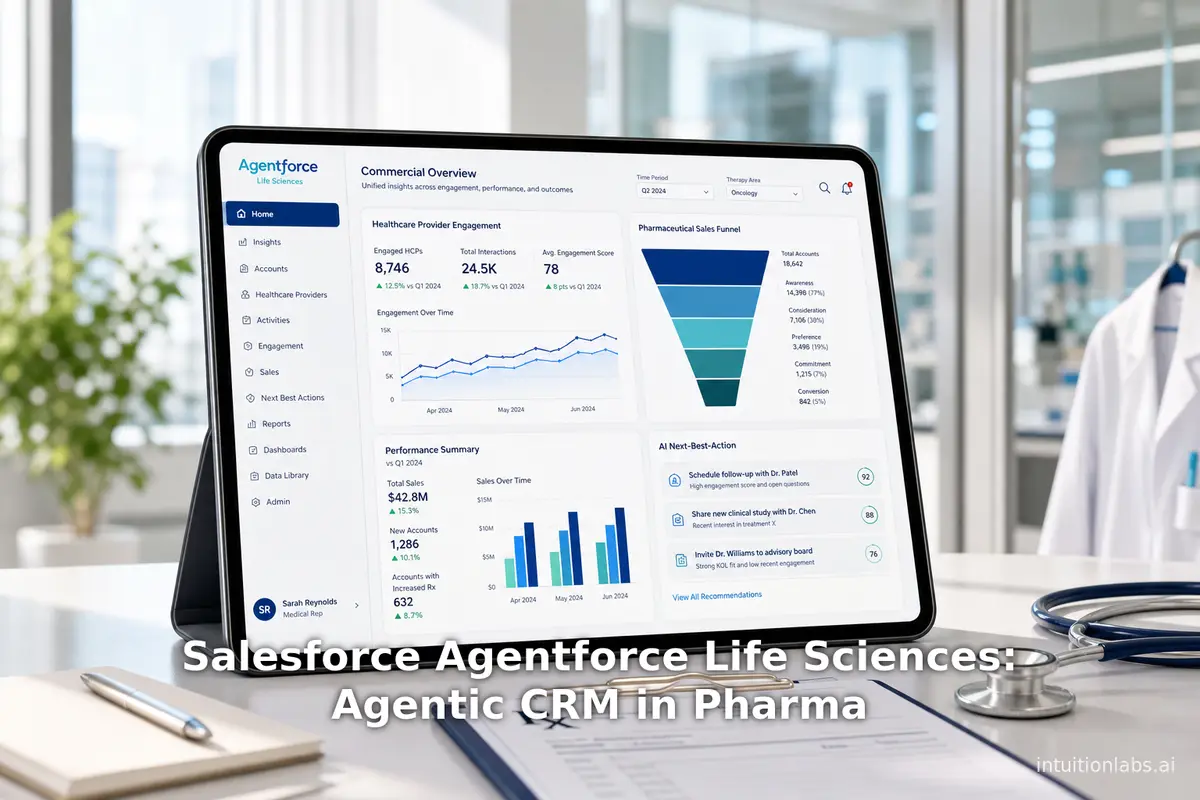
Salesforce Agentforce Life Sciences: Agentic CRM in Pharma
Examine the architecture and adoption of Salesforce Agentforce Life Sciences. Learn how agentic CRM, headless design, and AI impact pharma commercial teams.