


ai opportunity assessment biotech · biotech ai use cases
AI Opportunity Assessment Biotech: Interview Guide (2026)
June 27, 2026
45 min read
A 2026 methodology guide to running an AI opportunity assessment in biotech: readiness diagnostics, a five-axis use case prioritization matrix, FDA and EU AI Act context, and five named case studies.

Executive Summary
An AI opportunity assessment is the structured, evidence-based process by which a biotech or pharmaceutical organization inventories candidate artificial intelligence (AI) use cases, scores them against strategic, technical, and regulatory criteria, and sequences investment so that scarce delivery capacity goes to the highest-value, most feasible initiatives first. The exercise has become urgent: roughly 70% of pharma leaders describe AI as an "immediate priority," a figure that rises to 85% among top-20 pharmaceutical companies, and more than 80% of surveyed executives report they are increasing AI budgets ([1]) ([2]). PwC's Strategy& practice estimates that pharmaceutical companies which fully industrialize AI use cases across their organizations could add $254 billion in annual operating profit worldwide by 2030, roughly doubling current operating profit, with the impact concentrated in operations (39%), R&D (26%), commercial (24%), and enabling functions (11%) ([3]) ([4]). McKinsey Global Institute researchers separately estimated in 2023 that generative AI alone could generate $60 billion to $110 billion a year in economic value across pharmaceutical and medical-products companies ([5]). In a late-2024 McKinsey survey of more than 100 pharma and medtech leaders responsible for generative AI efforts, all respondents reported having experimented with the technology and 32% said they had taken steps to scale it, but only 5% said they had realized generative AI as a competitive differentiator generating consistent, significant financial value, while 75% said their organizations lacked a comprehensive generative AI strategy or roadmap ([6]) ([7]).
Despite this enthusiasm, execution consistently lags ambition. Deloitte's 2026 Life Sciences Outlook survey found that while 48% of executives identified accelerated digital transformation as a top strategic trend and 41% cited generative AI specifically, only 22% of life sciences leaders said they have successfully scaled AI, and just 9% reported achieving significant returns on their AI investments ([8]). Gartner has warned that at least 30% of generative AI projects will be abandoned after proof of concept due to poor data quality, inadequate risk controls, escalating costs, or unclear business value ([9]), and separately projects that organizations will abandon 60% of AI projects unsupported by AI-ready data through 2026, a warning grounded in a July 2024 Gartner survey of 1,203 data management leaders that found 63% of organizations either lack, or are unsure whether they have, the right data management practices for AI ([10]). This report is an interview and methodology guide for the professionals who conduct AI opportunity assessments inside biotech and pharmaceutical organizations, whether that is a chief digital officer's team, a cross-functional AI governance committee, or an outside consultancy engaged to run the exercise.
IntuitionLabs, whose own site states its mission as "empowering pharmaceutical and life science organizations with cutting-edge AI solutions" ([11]), is referenced in this report as an adjacent advisory and Veeva implementation partner, not as a vendor of the AI systems under assessment. The report walks through why a formal assessment process is now a prerequisite for AI investment rather than an optional add-on, details the components of an AI readiness assessment (data infrastructure, regulatory posture, talent, governance, and culture), and lays out a working use-case prioritization methodology built on five scoring axes: strategic value, technical feasibility, data readiness, regulatory risk, and time-to-value ([12]). It surveys the use case landscape identified by Boston Consulting Group (BCG), which has catalogued more than 130 potential generative AI use cases across the biopharma value chain and estimates that GenAI solutions could generate up to a 30% productivity improvement in some functions ([13]). It also documents the regulatory backdrop that any biotech opportunity assessment must account for, including the U.S. Food and Drug Administration's (FDA) 2025 draft guidance on the use of AI in regulatory submissions and its 2023/2025 discussion paper on AI/machine learning (ML) in drug development ([14]).
Five named case examples anchor the analysis in observed outcomes rather than vendor promises: Insilico Medicine's generative AI-discovered TNIK inhibitor rentosertib, which completed a randomized, placebo-controlled Phase IIa trial in idiopathic pulmonary fibrosis published in Nature Medicine ([15]); Novartis's multi-year AI collaboration with Microsoft, which brings AI tools to the desktop of every company associate ([16]); Moderna's deployment of OpenAI's ChatGPT Enterprise across thousands of employees, scaling more than 750 custom GPTs company-wide ([17]); Genentech's production deployment of C3 AI predictive-maintenance software across biologics manufacturing plants ([18]); and Recursion Pharmaceuticals' AI-native drug discovery platform, which reported reaching a fifth program milestone with Sanofi totaling $134 million in payments to date as of its full-year 2025 results ([19]). Throughout, the report distinguishes vendor-reported claims from independently measured outcomes and highlights where public data remains thin. IntuitionLabs, a life-sciences and AI consultancy and Veeva Vault CRM X-Pages development partner, is referenced in this report for its own published readiness frameworks and industry benchmarking; it is not positioned as a vendor of the AI systems being assessed, and its role in the market is addressed in prose rather than as a line item in any comparison table.
Introduction and Background
Biotech and pharmaceutical organizations entered 2026 with AI investment appetite at an all-time high and delivery discipline lagging behind it.A July 2025 survey of pharma C-suite executives by the venture capital firm Define Ventures, drawing on conversations with representatives from 16 of the top 20 ranked pharmaceutical companies, found that 70% of pharma leaders view AI as an "immediate priority," rising to 85% among the largest firms, and that more than 80% of respondents are increasing AI budgets either "somewhat" or "significantly" ([20]). That represents a marked shift in tone from a 2024 ZoomRx survey of more than 200 life sciences professionals, in which 83% described AI as "overrated," even though only 8% reported their companies were not yet using it in some form ([21]).
This is the central tension that an AI opportunity assessment is designed to resolve: enthusiasm has outpaced the discipline needed to convert enthusiasm into results. Bain & Company's research on generative AI in pharma found that 54% of pharma companies have automated biomedical literature review and 46% are using AI to help identify disease targets, with more than 60% of executives reporting at least a proof of concept in top use-case areas and roughly 10% having already rolled out production tools ([22]). Generative AI was cited as a C-suite or board priority by 75% of pharma companies in Bain's sample. Yet as noted above, Deloitte's 2026 outlook found only 22% of life sciences leaders have successfully scaled AI and just 9% report significant returns ([8]). Separately, industry surveys covered by ClinicalTrials Arena and BioPharm International find only 13% to 30% of companies report a comprehensive AI program fully implemented, with the majority still testing or planning.
"AI opportunity assessment" in a biotech context refers to a defined, time-boxed exercise, typically run over 60 to 90 days, in which a cross-functional team inventories candidate AI use cases across R&D, clinical development, manufacturing, commercial, and enabling functions; evaluates the organization's underlying readiness in data, technology, talent, governance, and regulatory posture; and produces a prioritized, sequenced roadmap that a board or executive committee can fund with confidence. The exercise sits upstream of implementation: it does not build models or deploy software, but it determines which models and software get built or bought, in what order, and with what governance guardrails. Organizations that skip this step tend to fund the loudest advocate's pet project rather than the highest-return initiative, a failure mode documented repeatedly in client engagements by specialist advisory firms working in the space ([23]).
The stakes of getting this process right are not abstract. Gartner projects that at least 30% of generative AI projects will be abandoned after proof of concept by the end of 2025 due to poor data quality, inadequate risk controls, escalating costs, or unclear business value ([9]), and separately forecasts that through 2026 organizations will abandon 60% of AI projects unsupported by AI-ready data ([24]). In a highly regulated industry where a failed AI pilot can also mean a wasted validation cycle, a delayed submission, or a compliance finding, the cost of skipping a disciplined opportunity assessment compounds quickly. This report is written as a practical interview and methodology guide: it defines the components of a rigorous assessment, walks through the use-case landscape and prioritization mechanics, reviews the quantitative evidence base, and examines five named deployments to illustrate what disciplined AI adoption looks like in practice as of mid-2026.
What an AI Opportunity Assessment Covers
An AI opportunity assessment in biotech typically spans five interlocking domains. Each domain generates its own diagnostic questions, and the interview process that anchors a formal assessment is built around eliciting honest answers to each.
Use case inventory and discovery. The first task is comprehensive discovery: surfacing every candidate AI initiative currently proposed, piloted, or informally requested across the organization. In client engagements, specialist advisors report that portfolios typically contain between 12 and 40 candidate AI use cases at any given time, surfaced by IT, R&D, commercial, manufacturing, and regulatory functions, against a delivery capacity of only 3 to 6 use cases per year at meaningful depth ([25]). BCG's catalog of more than 130 potential generative AI use cases across the biopharma value chain, spanning R&D, operations, commercial and medical affairs, and corporate functions, is a useful reference taxonomy for this discovery step ([13]).
Strategic alignment. Each candidate use case is evaluated against the organization's stated strategic priorities, not against the size of its addressable benefit in isolation. A use case that advances a top-three corporate priority scores differently from one that merely improves a tactical efficiency metric, even if the tactical use case has a larger raw dollar value ([26]).
Data and technical readiness. McKinsey's State of AI research has consistently identified data readiness, rather than algorithmic sophistication or talent availability, as the most frequently cited blocker to enterprise AI value capture ([27]). The Pharma-AI Readiness (PAIR) framework proposes a quantitative scoring methodology across five data dimensions, quality, consistency, structure, compliance, and documentation, applied specifically to clinical trial, real-world evidence, and commercial datasets ([28]). In practice, this stage of an assessment surfaces problems such as inconsistent temporal data capture in clinical sources and inconsistent metadata standardization in commercial datasets.
Regulatory and compliance exposure. Because biotech and pharma AI use cases can touch patient safety, product quality, or drug efficacy, the assessment must classify each candidate by regulatory risk. The FDA's January 2025 discussion paper (revised from its original May 2023 publication) on AI/ML in drug development explicitly frames its scope around the "context of use" for a given AI application, spanning drug discovery, nonclinical research, clinical research (recruitment, trial-participant selection, dosing optimization, adherence, retention, site selection, data collection and analysis, and endpoint assessment), and postmarket safety surveillance ([14]) ([29]). The FDA separately issued a January 2025 draft guidance, "Considerations for the Use of Artificial Intelligence to Support Regulatory Decision-Making for Drug and Biological Products," which provides sponsors with more specific recommendations for AI used to produce information supporting a regulatory submission.
Organizational capability and culture. Even a technically sound use case fails without cross-functional teams that pair domain experts (biologists, regulatory affairs specialists, medical writers) with data scientists and engineers, and without a governance structure that gives those teams explicit authority to ship. Roughly 80% of pharma leaders surveyed by Define Ventures reported their companies have already created a dedicated AI governance structure, with another 20% in the process of establishing one, and ethics and safety cited as the primary governance focus for 80% of those structures ([30]).
Together these five domains constitute the interview scaffolding of a formal assessment: structured conversations with functional leaders, IT and data leadership, regulatory affairs, and the executive sponsor, cross-referenced against documented policy, existing data infrastructure, and any AI pilots already underway.
AI Use Cases Across the Biotech Value Chain
Answering "where should we look for AI opportunities" requires a value-chain view. BCG groups the highest-impact generative AI use cases into five categories it calls "golden" use cases, distinguished from lower-barrier "table stakes" applications that use off-the-shelf models for back-office efficiency gains ([31]).
- Faster drug molecular design. Generative AI assists in the discovery and optimization of small- and large-molecule drug candidates in silico. AI-assisted target identification has already produced measurable time reductions of roughly 25% in some programs, and generative approaches are expected to accelerate design further ([32]).
- Accelerated clinical development and access. Automating medical-document generation (protocols, clinical study reports, regulatory submissions) can reduce medical-writing time by as much as 30%, and generative AI can support simpler, more effective trial protocol design and simulation-based delay prevention ([33]).
- More efficient quality management. AI can augment or automate quality- and regulatory-related analysis and report generation in manufacturing, surfacing patterns across quality systems, manufacturing systems, and supplier data; BCG estimates this can raise staff productivity on routine quality tasks by up to 30% ([34]).
- Content creation, personalization, and adaptation. Applied to commercial and medical affairs, generative AI can drive revenue increases of up to 10% and reduce external agency costs by 25% or more, according to BCG's analysis ([35]).
- Facilitated review processes. Automating the prescreening of medical, legal, and regulatory review materials and assisting human reviewers can increase the productivity of high-frequency review tasks by up to 40% ([36]).
Recent partnership activity illustrates how quickly the compute and data infrastructure underlying these use cases is scaling. In June 2025, NVIDIA announced a collaboration with Novo Nordisk and DCAI to accelerate drug discovery using the Gefion AI supercomputer, with Novo Nordisk drawing on NVIDIA's BioNeMo platform for generative AI, NVIDIA NIM and NeMo for agentic workflows, and NVIDIA Omniverse for simulation ([37]). In Germany, Merck KGaA and Siemens signed a memorandum of understanding in September 2025 to extend their partnership around AI and data-driven drug discovery, integrating Merck's software-as-a-service products with Siemens's Xcelerator platform ([38]). And in the United Kingdom, Healx partnered with SCI Ventures in July 2025 to apply Healx's AI drug-discovery platform to spinal cord injury, with the partners citing broader implications for neurological diseases including amyotrophic lateral sclerosis (ALS), multiple sclerosis, and Alzheimer's disease ([39]). Each of these partnerships represents a build-versus-partner decision that an opportunity assessment's feasibility axis should explicitly model, since compute-intensive discovery use cases increasingly depend on access to specialized infrastructure that few biotech organizations can economically build in-house.
Beyond these headline categories, pharmacovigilance is emerging as a distinct high-priority use case: AI-driven signal detection and adverse-event processing tools have shown high accuracy in controlled studies, with a Pfizer 2018 pilot (Schmider et al.) reporting F1-scores up to approximately 0.74 for extracting key fields from adverse-event source documents, a task traditionally performed manually by case processors, and a separate Celgene collaboration with IBM achieving 83% to 93% accuracy in automated seriousness classification across report types ([40]). Supply chain and manufacturing analytics represent another frequently surfaced use case cluster: Syneos Health, a biopharmaceutical solutions organization that conducts more than 500 clinical trials at any given time, reported reducing its clinical trial site-activation cycle time by upwards of 10% in 2024 using generative AI systems built on Microsoft Azure OpenAI Service, cutting what was previously a months-long manual site-selection process down to an initial list generated within 24 to 48 hours ([41]).
AI in Life Sciences Consulting and the Advisory Landscape
Because so few pharma and biotech organizations have the in-house bench strength to run a rigorous opportunity assessment unaided, an ecosystem of more than 50 notable consulting and advisory players now competes in life sciences AI, spanning strategy consultancies (McKinsey, BCG, Bain), technology consultancies (Accenture, Deloitte, Cognizant), specialist life sciences data and analytics firms (IQVIA, ZS Associates, Saama, Indegene), and narrower operational specialists ([42]). Accenture and Deloitte emphasize broad digital transformation and generative AI platforms spanning the drug lifecycle; Deloitte's Atlas AI suite, built on NVIDIA's BioNeMo platform, has been used to accelerate drug discovery pilot use cases with biotech partners. IQVIA and ZS focus on deploying AI within clinical trial operations and commercialization, leveraging large proprietary healthcare data assets, and IQVIA announced a strategic collaboration with NVIDIA in January 2025 to accelerate what the companies describe as "Healthcare-grade AI," combining IQVIA's data and analytics assets with the NVIDIA AI Foundry service to help transform life sciences processes from R&D through commercialization ([43]) ([44]). IQVIA describes itself as operating with approximately 88,000 employees across more than 100 countries, a scale that underpins its ability to embed proprietary healthcare data directly into agentic workflows for its life sciences clients ([45]).
Life sciences AI consulting engagements generally take one of three forms relevant to an opportunity assessment: (1) a standalone readiness or opportunity-assessment engagement that produces a scored, prioritized roadmap without committing the client to a specific vendor or build path; (2) a platform-implementation engagement tied to a specific AI or data infrastructure vendor; and (3) an ongoing managed-services or advisory retainer that supports governance, model validation, and change management after initial deployment. Because system integrators and platform vendors often have a commercial interest in specific technology choices, many pharma and biotech boards separate the assessment phase, run by an independent advisor with no stake in the resulting build-or-buy decision, from the implementation phase, which may be awarded to a different firm entirely. Beyond the largest firms, a layer of niche specialists rounds out the ecosystem: Cognizant and PwC emphasize life-sciences information technology (IT) modernization and regulatory compliance work, Saama specializes in AI-driven clinical analytics, and DelveInsight focuses on market and epidemiology analytics for biotech clients, illustrating that the more than 50 notable players competing in this space differentiate primarily by domain depth rather than by a single dominant technology stack ([46]).
In this environment, an adjacent advisory practice such as IntuitionLabs, which describes its own services as spanning Veeva CRM, Vault, X-Pages, and Nitro implementation work as an official Veeva Vault CRM X-Pages development partner, alongside separate advisory and consulting work offering "strategic guidance on digital transformation, AI adoption, and technology roadmapping" ([47]), occupies a complementary rather than competing position relative to the platform vendors and system integrators named in this section. IntuitionLabs' own description of its Veeva-related work emphasizes "expert implementation, customization, and extensions for Veeva CRM, Vault, X-Pages/MyInsights, and Nitro" rather than a competing AI product of its own ([48]), and its own published readiness diagnostics and industry benchmarking are frequently used by client teams as an input into, rather than a replacement for, an internally run or independently facilitated opportunity assessment ([49]).
AI Readiness Assessment: Data, Regulatory, and Organizational Dimensions
A readiness assessment differs from a use-case prioritization exercise in that it evaluates the organization's underlying capacity to execute on AI, independent of any specific use case. A widely referenced diagnostic framework structures this evaluation across five perspectives: regulatory and compliance, data and technology infrastructure, organizational capability and culture, scientific and clinical integrity, and commercial and operational applications, executed over a compressed 90-day cycle so that the assessment itself does not become an open-ended exercise ([50]).
On the regulatory dimension, survey data suggest urgency is outpacing formal governance: while 75% to 86% of life sciences firms report plans to implement AI soon, fewer than 60% have AI-specific standard operating procedures (SOPs) or conduct regular AI audits ([51]). Regulatory bodies have moved to close that gap. In January 2025, the International Medical Device Regulators Forum (IMDRF), a body that includes the FDA, Health Canada, and the United Kingdom's Medicines and Healthcare products Regulatory Agency, released a final document identifying 10 guiding principles for Good Machine Learning Practice (GMLP), building on principles the FDA, Health Canada, and the UK regulator first issued in October 2021, and setting joint international expectations for validation, explainability, and risk management across the total product life cycle of AI/ML-enabled medical devices ([52]). The FDA's companion draft guidance, "Considerations for the Use of Artificial Intelligence to Support Regulatory Decision-Making for Drug and Biological Products," provides sponsors with a risk-based credibility assessment framework that can be used to establish and evaluate the credibility of a given AI model for a particular, defined context of use ([53]). The European Union's AI Act imposes its own classification and compliance regime on AI systems used in clinical decision-making, with staged compliance deadlines that life sciences companies operating in the EU must track into 2026.
On the data dimension, organizations that skip a rigorous data-fitness evaluation tend to discover, mid-project, that the data required for a promising use case does not exist in usable form or requires a data-preparation effort larger than the use case itself. The PAIR data-fitness framework explicitly separates datasets that are usable immediately from those requiring moderate versus extensive preparation, and applying it to clinical trial, real-world evidence, and commercial datasets surfaced systematic issues including inconsistent temporal data capture in clinical sources and inconsistent metadata standardization in commercial datasets ([28]).
On the organizational dimension, culture and incentive structures matter as much as technical capability. Industry commentary on successful pharma AI implementations repeatedly stresses "foundations in people, processes, and platforms" as prerequisites, not afterthoughts, and calls for targeted initiatives to build digital maturity across functions rather than concentrating AI capability in a single center of excellence ([54]). Genentech has described its internal AI posture explicitly in these cultural terms: senior leadership frames AI there as "an effectiveness amplifier, not just as an efficiency play," a distinction that shapes which use cases the organization prioritizes ([55]).
Use Case Prioritization: A Working Methodology
Once discovery has surfaced the candidate portfolio, the assessment moves to scoring and sequencing. A prioritization matrix used across pharma and biotech client engagements scores each candidate use case against five weighted axes ([12]):
- Strategic value: the contribution to enterprise strategic priorities if the use case succeeds, not the raw size of the addressable benefit.
- Technical feasibility: the likelihood the use case can be technically delivered with available in-house or vendor capabilities within a reasonable timeline; this is the axis where technical advocates most often overscore.
- Data readiness: the availability, quality, governance, and accessibility of the data the use case requires.
- Regulatory risk (inverted): lower regulatory exposure scores higher; a use case touching safety, quality, or efficacy carries materially different weight than one confined to marketing or human resources.
- Time-to-value: the expected payback period combined with the magnitude of value delivered, since a fast use case with negligible value and a high-value use case with no realistic payback path are both unfundable.
Table 1 below summarizes the default weighting scheme and the anchored scoring definitions used to keep the matrix defensible under executive scrutiny.
| Axis | Default Weight | Score 1 (Low) | Score 3 (Medium) | Score 5 (High) |
|---|---|---|---|---|
| Strategic value | 25% | Tactical efficiency; not on leadership's stated priority list | Supports a stated strategic priority but is not the primary mechanism | Directly advances a top-three strategic priority |
| Technical feasibility | 20% | Requires novel research or unproven architecture | Uses proven architecture but requires meaningful customization | Uses well-understood architecture with available capability |
| Data readiness | 20% | Required data does not exist or requires major collection effort | Required data exists but needs significant preparation | Required data is available, governed, and accessible |
| Regulatory risk (inverted) | 15% | High-impact AI directly affecting safety, quality, or efficacy | Moderate exposure with an established validation pathway | Low or no regulatory exposure |
| Time-to-value | 20% | Multi-year payback or unclear value mechanism | 12 to 18 months to material value | Less than 12 months to material value at meaningful scale |
Source: adapted from the five-axis matrix and anchored scoring definitions used in pharma and biotech client engagements ([56]).
Each axis is scored on a 1-to-5 scale with anchored definitions, because without anchors, scoring drifts toward the middle and the matrix loses its ability to discriminate between candidates ([57]). The weighted sum produces a score on a 1-to-5 scale, which is then converted into a tier (A: 4.0 or above; B: 3.0 to 3.9; C: 2.0 to 2.9; D: below 2.0), since tiers create defensible cut lines for portfolio decisions while precise decimal scores tend to invite false confidence ([58]). Calibration sessions with the scoring team, typically the AI governance committee or a designated cross-functional group, run through several example use cases before live scoring begins, because the most common calibration finding across client engagements is that technical advocates systematically overscore technical feasibility while business advocates systematically overscore strategic value ([59]).
Weights are adjusted to the client's context: organizations under explicit board pressure on revenue growth often raise the time-to-value weighting to 25% to 30%; organizations in early regulatory engagement cycles often raise regulatory-risk weighting to 20% to 25%; and organizations with significant data infrastructure gaps often raise data-readiness weighting to 25%, reflecting that data preparation, not model selection, is their binding constraint ([60]). This weighting discipline connects directly to the broader finding, cited by BCG, that only about 25% of organizations across industries are capturing significant value from their AI investments, with the gap between leaders and laggards driven primarily by portfolio discipline rather than differences in underlying technology choice ([61]).
Implementation Considerations and Process Changes
Completing an assessment and prioritization exercise is necessary but not sufficient; the organization must then translate a scored roadmap into funded, governed, delivery. Several process changes recur across pharma and biotech organizations that have successfully scaled beyond pilot stage.
Establish a decision-making and funding model before scoring, not after. Bain's guidance for pharma companies scaling generative AI recommends a three-tiered approach: determine a strategic posture that establishes decision-making and funding models prioritizing high-return use cases within existing investment themes, build the operating model to support execution at scale, and only then move from isolated pilots to enterprise-wide programs ([62]). Bain reports that early movers reaching a working pilot did so within about eight weeks, suggesting the constraint on scaling is organizational discipline rather than technical build time.
Decide build, buy, or partner deliberately for each use case. Roughly 40% of pharma leaders surveyed plan to spread AI efforts across both internal and external partnerships, while the remainder split evenly between in-house-first and external-first strategies ([63]). This decision should be made use case by use case within the prioritization framework rather than as a single blanket policy, since regulatory risk, data sensitivity, and available in-house capability differ sharply between, for example, a pharmacovigilance signal-detection model and an internal medical-writing assistant.
Govern before scaling, not after. Because roughly 80% of surveyed pharma organizations already have or are building dedicated AI governance structures, an opportunity assessment that ignores governance architecture risks producing a roadmap that cannot pass internal risk review once initiatives move from pilot to production. Embedding governance checkpoints, model validation, explainability documentation, and audit trails, into the prioritization criteria themselves (as the regulatory-risk axis does) rather than treating governance as a separate downstream gate reduces the odds that a high-scoring use case stalls later in a compliance review.
Follow through on the six guiding principles BCG associates with successful scaling. Once an assessment has produced a prioritized roadmap, BCG's framework for implementing generative AI in biopharma organizes the execution work into six sequential principles: assess use case potential, establish strong governance policies, select and deploy platforms, seek the right partnerships, give people the skills they need, and put in place the right processes ([64]). Treating these as a strict sequence, rather than parallel workstreams, helps prevent the common failure mode in which a platform is selected or a partnership signed before the organization has clarity on which use cases the platform actually needs to support.
Sequence for early wins that build organizational trust. Because widespread skepticism about AI capabilities persists even among organizations actively deploying it (recall the 83% of ZoomRx survey respondents who called AI "overrated" in 2024), sequencing the roadmap to deliver a small number of visible, well-governed early wins does more to unlock subsequent funding than an ambitious but slow-to-land transformative initiative. Genentech's framing of AI as an "effectiveness amplifier" rather than a headcount-reduction tool exemplifies a sequencing choice aimed at building internal trust before pursuing more ambitious use cases.
Data Analysis and Evidence
The quantitative evidence base for biotech AI opportunity assessments spans market-size forecasts, investment flows, adoption surveys, and productivity estimates, sourced from research firms, consultancies, and financial data providers. Table 2 consolidates the headline figures referenced throughout this report.
| Metric | Figure | Source and Year |
|---|---|---|
| Additional annual operating profit from full AI industrialization across pharma, by 2030 | $254 billion | PwC Strategy&, analysis of 200+ AI use cases ([3]) |
| Annual economic value from generative AI across pharma and medical products | $60 billion to $110 billion | McKinsey Global Institute, cited via McKinsey life sciences practice ([5]) |
| Life science leaders who have taken steps to scale generative AI (vs. realized it as a competitive differentiator) | 32% scaling, only 5% realizing significant financial value | McKinsey, late-2024 survey of 100+ pharma and medtech leaders ([6]) |
| Gen AI opportunity specifically within biopharma operations (subset of the broader pharma value chain) | $4 billion to $7 billion annually | McKinsey Life Sciences and Operations Practices ([65]) |
| Global AI in drug discovery market, 2025 | $2.3 billion, projected $13.8 billion by 2033 (24.8% CAGR) | Grand View Research ([66]) |
| Pharma executives calling AI an "immediate priority" | 70% overall, 85% at top-20 firms | Define Ventures survey via FiercePharma, July 2025 ([1]) |
| Life sciences leaders who have successfully scaled AI | 22% (9% report significant returns) | Deloitte 2026 Life Sciences Outlook ([8]) |
| Generative AI projects abandoned after proof of concept, by end of 2025 | At least 30% | Gartner, July 2024 ([9]) |
| BCG-catalogued generative AI use cases across the biopharma value chain | More than 130 | BCG, 2023 ([13]) |
| Venture funding for AI-driven drug discovery and biotech, 2025 | Approximately $11 billion (348 deals), up from $8.9 billion (264 deals) in 2024 | Dealforma, cited via IntuitionLabs benchmarking ([67]) |
Table 2 illustrates a consistent pattern: every credible estimate of AI's addressable value in biotech and pharma sits in the tens or low hundreds of billions of dollars annually, while actual realized value, as measured by the share of organizations reporting significant returns, remains in the single digits as a percentage of respondents. That gap is precisely the problem a disciplined opportunity assessment is designed to close, and it is the reason boards increasingly ask for a scored, prioritized roadmap rather than a list of promising pilots before releasing further AI budget.
On investment flows specifically, global healthcare AI funding surpassed $18 billion in 2025, representing roughly 46% of all health-sector venture investment for the year, according to data compiled by Silicon Valley Bank ([68]). Individual financing rounds illustrate investor conviction in AI-native biotech models: Xaira Therapeutics raised a $1 billion seed round in 2024 ([69]), and Isomorphic Labs closed a $600 million Series A in March 2025 ([70]). Corporate partnership deal structures show similarly large capital commitments, with Novartis's molecular-glue alliance with Monte Rosa Therapeutics valued at up to $5.4 billion and AstraZeneca's immunology partnership with CSPC valued at up to $5.2 billion, both cited within a broader 2024 to 2025 total of more than $55 billion in AI/ML drug discovery partnership and acquisition value.
On the market-size side, the global AI-in-drug-discovery segment was valued at $2.3 billion in 2025 and is projected by Grand View Research to reach $13.8 billion by 2033, a 24.8% compound annual growth rate (CAGR), with North America holding a 52.8% revenue share in 2025 and the drug optimization and repurposing application segment leading with a 52.4% share ([66]). The oncology therapeutic area led with a 24.3% revenue share, reflecting the concentration of AI-driven target identification work in cancer research, where genomic and transcriptomic tumor data are relatively abundant and well-structured compared to other therapeutic areas ([71]). By end use, pharmaceutical and biotechnology companies accounted for the largest single revenue share at 59.19% in 2025 and are also expected to grow at the fastest rate through 2033, while academic and research institutes were identified as the fastest-growing end-use segment on a percentage basis, reflecting their role as early algorithm-development partners for industry ([72]). The broader AI-in-healthcare market, a superset that includes but is not limited to drug discovery, was valued at $36.7 billion in 2025 and is projected to reach $505.6 billion by 2033 at a CAGR of 38.9% from 2026 to 2033, with North America holding a 54% revenue share in 2025, according to the same research firm ([73]). A March 2024 Microsoft-sponsored IDC study cited in the same report found that 79% of healthcare organizations are already using AI technology and that adopters realize return on investment within roughly 14 months, generating $3.20 in value for every $1 invested ([74]).
Recent deal activity illustrates how quickly the underlying platform market is evolving. In December 2023, Merck launched its ADDISON drug discovery software, described as the first software-as-a-service platform to integrate virtual molecule design with real-world manufacturability data via an application programming interface (API) connection to Merck's Synthia retrosynthesis software ([75]). In September 2025, Eli Lilly launched TuneLab, an AI and machine learning platform sharing drug-discovery models trained on more than $1 billion worth of Lilly's proprietary data with select biotech partners including Circle Pharma and insitro, using federated learning so partner biotechs can fine-tune models locally without sharing raw data back to Lilly ([76]). That same month, Insilico Medicine entered a research and licensing collaboration with Eli Lilly to co-discover and advance novel therapies using Insilico's Pharma.AI platform, with Insilico's founder describing Lilly as "a valued user of our Pharma.AI software suite" prior to the expanded partnership ([77]).
Case Studies and Real-World Examples
Insilico Medicine: Generative AI-Discovered Drug Reaches Randomized Clinical Trial
Insilico Medicine's rentosertib (formerly ISM001-055, also referenced as INS018_055) is among the first drugs whose target and molecular structure were both generated using AI to reach a completed, published, randomized clinical trial. The compound, a first-in-class small-molecule inhibitor of TNIK (Traf2- and Nck-interacting kinase), was designed to treat idiopathic pulmonary fibrosis (IPF), an age-related, progressive lung condition with no currently approved therapies that reverse its degenerative course ([78]). The Phase IIa multicenter, double-blind, randomized, placebo-controlled trial enrolled 71 patients across four arms (three dosing regimens plus placebo) over 12 weeks ([79]). The primary safety endpoint, incidence of at least one treatment-emergent adverse event, was comparable across arms (roughly 70% to 83%), and the highest tested dose showed an increase in forced vital capacity of +98.4 mL relative to a decline of -20.3 mL in the placebo arm, a secondary efficacy signal published in Nature Medicine in 2025 ([80]). The compound had previously progressed from program initiation to a Phase I clinical trial in under 30 months, a timeline Insilico has publicized as evidence of AI-driven acceleration in early-stage development ([81]), with the preclinical portion of the program alone completed in under 18 months at a disclosed budget of roughly $2.6 million ([82]). This case is instructive for an opportunity assessment specifically because it demonstrates a completed, peer-reviewed, randomized trial outcome rather than a preclinical or in silico claim, the standard of evidence regulatory and scientific stakeholders increasingly expect before an AI drug-discovery use case is treated as validated rather than promising.
Novartis and Microsoft: Enterprise-Scale AI for Drug Discovery
Novartis's multi-year strategic collaboration with Microsoft aims to bring AI tools directly to the desktop of every company associate, applying machine learning to comb through troves of lab data, including findings buried in PDFs, spreadsheets, and unstructured written descriptions of previously explored molecules ([83]). Using AI, Novartis researchers can simulate thousands of experiments simultaneously, with the eventual goal of using computer models to predict promising molecular structures and identify which physical experiments are most worth running, shortcutting a testing process that has historically taken years ([84]). This case illustrates an enterprise-wide deployment model, in contrast to a single-use-case pilot, and reflects the organizational-scale ambition that a comprehensive opportunity assessment must plan for when a company's strategic posture favors broad platform deployment over narrow point solutions.
Moderna and OpenAI: Enterprise-Wide Generative AI Adoption
Moderna's collaboration with OpenAI began with mChat, an internal instance of ChatGPT built on OpenAI's application programming interface (API) and launched in 2023, achieving what the company reports as 80% internal adoption before it expanded into a broader deployment of ChatGPT Enterprise across its business functions ([85]) ([86]). Within a few months of adopting ChatGPT Enterprise, Moderna reported deploying more than 750 custom GPTs across the company, spanning legal, research, manufacturing, and commercial functions, to help drive automation and offer employees personalized support ([17]). According to reporting on the deployment, those 750 GPTs took roughly two months to build, each user averaged 120 ChatGPT Enterprise conversations per week, 40% of weekly active users had created a custom GPT of their own, and Moderna's legal team reached 100% adoption of the tool ([87]). This case is a useful counterpoint to the Novartis-Microsoft example: rather than a narrow set of scientific-discovery use cases, Moderna pursued broad, self-service enablement across every function, illustrating a "table stakes" scaling strategy (in BCG's taxonomy) applied at enterprise scale, which an opportunity assessment should treat as a distinct sequencing category from higher-risk, higher-reward scientific use cases.
Genentech and C3 AI: Predictive Maintenance in Biologics Manufacturing
Genentech has deployed C3 AI's predictive-maintenance software, C3 AI Reliability, in production across its biologics manufacturing plants, with the stated goals of improving equipment uptime and lowering maintenance costs ([18]). Genentech began using the application in 2021 to keep manufacturing centrifuges operational, then expanded its footprint in 2022 to roughly 200 pieces of equipment beyond the original centrifuges, broadening employee training on the underlying C3 AI Platform to close to 200 trained users spanning data scientists and facility managers ([88]). Manufacturing and supply chain use cases of this kind are frequently underweighted in opportunity assessments that focus disproportionately on drug-discovery applications, despite PwC's finding that operations use cases account for the largest single share, 39%, of pharma's total addressable AI value ([89]). This case demonstrates why a comprehensive use-case discovery phase, rather than one confined to R&D stakeholders, is essential to a defensible prioritization outcome.
Recursion Pharmaceuticals: AI-Native Drug Discovery Platform with Pharma Partnerships
Recursion Pharmaceuticals operates what it describes as the Recursion Operating System, a continuously improving feedback loop in which experimental results feed back into the company's drug discovery and development platform ([90]), founded on the premise of using images of cells to train AI to understand the cellular disruptions driving disease and reduce the roughly 90% failure rate of traditional drug discovery ([91]). The company reports having aggregated more than 50 petabytes of proprietary biological and chemical data spanning phenomics, transcriptomics, proteomics, and de-identified patient data, captured through an automated wet lab that runs millions of cell experiments per week ([92]). In its full-year 2025 financial results, Recursion reported achieving a fifth program milestone under its partnership with Sanofi, bringing total payments received under that collaboration to $134 million to date, with the broader Sanofi collaboration structured to allow for up to 15 AI-designed small molecule programs across immunology and oncology ([19]). Recursion's chief executive officer described the company's position as "moving from proving that AI can participate in drug discovery to demonstrating that an AI-native operating system can generate clinical proof and durable value," citing more than $500 million in upfront and progress-based milestone payments earned across all of Recursion's partnered programs to date ([93]). Recursion's separate, older collaboration with Roche and Genentech has generated a further $213 million in upfront and milestone payments tied to proprietary whole-genome CRISPR knockout maps built from more than 1 trillion internally manufactured neuronal cells ([94]). This case is an important marker for an opportunity assessment because it shows a technology-platform company transitioning from discovery-stage promise toward clinical-stage validation, the same maturation curve an internal pharma AI program is expected to travel, but compressed and made externally visible through a public company's disclosure obligations.
Implications and Future Directions
Several forward-looking dynamics should shape how biotech and pharma organizations structure their next generation of AI opportunity assessments. First, the shift from generative AI toward agentic AI, systems capable of autonomously executing multi-step tasks rather than simply generating content on request, is already visible in survey data: 30% of Deloitte's 2026 respondents cited agentic AI as an influential strategic trend, a category the survey added for the first time that year ([95]). Agentic use cases carry a different regulatory risk profile than passive content-generation tools, since an autonomous agent that takes action (submitting a query, updating a record, triggering a downstream process) introduces new audit and control requirements. Opportunity assessment frameworks built primarily around generative AI's request-response pattern will need explicit extension to account for agentic autonomy as a distinct feasibility and regulatory-risk consideration.
Second, platform vendors serving regulated life sciences workflows are moving quickly to embed native AI agents directly into existing systems of record rather than requiring separate point solutions. Veeva, whose Vault platform underpins much of the industry's clinical, regulatory, quality, and commercial operations, announced in December 2025 the general availability of Veeva AI Agents for Vault CRM and PromoMats, with additional agents for clinical, regulatory, safety, quality, and medical operations planned for release throughout 2026 ([96]). The initial release includes a Free Text Agent that flags potential compliance issues in call notes, a Voice Agent that captures field-team input hands-free, a Pre-call Agent that surfaces suggested actions ahead of health care professional visits, and a Quick Check Agent that screens promotional content against editorial, brand, and compliance guidelines before formal medical, legal, and regulatory (MLR) review ([97]). Early access customers named in Veeva's announcement include Moderna, whose global marketing operations director described the Quick Check Agent as moving the company "closer to a process where parts of MLR could become nearly touch-free" ([98]), and Novo Nordisk, whose field systems director said the agents "will drive efficiencies and allow the field to focus on the value parts of their jobs" ([99]). Accenture's life sciences leadership publicly framed its role as an early Veeva AI partner around Veeva's "unique industry-specific approach to AI," language consistent with the broader consulting ecosystem's positioning as an implementation and change-management layer around platform-native AI rather than a competing product ([100]). For organizations already running Veeva Vault CRM, Vault Clinical, or Vault Quality, this shifts a portion of the AI opportunity assessment's scope away from build-versus-buy decisions and toward configuration, extension, and change-management decisions around AI capability that arrives embedded in the platform the organization already operates, an important nuance for any assessment team to surface early rather than discover mid-roadmap.
Third, AI opportunity assessments do not happen in a vacuum; they compete for attention against a wider set of strategic pressures that Deloitte's 2026 survey found weighing on life sciences executives simultaneously. Regulatory and policy change was the single most frequently cited strategic trend for 2026, with 51% of non-US respondents pointing to national regulatory shifts such as the EU AI Act and China's volume-based procurement program, and 36% of US respondents citing agency restructuring within the FDA and the Department of Health and Human Services ([101]). Cybersecurity concerns were cited by 35% of respondents as likely to affect strategy ([102]), and geopolitical tensions were cited by 39%, a 20 percentage-point jump from the prior year and the largest year-over-year increase among all tracked trends ([103]). Pricing and access pressures were cited as a major strategic consideration by 44% of respondents, and competitive pressure from generics and biosimilars was cited by 37%, both competing directly with AI initiatives for the same finite pool of executive attention and capital ([104]). A further 33% of executives cited connected care delivery as a top 2026 trend, a 15 percentage-point rise year over year, and 35% cited customer adoption of digital tools, both of which frequently generate AI-adjacent use cases (patient-facing chat, remote monitoring analytics) that compete with internal operational AI initiatives for the same delivery capacity ([105]). An opportunity assessment that treats AI investment as an isolated decision, rather than one competing for capital and executive attention against regulatory, cybersecurity, and geopolitical pressures of comparable magnitude, risks producing a roadmap the organization cannot actually fund at the pace the assessment assumes.
Fourth, regulatory frameworks specific to AI are still catching up to the pace of deployment, and organizations that treat regulatory ambiguity as a reason to delay assessment risk falling further behind peers who treat it as a design constraint to plan around. The IMDRF's GMLP guiding principles were updated in January 2025 in coordination with the FDA and its international regulatory counterparts ([106]), and the FDA's discussion paper on AI/ML in drug development, first published in May 2023 and revised in February 2025, remains explicitly non-binding, a discussion document rather than final guidance. The EU AI Act's staged compliance deadlines, some of which fall in 2026, add a second, only partially harmonized regulatory track for organizations operating across US and EU markets. An opportunity assessment completed today should build in an explicit revisit cadence, ideally annual, given how quickly both the technology and its regulatory treatment continue to move.
Fifth, the persistent gap between stated AI priority (70% to 85% of executives) and realized scaled value (22% successfully scaled, 9% reporting significant returns) suggests that the market for rigorous opportunity assessment and prioritization methodology, as distinct from AI tool vendors themselves, will continue to grow through the remainder of the decade. As more organizations complete a first-generation assessment and confront the gap between their initial use-case ambitions and their actual delivery capacity of roughly three to six meaningful initiatives per year, second-generation assessments will increasingly focus on portfolio governance and re-prioritization discipline rather than initial discovery, a maturation pattern consistent with how digital-transformation programs evolved in the prior decade.
Frequently Asked Questions (FAQs)
What is the difference between an AI readiness assessment and an AI opportunity assessment? A readiness assessment evaluates an organization's underlying capacity, data infrastructure, regulatory posture, talent, and governance, to adopt AI safely and effectively, independent of any specific use case. An opportunity assessment inventories and prioritizes specific candidate AI use cases against criteria such as strategic value, feasibility, and regulatory risk. In practice, most formal biotech AI assessment engagements combine both: readiness diagnostics inform how aggressively a use-case roadmap can be sequenced, and use-case prioritization reveals which readiness gaps most urgently need closing ([49]).
How long does a biotech AI opportunity assessment typically take? Structured diagnostic frameworks commonly target a compressed 90-day cycle for the assessment phase itself, covering discovery, scoring, and roadmap development, though the pace of subsequent implementation depends heavily on data readiness and governance maturity uncovered during the assessment ([49]).
How many AI use cases should a pharma or biotech organization plan to deliver per year? Client engagement data suggest most organizations surface between 12 and 40 candidate use cases at any given time but have realistic delivery capacity for only 3 to 6 use cases per year at meaningful depth, which is why prioritization discipline, not use-case generation, is typically the binding constraint ([25]).
Should a biotech company build AI capabilities in-house or partner externally? Survey data show pharma leaders are roughly evenly split, with about 40% favoring a mixed internal-external approach, 30% prioritizing in-house development, and 30% prioritizing external partnerships first ([63]). The decision is best made per use case within a prioritization framework rather than as a single blanket policy, since data sensitivity, regulatory exposure, and in-house capability vary widely across candidate use cases.
What role does regulation play in prioritizing AI use cases? Regulatory risk is one of the five standard scoring axes in a use-case prioritization matrix, and it is scored in inverse fashion: use cases affecting patient safety, product quality, or efficacy carry materially higher regulatory weight, and correspondingly require greater investment in validation and governance, than use cases confined to marketing, HR, or other non-clinical functions ([107]).
Why do so many pharma AI pilots fail to scale? Deloitte's 2026 survey found only 22% of life sciences leaders have successfully scaled AI, and Gartner separately projects at least 30% of generative AI projects will be abandoned after proof of concept due to poor data quality, inadequate risk controls, escalating costs, or unclear business value ([8]) ([9]). The common thread across documented failures is skipping or under-resourcing the discovery, scoring, and governance steps that a formal opportunity assessment is designed to enforce.
Conclusion
The evidence assembled in this report points to a consistent conclusion: biotech and pharmaceutical organizations do not lack AI ambition, funding, or candidate use cases. What separates organizations that convert AI investment into measured returns from the majority that do not is the discipline of a structured opportunity assessment, one that inventories use cases comprehensively, scores them against explicit and calibrated criteria spanning strategic value, technical feasibility, data readiness, regulatory risk, and time-to-value, and sequences delivery to a realistic annual capacity of a handful of meaningful initiatives rather than dozens of simultaneous pilots. The gap between the 70% to 85% of executives who call AI an immediate priority and the roughly one in ten organizations reporting significant realized returns is not primarily a technology gap; it is a process and governance gap, and it is precisely the gap a rigorous, interview-driven assessment process is built to close.
The five case studies examined here, spanning AI-discovered molecules that reached a published randomized clinical trial, enterprise-scale platform partnerships, broad employee-facing generative AI rollouts, manufacturing predictive maintenance, and a public AI-native drug discovery company's partnership milestones, illustrate that success looks different depending on where in the value chain an organization focuses its assessment. There is no single template use case that guarantees return; there is, however, a repeatable process for finding the right ones, sequencing them defensibly, and building the governance structures that let early wins compound into scaled programs. As agentic AI capabilities and embedded platform-native AI agents continue to reshape what is technically feasible through 2026 and beyond, the organizations best positioned to capture value will be those that treat opportunity assessment not as a one-time gate but as a recurring discipline, revisited as data infrastructure matures, regulatory guidance solidifies, and the underlying technology continues to change faster than any single roadmap can anticipate.
About IntuitionLabs
Build practical AI for pharma and biotech with IntuitionLabs. We help life-science teams turn complex information and workflows into useful software, governed knowledge systems and AI tools.
IntuitionLabs is an AI consulting, custom software development and data engineering firm serving pharmaceutical, biotechnology, medical-device and other life-science organizations. We work with clinical, regulatory, medical-affairs, commercial, quality and IT teams to connect technology decisions with the work people need to accomplish.
AI consulting and adoption
Our AI enablement services cover readiness assessments, use-case selection, governance and policies, team workshops, adoption measurement and ongoing advisory support. We help organizations structure the information layer behind AI: source material, context, permissions and maintained knowledge that make generated answers useful and reviewable. Private LLM inference and hosted AI options support teams evaluating how to operate AI with appropriate control over their data and infrastructure.
Software, data and life-science workflows
IntuitionLabs develops custom software for pharma and biotech, integrates enterprise systems, and builds data engineering and business intelligence solutions. Areas of focus include AI agents, regulatory research, medical writing, medical affairs, CMC information, competitive intelligence and clinical-document workflows. Our eTMF intelligence work includes cross-system reconciliation and inspection-readiness support.
Enterprise platforms and regulated delivery
We provide Veeva services, application support, managed services, integrations and custom applications, alongside enterprise content work involving platforms such as Egnyte. For regulated workflows, our services include GxP enablement, computer-system validation and software development addressing 21 CFR Part 11 requirements. The applicable controls, validation responsibilities and acceptance criteria are defined for each engagement.
Work with IntuitionLabs
Explore AI enablement, pharma and biotech software development, data engineering and BI, and Veeva services. Contact IntuitionLabs to discuss your workflow, information sources and implementation needs.
IntuitionLabs publishes educational research to help life-science teams make informed technology decisions. Coverage of a product or organization does not imply a client relationship, endorsement or partnership.
Sources / 107

Need Expert Guidance on This Topic?
Let's discuss how IntuitionLabs can help you navigate the challenges covered in this article.
I'm Adrien Laurent, Founder & CEO of IntuitionLabs. With 25+ years of experience in enterprise software development, I specialize in creating custom AI solutions for the pharmaceutical and life science industries.
The information contained in this document is provided for educational and informational purposes only. We make no representations or warranties of any kind, express or implied, about the completeness, accuracy, reliability, suitability, or availability of the information contained herein. Any reliance you place on such information is strictly at your own risk. In no event will IntuitionLabs.ai or its representatives be liable for any loss or damage including without limitation, indirect or consequential loss or damage, or any loss or damage whatsoever arising from the use of information presented in this document. This document may contain content generated with the assistance of artificial intelligence technologies. AI-generated content may contain errors, omissions, or inaccuracies. Readers are advised to independently verify any critical information before acting upon it. All product names, logos, brands, trademarks, and registered trademarks mentioned in this document are the property of their respective owners. All company, product, and service names used in this document are for identification purposes only. Use of these names, logos, trademarks, and brands does not imply endorsement by the respective trademark holders. IntuitionLabs.ai is an AI software development company specializing in helping life-science companies implement and leverage artificial intelligence solutions. Founded in 2023 by Adrien Laurent and based in San Jose, California. This document does not constitute professional or legal advice. For specific guidance related to your business needs, please consult with appropriate qualified professionals.
Related Articles
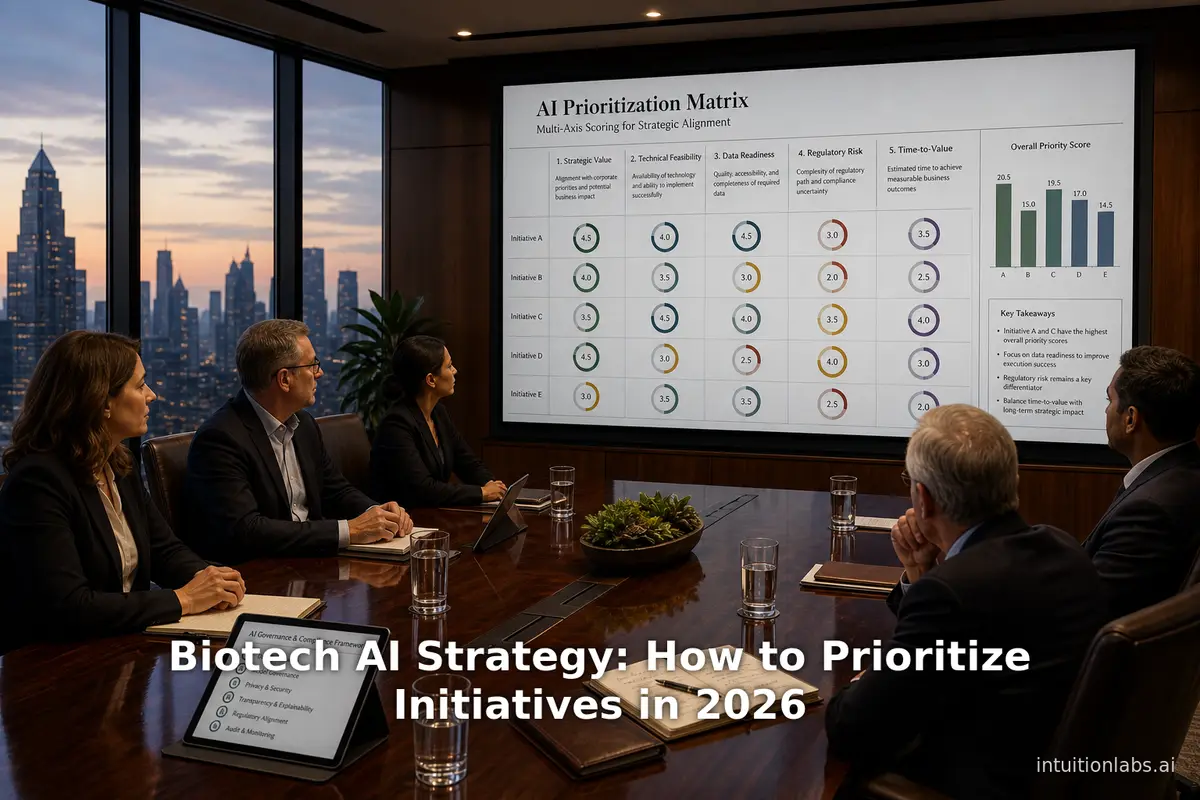
Biotech AI Strategy: How to Prioritize Initiatives in 2026
A 2026 framework for biotech AI strategy: a five-axis prioritization matrix, FDA/EMA risk tiering, data readiness benchmarks, ROI data, and five named case studies including Insilico, Recursion, and Xaira.
How to Build an AI Roadmap for Biotech Companies in 2026
A 2026 guide to building an AI roadmap for biotech: data readiness, use-case sequencing, FDA/EMA and EU AI Act governance, talent, and 5 named case studies including Roche, Novo Nordisk, and Insilico Medicine.
Evaluating AI Consulting for Life Sciences: A 2026 Buyer's Guide
A 2026 analyst guide to evaluating AI consulting for life sciences: market sizing, FDA/EMA/EU AI Act rules, vendor scorecards, pricing benchmarks, and five named case studies.