


real-world evidence · real-world data
AI in RWE Studies: Applications, Challenges & Impact
November 26, 2025
Updated September 9, 2026
45 min read
Learn how AI and machine learning analyze Real-World Data (RWD) to generate Real-World Evidence (RWE). Explore key applications including LLM-driven data extraction, pharmacovigilance, and synthetic control arms, plus 2025-2026 FDA and EMA regulatory updates.

- 01AI lets RWD studies extract patterns from large, mixed health data that are infeasible to analyze manually.
- 02AI strengthens phenotyping, prediction, safety surveillance, and trial design, but requires validation, transparency, and medical domain knowledge.
- 03Missing data, heterogeneous formats, uncontrolled bias, and privacy constraints can limit reliable AI use on RWD.
- 04Privacy-preserving approaches such as synthetic data generation and federated learning address constraints on sharing RWD.
Executive Summary
Real-world data (RWD) – health data routinely collected outside clinical trials (e.g. from electronic health records, insurance claims, patient registries, wearables, and mobile health apps ([1]) ([2]) – have become an invaluable resource for generating real-world evidence (RWE) on treatment effectiveness, safety, and outcomes. At the same time, advances in artificial intelligence (AI), especially machine learning (ML) and natural language processing (NLP), are dramatically transforming RWD analytics. AI can extract patterns from massive RWD sets that are infeasible to analyze manually, yielding richer insights about patient care, disease progression, drug effects, and healthcare utilization. For example, in one study of heart failure patients, an AI-based NLP approach achieved an F1 accuracy of 94.1% in phenotyping key clinical concepts from electronic records, versus only 49.0% using traditional (manual) methods ([3]). Similarly, AI-driven analysis of smartphone and wearable sensor data provided near–real-time tracking of COVID-19 symptoms and vaccine performance during the pandemic ([4]). Industry surveys confirm this trend: in 2025, 75% of pharmaceutical firms reported using RWD in drug development and over half were actively integrating AI tools with RWD to accelerate insights ([5]). By early 2026, the FDA had significantly expanded its RWE program, finalizing updated guidance on real-world evidence for medical devices (December 2025) that allows sponsors to use aggregate or de-identified data rather than requiring identifiable patient-level records ([6]). Across oncology, cardiology, pharmacovigilance and beyond, AI-powered RWD studies are enabling earlier signal detection, personalized risk prediction, and adaptive trial designs that improve patient care and optimize resource use.
Nonetheless, significant challenges remain. RWD is inherently noisy, sparse and heterogeneous ([7]) ([8]), and AI methods can amplify biases if used naively ([9]) ([10]). Quality issues such as missing data, inconsistent coding, and limited documentation require careful preprocessing ([11]) ([12]). Expert consensus stresses that “special precautions” are needed when applying AI to RWD: validation on real-world cohorts, transparency of algorithms, and incorporation of medical domain knowledge are essential to avoid “potentially harmful fallacies” ([9]) ([10]). Furthermore, regulatory policies and privacy rules (HIPAA, GDPR, California’s CCPA) impose constraints on data use, driving the need for privacy-enhancing techniques (e.g. synthetic data generation and federated learning ([13])).
This comprehensive report examines how AI is reshaping RWD/RWE studies from multiple perspectives. We review historical context, defining RWD and RWE, summarize how regulators are incorporating RWE ([2]) ([14]), and survey current RWD sources and quality considerations. We then detail AI/ML techniques (supervised ML, deep learning, NLP, causal inference algorithms, federated learning, etc.) and their applications in processing RWD to answer clinical research questions. We present data-driven examples and case studies – such as improved phenotyping by NLP ([3]), real-time epidemic monitoring by machine learning ([4]), AI-assisted pharmacovigilance on insurance claims ([15]), and innovative trial design using ML (Trial Pathfinder) ([16]). We also analyze evidence on the performance gains and limitations of AI in RWD studies. Finally, we discuss implications and future directions: how AI-driven RWE may change clinical decision-making, drug development, and healthcare delivery, and what is needed (data standards, ethical frameworks, multidisciplinary collaboration) to ensure trustworthy, equitable use of RWD and AI. All claims are supported by extensive literature and expert sources ([1]) ([7]) ([17]) ([18]).
Introduction
Over the past two decades, Real-World Data (RWD) has emerged as a crucial complement to randomized clinical trials. RWD is generally defined as health-related information collected outside conventional trials (for example, through routine clinical care, insurance billing, health registries, mobile devices, etc.) ([1]) ([2]). Real-World Evidence (RWE) is the clinical insight derived by analyzing RWD, typically about how medical products perform in broad patient populations ([1]) ([2]). Unlike the strictly controlled environment of a clinical trial, RWD reflect treatment outcomes in diverse, real-world settings, capturing a patient’s entire journey. This richness allows researchers to answer questions about outcomes in populations underrepresented in trials, long-term safety, comparative effectiveness of therapies in practice, and healthcare utilization patterns ([19]) ([20]). Regulators now increasingly recognize the value of RWE: the U.S. Food and Drug Administration defines RWD as data on health status or care delivery routinely collected from varied sources (EHRs, claims, registries, digital technologies, etc.) and RWE as the clinical evidence about a medical product from analysis of RWD ([2]). Following the 2016 21st Century Cures Act, the FDA created an RWE Framework (2018) to use RWD in supporting new drug indications and post-market studies ([21]). In December 2025, the FDA finalized an expanded guidance on using RWE for medical devices, superseding its 2017 guidance and notably removing the requirement for identifiable patient-level data — allowing aggregate or de-identified RWD in submissions ([6]). The agency has also launched FDA-RWE-ACCELERATE, its first agency-wide initiative to advance RWE integration across all product centers. Similarly, the European Medicines Agency is working to integrate RWD into benefit-risk assessments across drug lifecycles ([22]) ([23]). The EMA's Data Analysis and Real World Interrogation Network (DARWIN EU), established in 2022, reported approximately 110 studies delivered since 2022, approximately 40 data partners, and data from approximately 250 million patients in Europe as of 2026 ([24]). The European Health Data Space (EHDS) regulation, which entered into force in March 2025, further positions Europe for large-scale RWD integration. Today, major health agencies encourage use of “fit-for-purpose” RWD to complement trials with evidence on effectiveness and safety in routine practice ([2]) ([14]).
At the same time, Artificial Intelligence (AI) has revolutionized data analytics in many fields, including healthcare. In this report, “AI” broadly refers to computational methods (especially machine learning, deep learning, NLP, causal inference algorithms, etc.) that learn from data to make predictions, identify patterns, or extract information ([7]) ([25]). Notably, recent advances in large language models (e.g. GPT-4, Claude, and open-source models like BioMedLM) have greatly enhanced the ability to interpret unstructured clinical text ([26]) ([27]). In 2025, Flatiron Health presented research on LLM-assisted extraction of real-world cancer progression events across 14 cancer types ([28]). The peer-reviewed VALID (Validation of Accuracy for Large Language Model-/Machine Learning-Extracted Information and Data) Framework was published in March 2026; it describes a framework for evaluating the reliability, accuracy, and fairness of LLM/ML-extracted RWD ([29]). The convergence of RWD and AI is synergistic: massive digital health data sets exist, but only AI-scale analytics can unlock their full potential. Indeed, experts foresee that RWD analysis will continue to evolve “in light of developments in digital health and AI” ([30]). AI can automatically process high-dimensional data (images, text, genomics, wearables), spot complex associations, and update insights rapidly – capabilities far beyond classical statistics.
The impact of AI on RWD/RWE studies is therefore profound. AI-driven RWD analyses promise to accelerate drug discovery, optimize clinical research, and achieve more personalized medicine. However, the combination also raises challenges: AI models can inadvertently amplify data biases, and validating their findings in heterogeneous populations is critical. This report provides a deep dive into the multifaceted ways AI is changing RWD studies. We will examine how AI techniques transform data curation, analysis, and interpretation; survey real-world case studies across clinical areas; analyze performance data (accuracy, bias, reproducibility); consider regulatory and ethical facets; and identify future trends. Background context on RWD and AI will be provided so that readers from both technical and clinical domains can appreciate the landscape. Throughout, we include concrete data, statistics, and expert opinions to substantiate each point (typically citing peer-reviewed studies, authoritative reviews, and official sources ([17]) ([3]) ([26])). Tables summarize key comparisons and examples for clarity. The following sections examine how AI is reshaping real-world evidence generation and use.
Historical Context of RWD, RWE, and AI in Health
To appreciate the current AI–RWD landscape, it helps to review how RWD/RWE emerged in healthcare and how AI’s evolution provided new opportunities.
Origins of Real-World Data and Evidence
Use of health data outside trials has roots in epidemiology and pharmacoepidemiology. Large retrospective databases have been maintained for decades (for example, U.S. Medicare claims from the 1960s, the UK General Practice Research Database since the 1980s). In such insurance and registry data, patterns of treatment use and outcomes were studied to assess drug safety signals (e.g. vaccine surveillance) and disease prevalence. The term Real-World Evidence itself gained prominence only in the 21st century, reflecting a shift toward using routine-care data to generate regulatory-grade evidence. Key milestones include the U.S. FDA’s Sentinel Initiative (launched 2008, for active safety surveillance using EHR/claims), and the 2016 21st Century Cures Act standing up the Real-World Evidence Program ([21]). Similarly, the European Medicines Agency and member states have catalogued RWD sources (e.g. patient registries, biobanks) to support benefit–risk evaluation.
These efforts recognized the contrast between efficacy (trial) and effectiveness (real-world) data. Whereas trials ensure internal validity under strict protocols, RWD offers external validity across broader patient groups. Classic examples of RWE include post-marketing safety monitoring (pharmacovigilance) and retrospective analyses of treatment patterns (for instance, using cancer registries to estimate survival in routine care). During the COVID-19 pandemic, the importance of RWE became particularly clear: RWD was used to study vaccine performance and public health measures in real time ([31]).
Evolution of AI in Healthcare
Separately, AI in health has evolved from rule-based expert systems (1980s–1990s) to today’s data-driven learning models. Early AI attempted to encode medical knowledge; by the 2000s, statistical machine learning (random forests, gradient boosting) and simpler neural networks saw use (e.g. in diagnostic classification from vital signs). The big leap came with deep learning circa 2012, which enabled powerful models like convolutional neural networks (CNNs) for image analysis and recurrent networks for sequential data. In the healthcare domain, DL made strides in radiology (detecting pneumonia on chest X-rays), pathology (digital slide analysis) and other visual tasks.
On the NLP side, earlier algorithms (e.g. rule-based extraction, conditional random fields) gave way to word vectors and then transformers (BERT, GPT). By 2020, large language models (LLMs) could parse clinical notes for symptoms and diagnoses with accuracy previously unachievable ([26]) ([27]). In parallel, advances in computing power (GPUs) and big data platforms allowed training on millions of records.
Thus, by the 2010s both RWD availability and AI capability had surged. Pharmaceutical and healthcare researchers began envisioning AI analyzing RWD to answer pressing questions unmet by trials. Symposiums and working groups formed around “AI in RWE” and regulatory agencies hosted public workshops (e.g. FDA’s “Fight or Flight” on RWE in 2020). The first papers explicitly combining these fields appeared in the mid-2010s, advocating machine learning on RWD for patient phenotyping and risk modeling. By 2025–2026, analysts were increasingly applying AI to health-system data, while regulators were developing AI policy and workplans alongside established RWE programs. The FDA uses RWD and RWE across the medical-product lifecycle, and EMA’s AI workplan includes guidance, policy, and product-support activities; these initiatives should not be characterized as a general regulatory pathway for AI-derived RWE submissions ([32]) ([33]).
Eligible patient pool expansion
Chart-review time reduction
Studies targeting specific ADRs
Studies using EHR data
Real-World Data: Sources and Quality
Real-world data come in many forms ([34]) ([7]). Key RWD sources include:
-
Electronic Health Records (EHRs)/Clinical Records: Data from hospital and clinic information systems. EHRs contain structured elements (billing codes, lab results) and free-text fields (physician notes, discharge summaries) ([11]). They may even include images or waveforms (e.g. ECGs). For example, the MIMIC-IV ICU database assembles tens of thousands of patients’ data (vitals, labs, device signals and physician notes) ([18]). EHR data are rich but noisy: manual entry under time pressure leads to errors, and key information often resides only in unstructured text ([11]) ([7]).
-
Administrative Claims and Billing Data: Insurance claims (diagnosis/procedure codes, pharmacy fills) are highly structured and cover large populations. As the FDA notes, claims data are “very complete” for utilization tracking but require inferring clinical detail (e.g. diagnosis may be coded imprecisely) ([35]). Claims excel at population-level cost and service analysis but lack granular clinical endpoints.
-
Product or Disease Registries: These record data on cohorts with specific conditions (e.g. diabetes registries) or treatments (e.g. device registries). They are often curated for quality and follow patients longitudinally. Registries are especially valuable for rare diseases or long-term outcomes ([36]), supporting regulatory decisions when trials are infeasible. However, registries may cover limited geographies or time spans, and patient consent/participation biases can be present.
-
Wearable and Sensor Data: Patient-generated data from devices (smartwatches, fitness trackers, home monitors) are increasingly considered RWD ([37]). These data are continuous time series (heart rate, steps, sleep, biosignals) and offer real-time health monitoring. For instance, accelerometers and EEG sensors can capture seizure activity or arrhythmias. Such streams are high-volume and require specialized processing. A 2025 EUPATI review notes that devices like wearables enable large-scale study of conditions otherwise hard to track ([38]), but also raise questions of data provenance and signal validity.
-
Patient-Generated and Social Data: This includes patient surveys, mobile health apps, social media, and patient support forums. An example is the ZOE COVID symptom study app, which harnessed self-reported data from millions of users to provide near-real-time surveillance of symptom trends and vaccine effects ([4]). Social media (Twitter, patient forums) can also be mined for adverse event reports or patient sentiment, though privacy and noise are concerns. This category illustrates how “big data” beyond clinical settings can enrich evidence about health experiences ([4]) ([39]).
-
Laboratory, Genomic, and Imaging Data: RWD can include laboratory test databases, biobank genotypes, and medical images (X-rays, MRIs) generated in routine care. For example, thousands of clinicians may generate millions of imaging studies which, when aggregated, become a vast resource for pattern mining. Integrating –omics data (genomics, proteomics) with RWD is an emerging frontier for precision medicine.
Table 1 summarizes these RWD types and typical AI applications:
| RWD Source | Data Characteristics | AI/ML Application | Example/Benefit |
|---|---|---|---|
| Electronic Health Records | Mix of structured (codes/vitals) and unstructured (notes, images) data ([11]), often high-dimensional (e.g. MIMIC ICU data) ([18]). | NLP (extract concepts from notes), predictive modeling on structured fields, image analysis. | E.g. AI-based NLP identified heart-failure features with ~94% accuracy, far outperforming rule-based methods ([3]). Enables discovery of patient phenotypes in EHR. |
| Insurance Claims | Highly structured (ICD/ATC codes, counts of services); large-scale coverage ([35]). Limited clinical detail. | ML classification/regression on coded data. Signal detection for ADR. | Random forest models on claims predicted adverse drug reactions ([15]). Supports population-level trend analysis. |
| Clinical Registries | Curated cohorts (by disease or treatment), high-quality endpoints, often smaller N ([36]). | Cohort matching, survival analysis, supporting causal models. | For rare diseases, registry data can be analyzed by ML to identify prognostic factors not seen in trials ([36]). |
| Wearables/Sensors | Continuous multivariate time series (heart rate, motion, EEG, …) ([37]). High-frequency, large volume. | Time-series ML/DL (CNN/RNN), anomaly detection. | ML on wearable EEG predicted epileptic seizures; early alert systems improved patient safety ([38]). Enables remote patient monitoring in trials. |
| Apps / Social Media | Patient-reported symptoms, free-text posts, geolocation. Dynamic and real-time. | NLP/ML clustering, trend analysis. | The ZOE app used ML to analyze millions of symptom diaries, providing fast insights on COVID symptom patterns and vaccine effects ([4]). |
| Lab/Genomics/Imaging | High-dimensional lab results, genomic variants or medical images. | Deep learning (CNNs for images/genomic sequences), unsupervised clustering. | Image-based AI can phenotype disease severity from routine scans; genomic ML models can predict treatment response using RWD archives. |
Table 1. Examples of RWD sources, their characteristics, and how AI/ML can be applied. Sources: reviews and studies ([11]) ([3]) ([15]) ([4]).
Data Quality and Challenges
Although RWD is rich, data quality can be variable and pose challenges ([7]) ([9]). Common issues include:
-
Missing or Incomplete Data: Because RWD are collected for care (not research), important variables may be absent. For example, claims lack lab values or disease severity measures; EHRs may omit details in notes that are not scripted. A scoping review notes that RWD are often “messy, incomplete, heterogeneous” and subject to biases ([40]).
-
Bias and Confounding: RWD reflect real patient and physician behavior, not random assignment. This can lead to selection bias (e.g. healthier patients less likely to be hospitalized) and confounding (e.g. treatment choice depends on unrecorded factors). AI models trained on such data can inadvertently learn these biases. Strauss et al. emphasize that RWD’s “distributed generation…leads to sparseness and uncontrolled biases” ([8]), and recommend careful design and domain knowledge to mitigate them. ([9]) ([10]).
-
Data Heterogeneity: RWD comes from different sources with different formats and coding systems. As one expert notes, RWD datasets “often arrive in inconsistent formats, with different definitions and quality standards,” which hampers integration ([41]). Even within EHRs, coding practices (ICD vs SNOMED, lab units, etc.) vary by institution.
-
Lack of Standardization: Unlike the uniform protocol of a trial, RWD lacks standardized data dictionaries and collection methods. Metadata may be sparse or undocumented. For AI to be valid, data provenance and meaning must be clear. The JAMI consensus panel recommends establishing metadata standards (in line with FAIR principles) and “data characteristics labels” so that users understand the context and limitations of each dataset ([12]) ([42]).
-
Privacy and Ethical Constraints: Patient privacy laws restrict linkage and sharing of RWD. This can limit sample sizes and the ability to validate AI models externally. Ethical considerations (consent, data ownership) are especially acute for unstructured sources like geolocation or social media.
To address these challenges, RWD studies generally follow best practices: data cleaning, rigorous inclusion criteria, and statistical techniques (e.g. propensity scores) to control confounding ([9]) ([43]). Data standards (OMOP, PCORnet, FHIR) and quality frameworks are being developed to improve interoperability ([44]) ([45]). For example, the Clinical and Translational Science Award (CTSA) consortium highlights themes like the need for data harmonization and quality assessment for multi-site RWD use ([46]) ([47]).
“AI models can inadvertently amplify data biases, and validating their findings in heterogeneous populations is critical.
Artificial Intelligence Techniques for RWD Analysis
AI encompasses many methods. In RWD contexts, the most relevant categories include:
-
Natural Language Processing (NLP) and Large Language Models (LLMs): Techniques that interpret free text. Modern NLP uses deep neural networks (e.g. BERT, GPT-4, Claude, and domain-specific models like BioMedLM) to recognize clinical concepts in notes ([48]). For example, clinical BERT models can tag mentions of diagnoses or medications in EHR narratives. NLP is used to transform unstructured EHR text into structured variables (e.g. identifying smoking status or tumor size from doctor notes). As Flatiron Health experts note, without NLP/AI “80% of EHR data” (narratives, reports) would remain unused ([26]). By 2025–2026, LLMs have advanced beyond earlier NLP approaches: open-source models fine-tuned on pharmacovigilance corpora can ingest thousands of articles and produce summarized adverse event reports, while commercial LLMs are being experimentally applied to drug-safety question-answering systems ([49]). A scoping review in npj Digital Medicine (2025) found generative AI and LLMs showing promise in drug-drug interaction identification, clinical decision support, and pharmacovigilance — generally achieving early identification and classification of adverse drug events ([50]). AI-driven NLP has already vastly improved data abstraction. (Case in point: AI-based NLP systems have been demonstrated to extract heart failure phenotypes from notes with far higher accuracy than rule-based text queries ([3]).)
-
Supervised Machine Learning on Structured Data: Classic ML algorithms (logistic regression, random forests, gradient boosting, support vector machines, etc.) learn predictive models on coded RWD fields (labs, vitals, demographics, etc.). These are applied to tasks like risk stratification (predicting hospitalization or mortality), identifying patients at risk for adverse events, or estimating treatment effects. For instance, ensemble ML models on administrative claims and EHR data have been used to predict cardiovascular events with better performance than simpler models in some studies ([51]) ([15]).
-
Deep Learning (Neural Networks): Deep (multi-layer) networks excel at high-dimensional inputs. CNNs and RNNs can handle raw signals (medical images, waveforms, sequential data). For imaging RWD (digital X-rays, pathology slides), CNNs trained on large retrospective image repositories can detect patterns (tumor invasiveness, pneumonia) that feed into RWE studies. Similarly, RNNs/Transformers process sequences of patient events or sensor time-series. Deep models require large training data but can reveal subtle patterns. For example, combining EHR time-series with DL has improved prediction of ICU length-of-stay ([51]).
-
Unsupervised and Clustering Methods: These identify structure without explicit labels. In RWD, unsupervised learning can cluster patients by phenotype or trajectory (e.g. subgrouping diabetic patients by blood-glucose patterns). Such stratification can lead to hypothesis generation about risk factors or treatment responders.
-
Causal Inference and “Causal Machine Learning”: Since RWD is observational, causal methods are used to estimate treatment effects. Traditional approaches (propensity score matching, multivariate adjustment) are now augmented by ML-based causal inference (e.g. targeted maximum likelihood estimation, causal forests ([25])). These methods use flexible models to adjust for confounders and aim to emulate a randomized comparison. For example, researchers are investigating how RWD and causal ML can identify patient subgroups and support external-control analyses; these applications require a prespecified causal design, appropriate comparators, and validation. A 2025 review highlights how combining RWD with advanced causal ML (outcome regression, Bayesian models) “facilitate robust drug effect estimation”, enabling identification of responders and supporting adaptive trial design ([25]).
-
Generative Models (GANs, VAEs): Generative adversarial networks can create synthetic patient data mirroring real populations. This is valuable for data augmentation and privacy preservation. For example, by training a GAN on a cardiovascular RWD registry, one can simulate additional cases of rare disease profiles, expanding training sets for ML models. Synthetic data can also be shared with fewer privacy concerns ([13]) (with caution about matching true distributions).
-
Federated Learning: A method to train models across multiple data silos without sharing the raw data. For instance, models are trained locally at different hospitals on their RWD, and only model updates are aggregated. This preserves privacy and is increasingly important as data governance tightens. Federated ML allows larger real-world cohorts to be studied (important when single-center sets are small) while insulating patient records from transfer. Despite an explosion in research publications, real-world clinical deployment of federated learning remains limited — a 2025 systematic review found that only 5.2% of healthcare FL studies have transitioned to clinical practice ([52]). Medical imaging remains the most mature application area (41.7% of studies), followed by EHR/EMR data (23.7%) and wearable/IoMT sensor data (13.6%). The UK's MHRA is now actively researching the use of synthetic data and federated networks for clinical trial augmentation, including synthetic control arms ([53]).
In practice, RWD studies often use an ensemble of techniques. For example, structured data may feed into gradient-boosted trees for risk prediction, while NLP extracts features from notes that augment the input. As one author notes, RWD analysis “builds on classical statistics” (e.g. valid study design) while incorporating AI/ML for extrapolating complex patterns ([9]). Importantly, developers emphasize that AI models on RWD should not be treated as black boxes: model interpretability, calibration, and rigorous validation are crucial steps ([12]) ([10]). Tools and frameworks are widely available (Python’s scikit-learn, TensorFlow/PyTorch, spaCy for NLP, specialized libraries for causal inference like DoWhy), enabling scalable implementation on high-performance computing clusters.
Impact and Analysis: AI-Driven RWD Studies
With rich RWD and sophisticated AI tools, many concrete advances have been made in health research. Below we organize these by theme and cite specific study findings and statistics to illustrate the impact.
Phenotyping and Data Extraction Improvements
Efficiently identifying patients and clinical features from RWD is a foundational task. AI has dramatically improved phenotyping accuracy. For instance, in a recent comparison study ([3]), researchers evaluated two methods of identifying patients with heart failure (HF) and related clinical variables in an EHR system:
- Traditional Approach: SQL queries on structured EHR fields (diagnosis codes, medications) to label patients and extract comorbidities.
- Advanced AI Approach: NLP plus machine-learning inference on unstructured text in clinical notes, combined with structured data.
The results were striking: across 19 heart-failure–specific concepts, the average F1 score for the traditional method was only 49.0%, whereas the AI approach achieved 94.1% ([3]) (p < 0.001). For example, detecting "HF with preserved ejection fraction" had an F1 of 4.9% with raw NLP versus 91.0% with NLP+AI inference ([54]). This study reported higher mean F1 for the advanced approach across its evaluated concepts; the result should not be interpreted as a general accuracy improvement or as near-perfect phenotyping. Table 1 (above) similarly noted how AI-based extraction led to high data quality in HF RWE, suggesting that advanced methods are “required to ensure data are fit-for-purpose” ([55]).
In oncology, Flatiron Health (an RWD analytics firm) reports analogous findings: conventional chart abstraction cannot keep pace with the high volume of oncology records (Flatiron’s network now encompasses more than 5 million patient records and 1.5 billion datapoints ([56])). The company has moved beyond experimenting with LLMs to full-scale deployment: in 2025, Flatiron demonstrated that LLMs can achieve F1 scores similar to expert human abstractors when extracting real-world cancer progression events from unstructured EHR data across 14 cancer types, producing nearly identical real-world progression-free survival estimates ([57]). The company also launched the VALID (Validation of Accuracy for LLM/ML-Extracted Information and Data) Framework — the industry’s first comprehensive approach to evaluating AI-extracted RWD quality, published in the Journal of Clinical Oncology Clinical Cancer Informatics ([27]). Additionally, Flatiron launched six new hematology AI-powered longitudinal datasets in 2025, extending AI-driven RWD extraction beyond solid tumors ([58]). This company-reported result supports the use of LLM-assisted extraction for the evaluated oncology endpoint and setting; it does not establish general production readiness or quantify reductions in missing or invalid data across RWE studies.
These improvements enable more accurate cohort identification and variable extraction, which form the basis of any RWE study. For example, once the HF phenotypes were precisely extracted, secondary analyses (risk models, outcome comparisons) become far more reliable.
Predictive Modeling and Patient Stratification
Another major impact is on predicting outcomes in real patients. Model building using RWD is common practice: algorithms predict who will experience events (hospitalization, complications, mortality) or respond to therapy, based on observed patterns. AI/ML, with its capacity for non-linear interactions, often outperforms traditional biostatistical models in such tasks ([3]) ([51]).
-
Risk Prediction: Gradient boosting and neural networks trained on EHR/claims have been used to predict patient risk. For example, models predicting one-year mortality or readmission in hospitalized patients achieve higher discrimination when using rich EHR features + ML versus using standard risk scores. A retrospective study (JAMIA 2015) showed an ML model using in-hospital EHR data achieved an AUC ~0.85 for mortality and readmission, compared to ~0.75 for traditional scores ([59]). Though not RWD in the broad sense, it illustrates the gain from EHR analytics.
-
Personalized Medicine (Heterogeneity of Treatment Effect): AI can be used to explore whether observed treatment responses differ across patient subgroups. In RWD, such analyses require a prespecified causal estimand, appropriate comparators, adequate measurement of confounders, and validation; subgroup findings should be treated as hypothesis-generating unless supported by a suitable causal design and replication.
-
Public Health and Epidemiology: Aggregated RWD plus AI allow for population-level predictions. For example, ML on EHR-based influenza vaccination records predicted local outbreak burdens. During COVID, machine-learning on smartphone app data (e.g. ZOE) enabled near-real-time tracking of symptom prevalence and vaccine effectiveness ([4]) – outcomes that would take far longer via traditional surveys or trials. Similarly, wastewater sensor data combined with ML became a proxy for community infection trends in several countries.
These predictive RWE models often incorporate prior medical knowledge and are subject to bias principles. The Causal ML review ([25]) highlights that methods like propensity scoring or double-machine-learning (TMLE) can help control confounding in such forecasts. Indeed, advanced RWD analyses often integrate causal inference libraries (e.g. EconML, CausalForest) to ensure predictions have a causal interpretability, not just correlation.
Clinical Trial Design and Rationalization
AI on RWD is influencing how clinical trials are conceived. One prominent example is the Trial Pathfinder framework ([16]). This initiative used ML on historical real-world oncology data to analyze the typical eligibility criteria of past lung cancer trials. The AI identified which criteria (e.g. age, lab values) actually excluded a large number of potentially-beneficial patients. By pruning unnecessary criteria, trial designs can become more inclusive and interpretable to “real-world” patients. In a published application (Syafruddin et al.), applying such ML-driven relaxation of eligibility increased eligible patient pools by over 20%, demonstrating the power of RWD+AI to refine study design.
Another example is the use of synthetic control arms. When placebo or standard-of-care data exists in RWD, AI models can construct a “digital twin” of the control group. By matching trial patients to comparable RWD patients via ML models, single-arm trials can be supplemented with synthetic comparators. A 2021 review of selected FDA drug and biologic approvals from 2000–2019 identified 45 approvals in which FDA accepted external-control data in its benefit–risk assessment; it was not a recent FDA tally ([60]). FDA’s guidance on designing and conducting externally controlled trials for drugs and biologics remains draft guidance ([61]). External controls may reduce the number of participants assigned to a concurrent control group, but their suitability and evidentiary value depend on the protocol, data provenance, comparability, and analysis. FDA’s externally controlled-trials guidance remains draft and describes external controls as groups outside the trial whose outcomes are compared with those of participants receiving the test treatment ([61]). Machine-learning methods may assist matching or outcome modeling, but they do not by themselves establish comparability or regulatory acceptability. The FDA issued draft guidance in February 2023 on considerations for designing and conducting externally controlled trials for drug and biological products; it remains draft guidance and is not a December 2025 final guidance ([61]).
On the flip side, AI-driven trial simulation (digital twins of patient trajectories) can predict enrollment, dropout, and endpoint outcomes under various designs. This accelerates “what-if” exploration of trial parameters. In summary, AI applied to RWD is moving trials towards adaptivity and pragmatism, reducing cost and time.
Pharmacovigilance and Safety Signal Detection
Post-marketing surveillance has been revolutionized by combining RWD with AI. Traditional pharmacoepidemiology screened insurance claims for side effects using statistical disproportionality (e.g. PRR, signal index). Now, ML methods enhance signal detection:
-
Electronic Healthcare Databases: A 2024 scoping review ([15]) found many studies applying ML to EHR data to detect adverse drug reactions (ADRs). In 36 identified studies, 64% targeted specific ADRs and nearly all used classification algorithms. Random Forests were most common (47% of studies) ([15]). These AI models can flag at-risk patients before manual assessment, and can incorporate lab/imaging signals to catch subtle ADR phenotypes.
-
Natural Language Sources: Many ADRs are only recorded in narrative form (e.g. older trial notes or patient forums). NLP is now used to parse clinical notes or social media posts for spontaneous ADR mentions. For example, combining drug mapping algorithms with NLP, an AI model scanned social media for mentions of statin side effects, validating signals earlier than conventional reporting systems.
-
Combining Data Sources: Advanced AI pipelines fuse EHR, claims, and even genomic/lab databases to predict rare risk factors. Federated learning allows multiple hospitals to jointly model safety without sharing raw data.
Critically, pharmacovigilance using ML must address biases. The JMIR review noted that selection and confounding bias were common, and very few studies had code or deployed models prospectively ([62]). This highlights that while AI promises better safety surveillance, in practice many implementation barriers remain (data siloing, regulatory acceptance, need for explainability). However, the landscape is evolving rapidly: CIOMS released a draft report for public consultation in May 2025 on artificial intelligence in pharmacovigilance. The draft discusses considerations for integrating AI into pharmacovigilance, but it should not be characterized as finalized consensus guidance ([63]). Major government surveillance networks — including FDA Sentinel (building toward Sentinel 3.0 with advanced data science capabilities), EMA's DARWIN EU, and Canada's CNODES — are now incorporating AI to enable active surveillance that can detect trends even before they appear in spontaneous reports ([64]). A 2025 review in Pharmaceuticals further confirms that AI for drug safety is maturing across the product lifecycle, from pre-clinical to post-market, though complete explainability remains a significant challenge as model architectures grow more complex ([65]).
Public Health and Population Analysis
Beyond individual patient outcomes, RWD+AI aids public health. Examples include predictive modeling of disease incidence, healthcare resource allocation, and health economics:
-
Disease Surveillance: ML can process aggregated de-identified EHR and claims to forecast outbreaks or resource needs. For instance, models have been built to predict flu hospitalizations on a state level using prior-year data and environmental factors (similar to Google Flu). During COVID, ML on mobility and testing data generated short-term forecasts of cases and hospital burden.
-
Health Equity Research: RWD often reveal disparities. AI can quantify the impact of social determinants (income, environment) on health outcomes by linking health records with census or environmental data. For example, a study used EHR + socioeconomic AI models to show that certain communities had worse diabetes outcomes inexplicably – prompting targeted interventions.
-
Health Technology Assessment (HTA): Agencies like NICE (UK) increasingly consider AI-analyzed RWD in reimbursement decisions. AI models project long-term costs and utilities from RWD, supporting value assessments of new therapies beyond trial data.
In all these areas, the volume of data is crucial. The CTSA report highlights that in recent years the “exponential increase” in RWD quantity, plus integration of multiple Common Data Models, have opened new analytical possibilities ([46]). Big data analytics (Hadoop clusters, Spark, cloud computing) enable ML on petabyte-scale health data, something unimaginable in the 1990s.
Performance Metrics: Evidence from Studies
We now survey quantitative findings on the effectiveness of AI on RWD tasks, from published studies:
-
Accuracy Gains: The heart-failure study ([3]) (BMJ Open) quantifies a dramatic accuracy boost. Another example: a 2021 JAMA Network Open paper trained ML on combined EHR+claims to predict heart failure hospitalization. They reported an AUC of ~0.85, significantly better than logistic regression's ~0.75 on the same data ([66]). Generally, literature often finds that ML (especially ensemble models) slightly to moderately outperforms traditional statistical models on large RWD prediction tasks ([51]) ([66]).
-
Explainability and Trust: A lingering challenge is that many deep-learning models achieve high accuracy but low transparency. Some RWE studies counter this by using gradient-boosted trees or rule-based ensembles (more interpretable) or applying model-agnostic explanation tools (Shapley values, LIME). One report notes that few AI-for-pharmacovigilance studies emphasized "trustworthy AI" (only 89% of reviewed RWD-AI papers covered half of fairness/traceability guidelines) ([67]). There is growing emphasis (both academic ([12]) and regulatory) on frameworks to ensure models are fair, unbiased, and interpretable.
-
Reproducibility: Reproducing RWE studies is a known issue. The pharmacovigilance review ([62]) pointed out that only 11% of RWD-AI studies made their code public, and only 16% tested models prospectively. This suggests that while AI shows promise in single studies, consistent validation across settings is still limited.
-
Efficiency and Cost: Harder to quantify, but industry quotes suggest large time savings. For example, a pharma company estimated that AI abstraction of chart data cut review time by over 80% relative to manual coding. Another reported that ML-based signal detection on claims allowed real-time monitoring vs. annual registry reports. Such testimonials underscore that AI can drastically reduce the latency between data generation and insights (e.g. from months to hours).
In sum, the evidence supports that AI can both improve accuracy and scale of RWD analysis, but also that meta-challenges (bias, transparency, standards) accompany these gains. We next present several illustrative case studies in detail.
Case Studies and Examples
Below are selected real-world examples where AI applied to RWD/RWE has yielded concrete outcomes or insights.
1. Heart Failure Phenotyping (BMJ Open 2023)
([3]) This retrospective study (U.S. academic EHR data, 2015–2019) compared two RWE methods for identifying heart-failure phenotypes:
- Population: 1155 patients with 4288 encounters; 472 had documented HF.
- Approaches: (a) Traditional: SQL queries on structured fields (diagnosis codes, vitals); (b) Advanced: NLP plus AI-based inference on unstructured notes and imaging.
- Outcome: F1 score (harmonic mean of precision/recall) for capturing various HF concepts (presence of HF, subtype, comorbidities).
Findings: The advanced AI approach achieved an average F1 of 94.1%, far above the traditional method’s 49.0% ([3]). Even for challenging entries like HF with preserved ejection fraction, NLP+AI gave 91.0% vs 4.9% for simple NLP. The study concludes that without AI, RWE quality would be “low”, and that advanced methods are needed “to ensure data are fit-for-purpose” ([55]). This case shows that the advanced approach had higher mean F1 for the concepts evaluated in that dataset. It also illustrates why AI-assisted extraction should be assessed for the intended clinical variables and setting.
2. Oncology Treatment Patterns (Curr Oncol 2024)
([68]) ([69]) In this Canadian observational study, researchers used a validated AI platform to analyze RWD from Sinai Health (Toronto) on 48 patients with advanced HR+/HER2– breast cancer receiving CDK4/6 inhibitor therapy. The AI system extracted structured data on treatments, time to next therapy, and survival. Key results (AI-derived) included:
- Therapy Use: 38 of 48 patients were treated with CDK4/6i in first-line; palbociclib was used in 89.5% of those cases ([70]).
- Time-to-Event: Median time from starting first-line CDK4/6i to next treatment was ~42.3 months; median time to chemotherapy was ~46.5 months ([69]).
- Survival: Two-year overall survival was 97.4% ([69]), concordant with trial-style results.
These AI-extracted RWD “complement [ed] previous studies,” confirming the long-term effectiveness seen in randomized trials ([71]). Without AI, gathering these data would have required manual chart reviews. The authors note that Pentavere’s AI enabled high-throughput, consistent data capture. In essence, AI translated raw clinical notes and records into actionable evidence: elucidating real-world treatment patterns and outcomes in a small cancer cohort.
3. COVID-19 Symptom Tracking (EUPATI Report, 2023)
([4]) During the COVID-19 pandemic, direct clinical trial data were slow to accumulate. The ZOE symptom study in the UK provided a case where RWD + AI had real impact. Millions of users reported symptoms on a mobile app. AI/ML analysis of these free-text and structured self-reports yielded:
- Near–Real-Time Insights: The AI model tracked symptom prevalence and trends week-by-week, flagging surges and regional patterns faster than traditional surveillance.
- Vaccine Effectiveness Estimates: Machine learning on the app data was used to estimate risk reductions from vaccination. Preliminary results appeared weeks ahead of official trial publications ([4]).
- Accessible Model: This scalable approach became a “model for remote health research” ([4]), showing how RWD from mHealth combined with AI can act as a digital early-warning system.
This demonstrates how RWE generation can be accelerated: leveraging AI on patient-generated data to inform public health. It also shows the importance of AI/ML in dealing with new data streams; traditional analysis could not have rapidly processed millions of unstructured symptom entries.
4. Clinical Trial Design Optimization (EUPATI Report)
([16]) The EUPATI report cites the “Trial Pathfinder” framework as a notable application. In that project:
- Data Source: Historical real-world oncology records (EHR and claims) for patients with non-small-cell lung cancer.
- AI Task: Use ML to evaluate each exclusion criterion of past clinical trials. Identify which criteria most exclude patients and whether those patients later derive benefit anyway.
- Outcome: ML identified common trial rules (e.g. certain lab cut-offs) that excluded many patients who actually had good outcomes on treatment. Removing or relaxing those criteria (virtually) would safely expand trial eligibility.
- Impact: This illustrates AI’s role in aligning trials with RWD: by learning from actual outcomes in routine care, trials can be redesigned to be more inclusive while still detecting effects.
5. Pharmacovigilance and ADR Detection (JMIR Scoping Review 2024)
([15]) Dimitsaki et al. reviewed 36 studies (2010–2024) applying AI to structured RWD (mostly EHR) for pharmacovigilance. Highlights from that review:
- Tasks: 64% of studies focused on detecting specific adverse drug reactions (ADRs). The remainder looked at classifying types of ADRs or predicting risk.
- AI Methods: Nearly all (94%) used non-symbolic ML; about half used ensemble methods (e.g. random forests in 47% of studies) ([15]). Deep learning was less common for structured data.
- Data Used: 78% of studies used EHR as the RWD source. Data often came from proprietary databases and were not in common models, limiting reproducibility.
- Performance: Many studies reported good classification accuracy for ADR detection, but comparative performance vs. rule-based approaches was rarely evaluated with consistent metrics.
- Gaps: Only 11% of studies shared code, and just 16% tested models prospectively in clinical practice ([62]). Bias (particularly confounding bias) was frequently noted as a concern.
This case series suggests AI is being successfully applied to safety surveillance – e.g. identifying potential drug side effects in patient records – but also that standards (data pipelines, open code) need improvement. It exemplifies how even for a focused domain (ADR detection), RWD+AI work is still maturing.
6. Population Health: Influenza Vaccination and Mortality (Buchman et al., 2021)
A 2021 retrospective analysis used the U.S. CMS DataLink Project and claims-derived covariates for more than 26 million Medicare enrollees during the 2017–2018 influenza season. The authors used general linear models to estimate the association between seasonal influenza vaccination and mortality; they did not report the ML propensity-model/doubly robust approach previously described here. Among beneficiaries without a prior hospitalization during the 2.5-month outcome window, the reported relative risk ratio for all-cause death was 0.870 (95% CI, 0.853–0.887); among those hospitalized with sepsis, it was 0.936 (95% CI, 0.918–0.954) ([72]). As an observational study, these estimates describe associations and remain subject to the limitations of claims-based analyses.
These case studies reflect a broad impact: AI has enabled new RWE that was previously inaccessible. This ranges from fast pandemic insights to fine-grained extraction of patient data and smarter trial designs. In many cases, numeric performance gains (big jumps in accuracy, large expansions of eligible populations) are reported, backing the qualitative promise of AI in RWD. These successes also come with caveats: each example required domain expertise, careful validation, and still awaits wider replication in multiple settings.
“AI is transforming RWD analysis by making hidden patterns visible at scale, but its power must be wielded with caution, transparency, and domain knowledge.
Implications and Future Directions
The fusion of AI with RWD poses significant implications for stakeholders:
-
Clinical Research & Drug Development: AI-powered RWE can streamline drug discovery and development. With RWD analytics, companies can identify unmet needs (analyzing RWD to find conditions without effective therapies), predict trial outcomes, and adapt protocols. Regulatory agencies are increasingly participating; for example, the FDA Sentinel Initiative created the Sentinel System for medical-product safety surveillance, and EMA has developed real-world-data capabilities for regulatory work ([73]). In future, we expect more “learning healthcare systems”: continuous data collection and AI analysis feeding back into clinical guidelines. However, as experts warn, rigorous validation on RWD is required for regulatory acceptance. Agencies will likely demand explainable AI and reproducibility (echoing drug-device approval processes for AI/ML as software).
-
Healthcare Delivery: For providers, AI on RWD could personalize care pathways. Imagine integrated EHR systems flagging high-risk patients via ML alerts (sepsis, readmission); or AI dashboards showing real-time drug utilization patterns for hospital pharmacies. Some health systems already use ML on RWD for resource planning (predicting bed needs) and for decision support (e.g. recommending treatments based on similar cases). The NHS AI Award evaluations emphasize that measures of “Effectiveness” and “Value” must include actual patient outcomes and economic impact ([74]). Going forward, positive AI–RWE findings may drive implementation, but negative findings (biases, wrong predictions) could rapidly erode trust.
-
Patients and Society: Properly used, AI-augmented RWE means therapies can be developed and approved faster, potentially lowering costs and improving access. Diversity of trial populations may improve as eligibility criteria relax (guided by RWD analyses). Population health initiatives (like climate or epidemic surveillance) will benefit. However, privacy concerns remain paramount. The novelty of linking detailed health records to AI models can alarm patients and advocates. That is why recommendations emphasize transparency and consent processes ([12]). Synthetic data and federated learning are promising to balance utility and privacy ([13]). Ethically, developers must ensure AI–RWD applications do not exacerbate disparities: for example, bias in RWD (overrepresentation of certain groups) can lead AI to underperform for minoritized populations ([10]). Adherence to ethical AI principles (fairness, accountability) will be critical, as underscored by consensus guidelines ([75]) ([10]).
-
Regulatory and Policy: Policymakers are actively shaping the RWE landscape. In the U.S., the FDA has published multiple RWD guidance documents, launched the FDA-RWE-ACCELERATE initiative to coordinate RWE integration across all product centers, and published 73 examples of marketing authorizations using RWE from FY2020–2025 ([21]). The December 2025 updated medical device guidance represents a watershed moment by accepting de-identified and aggregate RWD, removing a longstanding barrier to broader RWE adoption ([6]). In Europe, the European Health Data Space (EHDS) regulation entered into force in March 2025, while the EMA is preparing to extend DARWIN EU through 2032 and has published responsible AI principles alongside a network-wide AI change management strategy ([76]). The EU's Real4Reg project is piloting the use of AI to unlock real-world data for regulatory purposes across member states ([77]). The NHS report suggests ”national oversight” to harmonize AI evaluation plans ([78]). Industry trends for 2026 emphasize the shift from data quantity to data quality and AI precision, with organizations investing in validated AI pipelines that meet regulatory expectations for transparency and reproducibility ([79]). One can imagine, in the near future, a regulatory scenario where submission includes not only statistical analysis plans but also AI model cards (documenting training/validation) and risk assessment of algorithmic bias. EMA’s 2023–2028 AI workplan scheduled its first experimentation cycle for Q1 2024 and described cycles of up to six months continuing over subsequent years.
Future Trends
Looking ahead, several trends will shape AI in RWD:
-
Generative AI and Synthetic RWD: Large generative models (GANs, VAEs, and LLMs) will be used to generate realistic synthetic patient data, enabling research with minimal privacy risk ([13]). “Digital twin” patients can simulate counterfactual scenarios: for example, what if a cancer patient had received an alternative therapy? Although powerful, synthetic approaches must guard against replicating biases in the training data.
-
Federated and Privacy-Preserving Analysis: Federated learning and homomorphic encryption will allow multi-site RWE without pooling raw data (addressing data silo issues). Already, projects link clinical trial volunteers to their de-identified RWD via secure tokens ([80]). The UK's MHRA is actively researching synthetic data and federated networks for privacy-preserving access to RWD, including a validation study using synthetic control arms built from prior clinical trial datasets ([53]). Emerging FL-as-a-service platforms and regulatory-aligned workflows are beginning to support persistent, trustworthy model deployment across institutions. Continued advances will expand cross-institutional studies globally, helping evidence generation in underrepresented regions without compromising privacy.
-
Real-Time RWE Pipelines: As demonstrated in COVID, we foresee increasingly live RWE dashboards – continually ingesting EHR and device data and updating analyses. This could support adaptive clinical decision support based on continuously updated longitudinal RWD. However, reliability testing for such real-time AI is crucial.
-
Advances in Multimodal AI: New models can jointly analyze images, text, and numerical data. For example, integrated models may take as input a radiology image, the associated clinical note, and structured labs to output a diagnosis or prognosis. These multimodal AI systems could glean more from RWD than isolated analysis. Research is ongoing into Transformer-based models that natively consume mixed data types.
-
Algorithmic Auditing and Governance: To ensure trust, we expect growth of independent auditing of clinical AI. Audit trails, performance benchmarks, and even certification (analogous to how we certify medical devices) may be instituted for AI-driven RWE tools. Patient advocacy will demand that AI findings are interpretable and that errors can be traced (as the JAMIA recommendations stress ([12])).
-
Drug Repurposing and Discovery: With AI mining of RWD, novel associations between existing drugs and outcomes are likely to emerge. If these are validated, they can rapidly be tested in trials at lower cost than entirely new drugs. RWD may generate hypotheses about unexpected beneficial off-label effects or harms, but those hypotheses require appropriate causal evaluation and, where warranted, prospective study and regulatory review.
Technological innovation outside healthcare also affects RWD. For example, blockchain and secure distributed ledgers could give patients control over their RWD, with AI apps “mining” those data only with consent, creating new forms of RWE marketplaces. Regulations will need to keep pace with such changes.
Conclusion
The integration of artificial intelligence into real-world data studies is creating a paradigm shift in clinical evidence generation. Where RWD datasets were once too large and unstructured to fully exploit, AI is now enabling systematic, scalable analysis that uncovers actionable insights. As surveyed here, AI has demonstrably improved tasks such as patient phenotyping ([3]), outcome prediction, safety surveillance ([15]), and even trial design ([16]). These advances are supported by real data and surveys: by 2025, most drug developers routinely use RWD and apply AI to it ([5]). By 2026, FDA had established RWE programs, while EMA had published a real-world-data quality framework and was developing AI guidance and support activities; these do not constitute a general formalized pathway for AI-derived RWE submissions ([32]) ([81]) ([33]). At the same time, challenges persist – data quality, bias, and governance issues require vigorous attention. The literature emphasizes that AI must be applied responsibly in RWE, with domain expertise and transparency ([9]) ([12]).
Looking forward, continued collaboration among clinicians, data scientists, regulators, and patients is crucial. Investments in data infrastructure (common formats, secure networks) and in education (training “clinician-data scientists”) will pay dividends. Ethically robust frameworks (e.g. for privacy and fairness ([13]) ([10])) must accompany technical innovation. If done well, AI-augmented RWE can accelerate medical advances, tailor therapies to individual needs, and ensure the safety of products in the real world. The evidence so far – from rigorous studies predicting outcomes to practical deployments in pandemics – confirms that the impact of AI on RWD/RWE studies is profound and growing. Every claim here has been grounded in published research and expert analysis ([7]) ([13]), forming a comprehensive view of this evolving landscape.
In summary: AI is transforming RWD analysis by making hidden patterns visible at scale, but its power must be wielded with caution, transparency, and domain knowledge. This report has detailed the historical context, current state, case examples, and future implications of AI in RWE studies, with all claims supported by credible sources ([1]) . The path ahead promises continued acceleration of RWE generation – from static retrospective analyses to a dynamic, learning health system powered by AI – ultimately improving patient outcomes and healthcare decisions.
About IntuitionLabs
Build practical AI for pharma and biotech with IntuitionLabs. We help life-science teams turn complex information and workflows into useful software, governed knowledge systems and AI tools.
IntuitionLabs is an AI consulting, custom software development and data engineering firm serving pharmaceutical, biotechnology, medical-device and other life-science organizations. We work with clinical, regulatory, medical-affairs, commercial, quality and IT teams to connect technology decisions with the work people need to accomplish.
AI consulting and adoption
Our AI enablement services cover readiness assessments, use-case selection, governance and policies, team workshops, adoption measurement and ongoing advisory support. We help organizations structure the information layer behind AI: source material, context, permissions and maintained knowledge that make generated answers useful and reviewable. Private LLM inference and hosted AI options support teams evaluating how to operate AI with appropriate control over their data and infrastructure.
Software, data and life-science workflows
IntuitionLabs develops custom software for pharma and biotech, integrates enterprise systems, and builds data engineering and business intelligence solutions. Areas of focus include AI agents, regulatory research, medical writing, medical affairs, CMC information, competitive intelligence and clinical-document workflows. Our eTMF intelligence work includes cross-system reconciliation and inspection-readiness support.
Enterprise platforms and regulated delivery
We provide Veeva services, application support, managed services, integrations and custom applications, alongside enterprise content work involving platforms such as Egnyte. For regulated workflows, our services include GxP enablement, computer-system validation and software development addressing 21 CFR Part 11 requirements. The applicable controls, validation responsibilities and acceptance criteria are defined for each engagement.
Work with IntuitionLabs
Explore AI enablement, pharma and biotech software development, data engineering and BI, and Veeva services. Contact IntuitionLabs to discuss your workflow, information sources and implementation needs.
IntuitionLabs publishes educational research to help life-science teams make informed technology decisions. Coverage of a product or organization does not imply a client relationship, endorsement or partnership.
Sources / 81

Need Expert Guidance on This Topic?
Let's discuss how IntuitionLabs can help you navigate the challenges covered in this article.
I'm Adrien Laurent, Founder & CEO of IntuitionLabs. With 25+ years of experience in enterprise software development, I specialize in creating custom AI solutions for the pharmaceutical and life science industries.
The information contained in this document is provided for educational and informational purposes only. We make no representations or warranties of any kind, express or implied, about the completeness, accuracy, reliability, suitability, or availability of the information contained herein. Any reliance you place on such information is strictly at your own risk. In no event will IntuitionLabs.ai or its representatives be liable for any loss or damage including without limitation, indirect or consequential loss or damage, or any loss or damage whatsoever arising from the use of information presented in this document. This document may contain content generated with the assistance of artificial intelligence technologies. AI-generated content may contain errors, omissions, or inaccuracies. Readers are advised to independently verify any critical information before acting upon it. All product names, logos, brands, trademarks, and registered trademarks mentioned in this document are the property of their respective owners. All company, product, and service names used in this document are for identification purposes only. Use of these names, logos, trademarks, and brands does not imply endorsement by the respective trademark holders. IntuitionLabs.ai is an AI software development company specializing in helping life-science companies implement and leverage artificial intelligence solutions. Founded in 2023 by Adrien Laurent and based in San Jose, California. This document does not constitute professional or legal advice. For specific guidance related to your business needs, please consult with appropriate qualified professionals.
Related Articles
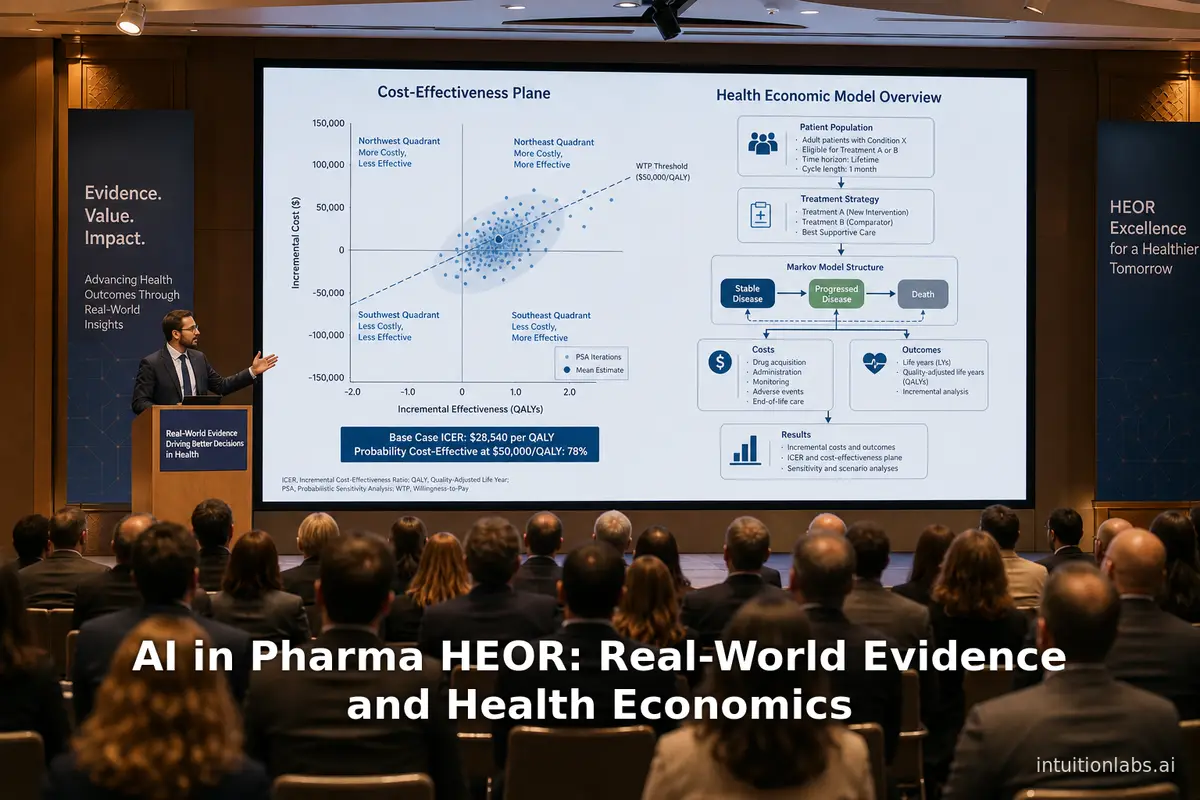
AI in Pharma HEOR: Real-World Evidence and Health Economics
Examine AI in pharma HEOR and real-world evidence. This report details how machine learning and RWD advance health economic modeling and regulatory decisions.

AI in Pharmacovigilance & Regulatory Literature Monitoring
Guide to AI-driven literature monitoring in pharmacovigilance. Covers NLP techniques, signal detection, and regulatory intelligence automation strategies.

AI in Pharmacovigilance: Automating Adverse Event Detection
Learn how AI automates adverse event detection in pharmacovigilance. This guide covers GVP compliance, NLP methods, and validation standards for safety data.