Videos
Browse videos by topic
All Videos
Showing 145-168 of 1435 videos

Veeva Vault Crm Tutorial For Beginners (2025)
Ned TECH
/@Ned_TECH
Jul 22, 2025
This video provides a comprehensive beginner's tutorial on Veeva Vault CRM, positioning it as the enterprise CRM solution specifically tailored for the life sciences industry and built upon the robust Veeva Vault platform. The context is set around a significant strategic shift expected in late 2025, where the system is transitioning away from reliance on Salesforce and becoming natively integrated into the Veeva Vault ecosystem. This move is highlighted as crucial for ensuring fast, compliant, and insightful performance for pharmaceutical and biotech field teams. The tutorial progresses logically, starting with the fundamental steps of logging in and accessing the system. It immediately establishes that Vault CRM is a cloud-based solution designed for managing critical commercial activities, including healthcare provider (HCP) relationships, content presentation, activity logging, and sample tracking, all within a strictly regulated environment. The core operational workflow is detailed through the "Account and Calls" feature, which guides users to browse HCP accounts, review recent call history, and utilize "smart insights" or AI-driven suggestions for visit preparation. During the actual visit, the system facilitates logging call objectives, attaching follow-up actions, and marking the outcome status, ensuring a complete audit trail of interactions. A major feature explored is Closed Loop Marketing (CLM), which allows field teams to create custom presentations by selecting relevant slides to tailor their messaging to specific HCPs. Crucially, the system automatically tracks the content shown, providing essential data for both internal analytics and external audits, reinforcing the platform's focus on regulatory compliance. Beyond daily field operations, the video touches upon the administrative and strategic capabilities of Vault CRM, including advanced tools, admin setups, robust reporting and dashboards, and managing permissions and licensing. The speaker also notes the availability of specialized workshops, such as "Vault CRM and Belment," which are designed to help experienced users transition smoothly from legacy Veeva CRM systems to the native Vault platform, emphasizing the current market need for migration support. Ultimately, the system is presented as a user-friendly solution, accessible via mobile and desktop, built to streamline call execution and enhance operational insight through robust data capture and evolving AI capabilities. Key Takeaways: • **Veeva Vault CRM is the Strategic Future for Pharma CRM:** The video explicitly notes the platform's transition in late 2025 to become natively integrated into the Veeva Vault platform, signaling a major industry shift away from legacy Salesforce dependencies. This confirms that future consulting and integration efforts must prioritize the native Vault architecture. • **Compliance is the Foundational Design Principle:** Vault CRM is engineered specifically for use within a "regulated compliant environment," managing sensitive activities like sample tracking and activity logging. Any custom software or AI integration must inherently support and enhance adherence to strict industry regulations (e.g., FDA, GxP). • **AI is Embedded in Commercial Workflow:** The platform utilizes "AI-driven suggestions" and "smart insights" to aid field teams in preparing for HCP visits, confirming that AI is already a native component of the commercial workflow. This presents opportunities for IntuitionLabs to develop and integrate more sophisticated LLM agents for enhanced preparation and decision support. • **Closed Loop Marketing (CLM) is Critical for Audits:** The system tracks exactly what content is presented to HCPs, providing essential data for analytics and regulatory audits. Consulting services should focus on optimizing CLM content management and ensuring the integrity of the tracking mechanism for compliance reporting. • **Migration Services are in High Demand:** The mention of workshops designed to transition experienced users from "legacy Viva CRM to vault natively" highlights a significant market opportunity for specialized consulting services focused on efficient, compliant, and comprehensive migration strategies. • **Focus on Field Efficiency and Mobile Access:** Vault CRM is designed for "flight level CRM performance" with user-friendly mobile and desktop access, meaning that optimization projects should prioritize mobile usability, fast data entry, and minimizing friction for field professionals. • **Robust Data Capture Fuels Business Intelligence:** The platform emphasizes "robust data capture" and features native reporting and dashboards. Successful implementation requires strong data engineering capabilities to integrate this captured commercial data into broader enterprise data pipelines for actionable business intelligence. • **HCP Account Management is Enhanced by AI:** The workflow encourages field teams to review recent notes and utilize AI-driven suggestions before visits, underscoring the value of integrating custom LLM solutions that can synthesize complex clinical or commercial data into concise, actionable pre-call summaries. Tools/Resources Mentioned: * Veeva Vault CRM * Closed Loop Marketing (CLM) * Vault CRM and Belment (workshops for transitioning users) Key Concepts: * **Veeva Vault CRM:** A cloud-based Customer Relationship Management system built specifically for the life sciences industry, designed to manage commercial operations and HCP interactions in a compliant manner. * **Closed Loop Marketing (CLM):** A feature within Veeva that enables field teams to present tailored marketing and medical content while automatically logging the specific content shown for audit and analytic purposes. * **HCP Accounts:** Healthcare Provider accounts, representing the target audience for pharmaceutical and biotech field teams. * **Smart Insights/AI-driven Suggestions:** Automated recommendations or data summaries generated by the platform's evolving AI features to assist sales representatives in preparing for client interactions.
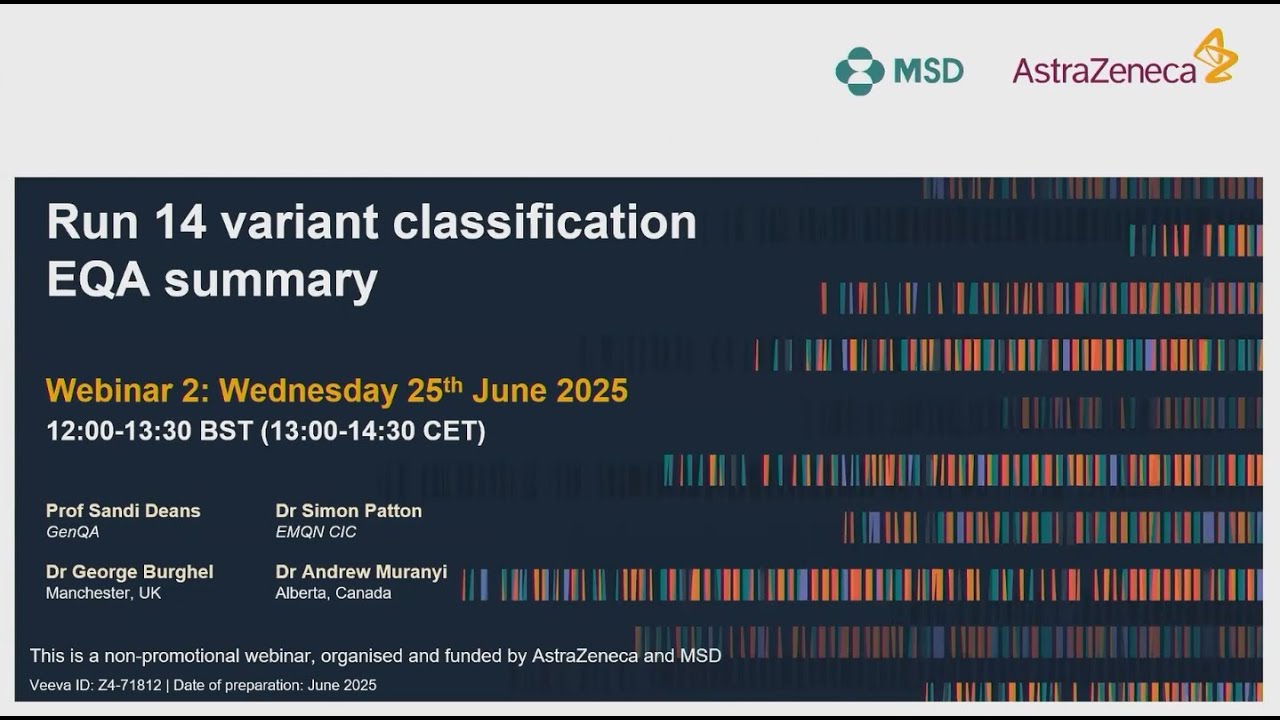
VEEVA APPROVED Run 14 Variant Classification EQA Summary Webinar recording
EMQN CIC
/@EMQN
Jul 22, 2025
This webinar provides an in-depth summary and analysis of the outcomes from Run 14 of the BRCA variant classification External Quality Assessment (EQA) scheme, co-hosted by EMQN CIC and GenQA. The primary goal of the EQA is to assess and improve the competency of clinical scientists and molecular pathologists globally in classifying variants within BRCA1, BRCA2, and other Homologous Recombination Repair (HRR) genes, such as ATM. The session, funded by AstraZeneca and MSD, highlights the critical challenges and discrepancies encountered when applying complex, evolving variant classification guidelines, specifically focusing on the differences between ClinGen's Variant Curation Expert Panel (VCEP) guidelines (e.g., ATM VSEP, BRCA VSEP) and the UK-specific Canvig guidelines. The assessment utilized the Genie platform, GenQA’s genomic online education platform, and involved 359 participants from 58 countries. A key finding was the significant improvement in performance compared to previous runs, with 50% of participants correctly classifying all six variants—the highest percentage of accurate classifications recorded to date. The webinar detailed the classification of six specific variants spanning Class 1 (benign) through Class 5 (pathogenic), covering missense, frameshift, and deletion variants. A major theme was the variability introduced by different guideline combinations. For instance, the majority of participants (40%) used a three-way combination of guidelines (ACMG 2015, UK ACGS 2020, and Canvig UK 2020), demonstrating a lack of universal standardization, which leads to classification discrepancies even when the clinical outcome remains the same (e.g., benign vs. likely benign). Detailed discussions focused on the nuanced application of specific ACMG/ClinGen criteria, such as PVS1 (very strong evidence for loss-of-function), PM3 (co-occurrence with a pathogenic variant), BS1 (allele frequency in controls), and BP1 (missense variant outside a key functional domain). For example, the analysis of an ATM missense variant (Variant 1) highlighted the ambiguity in applying PM2 (absence in control databases) due to conflicting recommendations between the latest ClinGen VSEP version (which removed specific Nomad version requirements) and the corresponding publication or Canvig guidelines (which recommend using Nomad version 2.1). Furthermore, the classification of a BRCA1 missense variant (Variant 3) showed how the same functional study evidence (Stoita et al. 2018) is weighted differently—strong (BS3) under ClinGen VSEP but only moderate under Canvig UK, resulting in benign versus likely benign classifications, respectively. The experts also addressed common pitfalls, such as the misuse of criteria (e.g., applying BP1 and BP4 together, which constitutes double-counting evidence) and the incorrect application of criteria based on domain location (e.g., applying PP3 for in silico predictions outside BRCA1 functional domains). The discussion around Variant 5 (a BRCA1 deletion) introduced the use of PS4 (case-control data) under Canvig UK guidelines, leveraging NHS and UK Biobank data, a powerful criterion currently unavailable in the ClinGen VSEP framework. This highlights a crucial difference in how regional groups incorporate local, high-quality population data into their classification schemes. The session concluded by emphasizing that while performance is improving, ongoing education and harmonization efforts are essential, particularly as the community anticipates the release of the new ACMG/AMP guidelines (Version 4). Key Takeaways: • **Improved Classification Accuracy:** Run 14 saw a significant improvement, with 50% of participants correctly classifying all six variants, suggesting that increased use of standardized guidelines and training tools is raising the global standard of variant interpretation. • **Guideline Discrepancies are Common:** Differences exist between the ClinGen VSEP (e.g., ATM, BRCA) and Canvig UK guidelines, particularly in the strength assigned to specific evidence codes (e.g., BS1, BP1, BS3), leading to classifications like benign vs. likely benign for the same variant. • **Ambiguity in PM2 Application:** For ATM variants, there is current ambiguity regarding which version of the Nomad database should be used to apply PM2 (absent in controls), with ClinGen VSEP recommendations conflicting slightly with their own publications and Canvig guidelines. • **Regional Data Advantage (PS4):** The Canvig UK guidelines allow for the application of PS4 (case-control data) using UK-specific resources like NHS data and UK Biobank controls, enabling a "very strong" classification strength that is not currently supported by the ClinGen VSEP framework. • **Avoid Double-Counting Evidence:** Participants frequently misused criteria, such as applying both BP1 (missense outside functional domain) and BP4 (in silico prediction benign), which is explicitly discouraged as it double-counts evidence towards a benign classification. • **Domain-Specific Criteria:** Criteria like PP3 (in silico prediction) and BP1 are highly domain-specific; for BRCA1, they should only be applied if the variant is located within specific functional domains (Ring, Coiled-Coil, BRCT repeats) or outside them, respectively. • **Importance of PM5 Repurposing:** For truncating variants in ATM and BRCA, the PM5 code has been repurposed by both VSEP and Canvig to apply at a strong strength, yet nearly half of participants failed to apply this criterion correctly for the BRCA2 frameshift variant (Variant 6). • **Functional Study Weighting Varies:** The strength assigned to functional studies (BS3/PS3) can differ between guidelines; the same study on a BRCA1 variant was rated as strong evidence for benign classification by ClinGen VSEP but only moderate by Canvig UK. • **Impact of Paywalls on Classification:** Access to crucial publications hidden behind paywalls remains a challenge, potentially limiting the evidence available to some labs and affecting the application of criteria like PM3 (co-occurrence/phenotype evidence). • **Future Guideline Adaptation:** The upcoming release of the new ACMG/AMP Version 4 guidelines will necessitate a significant effort by VCEPs to review and adapt gene-specific criteria, creating a temporary lag where labs must continue to rely on the existing gene-specific VCEP criteria. Tools/Resources Mentioned: * **Genie Platform:** GenQA genomic online individual education platform used for delivering the EQA. * **Nomad (v2.1, v4.1):** Genomic databases used for assessing allele frequency and applying BS1/PM2 criteria. * **ClinVar:** Database for variant classifications. * **BRCA Exchange:** Database for BRCA variant information. * **LOVD (Leiden Open Variation Database):** Database mentioned for variant data. * **SpliceAI:** Tool used for predicting splicing impact. * **Canvar UK:** Variant database used by UK scientists, providing access to functional study scoring sheets and case counts from NHS data. * **CardioB Calculator:** Used for calculating the maximum tolerated allele count for BS1 application. Key Concepts: * **External Quality Assessment (EQA):** A scheme used to monitor and improve the quality and consistency of laboratory performance, in this case, genomic variant classification. * **Variant Classification Expert Panel (VCEP):** ClinGen working groups that develop gene-specific rules and modifications for the ACMG/AMP guidelines (e.g., ATM VSEP, BRCA VSEP). * **PVS1 (Pathogenic Very Strong):** Criterion applied to predicted loss-of-function variants (frameshifts, nonsense) that are likely to undergo Nonsense-Mediated Decay (NMD). * **PM3 (Pathogenic Moderate):** Criterion applied when a variant is found in trans with a known pathogenic variant for a recessive disorder, or when phenotype evidence is strong. * **BS1 (Benign Strong):** Criterion applied when the allele frequency of a variant in control populations (Nomad) is too high to be consistent with the disease prevalence. * **BP1 (Benign Supporting):** Criterion applied to missense variants in genes where truncating variants are the primary cause of disease, provided the missense variant is outside a known functional domain. * **PM5 PTC (Protein Truncating Codon):** A repurposed criterion used for protein truncating variants (frameshifts, nonsense) in ATM and BRCA to provide additional strong evidence of pathogenicity.

💰 High-Paying Desk Jobs for Pharma & Life Sciences, Medicine Students | Career Guidance
Pharma bharat Jobs
/@pharmaJobs1
Jul 20, 2025
This video, titled "High-Paying Desk Jobs for Pharma & Life Sciences, Medicine Students," provides comprehensive career guidance for individuals from diverse academic backgrounds, including B.Pharm, M.Pharm, Pharm.D, MBBS, BDS, and various life sciences and biotech degrees. The expert analyst outlines specific career paths to avoid due to low pay, slow growth, and repetitive tasks, such as medical coding, QC/production roles, and medical representative positions. Conversely, the video strongly advocates for pursuing desk-based, high-growth roles within clinical research (CRA, CDM, Government CRC), pharmacovigilance, medical writing, regulatory affairs, medical affairs (MSL), HEOR/RWE, and particularly data science in pharma. A core message emphasizes the critical importance of starting with a high salary and prioritizing the *company* over the specific job role. The speaker highlights that sponsor companies (e.g., Johnson & Johnson, Pfizer) offer significantly higher salaries, better learning opportunities, and more responsibility compared to service-based Contract Research Organizations (CROs) like IQVIA, which tend to hire in bulk for repetitive tasks at lower pay. The video also provides tailored career recommendations for different academic backgrounds and underscores data science as a highly lucrative field where practical skills (Python, SQL, AI/ML) often outweigh academic degrees, citing examples of freshers landing substantial packages. Key Takeaways: * **Avoid Low-Growth, Repetitive Roles:** Steer clear of jobs like medical coding, QC/production, and medical representative roles, which offer minimal salary growth, limited learning, and often treat employees as numbers. * **Prioritize High-Paying, Desk-Based Careers:** Focus on fields such as Clinical Research (CRA, CDM, Government CRC), Pharmacovigilance, Medical Writing, Regulatory Affairs, Medical Affairs (MSL), HEOR/RWE, and Data Science for better pay, growth, and work-life balance (including hybrid/remote options). * **Company Matters More Than Role:** Always aim for sponsor companies (e.g., Eli Lilly, Johnson & Johnson) over service-based CROs (e.g., IQVIA). Sponsor companies offer higher salaries, comprehensive learning, and greater responsibility, while CROs often pay less for bulk, repetitive work. * **Start with a High Salary:** A low starting salary (e.g., 2-3 LPA) can severely limit future earning potential. Aim for a minimum of 4 LPA, ideally much higher (8-10 LPA), as initial compensation significantly impacts long-term career growth. * **Data Science is a High-Potential Field:** Data science in pharma (AI/ML, predictive modeling) is presented as a highly lucrative area with less competition. Skills (Python, SQL, AI/ML) and projects are more important than the specific degree, making it accessible to various life science backgrounds.
Mark Cuban's Healthcare Tweet, Healthcare Is America's Top Employer | Last Month In Healthcare
Self-Funded
@SelfFunded
Jul 18, 2025
This video provides an in-depth exploration of recent headlines and trends in the healthcare industry, presented as a monthly news review. The hosts, Spencer and Nathaniel, discuss a range of topics from policy debates and public health concerns to technological risks and healthcare system reform, interspersed with reviews of related podcast episodes and a lighthearted game. The discussion aims to inform listeners about the dynamic landscape of healthcare, highlighting both challenges and potential solutions, particularly within the context of self-funded healthcare. Key themes explored include the significant influence of pharmaceutical advertising and lobbying on policy, the alarming rise of pre-diabetes rates among youth, and the critical issue of patient data security in the age of AI. The hosts delve into Mark Cuban's speculative healthcare reform ideas, which aim to disrupt the traditional insurance model, and reflect on healthcare's growing economic dominance as a top employer across the United States. The latter part of the video transitions into a "Self-Funded Review," summarizing recent podcast episodes that cover innovative solutions for employers, such as integrated health plans, functional medicine, and comprehensive care navigation, alongside practical advice for managing stop-loss insurance renewals. Throughout the discussion, the speakers offer their perspectives on the implications of these trends. They express concern over the financial power of the pharmaceutical industry and its impact on drug pricing and advertising regulations. A significant portion of the conversation is dedicated to the risks associated with healthcare workers using personal AI tools, underscoring the urgent need for robust compliance and secure, proprietary AI instances to protect Protected Health Information (PHI). The segment on Mark Cuban's plan reflects an appetite for disruptive innovation in healthcare, while the "Self-Funded Review" emphasizes the evolving role of HR professionals as fiduciaries and the importance of strategic healthcare planning for employers. The video also touches on broader societal issues, such as the impact of processed foods on public health and the long-term economic implications of the US economy shifting from manufacturing to a service-heavy healthcare sector. The "Ask Spencer Anything" segment provides practical consulting advice on navigating stop-loss renewal challenges, offering a blend of market reality, claims analysis, and strategic adjustments like raising specific deductibles. Overall, the video serves as a comprehensive snapshot of current events and strategic considerations within the complex and ever-changing healthcare ecosystem. Key Takeaways: * **Pharmaceutical Advertising Influence:** The pharmaceutical industry spends billions on direct-to-consumer advertising ($5 billion in 2024 by top 10 companies) and exerts significant lobbying power (2.5 times more than military and another large industry combined), influencing policy and potentially leading to over-prescription of expensive drugs. * **Global Rarity of Drug Ads:** The United States and New Zealand are reportedly the only two countries that permit direct-to-consumer advertising for pharmaceuticals, highlighting a unique regulatory environment. * **Alarming Pre-Diabetes Trends:** Pre-diabetes rates in children aged 12-17 have tripled in 23 years (from 11.6% in 2000 to 33% in 2023), with 38% of adults currently pre-diabetic, raising significant public health concerns linked to processed foods. * **AI and Patient Data Leakage Risk:** A study by NetScope reveals 71% of healthcare workers use personal AI accounts (e.g., Google Gemini, ChatGPT) for work, posing substantial HIPAA and PHI leakage risks, even if names are not explicitly entered. * **Importance of Secure AI Instances:** Healthcare organizations must prioritize using closed, proprietary AI instances that are not connected to open-source networks and are vetted by security and IT teams to mitigate data privacy and compliance risks. * **Enhanced Compliance for AI Use:** The proliferation of AI tools necessitates increased emphasis on compliance regulations and training to ensure healthcare workers understand the risks and proper protocols for handling patient data with AI. * **Mark Cuban's Healthcare Reform Vision:** Mark Cuban proposes a disruptive healthcare model involving cash pay options, untethering insurance from employers, a family reinsurance cap at $50k/year for $400-500/month, elimination of PBMs, and government net pricing for Medicare/Medicaid. * **Healthcare as a Dominant Employer:** Healthcare is now the top employer in 38 out of 50 US states, reflecting its significant economic footprint and contribution to the GDP (around 18%), but also raising concerns about long-term sustainability and potential resource shortages like nurses. * **Strategic Employer Healthcare Solutions:** Solutions like Veilance One offer integrated approaches for self-funded employers, combining stop-loss, member engagement, network design, and cost containment to improve member experience. * **Functional Medicine in Employer Space:** Functional medicine, focused on treating the root cause of disease, is gaining traction as a deployable solution in the employer space, offering advanced diagnostics and personalized care. * **Care Navigation and Simplification:** Companies like Amaze Healthcare aim to simplify the complex healthcare landscape by providing a single point of contact for members to navigate care, triage needs, and reduce reliance on numerous point solutions. * **HR as Healthcare Fiduciaries:** HR professionals are increasingly recognized as fiduciaries of their organization's healthcare plan, requiring them to actively understand and strategize healthcare benefits as critically as sales and operations plans. * **Addressing Stop-Loss Renewal Hikes:** When facing significant stop-loss rate hikes, employers should be informed about market realities (e.g., 9-10% medical trend, poor loss ratios), analyze specific claims driving costs, and consider raising specific deductibles for potential premium reductions. * **Hidden Ingredients in Processed Foods:** Even seemingly healthy or "protein" foods (like protein cookies or bars) and common staples (like bread) often contain a surprisingly high number of ingredients, including preservatives, seed oils, and sugar alcohols, impacting their nutritional value and digestive comfort. Tools/Resources Mentioned: * Google Gemini (AI tool) * ChatGPT (AI tool) * NetScope (Cybersecurity company) * Veilance One (Integrated health plan solution) * Amaze Healthcare (Care navigation platform) * HCC (Stop-loss carrier) Key Concepts: * **Direct-to-Consumer (DTC) Drug Advertising:** Pharmaceutical companies marketing prescription drugs directly to the public, a practice common in the US and New Zealand. * **Pre-diabetes:** A condition where blood sugar levels are higher than normal but not yet high enough to be diagnosed as type 2 diabetes. * **Protected Health Information (PHI):** Any information about health status, provision of healthcare, or payment for healthcare that can be linked to an individual. * **HIPAA (Health Insurance Portability and Accountability Act):** US legislation providing data privacy and security provisions for safeguarding medical information. * **Closed vs. Open-Source AI:** Refers to AI systems that are proprietary and contained within an organization's secure environment versus publicly accessible AI models. * **Self-Funded Healthcare:** An employer-sponsored health plan where the employer directly pays for employees' medical claims rather than paying premiums to an insurance carrier. * **Stop-Loss Insurance:** Insurance purchased by self-funded employers to protect against catastrophic claims that exceed a predetermined threshold. * **Functional Medicine:** A personalized, systems-oriented approach to healthcare that addresses the root causes of disease, rather than just treating symptoms. * **PBMs (Pharmacy Benefit Managers):** Third-party administrators that manage prescription drug programs for health insurance companies, often criticized for their role in drug pricing. * **Fiduciaries:** Individuals or entities legally and ethically bound to act in the best interests of another party, in this context, HR professionals managing healthcare plans for employees. Examples/Case Studies: * **Mark Cuban's Proposed Healthcare Plan:** A hypothetical model for US healthcare reform, emphasizing cash pay, untethered insurance, and direct pricing. * **Veilance One Solution:** An example of an integrated health plan offering for self-funded employers, aiming for a holistic approach to benefits. * **Amaze Healthcare's Care Navigation Model:** A service designed to simplify healthcare access and decision-making for individuals by providing a central point of contact for all medical needs. * **Colorado Legislation Lobbying Example:** An anecdote shared about a proposed healthcare legislation in Colorado that was reportedly "poo-pooed" at the last second due to lobbying efforts, illustrating the influence of special interests in politics.

Regulatory Zone | 2025 Veeva R&D and Quality Summit, U.S. | Register Now
Veeva Systems Inc
/@VeevaSystems
Jul 18, 2025
This video serves as an invitation to the Regulatory Zone at the 2025 Veeva R&D and Quality Summit in Boston, positioning it as the premier industry event for life sciences leaders focused on enhancing regulatory efficiency and driving innovation. The summit aims to convene over 2,600 life sciences professionals, with a significant portion (over 450) specifically dedicated to the regulatory track. The core message emphasizes the opportunity for attendees to network with peers, explore industry trends, and learn strategies directly impacting regulatory operations and compliance. The presentation delves into key updates regarding Veeva's RIM (Regulatory Information Management) product strategy. A central theme is the unification of data and documents, aiming to streamline regulatory processes. The strategy also focuses on improving support for advanced submission processes and enabling seamless integration with multi-health authority platforms such as Accumulus and PRISM. These advancements are highlighted as crucial for boosting team productivity and ensuring robust compliance in an increasingly complex regulatory landscape. The speaker underscores that customer presentations will be a focal point, offering real-world insights from a diverse range of biopharmaceutical companies, from large enterprises like Roche and AstraZeneca to mid-sized and smaller biotech firms. Further expanding on the content, the summit's roadmap sessions will reveal current plans for "Veeva AI for regulatory," alongside the latest developments in publishing, active dossier management, global content planning, and registrations. A significant highlight is a panel discussion featuring biopharma leaders who have successfully implemented generative AI (GenAI) solutions in regulatory contexts. This session promises to share best practices for measuring value, building end-user trust, and achieving scalable adoption of AI technologies. Additionally, a keynote speaker will provide practical strategies for modernizing legacy publishing processes, navigating diverse health authority platforms, and rethinking traditional implementation models, emphasizing the foundational role of internal conversations in driving meaningful change. The event also offers interactive elements, including workshops with product managers for direct input, innovation theater sessions demonstrating end-to-end use cases, and live demos with Veeva's full team. Key Takeaways: * The 2025 Veeva R&D and Quality Summit's Regulatory Zone is positioned as a critical event for life sciences leaders seeking to advance regulatory efficiency and innovation. It offers a unique opportunity to connect with over 450 regulatory peers and explore cutting-edge industry trends. * Veeva's RIM product strategy is evolving with a strong focus on unifying data and documents, which is essential for streamlining complex regulatory workflows and improving overall data governance. * Significant advancements are planned for supporting advanced submission processes and enabling seamless integration with crucial multi-health authority platforms like Accumulus and PRISM, addressing a key challenge in global regulatory affairs. * "Veeva AI for regulatory" is a prominent feature on the product roadmap, indicating Veeva's commitment to leveraging artificial intelligence to transform regulatory operations. * The summit will feature a dedicated panel discussion on regulatory GenAI solutions, offering practical insights from biopharma leaders on how to measure the value of AI, build end-user trust, and achieve scalable adoption within organizations. * Attendees will gain real-world insights from customer presentations by a wide array of companies, including large biopharmaceuticals (Roche, Sanofi, AstraZeneca), mid-sized firms (Daiichi Sankyo, BeOne, Vertex), and smaller biotechs (Aimmune, BridgeBio, BioCryst, Lexicon). * Strategies for modernizing legacy publishing processes are a key theme, providing actionable advice on how to update outdated systems and workflows to meet current regulatory demands. * The event will address the complexities of navigating multi-health authority platforms, offering guidance and best practices for managing diverse regulatory requirements across different regions. * Discussions will include when a custom solution within Veeva RIM might be the most effective approach for meeting specific organizational needs, with insights from both customers and Veeva's technical services team. * Opportunities for direct engagement include workshops with Veeva product managers, allowing attendees to provide input and influence future product development in a collaborative setting. * Innovation theater sessions will provide in-depth demonstrations of end-to-end use cases, showcasing the latest features and how they can be applied in practice to optimize regulatory processes. * The summit emphasizes the importance of networking, providing a platform for attendees to connect with hundreds of industry peers to learn, share experiences, and forge valuable professional relationships. Tools/Resources Mentioned: * Veeva RIM (Regulatory Information Management) * Veeva AI for regulatory * Accumulus (multi health authority platform) * PRISM (multi health authority platform) Key Concepts: * **Regulatory Efficiency:** Optimizing processes and workflows to reduce time, cost, and effort in meeting regulatory requirements. * **Data and Document Unification:** Integrating disparate data sources and documents into a single, cohesive system for improved management and accessibility. * **Advanced Submission Processes:** Utilizing sophisticated tools and methodologies to prepare and submit regulatory documents to health authorities. * **Multi Health Authority Platforms:** Systems designed to manage regulatory interactions and submissions across various global health agencies (e.g., FDA, EMA). * **Regulatory GenAI Solutions:** Application of generative artificial intelligence to automate, enhance, or create content and processes within the regulatory domain. * **Legacy Publishing Processes:** Traditional, often manual or outdated methods for preparing and publishing regulatory submissions. * **Active Dossier:** A dynamic, continuously updated collection of regulatory information and documents for a product. * **Global Content Plan:** A strategic framework for managing and distributing regulatory content across different regions and health authorities. Examples/Case Studies: * **Large Biopharmaceuticals:** Roche, Sanofi, AstraZeneca * **Midsized Companies:** Daiichi Sankyo, BeOne, Vertex * **Smaller Biotech Companies:** Aimmune, BridgeBio, BioCryst, Lexicon

Which CRM Is More API-Friendly? Veeva vs. Salesforce for Pharma Teams
Ciberspring
/@Cibersping
Jul 15, 2025
This video provides a deep dive into the API friendliness of Veeva and Salesforce CRM platforms, specifically for life sciences teams. It emphasizes that CRM is no longer just for logging calls but has become a central hub for clinical insights, commercial data, and payer signals, making API integration crucial for platform value. The discussion unpacks why strong system connectivity, real-time data movement, accessible developer tools, and low-code options are critical for pharma and biotech to move beyond data silos and achieve true interoperability. The video then contrasts Veeva's purpose-built, compliance-first approach, which excels in predictable, structured environments within its native ecosystem, with Salesforce's more modular, scalable, and flexible toolkit (leveraging Mulesoft, AppExchange, and Data Cloud) designed for broader, custom integrations across diverse external systems and fostering digital agility. Key Takeaways: * **API-Driven Interoperability is Paramount:** For life sciences, CRM's value is increasingly defined by its API capabilities, enabling seamless integration of clinical, commercial, and payer data for real-time insights and efficient workflows. * **Veeva's Compliance-First Strength:** Veeva CRM is purpose-built for pharma, offering robust native integrations, structured templates, and predictable deployment within its ecosystem, making it ideal for highly regulated environments prioritizing consistency and compliance. * **Salesforce's Flexible Integration Toolkit:** Salesforce provides a broader, more modular integration approach through tools like Mulesoft (for universal connectivity, including Veeva Vault), AppExchange (for pre-built solutions), and Data Cloud (for zero-copy integration and real-time insights), supporting diverse and scalable custom integrations. * **Real-time Data and Low-Code Empowerment:** The ability to move data in real-time and leverage low-code tools (e.g., Salesforce Flow Builder, Mulesoft Composer) is crucial for empowering business users to configure workflows, reduce manual effort, and adapt quickly to changing needs. * **Strategic CRM Selection for Future Agility:** Organizations must consider their long-term digital transformation goals, including the need for real-time coordination across multiple systems, integration of new data sources (e.g., payer APIs, wearables), and internal team enablement, when choosing a CRM integration platform.
Veeva Vault Learning Path Without Access – Real Tips That Work!
Anitech Talk
/@AnitechTalk
Jul 14, 2025
This video provides a practical guide for individuals aspiring to learn Veeva Vault and build a career in the Life Sciences IT sector, even without direct system access. The speaker addresses a common challenge faced by students, freshers, and career switchers: the limited availability of Veeva licenses, which are typically reserved for customers and partners. The core message is that lack of direct access is not a barrier to understanding the Veeva ecosystem and developing valuable skills. The video outlines a strategic roadmap focusing on conceptual understanding, leveraging public resources, practicing with analogous tools, and actively showcasing learned knowledge. The presentation emphasizes the importance of first grasping the "bigger picture" of Veeva's role within the life sciences industry. This includes understanding where Veeva fits into critical areas such as regulatory, clinicals, CTMS (Clinical Trial Management System), and commercial operations, and how it manages essential processes and content. The speaker encourages learners to explore what each Veeva module does, study real-world case studies, and comprehend its application in pharmaceutical operations. This foundational knowledge is presented as more crucial than immediate hands-on practice, setting the stage for more targeted learning. The video then progresses to actionable steps for skill development. It highlights the wealth of free and public resources available, such as Veeva's official sites (platform.veevavault.help and developer.veevavault.com), which offer overviews, product news, and webinars. A unique methodology suggested is to practice "system thinking" using similar workflow-based platforms like Salesforce Trailhead or SharePoint. While not Veeva itself, these tools help learners understand core concepts like metadata, document life cycles, workflows, and security roles, which directly translate to Veeva Vault's structure and logic. Finally, the speaker advises focusing on the functional aspects of Vault, such as document types, life cycles, workflow content movement for approvals, and security role assignments, even suggesting sketching these processes manually. The video concludes by stressing the importance of showcasing learning through LinkedIn posts, diagrams, and networking, asserting that consistent effort and curiosity will ultimately open doors in the industry. Key Takeaways: * **Veeva Access is Not a Barrier:** Direct system access to Veeva Vault is helpful but not essential for starting a learning journey or building a career in the Veeva ecosystem. Many foundational skills can be acquired without a license. * **Understand the Ecosystem First:** Prioritize understanding where Veeva fits within the broader life sciences industry, including its applications in regulatory, clinicals, CTMS, and commercial operations. Grasping the "why" and "where" Veeva is used to manage critical processes and content is paramount. * **Leverage Official Free Resources:** Utilize Veeva's official public websites, such as platform.veevavault.help and developer.veevavault.com, for comprehensive overviews, product news, and educational webinars. These platforms provide foundational knowledge directly from the source. * **Practice "System Thinking" with Analogous Tools:** Develop an understanding of core concepts like metadata, document life cycles, workflows, and security roles by practicing with similar workflow-based platforms like Salesforce Trailhead or SharePoint. This builds a logical framework applicable to Veeva Vault. * **Focus on Functional Knowledge:** Deeply understand the functional side of Veeva Vault, including how document types, life cycles, workflows (for content approval), and security roles operate. This conceptual knowledge is crucial for practical application. * **Proactively Showcase Your Learning:** Share your acquired knowledge and insights through platforms like LinkedIn posts, diagrams, or discussions. This helps build visibility, demonstrates initiative, and attracts networking opportunities. * **Network with Industry Professionals:** Connect with individuals who have Veeva knowledge and experience. Networking can provide valuable insights, mentorship, and potential career opportunities, enhancing your understanding and professional growth. * **Stay Curious and Consistent:** Continuous learning, curiosity, and consistency in effort are key to success. Even without direct credentials, a strong understanding of Veeva's process logic and industry impact will make you stand out. * **The "Why" Outweighs the "How" (Initially):** Understanding the underlying reasons for Veeva's design and its impact on life sciences operations is more valuable than merely knowing how to click buttons. This deeper comprehension allows for more effective problem-solving and strategic thinking. Tools/Resources Mentioned: * Veeva's official site: platform.veevavault.help * Veeva Developer site: developer.veevavault.com * Veeva News Overview: veeva.com/news * Salesforce Trailhead * SharePoint * LinkedIn * YouTube (Anitech Talk channel and other relevant channels) Key Concepts: * **Veeva Ecosystem:** The comprehensive suite of Veeva products and their interconnections, particularly within life sciences (e.g., Regulatory, Clinicals, CTMS, Commercial). * **Document Life Cycle:** The various stages a document goes through from creation to archiving within a system like Veeva Vault. * **Workflows:** Automated sequences of tasks or approvals that content or processes follow within Veeva Vault. * **Security Roles:** Permissions and access levels assigned to users within Veeva Vault, dictating what actions they can perform and what content they can view. * **Metadata:** Data that provides information about other data, crucial for organizing and searching content within Veeva Vault. * **Document Types:** Classifications for different kinds of documents within Veeva Vault, each potentially having unique attributes and life cycles. * **System Thinking:** An approach to understanding how individual parts of a system interact and influence each other, applied here to grasp the logic of platforms like Veeva Vault.
Veeva Vault Tutorial – Complete Guide for Beginners (2025 Edition)
The West Reviews
/@thewestreviewsandhow-tos
Jul 14, 2025
This video provides a foundational tutorial on Veeva Vault, positioning it as a critical cloud-based content management platform essential for regulated industries, particularly life sciences. The primary function of Vault is to securely manage documents, data, and associated processes, enabling teams to store, track, review, and approve various materials—ranging from critical clinical trial documentation to commercial marketing content—all within a centralized, compliant environment. The tutorial begins by outlining the initial user experience, emphasizing the necessity of organizational login details and the role-based nature of the interface. Depending on user permissions, individuals access specific tabs such as Documents, Library, Workflow, or Reports. A significant portion of the guide is dedicated to the document lifecycle within Vault. To upload content, users navigate to the Library or Documents tab, initiate the 'create or upload' function, and are then required to classify the content by choosing a specific document type and filling in mandatory metadata fields (e.g., title, product name, study name) to ensure proper categorization. Once uploaded, the document immediately enters a predefined, sequential workflow designed to ensure regulatory adherence and quality control. This workflow typically includes stages like review, formal approval, and eventual publishing, customized according to the company’s internal standard operating procedures (SOPs). The platform facilitates collaboration by allowing users to assign tasks, add contextual comments directly to documents, and maintain meticulous version tracking. A core benefit highlighted is the automatic logging of all review and approval actions, which guarantees the accuracy and security of the final, compliant version. Finally, the video notes the availability of dashboards and reports, which provide operational oversight by tracking key metrics such as document status, overdue tasks, and user activity, reinforcing Vault's role as a comprehensive tool for organized and compliant content management. Key Takeaways: * Veeva Vault is defined as a specialized cloud content management platform primarily serving the life sciences sector, focusing on the secure management of regulated documents, data, and associated business processes required for GxP and regulatory adherence. * The platform’s core utility is centralization, allowing companies to manage diverse content—from critical clinical trial records to commercial marketing materials—within a single, compliant system, thereby replacing fragmented storage solutions. * Access and navigation within Vault are strictly governed by user permissions; the interface dynamically presents different tabs (Documents, Library, Workflow, Reports) based on the user's defined role and access privileges within the organization. * The document upload process is highly structured and mandatory, requiring users to not only attach the file but also select the specific document type and populate essential metadata fields (e.g., product, study name) to ensure proper classification, searchability, and lifecycle management. * Regulatory compliance is intrinsically linked to the system via mandatory, sequential workflows (review, approval, publishing) that documents must pass through, ensuring that content meets the company's specific quality and regulatory requirements before public release or use. * Vault supports robust collaboration features, including the ability to assign specific tasks to team members, add comments for contextual feedback during review cycles, and automatically track all versions, which is essential for maintaining a clear and auditable history of changes. * A critical compliance feature is the automatic logging of all review and approval actions, which ensures the integrity, accuracy, and security of the final, approved document version, fulfilling audit trail requirements mandated by regulatory bodies. * Operational efficiency is supported by integrated dashboards and reporting tools, which allow managers to monitor key performance indicators such as the current status of documents, identify overdue tasks, and track overall user activity and system utilization across different departments. * The platform is designed to keep all regulated content organized and compliant with industry standards, serving as a powerful tool for managing complex processes in areas like clinical operations, quality assurance, and commercial content management. * While the interface may require an initial learning period, the familiarity gained is highly valuable, as Veeva Vault is an indispensable platform for managing regulated content and processes in the pharmaceutical and biotech sectors. Tools/Resources Mentioned: * Veeva Vault (Cloud-based content management platform) Key Concepts: * **Regulated Content Management:** The systematic process of storing, tracking, and controlling documents and data that are subject to strict industry regulations (e.g., FDA, EMA), ensuring data integrity and accessibility for audits. * **Workflow:** A predefined, automated sequence of steps (like review, approval, publishing) that a document must follow, ensuring quality control and compliance before the content is considered official or finalized. * **Metadata:** Structured data (like title, product, study name, document type) used to describe and classify documents, which is crucial for efficient searching, filtering, and governance within the Vault system. * **Version Tracking:** The automatic logging and storage of every iteration of a document, ensuring that the history of changes and the final approved version are always accessible and auditable, a core requirement for 21 CFR Part 11 compliance.

3345: Veeva Systems and the Future of Agentic AI in Pharma
Neil C. Hughes
/@NeilHughes
Jul 12, 2025
This video explores Veeva Systems' strategic approach to embedding agentic AI within the highly regulated pharmaceutical and life sciences industries. Chris Moore, President of Europe at Veeva Systems, discusses how the company balances cutting-edge AI innovation with stringent compliance requirements, leveraging its purpose-built, life sciences-specific cloud platform. The conversation delves into practical applications of Veeva AI, such as CRM bots for compliant free text and MLR agents for content review, emphasizing how these agents inherit application context and controls. Moore also addresses the EU AI Act, viewing it as a validating framework rather than a barrier, and outlines Veeva's flexible architecture designed to support customer-specific LLMs while ensuring data integrity and performance. The overarching theme is how AI can accelerate drug development, streamline operations, and ultimately improve patient outcomes by empowering specialist teams and reducing repetitive tasks. Key Takeaways: * Veeva's foundational advantage in AI integration stems from its purpose-built, life sciences-specific cloud platform, which inherently provides the necessary logic, structure, and controls for compliant AI deployment. * Veeva AI leverages "agentic AI" to embed intelligent agents directly into applications, offering context- and user-specific controls that ensure compliance, as exemplified by their CRM bot for compliant free text and MLR agents for content review. * The EU AI Act is viewed not as a barrier but as a validation, providing a framework that aligns with Veeva's disciplined approach to understanding AI's impact and ensuring responsible deployment in a highly regulated industry. * AI shortcuts are designed to boost individual productivity by automating repetitive tasks for regulatory and medical affairs teams, such as summarizing documents, drafting communications, classifying content, and extracting metadata, while maintaining human oversight for final compliance checks. * Veeva's strategy for future AI evolution includes a flexible "harness-based" architecture, allowing customers to integrate their own preferred LLMs or different models by geography or task, ensuring adaptability to rapidly changing AI capabilities and specific client needs. * The ultimate mission of Veeva AI is to accelerate drug development and improve patient outcomes by making highly skilled life sciences professionals more effective, reducing manual work, and generating insights from large datasets. * Veeva prioritizes a "last to announce, first to deliver" approach, focusing on demonstrable benefits, rigorous customer collaboration, and real-world testing to ensure global reliability and value before product release.

Veeva Vault Tutorial for Beginners (2025) – Learn Cloud-Based Content & Data Management for Life
Drex Solan
/@drexsolan
Jul 12, 2025
This video provides an in-depth exploration of Veeva Vault, a cloud-based content and data management platform specifically tailored for highly regulated industries such as life sciences, pharmaceuticals, biotech, and medical devices. The speaker begins by establishing Veeva Vault's core purpose: to serve as a secure, unified system for managing the vast and complex array of documents, processes, and data that are critical for these sectors. It highlights the platform's ability to replace fragmented, manual systems—like numerous spreadsheets and email chains—with a streamlined, auditable solution, thereby mitigating the "nightmare" of compliance and operational inefficiencies. The tutorial delves into the specific challenges Veeva Vault addresses, illustrating the frustrations and risks faced by teams in quality assurance (QA), regulatory affairs, and research & development (R&D). For instance, QA teams often grapple with outdated PDFs, posing significant compliance risks, while R&D teams struggle with inefficient data sharing, which can delay crucial drug approvals. Veeva Vault tackles these problems head-on by consolidating all content and data into a "validated" environment that inherently meets strict regulatory requirements, thus easing the burden on companies. The platform is presented as far more than just a storage solution, actively connecting disparate data points across various critical functions. The video details Veeva Vault's extensive functional coverage through its specialized modules, including Veeva eTMF (Electronic Trial Master File) for clinical trial documents, CTMS (Clinical Trial Management Systems), Veeva RIM (Regulatory Information Management), Veeva Station Manager for manufacturing floor content delivery, Veeva CRM for medical professionals (notably with offline access), and support for commercial operations. From a technical standpoint, Veeva Vault is characterized as an open platform, featuring an API and a direct data API that enable seamless integration with other enterprise software and certified partners. This open architecture prevents vendor lock-in, offers flexibility, and provides unparalleled visibility and audit readiness across an organization's entire technology landscape. Furthermore, it supports deep customization through a Java SDK and the Vault Object Framework (VOF), allowing users to create custom data objects to fit unique business needs precisely. Concluding the discussion, the speaker emphasizes how Veeva Vault enhances day-to-day workflows through robust automation tools for document lifecycle management, workflow automation, and process reporting. A standout feature, "Vault Connection," automates data and workflow sharing not only between different Vault applications but also between distinct companies, such as a sponsor and a Contract Research Organization (CRO), significantly reducing manual errors and accelerating operations. The platform prioritizes user experience with an intuitive, role-based interface, ensuring users only access relevant information, and underscores the paramount importance of security. The tutorial ends by pondering the future evolution of Veeva Vault, particularly with the upcoming integration of Veeva AI, envisioning a shift from passive data management to active insight generation, potentially guiding R&D, predicting regulatory issues, and fundamentally transforming the landscape of research and regulation. Key Takeaways: * **Veeva Vault as a Unified, Cloud-Based Platform:** Veeva Vault is a critical cloud platform for content and data management, purpose-built for highly regulated life sciences, pharma, biotech, and medical device industries, replacing fragmented systems with a single, secure, and auditable environment. * **Addressing Core Industry Challenges:** The platform directly solves significant inefficiencies and risks such as outdated documents (a major compliance risk for QA teams), difficult data sharing (leading to delays in drug approvals for R&D), and the general chaos of managing vast amounts of regulated information. * **Regulatory Compliance and Validation:** A core strength of Veeva Vault is its "validated" environment, meaning the system itself meets strict regulatory requirements, significantly reducing the compliance burden on companies and ensuring audit readiness for inspections. * **Extensive Module Coverage:** Veeva Vault supports a wide array of functions through specialized modules like eTMF (clinical trials), CTMS, RIM (regulatory), Quality (QMS), Station Manager (manufacturing), CRM (medical), and commercial operations, consolidating diverse needs within a single ecosystem. * **Open Architecture for Integration:** Its open API and direct data API facilitate seamless integration with other enterprise software and certified partners, offering flexibility, preventing vendor lock-in, and providing comprehensive data visibility across an organization's tech stack. * **Customization Capabilities:** The Vault Object Framework (VOF) and Java SDK allow companies to create custom data objects and tailor the platform to very specific business needs, ensuring compliance and auditability for unique processes and data types. * **Workflow Automation and Efficiency:** Veeva Vault automates document lifecycles, workflows, and reporting. "Vault Connection" further streamlines operations by automating data and workflow sharing between different Vault applications or even external partners like CROs, reducing manual errors and speeding up processes. * **User-Centric Design and Security:** The platform features an intuitive, role-based user interface that presents only relevant information and tasks, enhancing user experience and efficiency. Robust security measures are paramount to protect sensitive regulated data. * **Strategic Value Beyond Storage:** Veeva Vault's impact extends beyond mere document storage; it consolidates, automates, and ensures compliance, freeing scientists and business professionals to focus on innovation, quality, and developing treatments rather than administrative burdens. * **Future of AI Integration:** The upcoming integration of Veeva AI into the Vault platform is poised to transform data management into active insight generation, potentially guiding R&D, predicting regulatory issues, and fundamentally altering how research and regulation occur. * **Comprehensive Validation Packages:** The platform provides built-in, comprehensive validation packages, saving companies substantial time and money during regulatory inspections and ensuring adherence to standards like GxP and 21 CFR Part 11. * **Critical for Patient Safety and Product Approval:** In highly regulated fields, data accuracy, compliance, and speed are non-negotiable, directly impacting patient safety and the timely approval of products, making a unified system like Veeva Vault indispensable. Tools/Resources Mentioned: * Veeva Vault (cloud platform for content and data management) * Veeva eTMF (Electronic Trial Master File) * Veeva CTMS (Clinical Trial Management System) * Veeva RIM (Regulatory Information Management) * Veeva QMS (Quality Management System - implied) * Veeva Station Manager (for manufacturing content delivery) * Veeva CRM (specifically mentioned for medical professionals with offline access) * Open API / Direct Data API (for integration) * Java SDK (for customization) * Vault Object Framework (VOF) (for custom data objects) * Vault Connection (for inter-Vault/inter-company data/workflow sharing) * Veeva AI (future integration into Vault platform) Key Concepts: * **Cloud Platform:** A system hosted on the internet, accessible from anywhere, for managing content and data. * **Validated Environment:** A system that has been formally tested and documented to meet strict regulatory requirements (e.g., FDA, EMA, GxP, 21 CFR Part 11), ensuring its reliability and compliance. * **Audit Readiness:** The state of having all necessary documentation, processes, and data organized and accessible to withstand regulatory inspections. * **Document Lifecycle Management:** The automated process of managing a document from creation through approval, distribution, revision, and archival. * **Workflow Automation:** The use of technology to automatically execute a series of tasks or steps in a business process. * **Role-Based UI:** A user interface where the information and tasks displayed are tailored to the specific role and permissions of the logged-in user. * **Open API:** An Application Programming Interface that allows different software systems to communicate and integrate with each other, providing flexibility and interoperability. * **Vault Object Framework (VOF):** A feature within Veeva Vault that allows users to create and manage custom data objects with unique fields, adapting the platform to specific business needs. Examples/Case Studies: * **QA Team Risk:** Using outdated PDFs, which constitutes a huge compliance risk. * **R&D Team Delay:** Struggling to share vital trial data smoothly between groups, which can delay getting drugs approved. * **Manual Chaos:** The scenario of moving from 15 different spreadsheets and 800 email chains to one secure system for tracking. * **Sponsor-CRO Collaboration:** Vault Connection automating workflows and data sharing between a sponsor company and a Contract Research Organization, reducing manual steps and errors.

types of medical writing software (regulatory submission) part 3
Fineness Institute of Clinical Research
/@ficr2020
Jul 11, 2025
This video segment provides a focused overview of specialized software tools essential for medical writing, specifically targeting regulatory submissions and comprehensive document management within the pharmaceutical and life sciences industries. The discussion centers on systems that ensure compliance, security, and efficiency throughout the regulatory lifecycle, emphasizing the shift toward electronic documentation and submission standards like the Electronic Common Technical Document (eCTD). The analysis begins by highlighting the core necessity of regulatory document space software. A key system identified is Liquid Inside Publisher, which, when utilized in conjunction with the Veeva platform, becomes the primary engine for eCTD compilation, publishing, and subsequent submission to various global regulatory authorities (such as the FDA and EMA). This integration underscores the complexity of modern regulatory filing, requiring validated, specialized tools to manage the vast amount of clinical and non-clinical data required for drug approval. Beyond the submission process itself, the video addresses the integrity and security of regulatory documentation. DocuSign is mentioned as a critical component, providing a secure method for electronic signatures on all important documents. This functionality is vital for maintaining compliance with regulations like 21 CFR Part 11, which dictates the standards for electronic records and signatures. Furthermore, the discussion introduces DocuTerm and OpenText Reference Information Management (RIM) systems, which are utilized to manage the entire regulatory lifecycle, from initial clinical development through post-market activities, ensuring that reference information and documentation are consistently maintained and auditable. The segment concludes by emphasizing the central role of the Veeva ecosystem in content management across regulated functions. Veeva Vault RIM (Regulatory Information Management) and PromoMats are specifically cited as platforms used for managing content related to Clinical operations, Regulatory affairs, and Medical Affairs. This demonstrates the industry's reliance on integrated, cloud-based solutions to harmonize content workflows, ensuring that promotional materials (PromoMats) and core regulatory documents (Vault RIM) are managed under a unified, compliant governance structure. Key Takeaways: * **eCTD Submission Requires Specialized Integration:** The process of compiling and submitting the Electronic Common Technical Document (eCTD) relies heavily on specialized publishing tools, such as Liquid Inside Publisher, which must be seamlessly integrated with core enterprise platforms like Veeva to manage source content and ensure submission readiness. * **Veeva Vault is the Regulatory Content Hub:** Veeva Vault RIM and PromoMats are confirmed as industry-standard platforms for managing content across critical functions, including Clinical, Regulatory, and Medical Affairs, reinforcing the need for expertise in customizing and optimizing these systems for compliance and workflow efficiency. * **Electronic Signatures are Non-Negotiable for Compliance:** The use of DocuSign highlights the necessity of implementing secure, validated electronic signature solutions to meet stringent regulatory requirements (e.g., 21 CFR Part 11) for all high-value regulatory documents and audit trails. * **Regulatory Lifecycle Management (RIM) is Comprehensive:** Tools like DocuTerm and OpenText RIM are employed to manage the full lifespan of regulatory information, indicating that companies require robust data governance and retrieval capabilities extending far beyond the initial submission phase. * **Opportunity for AI in Document Automation:** The reliance on multiple document management and submission tools presents a significant opportunity for AI and LLM solutions to automate document classification, streamline content tagging, and accelerate the compilation of submission packages, reducing manual effort and potential errors. * **Medical Affairs Content Management is Integrated:** The mention of Veeva PromoMats confirms that content used by Medical Affairs and commercial teams is increasingly managed within the same regulated ecosystem, creating opportunities for AI-powered sales operations assistants and compliant medical information chatbots. * **Data Engineering is Crucial for Interoperability:** Given the use of disparate systems (eCTD publishers, e-signature platforms, RIM tools), robust data engineering services are essential to build reliable data pipelines that ensure auditability and seamless information exchange across the regulatory technology stack. * **Compliance Drives Technology Investment:** All software mentioned directly supports GxP processes and regulatory submissions, confirming that the primary driver for technology adoption in this sector is the need to maintain strict adherence to global regulatory standards. Tools/Resources Mentioned: * Liquid Inside Publisher (integrated with Veeva) * DocuSign * DocuTerm * OpenText Reference Information Management (RIM) * Veeva Vault RIM * Veeva PromoMats Key Concepts: * **eCTD (Electronic Common Technical Document):** The standard format for submitting applications, amendments, supplements, and reports to regulatory authorities (like the FDA and EMA) for human medicinal products. * **Regulatory Submission:** The process of formally presenting drug or device documentation to a regulatory body for review and approval. * **Regulatory Life Cycle Management:** The continuous process of managing all regulatory information and documentation associated with a product from development through discontinuation, ensuring ongoing compliance and accurate record-keeping. * **Content Management (Clinical, Regulatory, Medical Affairs):** The systematic organization, storage, retrieval, and governance of all documents and data used by these regulated departments, often centralized in platforms like Veeva Vault.

Is Veeva Systems Stock the Next Big Thing in Cloud Computing?
The Motley Fool
/@MotleyFool
Jul 10, 2025
This video provides an investment analysis of Veeva Systems (VEEV), positioning it as a unique cloud computing player specifically tailored for the pharmaceutical and life sciences industries. The discussion covers Veeva's business model, which includes managing clinical trials, navigating regulatory complexities, and handling CRM, sales, and marketing functions for big pharma and biotech companies. The analysts praise Veeva's specialized, deep industry knowledge as a critical differentiator in a highly arcane and regulated sector. They also delve into the company's strong founder-led management, robust financial performance, and a high valuation that presents both opportunities and risks. A key point of contention and insight is the potential for larger cloud players and AI specialists to challenge Veeva, particularly as artificial intelligence becomes more integral to pharmaceutical development and operations. Key Takeaways: * **Veeva's Specialized Niche:** Veeva Systems is highlighted as a critical cloud-based platform for the life sciences, providing specialized solutions for clinical trials, regulatory compliance, and commercial operations (CRM, sales, marketing). Its deep industry-specific knowledge is a significant competitive advantage in a highly regulated environment. * **Founder-Led Expertise:** Veeva's success is attributed to its founder CEO, Peter Gassner, who leveraged his tech background (IBM, Salesforce) to identify and address the unique demands of the pharmaceutical industry with a tailored solution. * **Strong Financial Performance:** Veeva exhibits robust financial health, characterized by consistent double-digit revenue growth, strong operating cash flow, high profitability, and a pristine balance sheet with significant cash reserves and minimal debt. * **Valuation vs. Growth:** Despite strong fundamentals and a solid business model, analysts express caution regarding Veeva's high valuation (e.g., 14x sales, 60x earnings). The concern is whether the company's growth rate, while impressive, can fully justify its current market price, implying potential downside risk if growth expectations are not met.

Marketplace – Veeva Vault PromoMats Integration
Magnolia
/@MagnoliaCMSPlus
Jul 10, 2025
This video provides an in-depth demonstration of how content authors can leverage an integration between Magnolia's Digital Experience Platform (DXP) and Veeva Vault PromoMats to ensure the use of approved, compliant medical content on digital portals. The presentation highlights the critical need for pharmaceutical and life sciences companies to maintain regulatory adherence in all public-facing materials. It showcases a practical solution that streamlines the content authoring process while upholding strict compliance standards, thereby mitigating risks associated with unapproved content. The demonstration begins by illustrating a common challenge: authors often have access to a Digital Asset Management (DAM) system within their DXP (e.g., Magnolia's DAM) that contains numerous assets, but without any certainty regarding their approval status for medical use. The video then introduces the integration with Veeva Vault PromoMats, a system specifically designed for managing approved promotional materials in regulated industries. It walks through the process of an author replacing an unapproved, pixelated banner image with an approved one directly from Veeva Vault PromoMats. A key aspect emphasized is that the content is referenced, not copied, from Veeva, establishing Veeva Vault PromoMats as the single source of truth. This means any updates or new versions of the asset in Veeva Vault are automatically reflected on the Magnolia-powered portal, eliminating manual updates and ensuring consistency. Beyond individual assets like images and text paragraphs, the video delves into the concept of "modular content." This advanced feature allows for the creation and approval of combinations of different data elements (e.g., a thumbnail, title, and paragraph) as a single module within Veeva Vault PromoMats. The significance of modular content lies in its ability to ensure that not only are individual components compliant, but their combined use is also pre-approved. This dramatically simplifies the authoring process, as authors can select a pre-approved module, reducing the need for additional layers of approval for content combinations. The demonstration concludes by showcasing a live update: a modification made to a module directly within Veeva Vault PromoMats is instantly reflected on the Magnolia portal, reinforcing the "single source of truth" principle and the efficiency gained through this integration. Key Takeaways: * **Ensuring Regulatory Compliance:** The core value proposition of the integration is to guarantee that all medical content published on digital platforms is approved and compliant with industry regulations, directly addressing a critical need in the pharmaceutical and life sciences sectors. * **Single Source of Truth:** By referencing content directly from Veeva Vault PromoMats rather than copying it, the integration establishes Veeva as the definitive single source of truth for all approved medical assets. This prevents content fragmentation and ensures consistency across all channels. * **Automated Content Updates:** The direct referencing mechanism means that any changes, version updates, or modifications made to assets or modules within Veeva Vault PromoMats are automatically reflected on the integrated digital portal, eliminating manual synchronization efforts and potential errors. * **Streamlined Authoring Workflow:** Authors can easily browse and select approved images and text directly from Veeva Vault PromoMats within their DXP interface, significantly simplifying the content creation process and reducing the risk of using unapproved materials. * **Value of Modular Content:** Modular content allows for the pre-approval of combinations of assets (e.g., an image, title, and paragraph). This accelerates content creation by providing authors with ready-to-use, compliant content blocks, thereby reducing subsequent approval cycles for combined elements. * **Mitigating Approval Bottlenecks:** By using pre-approved modular content, companies can bypass additional layers of approval that would typically be required when combining individually approved assets, leading to faster content deployment and improved speed to market. * **Enhanced Content Governance:** The integration provides robust content governance by ensuring that only assets with an "approved" status in Veeva Vault PromoMats are available for use, preventing the accidental publication of draft or non-compliant materials. * **Improved Digital Experience Quality:** The ability to easily access and deploy high-quality, approved assets directly from Veeva Vault PromoMats helps maintain a professional and compliant digital experience for healthcare professionals and other stakeholders. * **API-Driven Integration:** The connector works by configuring the DXP with Veeva credentials, which then invokes Veeva Vault PromoMats' content APIs to read and expose content, highlighting the importance of robust API capabilities for enterprise integrations. * **User-Friendly Authoring Experience:** The demonstration shows a user-friendly interface within the DXP, allowing authors to select and apply compliant content with ease, similar to using assets from a native DAM, thereby enhancing productivity. Tools/Resources Mentioned: * Magnolia Digital Experience Platform (DXP) * Veeva Vault PromoMats Key Concepts: * **Approved Compliant Content:** Content that has undergone and passed all necessary regulatory and internal review processes, making it suitable for public or professional use in regulated industries. * **Single Source of Truth:** A concept in information systems design where all data elements are stored in one, and only one, location, ensuring data consistency and accuracy across all applications that use it. * **Modular Content:** Content broken down into reusable, self-contained components or modules, which can be individually approved and then combined in various ways, often with pre-approval for specific combinations. * **Digital Asset Management (DAM):** A system for organizing, storing, and retrieving rich media assets (images, videos, audio, documents) within an organization. * **Content APIs:** Application Programming Interfaces that allow external systems to programmatically access, retrieve, and manage content from a content management system or digital asset repository. Examples/Case Studies: * **Replacing a Banner Image:** An author replaces a pixelated, unapproved banner image on a portal page with an approved image pulled directly from Veeva Vault PromoMats. * **Inserting Educational Text:** An author inserts a text paragraph about "thrombosis" from Veeva Vault PromoMats into an educational component on the portal, ensuring the text is pre-approved. * **Building a Treatment Section:** A "treatment section" component, comprising a thumbnail, title, and paragraph for drug information, is built using pre-approved "modular content" from Veeva Vault PromoMats, demonstrating how combinations of elements can be approved together.

Veeva Vault CRM Beginner Tutorial | Life Science Software Demo
How To Helper
/@howtohelperyt
Jul 10, 2025
This video provides an in-depth exploration of Veeva Vault CRM, serving as a beginner's tutorial that meticulously breaks down its features, advantages, disadvantages, and pricing structure. The presenter begins by establishing Veeva Vault CRM as a best-in-class, industry-tailored solution specifically designed for the demanding compliance, data tracking, and multi-channel needs of large life sciences and pharmaceutical organizations. The core value proposition highlighted is its exceptional regulatory compliance and robust document control capabilities, featuring advanced versioning, audit trails, encryption, user role segmentation, and adherence to GxP standards, all crucial for the highly regulated pharmaceutical environment. The tutorial further elaborates on Veeva's cloud-based architecture, which fosters real-time collaboration, enabling users to co-author documents, manage tasks, and streamline approvals across commercial and medical teams. A significant strength emphasized is its fully integrated life science CRM experience, seamlessly combining data from marketing, event planning, medical engagement, and field activity tracking via Veeva Network and Pulse. This integration provides a unified customer view, empowering smarter multi-channel campaign management through embedded AI and analytics. The platform's ability to help biotech and big pharma gain actionable insights on Healthcare Professional (HCP) engagement and targeting efficiency is presented as a key benefit. However, the video also thoroughly addresses the significant drawbacks of Veeva Vault CRM. Due to its enterprise-level and highly regulated nature, it presents a steep learning curve, with users often reporting a dense and difficult-to-navigate interface that necessitates extensive training and ongoing administrative support. Performance lag, particularly when handling large datasets or complex workflows, is another noted limitation that can impede daily operations. Furthermore, the high cost is a major consideration, with base clients starting around $200 per user per month for core features, and modular add-ons significantly increasing the total cost, making it one of the most expensive CRM systems on the market. The system's limited flexibility and restriction on heavy customization can also frustrate teams needing to adapt workflows to unique internal processes. The overall perspective is that while Veeva Vault CRM offers exceptional ROI for large-scale enterprises willing to invest in robust onboarding, training, and process standardization, it may be less suitable for smaller or less regulated companies, for whom alternatives like Exeevo or Health Cloud might offer greater flexibility and lower total cost of ownership. Key Takeaways: * **Regulatory Compliance Excellence:** Veeva Vault CRM is specifically built for the life sciences industry, offering exceptional regulatory compliance and document control features such as advanced versioning, audit trails, encryption, and user role segmentation, ensuring adherence to GxP and other industry standards. * **Integrated Life Science CRM:** The platform provides a comprehensive, integrated CRM experience by combining data from marketing, event planning, medical engagement, and field activity tracking through Veeva Network and Pulse, creating a unified customer view. * **Enhanced Collaboration:** Its cloud-based structure facilitates real-time collaboration, allowing commercial and medical teams to co-author documents, leave comments, review, edit, and manage task approvals within the platform, improving cross-functional synchronization. * **AI and Analytics for Commercial Operations:** Embedded AI and analytics are leveraged for smarter multi-channel campaign management, providing biotech and big pharma companies with actionable insights into HCP engagement and targeting efficiency. * **Steep Learning Curve and Complex UI:** A significant challenge is the platform's steep learning curve and dense user interface, which can be difficult for beginners and untrained staff, requiring substantial corporate investment in extensive training and ongoing administrative support. * **Performance Limitations:** Users may experience performance lag, especially when dealing with larger datasets or complex processes and workflows, which can slow down daily operations and impact user experience. * **High Cost of Ownership:** Veeva Vault CRM is a premium solution with high licensing costs, typically starting around $200 per user per month for core features, with additional modular add-ons significantly increasing the total cost, making it one of the most expensive CRMs available. * **Limited Customization:** The system restricts heavy customization, which can be a drawback for organizations that require significant adaptation of their workflows to unique internal processes. * **Success Requires Strategic Investment:** Achieving success and ROI with Veeva Vault CRM is contingent on a substantial corporate investment in robust onboarding processes, comprehensive training, process standardization, and the cultivation of internal champions. * **Ideal for Large Enterprises:** The platform is best suited for large-scale, enterprise-grade pharmaceutical and life science organizations that have demanding compliance requirements and are prepared to invest heavily in infrastructure, onboarding, and standardized processes. * **Alternatives for Mid-Market Firms:** For mid-market or niche firms, or those with less stringent regulatory needs, alternatives like Exeevo or Health Cloud may offer similar outcomes with greater flexibility and a lower total cost of ownership. * **Long-Term User Satisfaction (Post-Training):** Despite initial adoption challenges, long-term users describe Vault CRM as ultimately intuitive once trained, praising its powerful filtering tools and dashboard customization that support effective and efficient workflows in a regulatory environment. **Tools/Resources Mentioned:** * Veeva Vault CRM * Veeva Network * Veeva Pulse * Exeevo (as an alternative) * Health Cloud (as an alternative) **Key Concepts:** * **Regulatory Compliance:** Adherence to industry standards and regulations (e.g., GxP, 21 CFR Part 11 implied by features like audit trails, versioning, encryption) critical for pharmaceutical and life sciences. * **Document Control:** Features for managing documents, including versioning, audit trails, and secure access, essential for regulated industries. * **Multi-channel Campaign Management:** Strategies and tools for coordinating marketing and engagement efforts across various communication channels to reach Healthcare Professionals (HCPs) and other stakeholders. * **HCP Engagement:** The process of interacting with healthcare professionals, often involving tracking interactions, providing medical information, and managing relationships. * **AI and Analytics in CRM:** The use of artificial intelligence and data analysis within a CRM system to gain insights, automate tasks, and improve decision-making, particularly for targeting and engagement efficiency.

Be Future-Ready with Online Veeva Safety Workshop: Pharmacovigilance Training + Certification
Sparkling CliniTech
/@SparklingCliniTech
Jul 10, 2025
This online workshop is designed to equip pharmaceutical and life sciences professionals with specialized knowledge and certification in the critical domain of pharmacovigilance (PV), focusing specifically on the utilization and advanced features of the Veeva Safety Database. The program targets individuals seeking to advance their careers in drug safety by providing practical, hands-on training that covers the entire lifecycle of adverse event management within a regulated environment. The core curriculum emphasizes mastering operational efficiency, ensuring regulatory compliance, and preparing participants for the future of PV through the integration of artificial intelligence. The training delves into the practical mechanics of the Veeva Safety Database, covering essential workflow activities and system navigation, which are foundational skills for any PV specialist. Understanding these workflows is crucial for maintaining audit trails, ensuring data integrity, and facilitating timely submission of safety reports to regulatory bodies like the FDA and EMA. A significant and forward-looking component of the workshop is the explicit focus on AI integration. This suggests the curriculum addresses how emerging technologies, such as Large Language Models (LLMs) and intelligent automation agents, can be leveraged to streamline traditionally manual PV tasks, including case intake, narrative generation, and signal detection. This dual focus—mastery of the regulated platform (Veeva) combined with cutting-edge technology (AI)—positions the training as highly relevant for modern drug safety operations. The workshop’s structure, which includes a final assessment and certification, underscores the necessity of validated expertise in handling regulated enterprise software. For organizations, this training highlights the market demand for PV professionals who can not only operate within the Veeva ecosystem but also drive digital transformation within their safety departments. The emphasis on becoming "Veeva-ready" signifies that proficiency in this platform is now a prerequisite for effective pharmacovigilance, moving beyond legacy systems and embracing cloud-based, integrated solutions for global safety data management. This strategic intersection of regulated software, operational efficiency, and AI implementation represents the current trajectory of pharmaceutical commercial and clinical operations. Key Takeaways: * **Veeva Safety Mastery is Essential for PV Careers:** The workshop confirms that the Veeva Safety Database is a cornerstone technology in modern pharmacovigilance, making proficiency in its workflow activities and tab navigation a mandatory skill set for career advancement in drug safety and regulatory affairs. * **AI Integration is the Future of Pharmacovigilance:** The explicit inclusion of AI integration in the curriculum signals a market shift where automated solutions are expected to handle routine PV tasks, requiring professionals to understand how to deploy and manage intelligent systems for enhanced efficiency and accuracy in case processing. * **Focus on Workflow Optimization:** Training on "workflow activities" within Veeva Safety is critical for ensuring compliance, as optimized workflows reduce manual errors, accelerate the processing of adverse events, and guarantee timely submission of mandated reports to regulatory agencies. * **Validation through Certification:** The provision of a final assessment and certification validates the participant's competency in a regulated system, offering a tangible measure of expertise valuable for both individual career growth and organizational compliance assurance. * **Strategic Relevance for Data Engineering:** Understanding the internal structure and data flow within the Veeva Safety Database is vital for data engineering teams, enabling the creation of robust data pipelines and business intelligence dashboards necessary for advanced safety signal detection and risk management reporting. * **LLMs for Case Intake Automation:** The AI focus implies training on leveraging Generative AI (LLMs) to automate the initial stages of adverse event processing, such as extracting relevant information from unstructured reports and drafting preliminary case narratives, thereby reducing the burden on human PV specialists. * **Bridging Regulatory and Technological Gaps:** The workshop addresses the critical industry need to bridge the gap between strict regulatory requirements (GxP, 21 CFR Part 11) and the implementation of innovative, non-validated technologies like AI, emphasizing approaches for maintaining compliance while adopting new tools. * **Investment in Human Capital for Digital PV:** The existence of this specialized training indicates that pharmaceutical companies must invest in upskilling their PV staff to manage and oversee AI-driven safety systems, shifting the human role from data entry to complex data analysis and quality control. Tools/Resources Mentioned: * Veeva Safety Database Key Concepts: * **Pharmacovigilance (PV):** The science and activities relating to the detection, assessment, understanding, and prevention of adverse effects or any other drug-related problem. * **Veeva Safety Database:** A cloud-based, regulated enterprise application (part of the Veeva Vault suite) used by pharmaceutical companies globally to manage the entire lifecycle of adverse event reporting, from case intake to regulatory submission. * **AI Integration:** The process of embedding Artificial Intelligence and Machine Learning models (including LLMs) into existing regulated software workflows (like Veeva Safety) to automate tasks, improve data quality, and enhance signal detection capabilities.

Unlocking Veeva Value: Services, Migrations, and Strategic Shifts in 2025
Everest Group
/@EverestGroup
Jul 9, 2025
This video provides an in-depth exploration of the evolving landscape of Veeva services, migrations, and strategic shifts anticipated in 2025, drawing insights from Everest Group's upcoming Veeva Services PEAK Matrix® Assessment. The discussion, led by Everest Group experts Durga Ambati, Rohit K, and Chunky Satija, highlights how life sciences companies are expanding their use of Veeva across clinical, regulatory, quality, and commercial functions, intensifying the demand for specialized service providers. The session delves into critical trends such as the shift from module-based to platform-based Veeva implementations, the changing role of service providers, and the cautious yet impactful integration of Generative AI (GenAI) into Veeva operations. A central theme of the discussion is the significant shift from siloed, module-based Veeva implementations to integrated, platform-level programs. Enterprises are increasingly seeking connected workflows, shared data, and unified reporting across various Veeva Vaults (e.g., quality, safety, RIM rolled out together). This transition presents complexities for delivery, demanding cross-functional teams, advanced validation frameworks, and robust governance models that understand both process and technology. The analysts emphasize that this platformization, particularly in R&D, is happening faster than previously anticipated, with some organizations already pursuing end-to-end platform visions. The video further explores the evolution of service provider strategies, moving beyond traditional execution-focused models to value-linked and outcome-based services. Providers are now expected to commit to specific business outcomes, such as reducing change request backlogs or improving submission cycle times, often reflected in incentive-based pricing and continuous improvement mandates. The discussion also covers the growing importance of "cross-cloud maturity," where successful providers build credibility across the entire Veeva value chain, linking disparate functions like safety with labeling or CRM with content operations. The role of accelerators, particularly GenAI-powered tools for testing, migration, and content operations, is highlighted as a new currency of credibility, moving from mere slide-deck concepts to embedded core services. While GenAI buzz is significant, actual production-level adoption remains cautious, focusing on specific, value-adding use cases like AI-assisted call planning, validation bots, and content autotagging. Key Takeaways: * **Veeva Services Market Expansion:** The Veeva services market has seen substantial growth, with the number of evaluated service providers for the PEAK Matrix increasing from 15 in 2021 to over 35 in 2025, indicating intense competition and specialized demand. * **Shift to Platform-Based Implementations:** Enterprises are moving from individual module implementations to integrated, platform-level Veeva programs, aiming for connected workflows, shared data, and unified reporting across functions like clinical, regulatory, safety, and quality. This requires a holistic approach to delivery, validation, and governance. * **Evolution of Service Provider Engagement:** The focus is shifting from traditional execution-focused delivery to value-linked and outcome-based services. Clients now expect providers to commit to tangible business outcomes, such as reducing change request backlogs or improving submission cycle times, often tied to incentive-based pricing. * **Cross-Cloud Maturity is Critical:** Successful service providers are building credibility across the entire Veeva value chain, demonstrating expertise in linking various Veeva Clouds and modules (e.g., safety with labeling, regulatory with quality, CRM with content operations) to enable seamless lifecycle alignment. * **Accelerators as a Credibility Currency:** Tools and accelerators, including GenAI testing bots, auto-migration utilities, and compliant assistants, are becoming front and center in provider offerings, moving beyond conceptual slides to being bundled into core services and demonstrating maturity. * **Winning Characteristics for Service Partners:** Key factors for winning and retaining clients include ensuring continuity of talent pool throughout long-standing engagements, demonstrating agility and flexibility in addressing compliance risks or urgent go-live activities, and providing strategic insights that help pharma companies stay ahead of market trends. * **Specialist vs. Global System Integrators:** Boutique specialists excel in high-compliance, tightly scoped work (e.g., Vault Safety build, CRM rebuild) due to their deep domain expertise and nimble approach. Global SIs are preferred for multi-country rollouts, complex integrated landscapes (Veeva + Salesforce + SAP), and large-scale program management, offering broader scale and geographical coverage. Hybrid sourcing models are also gaining traction. * **Significant Market Size:** The overall addressable market for Veeva services is estimated to be over $1 billion, with consulting and custom app development growing significantly, now accounting for 30-35% of the total pie. * **GenAI Adoption is Cautious but Growing:** While there's significant buzz around GenAI, its adoption in Veeva services is moving from pilots to cautious production-level use cases. Examples include AI-assisted call planning and coaching in CRM, summarizing SOP impacts, drafting validation scripts, and speeding up quarterly release cycles in Vault. * **GenAI is Not Yet a "Checkbox":** GenAI capabilities are not yet a primary "checkbox" in RFPs for platforms. Enterprises prioritize strong tech architecture and customizability, though providers demonstrating real GenAI delivery stories and working automation in production are gaining attention and credibility. * **Future of CRM as a System of Engagement:** The CRM landscape is evolving from a mere system of record to a system of engagement. Service partners will play a critical role in helping enterprises define their future CRM expectations and navigate platform options like Veeva CRM and Salesforce Life Sciences Cloud. * **Safety Vault as a Strategic Gateway:** Implementations of Safety Vault are emerging as an anchor point for expanding into broader regulatory domains (quality, regulatory, medical affairs), making it a crucial entry point for service providers on the development cloud side. * **Accountability for Outcomes:** Providers are increasingly being held accountable for tangible business metrics, with analytics dashboards embedded into delivery to track KPIs like change request velocity and user adoption, and pricing models incorporating tangible impact. * **Shifting Competitive Landscape:** The competitive landscape between Veeva and Salesforce Life Sciences Cloud is becoming more level, with current estimates suggesting a split of approximately 55-60% for Veeva and 35-40% for Salesforce, a significant shift from Veeva's past dominance. **Tools/Resources Mentioned:** * **Everest Group's Veeva Services PEAK Matrix® Assessment 2025:** An upcoming research report evaluating 35+ service providers in the Veeva ecosystem. * **Accenture's GenAI Engine:** Mentioned for automating validation matrices and test documentation, designed for quarterly Vault releases. * **Dakoma's Good Practices Compliant Assistant:** A tool that drafts audit reports, retrieves SOPs, and connects directly into Veeva workflows. **Key Concepts:** * **Platformization:** The strategic shift from implementing individual software modules to deploying integrated, end-to-end platforms that connect various business functions and data. * **Value-Linked Services:** Service contracts where a portion of the fees or incentives are tied to the achievement of specific, measurable business outcomes and KPIs, rather than just effort or time. * **Cross-Cloud Maturity:** A service provider's ability to deliver integrated solutions and expertise across multiple Veeva Clouds (e.g., Commercial Cloud, R&D Cloud) and their respective modules, ensuring seamless data flow and process alignment. * **Accelerators:** Pre-built tools, templates, methodologies, or software components (often AI-powered) designed to speed up implementation, testing, migration, or other service delivery aspects, enhancing efficiency and quality. * **Outcome Ownership:** The principle where service providers take responsibility not just for delivering a service, but for the ultimate business results and improvements achieved by the client. * **Hybrid Sourcing:** A strategy where enterprises engage different types of service providers (e.g., boutique specialists for niche expertise, large global SIs for scale) for different phases or aspects of a project to leverage their respective strengths.

Unlocking Veeva Value: Services, Migrations, and Strategic Shifts in 2025
Everest Group
/@Everestgrp
Jul 9, 2025
This video provides an in-depth analysis of the evolving Veeva services market, drawing insights from the upcoming Everest Group Veeva Services PEAK Matrix® Assessment 2025. The discussion, featuring Everest Group experts, focuses on major strategic shifts impacting pharmaceutical and life sciences companies, particularly the move toward platform-based implementations, the increasing role of AI, and changes in service provider engagement models. The context is set by highlighting Veeva's significant growth and influence in changing how pharma companies utilize technology, positioning the services market (estimated to be over $1 billion) as a critical area for optimization and innovation. A major theme explored is the industry-wide shift from module-based to platform-based Veeva implementations. Historically, companies adopted modules in silos (e.g., PromoMats here, RIM there), but clients now demand integrated "Veeva programs" that connect workflows, share data, and utilize a single reporting universe across functions like Quality, Safety, and Regulatory (RIM). This platform thinking, which is long overdue, creates complexity in delivery, requiring cross-functional teams with expertise in architecture, validation, and regulatory compliance. The speakers emphasize that this shift is particularly evident in R&D, where organizations are consolidating applications across Clinical, Safety, Regulatory, and Quality onto an end-to-end platform, a trend that began around 2019-2020 and is now manifesting in major sourcing initiatives (e.g., Boehringer Ingelheim's "one medicine platform"). The panel also delves into the changing dynamics of service provider strategies and the increasing maturity of the market, which has grown from 15 assessed players in 2021 to 35 in the current assessment. Providers are pivoting away from traditional execution-focused delivery (measured by consultant count and implementation volume) toward value-linked services. This involves outcome-based contracts, such as Application Management Services (AMS) tied to reducing change request backlogs by a percentage or improving submission cycle times. Furthermore, successful providers are building credibility across the entire Veeva value chain, linking functions like Safety with Labeling, Regulatory with Quality Management, and CRM with Content Ops. The role of accelerators—like GenAI testing bots and automigration utilities—has become central to provider pitches, moving from being buried in slide decks to becoming core components of service delivery, signifying a shift from mere execution to anticipation and innovation. Finally, the discussion addresses the impact of Generative AI (GenAI) and the competitive landscape. While GenAI buzz is "deafening," its adoption in production-level Veeva services remains cautious and focused on specific, high-value areas. Current use cases include AI-assisted call planning and coaching in CRM, and validation bots, autotagging, and content reuse in Vault. Providers are gaining traction by demonstrating real delivery stories and tangible results, such as one partner renewing a contract by using GenAI-based regression tests to shave off 60% of effort. The competitive dynamic between Veeva and Salesforce Life Sciences Cloud is also highlighted, with the market now considered a more level playing field than initially anticipated after the split, with an estimated 55-60% of customers with Veeva and 35-40% considering Salesforce, emphasizing that platform decisions prioritize strong tech architecture and customization over AI capabilities alone. Key Takeaways: * **Platformization is the Core Strategic Shift:** Enterprises are moving away from siloed, module-based Veeva implementations toward integrated, platform-level "Veeva programs" that connect Quality, Safety, Regulatory, and Commercial functions for shared data and connected workflows. This demands cross-functional delivery teams and integrated governance. * **Outcome-Based Service Models are Gaining Traction:** Service providers are shifting from traditional time-and-materials support to value-linked, outcome-based contracts (e.g., AMS contracts committing to reducing change request backlogs or improving submission cycle times by a specific percentage). This holds providers accountable for tangible business impact post-implementation. * **GenAI Adoption is Cautious but Targeted:** While GenAI is a major buzzword, production-level adoption focuses on specific, compliant use cases, such as AI-assisted call planning and sales coaching in CRM, and validation bots, automated test documentation, and content summarization/autotagging in Vault. * **Accelerators are the New Currency of Credibility:** Tools like GenAI testing bots, automigration utilities, and compliant assistants (e.g., for drafting audit reports) are now front-and-center in provider pitches, indicating that providers must anticipate client needs and embed innovation into core services, not just execute tasks. * **Safety Vault is a Strategic Gateway:** Safety Vault implementations are increasingly acting as the anchor point for broader R&D platform expansion, often leading to subsequent engagements in Quality, Regulatory, and Medical Affairs. Partners must demonstrate deep domain expertise in areas like PV-compliant rollouts and Argus interoperability. * **Talent Continuity is a Key Differentiator:** For long-standing engagements, pharma clients highly value continuity in the service partner's talent pool, disliking resource swaps once a project finds its footing. Consistency in the A-team throughout planning, execution, and maintenance is critical for renewals and expansion. * **Hybrid Sourcing is Common:** Clients frequently employ a dual sourcing strategy, using boutique specialists for high-compliance, tightly scoped work (like MVP design or validation) due to their deep domain expertise, and then bringing in Global System Integrators (SIs) for scale, multi-country rollouts, and cross-platform integration (Veeva + Salesforce + SAP). * **Market Growth and Competition:** The Veeva services market is estimated to be over $1 billion annually, with the number of assessed service providers growing significantly (from 15 to 35). The consulting and custom application development portion of the market has expanded from 15-20% to nearly 30-35% of the total pie. * **Evolving CRM Expectations:** The future CRM is expected to be a "system of engagement," not just a system of record. Service partners must help enterprises define their future CRM needs and weigh platform options (Veeva vs. Salesforce Life Sciences Cloud) based on architectural strength and customization capabilities, not just AI features. * **Compliance and Agility Drive Partner Selection:** Pharma companies seek partners who are agile in addressing compliance risks or fast-paced go-live activities, demonstrating flexibility both within and outside the defined service engagement scope. * **GenAI is Not a Platform Checkbox (Yet):** When enterprises evaluate platforms, the decision prioritizes fundamental factors like strong technology architecture and customization capabilities over AI/GenAI features, which are still viewed as secondary, albeit important, capabilities. Tools/Resources Mentioned: * **Veeva Vault:** Mentioned across various functions (Safety, RIM, Quality, Content Ops). * **Veeva CRM:** Discussed in the context of AI-assisted call planning and sales coaching. * **Accenture GenAI Engine:** Example of a provider tool automating validation matrices and test documentation for quarterly Vault releases. * **Dakoma Good Practices Compliant Assistant:** Example of a provider tool that drafts audit reports and retrieves SOPs, integrated into Veeva workflows. * **Salesforce Life Sciences Cloud:** Mentioned as the primary competitor to Veeva in the commercial space. Key Concepts: * **Platformization:** The strategic move by life sciences companies to consolidate multiple functions (e.g., Clinical, Regulatory, Safety, Quality) onto a single, integrated platform (Veeva Vault) to ensure connected workflows, shared data, and unified reporting, moving away from siloed module implementations. * **Value-Linked Services:** A shift in service provider engagement where contract terms and pricing (often incentive-based) are tied directly to measurable business outcomes (e.g., cycle time reduction, improved audit readiness) rather than just time and materials or execution volume. * **Cross-Cloud Maturity:** The ability of service providers to deliver integrated solutions across different Veeva clouds (e.g., Development Cloud and Commercial Cloud) and link disparate functions (e.g., Safety with Labeling, CRM with Content Ops). Examples/Case Studies: * **Boehringer Ingelheim's "One Medicine Platform":** Cited as a public example of an organization pursuing an end-to-end platform vision for R&D. * **GenAI Regression Testing:** A service provider successfully renewed an MSD contract by using GenAI- based regression tests, reducing effort by 60%. * **Quarterly Release Cycles:** A large pharma company is using GenAI tools to speed up their quarterly release cycles, demonstrating a cautious, efficiency-focused application of the technology.

🎓 Veeva Vault Platform Training | Certification Course | Vistasparks Solutions 🎓
Vistasparks Solutions
/@Vistasparks-Solutions
Jul 8, 2025
This video provides a comprehensive overview of Vistasparks Solutions' Veeva Vault platform training and certification course, specifically tailored for professionals in the life sciences and pharmaceutical IT industries. It introduces Veeva Vault as a revolutionary cloud-based content and data management platform essential for unified document management, streamlined regulatory submissions, and validated quality management workflows in regulated environments. The training covers core architecture, robust security features including multi-tenant SaaS, SOC1 Type 2, ISO 2701 certifications, role-based access controls, and complete audit trails. It delves into key modules such as QualityDocs, Quality Management (QM), Regulatory Information Management (RIM), and PromoMats, detailing how to configure document lifecycles, manage electronic signatures compliant with 21 CFR Part 11, handle CAPA/deviation/audit processes, and ensure inspection readiness. The program emphasizes hands-on learning with real-world scenarios, preparing individuals and corporate teams for operational excellence and robust regulatory compliance. Key Takeaways: * **Veeva Vault's Industry Dominance & Importance:** The video highlights Veeva Vault as a leading platform in pharmaceutical IT with an 80% market share, crucial for enterprise content and data management, regulatory submissions, and quality workflows across the life sciences sector. * **Comprehensive Regulatory Compliance Focus:** The training deeply covers critical compliance aspects, including 21 CFR Part 11 for electronic signatures, GxP regulations, audit preparation, and the configuration of audit trails and security controls for regulated environments. * **Core Modules and Functionality:** Detailed insights are provided into essential Veeva Vault modules such as QualityDocs (quality document management, SOPs), Quality Management (CAPA, deviations, audits), Regulatory Information Management (RIM) for submissions and tracking, and PromoMats for compliant promotional material review. * **Robust Security and Architecture:** The video emphasizes Veeva Vault's multi-tenant SaaS architecture, adherence to SOC1 Type 2 and ISO 2701 certifications, implementation of role-based access controls, and complete audit trails, ensuring data integrity and privacy. * **Operational Optimization through Configuration:** The training equips participants with skills to configure document workflows (parallel/sequential reviews), custom objects, fields, and security models to optimize operations, reduce document cycle times, and accelerate implementation, leading to measurable business impact. * **Strategic Value for Life Sciences Professionals:** Learning Veeva Vault is positioned as a significant career accelerator, increasing market value and contributing to the digital future of the life sciences sector due to the high demand for certified professionals.

🎓 Veeva Vault CTMS Training | Become a Clinical Trial Master System Expert
Vistasparks Solutions
/@Vistasparks-Solutions
Jul 8, 2025
### Summary This video is a promotional presentation for a training program on Veeva Vault CTMS, a widely adopted cloud-based system for clinical trial management. It highlights the system's core functionalities, including study creation, site management, milestone tracking, and issue resolution, emphasizing its role as a central hub for streamlining operations and managing documents and regulations. The training program aims to equip individuals and organizations with the skills to effectively use CTMS, citing benefits such as increased operational efficiency, global oversight of studies, and enhanced regulatory compliance. The video details various training tracks (functional user, admin, custom), hands-on labs simulating real-world scenarios, and the importance of GxP compliance, validation concepts, and data integrity within CTMS. It also covers advanced features like custom workflows, interactive dashboards, advanced reporting, and critical integrations with TMF, EDC, safety systems, and third-party APIs, showcasing the platform's comprehensive capabilities for the clinical research ecosystem. ### Key Takeaways: * **Veeva Vault CTMS as an Industry Standard:** The platform is widely adopted by over 200 sponsors and CROs, including 85% of top pharmaceutical companies, serving as a central hub for clinical trial management, document control, and regulatory tracking. * **Operational Efficiency & Global Oversight:** Mastering CTMS significantly boosts operational efficiency (e.g., 85% average increase, 30% faster trial setup/execution) by eliminating data silos, providing real-time visibility through interactive dashboards, and enabling unified global oversight of studies and sites. * **Robust Regulatory Compliance:** The system and training emphasize GxP compliance, 21 CFR Part 11, GDPR, and GCP adherence, covering critical aspects like audit trails, data integrity, role-based access controls, electronic signatures, and automated regulatory notifications. * **Advanced Features & Integrations:** CTMS supports custom workflows, advanced reporting, and crucial integrations with TMF (Trial Master File) for document exchange, EDC (Electronic Data Capture) for subject data synchronization, safety systems for adverse event tracking, and third-party APIs, highlighting its role in a connected clinical ecosystem. * **Data Management & Analytics Capabilities:** The platform offers comprehensive tools for managing study timelines, investigator databases, enrollment tracking, and provides advanced reporting and analytics, including the capability to migrate study data from legacy systems. * **Significant Organizational Benefits:** Beyond individual career advancement, organizations leveraging CTMS can expect accelerated trial setup, reduced manual data entry, improved visibility into trial progress, enhanced risk reduction, and streamlined compliance processes, as evidenced by successful FDA inspections.

🎯 Veeva Vault Developer Training | Real-Time Project-Based Online Course | Vistasparks Solutions
Vistasparks Solutions
/@Vistasparks-Solutions
Jul 8, 2025
This video provides an in-depth overview of Vistasparks Solutions' Veeva Vault developer training program, designed for IT professionals in the life sciences and pharmaceutical industries. The training aims to equip participants with the skills to master the Veeva Vault platform, a leading cloud-based content management solution crucial for managing regulated content. It covers essential aspects like Vault configuration, API integration, object lifecycle customization, and security settings, with a strong emphasis on real-world application through case studies and capstone projects. The curriculum delves into specific Veeva Vault applications such as Quality Management System (QMS), Regulatory Information Management (RIM), PromoMats, and Electronic Trial Master File (eTMF), highlighting their role in ensuring GXP and regulatory compliance. The program also offers advanced specializations in integration, automation, and migration, including the use of REST API and Java SDK for custom development and integration with other enterprise systems. Key Takeaways: * **Dominant Platform in Life Sciences:** Veeva Vault is presented as the premier choice for cloud-based content management in the life sciences industry, with a rapidly growing demand for skilled developers, underscoring its critical role in the sector. * **Comprehensive Technical Skill Development:** The training covers a broad range of technical skills vital for developers, including Vault API integration (REST), custom application development using Java SDK, automation, and migration strategies, which are directly applicable to building and integrating custom AI solutions. * **Deep Regulatory Compliance Integration:** A significant portion of the training focuses on configuring Veeva Vault modules (QMS, RIM, PromoMats, eTMF) to meet stringent regulatory requirements (GxP, FDA, EMA), emphasizing compliance tracking, audit trails, and regulated content management.ai can leverage in its solution delivery.

🎓 Veeva Vault QualityDocs Training | Learn GxP Document Management | Vistasparks Solutions 🧪
Vistasparks Solutions
/@Vistasparks-Solutions
Jul 8, 2025
This video provides an in-depth exploration of Veeva Vault QualityDocs, focusing on its functionalities for GxP document management and regulatory compliance within the life sciences industry. The training program, offered by Vistasparks Solutions, aims to empower professionals in Quality Assurance, Regulatory Compliance, and Document Control by teaching them how to effectively manage critical documents like SOPs, policies, and work instructions in a 21 CFR Part 11-compliant environment. The presentation systematically covers the platform's core features, operational benefits, and advanced administrative capabilities, emphasizing real-world application and career development. The training highlights Veeva Vault QualityDocs as a cloud platform designed to centralize GxP manufacturing and validation records, providing secure access, real-time visibility into document status, and workflow automation. It details how the software enhances document management through automated workflows, comprehensive audit trails, and secure collaboration features that facilitate interaction between internal teams, external partners, and regulatory bodies. A significant focus is placed on accelerating document review and approval processes using automated routing, electronic signatures, and real-time notifications, which collectively reduce processing time and regulatory risks. The program also delves into advanced topics such as security model configuration, user management, document lifecycle customization, and system integrations, catering to both functional users and system administrators. Throughout the presentation, the speaker emphasizes the practical application of QualityDocs, incorporating hands-on project scenarios that simulate pharmaceutical quality challenges. These scenarios include managing change control processes, handling audit observations, navigating CAPA documentation, preparing for regulatory inspections, implementing risk-based document review schedules, and managing deviation documentation. The training also addresses the critical integration of QualityDocs with training management processes, enabling automatic assignment of training tasks based on document changes and role requirements, thereby creating a closed-loop system for document-related training. Success metrics from clients, such as a 42% reduction in document cycle time and an 87% decrease in SOP approval cycles for a mid-size pharmaceutical manufacturer, are presented to underscore the tangible operational enhancements achievable through effective implementation. Key Takeaways: * **Centralized GxP Document Management:** Veeva Vault QualityDocs serves as a secure, cloud-based repository for all GxP manufacturing and validation records, ensuring easy access and real-time visibility into document status and workflows. This centralization is crucial for maintaining control and compliance in life sciences. * **Robust Regulatory Compliance:** The platform is designed to ensure consistent compliance with industry regulations, including GxP and 21 CFR Part 11. It features automated document control, predefined workflows, comprehensive audit trails, and electronic signature compliance to meet strict regulatory standards. * **Operational Efficiency and Productivity:** QualityDocs significantly reduces document processing time by up to 30% through automated routing, electronic signatures, and real-time notifications. This acceleration of review and approval processes leads to improved efficiency and productivity, saving time and resources. * **Secure and Controlled Collaboration:** The software enables secure collaboration among internal teams, external partners (like CROs, CSOs, consultants), and regulatory bodies through controlled sharing, granular permission controls, and role-based access. This ensures sensitive information is protected while fostering efficient partnerships. * **Integrated Training Management:** QualityDocs seamlessly integrates with training management processes by automatically assigning training tasks based on document changes, role requirements, and periodic retraining schedules. This creates a closed-loop system, ensuring personnel are promptly trained on the latest procedures and maintaining role readiness. * **Hands-On Real-World Application:** The training incorporates practical project scenarios that simulate critical pharmaceutical quality challenges, such as managing change control, audit observations, CAPA documentation, and deviation records. This practical approach equips learners with skills directly applicable to regulatory inspections and daily operations. * **Comprehensive Audit Readiness:** The platform helps organizations stay audit-ready by providing comprehensive audit trails that track all user interactions, automated workflows, and tools for verifying readiness and identifying competency gaps. This proactive approach minimizes risks during regulatory inspections. * **Advanced Administration and Configuration:** For system administrators, the training covers essential skills like security model configuration (object and field-level permissions), user management (authentication methods, SSO), document lifecycle and workflow customization, document type hierarchy setup, and report/dashboard creation. * **Quantifiable Business Impact:** Case studies demonstrate significant improvements for clients, including a 42% reduction in overall document cycle time, a 30% increase in audit readiness scores, and an 87% decrease in SOP approval cycles, highlighting the tangible benefits of effective QualityDocs implementation. * **Career Development Support:** The program offers extensive career development resources, including resume review, mock interviews, job placement assistance through partnerships with pharmaceutical companies, and access to an alumni community for networking and knowledge sharing. **Tools/Resources Mentioned:** * Veeva Vault QualityDocs * Microsoft Office Online (for collaborative authoring) **Key Concepts:** * **GxP Compliance:** Good x Practice, a set of guidelines and regulations governing the manufacturing, testing, and distribution of pharmaceutical products to ensure quality and safety. * **21 CFR Part 11:** Regulations issued by the FDA that set forth requirements for electronic records and electronic signatures, ensuring their trustworthiness, reliability, and equivalence to paper records. * **SOPs (Standard Operating Procedures):** Detailed, written instructions to achieve uniformity of the performance of a specific function. * **CAPA (Corrective and Preventive Actions):** A system for identifying, documenting, and resolving non-conformances and preventing their recurrence. * **Audit Trails:** A chronological record of system activities that allows for the reconstruction and examination of the sequence of events. * **Electronic Signatures:** Digital representations of a person's signature that are legally binding and compliant with regulations like 21 CFR Part 11. * **Document Lifecycle Management:** The process of managing a document from its creation through its review, approval, distribution, revision, and eventual archiving or obsolescence. * **Version Control:** A system that manages changes to documents over time, allowing for tracking of revisions and retrieval of previous versions. * **Role-Based Access:** A security mechanism that restricts system access based on the roles individual users play within an organization. * **Collaborative Authoring:** The ability for multiple users to work on and edit a single document simultaneously. * **Risk-Based Document Review:** A strategy for reviewing documents where the frequency and intensity of review are determined by the associated risks. **Examples/Case Studies:** * A mid-size pharmaceutical manufacturer achieved an 87% decrease in their SOP approval cycle, reducing it from 45 days to 26 days after completing the Veeva Vault QualityDocs training program. * Quality teams who completed the training demonstrated higher scores on mock regulatory inspections compared to their pre-training scores, showcasing improved audit readiness. * Clients experienced a 42% reduction in overall document cycle time and a 30% increase in audit readiness scores by implementing recommended document management configurations.

The Empowering Employers Live Podcast with Q&A!
Self-Funded
@SelfFunded
Jul 8, 2025
This live podcast panel discussion, "The Empowering Employers Live Show," focuses on the critical challenges and opportunities for employers managing self-funded healthcare benefits in the current market. The panelists, including experts in PBMs, HR, claims integrity, and consulting, assert that every employer is fundamentally "in the healthcare business" and must adopt a proactive, fiduciary-driven strategy rather than relying on the status quo. A central theme is the widespread issue of misaligned incentives across the healthcare ecosystem, particularly involving Pharmacy Benefit Managers (PBMs) and traditional carrier networks, which often prioritize profitability over plan performance and employee well-being. The discussion emphasizes the necessity of transparency, data ownership, and strategic plan design to achieve both cost savings and improved employee benefits. The panel thoroughly explores the concept of "status quo healthcare," defining it as the cycle of renewing the same plans, accepting rising premiums, and increasing employee deductibles, which ultimately leads to functional uninsurance and medical debt for millions of Americans. They argue that this inertia is often driven by a lack of education among employers (HR, CFOs, C-suite) and an "affinity for an iconic logo" (major carriers) among employees, despite widespread dissatisfaction with the system. The solution proposed is for HR professionals to recognize their fiduciary duty and elevate healthcare strategy to the same importance as sales and operations planning. This requires HR to partner closely with finance and leverage claims data to identify cost drivers and deploy disruptive, non-traditional solutions, such as reference-based pricing (RBP) and independent PBMs. Significant attention is dedicated to the pharmaceutical space, highlighting PBM transparency, vertical integration, and the impact of high-cost specialty drugs. The panelists advocate for PBMs to function primarily as claim processors with a per-claim fee, removing misaligned incentives like rebates and spread pricing. State-level legislative reform, such as measures in Arkansas preventing PBMs from owning pharmacies, is noted as a powerful catalyst for change, contrasting with slower federal action. Finally, the panel addresses the unavoidable topic of GLP-1 medications, stressing the need for employers to implement "guardrails" (e.g., pre-determination, physician management) and consider carving out weight-loss coverage into separate, opt-in programs to manage costs and prevent the expense from counting against major medical out-of-pocket maximums. The consensus is that GLP-1s represent a new category that will continue to grow, necessitating multi-year, evolving strategies. ## Detailed Key Takeaways * **Elevate Healthcare Strategy to a Core Business Function:** HR professionals must recognize their fiduciary responsibility and treat healthcare strategy with the same rigor and importance as sales or operations plans. Remaining passive or taking a "backseat" is no longer acceptable given the financial impact on the organization and the well-being of employees. * **The Status Quo is "Healthcare Insanity":** Continuously renewing traditional fully insured plans while expecting different results (i.e., lower costs) is defined as the definition of healthcare insanity. This practice leads to unsustainable premium increases, resulting in benefit cuts (higher deductibles/out-of-pocket maximums) that deter employees from seeking necessary care. * **Transparency Must Be Actionable:** True transparency is defined as empowering employers with actionable claims data, coupled with the guidance of a consultant partner, to deploy effective cost-saving and benefit-enhancing strategies. Dumping raw data on an employer without context is insufficient. * **Fiduciary Duty Requires Claim Review and Action:** Employers fulfill their fiduciary duty not just by conducting an annual audit, but by actively reviewing claims for ineligible charges and acting on the findings. Failure to act on identified overspending or errors, especially with large claims, may constitute a breach of fiduciary obligation. * **PBMs Should Focus on Safety and Processing:** The ideal PBM model involves processing claims for a clear, per-claim fee, while removing themselves from the profit-driven incentives tied to rebates and drug pricing. Their core value should be ensuring patient safety and efficacy by electronically correlating all prescriptions filled across different pharmacies. * **GLP-1 Strategy Requires Guardrails and Carve-Outs:** To manage the rising cost of GLP-1s, employers should implement strict guardrails (e.g., pre-determination, clinical management for Type 2 diabetes). For weight loss coverage, it is recommended to carve it out into a separate, opt-in program to control the budget and prevent the expense from counting toward major medical out-of-pocket maximums. * **The Power of the CHRO/HR Leader:** HR leaders are often the most powerful executives in a company outside the CEO, controlling both the salary line and the benefits line (the two largest expenses). They must use this leverage to challenge the status quo and drive innovative benefit solutions, rejecting the notion that they are merely an "offshoot" in strategic conversations. * **Address Root Causes, Not Just Symptoms:** Effective healthcare strategy moves beyond treating chronic symptoms (allopathic medicine) and focuses on root cause solutions, such as primary care, preventative wellness, functional medicine, and pharmacogenomics testing, to improve the average baseline health of the population. * **Technology Must Bridge System Gaps:** Technology and data must be better utilized to provide clinical value, not just cost control. The system currently has fragments where patients (especially those with chronic conditions like asthma) can fall through the cracks when formularies change or costs increase, potentially leading to tragic outcomes. * **The Future of Transparency is Shopping:** Medical shopping and price transparency (driven by Tika, CAA, and No Surprises Act) will only scale when the process is simple, and the patient has a clear incentive (e.g., waiving deductibles or co-pays) to choose a lower-cost provider. High deductible plans alone have failed to create educated consumers. * **Proactive High-Cost Claim Management:** Managing high-cost claims requires a proactive approach, including designing the Summary Plan Description (SPD) to allow for flexible strategies (e.g., site-of-care optimization for infusions) and ensuring stop-loss policies protect the plan across multiple years, given the 14.5x increase in $2M+ claims observed recently. ## Tools/Resources Mentioned * **Varys RX:** An independent PBM partner used by one of the panelists. * **Walk-On Clinic:** An on-site primary care clinic partner used by one of the panelists. * **Shoulder:** A behavioral health partner (mentioned by an audience member). * **Claim Doc:** A medical claim auditing and member advocacy company (sponsor). * **Medifi:** A company mentioned in relation to employee benefit engagement statistics. * **Nomi Health:** A company focused on rebuilding self-funded benefits (sponsor). * **Veailance:** A company focused on data-driven claim cost management (sponsor). * **Talon:** A company focused on medical shopping price transparency. ## Key Concepts * **Misaligned Incentives:** The structural problem in healthcare where entities (like PBMs, carriers, or brokers) profit more when costs or premiums increase, rather than when they decrease or when patient health improves. * **Reference-Based Pricing (RBP):** A disruptive healthcare payment model where payment rates for medical services are set based on a benchmark (often a percentage of Medicare), rather than relying on traditional carrier-negotiated network rates. * **Fiduciary Obligation:** The legal duty of employers (specifically plan sponsors and HR leaders) to act solely in the best interest of the plan participants (employees) when managing and administering the health plan. * **Vertical Integration:** The consolidation of multiple stages of the supply chain (e.g., a PBM owning a pharmacy and a health plan) under one corporate umbrella, which often exacerbates misaligned incentives and limits competition. * **GLP-1s (Glucagon-like Peptide-1 Receptor Agonists):** A class of medications (e.g., Ozempic, Wegovy) originally for Type 2 diabetes but increasingly used for weight loss, posing a massive financial challenge to employer health plans. * **Functional Uninsurance:** The state where employees have health insurance but cannot afford to use it due to high deductibles, co-pays, and out-of-pocket maximums, effectively making them uninsured for routine or necessary care.

🎓 Veeva Vault Quality Online Training | Master Veeva QMS with Real-Time Projects | Vistasparks
Vistasparks Solutions
/@Vistasparks-Solutions
Jul 7, 2025
This video, presented by Vistasparks Solutions, provides an in-depth overview of their online training program for Veeva Vault Quality, a critical cloud-based Quality Management System (QMS) used extensively in the pharmaceutical and life sciences industries. The training aims to equip professionals with the skills to effectively manage GxP document workflows and ensure compliance with stringent regulatory requirements from the FDA, EMA, and 21 CFR Part 11. It details how Veeva Vault Quality eliminates silos between quality processes, documents, and training, fostering continuous inspection readiness through automated workflows, comprehensive audit trails, and electronic signatures. The curriculum covers core functionalities such as document control, audit readiness, training management, CAPA processes, deviation handling, change control, and supplier qualification. Designed for a diverse audience including QA/QC professionals, regulatory analysts, and IT specialists, the program emphasizes practical application, system administration, validation approaches, and configuration to optimize the software for compliance and operational excellence. Key Takeaways: * **Centrality of Veeva Vault Quality:** Veeva Vault Quality is positioned as an essential cloud-based QMS for life sciences, streamlining operations, ensuring regulatory compliance, and eliminating data silos across quality processes. * **Regulatory Compliance Focus:** The training heavily emphasizes adherence to critical regulations such as 21 CFR Part 11, GxP, FDA, and EMA, showcasing how Veeva Vault Quality supports audit readiness, automated audit trails, and electronic signatures. * **Comprehensive QMS Functionality:** The platform offers robust capabilities for document management (creation, revision, approval), quality record management (deviations, CAPA, change control), training management, and supplier qualification. * **Demand for Expertise:** There is a high demand for professionals skilled in Veeva Vault Quality, with certified individuals potentially commanding a salary premium due to their ability to implement and manage validated systems efficiently. * **Practical, Hands-on Learning:** The training methodology includes extensive hands-on practice in dedicated sandbox environments, guided exercises, and real-world use cases to build practical skills in system administration, configuration, and workflow design. * **Organizational Impact:** Implementing Veeva Vault Quality, especially with a properly trained team, leads to significant operational improvements, including increased SOP adherence, efficiency gains (e.g., 30% in pharmaceutical rate), and reduced cycle times (e.g., 50% in document processing).

🎓 Veeva Vault Clinical eTMF Online Training | eTMF System with Real-Time Projects | Vistasparks
Vistasparks Solutions
/@Vistasparks-Solutions
Jul 6, 2025
This video provides an in-depth exploration of Veeva Vault Clinical eTMF, an electronic Trial Master File system, and outlines a comprehensive online training program designed by Vistasparks Solutions. The primary purpose of the training is to equip professionals in the life sciences industry with the knowledge and practical skills required to efficiently manage clinical trial documentation while ensuring strict adherence to regulatory standards such as GCP and FDA 21 CFR Part 11. The video emphasizes the critical role of eTMF in the highly regulated clinical research environment, highlighting its contribution to robust, inspection-ready documentation, improved operational efficiency through streamlined digital workflows, and enhanced transparency for all stakeholders including sponsors, Contract Research Organizations (CROs), and regulatory authorities. The training program adopts a role-based approach, tailoring content to the specific needs of various job functions within clinical operations, quality assurance, and regulatory affairs, as well as organizational teams across pharmaceutical, biotech, and CRO sectors. It covers a wide array of topics, progressing from foundational eTMF concepts and regulatory requirements to advanced skills in document lifecycle management, vault navigation, and compliance features. Key areas include leveraging e-signatures, audit trails, automated compliance checks, and configuring custom dashboards for monitoring progress. The curriculum also focuses on practical application through hands-on exercises, real-world scenarios, and simulations of audit findings to prepare learners for identifying and remediating documentation gaps, managing protocol amendments, and responding to regulatory inquiries with thorough documentation. Vistasparks Solutions positions its training as a vital tool for empowering the digital future of clinical research, offering flexible learning options such as self-paced modules, live virtual sessions, and customized corporate programs. The training integrates seamlessly with clinical operations, demonstrating how Veeva Vault Clinical eTMF, when combined with Veeva Vault Study Training, facilitates centralized management of study personnel and ensures real-time updates across connected systems. The video underscores the significant business benefits of adopting Veeva Vault eTMF, citing potential operational efficiency boosts of 30-50%, a 100% improvement in audit readiness, and a 40% reduction in documentation processing time. Success stories from individual learners and corporate clients, including flawless FDA inspections and rapid global adoption, serve to validate the effectiveness of the training and the platform's capabilities in enhancing compliance and trial management efficiency. Key Takeaways: * **Critical Role of eTMF:** Electronic Trial Master Files (eTMF) are indispensable for clinical research, ensuring compliance with regulations like GCP and FDA 21 CFR Part 11, providing robust documentation, and enhancing operational efficiency and transparency across the clinical trial ecosystem. * **Veeva Vault Clinical eTMF Capabilities:** The platform offers comprehensive document management, multi-stakeholder support, 21 CFR Part 11 compliance, robust version control, quality checks, electronic approvals, audit trails, and role-based access controls, making it a powerful tool for managing complex clinical trials. * **Regulatory Compliance Focus:** Training emphasizes configuring compliant e-signature workflows, customizing business rules to enforce SOPs, understanding comprehensive audit trail functionality, implementing robust change control, and generating audit reports to meet global regulatory standards (EMA, PMDA). * **Operational Efficiency Gains:** Implementing Veeva Vault eTMF can lead to a 30-50% boost in operational efficiency, primarily through 24/7 access to critical information, reduced manual tracking, and streamlined digital workflows, ultimately lowering overhead costs. * **Enhanced Audit Readiness:** The system provides 100% improvement in audit readiness and compliance oversight due to real-time visibility and unified dashboards, eliminating fragmented electronic systems and leading to improved inspection outcomes and fewer regulatory findings. * **Comprehensive Training Curriculum:** The program covers eTMF fundamentals, regulatory requirements, document lifecycle management, vault navigation, compliance features (e-signatures, audit trails), custom dashboard building, reporting, and hands-on practice with realistic scenarios for documentation gap remediation. * **Role-Based Learning:** Training is tailored to specific user personas, including clinical research professionals, data managers, TMF document specialists, and IT professionals, ensuring practical knowledge directly applicable to their roles and responsibilities. * **Corporate Training Benefits:** Corporate programs focus on change management, system migration, process mapping, workflow adaptation, user acceptance testing (UAT) preparation, and post-implementation support, facilitating smooth transitions and rapid enterprise-wide adoption. * **Integrated Platform Approach:** Veeva Vault Clinical eTMF integrates with Veeva Vault Study Training, enabling centralized management of study personnel, real-time updates across connected systems, and automated triggering of documentation and actions for personnel changes. * **Proven Success Metrics:** The training has resulted in tangible outcomes such as zero documentation issues during audits, an 89% increase in efficiency for clinical research coordinators, 92% increased confidence in regulatory inspections, and 78% career advancement opportunities for certified professionals. * **Elimination of Paper Documentation:** Corporate clients have achieved significant reductions in documentation processing time (e.g., 40%) and eliminated paper documentation for numerous active clinical trials, showcasing the platform's ability to drive digital transformation. * **Global Adoption and Localization:** Customized corporate training delivered in multiple languages has enabled rapid adoption in diverse international settings, with one multinational pharmaceutical company achieving a 97% user adoption rate in the first quarter across five languages. Tools/Resources Mentioned: * Veeva Vault Clinical eTMF * Veeva Vault Study Training * TMF Reference Model Key Concepts: * **eTMF (Electronic Trial Master File):** A digital system for managing essential clinical trial documents, ensuring they are inspection-ready, compliant, and accessible. * **GCP (Good Clinical Practice):** An international ethical and scientific quality standard for designing, conducting, recording, and reporting trials that involve the participation of human subjects. * **FDA 21 CFR Part 11:** Regulations concerning electronic records and electronic signatures, ensuring their trustworthiness, reliability, and equivalence to paper records. * **GxP:** A general term for "good practice" quality guidelines and regulations, including Good Clinical Practice (GCP), Good Manufacturing Practice (GMP), Good Laboratory Practice (GLP), etc., applicable to life sciences. * **Audit Trails:** A chronological record of system activities, including user actions, changes, and events, crucial for regulatory compliance and data integrity. * **e-Signatures (Electronic Signatures):** Digital representations of a person's signature, legally binding under regulations like 21 CFR Part 11, used for electronic document approvals. * **Inspection Readiness:** The state of having all necessary documentation and processes in place to successfully pass regulatory inspections with minimal findings. Examples/Case Studies: * A clinical research coordinator reported an 89% increase in efficiency after completing the training, leading to more time for other tasks. * 92% of certified professionals reported increased confidence in handling regulatory inspections and sponsor audits. * A CRO achieved a flawless FDA inspection after implementing the corporate training program, with rapid adoption in 14 countries in 8 weeks. * A multinational pharmaceutical company experienced rapid adoption (97% user adoption in Q1) through customized training delivered in five languages, resulting in no documentation findings during a 24-month FDA inspection. * Clients saw a 40% reduction in documentation processing time and eliminated paper documentation for 22 active clinical trials.