veeva vault
24 videos

Interview Q&A
Learn more about Veeva
/@amirthadeepann9598
Jan 7, 2025
This video provides a comprehensive guide for preparing for a Veeva Vault interview, focusing on both theoretical knowledge and practical, scenario-based questions. The speaker emphasizes the importance of clearly articulating one's experience, particularly in Veeva Vault, and being prepared to discuss challenges faced and solutions implemented. Key technical areas highlighted for strong preparation include bulk actions, loaders, document field configuration, DAC (Document Access Control), user creation and permission sets, life cycle configurations (user and entry actions, atomic security), workflow configuration (object and document workflows), package deployment, object configuration, REST API, and migration. Beyond core configurations, the video delves into common interview scenarios, such as updating metadata for numerous documents, creating and sharing metadata fields, understanding document field dependencies, and managing user access (SSO/non-SSO). It also covers support-related scenarios like responding to outages and resolving configuration issues, stressing the importance of knowing where to seek help (Veeva help page, product tickets, Veeva Connect). Integration topics, including pushing documents to downstream applications and leveraging REST APIs for backend activities, are also discussed. The speaker advises candidates to stay updated with Veeva release notes, understand new "auto-on" features, and be familiar with release impact assessments. Furthermore, for specialized roles, domain knowledge in specific Vaults like Regulatory or Clinical is deemed crucial, alongside certifications and strong configuration skills, especially at the object level. Key Takeaways: * **Veeva Vault Technical Mastery:** Interview success hinges on a deep understanding and ability to explain core Veeva Vault functionalities like DAC, life cycles, workflows, object configuration, and package deployment. * **Hands-on & Scenario-Based Experience:** Candidates must demonstrate practical experience by effectively addressing scenario-based questions related to bulk updates, field dependencies, user access management, and integration challenges. * **Integration and API Proficiency:** Knowledge of Veeva's integration capabilities, particularly using REST APIs for backend operations and connecting with downstream applications, is a significant advantage. * **Regulatory and Domain Awareness:** For specialized roles, a foundational understanding of specific Veeva Vault domains (e.g., Regulatory Vault, Clinical Vault) and their associated industry processes is essential. * **Continuous Learning & Support Acumen:** Staying current with Veeva release notes, new features, and knowing how to troubleshoot and escalate support issues (e.g., outages, configuration problems) are critical for demonstrating comprehensive capability.

Veeva Systems Stock | Cheap or Expensive ???
KNTV
/@kncashtv
Mar 27, 2023
This video explores a financial analysis of Veeva Systems (VEEV stock), discussing whether its current valuation makes it a cheap or expensive investment. The speaker delves into Veeva's business model, highlighting its dominant position within the pharmaceutical, biotech, and medtech industries, serving these sectors with cloud-based solutions across Development, Commercial, and Data Clouds. A significant portion of the discussion focuses on Veeva's impressive revenue growth, market capitalization, and the strategic importance of its flagship Vault platform, which accounts for 60% of its revenue. The analysis also touches upon customer stickiness due to deep product integration, Veeva's substantial total addressable market (TAM), consistent execution on long-term revenue goals, and the role of R&D in maintaining its competitive edge.ai offers its AI, CRM consulting, and data engineering services. * **High Customer Stickiness:** Veeva benefits from significant customer lock-in due to deep product integration and the complexity of switching systems, indicating a stable and entrenched market for related consulting and integration services. * **Strong Growth and Market Potential:** Veeva's consistent revenue growth, large total addressable market, and ambitious long-term targets confirm the robust and expanding demand for specialized cloud solutions in the life sciences sector.

2019 Veeva R&D Summit Keynote: Veeva Vision
Veeva Systems Inc
/@VeevaSystems
Sep 12, 2019
This.ai offers specialized consulting. The discussion of clinical data management, regulatory compliance (e.g. This video explores Veeva's vision for an integrated "Development Cloud" for the life sciences R&D sector, delivered through a keynote address at their 2019 R&D Summit. The speaker outlines Veeva's core vision to build an industry-specific cloud for life sciences, encompassing applications, data, professional services, and an ecosystem of partners, all aimed at improving and extending human life. Key themes include Veeva's foundational values ("do the right thing," customer success, employee success, speed) and significant product innovations across various R&D domains. The presentation details advancements in clinical data management (e.g., agile study design, autosave), the introduction of Vault Safety for pharmacovigilance, and the development of "Safety AI" to automate the processing of unstructured safety content. Other innovations include continuous publishing for regulatory submissions, enhanced collaborative authoring capabilities through Microsoft Word integration, and a complete quality suite (Quality Docs, QMS, Training). The speaker emphasizes the importance of integration via "Spark" technology to connect various Vaults and external systems, and the necessity for customers to embrace business process changes alongside new technology adoption. Key Takeaways: * **Integrated Development Cloud Strategy:** Veeva is pursuing a comprehensive "Development Cloud" strategy, aiming to provide an integrated suite of modular applications that serve as the "operating system for drug development," covering clinical, safety, regulatory, and quality functions to break down silos. * **Strategic AI Investment in Pharmacovigilance:** Veeva is making a significant move into AI with "Safety AI," a specialized product designed to process unstructured content (PDFs, emails, text) using an AI engine to generate review-ready safety cases, addressing a complex and error-prone area in pharmacovigilance. * **Focus on Continuous and Incremental Innovation:** The company emphasizes "reimagining" existing processes and delivering incremental improvements (e.g., agile study design, quick view, autosave in clinical data management, continuous publishing) to enhance efficiency, user experience, and adaptability to evolving industry needs like frequent protocol amendments. * **Modernizing Regulatory and Content Management:** Innovations like "Vault Publishing" with continuous publishing capabilities for eCTD formats and tight integration with Microsoft Word for collaborative authoring demonstrate a strong commitment to streamlining regulatory submission processes and improving content management within a compliant framework. * **Importance of Integration and Ecosystem:** Veeva's "Spark" integration technology is critical for connecting various Vault applications and external systems, facilitating seamless data flow and business processes across the entire R&D lifecycle, and enabling a more unified operational environment. * **Business Process Transformation is Key:** The speaker explicitly highlights that adopting new technologies, particularly transformative ones like continuous publishing, necessitates significant changes in business processes and roles, underscoring that technology implementation is not merely a tool adoption but a fundamental shift in operations.
Day-01 Upload Document, Unclassified Documents, Action Bar, User Action and All Action menu.
TechTalks With Komal Thorat
/@techtalkswithkomalthorat
Nov 7, 2024
This video provides a foundational guide to document management within Veeva Vault, a critical platform in the pharmaceutical and life sciences industries. It systematically walks through the process of uploading documents, explaining the options for immediate versus later classification, and detailing the characteristics and limitations of "unclassified documents." The speaker also covers the creation of document placeholders and binders, which are essential for organizing content. Furthermore, the video clarifies the distinct functions of key Veeva Vault user interface elements: the Action Bar for frequently used actions, User Actions for state-specific document operations, and the comprehensive All Actions menu, all of which are permission-dependent. Key Takeaways: * **Document Upload and Classification:** Users can upload documents into Veeva Vault via a "Create" button, with visibility and options dependent on user permissions and the current tab. Documents can be classified immediately by selecting type, subtype, and classification, or classified later, which designates them as "unclassified documents." * **Understanding Unclassified Documents:** Documents chosen for later classification are automatically assigned the "unclassified" document type and an "inbox" lifecycle. These documents have limited actions available (e.g., no archiving, check-out, or new version uploads) until they are reclassified and required fields are populated. * **Placeholders and Binders:** Veeva Vault supports creating placeholders (metadata-only entries without uploaded files) and binders. Binders serve as organizational structures, grouping multiple documents or sections, often used for multi-channel presentations, and are displayed alongside other documents in the library. * **Veeva Vault UI Elements:** The video differentiates between the Action Bar (displaying frequently used actions on the document's right corner), User Actions (left of the Action Bar, showing state-dependent actions a user can perform, like starting a workflow), and the All Actions menu (accessed via an ellipses symbol, providing a comprehensive list of all possible actions, also permission-dependent). * **Regulatory Compliance Foundation:** The detailed explanation of document classification, types, subtypes, and lifecycle management within Veeva Vault implicitly highlights the platform's role in establishing a robust, auditable framework for content control, which is crucial for meeting regulatory requirements like GxP and 21 CFR Part 11 in the life sciences.

Episode 6: Data Managers: Driving the Future of Clinical Research
Veeva Systems Inc
/@VeevaSystems
Dec 2, 2022
This video directly addresses the evolving landscape of clinical data management within the pharmaceutical industry, the strategic importance of data, and the increasing role of advanced technologies like AI/ML. This video explores the transformative journey of clinical data management, highlighting its shift from a back-office function to a strategic imperative driving the future of clinical research. Richard Young and Mayank Anand discuss how data professionals' roles are evolving in an era of decentralized data, emphasizing the critical need for data to optimize trial protocols, operations, and patient access to treatments. The conversation delves into GSK's innovative approach to data strategy and management, which integrates various data functions and prioritizes an enterprise mindset, stakeholder collaboration, and patient-centricity. A key theme is the operationalization of AI/ML in clinical research, moving beyond buzzwords to real-world applications, while also considering ethical implications and the need for continuous professional evolution. Key Takeaways: * **Strategic Elevation of Data Management:** Clinical data management is no longer a secondary function but is now "front and center" in optimizing clinical trials, requiring professionals to drive the future of research rather than just support it. * **AI/ML as an Operational Reality:** AI and Machine Learning are no longer just buzzwords but are becoming integral to clinical data management, offering significant opportunities for efficiency and transformation, necessitating discussions around ethical AI and regulatory alignment. * **Integrated Data Strategy for End-to-End Oversight:** Leading pharmaceutical companies like GSK are adopting a holistic "Data Strategy and Management" approach, consolidating functions such as data acquisition, medical coding, core data management, centralized monitoring, and data analytics to ensure comprehensive and strategic data oversight. * **Enterprise Mindset and Collaborative Innovation:** Successful data transformation requires an "enterprise mindset" that considers all stakeholders (clinical operations, biostats, pharmacovigilance, etc.) and fosters collective ownership, utilizing agile methodologies to accelerate delivery and manage complex interdependencies. * **"Total Experience" for Adoption and Impact:** Designing new technologies and processes with "Total Experience" (TX) in mind—encompassing change management, communication, and the impact on all end-users, including patients and investigators—is crucial for successful adoption and achieving desired outcomes. * **Evolving Role of Data Professionals:** The traditional "data manager" role is transforming into future-oriented positions like "data scientist" or "data engineer," emphasizing continuous learning and adaptation to new technologies, rather than fearing job displacement by AI. * **Challenges in Infrastructure and Data Democratization:** Significant industry challenges persist in modernizing legacy infrastructure and achieving broader data democratization, highlighting areas for future innovation and collaborative efforts to unlock the full potential of clinical data.

CTMS Oversight Deep Dive Demo
Veeva Systems Inc
/@VeevaSystems
Mar 22, 2022
This video provides a deep dive into Veeva Vault CTMS, showcasing its capabilities for comprehensive clinical trial oversight. It highlights how the platform facilitates effective collaboration, streamlines negotiations with CRO partners, and ensures regulatory compliance. The demonstration covers integrated study management, from initial planning and site activation to ongoing monitoring, risk assessment, and issue resolution. A central theme is the seamless integration between CTMS and TMF components, ensuring all clinical activities and documentation are managed within a unified, compliant system. The video also emphasizes robust data tracking, automated processes, and advanced reporting for real-time insights into study progress, site performance, and CRO oversight. Key Takeaways: * **Integrated Clinical Operations & Compliance:** Veeva Vault CTMS provides a unified platform for managing clinical trials, integrating CTMS and TMF functionalities to ensure seamless document management, regulatory compliance (e.g., 21 CFR Part 11 for signatures, automatic TMF artifact creation), and inspection readiness. * **Enhanced CRO and Vendor Oversight:** The system offers robust tools for managing and collaborating with CROs, including a global personnel directory for access control, automated notifications for CRO-submitted data (e.g., trip reports), dedicated issue logging against CROs, and dashboards for tracking vendor performance and issue resolution times.ai to offer AI-powered enhancements for predictive CRO performance, automated contract compliance checks, or intelligent issue triage. * **Proactive Risk Management & Issue Resolution:** The platform supports templatized risk assessments with automated scoring and integrated mitigation plans. It also provides comprehensive issue management capabilities, allowing for logging, assignment (including to CROs), tracking of resolution times, and trending analysis of quality findings and protocol deviations.ai could leverage AI/LLMs to enhance risk prediction, suggest optimal mitigation strategies, or automate the generation of issue summaries. * **Data-Driven Decision Making & Business Intelligence:** Extensive reporting and dashboard features provide real-time visibility into study progress, enrollment metrics, site performance, and TMF completeness. This enables data-driven decision-making, identification of at-risk milestones, and comparative analysis of CRO performance. * **Streamlined Workflow Automation:** The system automates several critical workflows, such as subject data calculation for actuals, automatic completion of milestones, generation of risk assessment documents, and creation of Part 11 compliant trip reports, significantly reducing manual effort and enhancing efficiency.

Veeva Vault 22R2 Release Questions and Answers || Veeva 22R2 New Release Features || Veeva Vault Que
The Corporate Guys
/@TheCorporateGuys
Nov 5, 2022
This video provides an in-depth overview of the new features introduced in the Veeva Vault 22R2 release, primarily aimed at administrators and users preparing for the associated certification exam. The speaker, Vaibhav Agrawal, details three significant enhancements: improved configuration migration with "Outbound Package View and Add Dependencies," streamlined content discovery through "Add Documents to Expanded Search" (Search Collections), and advanced reporting capabilities by supporting "Document Roles as a Reporting Object." The discussion also covers the exam structure, passing criteria, and important considerations for each new feature. Key Takeaways: * **Enhanced Configuration Migration:** The "Outbound Package View and Add Dependencies" feature allows administrators to proactively identify and include missing dependent components (e.g., picklist values, document fields) when migrating configurations between Veeva Vault environments (e.g., sandbox to production). This significantly reduces deployment errors by ensuring all necessary components are moved together, with a maximum display of 2000 dependent components. * **Consolidated Content Search:** "Search Collections" enable users to group up to 15 objects and a single document type into a unified collection, facilitating a single-point search for related records and documents. This eliminates the need to navigate multiple tabs, improving efficiency in content discovery, provided the "Allow Expanded Search" option is enabled during collection creation. * **Advanced Document Role Reporting:** The introduction of "Document Role" and "Document with Document Role" as new report types empowers administrators to generate detailed reports on user roles and group assignments across documents. This allows for analysis of active/inactive users with specific document permissions (e.g., owners, reviewers), and when "Document" is the primary object, "Users and Groups" can also be selected as related reporting objects. * **Veeva 22R2 Exam Preparation:** The video outlines the critical aspects of the Veeva Vault 22R2 certification exam, including a deadline of December 16th, a passing score of 80% (8 out of 10 questions), and specific policies for retakes based on initial performance. * **Practical Implementation Details:** For each feature, the speaker provides practical details such as navigation paths (e.g., Admin > Settings > Search Collections), specific checkboxes to enable functionality, and limitations (e.g., only one document type per search collection, maximum three related objects for relationships).

Infosys Interview For 2 Years Experience || Veeva Vault Developer || Veeva Interview Experience
The Corporate Guys
/@TheCorporateGuys
Jul 19, 2021
This. Understanding the technical intricacies, configuration, and domain-specific applications of Veeva Vault, as detailed in the interview, isai in developing integrated solutions and providing expert consulting. This video details a candidate's interview experience for a Veeva Vault Developer position at Infosys, highlighting the technical and functional expertise required for such a role within the life sciences domain. The discussion covers the candidate's background working extensively with Veeva Vault in pharma and clinical projects, the multi-round interview process, and the specific types of questions encountered, which heavily focused on Veeva Vault configuration, security, and scenario-based problem-solving. Key Takeaways: * **Veeva Vault Technical Depth:** The interview questions underscore the necessity of deep technical knowledge in Veeva Vault, particularly regarding access control, lifecycle and workflow configurations, security permissions (profiles, licenses), custom objects, and administrative functions. * **Life Sciences Domain Expertise:** The candidate's experience and the interview's focus emphasize that practical application of Veeva Vault is predominantly within the life sciences (pharma, clinical), requiring domain-specific understanding for project execution, including migrations. * **Scenario-Based Problem Solving:** Interviewers heavily relied on scenario-based questions to assess practical problem-solving skills related to Veeva Vault functionalities (e.g., restricting user access, handling project deadlines, client interactions), indicating a need for applied knowledge beyond theoretical concepts. * **Agile and Client Management Skills:** The inclusion of questions on Agile methodology and client interaction highlights the importance of modern project management practices and soft skills for successful delivery in Veeva Vault projects. * **Pervasiveness of Veeva Vault:** The candidate's career progression within major IT service providers (Cognizant, Infosys) consistently working on Veeva Vault projects reinforces its widespread adoption and critical role in the pharmaceutical and life sciences sectors. * **Confidence from Knowledge:** The advice for aspiring candidates stresses that strong command over one's core technology and domain knowledge is the foundation for building confidence, which is crucial for effective interview performance.

Episode 5: How Will RTSM Impact Clinical Data?
Veeva Systems Inc
/@VeevaSystems
Nov 3, 2022
This video provides an in-depth exploration of the evolution and future impact of Randomization and Trial Supply Management (RTSM) on clinical data, featuring Natalie Townsend, VP, Strategy, Veeva RTSM, and Richard Young, VP, Strategy, Veeva Vault CDMS. The discussion traces the journey of digital clinical trials from their early, often cumbersome, phone-based and spreadsheet-centric beginnings to the sophisticated, cloud-based solutions prevalent today. A central theme is the critical interplay between RTSM and Electronic Data Capture (EDC) systems, examining how data management, site supplies, and randomization can harmoniously integrate to overcome long-standing challenges in clinical trial operations. The conversation highlights the persistent issues within the RTSM space, such as managing complexity and ensuring timely, accurate data flow, despite significant technological advancements. Townsend points out that many current processes are still influenced by past Corrective and Preventive Actions (CAPAs) from 10-15 years ago, even when modern tools could offer more efficient solutions. This leads to the concept of moving from "anxiety of change" to "confidence in success," urging the industry to re-evaluate legacy practices and embrace new technologies to anticipate future needs rather than being inhibited by past failures. The speakers emphasize the need for open architecture and intelligent, connected workflows that allow both RTSM and EDC systems to operate optimally without compromising each other's design requirements. Furthermore, the video delves into the strategic considerations for integrating these systems, advocating for a flexible approach rather than a mandated one-way data flow. It suggests that RTSM should ideally handle only the minimal data necessary for randomization and trial supply, keeping processes lean and efficient. The dialogue also touches upon the broader tension between scientific rigor and operational excellence in trial design, likening it to solving a complex Rubik's Cube. The ultimate goal is to bridge existing silos between data managers and supply managers, fostering a unified approach that ensures technology supports, rather than hinders, scientific advancement and operational agility, especially in the face of unforeseen circumstances like a pandemic. The discussion concludes with a vision for truly digital communication workflows, enhanced compliance reporting, and the elimination of outdated practices like paper CRFs and batch edit checks in favor of real-time, intelligent monitoring. Key Takeaways: * **Evolution of Clinical Data Management:** Clinical trials have progressed from rudimentary phone-based and spreadsheet systems to sophisticated web and cloud-based solutions, significantly improving data entry and management processes. * **Persistent Challenges in RTSM:** Despite technological advancements, the RTSM space still grapples with challenges related to handling complexity, ensuring data is in the right place at the right time, and seamless integration with other clinical systems. * **Re-evaluating Legacy Processes:** Many current operational practices are rooted in past CAPAs or decisions made years ago, which may no longer be optimal with modern toolsets. There's a critical need to revisit and modernize these processes. * **Embracing Change with Confidence:** The industry should shift from an "anxiety of change" mindset, which anticipates failure, to a "confidence in success" approach, leveraging new technologies to drive efficiency and innovation. * **Seamless RTSM-EDC Integration:** The goal is to achieve better connected workflows between RTSM and EDC systems, allowing each system to maintain its optimal design without being compromised by integration requirements, moving beyond simple data auto-population. * **Open Architecture for Flexibility:** Systems should be built with open architecture to support flexible, bidirectional data flow, acknowledging that the starting point for data integration (e.g., EDC to RTSM or vice versa) can vary based on protocol design. * **Minimalist RTSM Data Strategy:** RTSM systems should ideally focus on handling only the minimal data required for randomization and trial supply, ensuring lean processes and reducing complexity for data managers. * **Balancing Scientific and Operational Excellence:** Clinical trial design involves a delicate balance between scientific rigor and operational efficiency. Technology should enable both to move in lockstep, rather than creating tension or holding back scientific progress. * **Bridging Silos in Clinical Operations:** There is a need to unify the perspectives and solutions for data managers and supply managers to prevent fragmented approaches and ensure a holistic view of trial operations. * **Agile and Adaptable Technology:** To cope with rapidly changing scientific needs and unforeseen global events (e.g., pandemics), clinical trial applications must be agile and capable of quick adaptation, avoiding monolithic systems that are difficult to pivot. * **Standardization for Clarity:** Establishing RTSM standards, similar to CRF libraries in EDC, and aligning on terminology (e.g., "transaction dates" vs. "event dates") is crucial to prevent confusion, reconciliation issues, and improve overall data quality. * **Truly Digital Communication Workflows:** A future vision includes entirely digital and seamless communication workflows for resolving data changes, queries, and deviations, eliminating reliance on paper, emails, and manual interventions. * **Enhanced Compliance Reporting:** The industry should better utilize existing data from RTSM (drug accountability), EDC (visit dates), and ePRO/devices to generate more comprehensive and insightful compliance reports, moving beyond basic data cleaning. * **Elimination of Outdated Practices:** Practices like paper CRFs, scanning/signing paper forms, and batch edit checks should be relegated to the past. Modern systems should provide real-time alerting and intelligent monitoring of data discrepancies. Tools/Resources Mentioned: * Veeva RTSM (Randomization and Trial Supply Management) * Veeva EDC (Electronic Data Capture) * Veeva Vault CDMS (Clinical Data Management System) * ePRO (Electronic Patient Reported Outcomes) * IVR (Interactive Voice Response) Key Concepts: * **RTSM (Randomization and Trial Supply Management):** Technology used in clinical trials to manage patient randomization into study arms and the supply of investigational products. * **IRT (Interactive Response Technology):** An older, broader term encompassing IVR and IWR (Interactive Web Response), often used interchangeably with RTSM in the past. * **EDC (Electronic Data Capture):** Software used to collect clinical trial data from sites in an electronic format. * **ePRO (Electronic Patient Reported Outcomes):** Electronic systems for patients to directly report their health status and experiences. * **CAPA (Corrective and Preventive Action):** A system for identifying, documenting, and resolving non-conformances and preventing their recurrence, often impacting operational processes. * **CRF (Case Report Form):** A document, electronic or paper, designed to record all protocol-required information on each trial participant. * **Open Architecture:** System design that allows for easy integration and interoperability with other systems and platforms. Examples/Case Studies: * **Adaptive Trials:** Discussion of planned mid-study amendments for adaptive trials, including new cohorts, doses, and visit schedules, highlighting the need for flexible systems. * **Extensive Screening Processes:** An example where a very extensive screening process with numerous calculations and data points naturally sits better within the CRF before integrating with RTSM, illustrating the need for protocol-specific data flow decisions.

A Quick Overview Of Some Study Startup Regulatory At The CRC Academy Using Veeva eReg!
Dan Sfera
/@dansfera
Dec 10, 2022
This video provides a practical overview of study startup regulatory processes, specifically focusing on the use of Veeva eReg (electronic regulatory) through Veeva Site Vault within the context of a Clinical Research Coordinator (CRC) Academy internship. The main purpose is to familiarize aspiring clinical research professionals with the essential regulatory documents and the technological tools used to manage them in real-world clinical trials. The presenters, Dan Sfera and Monica, emphasize the importance of hands-on experience with industry-standard platforms to prepare students for their careers. The presentation delves into the structure and content of an electronic Investigator Site File (e-binder) within Veeva Site Vault. It highlights how sites can customize their e-binder sections to match their specific study needs, mirroring traditional paper ISFs. A significant portion of the video is dedicated to explaining various critical regulatory documents required during study startup. This includes detailing who is responsible for signing or providing each document and its significance from a regulatory perspective, particularly concerning FDA requirements. The speakers use the CRC Academy's mock study to demonstrate the practical application of these concepts, allowing interns to gain direct exposure to the platform and the documents. Throughout the discussion, the video underscores the increasing role of technology in streamlining clinical trial operations. Veeva Site Vault is presented as a free and accessible tool for clinical sites to manage their regulatory documents electronically, offering features like electronic delegation of authorities logs and integration with sponsor systems via Veeva Study Connect. The presenters also explain the pedagogical approach of the academy, where CRC interns manage these documents and CRA (Clinical Research Associate) interns monitor them, providing a comprehensive learning experience that simulates the collaborative environment of clinical research. The overall message is that understanding both the regulatory requirements and the technological solutions for managing them is crucial for success in the clinical research field. Key Takeaways: * **Veeva Site Vault as a Free eReg Solution:** Veeva Site Vault is highlighted as a readily available, free electronic regulatory platform that any clinical site can use to manage their e-rec documents, offering a significant advantage for smaller sites or those transitioning to digital systems. * **Customizable e-Binder Structure:** The platform allows for flexible customization of the e-binder (Investigator Site File) to match a site's specific study binder structure, ensuring adaptability to different study requirements and internal organizational preferences. * **Essential Study Startup Regulatory Documents:** The video provides a detailed walkthrough of critical documents, including the Financial Disclosure Form, Investigator Brochure (IB), Study Protocol, Protocol Signature Page, FDA Form 1572, Curriculum Vitae (CV), Good Clinical Practice (GCP) training records, medical licenses, and the Delegation of Authorities (DOA) Log. * **Significance of FDA Form 1572:** The 1572 is emphasized as one of the most important regulatory documents from the FDA's perspective, representing the Principal Investigator's (PI) promise and responsibility for the conduct of the study at their site. * **Distinction Between PI and Staff Documents:** The presentation clarifies which documents require the PI's signature (e.g., IB acknowledgment, protocol signature page, 1572, amendments) versus those required for all study staff or sub-investigators (e.g., Financial Disclosure Form, CV, medical licenses, training evidence). * **Electronic Delegation of Authorities Log:** Veeva Site Vault offers an electronic DOA log, which automates and streamlines the process of tracking staff roles and responsibilities, a key component for regulatory compliance and audit readiness. * **Hands-on Experience with Industry Tools:** The CRC Academy's approach of providing interns with direct access and experience using Veeva Site Vault for a mock study is crucial for preparing them for real-world scenarios and enhancing their marketability. * **Technology's Transformative Role in Clinical Research:** The video consistently reinforces how technology, specifically platforms like Veeva Site Vault, is increasingly integral to study startup, site management, and overall regulatory compliance, making processes more efficient and transparent. * **Veeva Study Connect for Sponsor Oversight:** Although not used in the academy's mock study, Veeva Study Connect is mentioned as a feature that allows sponsors to directly access and monitor site documents within the e-reg system, facilitating seamless communication and oversight without manual document transfers. * **Timing of Protocol Training:** It's noted that while other regulatory documents are part of study startup, formal protocol training logs are typically completed during the Site Initiation Visit (SIV), not prior to it, which is an important practical detail for new CRCs. Tools/Resources Mentioned: * **Veeva Site Vault:** An electronic regulatory platform for managing clinical trial documents, offered free to clinical sites. * **Veeva Study Connect:** A feature that allows sponsors to access site documents directly within Veeva's e-reg ecosystem. Key Concepts: * **eReg (Electronic Regulatory):** The digital management of regulatory documents for clinical trials, replacing traditional paper-based systems. * **Investigator Site File (ISF) / e-binder:** A collection of essential documents maintained at the investigational site, demonstrating the conduct of a clinical trial in accordance with regulatory requirements and GCP. An e-binder is the electronic version of this file. * **Study Startup Regulatory:** The initial phase of a clinical trial involving the collection, review, and approval of all necessary regulatory documents before patient enrollment can begin. * **Principal Investigator (PI):** The qualified physician or other health care professional responsible for the conduct of the clinical trial at a site. * **FDA Form 1572 (Statement of Investigator):** A form signed by the PI to provide the FDA with information about the investigator, sub-investigators, facilities, IRB, and other details relevant to the clinical trial, serving as a commitment to comply with FDA regulations. * **Investigator Brochure (IB):** A compilation of the clinical and nonclinical data on the investigational product(s) that is relevant to the study of the product(s) in human subjects. * **Delegation of Authorities (DOA) Log:** A document that formally assigns specific tasks and responsibilities related to the clinical trial to qualified study staff members, ensuring accountability and compliance. * **Site Initiation Visit (SIV):** A visit conducted by the sponsor or CRO to the investigational site to ensure that all necessary preparations are complete and that the site staff are fully trained and ready to begin the study.

VEEVA VAULT Online Training Explained By Expert: Everything You Need to Know
MaxMunus Training
/@maxmunustraining
Apr 19, 2022
This video provides an overview of Veeva Vault training, highlighting its importance as a cloud-based enterprise content management platform specifically designed for the biological sciences. It emphasizes Veeva Vault's role in providing a single source of truth for content and data, thereby minimizing complexity and enhancing business agility within life sciences organizations. The training covers a comprehensive range of topics, from basic end-user functions like document and binder management to advanced administrative operations such as configuring document types, workflows, and dynamic access controls. The video also details Veeva's certification programs and underscores the significant global job opportunities available for Veeva Vault professionals, citing major pharmaceutical and life sciences companies as key employers. Key Takeaways: * **Veeva Vault as a Core Life Sciences Platform:** Veeva Vault is presented as an indispensable cloud enterprise content management platform for biological sciences, crucial for streamlining regulatory processes, data management, and ensuring compliance by providing a unified source of truth. * **Comprehensive Functional Scope:** The training curriculum covers a wide array of Veeva Vault functionalities, from fundamental document and binder operations to intricate system administration, including document type hierarchies, workflow creation, and dynamic access control, indicating its deep capabilities for managing complex industry content. * **High Market Demand for Expertise:** There is a robust global job market for Veeva Vault professionals across various roles (e.g., Veeva Vault Lead, Senior Manager Veeva CRM, Analyst, Developer), with significant opportunities in major pharmaceutical and biotech companies, highlighting the value of this specialized skill set. * **Integration within the Veeva Ecosystem:** The mention of "Veeva Products Overview" and "Veeva CRM Certified White Belt qualification" suggests that Veeva Vault is an integral part of a broader Veeva suite, implying that expertise in Vault is complementary to other Veeva solutions like CRM. * **Focus on Implementation and Configuration:** The training emphasizes "implementation and configuration level" learning, indicating a practical, hands-on approach designed to make participants "project ready" and capable of deploying and managing Veeva Vault effectively from day one. * **Regulatory Compliance and Data Integrity:** The platform's design for "biological sciences" to "minimize complexity" and serve as a "unique source of truth" directly addresses critical industry needs for regulatory compliance, data integrity, and efficient information governance, aligning with stringent industry standards.

Day-03 What is Delegate Access? How to grant it? Notification Details, Vault Info and Veeva Connect
TechTalks With Komal Thorat
/@techtalkswithkomalthorat
Jul 28, 2025
This video provides a practical guide to essential user functionalities within Veeva Vault, a critical platform in the pharmaceutical and life sciences industries. The speaker details how to manage and utilize features such as delegate access, system notifications, vault information, and Veeva Connect for support. The core theme revolves around optimizing user operations and maintaining compliance within the Veeva ecosystem. Key Takeaways: * **Secure Delegate Access for Compliance:** Veeva Vault offers a robust delegate access feature, enabling users to securely grant temporary access to their accounts for task completion during absences without sharing credentials, thereby upholding compliance standards. The system logs changes made by delegates, attributing them to the delegate on behalf of the primary user. * **Comprehensive Notification Management:** Users can efficiently monitor all Vault activities through a centralized notification system. The platform allows viewing of recent notifications, sorting by date, and filtering by categories like tasks, user mentions, or shared views, ensuring users stay informed. * **Accessing Critical Vault Information:** The video demonstrates how to retrieve vital vault details, including the Vault ID, POD (Point of Delivery), domain name, and version. This information is crucial for understanding release schedules, troubleshooting, and system administration. * **Leveraging Veeva Connect for Expert Support:** Veeva Connect provides a direct channel to engage with Veeva developers and support teams. This resource is invaluable for resolving complex issues, understanding platform limitations, and accessing a knowledge base of previously asked questions and release notes. * **Enhancing Operational Continuity and Compliance:** The discussed features collectively contribute to seamless operational continuity and adherence to regulatory requirements within the pharmaceutical and life sciences sectors. Delegate access ensures tasks are completed even when key personnel are unavailable, while robust notification and support systems facilitate efficient workflow and problem resolution.

Know about Vault CRM - A discussion with @anirban
Learn more about Veeva
/@amirthadeepann9598
Jan 20, 2025
This video provides a comprehensive discussion on the ongoing migration from Veeva CRM (Salesforce-based) to the new Vault CRM, detailing the reasons behind this strategic shift by Veeva Systems, its phased implementation from 2025 to 2030, and the implications for pharmaceutical commercial operations. The speakers highlight the differences between the two platforms, emphasizing that Vault CRM leverages the native Veeva Vault architecture, which simplifies integration with other Vault applications like PromoMats and MedComms. A significant portion of the discussion is dedicated to the transformative AI use cases within the Veeva ecosystem, covering content automation, medical inquiry handling, and sales force effectiveness. The conversation also touches on the current adoption rates among pharma companies and the critical need for professionals to acquire Vault platform expertise. Key Takeaways: * **Strategic Platform Shift:** Veeva Systems is migrating its CRM offering from a Salesforce-dependent platform to a native Vault CRM by 2030, driven by a strategic decision to break ties with Salesforce, impacting all commercial operations in pharma. * **Enhanced Integration & Efficiency:** Vault CRM offers simplified, native integration with other Veeva Vault applications (e.g., PromoMats, MedComms), streamlining workflows for promotional material creation, distribution, and medical inquiry management, leading to improved operational efficiency and cost savings. * **AI-Driven Commercial & Medical Operations:** AI and LLM solutions are being actively integrated into the Veeva ecosystem to automate content tagging and compliance checks in PromoMats, power chatbots for faster medical inquiry responses in MedComms, and provide AI-generated "next best action" suggestions for sales reps in Vault CRM. * **Upskilling Imperative for Professionals:** The migration necessitates that professionals with Veeva CRM experience, particularly those involved in CLM and approved email templates, must acquire deep knowledge of the Veeva Vault platform to remain effective and capitalize on new opportunities. * **Early Adoption by Pharma:** Over 10 major pharmaceutical companies have already initiated the migration to Vault CRM, indicating a significant industry trend and a growing demand for Vault-specific expertise in consulting and development.

Veeva Systems (VEEV) Stock Analysis and Intrinsic Value | Buy Now or Wait?
Andrew Finance
/@andrewfinance5351
Mar 11, 2022
This video provides a detailed financial and technical analysis of Veeva Systems (VEEV) stock, assessing its intrinsic value using Discounted Cash Flow (DCF) and Earnings Per Share (EPS) models under various performance scenarios. It delves into Veeva's business strengths, risks, and future growth prospects, ultimately providing an investment recommendation. The analysis highlights Veeva's strong market position as a cloud-computing leader in the pharmaceutical and life sciences industries, its robust financial health, and its strategic expansion into other regulated sectors. Key Takeaways: * **Veeva's Dominance in Life Sciences:** Veeva Systems is firmly established as a leading cloud-computing provider for the pharmaceutical and life sciences industries, characterized by strong subscription revenue, high switching costs, and a strategic relationship with Salesforce, which limits competition in its core niche. * **Robust Financial Health and Growth Outlook:** The company demonstrates excellent profitability with a 23% profit margin, 11% return on assets, and 15% return on equity, coupled with a strong balance sheet. It is projected to achieve significant revenue growth (14% yearly) and EPS growth (10% yearly) over the next five years, indicating a healthy and expanding ecosystem for Veeva-centric solutions. * **Strategic Market Expansion:** Veeva has begun extending its content and data management solutions beyond life sciences into other regulated sectors such as consumer goods, chemicals, and cosmetics, signaling potential future growth avenues and broader applicability of its platform. * **Competitive Landscape and Operational Risks:** Despite its specialized market, Veeva faces competition from major enterprise software vendors like Oracle and Microsoft. Key risks include potential slowdowns in near-term growth due to labor pressures or challenges in closing large deals, customer churn, commercial execution issues, and litigation. * **Market Valuation Perspective:** The analysis concludes that Veeva stock is currently overvalued, recommending investors wait for signs of reversal or a price drop below $130 before considering an investment.

VISEVEN | 2018 | Webinar | Evolve your expertise in Veeva
Viseven
/@VisevenMarTech
Oct 2, 2018
This webinar, presented by Viseven, focuses on evolving Veeva expertise, particularly in managing multichannel content for pharmaceutical and life sciences companies. The speaker introduces e-Wizard, a unique platform designed to simplify content creation, localization, adaptation, and publishing to various Veeva solutions such as Veeva CRM, Veeva Vault PromoMats, Veeva Approved Email, Veeva CLM, Veeva CoBrowse, and Veeva MyInsights. The discussion highlights how e-Wizard addresses common challenges like the need for specialized knowledge, human resources, and high costs associated with traditional content management, offering a solution that streamlines workflows, ensures compliance, and provides actionable insights for commercial operations. Key Takeaways: * **Veeva Ecosystem Integration:** The e-Wizard platform offers deep, two-way integration with a comprehensive suite of Veeva solutions (CRM, Vault PromoMats, Approved Email, CLM, CoBrowse, MyInsights), enabling seamless content management and data synchronization across the pharmaceutical commercial ecosystem. * **Content Lifecycle Optimization:** e-Wizard drastically simplifies and accelerates the content lifecycle, from creation and localization to approval and publishing, by providing tools for converting various file types to HTML5 CLM, managing a global store of approved content, and offering a component-based templating approach for consistent branding and efficient adaptation. * **Enhanced Commercial Operations & Analytics:** The platform supports the creation of interactive presentations, remote visits, and customizable dashboards (leveraging Veeva MyInsights) to deliver targeted interactions, track detailed KPIs (e.g., slide duration, prescriptions, email open rates), and provide rich analytics for real-time monitoring of communication channel efficiency. * **Reduced Operational Overhead:** By automating content publishing and providing flexible tools, e-Wizard aims to reduce reliance on external agencies, minimize administrative work, and significantly cut down the time and cost associated with managing and deploying compliant marketing and sales content within the regulated life sciences industry. * **Compliance and Reusability:** The platform emphasizes the use of approved content, master templates, and a component library to ensure global branding consistency, facilitate effortless localization, and maintain regulatory compliance while maximizing content reusability across different channels and regions.

What is Life Sciences Cloud?
showerthinking
/@showerthinking
Oct 23, 2024
This video introduces Salesforce's new Life Sciences Cloud, a specialized CRM platform designed for the health and pharma sector. This launch signifies a major shift in the industry, driven by Veeva's 2022 decision to move off the Salesforce platform and develop its own CRM, Veeva Vault. Pharma companies are now faced with a critical strategic choice: either migrate to Veeva Vault or adopt Salesforce's Life Sciences Cloud, a decision with profound implications for their digital transformation, omnichannel strategies, and overall customer experience initiatives. Developed in partnership with IQVIA, Life Sciences Cloud is presented as a comprehensive, end-to-end engagement solution built on the robust Salesforce CRM, specifically tailored for clinical, medical, and commercial teams. It integrates Salesforce's advanced capabilities, including Einstein generative AI, Data Cloud for advanced customer segmentation, and Marketing Cloud for multichannel campaigns, aiming to unify and standardize customer management practices. The platform offers enhanced functionalities such as native content approval processes, improved iPad management for sales representatives (featuring Einstein Copilot for "Next Best Engagement" actions), a unified HCP view, direct consent management, and simplified territory management. The video contrasts Salesforce's extensive platform development experience with Veeva's relative inexperience in this area, positioning Life Sciences Cloud as a formidable competitor and a fresh start for pharma companies seeking integrated CRM and omnichannel solutions. Key Takeaways: * **Market Shift & Competitive Landscape:** Salesforce's Life Sciences Cloud directly challenges Veeva Vault, creating a two-platform market for pharma CRM. * **Integrated Platform Approach:** Life Sciences Cloud is an end-to-end solution built on the Salesforce CRM, integrating powerful existing tools like Einstein generative AI, Data Cloud, and Marketing Cloud. * **Enhanced Commercial & Medical Operations:** The platform introduces specific features designed to optimize field force effectiveness and content management, including native content approval processes, advanced iPad functionalities for reps (e.g., Einstein Copilot for next-best actions), unified HCP views, and integrated consent management. * **Opportunity for AI & Data Integration:** The emphasis on Einstein generative AI and Data Cloud highlights the growing role of AI and robust data engineering for advanced segmentation and personalized HCP engagement. * **Veeva Consulting Implications:** The video's central theme of the Salesforce vs. Veeva choice underscores the heightened demand for expert Veeva CRM consulting, system integration, and migration support

CRC Turned Clinical Research Site Director Turned Consultant At Veeva Systems Talks Key Site Issues
Dan Sfera
/@dansfera
Jan 6, 2023
This video explores critical operational aspects of clinical research sites, featuring Savannah Erickson, a consultant at Veeva Systems, who shares her journey from a Clinical Research Coordinator (CRC) to a Site Director and her current role. The discussion highlights the complexities of managing high-volume studies, optimizing CRC workload, and navigating interactions with sponsors and CROs. A central theme is the industry's ongoing transition from paper-based systems to electronic regulatory platforms, with a specific focus on Veeva Site Vault. Savannah emphasizes the importance of sites maintaining robust internal processes and confidently pushing back against mandates that could lead to inefficiencies, while also touching upon the challenges of CRC burnout and talent retention within the industry. Key Takeaways: * **Digital Transformation in Site Operations:** The clinical research industry is undergoing an accelerated shift from paper to electronic regulatory systems (e.g., Veeva Site Vault), which is becoming essential for operational efficiency, compliance, and future business development opportunities for sites. * **Site Autonomy and Pushback:** Sites, especially those with established quality processes and deep protocol knowledge, should confidently push back against sponsor/CRO mandates (e.g., specific source document templates, deviation interpretations) that may create dual work or inefficiencies, advocating for their own proven, compliant methods. * **CRC Workload and Burnout:** Managing high CRC workloads requires strategic prioritization, starting with patient safety, followed by study-specific enrollment priorities. High pressure and workload contribute significantly to CRC burnout, influencing experienced professionals to seek roles in tech or sponsor organizations. * **Robust Internal Systems for Compliance:** Efficient site operations rely on strong internal quality assurance and regulatory departments, proactive monitor visit preparation, and daily operational meetings to ensure continuous inspection readiness and seamless management of multiple studies. * **Leveraging Academic Talent:** The clinical research sector offers valuable career paths for advanced degree holders (e.g., psychology masters) in specialized roles such as psychometric raters at CNS sites, providing an alternative to traditional academic careers and addressing specific industry needs.

Cloud Wars Minute: Veeva: Another Industry Cloud Superstar Worth Watching (May 13, 2021)
Acceleration Economy Network
/@accelerationeconomynetwork1324
May 13, 2021
This video from "Cloud Wars Minute" provides a concise yet insightful overview of Veeva as a prominent "industry cloud superstar" specializing in the life sciences sector. The speaker, from Acceleration Economy Network, aims to deliver unique insights into the rapidly expanding industry cloud market, highlighting how specialized players like Veeva are driving innovation and generating substantial revenue, often beyond the mega-companies typically featured. The discussion positions Veeva as a critical example of a vertical cloud solution provider that has achieved significant success by deeply embedding itself within a specific industry. The presentation delves into Veeva's comprehensive offerings and its unique market position. It describes Veeva as a Salesforce partner, yet also an interesting potential competitor, particularly in the CRM space, by offering more focused, higher-level variations of core products tailored for the life sciences industry. Veeva's suite of applications spans the entire spectrum of life sciences, from clinical trials management to customer relationship management (CRM), all available on the Salesforce partner app exchange. This broad coverage underscores Veeva's commitment to addressing the diverse operational needs of pharmaceutical and biotech companies. A key aspect highlighted is Veeva's value proposition, which centers on helping customers accelerate product time-to-market, reduce costs, and ensure full regulatory compliance throughout the development and commercialization process. The speaker references a compelling customer case study involving GSK, a major Veeva client undergoing an organizational transformation. This case study illustrates how Veeva solutions impacted the entire organization, from clinical trials to customer interactions, fostering a cultural shift. Notably, it transformed how GSK compensates its sales force, moving away from traditional commission-based models to a focus on patient experience, customer outcomes, and overall value delivered, signifying a profound shift in commercial strategy. The video concludes by emphasizing the broader trend of specialized industry cloud partners and their significant impact on the market. Veeva's financial performance, with 12-month revenue of approximately $1.46 billion and a market cap of $38 billion (at the time of the video), is presented as tangible evidence of the immense promise and growth potential these vertical-specific solutions hold. The speaker notes an increasing number of specialized partners emerging across various industries, reinforcing the idea that the industry cloud market is booming and rapidly evolving. Key Takeaways: * **Veeva as a Life Sciences Industry Cloud Leader:** Veeva is recognized as a leading provider of industry-specific cloud solutions tailored for the life sciences sector, demonstrating the power of vertical specialization in the cloud market. * **Comprehensive Life Sciences Coverage:** Veeva's platform offers a full spectrum of applications for the life sciences industry, encompassing critical functions from clinical trials management to customer relationship management (CRM). * **Strategic Partner and Competitor Dynamic:** Veeva operates as a Salesforce partner, leveraging the Salesforce AppExchange, but also presents an interesting competitive dynamic by offering highly specialized CRM solutions that can be seen as more focused alternatives to Salesforce's general CRM. * **Core Value Proposition for Pharma:** Veeva's primary benefits for its customers include accelerating product market entry, optimizing operational costs, and ensuring robust regulatory compliance across all stages of the life sciences value chain. * **Organizational Transformation Catalyst:** As exemplified by the GSK case study, Veeva solutions can drive significant organizational and cultural transformations within large pharmaceutical companies, impacting processes from R&D to commercial operations. * **Shift in Sales Compensation Models:** The video highlights a progressive shift in sales compensation strategies, moving away from purely commission-based models towards incentivizing sales teams based on patient experience, customer outcomes, and overall value delivery, a trend supported by Veeva's impact. * **Importance of Industry-Specific Solutions:** The success of companies like Veeva underscores the growing demand and value of cloud solutions that are deeply customized to the unique requirements, workflows, and regulatory landscapes of specific industries. * **Growth of Specialized Cloud Partners:** The "industry cloud" market is booming, with significant growth driven not just by mega-companies but also by specialized partners offering targeted solutions across various sectors, including life sciences. * **Strong Financial Performance:** Veeva's substantial revenue and market capitalization serve as a strong indicator of the financial viability and significant market opportunity available to specialized industry cloud providers. * **Data Integration for Decision Making:** The sponsor message from HVR implicitly highlights the importance of seamless data integration from siloed sources to the cloud for fast, fresh, and informed decision-making, a crucial aspect for any industry cloud solution. * **Focus on Customer and Patient Experience:** The shift in sales compensation at GSK to prioritize patient and customer experience demonstrates a broader industry trend towards a more patient-centric approach in commercial operations. Tools/Resources Mentioned: * **Veeva CRM:** A specialized CRM platform for the life sciences industry. * **Salesforce AppExchange:** The marketplace where Veeva's industry cloud applications are available. * **HVR:** A data integration solution mentioned as the episode's sponsor, focusing on integrating high volumes of data to the cloud. Key Concepts: * **Industry Cloud:** Cloud computing services tailored to the specific needs, regulations, and workflows of a particular industry (e.g., life sciences, healthcare, finance). * **Life Sciences Applications:** Software solutions designed to support various functions within pharmaceutical, biotech, and medical device companies, including clinical trials, regulatory affairs, and commercial operations. * **CRM (Customer Relationship Management):** Systems and strategies used to manage and analyze customer interactions and data throughout the customer lifecycle, with a specialized focus in this context for healthcare professionals and organizations. * **Clinical Trials:** Research studies conducted on human volunteers to evaluate the safety and efficacy of new drugs, medical devices, or treatments. * **Organizational Transformation:** A significant change in an organization's strategy, structure, culture, or operations, often driven by technology adoption. * **Patient/Customer Experience:** The sum of all interactions a patient or customer has with a company or its products/services, increasingly becoming a key metric for success. Examples/Case Studies: * **GSK Organizational Transformation:** The video references a case study where GSK, a major pharmaceutical company, utilized Veeva solutions to undergo a significant organizational transformation, leading to cultural shifts and changes in sales compensation models to prioritize patient and customer experience.
![[Recording] How to automate submission content prep. & report generation for content stored in Veeva](https://i.ytimg.com/vi/Aee2dyK2uIo/hqdefault.jpg?sqp=-oaymwEcCNACELwBSFXyq4qpAw4IARUAAIhCGAFwAcABBg==&rs=AOn4CLCLwKUiSxs9GAYf1aVLERUE63wcBQ)
[Recording] How to automate submission content prep. & report generation for content stored in Veeva
DocShifter
/@docshifter
Mar 3, 2023
This video provides an in-depth exploration of automating content preparation and report generation for regulatory submissions, specifically focusing on content stored within Veeva Vault. The presenter, representing DocShifter, outlines how their platform integrates with Veeva to streamline traditionally manual, slow, and error-prone processes in the pharmaceutical and life sciences industries. The session highlights common challenges such as resource-intensive manual steps, the risk of human error, and the use of overly complex tools for simple tasks, proposing automation as a solution to enhance efficiency and compliance. The core of the presentation details DocShifter's capabilities as a software solution designed to automate content conversion and enrichment. It emphasizes the platform's ability to integrate with various repositories, including Veeva Vault, SharePoint, and legacy systems, to repurpose and transform content for different use cases. Beyond simple PDF conversion, DocShifter offers advanced functionalities like OCR, applying headers/footers, watermarks, pagination, merging/splitting documents to meet file size limitations, generating detailed bookmarks and tables of contents, managing security, and ensuring compliance with diverse health authority requirements. The discussion also touches upon non-PDF conversions, such as XML, HTML, and refreshing legacy document formats, underscoring the platform's versatility. A significant portion of the webinar is dedicated to demonstrating specific use cases through workflow automation. These include automatically preparing Microsoft Word content by validating and fixing issues before conversion, rendering submission-ready PDFs simultaneously for multiple global health authorities (e.g., FDA, PMDA, European specs) from a single source, and generating complex reports by leveraging Veeva binders. The platform automates the merging of documents, creation of cover pages, tables of contents, and pagination, all while ensuring full health authority compliance. Furthermore, the video showcases automated PDF validation, which checks generated PDFs against predefined requirements for bookmarks, hyperlinks, fonts, and other technical specifications, with the capability to report issues or automatically fix them. Additional use cases like content migration, archival preparation (PDF/A), and automated email processing are also briefly covered, illustrating the broad applicability of the platform in a regulated environment. Key Takeaways: * **Addressing Manual Inefficiencies in Regulatory Operations:** The video highlights that traditional content preparation and report generation for regulatory submissions are often slow, resource-intensive, and prone to human error due to manual steps. Automation, particularly when integrated with platforms like Veeva, can significantly mitigate these challenges. * **DocShifter as a Comprehensive Automation Platform:** DocShifter is presented as a versatile software solution that automates not only content conversion (e.g., to PDF) but also its enrichment and preparation for various use cases across the enterprise, integrating with major content repositories like Veeva Vault and SharePoint. * **Automated Word Content Preparation (Doc Validator):** The platform includes a "Doc Validator" feature that can automatically check Microsoft Word documents for errors, report identified issues, or even fix them directly. This pre-processing step helps ensure source document quality before conversion, reducing manual QA/QC efforts. * **Simultaneous Multi-Region PDF Rendition:** A key benefit is the ability to generate multiple, health authority-compliant PDF renditions (e.g., for FDA, PMDA, EMA, Swissmedic, Health Canada) simultaneously from a single source document. This is crucial for global submissions, allowing for region-specific nuances in PDF specifications based on metadata. * **Automated Report Generation from Veeva Binders:** The platform can leverage Veeva binders (or similar structures) to automatically compile complex reports. Users only need to define the content within the binder, and the system handles merging documents, adding cover pages, tables of contents, pagination, and ensuring compliance, eliminating the need for complex publishing tools. * **Comprehensive PDF Validation:** Post-conversion, PDFs can be automatically validated against specific health authority requirements for elements like bookmarks, hyperlinks, font embedding, security settings, and file size. The system can report non-compliance or automatically apply fixes where possible. * **Metadata-Driven Workflows:** Automation is driven by configurable workflows that leverage metadata from Veeva Vault. This allows for conditional processing, routing content based on document type, status, or regional requirements, ensuring tailored and compliant output without manual intervention. * **Beyond PDF Conversion:** While heavily focused on PDF, the platform also supports conversions to other formats like XML, HTML, and modernizing legacy document types (e.g., DOC to DOCX). It can also handle image, audio, and video format conversions, expanding its utility. * **Support for Content Migration and Archival:** DocShifter workflows can facilitate content migration between different repositories (e.g., SharePoint to Veeva) and prepare documents for long-term archival by converting them to formats like PDF/A. * **Automated Email Processing:** The platform can connect to email repositories to capture correspondences and attachments, convert them into readable formats, and store them in Veeva or other designated locations, streamlining the management of critical communications. * **Reduced Training Burden and Risk:** By automating complex and repetitive tasks, the solution aims to reduce the need for extensive training on multiple complex tools and minimizes the risk of human error inherent in manual processes. Tools/Resources Mentioned: * **DocShifter:** The primary software platform for content automation and rendering. * **Veeva Vault:** The main content repository and management system that DocShifter integrates with. * **Microsoft Word:** Source document format for content preparation and validation. * **PDF:** The primary output format, with a focus on health authority compliance. * **SharePoint, Documentum, Cara:** Other content repositories mentioned as being compatible with DocShifter. * **Acrobat:** Mentioned as a tool for viewing PDF reports. Key Concepts: * **Rendition:** A converted version of a document, typically a PDF, prepared for a specific purpose like regulatory submission. * **Health Authority Compliance:** Adherence to the specific technical and content requirements set by regulatory bodies (e.g., FDA, EMA, PMDA) for submission documents. * **Veeva Binders:** A feature within Veeva Vault that allows users to group multiple documents together, often used for compiling reports or submissions. * **Metadata-driven Workflows:** Automated processes that use document attributes and properties (metadata) to make decisions about how content should be processed, converted, or routed. * **PDF/A:** An ISO-standardized version of the Portable Document Format (PDF) for archiving and long-term preservation of electronic documents. * **OCR (Optical Character Recognition):** Technology that enables conversion of different types of documents, such as scanned paper documents, into editable and searchable data.

Registrations: Creating/Submitting/Approving a Non-data Submission
Envu's Guide Through Veeva Vault
/@envusguidethroughveevavaul5558
Sep 26, 2022
This video provides an in-depth exploration of the process for creating, submitting, and approving non-data regulatory submissions within Veeva Vault, a critical platform for regulatory affairs in the life sciences industry. The presenter guides viewers through a practical, step-by-step workflow, using the example of a product registration transfer to illustrate the various stages of a regulatory action. The core purpose is to demonstrate how to efficiently manage administrative documents and their associated metadata, ensuring compliance and streamlined operations within the Veeva ecosystem. The tutorial begins by outlining how to initiate a new regulatory action from an existing registration, emphasizing the critical initial data entry and the distinction between non-data submissions (which typically don't require a binder) and data submissions (which do). It then delves into the meticulous process of dossier management, covering how to edit dossier titles, add administrative documents by uploading them directly into Veeva, and efficiently manage metadata for multiple documents. A significant portion of the video focuses on document lifecycle management, detailing two methods for releasing documents from a draft state to a released state—both in bulk using a "cart" feature and individually—underscoring the flexibility of the platform. As the regulatory action progresses, the video demonstrates how to transition its state from draft to submitted, highlighting the automatic updates that occur for related objects like labels and dossiers when only a single dossier is involved. It also addresses scenarios where changes might be requested by a competent authority, explaining how to create additional dossiers to accommodate such revisions. Finally, the tutorial covers the crucial step of documenting approval by uploading all relevant correspondence and approval letters into the "received documents" section, culminating in the final approval of the regulatory action. Special attention is given to the additional steps required for product transfers, including documenting historical registration details and updating new product involvement information. Key Takeaways: * **Veeva Vault as a Central Regulatory Hub:** The video demonstrates Veeva Vault's integral role in managing regulatory submissions, acting as a centralized platform for creating, tracking, and approving regulatory actions and associated documents. * **Structured Regulatory Action Workflow:** Users are guided through a clear, sequential process for initiating a new regulatory action, filling in essential data, and navigating it through various lifecycle states from creation to final approval. * **Distinction Between Submission Types:** The tutorial highlights the difference between "non-data submissions" (often administrative, not requiring a binder) and "data submissions" (which necessitate a binder), influencing initial setup choices within Veeva. * **Efficient Dossier and Document Management:** The process of adding administrative documents to a dossier is detailed, including uploading files from a local drive and associating them with the specific regulatory action. * **Strategic Metadata Application:** Emphasis is placed on the importance of comprehensive and accurate metadata for each document. The video showcases how to efficiently apply metadata in bulk to multiple documents, with options for subsequent individual edits to save time and ensure consistency. * **Document Lifecycle State Management:** The concept of document states (e.g., draft, released) is explained, along with practical methods for transitioning documents between these states, including bulk "direct release" actions and individual document releases. * **Automated Workflow Transitions:** Veeva Vault automatically updates the lifecycle states of related objects (like labels and dossiers) when a regulatory action is moved to "submitted" or "approved," streamlining the workflow, though this automation is limited to single-dossier scenarios. * **Handling Competent Authority Change Requests:** In cases where a competent authority requests changes, the video demonstrates how to create additional dossiers by copying existing records, allowing for revisions and resubmissions without disrupting the original submission record. * **Comprehensive Documentation of Approval:** Post-submission, it is crucial to upload all correspondence from the competent authority, including the final approval letter, into the "received documents" section to maintain a complete audit trail. * **Specifics of Product Registration Transfers:** For product transfers, additional steps are required to document the transfer history (historic registration number, company, transfer date) and the new product involvement, ensuring a clear record of ownership and regulatory responsibility. * **User Responsibility for Data Accuracy:** The presenter stresses that users are the experts in their submissions and should fill out metadata as comprehensively and accurately as possible, as there typically isn't a secondary checker for this information. * **Modular Training Approach:** The video indicates that more complex topics, such as the specific lifecycle states and version control for labels or managing scenarios with multiple dossiers, are covered in separate, dedicated training modules, suggesting a structured learning path for Veeva users. **Tools/Resources Mentioned:** * **Veeva Vault:** The primary platform demonstrated for managing regulatory actions and submissions. * **Cart Feature:** Used for selecting and performing bulk actions on multiple documents within Veeva Vault. **Key Concepts:** * **Regulatory Action:** A container within Veeva Vault that encompasses all activities and documents related to a specific regulatory submission or change for a product. * **Non-data Submission:** A regulatory submission that primarily involves administrative documents (e.g., application forms, cover letters) rather than scientific study data. * **Dossier:** A collection of documents submitted to a regulatory authority as part of a regulatory action. * **Competent Authority:** The regulatory body responsible for reviewing and approving submissions (e.g., FDA, EMA). * **Metadata:** Descriptive information about a document (e.g., registration number, product name, document type, language) that aids in organization, search, and compliance. * **Document Lifecycle State:** The current status of a document within Veeva Vault's workflow (e.g., Draft, Released, Submitted, Approved). * **Direct Release:** A process within Veeva Vault to transition a document from a draft state to a released state, making it available for submission. * **Registration Transfer:** The process of transferring the regulatory registration of a product from one company or entity to another. **Examples/Case Studies:** * **Registration Transfer Process:** The primary example used throughout the video is the transfer of a product registration from "Bear" to "Envu," illustrating how to manage the regulatory action, documents, and approvals associated with such a transfer.
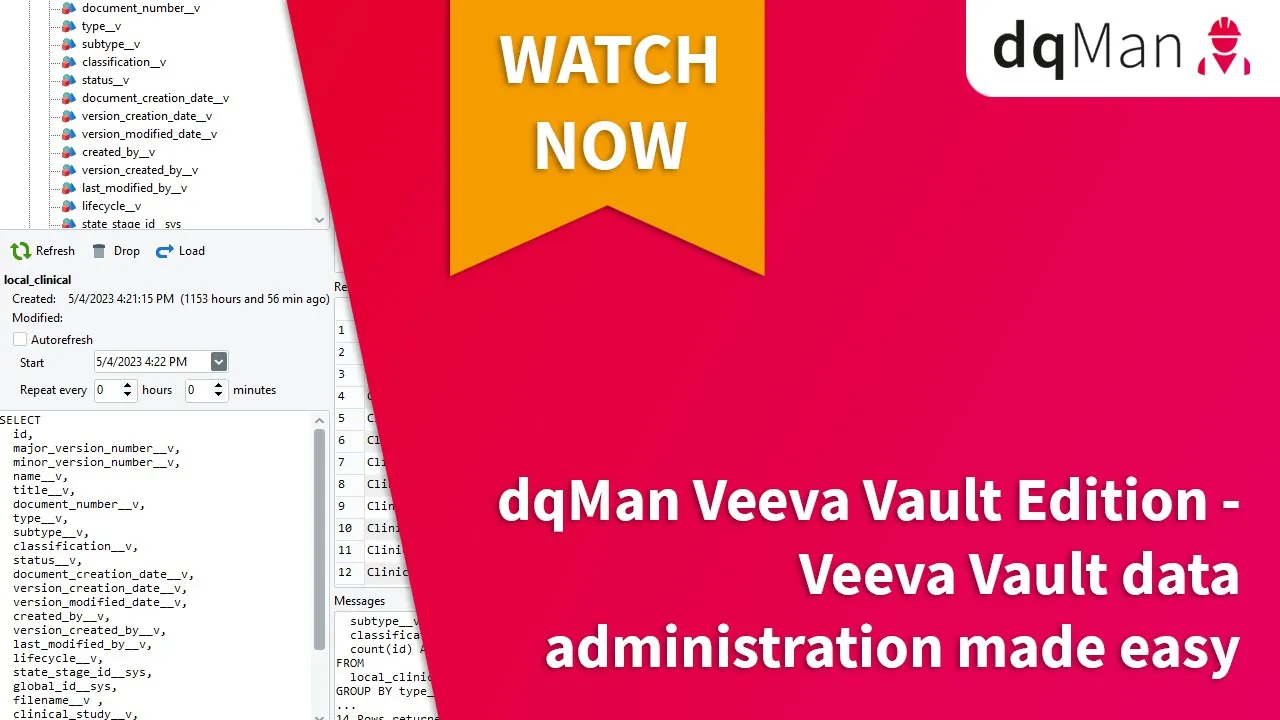
Webinar | dqMan Veeva Vault Edition - Veeva Vault data administration made easy
dqMan
/@fme_dqMan
Jul 27, 2023
This webinar introduces dqMan Veeva Vault Edition, a specialized administration tool designed to enhance productivity and efficiency for professionals managing Veeva Vault applications. Presented by Cecilia Gabrila, Head of Product Development at FME, a certified Veeva technology partner, the session highlights how dqMan simplifies complex data and configuration tasks within Veeva Vault. The core problem dqMan aims to solve is the difficulty in leveraging Veeva's powerful VQL (Veeva Query Language) and MDL (Metadata Definition Language) directly, which are essential for robust data administration but lack an easy-to-use interface. The presentation outlines FME's background as a digital transformation partner in life sciences and other industries, emphasizing their expertise in Enterprise Content Management (ECM). The genesis of dqMan for Veeva Vault stemmed from a real need identified by FME's services team and customers, particularly for validating data migration results into Veeva Vault. This validation often involves intensive checks of records and their metadata to ensure compliance with business requirements. dqMan positions itself as a powerful, customizable tool for Vault administrators, developers, consultants, and supporters, promising improved productivity, reduced administration costs through automation, and enhanced data quality. A significant portion of the webinar is dedicated to a live demonstration of dqMan's features. These include intuitive navigation for document types and objects, automatic VQL statement generation, and contextual help for query creation. Crucially, dqMan extends native VQL capabilities by supporting SQL-like syntax such as `SELECT *`, `COUNT(*)`, `GROUP BY`, `HAVING`, and aggregate functions, which are not natively available in VQL. The tool also incorporates local caching of query results, which is vital for generating aggregated reports efficiently and reducing the consumption of limited Veeva API requests. The roadmap for future versions includes bulk metadata updates, data comparison across different Vaults or external sources, bulk picklist management, and comprehensive audit trail functionality, further solidifying its utility for complex enterprise environments. The demonstration further showcases practical actions users can perform, such as viewing and dumping document/object metadata, inline editing and updating metadata, viewing content, renditions, and attachments, and exporting data to CSV or Excel. The MDL script editor, equipped with syntax highlighting and contextual help, allows for the creation and execution of scripts to manage Veeva objects like picklists. The ability to execute MDL scripts asynchronously is highlighted as particularly beneficial for handling high-volume objects, ensuring efficient and scalable operations. Overall, dqMan is presented as an indispensable tool for anyone involved in the detailed administration and management of Veeva Vault data and configurations, especially within regulated industries. Key Takeaways: * **Simplified Veeva Vault Administration:** dqMan provides an intuitive interface to manage Veeva Vault data and configurations, addressing the complexity of directly using VQL and MDL. This significantly boosts productivity for Vault administrators, developers, consultants, and support staff. * **Extended VQL Capabilities:** The tool enhances native Veeva Query Language (VQL) by supporting SQL-like syntax such as `SELECT *`, `COUNT(*)`, `GROUP BY`, `HAVING`, and various aggregate functions (Max, Min, Count), enabling more sophisticated data querying and reporting. * **Efficient Data Reporting and API Management:** dqMan allows for caching query results locally, which is crucial for generating aggregated reports without repeatedly querying Veeva Vault. This feature helps conserve limited Veeva API requests and improves report generation speed. * **Streamlined Metadata Management:** Users can easily navigate document types and objects, automatically generate VQL statements, and edit/update metadata inline within the results grid. This simplifies routine maintenance tasks and ensures data accuracy. * **Comprehensive Data Export and Viewing:** The tool supports exporting entire query results to CSV or Excel, viewing document content, renditions, and attachments, and dumping detailed metadata in JSON or table formats, providing robust data access and analysis capabilities. * **Advanced MDL Scripting:** dqMan includes an MDL (Metadata Definition Language) script editor with syntax highlighting and contextual help, facilitating the creation and management of Veeva objects like picklists. Script generation from templates further accelerates development. * **Asynchronous Script Execution for Scalability:** For managing high-volume objects, dqMan offers asynchronous execution of MDL scripts, which is essential for efficient and scalable operations, preventing timeouts and improving performance. * **Data Migration Validation:** The tool is particularly useful for validating data migration results into Veeva Vault, allowing users to check if records and their metadata are correctly set and meet business requirements, which is critical for compliance. * **Duplicate Content Identification:** By querying and grouping data based on MD5 checksums, dqMan enables the identification of duplicate documents within the Vault, helping to maintain a clean and efficient repository. * **Future Enhancements for Enterprise Needs:** The roadmap includes planned features like bulk metadata updates, data comparison between different Vaults or external sources, bulk creation of picklist values, and comprehensive audit trail functionality, indicating a commitment to addressing advanced enterprise requirements. * **Detailed Object and Document Navigation:** Users can easily navigate to object/document metadata, references (e.g., product details, user information), and document versions, providing a holistic view of data relationships within Veeva Vault. Tools/Resources Mentioned: * **dqMan Veeva Vault Edition:** The primary administration tool for Veeva Vault. * **Veeva Vault:** The enterprise content management platform for life sciences. * **VQL (Veeva Query Language):** Veeva's proprietary query language. * **MDL (Metadata Definition Language):** Veeva's language for defining and manipulating metadata. * **SQL (Structured Query Language):** Referenced for its similar syntax to VQL and dqMan's extensions. * **Excel/CSV:** Formats for exporting data from dqMan. * **API requests:** Mentioned as a resource that dqMan helps conserve. Key Concepts: * **Enterprise Content Management (ECM):** A system for managing unstructured information, a core focus for FME and Veeva Vault. * **Digital Transformation:** The strategic adoption of digital technology to improve processes and culture, a service area for FME. * **Metadata:** Data that provides information about other data, crucial for organization and search within Veeva Vault. * **API (Application Programming Interface):** A set of rules that allows different software applications to communicate with each other. * **MD5 Checksum:** A cryptographic hash function used to verify data integrity and identify duplicate content. * **Picklist:** A predefined list of values for a field in Veeva Vault, used for data standardization. * **Asynchronous Execution:** A method of running tasks independently without waiting for each task to complete, useful for high-volume operations. Examples/Case Studies: * **Validating Migration Results:** dqMan is used to intensively check if records and their metadata were correctly set in Veeva Vault after migration, ensuring they meet business requirements. * **Identifying Duplicate Documents:** The tool demonstrates how to group documents by their MD5 checksum to identify and count duplicates, enabling repository cleanup. * **Creating Veeva Objects via MDL:** The webinar shows how to use the MDL script editor with contextual help to generate and execute commands for creating new picklists and other objects within Veeva Vault.

Veeva 22R3 Release Questions and Answers || Veeva 22R3 New Features || Veeva Vault Certification
The Corporate Guys
/@TheCorporateGuys
Mar 28, 2023
This video provides an in-depth exploration of the new features introduced in the Veeva Vault 22R3 release, specifically tailored for individuals preparing for the Veeva Vault certification exam. The speaker, Vaibhav Agrawal, begins by outlining critical information regarding the certification process, including deadlines, the number of attempts allowed, and passing score requirements. He then systematically delves into several key new features, explaining their functionality, configuration steps, and practical implications for administrators and users within the Veeva Vault ecosystem. The presentation emphasizes how these updates address common challenges and enhance the platform's capabilities in areas such as data management, workflow automation, and reporting. The core of the video focuses on practical enhancements that improve user experience and administrative control within Veeva Vault. Each new feature is presented with a clear explanation of its purpose and how it can be configured or utilized. For instance, the discussion on "Person Object Duplicate Detection" highlights a solution to prevent redundant user accounts, detailing the configuration settings for matching rules based on various parameters like email or name. Similarly, the "Notification Email Notification Status" feature is presented as a crucial tool for troubleshooting email delivery issues, providing administrators with visibility into the success or failure of notifications. The speaker's approach is highly practical, often relating the features back to real-world scenarios and potential exam questions. Further into the presentation, the video covers more technical and administrative improvements. The "Object Reference Field Formula" feature is explained as an advancement that allows for more complex formula configurations by enabling the use of object reference fields within text or ID functions, thereby enriching reporting and automation possibilities. The introduction of "Output Package Support for Migrating Group Data" addresses a significant pain point for administrators, allowing for the automated migration of user groups between Veeva Vault environments, which previously required manual effort. The discussion culminates with features like "Limit Workflow Participants" and "Document with Object Report Type," which offer enhanced control over workflow assignments and more flexible reporting capabilities by linking documents with related business objects. The speaker concludes by reiterating key points that are likely to appear on the certification exam, reinforcing the practical and exam-oriented nature of the content. Key Takeaways: * **Veeva Vault 22R3 Certification Details:** The certification exam for the 22R3 release must be completed by April 14, 2023. Candidates are allowed two attempts; a score of 80% or higher on the first attempt qualifies, while a score above 50% but below 80% allows for a second attempt. Scoring below 50% on the first attempt disqualifies the candidate. * **Person Object Duplicate Detection:** This new feature helps prevent the creation of duplicate person records (e.g., user accounts) in Veeva Vault. Administrators can configure detection settings to check for duplicates based on parameters like first name, last name, email address, or username, with options for exact or fuzzy matching. * **Notification Email Notification Status:** A highly valuable feature for troubleshooting, it allows administrators to check the delivery status of email notifications sent to specific users or roles. This can be accessed via the "Operations" tab, providing clarity on whether a notification was successfully sent or if there were delivery issues. * **Object Reference Field Formula:** Veeva Vault 22R3 enhances formula capabilities by allowing the use of object reference fields within formulas. This means administrators can now reference related objects directly within text functions (to retrieve names) or ID functions (to retrieve IDs), enabling more dynamic and powerful calculations and data displays. * **Output Package Support for Migrating Group Data:** Previously, migrating user groups between Veeva Vault environments required manual recreation. With 22R3, administrators can now include user groups in outbound packages, streamlining the migration process and reducing manual effort when moving configurations between sandboxes and production environments. * **Limit Workflow Participants:** This feature allows administrators to set a maximum number of participants for a specific role within a workflow start step. This prevents scenarios where a workflow task is assigned to an excessively large group (e.g., thousands of users), which could lead to operational inefficiencies. The default maximum is 5000, but it can be configured to a lower limit (e.g., 100). * **Workflow Participant Limit Error Handling:** If a workflow is initiated with a group that exceeds the configured maximum number of participants for a specific role, the system will now throw an error, preventing the workflow from starting. This ensures adherence to the defined participant limits and avoids unintended mass assignments. * **Document with Object Report Type:** This new report type enables users to create reports that use a document as the primary object and any related business object (e.g., Product, Country) as the secondary object. This allows for more comprehensive reporting that links document-centric data with other critical business information. * **Standard Report Type Object Limit:** When creating a standard report type in Veeva Vault, a maximum of 10 objects can be selected for inclusion. This is an important limitation to be aware of for report design and certification exam questions. * **Permissions for Glossary and Glossary Definition:** To view Glossary and Glossary Definition records in Veeva Vault, users require the "Content View Content" permission. This ensures controlled access to critical terminology and definitions within the system. Key Concepts: * **Veeva Vault 22R3 Release:** The latest major update to the Veeva Vault platform, introducing new features and enhancements. * **Veeva Vault Certification:** An examination validating an individual's knowledge and proficiency in configuring and managing Veeva Vault. * **Person Object:** A standard object in Veeva Vault representing individuals (e.g., users, external collaborators). * **Outbound Package:** A mechanism in Veeva Vault to package and migrate configurations, data, and components from one environment to another. * **Workflow:** An automated sequence of tasks and approvals within Veeva Vault, often used for document review, approval, or process management. * **Report Type:** A predefined structure in Veeva Vault that specifies which objects and fields are available for reporting, serving as the basis for creating reports. Examples/Case Studies: * **Duplicate Person Records:** The speaker provides an example of a user, Vaibhav Agrawal, having two accounts created due to lack of duplicate detection, leading to wasted licenses and administrative issues. The new feature resolves this by flagging potential duplicates during record creation. * **Email Notification Troubleshooting:** The speaker recounts personal experiences where he was unsure if a configured email notification was sent due to Outlook settings. The "Notification Email Notification Status" feature provides a direct way to verify delivery within Veeva Vault. * **Workflow Participant Overload:** An example is given where a workflow task might be assigned to a group of 1000 users, causing inefficiency. The "Limit Workflow Participants" feature allows setting a maximum (e.g., 100) to prevent such scenarios and ensure tasks are assigned to manageable groups.

Demo: MarketBeam’s Social Media Integration with Veeva Vault PromoMats
Pushpa Ithal
/@pushpaithal8264
Oct 8, 2020
This video provides an in-depth exploration of how the highly regulated life sciences industry can effectively leverage social media for communication and engagement while maintaining strict compliance. Pushpa Ithal, the founder and CEO of MarketBeam, presents a solution that integrates MarketBeam's social media publishing, amplification, and analytics platform with Veeva Vault PromoMats. The presentation begins by highlighting the significant increase in social media usage for health and medical information, underscoring the urgent need for pharmaceutical, biotech, and medical device companies to engage with their audiences on these platforms. However, Ithal emphasizes the unique challenges faced by this industry, primarily the stringent regulatory requirements and the often inefficient, manual processes involved in content approval. The core of the discussion revolves around the inefficiencies of traditional social media content approval workflows in the life sciences sector. Ithal details how content creation, internal marketing review, preview generation, MLR/PRC committee review, and manual publishing often involve multiple teams, external agencies, and a cumbersome exchange of spreadsheets, emails, and images. This "old way" is not only resource-intensive but also lacks traceability and auditability, posing significant risks for non-compliant content publication and potential FDA audits. The speaker contrasts this with less regulated industries that can be far more agile and responsive on social media, highlighting the competitive disadvantage faced by pharma companies. MarketBeam's integration with Veeva Vault PromoMats is presented as a transformative solution to these challenges. The system automates several critical steps, from content creation and automatic preview generation (as a PDF) to direct submission into Veeva Vault PromoMats for approval. Once approved within Veeva, the content is automatically published to corporate social media channels (LinkedIn, Twitter, Facebook) at a scheduled time, eliminating manual intervention and reducing human error. Furthermore, the platform facilitates employee amplification of approved content, allowing colleagues to share compliant messages on their personal social media profiles, significantly expanding reach and engagement. The video concludes with a demonstration of the MarketBeam platform, showcasing its user interface for content creation, the seamless approval process within Veeva, automated publishing, and comprehensive analytics for tracking performance and engagement. Key Takeaways: * **Growing Importance of Social Media in Life Sciences:** Social media is increasingly used by consumers for health and medical information, with usage for health decisions rising from 25% in 2009 to over 52% in 2019. This necessitates that life sciences companies engage proactively on these platforms to reach their audiences. * **Regulatory Hurdles for Social Media Agility:** Unlike less regulated industries, pharmaceutical and life sciences companies face extensive compliance requirements (e.g., MLR/PRC review, FDA 2253 submissions) for all content, including social media posts, which significantly slows down publishing and limits agility. * **Inefficiencies of Manual Approval Processes:** Traditional workflows for social media content approval are highly inefficient, relying on manual steps, spreadsheets, emails, and multiple team hand-offs (marketing, branding, MLR/PRC, external agencies), leading to resource-intensive operations and delays. * **High Risk of Non-Compliance:** The manual nature of current processes increases the risk of publishing unapproved or non-compliant content, which can have severe consequences for brands and even individual employees who share content. * **Lack of Traceability and Auditability:** Manual processes often lack a clear audit trail, making it extremely difficult to trace who created, reviewed, and approved content, and when, which is critical for regulatory audits (e.g., FDA). * **MarketBeam-Veeva Vault PromoMats Integration:** MarketBeam offers a specialized integration with Veeva Vault PromoMats, leveraging Veeva's established digital asset management and robust approval processes to streamline social media content workflows. * **Automated Content Workflow:** The integration automates several steps: content creation in MarketBeam, automatic generation of PDF previews, direct submission to Veeva Vault PromoMats for MLR/PRC review, and automated publishing to social media channels upon approval. * **Reduced Human Error and Increased Efficiency:** By automating the approval and publishing process, the solution significantly reduces the potential for human error, accelerates content delivery, and frees up resources. * **Employee Amplification of Compliant Content:** The platform enables employees to connect their personal social media accounts and share pre-approved, compliant content, vastly extending the reach and impact of corporate messaging while mitigating compliance risks. * **Comprehensive Analytics and Insights:** MarketBeam provides integrated analytics dashboards that track hourly engagement, identify top-performing content and channels, and offer insights into audience behavior, helping companies optimize their social media strategy. * **Global Applicability:** The workflow and integration are designed to be globally applicable, accommodating various regional compliance requirements, though specific regulations will still need to be managed within the Veeva system. * **Support for Multiple Social Networks:** MarketBeam currently supports LinkedIn, Twitter, and Facebook, with plans to expand to Instagram and Xing, catering to a broad range of social media strategies. Tools/Resources Mentioned: * **MarketBeam:** A social media publishing, amplification, and analytics platform. * **Veeva Vault PromoMats:** A digital asset management and content approval platform widely used in the pharmaceutical industry. * **LinkedIn, Twitter, Facebook:** Social media platforms supported for publishing and amplification. * **Instagram, Xing:** Social media platforms planned for future support. Key Concepts: * **MLR/PRC Committee:** Medical, Legal, and Regulatory / Promotional Review Committee, responsible for reviewing and approving all content in the life sciences industry to ensure compliance. * **FDA 2253:** A specific FDA requirement in the US for submitting promotional materials to the agency before or at the time of initial dissemination. * **Auditability and Traceability:** The ability to track and verify the entire lifecycle of a piece of content, including its creation, review, approval, and publication, which is crucial for regulatory compliance. * **Employee Amplification:** A strategy where employees share approved corporate content on their personal social media channels to extend reach and credibility.

How technology can simplify medical device regulatory compliance | Veeva Systems
Informa Connect Life Sciences
/@Ibclifesciences
Oct 27, 2020
This video provides an in-depth exploration of how technology can significantly simplify and enhance regulatory compliance within the medical device and diagnostics industry, particularly in light of evolving regulations like the EU MDR. Annemien Pullen, Director of Strategy for Vault Medical Devices & Diagnostics at Veeva Systems, outlines a strategic approach for companies to transition from reactive compliance management to a proactive, sustainable model enabled by robust technological solutions. The discussion begins by highlighting common regulatory challenges faced by medical device companies, such as fragmented data across organizations, inconsistencies in information, and a reliance on short-term workarounds. Dr. Pullen emphasizes that addressing these foundational issues through structural changes in regulatory operations, rather than temporary fixes, is crucial for long-term organizational sustainability. She underscores that despite external pressures like the COVID-19 pandemic and budget constraints, global regulatory changes, such as the EU MDR, are inevitable and require a strategic investment in a resilient regulatory operating model. Dr. Pullen elaborates on how technology acts as a powerful enabler, not an end goal, for optimizing the entire regulatory process. A single, global tool can harmonize business processes across different geographies and business units, providing leadership with real-time insights for informed decision-making. This approach significantly boosts efficiency by eliminating time wasted searching for data or the latest document versions. Critically, an effective Regulatory Information Management (RIM) system can track and trend health authority correspondence, allowing companies to anticipate questions, improve the quality of submission documents, and ultimately reduce time to market. This proactive stance also frees highly skilled regulatory professionals to focus on strategic intelligence and value-adding tasks rather than administrative burdens. The conversation concludes with essential considerations for selecting and implementing appropriate technology. Key factors include the system's security, its ability to facilitate secure internal and external collaboration (e.g., with economic operators and notified bodies for remote audits with granular access controls), and its overall usability. An intuitive user interface is paramount for high user adoption, ensuring the technology delivers its intended value. Furthermore, the chosen system must support the entire end-to-end regulatory process, functioning as more than just a data repository by enabling joint drafting, submission planning, product registration linking, and comprehensive correspondence tracking. Key Takeaways: * **Prioritize Structural Regulatory Change:** Medical device companies should focus on solving fundamental regulatory challenges like data sprawl and inconsistency through structural changes to their regulatory operating model, rather than relying on short-term workarounds. * **Invest in Organizational Sustainability:** View structural changes in regulatory operations as a critical investment in long-term organizational sustainability, especially given the continuous evolution of global regulations like the EU MDR. * **Leverage Technology as an Enabler:** Technology is not an end in itself but a powerful enabler for optimizing the end-to-end regulatory process, allowing for harmonization across business units and geographies. * **Shift to Proactive Compliance:** Implement technology to move from a reactive approach (responding to audits and non-conformities) to a proactive one, continuously monitoring the regulatory environment and maintaining compliance 24/7. * **Gain Real-time Insights and Efficiency:** A global regulatory tool provides leadership with real-time insights for better decision-making and increases efficiency by reducing time spent searching for data or managing disparate systems. * **Improve Submission Quality and Time to Market:** Utilize a robust RIM system to track and trend health authority correspondence. This intelligence allows companies to anticipate potential questions, improve the quality of initial submissions, and thereby reduce time to market. * **Empower Regulatory Professionals:** By automating administrative tasks and streamlining processes, technology enables highly skilled regulatory teams to focus on strategic activities, regulatory intelligence, and other value-adding tasks. * **Reduce Non-Compliance Issues:** An appropriate technology solution can significantly decrease non-compliance issues caused by human error or a lack of insight, contributing to a more robust compliance posture. * **Ensure High System Security:** When selecting a regulatory system, prioritize a high level of security, as it will serve as the single source of truth for sensitive regulatory documentation and process data. * **Facilitate Secure External Collaboration:** The system must support secure collaboration with external stakeholders, such as economic operators and notified bodies, by providing appropriate access rights and permissions for specific documents during remote audits. * **Emphasize Usability and Intuitive Design:** A user-friendly and intuitive interface is crucial for high user adoption. A modern system that is difficult to navigate will not deliver its full value, regardless of its features. * **Support End-to-End Regulatory Processes:** The chosen technology should be more than just a document repository; it must support the entire regulatory lifecycle, including joint drafting of submission documents, planning submissions, relating product registrations, and tracking health authority correspondence. **Key Concepts:** * **EU MDR (European Medical Device Regulation) & IVDR (In Vitro Diagnostic Regulation):** Key European regulations governing medical devices and in vitro diagnostic medical devices, driving significant changes in compliance requirements. * **Regulatory Operating Model:** The framework and processes an organization uses to manage its regulatory activities and ensure compliance. * **RIM System (Regulatory Information Management System):** A comprehensive software solution designed to manage all aspects of regulatory information, submissions, and compliance throughout the product lifecycle. * **Economic Operator Obligations:** Requirements placed on various entities in the supply chain (manufacturers, authorized representatives, importers, distributors) under regulations like the EU MDR. * **Notified Body:** An independent third-party organization designated by an EU member state to assess the conformity of certain products before they are placed on the market. * **Remote Audits:** Audits conducted remotely, often leveraging technology to provide auditors with access to necessary documentation and data without requiring physical presence. **Tools/Resources Mentioned:** * **Veeva Systems:** The speaker is from Veeva Systems, and the discussion implicitly refers to their suite of solutions, particularly Veeva Vault RIM, which addresses regulatory information management for the life sciences industry.