Videos
Browse videos by topic
All Videos
Showing 1393-1416 of 1435 videos

Veeva CEO Peter Gassner on the Industry Cloud Market Opportunity
Veeva Systems Inc
/@VeevaSystems
Dec 1, 2015
This video features Veeva Systems CEO Peter Gassner providing a foundational perspective on the immense, yet often underestimated, market opportunity presented by the Industry Cloud segment of enterprise software. Gassner argues that industry-specific solutions are significantly larger and faster-growing than traditional horizontal software categories like Customer Relationship Management (CRM) and Enterprise Resource Planning (ERP), claiming the Industry Cloud is four times the size of both. The core thesis is that the market size is consistently undervalued because much of the demand is currently met by custom, uncounted internal solutions rather than commercially available, categorized software. Gassner attributes the massive size of the Industry Cloud to three key characteristics of vertical solutions: they are industry-specific, they are inherently difficult to build, and they are critically important to the customers they serve. Because these solutions are essential and complex, customers are willing to pay a premium, driving substantial market growth. He forecasts that this segment will continue to triple the size of other enterprise software categories. This perspective challenges the conventional wisdom that horizontal platforms dominate the enterprise landscape, asserting that specialized, regulated industries require deep vertical expertise that generic platforms cannot provide. To illustrate his point about market underestimation, Gassner recounts the founding of Veeva in 2007. Having previously worked at major horizontal software companies like IBM and PeopleSoft, he faced significant skepticism when proposing a pharmaceutical-specific CRM solution. He recalls an instance where a colleague minimized the opportunity, drawing a pie chart of enterprise software where "life sciences CRM" was depicted as a mere "pinprick." Gassner explains that this skepticism stemmed from a failure to recognize that the true market for vertical solutions "comes out of the woodwork." The demand isn't visible in existing market reports because it resides in custom-built systems and processes that are not categorized or counted by analysts, leading to a profound underestimation of the total addressable market for specialized software in regulated sectors like pharmaceuticals and biotech. ### Key Takeaways: * **Industry Cloud Dominance:** The Industry Cloud segment is presented as the largest and fastest-growing area of enterprise software, estimated to be four times larger than traditional horizontal categories like CRM and ERP combined. This scale is driven by the necessity of highly specialized, vertical solutions. * **Market Underestimation:** The total addressable market for industry-specific software is consistently underestimated by analysts and generalists. This is because a significant portion of the demand is currently met by custom, in-house solutions that are not tracked or categorized in standard market sizing reports. * **Value Proposition of Vertical Solutions:** Industry-specific software commands high value because the solutions are inherently difficult to create, yet critically important for customer operations, especially in regulated environments like life sciences. This complexity and necessity justify higher investment from clients. * **The Veeva Origin Story as Proof:** Veeva's founding in 2007, focusing on pharmaceutical-specific CRM, serves as a case study for the success of vertical specialization. Despite initial industry skepticism that dismissed life sciences CRM as a niche "pinprick," the market proved vast due to the unmet need for compliant, tailored commercial software. * **Strategic Focus on Specialization:** Companies serving the life sciences sector should prioritize deep vertical expertise over broad horizontal applicability. The market rewards firms that can solve complex, industry-specific problems that generic platforms cannot handle. * **The Emergence of Demand:** The market for vertical solutions "comes out of the woodwork" once a viable, commercial product is introduced. This suggests that the true opportunity lies in identifying and productizing processes currently handled inefficiently through custom development or manual workarounds within pharmaceutical companies. * **Growth Trajectory:** The Industry Cloud is expected to continue its rapid growth, potentially tripling the size of other enterprise software markets. This indicates a sustained, long-term opportunity for specialized AI and software development firms targeting regulated industries. * **Challenging Horizontal Thinking:** The analysis suggests that relying on experience solely in horizontal software (like general CRM or ERP) can lead to a fundamental misunderstanding of the specialized needs and market size within regulated industries like pharma. ### Key Concepts: * **Industry Cloud:** Refers to cloud-based software solutions designed and built specifically for the unique processes, regulatory requirements, and workflows of a particular vertical industry (e.g., life sciences, healthcare, financial services). These solutions offer deep functionality tailored to industry needs, contrasting with horizontal software. * **Horizontal Software:** General-purpose enterprise applications designed to serve common functions across many different industries (e.g., generic CRM, ERP, HR management systems). * **Pharmaceutical Specific CRM:** Customer Relationship Management systems tailored to meet the specific compliance, regulatory, and commercial engagement needs of pharmaceutical sales and medical affairs teams, such as those provided by Veeva Systems.

Veeva CEO Peter Gassner on the Industry Cloud Model
Veeva Systems Inc
@VeevaSystems
Dec 1, 2015
This video features Veeva Co-founder and CEO Peter Gassner outlining the foundational elements of Veeva’s highly successful industry cloud model, specifically tailored for the pharmaceutical, biotech, and life sciences sectors. Gassner defines the industry cloud as a triad composed of three mutually reinforcing components: specialized software, unique industry data, and high-value professional services. He emphasizes that while Veeva initially focused solely on developing software applications—starting with just one app—the full strategic value is unlocked only when all three elements are integrated, a philosophy considered right from the company’s inception. Gassner explains the critical role of professional services within the industry cloud ecosystem. He posits that in a specialized industry like pharmaceuticals, customers require more than just a technology URL; they need guidance on how to effectively utilize the platform, what steps to prioritize (especially when dealing with a suite of 18 solutions), and what best practices are being adopted by peers. This necessity for strategic guidance and business process consulting mirrors the services traditionally provided by firms like Accenture or McKinsey, but applied specifically to the technology and data enablement within the Veeva ecosystem. This highlights the crucial need for specialized consulting partners who understand both the technology and the complex, regulated industry workflow. Furthermore, the CEO stresses the strategic importance of data within the industry cloud. When customers utilize a centralized industry cloud platform, the resulting aggregated data becomes unique and unavailable elsewhere, offering unparalleled strategic value for commercial operations and compliance tracking. However, Gassner introduces a crucial caveat regarding the monetization and pricing of this proprietary data. He warns that companies must be extremely careful and thoughtful about how they price and distribute this data; otherwise, they risk being perceived by the industry as "holding the industry hostage," which could severely damage trust, adoption rates, and the company’s standing as a strategic partner. This perspective underscores the delicate balance between leveraging unique data assets and maintaining a partnership-oriented relationship with the client base. Key Takeaways: * **The Industry Cloud Triad:** The successful industry cloud model, as exemplified by Veeva, is built upon the integration of three core pillars: specialized software applications, unique industry data, and high-value professional services. Focusing solely on the technology component (the "URL") is insufficient for deep industry penetration and strategic partnership. * **Services are Essential for Adoption:** Customers in complex, regulated industries do not merely want technology; they require strategic guidance on implementation, prioritization (e.g., choosing which of 18 solutions to deploy first), and workflow optimization. This demand necessitates robust professional services capabilities integrated into or alongside the software offering. * **Technology Enablement Requires Business Process Expertise:** The consulting required around an industry cloud goes beyond technical implementation; it involves deep business process expertise—similar to the strategic advice offered by major consulting firms—but focused specifically on leveraging the technology and data within the life sciences context. * **Data as a Unique Strategic Asset:** Utilizing an industry cloud generates proprietary data that is often unavailable through any other means. This unique dataset holds immense strategic value for optimizing commercial operations, clinical trials, and regulatory processes within the pharmaceutical sector. * **Pricing Data Requires Caution:** While data is highly valuable, companies must approach its pricing and distribution with extreme care. Overly aggressive or restrictive data pricing strategies can lead to the perception of exploiting customers or "holding the industry hostage," which is detrimental to long-term partnership and trust within the industry. * **Phased Implementation Strategy:** Veeva’s initial focus was on building a single, high-quality software application before expanding into a broader suite of solutions and services. This suggests a best practice of establishing core value and deep trust with a foundational product before attempting to capture the entire market workflow. * **Strategic Partnership Focus:** The ultimate goal of the industry cloud model is to become a strategic partner to the pharma, biotech, and life science industries, moving beyond a transactional vendor-client relationship to one focused on mutual growth and operational excellence. * **Addressing the "Edge of the URL":** The technology itself is only part of the solution; the real value lies in addressing the challenges "around the edge of the URL"—how to use it, what to do next, and what industry peers are doing—which is the domain of high-value consulting services. Tools/Resources Mentioned: * Veeva Solutions (Reference to having "18 solutions") Key Concepts: * **Industry Cloud Model:** A specialized software delivery model that combines software, data, and services tailored specifically for the unique needs, workflows, and regulatory requirements of a single industry (life sciences). * **Software, Data, and Services Triad:** The three essential, interdependent components that define the strategic value and comprehensive offering of the industry cloud model. * **Holding the Industry Hostage (Pricing Pitfall):** A warning against setting data pricing or access policies that are perceived as exploitative or restrictive, potentially leading to industry backlash and hindering widespread adoption or trust.

Zinc Ahead and Veeva Systems join forces
Zinc Ahead
/@Zinc-ahead
Oct 26, 2015
This video provides a strategic announcement detailing the acquisition of Zinc Ahead by Veeva Systems, an event that significantly reshaped the landscape of commercial content management and regulatory compliance within the life sciences industry. The primary goal of the merger, which occurred in 2015, was to address the growing industry need for end-to-end compliance management capable of reducing regulatory risk and enhancing operational efficiency. This necessity arose from the increasing volume of pharmaceutical content, the proliferation of digital communication channels, and heightened regulatory scrutiny. The speakers emphasize that the strategic benefit for customers lies in combining Zinc Ahead’s deep domain expertise in life sciences—specifically its heritage in regulatory approval and the digital supply chain—with Veeva’s established proficiency in providing robust, cloud-based software solutions. This synergy was envisioned to accelerate the creation of solutions that drive productivity and streamline workflows across the entire digital supply chain, a long-term vision for the Zinc Ahead team. By integrating specialized regulatory knowledge with the scalability of the Veeva cloud platform, the combined entity aimed to achieve its goals faster and more effectively. Operationally, the video focuses on customer assurance and the transition plan. The number one priority was ensuring that existing Zinc Maps customers would receive continued "gold standard service and support" for their current implementations through 2020. This commitment provided a long runway for stability. Furthermore, the company pledged to assist these customers in migrating to Veeva PromoMats when the timing was appropriate, utilizing a set of "very easy tools" to facilitate a smooth transition. For companies already utilizing PromoMats, the acquisition meant immediate benefits from the depth of expertise provided by the Zinc team, particularly in understanding and applying specific country-level regulatory requirements and maximizing the utility of the underlying Veeva Vault platform. The overall message reinforces that the merger was founded on a shared DNA of customer success, ensuring that the combined leadership would remain laser-focused on delivering the best possible product in the commercial content management space. Key Takeaways: * The acquisition of Zinc Ahead by Veeva Systems was a strategic move aimed at creating a comprehensive, end-to-end compliance management solution for the life sciences sector, addressing the challenges posed by increasing content volumes and digital channel complexity. * The core value proposition of the merger was the combination of Zinc Ahead’s deep domain expertise in life sciences regulatory approval and the digital supply chain with Veeva’s proven capabilities in delivering scalable, cloud-based software solutions. * The combined entity’s focus is on accelerating productivity across the digital supply chain by integrating specialized regulatory knowledge directly into a robust cloud platform, thereby reducing regulatory risk for pharmaceutical and biotech clients. * For existing customers utilizing the legacy Zinc Maps platform, the company guaranteed continuity of "gold standard service and support" for their current implementations, ensuring stability and minimizing disruption through 2020. * A defined migration path was established for Zinc Maps customers to transition to Veeva PromoMats, utilizing a set of "very easy tools" designed to simplify the process and ensure data integrity during the shift to the new platform. * Current Veeva PromoMats customers immediately benefited from the integration of the Zinc Ahead team’s expertise, gaining deeper insights into specific country-level regulatory requirements necessary for global commercial content approval. * The integration leverages the foundational strength of the Veeva Vault platform, positioning PromoMats as the centralized, compliant solution for managing commercial content, a critical component of pharmaceutical commercial operations. * The decision to merge was driven by a shared cultural emphasis on customer success, assuring clients that the commitment to product quality, support, and continuous improvement in the specialized regulatory space would remain paramount. * The combined leadership committed to remaining "laser-focused" on the commercial content management and regulatory approval area, indicating a continued investment in developing specialized tools for this highly regulated segment of the life sciences industry. Tools/Resources Mentioned: * Zinc Maps (Legacy commercial content management system) * Veeva PromoMats (Veeva Vault module for promotional materials review and approval) * Veeva Vault Platform (The underlying cloud platform supporting Veeva applications) Key Concepts: * **Digital Supply Chain:** Refers to the end-to-end process of creating, reviewing, approving, distributing, and tracking commercial content (promotional materials) across various digital and traditional channels in a regulated environment. * **End-to-End Compliance Management:** A system designed to manage all stages of content lifecycle—from creation to retirement—while ensuring adherence to strict regulatory standards (e.g., FDA, EMA) at every step to mitigate risk. * **Domain Expertise in Life Sciences Regulatory Approval:** Specialized knowledge concerning the specific legal and operational requirements for reviewing and approving promotional and medical content within the pharmaceutical and biotech industries.

XTalks eCademy - Best Practices for Your Trial Master File
Xtalks
/@XtalksWebinars
Sep 29, 2015
This online course module, presented by Shelley Active of LMK Clinical Research Consulting, serves as a foundational guide to understanding and modernizing the Trial Master File (TMF). The session aims to demystify the TMF—an acronym often viewed with apprehension—by clearly defining its critical role and offering best practices for its management throughout the entire clinical trial continuum. The speaker emphasizes that while historically the TMF was merely a repository (often physical boxes) reviewed only during regulatory inspections, modern technology demands a shift toward proactive management focused on document quality and completeness. The core objective of the training is to redefine the TMF from a passive filing system into an active, essential component of clinical trial success and regulatory readiness. The course promises to detail the requirements set forth by international bodies, specifically citing ICH-GCP (International Council for Harmonisation of Technical Requirements for Pharmaceuticals for Human Use – Good Clinical Practice) and various global regulatory agencies. A significant focus is placed on the transition from traditional, reactive TMF management to a compliant, proactive approach. This includes practical guidance on setting up, maintaining, and closing out a TMF, regardless of whether the medium is paper-based or electronic (eTMF). Furthermore, the session highlights the speaker’s involvement with the Metrics Champion Consortium (MCC), where standard metrics and Key Risk Indicators (KRIs) supporting TMF quality are being defined. This suggests the course delves into data-driven strategies for TMF oversight, moving beyond simple volume checks to assessing the quality and completeness of documentation in real-time. Attendees are encouraged to become "TMF champions" within their organizations, driving the cultural and procedural changes necessary to ensure continuous compliance and inspection readiness. The overall progression of the content moves from defining the regulatory necessity of the TMF to implementing modern, data-informed strategies for achieving and sustaining compliance. Key Takeaways: • **TMF as a Foundational Compliance Tool:** The TMF is not merely an archive but the essential documentation set required to reconstruct and evaluate the conduct of a clinical trial. Its completeness and quality are paramount for demonstrating adherence to the protocol and regulatory standards, including ICH-GCP. • **Shift from Archival to Active Management:** Best practices dictate moving away from the historical view of the TMF as a "banker’s box" repository only accessed during inspections. Modern TMF management requires continuous oversight, quality checks, and real-time completeness assessments. • **Technology Alone is Insufficient:** While electronic Trial Master Files (eTMFs) provide immediate access and eliminate physical rummaging, technology does not inherently solve issues of document quality, proper filing order, or overall completeness; these require robust processes and human oversight. • **Focus on Quality and Completeness:** A critical best practice involves filing documents with a conscious focus on their quality and ensuring the TMF is complete according to the trial's requirements, rather than simply filing every document collected without scrutiny. • **Regulatory Mandates and Expectations:** The course emphasizes understanding what ICH-GCP and global regulatory agencies require regarding TMF documentation. Compliance requires not just having the documents, but ensuring they meet specific quality and timeliness criteria. • **Defining Standard Metrics and KRIs:** Utilizing the work of groups like the Metrics Champion Consortium, organizations should implement standard metrics and Key Risk Indicators (KRIs) to proactively monitor the health and compliance status of the TMF, allowing for early intervention on potential risks. • **Proactive Compliance Strategy:** The training provides actionable steps on how to "get compliant and stay that way," focusing on establishing compliant processes during the TMF setup phase and maintaining vigilance throughout the trial's execution, rather than scrambling before an audit. • **The Role of the TMF Champion:** Attendees are encouraged to adopt the role of a TMF champion, driving organizational change to prioritize TMF quality, educate staff, and implement the necessary procedural shifts to ensure the TMF is inspection-ready at all times. • **TMF Lifecycle Management:** Best practices cover the entire TMF lifecycle, providing guidance on critical phases including initial setup (defining the structure and content plan), ongoing maintenance (ensuring timely and quality filing), and final closeout procedures. Key Concepts: * **Trial Master File (TMF):** The collection of essential documents that individually and collectively permit the reconstruction and evaluation of the conduct of a clinical trial, the quality of the data produced, and the adherence to ICH-GCP and regulatory requirements. * **ICH-GCP:** The International Council for Harmonisation of Technical Requirements for Pharmaceuticals for Human Use – Good Clinical Practice, which sets the international ethical and scientific quality standard for designing, conducting, recording, and reporting trials that involve the participation of human subjects. * **Metrics Champion Consortium (MCC):** A working group focused on defining and standardizing metrics and Key Risk Indicators (KRIs) specifically for TMF management, enabling data-driven oversight and risk mitigation in clinical operations.

The Evolution of the TMF Reference Model Version 3.0.
TMF Reference Model
/@TMFReferenceModel
Jul 10, 2015
This webinar provides an in-depth exploration of the evolution of the Trial Master File (TMF) Reference Model, focusing on the release of Version 3.0 in 2015. The speakers, Karen Roy (Flex Global), Todd Tullis (Veeva Systems), and Wendy Troli (ESI), detail the background, structure, and key changes in the model, emphasizing its role as a regulatory requirement for clinical trials. The presentation highlights the industry's collaborative effort to standardize TMF content beyond the minimum essential documents outlined by ICH GCP, aiming to create a comprehensive narrative of a clinical trial. The discussion delves into the organizational structure of the TMF Reference Model, which is divided into 11 zones, further segmented into sections and 248 artifacts. These artifacts represent document or record types, applicable at trial, country, and site levels, with metadata being crucial for electronic TMF (eTMF) systems. A significant portion of the webinar is dedicated to the changes introduced in Version 3.0, including the updating, adding, removing, and consolidating of artifacts, refinement of zone definitions (e.g., Zone 8 becoming "Central and Local Testing"), and the introduction of "sub-artifacts" to allow for deeper, company-specific granularity while maintaining core standardization. Furthermore, the webinar introduces the concept of an eTMF Exchange Mechanism, a pragmatic approach to facilitate the electronic transfer of TMF content between organizations, such as CROs and sponsors, or during company acquisitions. This mechanism, defined with an XML structure, aims to standardize the transfer of essential metadata (e.g., TMF reference model version, artifact identifier, study, site, country). The speakers also present new resources like an improved digital presentation format (a MindMap-like PDF with power filters for attributes) and a comprehensive user guide, designed to aid companies, from biotech startups to large pharma, in implementing and customizing the TMF Reference Model for their specific needs. The session concludes with a case study from ESI, illustrating their journey of adopting and customizing the TMF Reference Model (versions 1 and 2) within their global eTMF system, detailing their strategy, challenges, and plans for integrating Version 3.0. Key Takeaways: * **TMF as a Regulatory Requirement:** The Trial Master File is a critical regulatory requirement, serving to "tell the story" of a clinical trial, encompassing essential documents and other records collected during planning, conduct, and execution. * **Evolution of Standardization:** The TMF Reference Model was initiated in 2009 by the DIA to address the lack of a comprehensive, industry-agreeable list of TMF contents beyond the minimum specified by ICH GCP, evolving through versions 1, 2, and 3.0. * **Structured Organization:** The model is structured into 11 zones, each containing sections and specific artifacts (document/record types). This hierarchical structure provides a standardized framework for organizing TMF content. * **Metadata for eTMF:** For electronic TMFs, the applicability of artifacts at the trial, country, and site levels is managed through metadata, allowing for flexible organization and retrieval. * **Version 3.0 Enhancements:** Key changes in Version 3.0 include updated artifact lists (additions, removals, consolidations), refined definitions, updated zone names (e.g., Zone 8 now "Central and Local Testing"), and simplified notation for sponsor vs. investigator documents. * **Introduction of Sub-Artifacts:** Sub-artifacts provide a mechanism for deeper granularity within the standardized artifact structure, allowing companies to incorporate their specific forms, approvals, meeting notes, and SOP-driven document types without altering the core model. * **eTMF Exchange Mechanism:** A new XML-based standard for electronically exchanging TMF content and associated metadata between organizations (e.g., CROs to sponsors, internal system transfers) has been developed, aiming for pragmatic interoperability. * **Improved Presentation and User Guide:** New resources include a digital, interactive presentation (MindMap-like PDF with power filters) for easier navigation and filtering of artifacts, and a user guide providing practical advice and case studies for implementing the model. * **Importance of Top-Down Buy-in:** Successful implementation of the TMF Reference Model, as demonstrated by the ESI case study, requires strong top-down support from functional area heads and cross-functional collaboration. * **Customization for Company-Specific Needs:** While promoting standardization, the model allows for customization through "document type examples" or sub-artifacts, submission guidance, and defining responsible functions and document locations specific to a company's processes. * **Continuous Improvement:** Implementation is an ongoing process, requiring continuous evaluation, collection of feedback through change requests, and adaptation to new versions of the reference model. * **Global Collaboration:** The TMF Reference Model is a product of extensive global collaboration involving pharmaceutical companies, medical device manufacturers, biotech firms, consultants, vendors, and regulators. * **Leveraging Existing Standards:** The eTMF Exchange Mechanism is framed in the context of existing industry standards like eCTD (for submissions) and CDISC (for clinical data), promoting broader interoperability. Tools/Resources Mentioned: * **TMF Reference Model (Versions 1, 2, 3.0):** The core framework for standardizing Trial Master File content. * **TMFReferenceModel.com:** The official website for the TMF Reference Model, providing links and documents. * **TMF Reference Model Group on LinkedIn:** An active community for knowledge sharing and education. * **User Guide:** A comprehensive guide explaining the model's use, implementation, and case studies. * **Digital Presentation (MindMap-like PDF):** A new interactive format for navigating and filtering the reference model. * **eTMF Exchange Mechanism (XML structure):** A defined format for electronic transfer of TMF content and metadata. * **Veeva Systems:** Mentioned as a panelist, indicating its role in the eTMF and clinical trial management space. Key Concepts: * **Trial Master File (TMF):** A collection of essential documents and records that individually and collectively permit the evaluation of the conduct of a clinical trial and the quality of the data produced. * **Essential Documents:** Documents that individually and collectively permit evaluation of the conduct of a trial and the quality of the data produced (as per ICH GCP). * **Artifacts:** The lowest level of organization in the TMF Reference Model, representing specific document or record types (e.g., protocols, consent forms, monitoring reports). * **Zones:** The highest level of organization in the TMF Reference Model, grouping related sections and artifacts (e.g., Zone 1: Management, Zone 8: Central and Local Testing). * **Sub-artifacts:** Company-specific document types or granular details that sit within an artifact, allowing for customization without altering the core standardized structure. * **eTMF Exchange Mechanism:** A standardized approach for the electronic transfer of TMF content and its associated metadata between different organizations or systems. * **Metadata:** Data that provides information about other data, crucial for organizing, searching, and managing content within an eTMF system (e.g., study ID, site ID, artifact type). Examples/Case Studies: * **ESI's Implementation Journey:** Wendy Troli from ESI shared a detailed case study of their adoption and implementation of TMF Reference Model versions 1 and 2 in their global eTMF system since 2010. This included: * **Customization:** Developing their own version based on TMF Reference Model V1, then aligning with V2. * **Guidance:** Adding "document type examples" and "submission guidance" columns to their file structure to clarify what documents go into which artifact and how they should be submitted. * **Location and Responsibility:** Including columns to document the official location of documents, the responsible functional area, and who (sponsor or CRO) is responsible for sending documents to the eTMF. * **TMF Filing Plan Templates:** Creating study-specific templates based on the customized file structure to ensure clarity and consistency for each clinical trial. * **Challenges:** Encountering issues with user confusion, multiple locations for documents, long development timeframes, company restructuring, and internal questioning of existing processes. * **Strategy:** Emphasizing top-down buy-in, cross-functional working groups (clinical operations, CQA, data management, biostatistics, regulatory, etc.), and extensive training sessions tailored to each functional area.

The latest from the FDA Preparing for the New Module 1 and Validation Criteria Recording 05122011
USDM Life Sciences
/@usdatamanagement
Jul 2, 2015
This video provides an in-depth exploration of the FDA's proposed changes to eCTD Module 1 and updated validation criteria, as presented in 2011. Harve Martin of expedo, a seasoned expert in life sciences information systems and a key figure in ICH M2 and IRISS, offers a unique perspective as a software designer tasked with implementing these complex regulatory requirements. The presentation aims to clarify the reasons behind varying eCTD validator outcomes and highlight critical areas for pharmaceutical companies to focus on as the FDA moved towards implementation of these new standards. The discussion begins by detailing the FDA's draft validation criteria version 2.0, released in December 2010, which introduced 58 new rules, removed 14, and significantly revised many existing ones. Martin explains the technical underpinnings of eCTD, emphasizing its XML basis and the role of DTDs (currently version 3.2) in defining rules. He highlights the challenges faced by software developers in interpreting and implementing ambiguous or technically impossible rules, citing specific examples of problematic criteria that could lead to submission rejections. A significant shift noted was the FDA's intention to become tougher on enforcement, with a heavy emphasis on document quality, the content validation of fillable forms, and robust PDF validation, including checks for broken or corrupt hyperlinks and bookmarks. Following the validation criteria, the presentation shifts to the anticipated changes in eCTD Module 1, which was not yet published but expected in draft form by July 2011. These changes aimed to address inconsistencies and improve granularity, particularly for CBER/CDER (DD Mac and CBER APLB) submissions. Key updates included reorganizing administrative information, allowing multiple applications per submission instance, and introducing more detailed headings and attributes for promotional materials to distinguish between professional and consumer audiences. Martin also outlines the FDA's internal "to-do list" for updating related guidance documents and specifications. He concludes with practical recommendations for companies, focusing on transition planning, impact on document lifecycle, reviewing SOPs, ensuring PDF compliance, and engaging with vendors and industry groups like IRISS to navigate these evolving regulatory landscapes. Key Takeaways: * **Evolving FDA Validation Criteria:** The FDA's draft validation criteria version 2.0 (circa 2010) introduced a substantial number of new rules (58 total, including 4 high-severity), removed problematic ones, and aimed for stricter, more uniform enforcement, particularly for high-severity issues that could lead to submission rejection. * **Technical Challenges in Implementation:** Software designers faced significant challenges in implementing validation rules due to ambiguities, technical impossibilities (e.g., "more than one version of the US Regional XML file exists"), or lack of clear definitions, leading to inconsistencies across different eCTD validators. * **Emphasis on Document and PDF Quality:** The new criteria placed a heavy emphasis on the quality of submitted documents, including the content validation of fillable forms downloaded from the FDA website and comprehensive PDF validation, checking for issues like broken hyperlinks, corrupt bookmarks, and proper embedded fonts. * **Module 1 Granularity and Multiple Applications:** The anticipated Module 1 changes aimed for greater granularity, especially in administrative information and promotional materials, and a significant departure from previous standards by allowing submissions to target multiple applications within a single submission instance. * **Impact on Lifecycle Management:** The increased granularity and structural changes in Module 1 were expected to have a significant impact on the lifecycle management of regulatory documents, requiring companies to re-evaluate their document authoring SOPs and potentially their content management systems. * **Importance of Industry Standards and Interoperability:** The presentation underscored the role of ICH M2 and the newly formed IRISS (Implementation of Regulatory Information Submission Standards) in fostering interoperability and addressing implementation challenges for electronic regulatory submissions across the industry. * **Strategic Planning for Transition:** Companies were advised to plan carefully for the transition to the new Module 1, considering its impact on existing processes, engaging with software vendors, conducting pilot submissions, and ensuring robust internal validation processes. * **PDF Compliance Beyond Basic Generation:** Beyond simply generating PDFs, companies needed to focus on the quality of hyperlinking, bookmarking, and embedded fonts, as these elements would be subject to more rigorous validation checks by the FDA. * **The Role of XML in eCTD:** The eCTD structure is fundamentally based on XML, with rules defined by DTDs (e.g., version 3.2). Understanding the XML backbone and its validation against DTDs is crucial for ensuring submission compliance. * **Collaboration and Continuous Feedback:** The iterative nature of regulatory updates (e.g., draft criteria, comment periods) highlighted the importance of industry feedback to the FDA and collaboration with vendors and peer organizations (like IRISS) to refine and improve submission standards. **Key Concepts:** * **eCTD (electronic Common Technical Document):** A standard format for submitting applications, amendments, supplements, and reports to regulatory authorities. * **Module 1:** The region-specific administrative information and prescribing information within an eCTD submission. * **Validation Criteria:** A set of rules and checks applied by regulatory authorities (like the FDA) to ensure the technical and structural compliance of eCTD submissions. * **XML (Extensible Markup Language):** The foundational language used for structuring eCTD submissions. * **DTD (Document Type Definition):** A set of markup declarations that define the legal building blocks of an XML document, used to validate the structure of eCTD files. * **ICH M2:** An expert working group within the International Council for Harmonisation of Technical Requirements for Pharmaceuticals for Human Use, focused on electronic standards. * **IRISS (Implementation of Regulatory Information Submission Standards):** A multi-industry, multinational, non-profit organization established to advance technical and electronic regulatory submission standards, with a focus on implementation and interoperability. * **RPS (Regulatory Product Submission):** A standard for electronic submissions that aims to provide a harmonized approach across different regulatory agencies and product types. * **DD Mac (Document Data Management Center) / CBER APLB (Center for Biologics Evaluation and Research, Advertising and Promotional Labeling Branch):** FDA centers/branches that accept eCTD submissions, specifically mentioned in the context of Module 1 changes.
Meeting the Challenges Facing Emerging GxP Regulated Organizations in the Life Sciences Recording 11
USDM Life Sciences
/@usdatamanagement
Jul 2, 2015
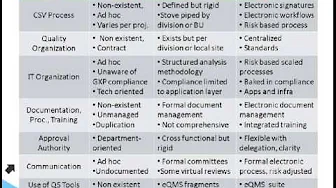
This video provides an in-depth exploration of the challenges faced by emerging GxP regulated organizations in the life sciences, particularly concerning the implementation and management of IT systems. Larry Isaacson, a practice leader at USDM Life Sciences, outlines common pitfalls and best practices for companies transitioning into regulated operations, emphasizing the importance of proactive compliance management to save time, money, and aggravation. The discussion moves beyond specific system validations to address the underlying organizational maturity and cultural shifts required to effectively manage GxP compliance for IT. The presentation introduces the concept of a "compliance maturity challenge," drawing parallels to well-known maturity models like CMMI in software engineering and enterprise architecture. Isaacson highlights that organizations often operate at lower maturity levels (e.g., "heroic efforts" or "reactive mode") when it comes to GxP IT compliance, leading to inefficient, costly, and often after-the-fact remediation efforts. He details a five-level maturity model, from unpredictable and reactive processes to optimized and integrated quality management, advocating for organizations to strive for at least level three ("defined") to significantly improve their compliance posture and operational efficiency. The speaker also presents a compliance risk model, illustrating how regulatory compliance is the pinnacle achieved through the alignment of administrative procedures, personnel management, infrastructure, applications, and business processes, emphasizing that any weak link can jeopardize overall compliance. A significant portion of the webinar is dedicated to explaining *why* GxP compliance is challenging for emerging organizations. Isaacson points to factors such as trial-and-error approaches, a cultural aversion to formal processes, lack of separation of duties, and a focus on outcomes rather than repeatable processes. He then outlines critical success factors, including the recognition of the need for system validation, organizational structure adjustments, acceptance of formal procedures, structured testing, and a champion for quality and change. The discussion further breaks down the maturity model across specific GxP considerations like computer system validation capabilities, quality organization, IT organization maturity, documentation, change management, approval authority, communication, and quality system tools, ultimately recommending a move towards integrated eQMS suites and risk-based processes. The webinar concludes with actionable recommendations for approaching compliance, such as recognizing emerging requirements, establishing a quality authority early, forming cross-functional teams, and prioritizing education. Isaacson strongly advises using established methodologies like GAMP 5, reconciling competing quality systems, simplifying review processes, and educating IT on GxP best practices. He also cautions against underestimating the risks associated with SaaS architectures and outsourcing, stressing the importance of early assessment of SOP impacts and adherence to a full system lifecycle (requirements, design, testing, maintenance, retirement). The core message is that proactive, integrated, and risk-adjusted compliance management, driven by a clear quality authority and continuous education, is essential for avoiding audit findings and achieving sustainable operational excellence in regulated life sciences. Key Takeaways: * **Compliance Maturity is Critical:** Organizations often struggle with GxP compliance due to low organizational maturity, leading to reactive, costly, and inefficient "heroic efforts" rather than structured, repeatable processes. Aim for at least level three ("defined") in a compliance maturity model. * **GxP IT Compliance is Foundational:** Regulatory compliance is built upon a pyramid of aligned administrative procedures, personnel, infrastructure, applications, and business processes. A weakness in any layer, especially IT, can compromise overall compliance. * **Common Organizational Challenges:** Emerging regulated organizations often face cultural aversion to formal processes, lack of separation of duties, a sole focus on outcomes, and resistance to a compliance-aware culture, which must be overcome. * **Critical Success Factors for Compliance:** Key to success are recognizing the need for system validation, adapting organizational structures, accepting formal procedures, implementing structured testing, establishing clear communication, improving IT maturity, and identifying a "champion of quality and change." * **IT Organization as an Achilles Heel:** IT organizations often lag in GxP awareness, operating with ad hoc processes and a technology-oriented rather than business-oriented culture, making them a common weak link in compliance efforts. * **Embrace Established Methodologies:** Utilize recognized frameworks like GAMP 5 as a foundation for compliance. These are accepted by regulatory bodies and auditors, providing a scalable and quick-start approach with standard templates. Avoid "newfangled flexible approaches" that require educating auditors. * **Risk-Based Approach to Validation:** Scale validation and qualification efforts to the inherent risk of the system. This saves significant money and time by focusing resources where they are most needed, rather than applying rigid, comprehensive validation to every project. * **Early Quality Authority and Cross-Functional Teams:** Establish a clear quality authority (internal or outsourced) as early as possible. Form cross-functional teams involving IT, business, and quality to address GxP compliance needs collaboratively from inception. * **Educate IT on GxP Compliance:** Provide early and targeted education to IT personnel on GxP IT compliance best practices. Help them understand that their servers, hardware, networks, and applications are essentially regulated equipment once in scope for a regulated system. * **Prioritize SOP Assessment and Development:** Do not leave Standard Operating Procedures (SOPs) until the end of a project. Assess their impact early, ensure they exist, are updated, and are comprehensive, as late assessment can unwind significant validation efforts. * **Beware of SaaS and Outsourcing Risks:** Do not underestimate the compliance risks of moving to Software-as-a-Service (SaaS) or outsourcing applications/hosting. Involve IT and compliance teams early to assess vendors and arrangements, as poorly positioned partners can lead to significant issues. * **Full Lifecycle Management:** Regulated systems require a full lifecycle approach, from requirements and design to formal testing (IQ, OQ, PQ), maintenance, and structured retirement, including data retention considerations. * **Justifying Investment:** To justify compliance investments, use external experience, examples of FDA compliance letters (e.g., 43s), and case studies demonstrating the money and time saved by proactive management versus reactive remediation. * **Integrated Quality System Tools:** Move from fragmentary eQMS systems (separate document control, CAPA, change control) to a comprehensive eQMS suite that integrates all quality management functions for a holistic view and easier audit management. Key Concepts: * **GxP:** A general term for Good Practice quality guidelines and regulations. The "x" stands for the specific field, e.g., GMP (Good Manufacturing Practice), GCP (Good Clinical Practice), GLP (Good Laboratory Practice). * **Compliance Maturity Challenge:** The problem organizations face in evolving their processes and culture to meet regulatory compliance requirements effectively and efficiently, often starting from an unpredictable, reactive state. * **CMMI (Capability Maturity Model Integration):** A process improvement approach that helps organizations improve their performance. The video references its application to software engineering and general organizational maturity. * **GAMP 5 (Good Automated Manufacturing Practice 5):** A guideline for validating automated systems in pharmaceutical manufacturing, widely accepted for computer system validation in regulated environments. * **Validation Accelerator Packs (VAPs):** Pre-configured documentation and templates designed to speed up the validation process for specific systems or platforms. * **eQMS Suite (Electronic Quality Management System Suite):** An integrated software solution that manages all aspects of quality and compliance, including document control, training, CAPA, audit management, and change control. * **IQ/OQ/PQ (Installation Qualification/Operational Qualification/Performance Qualification):** A three-stage process for validating equipment and systems, ensuring they are installed correctly, operate according to specifications, and perform consistently under actual use conditions. * **21 CFR Part 11:** Regulations issued by the FDA that set forth requirements for electronic records and electronic signatures, ensuring their trustworthiness, reliability, and equivalence to paper records.
Selecting the Right EDMS Vendor One Size Does NOT Fit All! Recording 04122012
USDM Life Sciences
/@usdatamanagement
Jul 2, 2015
This video provides an in-depth exploration of the critical process for selecting the right Electronic Document Management System (EDMS) vendor, specifically tailored for companies within the life sciences industry. Presented by Bob Lucazi, Vice President and Subject Matter Expert for Life Sciences at USDM Life Sciences, the webinar emphasizes that a "one-size-does-not-fit-all" approach is essential. The discussion is framed around best practices for Enterprise Content Management (ECM) and regulatory compliance, drawing on Lucazi's extensive experience in quality assurance and regulatory affairs across pharmaceutical, biotech, and medical device sectors. The presentation outlines a structured, multi-step methodology for EDMS vendor evaluation, beginning with a thorough internal needs analysis. This foundational step involves developing a User Requirement Specification (URS) by interviewing various organizational groups, distinguishing between mandatory and 'nice-to-have' features, and critically, identifying regulated versus non-regulated content. The process then progresses through identifying a long list of potential vendors, gathering basic information, conducting user checkpoints to assess initial findings, and narrowing down to a short list of two or three vendors. A significant portion of the webinar is dedicated to the detailed criteria for evaluating EDMS solutions. This includes general content management capabilities like forms, templates, record retention, collaboration, and workflow management. Crucially for modern enterprises, integration capabilities with existing systems such as SharePoint, ERP, HR, or Electronic Lab Notebooks (ELN) are highlighted. Other key areas of evaluation cover document management features (versioning, life cycles, search, annotations), storage mechanisms (native object storage, legal holds, timestamps), data management (database technology, audit trails, reporting), security (access control, roles, LDAP), and networking aspects (external access, portals). The speaker also touches upon non-functional requirements like ease of use, licensing, training, and ongoing support. The video concludes by discussing the necessary deliverables from the selection process, including the URS, a comprehensive comparison spreadsheet, storyboards for vendor demonstrations, and a final recommendation report. A crucial financial aspect, the capital expenditure report, is also covered, emphasizing the importance of demonstrating ROI and securing management buy-in. A brief case study illustrates the practical application of this methodology, highlighting factors such as budget constraints, the need for a SaaS environment, and unexpected requirements like Electronic Common Technical Document (ECTD) capabilities, which ultimately influenced the final vendor selection based on life sciences experience and customer references. Key Takeaways: * **Structured EDMS Selection Process:** A successful EDMS selection requires a methodical, multi-step approach, starting with a comprehensive needs analysis and culminating in a well-justified vendor selection. * **Thorough Needs Analysis (URS):** Begin by developing a detailed User Requirement Specification (URS) through interviews with diverse user groups, distinguishing between mandatory and 'nice-to-have' features. This document serves as the foundation for all subsequent evaluation. * **Regulated vs. Non-Regulated Content:** Clearly differentiate between regulated and non-regulated content within your organization, as regulated content necessitates validation and adherence to standards like 21 CFR Part 11 and GxP. * **Stakeholder Engagement:** Involve key decision-makers and users throughout the evaluation process, especially during vendor demos, to ensure alignment and prevent miscommunication or re-evaluation later on. * **Scenario-Based Demos:** For vendor demonstrations, create specific storyboards or scenarios based on your company's unique needs and workflows. This ensures vendors showcase relevant functionalities rather than generic features. * **Comprehensive Proposal Review:** Scrutinize vendor proposals not just for pricing, but also for hidden costs, different licensing models, included maintenance, and the type of ongoing support provided (e.g., automated upgrades, validation scripts). * **Critical EDMS Criteria:** Evaluate vendors across a broad range of criteria including general content management (forms, templates, collaboration, workflow), document management (versioning, life cycles, search, annotations), storage, data management (audit trails, reporting), security (access control, roles, LDAP), and networking. * **Integration Capabilities:** Assess the vendor's ability to integrate with your existing enterprise systems (e.g., SharePoint, ERP, HR, LMS, ELN, SAP) through APIs or pre-built connectors, as this is crucial for a cohesive IT ecosystem. * **Migration Strategy for Existing Systems:** If migrating from an existing EDMS, inquire about the vendor's experience with data migration, available migration tools (e.g., Bulldozer, Vance Partners), and verification processes to ensure data integrity. * **Regulatory Compliance as a Core Factor:** For life sciences companies, regulatory compliance (e.g., Part 11, GxP, validation support) must be a paramount consideration in the EDMS selection, influencing audit trails, security, and document control features. * **Ease of Use and User Adoption:** Prioritize ease of use, as a complex system may lead to underutilization, turning an expensive EDMS into merely a file store rather than a fully leveraged document management solution. * **Financial Justification and Management Buy-in:** Prepare a capital expenditure report, including ROI analysis, to present to management. This financial justification is critical for securing budget and approval for the EDMS investment. * **Vendor's Industry Experience and Customer Base:** Consider the vendor's specific experience within the life sciences industry and their customer references, as this often indicates a deeper understanding of regulatory requirements and industry-specific challenges. * **Cloud-Based (SaaS) Solutions:** Explore cloud-based or Software as a Service (SaaS) EDMS options, which can offer cost-effectiveness, scalability, and enhanced collaboration features, as exemplified by products like Box.net. **Tools/Resources Mentioned:** * **EDMS Vendors:** Documentum, OpenText, MasterControl, QUMAS, PharmaReady, GRM, ETQ (Quality Management System with EDMS component), Box.net (cloud-based product). * **Enterprise Systems:** SharePoint, ERP (Enterprise Resource Planning), SAP, LMS (Learning Management System), ELN (Electronic Laboratory Notebook). * **Migration Tools:** Bulldozer, Vance Partners (includes migration and verification tools), a German-based migration tool. **Key Concepts:** * **EDMS (Electronic Document Management System):** A system used to manage and track electronic documents and electronic images of paper-based information. * **ECM (Enterprise Content Management):** A broader set of strategies, methods, and tools used to capture, manage, store, preserve, and deliver content and documents related to organizational processes. * **URS (User Requirement Specification):** A formal document detailing the needs and expectations of the users for a new system or software. * **RFP (Request for Proposal):** A document issued by an organization to solicit proposals from potential vendors for a desired service or product. * **ROI (Return on Investment):** A performance measure used to evaluate the efficiency of an investment or compare the efficiency of several different investments. * **GxP (Good x Practice):** A collection of quality guidelines and regulations for various aspects of regulated industries, including Good Manufacturing Practice (GMP), Good Clinical Practice (GCP), Good Laboratory Practice (GLP), etc. * **21 CFR Part 11:** Regulations issued by the FDA that set forth the criteria under which electronic records and electronic signatures are considered trustworthy, reliable, and equivalent to paper records and handwritten signatures. * **GAMP (Good Automated Manufacturing Practice):** A series of guidelines for manufacturers and users of automated systems in the pharmaceutical industry. * **ECTD (Electronic Common Technical Document):** An interface and a standard for the electronic transfer of regulatory information and applications. * **SaaS (Software as a Service):** A software distribution model in which a third-party provider hosts applications and makes them available to customers over the Internet. * **API (Application Programming Interface):** A set of defined rules that enable different applications to communicate with each other. * **LDAP (Lightweight Directory Access Protocol):** A protocol for accessing and maintaining distributed directory information services. **Examples/Case Studies:** * **Client EDMS Selection Case Study:** A recent client sought an EDMS vendor, requiring a SaaS environment and operating within a specific budget. The process involved gathering user requirements from departments like regulatory, QA, validation, IT, legal, and management. An unexpected requirement for ECTD capabilities emerged, narrowing the vendor list. The final decision between two vendors (both around $100,000) hinged on factors like life sciences experience (vendor one) versus local support and ease of use (vendor two), with the client ultimately choosing vendor one due to its strong life sciences background and customer base. * **Integrated Systems Example:** An example was provided of a company that integrated its EDMS with a Learning Management System (LMS), an Electronic Laboratory Notebook (ELN), and SAP's HR module. This integration allowed for automated checks: when an operator used equipment, the system would verify via SAP and the LMS if the operator had completed the necessary training, with SOPs and training records stored in the EDMS.

The TMF Reference Model: It Doesn’t Have to be Scary
Rho
/@RhoWorld
Apr 17, 2015
This video provides an in-depth exploration of the Trial Master File (TMF) Reference Model, emphasizing its role in streamlining clinical trial documentation and ensuring regulatory compliance. Presented by Kristen Snipes and Missy Lavinder from Rho, a Contract Research Organization (CRO), the webinar aims to demystify the TMF Reference Model, particularly for smaller companies, by sharing practical tips and lessons learned from Rho's own implementation journey. The discussion establishes the TMF as a critical collection of content for evaluating clinical trial conduct, data integrity, and adherence to regulations like GCP. The speakers highlight common problems in traditional TMF management within pharma companies and CROs, such as content being scattered across multiple locations, leading to incomplete TMFs, inconsistent documentation, and a reactive approach to audit readiness. These issues often result in significant personnel diversion, increased costs, and rework during regulatory inspections. The TMF Reference Model is introduced as a solution—not a regulatory standard itself, but an industry-consensus framework based on ICH GCP E6, offering a comprehensive and standardized approach to TMF content, naming conventions, and structure, which can support both paper and electronic systems. The presentation then delves into a structured implementation process, beginning with the critical need for a dedicated core team, top-down buy-in from senior management, and continuous education and communication across the organization. Key steps include evaluating existing TMF structures, mapping them against the granular TMF Reference Model (which includes zones, sections, and artifacts), identifying gaps, and making strategic decisions about the scope of implementation (e.g., full model vs. subset, paper vs. electronic TMF). Rho's case study illustrates a major paradigm shift in assigning TMF content ownership from traditional clinical operations and project management teams to the actual content creators, thereby enhancing accountability and completeness. The video concludes with valuable lessons learned, stressing the importance of change management, pressure testing new structures, and the iterative nature of TMF optimization. Key Takeaways: * **TMF as a Compliance Cornerstone:** The Trial Master File is essential for evaluating clinical trial conduct, data integrity, and compliance with regulations like GCP. Its proper management is crucial for demonstrating the quality and integrity of research during audits. * **Challenges of Traditional TMF Management:** Common issues include TMF content being held in multiple locations, leading to incompleteness, inconsistencies in documentation, and a tendency to perform quality reviews only at the end of a study, causing "fire drills" before audits. * **Consequences of Poor TMF Management:** Inefficient TMF processes divert personnel from ongoing studies, increase the risk of quality gaps, hinder quick documentation retrieval during inspections, and ultimately lead to increased costs and low team morale due to rework. * **TMF Reference Model as an Industry Standard:** While not a regulatory standard, the TMF Reference Model is an industry-driven, comprehensive list of essential documents and a standardized structure, expanding beyond the minimal requirements of ICH GCP E6 Chapter 8. * **Benefits of the Reference Model:** It provides consistency, sets clear expectations across the industry, helps project teams identify missing documents for completeness, fosters ownership and accountability among content creators, and significantly improves continuous audit readiness. * **Implementation Requires Teamwork and Buy-in:** Successful implementation necessitates a dedicated core team, strong senior management buy-in, and continuous education and communication across all functional areas. Quality Assurance representatives are key stakeholders throughout the process. * **Strategic Implementation Decisions:** Organizations must critically assess whether to implement the entire TMF Reference Model or a subset, determine if their TMF will be paper, electronic (eTMF), or hybrid, and decide on a phased or all-at-once approach, considering resource availability and business needs. * **Mapping and Gap Analysis:** A critical step involves mapping the existing file structure to the TMF Reference Model to identify gaps, potential impacts on company policies, CTMS, document storage, and resource challenges. * **Shift in TMF Content Ownership:** A significant paradigm shift involves assigning TMF content ownership to the actual content creators (e.g., data management lead for DM documents) rather than solely to project management or clinical operations, ensuring greater accountability and completeness. * **Beyond Structure: Process Implications:** Implementing the TMF Reference Model has downstream implications for processes, such as policies on original signatures, management of correspondences (e.g., emails), and the need to update SOPs, working practices, and CTMS configurations. * **Importance of Change Management:** Change management is paramount. Acknowledge that the process involves new terminology, systems, and a shift in mindset. Continuous education, clear communication, and addressing resistance are vital for successful adoption. * **Lessons Learned: Pressure Testing and Iteration:** Conduct pilot runs or "pressure tests" of the new structure before full rollout. Recognize that TMF management is an iterative process requiring ongoing evaluation and updates, especially with new versions of the reference model. * **Resource Constraints and QA Involvement:** Plan for resource constraints among subject matter experts. Involve the Quality Assurance group from the outset as an invaluable resource for guidance, refocusing discussions, and ensuring compliance. **Key Concepts:** * **Trial Master File (TMF):** The collection of essential documents and content that individually and collectively permit the evaluation of the conduct of a clinical trial, the integrity of the data, and the compliance of the trial with all applicable regulatory requirements. * **TMF Reference Model:** An industry-developed, comprehensive, and standardized taxonomy and metadata for clinical trial documents, providing a consistent structure and naming convention for TMFs. It's based on ICH GCP E6 but offers a more granular and extensive list of content. * **ICH GCP E6:** International Council for Harmonisation of Technical Requirements for Pharmaceuticals for Human Use, Guideline for Good Clinical Practice. Chapter 8 outlines essential documents for clinical trials. * **eTMF (Electronic Trial Master File):** A TMF managed entirely electronically, often using specialized software applications. * **Content Owner:** The individual or functional lead responsible for creating, filing, storing, and performing quality checks on specific TMF content related to their area of expertise. * **Zones/Sections/Artifacts:** The hierarchical structure of the TMF Reference Model, organizing documents by functional area (zones), further breaking them down into sections, and then specifying individual document types (artifacts) with alternate names and definitions. **Examples/Case Studies:** * **Rho's Implementation:** The entire webinar serves as a case study of Rho's experience in implementing the TMF Reference Model. * **Motivation:** Need for process improvement, expanding content list, and responding to sponsor requests for TMF Reference Model alignment. * **Key Change:** Shifting TMF content ownership from project management/clinical operations to the actual content creators (e.g., data management, biostats, statistical programming). * **Downstream Impacts:** Updating CTMS file structure, revising SOPs (from paper-centric to hybrid TMF), creating a standalone TMF management plan, and conducting technology reviews. * **Specific Document Example:** Addressing inconsistency in storing "migration reports" after migrating to Rave, ensuring they are consistently placed in the TMF. * **Nomenclature Example:** Standardizing terms like DSMB, SRC, IDMC, and DMC under a single artifact name to reduce confusion.
Introduction to the Homepage of Veeva CRM
Pendopharm Training
/@pendopharmtraining3642
Feb 4, 2015
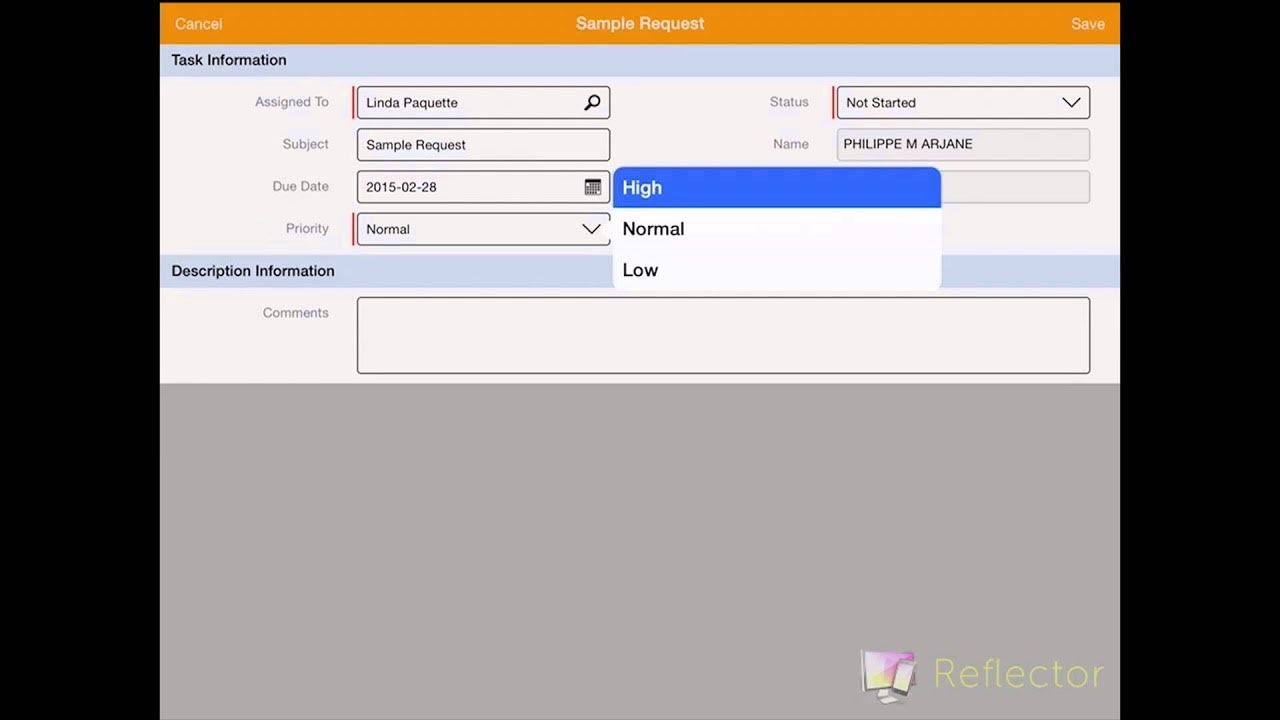
This tutorial provides an introductory walkthrough of the homepage interface within Veeva CRM, a critical platform for pharmaceutical and life sciences commercial operations. The presenter systematically guides viewers through the various sections and tools available on the homepage, emphasizing their utility for daily tasks and performance monitoring. The video aims to familiarize users with the layout and fundamental functionalities, setting the stage for more detailed explorations of specific features in subsequent tutorials. The tutorial begins by segmenting the homepage into left and right sections, each housing distinct functions and easily accessible tools. A significant portion of the demonstration focuses on the "My Tasks" section, detailing how users can view assigned tasks, identify overdue items (indicated by a red due date), and interact with individual task details. The process of editing a task is thoroughly explained, covering modifiable fields such as assignee, subject, due date, priority, and status, while also highlighting immutable aspects like the associated account and document. Users are shown how to add comments, save changes, or cancel modifications, and finally, how to mark a task as complete, causing it to automatically disappear from the list. Beyond task management, the video introduces "My Cycle Plan," which offers an overview of a user's overall sales performance, including territory plan status and planned versus expected attainment. This section provides a high-level view of commercial objectives and progress. Following this, "Territory Updates" is presented as a tool for staying informed about recent changes to one's assigned territory, such as the addition of new accounts. The tutorial concludes by explaining essential functions located on the left side of the homepage: "Go Online" for web access, "Synchronization" for saving entered data to the database (a process that may take a few minutes), and "Options" for logging out. A key advantage highlighted is Veeva CRM's ability to function offline, contrasting it with purely web-hosted platforms, underscoring its utility for field-based professionals. Key Takeaways: * **Centralized Homepage:** The Veeva CRM homepage serves as a central hub, providing quick access to essential functions and tools for managing daily commercial operations in the pharmaceutical and life sciences sectors. * **Efficient Task Management:** Users can effectively manage their assigned tasks, view their status, identify overdue items, and access detailed information about each task directly from the homepage. * **Task Editing Capabilities:** Veeva CRM allows for comprehensive editing of tasks, enabling users to update the assignee, subject, due date, priority, and status, as well as add comments for better collaboration and tracking. * **Fixed Task Associations:** While many task attributes are editable, the name of the associated account and the related document are fixed once assigned, indicating a structured approach to linking tasks with specific commercial entities and activities. * **Performance Monitoring via Cycle Plan:** The "My Cycle Plan" feature provides a crucial overview of individual sales performance, territory plan status, and attainment metrics, allowing users to track progress against their commercial objectives. * **Dynamic Territory Updates:** The "Territory Updates" section ensures that field representatives are continuously informed about changes within their assigned territories, such as the addition of new accounts, facilitating proactive engagement. * **Offline Functionality Advantage:** A significant benefit of Veeva CRM highlighted is its ability to operate offline, which is critical for sales representatives in areas with limited internet access, ensuring continuity of work. * **Crucial Data Synchronization:** The synchronization feature is vital for saving all data entered offline or online into the central database, emphasizing the need for regular synchronization to maintain data integrity and ensure all records are up-to-date. * **Managerial Communication via Alerts:** The "My Alerts" section serves as a direct channel for managers to send messages to their teams, providing a structured way for internal communication and urgent notifications. * **User-Friendly Navigation:** The tutorial demonstrates a clear and intuitive interface, with functions logically grouped, making it easier for new users to navigate and utilize the platform effectively. Tools/Resources Mentioned: * Veeva CRM Key Concepts: * **Veeva CRM Homepage:** The primary landing page for users, providing an overview and access to core functionalities. * **My Alerts:** A section for receiving messages and notifications, typically from managers. * **My Tasks:** A feature for viewing, managing, editing, and completing assigned tasks. * **My Cycle Plan:** A dashboard providing an overview of sales performance, territory plans, and attainment metrics. * **Territory Updates:** A tool that informs users about recent changes or additions within their assigned sales territory. * **Go Online:** A function to access web-based features or external links if necessary. * **Synchronization:** The process of saving local data entries to the central Veeva CRM database, crucial for data consistency and backup. * **Offline Capability:** The ability of Veeva CRM to function without an active internet connection, allowing field users to continue working in remote or connectivity-challenged environments.
A Day In the Life of Wingspan eTMF
Wingspan
/@wingspan4349
Jan 20, 2015
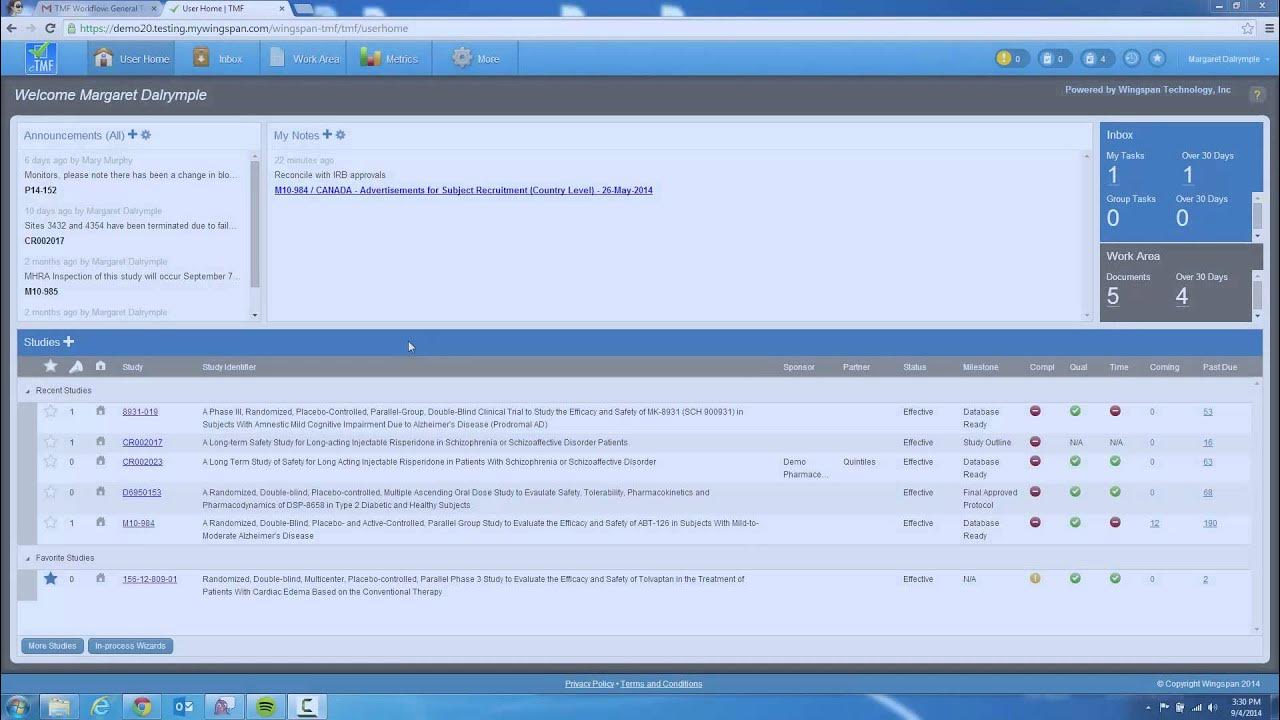
This video provides an in-depth exploration of the Wingspan eTMF (electronic Trial Master File) system, demonstrating its functionality through the typical daily tasks of a study owner and a Clinical Research Associate (CRA). The primary purpose is to showcase how Wingspan eTMF streamlines the management of clinical trial documents, ensuring efficiency, quality, and compliance throughout the study lifecycle, from setup to closeout. The presentation highlights the system's intuitive interface, robust workflow capabilities, and comprehensive tracking features designed to provide real-time insights into study health and document status. The demonstration begins with Mary Murphy, a study owner, logging into the eTMF system. Her personalized dashboard immediately presents critical information, including general and study-specific announcements, personal notes, a summary of tasks in her inbox, documents in her work area, and a list of her active studies. This dashboard emphasizes proactive issue identification, displaying visual indicators for the completeness, quality, and timeliness of each study, which are crucial critical quality measures for eTMFs. Mary's ability to drill down into these indicators, for instance, to understand why a study is lagging in completeness by site, underscores the system's analytical depth and its capacity to generate actionable reports for problem-solving and collaboration. The narrative then shifts to Francis O'Brien, a CRA, illustrating the document submission and rework process. Francis receives an email notification about a document returned for rework due to missing information, with a direct link to the task in the eTMF. This seamless integration facilitates quick corrections and re-submission to QC. The video further demonstrates Francis uploading a new financial disclosure document into a pre-existing placeholder, highlighting the efficiency gained from pre-defined metadata and the system's ability to automatically transform Word documents into PDF renditions while retaining the original format. The final indexing process, guided by organizational instructions, ensures accurate metadata assignment, including document dates, receipt dates, and crucial expiration dates, which the system uses to schedule future replacement documents. The workflow concludes with Ned, a QC user, reviewing documents, marking them as final, or failing them back with specific codes and comments, ensuring all necessary documents are complete and compliant for critical milestones like site initiation. Key Takeaways: * **Centralized eTMF for Clinical Operations:** The Wingspan eTMF serves as a single, centralized repository for all clinical trial documents, crucial for maintaining regulatory compliance and operational efficiency across studies. * **Role-Based Dashboards for Proactive Management:** Study owners receive personalized dashboards providing immediate insights into study health (completeness, quality, timeliness), task summaries, and announcements, enabling proactive identification and resolution of issues without extensive reporting. * **Drill-Down Capabilities for Issue Resolution:** Users can click on health indicators to drill down into detailed reports, such as breaking down document completeness by site, to pinpoint specific areas of concern and understand root causes of delays. * **Streamlined Document Rework Workflows:** The system facilitates efficient document rework by sending automated email notifications to CRAs with direct links to tasks, detailed feedback on errors (e.g., missing phone numbers), and the ability to upload corrected versions quickly. * **Efficient Document Upload with Placeholders and Metadata:** Documents can be easily uploaded into pre-defined placeholders, which come with extensive pre-populated metadata, significantly reducing manual data entry for CRAs and ensuring consistency. * **Automated Document Rendition and Retention:** The eTMF automatically transforms uploaded documents (e.g., Word) into PDF renditions while retaining the original file, ensuring accessibility and archival integrity. * **Structured Quality Control (QC) Process:** A robust QC process is integrated, allowing reviewers to assess content and metadata accuracy, provide specific feedback codes and comments for rejected documents, and mark documents as final. * **Metadata-Driven Document Management:** Accurate metadata assignment, guided by organizational instructions, is critical for document searchability, compliance, and automated processes like tracking expiration dates. * **Automated Expiration Date Tracking:** The system tracks document expiration dates and automatically schedules replacement tasks, ensuring that critical documents remain current and compliant throughout the study. * **Ensuring Site Initiation Readiness:** The eTMF facilitates the collection and finalization of all necessary documents required for critical milestones like site initiation, ensuring that studies can proceed without compliance-related delays. * **Integration Potential:** The system can source key study information from a CTMS (Clinical Trial Management System), suggesting potential for broader data integration across clinical operations platforms. Tools/Resources Mentioned: * **Wingspan eTMF:** The primary electronic Trial Master File system demonstrated. * **CTMS (Clinical Trial Management System):** Mentioned as a potential source for key study information. * **Excel:** Used for generating and sharing reports. Key Concepts: * **eTMF (electronic Trial Master File):** A digital system for managing and storing essential documents of a clinical trial, critical for regulatory compliance and audit readiness. * **Study Owner:** A user role responsible for setting up, monitoring, maintaining, and closing out a set of studies within the eTMF. * **CRA (Clinical Research Associate):** A user role responsible for tasks like document collection, upload, and ensuring site-level compliance. * **Completeness, Quality, Timeliness:** Key performance indicators used to assess the health and status of a clinical study within the eTMF. * **QC (Quality Control):** A process within the eTMF workflow to review documents for correctness, completeness, and adherence to standards before finalization. * **Site Initiation:** A critical milestone in a clinical trial where a study site is formally approved to begin enrolling patients, requiring a complete set of finalized documents. * **Metadata:** Descriptive information about a document (e.g., date, author, type, expiration date) that facilitates organization, search, and compliance. * **Placeholders:** Pre-defined slots within the eTMF for specific documents, often pre-populated with metadata, to guide document upload and ensure proper categorization.

SureClinical SurePortal
SureClinical
/@SureClinical
Oct 7, 2014
The SureClinical SurePortal demonstration showcases a specialized software solution designed to eliminate the pervasive inefficiencies associated with manual, paper-based processes in clinical trials. The core purpose of the application is to transition clinical study teams, investigators, CROs, sponsors, and auditors to a 100% paperless environment, thereby addressing the traditional challenges of slow, costly, and labor-intensive document management—specifically printing, signing, scanning, and filing. The platform promises significant improvements in document quality, integrity, efficiency, and visibility across clinical trial workflows by automating critical steps, particularly the signing process, while ensuring strict regulatory adherence. The central technological feature highlighted is the use of FDA-compliant Adobe PDF digital signatures, which automate the signing process for the entire clinical study team. The platform ensures document integrity and security through a patented High Trust Adobe Digital certificate signing feature. The demonstration illustrates a robust, multi-layered security protocol for e-signing, requiring the user (a Principal Investigator, Dr. John Sun) to confirm identity via a six-digit code sent to a mobile phone, followed by the entry of a personal PIN code and the selection of a reason for signing. This rigorous process ensures that the resulting document is digitally notarized and fully compliant with FDA 21 CFR Part 11 requirements, a critical standard for electronic records and signatures in the life sciences sector. The workflow progression is demonstrated through a typical investigator task. Upon logging in, Dr. Sun receives an email and an in-app task notification requesting the upload and e-signing of his CV. The system streamlines the upload process by automatically tagging the document with the signer’s information. Once signed using the secure digital certificate process, the document is automatically placed in a "review status" for quality checks by study staff. Beyond signing, the portal functions as a comprehensive document management system, allowing users to quickly find documents using an expandable folder structure (document tree) or a powerful search feature (demonstrated by searching for a Serious Adverse Event or SAE report). Furthermore, SurePortal facilitates collaboration and access control. Users can review documents within an integrated viewer, download them, or share them with colleagues using bookmarks, which can include associated messages for review requests (e.g., reviewing a prospective sub-investigator CV). The platform also offers customizable user preferences, allowing investigators to adjust document viewing settings, such as displaying category codes in the document tree, and manage their access rights to various studies. This focus on secure access, regulatory compliance, and streamlined workflow management positions SurePortal as a critical tool for modernizing clinical operations. Key Takeaways: • **Elimination of Paper-Based Inefficiencies:** SurePortal directly tackles the slow, costly, and inefficient manual processes common in clinical trials by enabling 100% paperless document completion from the point of origin, significantly improving operational speed and reducing labor intensity. • **Robust 21 CFR Part 11 Compliance:** The platform achieves regulatory compliance through digital notarization and the use of FDA-compliant Adobe PDF digital signatures, ensuring that electronic records and signatures meet stringent industry standards. • **Multi-Factor Digital Signature Security:** The e-signing process incorporates multiple security layers, including a patented High Trust Adobe Digital certificate, confirmation via a six-digit code sent to the user’s mobile phone, and a personal PIN code entry, providing high assurance of signer identity and transaction integrity. • **Automated Workflow and Task Management:** Users receive immediate workflow task notifications via email and in-app dialogues, guiding them through required actions such as document upload and signing, thereby ensuring timely completion of critical study tasks. • **Enhanced Document Integrity and Audit Trails:** By eliminating paper, the system improves document quality and integrity. Once signed, the document is automatically placed in a review status, establishing a clear audit trail and workflow visibility for study staff. • **Integrated Document Management System (DMS):** The portal offers comprehensive document retrieval capabilities, including an expandable document tree organized by folders and a robust search feature allowing users to quickly locate specific documents (e.g., SAE reports) using keywords. • **Secure Access and Collaboration Tools:** The platform supports collaborative workflows through features like document sharing via bookmarks, which allows users to send specific documents along with review requests and comments to other study team members. • **User-Centric Customization:** Investigators can manage their access rights to specific studies and customize their viewing experience through settings menus, such as changing the appearance of the document tree by enabling category codes. • **Universal Accessibility and Validation:** Clinical study teams can access the platform anytime, anywhere across mobile and web-connected devices, and the use of standard Adobe Reader allows anyone to instantly validate the signatures and document integrity outside the SurePortal environment. Tools/Resources Mentioned: * SureClinical SurePortal * Adobe PDF Digital Signatures * Adobe Reader Key Concepts: * **21 CFR Part 11:** The regulation established by the FDA governing electronic records and electronic signatures in the life sciences industry, ensuring their trustworthiness, reliability, and equivalence to paper records. * **Digital Notarization:** The process by which the electronic signature is secured, timestamped, and verified, making the document legally binding and compliant with regulatory standards. * **High Trust Adobe Digital Certificate:** A specific type of digital certificate used by SureClinical to ensure the security and validity of the electronic signatures, often involving stringent identity verification processes. * **Serious Adverse Event (SAE) Report:** A critical document in clinical trials detailing unexpected and serious patient outcomes that must be reviewed and documented promptly.

eTMF
ePharmaSolutions
/@ePharmaSolutions
Aug 13, 2014
This video by ePharmaSolutions details their cloud-based Electronic Trial Master File (eTMF) solution, which is designed to streamline and accelerate the clinical development process for sponsors, Contract Research Organizations (CROs), and study sites. The solution focuses on efficient clinical document management, system integration with leading e-clinical platforms like CTMS and EDC, and ensuring regulatory compliance. Key features include configurable workflows, automated document routing, digital signatures, role-based access, and extensive reporting capabilities, all while reducing manual tasks and ensuring data integrity across thousands of studies and millions of documents. The system is built to be highly scalable, configurable, and extensible to external users, maintaining global security and compliance standards. Key Takeaways: * **Critical Role of Compliant Clinical Document Management:** The video highlights the necessity of a robust eTMF solution for managing vast quantities of clinical trial documents securely and compliantly, adhering to standards like the DIA 2.0 reference model. * **Automation and Efficiency in Clinical Operations:** The eTMF significantly reduces manual efforts through intelligent routing, auto-configuration, and automated workflows for document completion, approval, and QC. * **Interoperability and Data Integration:** The solution's robust integration APIs with industry-leading e-clinical vendors (CTMS, EDC, IVRS, lab systems) and ETL capabilities underscore the importance of a connected data ecosystem. * **Data-Driven Insights and Quality Assurance:** The eTMF offers comprehensive reporting (20+ out-of-the-box reports, ad hoc capabilities, milestone tracking) and advanced QC modules with configurable thresholds and bulk review.ai to apply its AI and LLM expertise. Potential applications include intelligent document classification, automated content extraction for compliance checks, AI-powered summarization of trial progress, and predictive analytics for document completion or quality issues.

Complete Form and Esign
SureClinical
/@SureClinical
Aug 5, 2014
This video details the precise, regulated workflow required for completing and applying a compliant electronic signature (e-sign) to a PDF form within the SureClinical eTMF (Electronic Trial Master File) system. The process is designed to ensure data integrity, maintain a robust audit trail, and meet the stringent requirements for electronic records and signatures common in pharmaceutical and life sciences operations, particularly those adhering to regulations like 21 CFR Part 11. The tutorial emphasizes the necessary steps for secure identity verification and document finalization, which are crucial for documents related to clinical trials, regulatory submissions, and quality management systems. The workflow begins with an external notification, typically via email or text message, prompting the user to complete a pending task. Upon logging into the SureClinical platform, the user is presented with a task notification dialogue box outlining a multi-step process: download, complete, upload, and sign. A key operational detail is the requirement to download the PDF form and complete it externally using Adobe Reader. This hybrid approach—leveraging a trusted third-party application for form completion before returning to the regulated system—highlights the need for interoperability and the reliance on established PDF standards for data capture in GxP environments. Once completed and saved locally, the user returns to SureClinical to upload the finalized document. The final and most critical phase involves the electronic signing process, which incorporates strong identity verification methods. After selecting the document within the platform, the user is prompted to initiate the signing sequence by requesting a verification code, delivered via email or text message. This code, combined with the user’s personal signing PIN, constitutes a two-factor authentication method, satisfying regulatory requirements for secure electronic signatures. Furthermore, the user must select a specific "reason for signing" the document, which provides the necessary context and intent required for regulatory acceptance. The video concludes by highlighting the use of an Adobe digital ID provided by SureClinical, ensuring that the resulting digital signature is instantly and globally verifiable by anyone using Adobe Reader, a non-repudiation feature essential for regulatory compliance and long-term record retention. Key Takeaways: • Regulated e-signature workflows necessitate a multi-step process that begins with external notification and ends with verifiable digital authentication, ensuring every action is logged for audit purposes. • The workflow described utilizes a hybrid approach where form completion is handled offline using industry-standard software (Adobe Reader) before the document is uploaded back into the regulated eTMF system for finalization. • Compliance with electronic signature regulations (such as 21 CFR Part 11) is achieved through two-factor authentication, requiring both a unique, time-sensitive verification code (sent via email/text) and a static personal signing PIN. • The system requires users to explicitly select a "reason for signing" the document, which captures the necessary context and intent, a mandatory component for regulatory acceptance of electronic records. • The use of an Adobe digital ID is crucial for establishing non-repudiation, guaranteeing that the digital signature is instantly verifiable worldwide, which simplifies regulatory inspections and ensures long-term document integrity. • Upon uploading the completed form, the SureClinical platform employs an "automated workflow instrument" to prefill metadata about the document, streamlining the process while ensuring data accuracy and automated tracking. • The reliance on external PDF completion (Adobe Reader) suggests a potential gap in native, browser-based form-filling capabilities within the eTMF platform, an area where custom software development firms could offer integrated solutions. • The entire process is designed to create a comprehensive audit trail, recording the time stamps of the download, upload, verification code request, and final signature application, satisfying GxP documentation requirements. • For IntuitionLabs, this workflow demonstrates the high security and verification standards required for any AI or automation solution interacting with clinical or regulatory data, emphasizing the need for secure APIs and compliant data handling practices. • The video implicitly warns against using non-validated or non-secure signing methods, reinforcing that only signatures backed by verifiable digital IDs and multi-factor authentication are acceptable in the life sciences sector. Tools/Resources Mentioned: * SureClinical (eTMF platform) * Adobe Reader (Used for offline PDF form completion) Key Concepts: * **E-sign (Electronic Signature):** A legally recognized method of signing documents electronically, requiring specific controls (like verification codes and PINs) in regulated industries to ensure authenticity and non-repudiation. * **Adobe Digital ID:** A certificate-based digital identity used to create verifiable digital signatures that are globally recognized and trusted, crucial for regulatory submissions. * **Automated Workflow Instrument:** A feature within the SureClinical platform that automatically extracts and prefills metadata about an uploaded document, ensuring consistency and accuracy in the audit trail. * **Signing PIN:** A personal identification number used in conjunction with a verification code to provide two-factor authentication for electronic signatures, meeting 21 CFR Part 11 requirements.

User Settings - Mobile Web Client
SureClinical
/@SureClinical
Aug 5, 2014
This video provides a practical, step-by-step guide on navigating and customizing user settings within the mobile web client of a specialized clinical or regulatory document management system, likely an electronic Trial Master File (eTMF) or e-regulatory platform such as SureClinical. The primary purpose is to empower users—who are typically clinical research associates, study coordinators, or regulatory personnel—to tailor their interface, manage their digital identity, and optimize document viewing preferences for efficient mobile workflow. The presentation focuses on three main areas: user account security, profile management related to clinical studies, and specific settings for document tree visualization and electronic signature appearance. The initial segment details critical security and identity management functions available under the "User Account Settings." This section emphasizes the user's control over their digital credentials, which is paramount in regulated environments like pharmaceuticals. Users are shown how to change their password and PIN code, essential practices for maintaining data security and adherence to regulatory requirements like 21 CFR Part 11 for electronic records and signatures. Furthermore, the ability to revoke a digital ID and email the administrator for support highlights built-in compliance and support mechanisms necessary for audit trails and system integrity. The focus on notification preferences also ensures that users can stay current on critical document updates or required actions, minimizing delays in regulated workflows. The subsequent sections delve into operational efficiency within a clinical context. The "User Profile" settings allow personnel who work across multiple trials to seamlessly switch between studies, enabling them to view either all active studies or focus on a single study at a time. This functionality is crucial for maintaining focus and preventing errors in multi-study environments. Most importantly, the "Document Tree Settings" provide granular control over how regulated documents are organized and displayed. Users can select various viewing hierarchies, such as grouping documents by person, person role, organization, organization role, study site, or the highly specific combination of study subject and visit number. This flexibility is vital for clinical monitoring and data review, allowing users to quickly locate documentation based on the specific context of the clinical trial. Finally, the video addresses workflow management and regulatory appearance standards. The system offers filtering capabilities that allow users to quickly isolate documents based on their current status in the workflow—such as "in review," "quality items," "unsigned documents," "signed documents," or "my documents." This feature streamlines quality control and compliance checks. The demonstration concludes with the "Digital ID Appearance" section, allowing users to customize the visual style of their electronic signature. While the underlying legal validity remains constant, customizing the appearance helps users quickly identify their own signatures and ensures organizational consistency, before finally showing the standard sign-out procedure. Key Takeaways: • **Digital Identity and Security Management:** Users have direct control over core security credentials, including the ability to change passwords and PIN codes, which is foundational for maintaining the integrity and non-repudiation required by regulatory standards like 21 CFR Part 11. • **Electronic Signature Compliance:** The system explicitly supports managing the digital ID, including the ability to revoke it and customize its appearance, underscoring the importance of compliant electronic signatures in GxP documentation workflows. • **Optimized Multi-Study Workflow:** Clinical personnel can efficiently manage their workload by utilizing the user profile settings to switch between viewing all studies or focusing on a single study, preventing context switching errors and enhancing productivity. • **Granular Document Organization:** The platform offers highly flexible document tree settings, allowing users to organize documents based on clinical context (e.g., study subject and visit number) or organizational structure (e.g., person role, study site). This is essential for effective eTMF management and audit preparation. • **Workflow Status Filtering:** Users can leverage filtering options to quickly isolate documents based on their status (e.g., unsigned, in review, quality items). This feature is critical for accelerating quality assurance processes and ensuring timely completion of required signatures. • **Role-Based Document Viewing:** The option to view documents organized by "person role" or "organization role" facilitates compliance checks, ensuring that documents are accessible and reviewed by the appropriate authorized personnel within the clinical hierarchy. • **Mobile Client Focus:** The entire demonstration is centered on the mobile web client, highlighting the necessity for regulated systems to provide full functionality and compliance features (like digital ID management) on mobile devices for field-based clinical operations staff. • **Proactive Support Access:** The inclusion of an option to "email your administrator for support" directly within the user account settings ensures that users can rapidly address technical or security issues related to their digital ID or access. • **Notification Customization:** Users can set preferences for notifications, allowing them to tailor alerts for document updates or required actions, which helps prevent bottlenecks in time-sensitive regulatory and clinical workflows. Tools/Resources Mentioned: * SureClinical (Implied Platform) * Mobile Web Client (Interface) Key Concepts: * **Digital ID:** An electronic credential used to verify a user's identity and apply legally binding electronic signatures, often required under 21 CFR Part 11. * **PIN Code:** A secondary security measure used to protect the digital ID, often required before applying an electronic signature. * **Document Tree Settings:** Configuration options that determine the hierarchical structure and grouping of documents within a regulated system, crucial for organizing clinical data (eTMF). * **Electronic Signature Appearance:** The customizable visual representation of the digital ID when applied to a document, which must meet specific organizational and regulatory standards.

Compliant Laboratory Information Management Systems – a Modern Approach to Batch Records
Technology Services Group is now part of Hyland
/@tsgrp
Jul 31, 2014
This video provides an in-depth exploration of modernizing Laboratory Information Management Systems (LIMS) and batch record processes within the life sciences industry, focusing on achieving compliance and operational efficiency. The presentation, a joint effort by Alfresco Software and Technology Services Group (TSG), highlights a solution built on the Alfresco Enterprise Content Platform that transforms traditional paper-based batch record management into a digital, author-driven system. It addresses the common challenges faced by manufacturing plants using outdated LIMS, which often rely on manual data entry, printed forms, and extensive IT involvement for simple updates, leading to high costs, errors, and compliance risks. The core of the solution revolves around a document-centric approach that empowers authors to manage their Standard Operating Procedures (SOPs) and batch records using familiar tools like Microsoft Word. By leveraging Word documents with embedded mail merge fields, the system enables real-time electronic data capture directly on the manufacturing floor, eliminating the need for paper forms and manual re-keying into legacy LIMS. This digital transformation not only streamlines data collection but also ensures a compliant 21 CFR Part 11 approval process for document changes and data entries, significantly reducing the total cost of ownership and operational risk associated with traditional methods. The demonstration walks through the entire lifecycle of an electronic batch record, from its creation and data collection to approval and subsequent modification. It showcases how individual SOPs are automatically assembled into a "Master Batch Record" with consistent lot numbers, expiration dates, and page numbering. Operators on the floor can digitally input data into the designated fields, which are then automatically merged into the final document. The system includes dynamic workflow for change control, allowing authors to update SOPs, add new data fields, and route them for approval with electronic signatures and comprehensive audit trails, all without requiring IT intervention. This approach provides end-to-end reporting capabilities, enabling quick analysis of collected data for trends and insights, such as monitoring temperature variations across batches. Key Takeaways: * **Addressing Legacy LIMS Challenges:** The video highlights the inefficiencies of outdated LIMS, characterized by terminal screens, printed forms, manual data entry, and significant IT dependency for simple updates, leading to high costs, errors, and compliance issues. * **Document-Centric Digital Transformation:** The proposed solution shifts from a data-entry-centric LIMS to a document-centric approach, leveraging Microsoft Word documents as the primary interface for SOPs and batch records, making it intuitive for authors. * **Author Empowerment and Control:** Authors gain direct control over their SOPs, including versioning, adding new data fields, and managing the change control process, reducing reliance on IT for document updates and system modifications. * **Streamlined Batch Record Creation:** The system automates the assembly of individual SOPs into a comprehensive Master Batch Record, consistently applying lot numbers, batch numbers, expiration dates, and page numbers across all documents. * **Real-time Electronic Data Capture:** Mail merge fields embedded in Word documents facilitate electronic data entry directly on the manufacturing floor, eliminating paper forms, manual transcription, and associated errors. * **Enhanced Regulatory Compliance:** The solution incorporates a 21 CFR Part 11 compliant approval process, including electronic signatures, audit trails, and robust document management practices, crucial for life sciences companies. * **Dynamic Change Control Workflows:** A configurable workflow engine (Active Wizard) enables dynamic routing of document changes for approval, providing context to approvers and adapting based on priority levels (e.g., high priority changes routing to additional QA users). * **Automated Metadata and Overlays:** Key metadata such as version, approval date, lot number, and expiration date are automatically pulled from the repository and overlaid onto the rendered PDF documents, ensuring consistency and accuracy. * **Comprehensive Reporting and Analytics:** All electronically captured data is stored (e.g., in XML format) and can be easily extracted for reporting, trending, and business intelligence, allowing for quick identification of operational insights like temperature trends. * **Effective Date Management for SOPs:** The system supports setting future effective dates for updated SOPs, ensuring that new procedures and data collection requirements are automatically incorporated into batch records only after the designated training period. * **Reduced IT Involvement:** By empowering authors and leveraging configurable software, the solution significantly reduces the need for IT intervention in routine document updates and process changes, accelerating time-to-market for procedural modifications. * **Future Enhancements for Data Integrity:** Planned future capabilities include adding constraints to data fields (e.g., numerical ranges, data types) and implementing referential integrity to perform calculations or validate data based on other values, further enhancing data quality. **Tools/Resources Mentioned:** * **Alfresco:** An Enterprise Content Platform used for document management, collaboration, records management, and case management. * **Microsoft Word:** Utilized as the primary authoring tool, leveraging its mail merge functionality for data collection fields. * **TSG's HPI (High Performance Interface):** A custom search and authoring interface that runs on top of Alfresco. * **TSG's Active Wizard:** A workflow initiation and electronic form tool used for dynamic approval processes. **Key Concepts:** * **Laboratory Information Management System (LIMS):** A software system designed to manage laboratory data and processes. The video discusses modernizing a legacy LIMS. * **Batch Records:** Detailed documentation of the manufacturing process for a specific batch of a product, critical for quality control and regulatory compliance in life sciences. * **21 CFR Part 11:** A regulation from the FDA that sets requirements for electronic records and electronic signatures, ensuring their trustworthiness, reliability, and equivalence to paper records. The solution is designed to be compliant with this. * **Standard Operating Procedures (SOPs):** Detailed, written instructions to achieve uniformity of the performance of a specific function. These are central to the document-centric approach. * **Master Batch Record:** A compilation of all individual SOPs and related documents required for the production of a specific product batch. * **Mail Merge Fields:** Placeholders within a document that are dynamically populated with data, used here for electronic data collection. * **Electronic Signatures:** Digital representations of a person's signature, compliant with regulations like 21 CFR Part 11, used for approvals and record authentication. * **Change Control:** A formal process used to manage changes to documents, systems, or processes in a regulated environment, ensuring proper review, approval, and documentation. * **Enterprise Content Platform (ECP):** A comprehensive system for managing various types of content and documents across an organization, exemplified by Alfresco. **Examples/Case Studies:** The video presents a case study of a life sciences manufacturing plant that sought to innovate and improve its Quality Systems. This client had a dated LIMS that relied on terminal screens, printed forms with handwritten notes, and manual data entry. The solution implemented for them involved a simplified LIMS leveraging Word documents for real-time, paperless data capture and a 21 CFR Part 11 compliant approval process.

2014 07 22 13 30 Understanding the OASIS eTMF Specification for Technical Professionals
OASIS Open
/@Oasis-openOrg
Jul 25, 2014
This webinar, presented by OASIS Open, provides an in-depth exploration of the recently released OASIS Electronic Trial Master File (eTMF) Specification Version 1.0, specifically tailored for technical professionals in the BioPharma industry. The speakers, Zach Schmidt and Rich Lustig, begin by establishing the critical need for standardized electronic systems in clinical trials as the industry rapidly moves away from paper-based processes. They highlight that the absence of such standards leads to significant challenges, including system silos, high maintenance costs, vendor lock-in, and hindered productivity, ultimately slowing down the delivery of new drugs to market. The core purpose of the OASIS eTMF standard is to address these issues by providing an open, interoperable framework for exchanging clinical trial information seamlessly and efficiently. The presentation details the foundational principles and architectural components of the OASIS eTMF standard. It emphasizes the use of open web standards and a controlled vocabulary to ensure flexibility, interoperability, and compliance. The standard is built upon three key layers: a Classification System Layer that defines the eTMF content model, metadata, and rules; a Vocabulary Layer that incorporates metadata terms from established organizations like the National Cancer Institute (NCI), CDISC, and HL7; and a Web Technology Layer that provides core services for interoperability, digital signatures, and business process modeling. This multi-layered approach ensures that the standard can support various content models, including the widely used TMF Reference Model, through flexible mapping and display labels, while maintaining a consistent underlying data structure. A significant portion of the webinar is dedicated to demonstrating the practical application of the standard. The speakers showcase the NCI Thesaurus as the global repository for the controlled vocabulary terms used in the eTMF specification, illustrating how each term has a unique code, definition, and URL, curated for health science metadata. They also introduce Protege, a free open-source taxonomy editing tool from Stanford University, demonstrating how it can be used to import and navigate the eTMF hierarchy, content types, and associated metadata (core, domain-specific, and general). The demonstration further illustrates how an eTMF archive can be viewed in a web browser, even offline, emphasizing the standard's focus on the backend data exchange rather than prescribing application presentation. The discussion concludes with a strong call for industry participation in reviewing and commenting on the specification draft to ensure its broad usability and adoption. Key Takeaways: * **Urgent Need for eTMF Standards:** The pharmaceutical industry's shift from paper to electronic systems for clinical trials necessitates robust data standards to improve productivity, reduce time-to-market for new drugs, and enable efficient information exchange. * **OASIS as a Global Standard Body:** OASIS was chosen for this initiative due to its status as a leading global standards organization for interoperable technology, known for its open processes, transparency, and broad industry participation. * **Addressing Industry Challenges:** The OASIS eTMF standard aims to resolve issues like data silos, high maintenance costs, and vendor lock-in by providing a common, open framework for data exchange. * **Foundation on Open Web Standards:** The standard is built upon established web standards, including the W3C RDF/XML for machine-readable taxonomies and the CMIS (Content Management Interoperability Standard) for seamless integration with enterprise content management systems. * **Comprehensive Requirements:** The standard's core requirements include support for paperless transactions, digital signatures, a standard-based controlled vocabulary, model flexibility, open standards integration (CDISC, NCI, FDA), multi-media support, portability (cloud/offline), localization (Unicode), and built-in audit trails via XML metadata. * **Three-Layered Architecture:** The eTMF architecture comprises a Classification System Layer (content model, metadata, rules), a Vocabulary Layer (standardized terms from NCI, CDISC, HL7), and a Web Technology Layer (interoperability, digital signatures, business process modeling). * **Key Deliverables:** The initiative's main outputs include a published controlled vocabulary, a machine-readable taxonomy (RDF/XML), and a content model/data model for information exchange, alongside guidance for CMIS integration. * **Compatibility with TMF Reference Model:** The OASIS eTMF standard is designed to support existing industry models, such as the TMF Reference Model, through flexible mapping of terms and display labels, ensuring a smooth migration path. * **NCI Thesaurus as Vocabulary Repository:** The National Cancer Institute (NCI) Thesaurus serves as the global repository for the controlled vocabulary, providing curated terms with unique codes, definitions, and URLs, widely used across health science metadata. * **Focus on Backend Interoperability:** OASIS focuses on standardizing the backend application services and data services layers, allowing application vendors the flexibility to design their own presentation layers while ensuring underlying data exchange consistency. * **Future Vision for Clinical Trials:** The long-term objective is to foster broader system interaction, platform-agnostic data exchange (cloud, network, offline), and global communication within a compliant framework to accelerate the delivery of effective therapies. * **Call for Industry Engagement:** Technical professionals and organizations are strongly encouraged to download the specification and code, review the work, and provide specific, solution-focused comments to refine the standard before its final publication. Tools/Resources Mentioned: * **OASIS Website:** For downloading the eTMF specification, code, and submitting comments. * **National Cancer Institute (NCI) Thesaurus:** A global terms database of controlled vocabulary terms, used as the repository for eTMF terms. * **Protege:** A free, open-source taxonomy editing tool from Stanford University for working with RDF/XML models. Key Concepts: * **eTMF (Electronic Trial Master File):** An electronic system for managing and storing essential documents and data related to a clinical trial, moving away from paper-based TMFs. * **OASIS (Organization for the Advancement of Structured Information Standards):** A non-profit consortium that drives the development, convergence, and adoption of open standards for the global information society. * **CMIS (Content Management Interoperability Standard):** An OASIS standard that defines a web services interface allowing different content management systems to interoperate. * **RDF/XML (Resource Description Framework / Extensible Markup Language):** A W3C standard for describing information and creating machine-readable taxonomies, used for the eTMF specification's underlying data model. * **NCI Thesaurus:** A comprehensive, curated vocabulary and ontology for cancer and biomedical sciences, utilized by the eTMF standard for its controlled vocabulary. * **TMF Reference Model:** A widely adopted, industry-driven model that provides a standardized structure for the Trial Master File, which the OASIS eTMF standard is designed to support and integrate with.
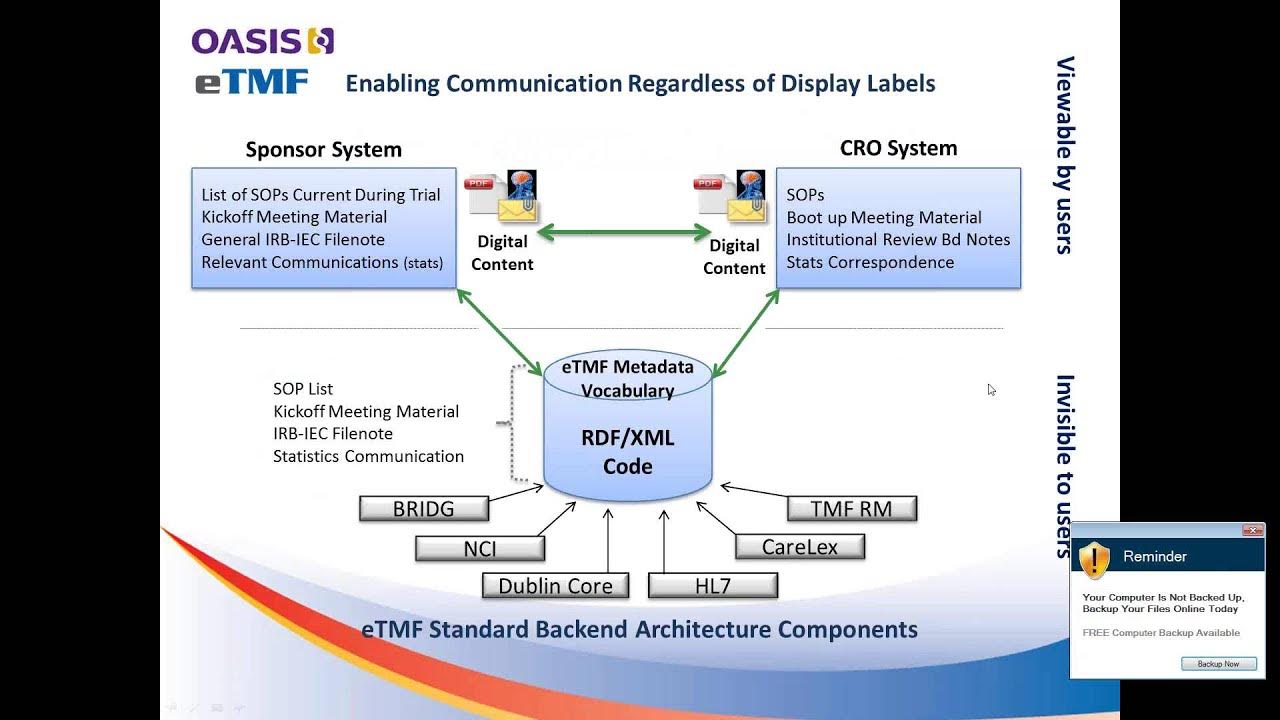
2014 07 22 11 00 Understanding the OASIS eTMF Specification for Non Technical Professionals
OASIS Open
/@Oasis-openOrg
Jul 24, 2014
This video provides an in-depth exploration of the OASIS Electronic Trial Master File (eTMF) Specification Version 1.0 CSD01, specifically tailored for non-technical clinical professionals. The webinar, presented by Jennifer Alpert Pulch (OASIS eTMF Technical Committee co-chair and CEO of Carlex) and Sharon Ames (OASIS eTMF TC member and Director of Enterprise Solutions at Nexto), aims to demystify the specification and encourage broader industry participation in its development. The core problem addressed is the pervasive lack of interoperability—or "islands of automation"—within the clinical trials ecosystem, where various stakeholders use disparate systems and terminologies, leading to increased costs, time, and data integrity challenges during information exchange. The presentation details the purpose and architecture of the OASIS eTMF standard, emphasizing its role in enabling seamless exchange of digital records between collaborator systems. It highlights that the standard is built upon existing frameworks and regulatory guidelines (including EMA, FDA, and ICH), utilizing an open systems approach that is independent of specific operating systems or programming languages. A key aspect discussed is the use of a controlled metadata vocabulary, curated by entities like the National Cancer Institute (NCI) Enterprise Vocabulary Services, to create a universal "machine code" (RDF/XML) that allows different eTMF systems to communicate effectively, regardless of their front-end display labels or even natural language differences. This backend standardization is compared to HTML, which enables universal web viewing despite diverse underlying technologies. The speakers also outline the current status of the specification, which is in a public review period, and detail how clinical professionals can provide impactful feedback. They stress that while the immediate impact is primarily on vendors who will implement the standard, the long-term benefits for sponsors, Contract Research Organizations (CROs), and ultimately sites, will be significant in terms of data portability, quality retention, and efficiency. The webinar concludes by emphasizing that the standard is an evolving process, requiring ongoing collaboration and input from diverse industry groups to meet changing industry needs, with future versions anticipated to further enhance its capabilities and unlock new potentials like big data analysis of historical clinical trial data. Key Takeaways: * **Addressing Interoperability Challenges:** The primary goal of the OASIS eTMF Specification is to overcome the "islands of automation" in clinical trials, where disparate systems and terminologies hinder the seamless exchange of Trial Master File (TMF) information, leading to increased costs and time. * **Data Portability as a Core Benefit:** The standard is designed to enable "data portability," allowing for the easy and reliable migration of digital records between different companies and systems, such as between sponsors and CROs, or during company acquisitions. * **Significant Cost and Time Savings:** By standardizing data exchange, the eTMF specification is expected to increase productivity, reduce the time and effort spent on data migration, and improve overall efficiency in clinical trial operations. * **Foundation on Existing Standards and Regulations:** The eTMF standard is not reinventing the wheel; it integrates existing regulatory guidelines from the EMA, FDA, and ICH, as well as technology standards like Business Process Modeling (BPM), CMIS, and digital/electronic signatures. * **Open Systems Approach:** The specification is developed with an open systems approach, making it independent of any specific operating system, software application, or computer language, which provides flexibility for vendors and their customers. * **Flexible Customization for Organizations:** While providing a standard framework, the specification allows organizations to integrate their unique needs by adding or editing organization-specific metadata terms and content items, ensuring flexibility while maintaining interoperability. * **Backend Technical Standard, Vendor-Controlled Frontend:** The OASIS eTMF Technical Committee focuses on the backend architecture and machine code (RDF/XML) that enables systems to communicate. Vendors will then dictate what the end-user sees through display labels, tailoring solutions to their customers' specific needs. * **Leveraging Controlled Vocabularies:** The standard draws heavily on controlled vocabularies, particularly from the National Cancer Institute (NCI) Enterprise Vocabulary Services, which curates global health sciences terminologies, ensuring broader interoperability and avoiding conflicts. * **Impact on Stakeholders:** Vendors are most immediately impacted as they implement the standard into their products. Sponsors and CROs will benefit from improved data portability and quality. The impact on clinical sites is currently limited, though future vendor solutions may integrate site-level permissions. * **Importance of Public Review and Specific Feedback:** The specification is undergoing a public review period (e.g., 45 days ending August 8th for the initial draft). Stakeholders are encouraged to provide specific, solution-oriented comments, focusing on their areas of expertise, such as suggesting synonyms for metadata vocabulary terms. * **Evolutionary Nature of the Standard:** The development of the eTMF standard is an ongoing, evolving process. The initial version is a foundational step, with future versions anticipated to incorporate additional feedback and adapt to changing industry needs. * **Long-Term Strategic Benefits:** Beyond immediate operational efficiencies, a fully implemented eTMF standard could enable "big data analysis" of historical clinical trial data, potentially leading to new learnings and treatments by breaking down data silos. * **Vendor Adoption Timeline:** Full vendor adoption and widespread implementation are expected to take a year or more after the standard is finalized, as vendors will need time to assess, integrate, and roll out the new capabilities. * **Comparison with DIA TMF Reference Model:** The TC has attempted to map the eTMF specification to the DIA TMF Reference Model, and encourages reviewers to provide further input on this comparison, noting that the eTMF specification includes technical elements (like business processes, e-signatures) that may not be present in the reference model. **Key Concepts:** * **OASIS Open:** A leading global standards organization for technical specifications, fostering open processes and publicly viewable development. * **eTMF Specification:** A technical standard for the Electronic Trial Master File, designed to enable interoperability and seamless data exchange in clinical trials. * **Interoperability / Data Portability:** The ability of different computer systems or software to exchange and make use of information, specifically referring to the ease of migrating clinical trial data between various systems and organizations. * **Controlled Vocabulary:** A carefully selected list of words and phrases used to tag information, ensuring consistency and precision in data classification and retrieval. * **Metadata Vocabulary:** A specific set of controlled terms and definitions used to describe data within the eTMF, forming the basis for machine-to-machine communication. * **TMF Reference Model:** A widely recognized, standardized structure for the Trial Master File, providing a common understanding of TMF content and organization. * **RDF/XML Machine Code:** A technical standard for data interchange on the Web, used in the eTMF specification to encode metadata and enable systems to "speak" to each other. * **CMIS (Content Management Interoperability Services):** An OASIS standard that defines a web services interface for content management systems, enabling additional interoperability for the eTMF. * **NCI Enterprise Vocabulary Services (EVS):** A comprehensive repository of biomedical vocabularies and ontologies, used by the eTMF specification to curate its controlled vocabulary and ensure broad health sciences compatibility. **Examples/Case Studies:** * **Acquisitions:** The standard offers a significant advantage for companies undergoing acquisitions, allowing for easier and more reliable incorporation of eTMF systems or data from acquired entities into existing systems. * **Sponsor-CRO Data Sharing:** The standard directly addresses the challenges faced by sponsors and CROs in sharing clinical trial information, enabling seamless data exchange regardless of the specific eTMF systems used by each party.

2014 07 21 16 00 Understanding the OASIS eTMF Specification An Overview for TMF RM Members
OASIS Open
/@Oasis-openOrg
Jul 24, 2014
This video provides an in-depth exploration of the OASIS eTMF Specification, offering a non-technical overview tailored for members of the TMF Reference Model community. The main purpose is to introduce the recently released Electronic Trial Master File (eTMF) Specification Version 1.0 CSD01, explain its core objective of achieving interoperability within the biofarma industry, and encourage public participation in its review process. The speakers, Jennifer Pulch (Chair of the OASIS eTMF Technical Committee) and Fran Ross (TC member), along with Michael Agard, emphasize the critical need for a standardized technical framework to overcome the challenges of data exchange between disparate eTMF systems used by sponsors and Contract Research Organizations (CROs). The presentation delves into the "why" behind eTMF interoperability, highlighting the prevalent issue of "islands of automation" where different organizations use varying systems and nomenclature, making data migration and collaboration complex and costly. The OASIS eTMF standard aims to resolve this by creating a technical standard based on open systems principles, independent of specific operating systems, software applications, or computer languages. It provides broad flexibility while ensuring standardization, allowing for company-specific metadata terms and content items to remain interoperable through a defined set of rules for editing metadata. This flexibility is crucial as every company has unique needs, but the underlying standard ensures seamless data exchange. The speakers clarify what the eTMF standard *is* and *is not*. It is a detailed specification for application developers, acting as a technical roadmap for data portability, comprising a content model, data model, machine code (OWL), and controlled vocabulary. Crucially, it is *not* a new TMF model for end-user content organization, nor does it dictate document names as viewed by users. Instead, it provides the backend architecture that allows vendors to develop products with varied front-end displays while maintaining interoperability. The standard integrates existing document formats (over 1,800 media types) and supports various system approaches (offline, network, cloud), ensuring broad applicability and non-restrictiveness. The ultimate goal is to increase efficiency, accuracy, and reduce costs in clinical trial operations, with a longer-term vision of enabling better data analysis and repurposing from past trials. Key Takeaways: * The OASIS eTMF standard is designed to enable machine-to-machine interoperability and data portability for Electronic Trial Master File (eTMF) systems within the pharmaceutical and life sciences industries. This addresses the significant challenge of data exchange between sponsors and CROs using different TMF systems. * The core problem the standard aims to solve is the "islands of automation" effect, where disparate systems and varying nomenclature lead to complicated and expensive data migration processes, hindering efficient clinical trial operations. * Guiding principles for the standard include being a technical standard based on existing open standards, adopting an open systems approach independent of specific software or languages, and remaining open source while offering flexibility for unique organizational needs. * The eTMF specification comprises three main components: a content model, a data model, and a machine code (OWL), all supported by a controlled vocabulary that includes domain-specific eTMF metadata. These components provide the architectural blueprint for application developers. * It's important to understand that the eTMF standard is *not* a new TMF model for end-user content organization, nor does it dictate document names as seen by users. Instead, it provides the backend technical framework that allows for front-end customization by vendors while ensuring underlying interoperability. * The standard is non-restrictive regarding document formats, integrating over 1,800 media types (e.g., JPEG, Microsoft, Adobe), and supports various system approaches including offline, network, and cloud-based solutions, allowing vendors broad implementation flexibility. * The TMF Reference Model serves as the end-user taxonomy, and the eTMF standard integrates this taxonomy with codes and ontology for vendors to build interoperable systems, ensuring alignment between business content and technical implementation. * The standard's adoption is expected to greatly benefit sponsors and CROs by eliminating vendor lock-in, enabling seamless data exchange, increasing efficiency, reducing costs associated with data migration and re-coding, and improving overall data quality and compliance. * The Committee Specification Draft (CSD) is currently open for public review, with a strong emphasis on gathering feedback for the metadata vocabulary. This is a critical opportunity for industry experts to ensure the standard is accurate and comprehensive. * The technical committee encourages TMF Reference Model members and other industry experts to actively participate in the public review, particularly by focusing on the metadata worksheet to identify missing terms, inaccuracies, or potential compliance issues. * When providing feedback, commenters are urged to be specific, provide solutions rather than just criticisms, and focus on areas of their expertise to maximize impact on the standard's development. * The development of the eTMF standard is an evolving process; this first version lays the groundwork, and future iterations will incorporate learnings from implementation and adapt to changing industry needs, requiring ongoing cooperation. * The long-term vision extends beyond immediate operational efficiencies to include enhanced data analysis capabilities from past clinical trials, facilitating data repurposing, and ultimately contributing to scientific learning and innovation. * The standard aims to support compliance, with discussions around integrating relevant regulatory requirements, such as those from the FDA and EMA, and aligning with other standards bodies like HL7. **Tools/Resources Mentioned:** * **OASIS Open:** The global standards organization responsible for developing the eTMF specification. * **TMF Reference Model LinkedIn Group:** Suggested platform for community peers to discuss the eTMF standard and frame comments. * **OWL (Web Ontology Language):** The machine code component of the eTMF specification, used by application developers. **Key Concepts:** * **eTMF (Electronic Trial Master File):** The digital repository for essential documents and records related to a clinical trial, ensuring compliance and data integrity. * **Interoperability:** The ability of different information systems, devices, or applications to connect, communicate, and exchange data in a coordinated manner, without special effort from the end user. * **Data Portability:** The ability to move data from one system or application to another easily and seamlessly, maintaining its integrity and usability. * **TMF Reference Model:** A standardized taxonomy and structure for organizing TMF documents, widely adopted by the industry for content organization. * **Controlled Vocabulary:** A standardized and organized set of words and phrases used for indexing, tagging, and retrieving information, ensuring consistency across systems. * **Committee Specification Draft (CSD):** A preliminary version of a technical specification released by OASIS for public review and input before finalization.
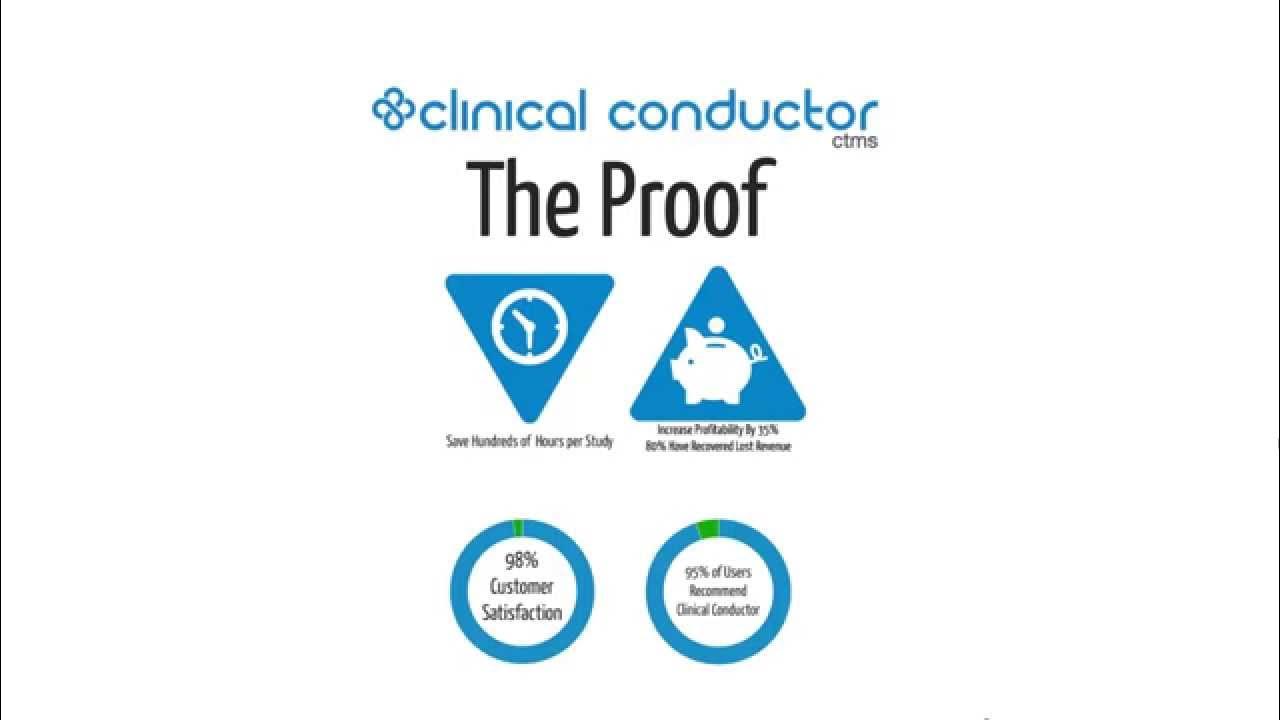
Clinical Conductor CTMS
Bio-Optronics
/@Biooptronics
Jul 13, 2014
This video provides an in-depth overview of Clinical Conductor, a Clinical Trial Management System (CTMS) developed by Bio-Optronics, positioned as a revolutionary solution designed to bring clinical research operations into the 21st century. The core premise is that the demands of modern research—characterized by fast turnarounds, split-second decisions, and the need to interact with numerous research partners—require a management system that moves beyond traditional, siloed approaches. Clinical Conductor is presented as the industry's first collaborative CTMS, fundamentally changing how organizations of all sizes manage and execute trials by integrating all research components and partners in real time. The central innovation highlighted is the system's collaborative and configurable nature. By bringing all stakeholders together in a single platform, Clinical Conductor facilitates faster, more accurate decision-making and significantly improved communication across the research ecosystem. Furthermore, the platform offers new CTMS configurations tailored specifically for different organizational types, including sites, site networks, hospitals, Academic Medical Centers (AMCs), health systems, and Contract Research Organizations (CROs). This configurability ensures that each entity receives the precise features and functionality required to complete its specific piece of the clinical trial puzzle, maximizing efficiency and operational fit. Beyond collaboration and configuration, the video emphasizes that Clinical Conductor offers the richest set of features available in any CTMS today. These features span the entire lifecycle of a clinical trial, addressing critical operational and financial aspects. Key functionalities include comprehensive financial management, full project tracking, patient enrollment management, scheduling and tracking of monitoring activities, study setup, partner management, patient tracking, secure document sharing and storage, and robust reporting capabilities across every facet of the clinical trial. The presentation concludes by stressing the proven operational success of the platform. Clinical Conductor is credited with revolutionizing the operations of thousands of research organizations globally, demonstrating tangible benefits such as saving money and time. The vendor cites a high 98% customer satisfaction rate, positioning the CTMS as the essential tool for achieving greater clinical and business success by solving complex research challenges and making the "impossible possible" in clinical operations management. Key Takeaways: • **The Need for Real-Time Collaboration in Clinical Operations:** The video identifies the necessity of moving beyond outdated CTMS solutions to accommodate fast-paced research environments that require split-second decisions and interaction with numerous partners. The collaborative CTMS model is essential for integrating all research components and partners in real time to ensure accuracy and speed. • **Configurability for Diverse Stakeholders:** Clinical Conductor's unique value proposition includes tailored CTMS configurations designed specifically for various entities in the life sciences ecosystem, such as CROs, site networks, hospitals, and AMCs, ensuring the system aligns perfectly with their unique operational requirements. • **Comprehensive Financial Management Integration:** A key feature is the ability to manage all trial finances within the system. This integration of financial tracking with operational data is crucial for maximizing profitability and demonstrating fiscal accountability across complex multi-site trials. • **Full-Cycle Project and Patient Management:** The system provides tools to fully enroll every study, track each project from initiation to completion, and manage patient data, highlighting the platform’s role as the central operational hub for clinical operations teams. • **Optimized Monitoring and Partner Activity Tracking:** Clinical Conductor allows for the efficient setup and scheduling of monitoring activities and robust management of all research partners, which is vital for maintaining quality assurance and regulatory compliance throughout the trial. • **Data Centralization and Business Intelligence Foundation:** By offering the ability to "report on every facet of your clinical trial" and share/store all documents, the CTMS establishes a centralized data environment, creating a strong foundation for advanced data engineering and business intelligence initiatives. • **Proven Operational Efficiency and Customer Satisfaction:** The platform is marketed based on quantifiable results, claiming to have revolutionized operations for thousands of organizations, resulting in time and cost savings, backed by a high 98% customer satisfaction rate. • **Addressing Complexity in Research:** The system is explicitly designed to solve "today's most complex research challenges," suggesting a focus on handling intricate trial designs, regulatory demands, and multi-party coordination inherent in modern clinical research. Tools/Resources Mentioned: * **Clinical Conductor CTMS:** A Clinical Trial Management System. * **Bio-Optronics:** The developer of the Clinical Conductor software. * **Clinical Conductor.com:** The website for demonstrations and further information. Key Concepts: * **CTMS (Clinical Trial Management System):** Enterprise software designed to manage and track the planning, execution, and reporting of clinical trials. It is the central operational platform for clinical operations departments. * **Collaborative CTMS:** A system architecture that enables real-time interaction and data sharing among diverse research partners (sites, CROs, sponsors, etc.), moving beyond traditional, site-specific data silos. * **CTMS Configurations:** Tailored versions of the CTMS software designed to provide specific features and functionality required by different organizational roles within the research process (e.g., a CRO configuration versus a hospital configuration). * **Clinical Operations:** The department or function responsible for the execution and management of clinical trials, including site selection, patient enrollment, monitoring, and data collection.

Paper TMF vs. eTMF Part 2
Database Integrations
/@databaseintegrations
Jun 26, 2014
This video provides an in-depth exploration of the security aspects of an electronic Trial Master File (eTMF) compared to a traditional paper-based TMF, emphasizing why security is paramount in clinical studies. The discussion highlights the critical role of robust security measures in protecting invaluable clinical data and documentation, which represent the culmination of millions of dollars in investment by sponsors and are essential for regulatory submissions. The speaker asserts that security must be the number one priority, especially given the sensitive nature and high stakes involved in pharmaceutical research and development. The presentation delves into the specific security features inherent in a well-implemented eTMF system, particularly those designed to meet regulatory standards like 21 CFR Part 11. It explains that compliance with such regulations automatically builds in a foundational layer of security. Beyond this system-level compliance, the video details a layered approach to security within the eTMF itself, starting with system-level permissions that grant different types of access (e.g., read, write, admin, preview) to various users, including auditors. This granular control extends to folder-level permissions, allowing organizations to restrict access for Contract Research Organizations (CROs) to only the data relevant to their specific region or scope, preventing unnecessary exposure or potential tampering. Further enhancing security, the discussion introduces file-level permissions, exemplified by a "preview only" option. This feature allows users to view a document without the ability to download, upload new versions, or otherwise alter it. A sophisticated aspect mentioned is the integration of an optical character recognition (OCR) blanket or screen over the preview, designed to prevent users from taking screen captures and then using OCR to reproduce the document, thereby safeguarding intellectual property and sensitive information. In stark contrast, the video outlines the inherent vulnerabilities of paper TMFs, such as susceptibility to physical damage from fire or water, and the complete lack of audit trails or tracking reports that are standard in eTMFs. These tracking reports are crucial for monitoring who has accessed, reviewed, and handled documents, providing an invaluable layer of accountability and security that paper systems simply cannot offer. Key Takeaways: * **Security as a Top Priority:** In clinical studies, security for data and documentation is paramount, as these assets represent significant financial investment and are critical for regulatory submissions. Protecting them is non-negotiable for sponsors. * **21 CFR Part 11 Compliance:** An eTMF system that is truly 21 CFR Part 11 compliant inherently includes robust security features, forming the baseline for secure electronic document management in the pharmaceutical industry. * **Layered Security Approach:** Effective eTMF security extends beyond system-level compliance to include granular permissions at multiple levels: system, folder, and file. This multi-tiered strategy ensures controlled access tailored to user roles and data sensitivity. * **System-Level Permissions:** Different user roles (e.g., read, write, admin, preview) should be assigned specific access rights to the eTMF, allowing for precise control over who can interact with the system and how. Auditors, for instance, might only require preview access. * **Folder-Level Access Control:** For global operations involving multiple CROs, folder-level permissions are crucial. This allows organizations to restrict a CRO's access to only the specific sections or regions of the eTMF relevant to their work, preventing unauthorized exploration or modification of unrelated data. * **File-Level Security (Preview Option):** Implementing a "preview only" permission for specific documents enables users to view content without the ability to download, upload new versions, or make any changes, significantly reducing the risk of data manipulation or exfiltration. * **Anti-Screen Capture Measures:** Advanced eTMF systems can incorporate an optical character recognition (OCR) "blanket" or screen over previewed documents. This feature aims to prevent users from taking screen captures and then using OCR software to reproduce the document, protecting sensitive information from unauthorized duplication. * **Inherent Risks of Paper TMFs:** Paper-based TMFs are highly vulnerable to physical risks such as fire and water damage, which can lead to irreversible loss of critical study documentation if proper environmental controls (e.g., fire/water suppressants) are not in place. * **Lack of Audit Trails in Paper TMFs:** A significant disadvantage of paper TMFs is the inability to generate tracking reports. This means there's no inherent way to monitor who accessed a document, when they reviewed it, how long they had it, or what actions were taken, leading to a critical lack of accountability and security oversight. * **Importance of Tracking Reports in eTMFs:** eTMFs provide invaluable tracking reports that detail every interaction with a document – who accessed it, when, for how long, and what actions were performed. These audit trails are essential for regulatory compliance, accountability, and maintaining data integrity throughout a clinical study. * **Superior Security of eTMFs:** Overall, the security features and capabilities of an eTMF system are vastly superior to those of a paper-based TMF, offering comprehensive protection, granular access control, and robust audit trails crucial for regulated clinical environments. **Key Concepts:** * **Trial Master File (TMF):** A collection of essential documents for a clinical trial that individually and collectively permit the evaluation of the conduct of a trial and the quality of the data produced. * **Electronic Trial Master File (eTMF):** A digital system for managing and storing TMF documents, offering enhanced security, accessibility, and compliance features compared to paper TMFs. * **21 CFR Part 11:** A regulation from the U.S. Food and Drug Administration (FDA) that sets forth criteria under which the agency considers electronic records and electronic signatures to be trustworthy, reliable, and generally equivalent to paper records and handwritten signatures executed on paper. * **Optical Character Recognition (OCR):** Technology that converts different types of documents, such as scanned paper documents, PDFs, or images captured by a digital camera, into editable and searchable data. In the context of eTMF security, it's mentioned as a tool to prevent unauthorized reproduction of documents from screen captures. **Tools/Resources Mentioned:** * **eTMF (Electronic Trial Master File) Systems:** The core technology discussed for managing clinical trial documentation securely.
Paper TMF vs. eTMF Part 3
Database Integrations
/@databaseintegrations
Jun 26, 2014
This video provides an in-depth exploration of the regulatory and operational advantages of utilizing electronic signatures within an Electronic Trial Master File (eTMF) system, specifically focusing on compliance with 21 CFR Part 11. The discussion centers on how modern eTMF solutions, such as the referenced "Adams" system by Database Integrations, streamline the critical review and approval processes inherent in clinical trial documentation, contrasting this efficiency with the cumbersome nature of paper-based systems. The speaker emphasizes that achieving 21 CFR Part 11 compliance is foundational, requiring robust security features and a formal submission process to the FDA regarding the intent to use electronic signatures. A key aspect detailed is the dual responsibility for regulatory notification: the eTMF system provider must inform the FDA of their system's capability to use electronic signatures, and the clinical trial sponsor must also submit documentation confirming their plan to utilize electronic signatures within their specific study. This dual submission ensures all regulatory bases are covered for legally binding electronic sign-offs. The primary operational example provided is the review of a protocol amendment. In a compliant eTMF environment, the ability for users to electronically review, comment, approve, and sign off on documents drastically reduces the time and effort traditionally spent tracking paper signatures, scanning, and filing. The system described facilitates a structured reviewer process, allowing administrators to define the sequence and order of document reviews. The eTMF platform automates notifications (e.g., via email) to users when it is their turn to interact with the document. Reviewers can add comments, upload new versions, assign approval statuses (e.g., "approved as is" or "approved with changes"), and affix their electronic signature. This digital workflow generates immediate, auditable reports detailing who signed, when they signed, and the exact time of the action, providing instant access to compliance data that would otherwise require manual searching through binders. Beyond compliance and workflow automation, the speaker frames the shift to eTMF and electronic signatures as an environmental and financial imperative, encapsulated by the slogan "going green to save green." The immense volume of documentation in a typical clinical study—thousands of pages—is compounded by the repetitive printing, signing, and scanning cycles required for paper-based approvals. These interim paper copies often serve no purpose other than to be shredded, representing a significant waste of resources (paper, toner, storage). Crucially, "saving green" extends beyond material costs to include the substantial savings in personnel time and effort. By eliminating the need for staff to manually manage print-sign-scan processes and follow up on signature tracking, the electronic system frees up valuable employee time, making the entire clinical documentation process significantly more efficient and less burdensome for all involved parties. Key Takeaways: • **21 CFR Part 11 Compliance is Foundational:** An eTMF system must be inherently compliant with 21 CFR Part 11, requiring built-in security features and the legal capability to handle electronic signatures recognized by regulatory bodies. • **Dual FDA Notification Requirement:** Both the eTMF system vendor (e.g., Database Integrations) and the clinical trial sponsor must formally notify the FDA of their intent to use electronic signatures within the system and the specific study, respectively, to ensure full regulatory coverage. • **Streamlined Review Workflow:** eTMF systems enable the creation of structured reviewer processes, allowing the definition of review order and automated email notifications to users when documents (like protocol amendments) require their attention. • **Comprehensive Audit Trail Generation:** Electronic signatures automatically generate detailed reports that track who signed a document, the date, and the exact time of the signature, providing immediate, auditable evidence for compliance purposes. • **Efficiency in Document Approval:** The ability to electronically review, comment, approve, and sign documents eliminates the time-consuming, multi-step process of printing, physically signing, scanning, and tracking paper copies, significantly accelerating the clinical documentation lifecycle. • **"Going Green to Save Green":** The adoption of eTMF offers substantial financial savings by reducing the need to print thousands of pages of documentation, particularly the repeated printing required for interim signature cycles that ultimately result in obsolete paper copies. • **Significant Time Savings for Personnel:** The greatest cost saving comes from reclaiming staff time. Employees are freed from tedious manual tasks like printing, scanning, and chasing signatures, allowing them to focus on higher-value clinical operations tasks. • **Digital Document Management:** Reviewers can utilize the eTMF system to add comments, upload revised versions, and assign specific approval statuses (e.g., "approved as is" or "approved with changes") before affixing their electronic signature. • **Instant Access to Compliance Data:** Unlike paper systems where signature tracking requires manual searching, the eTMF provides instant reporting capabilities that summarize the status of all required electronic signatures and approvals. Tools/Resources Mentioned: * Adams (eTMF system by Database Integrations) Key Concepts: * **eTMF (Electronic Trial Master File):** A digital system used to manage and store the essential documents for a clinical trial, ensuring regulatory compliance and data integrity. * **21 CFR Part 11:** The FDA regulation governing the use of electronic records and electronic signatures, ensuring that digital records are trustworthy, reliable, and equivalent to paper records. * **Protocol Amendment:** A formal change or update to the original clinical trial protocol, requiring review and approval by relevant stakeholders and regulatory bodies. * **Electronic Signatures:** Digital representations of a person's signature that are legally binding under 21 CFR Part 11, provided the system meets specific security and audit requirements.

EtQ's Mobile Compliance Platform
Nance Lordan
/@etqweb
May 27, 2014
This video introduces the EtQ Reliance Mobile Compliance Platform, a solution designed to extend the functionality of enterprise compliance systems—such as Quality Management Systems (QMS), Environmental, Health, and Safety (EHS) systems, or general compliance solutions—to personnel working in the field. The core purpose of the platform is to bridge the data gap that occurs when employees are away from their workstations, ensuring continuous access to and recording of critical compliance data. The speaker establishes that relying on manual recording and subsequent re-entry of information when returning to the office leads to significant data disconnects, inefficiencies, and potential errors, which the mobile platform aims to eliminate. The platform’s central methodology focuses on mobilizing existing compliance workflows. Users can select any form already established within the EtQ Reliance enterprise system, add necessary fields and mobile-specific elements, and instantly deploy it to the Reliance mobile application. This capability ensures rapid adoption and consistency with established organizational processes. Crucially, the system is engineered for both online and offline use. Users can sync the required forms and data to their mobile device before heading into areas with poor connectivity. They can then complete tasks, such as conducting complex audits or recording findings, entirely offline. Once connectivity is restored, the collected data is easily resynced, automatically transferring all information to the central Reliance enterprise system. The strategic value proposition of this mobile solution lies in enhancing operational efficiency and improving data integrity, both critical concerns in regulated industries like pharmaceuticals and life sciences. By enabling direct data capture at the point of action—whether on a manufacturing floor, in a remote facility, or during a field inspection—the platform eliminates the double handling of information and the associated risks of transcription errors. Furthermore, the platform supports collaboration and communication by providing real-time information, notifications, and updates on assignments and tasks, ensuring that compliance activities are managed effectively regardless of the user’s physical location. The application is broadly accessible, supporting deployment on both Apple and Android tablets, ensuring wide organizational reach. Key Takeaways: • **Elimination of Manual Data Re-entry:** The platform directly addresses the inefficiency and data integrity risks associated with recording compliance information manually in the field (e.g., on paper) and then having to re-enter that data into the enterprise system later, ensuring a single source of truth from the point of capture. • **Critical Offline Capability:** The ability to mobilize forms and data for offline use is essential for regulated environments where audits or inspections often occur in locations (like remote manufacturing sites or facilities) where continuous network access cannot be guaranteed. • **Rapid Form Mobilization:** The system allows administrators to quickly convert any existing compliance form within the EtQ Reliance enterprise system into a mobile-ready format, minimizing the friction and development time typically associated with deploying new mobile applications. • **Enhanced Data Accuracy in GxP Environments:** By capturing data directly into a structured digital format at the source, the platform significantly improves data accuracy and integrity, which is vital for maintaining regulatory compliance and audit readiness (e.g., GxP and 21 CFR Part 11 requirements). • **Streamlining Field Audits:** A primary use case involves conducting comprehensive audits directly on the mobile device, allowing personnel to record findings, observations, and evidence immediately, with automatic transfer to the central QMS upon synchronization. • **Increased Operational Efficiency:** Extending the compliance system to mobile devices increases the efficiency of field operations by ensuring that tasks can be completed and documented instantly, rather than waiting for personnel to return to their desks. • **Real-Time Task Management:** The mobile platform provides users with immediate notifications and real-time updates regarding assignments and compliance tasks, facilitating proactive management and timely completion of regulatory requirements. • **Broad Device Support:** The application is designed for accessibility across the enterprise, supporting both Apple and Android tablets, with easy deployment via the respective official app stores. • **Extending Regulatory Reach:** Strategically, the platform ensures that the organization's compliance reach is extended beyond the physical office, guaranteeing that all compliance activities, regardless of location, are consistently managed and recorded within the enterprise system. Tools/Resources Mentioned: * EtQ Reliance Mobile Compliance Platform * EtQ Reliance Enterprise System * Apple App Store * Google Play Key Concepts: * **Mobile Compliance:** The practice of utilizing mobile devices (tablets, smartphones) to execute, record, and manage regulatory and quality compliance tasks outside of a traditional office setting. * **Offline Synchronization:** The technical capability that allows users to work with data and forms while disconnected from the network, securely storing the input locally until connectivity is restored, at which point the data is automatically uploaded and integrated into the central enterprise system. * **QMS (Quality Management System):** A formalized system that documents processes, procedures, and responsibilities for achieving quality policies and objectives, often a core component of pharmaceutical and biotech operations. * **EHS (Environmental, Health, and Safety):** Management systems focused on protecting the environment, preventing workplace injuries, and ensuring adherence to related regulations.

Veeva Vault QualityDocs
Veeva Systems Inc
/@VeevaSystems
Apr 21, 2014
This video provides an in-depth demonstration of Veeva Vault QualityDocs, focusing on its specialized capabilities for managing controlled documents throughout the GxP life cycle within the pharmaceutical and life sciences industries. The application is presented as a secure, centralized platform designed to help document managers and general quality consumers efficiently handle critical documentation while maintaining strict regulatory compliance. The overview establishes Vault QualityDocs as a necessary tool for organizations needing robust control over their quality management system (QMS) documentation. A core focus of the demonstration is the platform’s adherence to global regulatory standards, particularly 21 CFR Part 11 (FDA regulations on electronic records and electronic signatures) and Annex 11 (EU guidelines). The video illustrates the final signatory event, where a quality user is required to re-enter their username and password to perform an electronic signature. This multi-factor authentication step ensures the integrity and non-repudiation of the approval. Crucially, every action—from document creation and changes in properties to the final signature—is captured within a comprehensive, immutable audit trail, providing the necessary documentation for regulatory inspections and quality assurance. Once a document achieves approval, Vault QualityDocs facilitates the subsequent steps required for operational readiness and compliance. The system allows for the immediate issuance of the approved document for mandatory personnel training. It also supports a "confirm and read and understood" process, ensuring that relevant staff acknowledge and understand the new or revised procedure. Furthermore, the platform manages the document's effective life span by allowing users to set an effective date and either manually input an expiration date or utilize Vault’s internal rules engine to automatically determine the expiration based on organizational policies. Beyond compliance tracking, the application enhances user experience and efficiency through advanced search and reporting tools. Users can quickly locate specific documents using faceted filters, which mimic the intuitive search functionality found on major e-commerce sites. The reporting section enables users to create powerful business reports through simple point-and-click configuration. An example highlighted is the generation of periodic review reports, which are essential for proactive compliance, as they indicate all upcoming document reviews organized on a per-country basis, ensuring that critical GxP documentation remains current and compliant. Security is also maintained even when documents are accessed externally; any document viewed, printed, or exported outside the Vault automatically receives a watermark to ensure traceability and control. Key Takeaways: • **Regulatory Compliant Electronic Signatures:** Vault QualityDocs enforces strict electronic signature requirements, demanding re-entry of username and password for final signatory events, directly satisfying the technical controls mandated by 21 CFR Part 11 and Annex 11. • **Immutable Audit Trail:** The system maintains a comprehensive audit trail that captures the entire history of a controlled document, logging every change, property modification, and signature event from creation through approval, providing essential evidence for GxP compliance. • **Integrated GxP Life Cycle Management:** The platform manages the full document life cycle, including creation, review, approval, issuance for training, and setting effective/expiration dates, ensuring a controlled and compliant process flow for all quality documentation. • **Mandatory Training and Acknowledgment Tracking:** Approved documents are seamlessly integrated with training requirements, utilizing a "confirm and read and understood" process to document that personnel have reviewed and acknowledged critical procedural changes. • **Advanced Faceted Search:** Users can efficiently navigate large document libraries using faceted filters, similar to modern consumer search tools, significantly improving the speed and accuracy of locating specific controlled documents. • **Automated Document Expiration:** The system supports setting effective dates and can automatically calculate document expiration dates based on predefined organizational rules, reducing manual effort and preventing the use of outdated procedures. • **Controlled External Access via Watermarking:** To prevent unauthorized use or distribution of controlled documents, the system automatically applies a watermark when a document is viewed, printed, or exported outside of the Veeva Vault environment. • **Point-and-Click Business Reporting:** Users can generate sophisticated business reports, such as periodic review schedules, using intuitive point-and-click tools, eliminating the need for complex data engineering or IT involvement. • **Proactive Compliance Management:** The ability to generate periodic review reports, segmented by criteria like country, allows quality managers to proactively schedule necessary document updates and reviews, ensuring continuous compliance and preparedness for audits. • **Centralized Quality System:** The demonstration highlights the value of a centralized, secure platform for managing all quality documentation, which is essential for maintaining control, consistency, and adherence to GxP standards across global operations. Tools/Resources Mentioned: * Veeva Vault QualityDocs * Veeva Vault (Platform) Key Concepts: * **GxP (Good Practices):** A general term referring to quality guidelines and regulations in the life sciences industry, ensuring products are safe and meet quality standards (e.g., Good Manufacturing Practices, Good Clinical Practices). * **21 CFR Part 11:** Regulations issued by the FDA governing electronic records and electronic signatures, requiring systems to ensure data integrity, security, and traceability. * **Annex 11:** European Union guidelines concerning computerized systems used in GxP regulated activities, often harmonized with 21 CFR Part 11 requirements for electronic signatures and audit trails. * **Audit Trail:** A secure, computer-generated, time-stamped record that independently documents the sequence of events and actions relating to a document or record. * **Faceted Filters:** A search technique that allows users to narrow down results by selecting multiple criteria (facets) simultaneously, improving search efficiency.